I’m starting on one of my New Year’s Resolutions early: to spend more time presenting fresh translations here. I expect a sizeable portion of them will be from French. Today’s piece, from the poet Paul Éluard, will be one example. Since there will be others, I’m going to start today with an aside about the translator’s tasks and my tactics and credentials for doing them, before we get to today’s combination of poetry and music.
I am not a native French speaker, nor do I have great facility with that language. Growing up in a little Iowa town, I had the luck to be able to take French at our small community high school, and later attempted to study it in college. French was Hobson’s choice for any foreign language classes at my small high school, but I welcomed that particular chance. In at least one previous post I’ve mentioned some of my accidental connections to the French language, but let me summarize them for newcomers. I first encountered French during my father and his brother Bill’s fishing trips to Ontario Canada, where I, a grade-school aged kid, was amazed to find the labels on many boxes and cans were bilingual, French and English. Around the same time my beloved Auntie Red, found herself and her young family stationed in France when her military husband was restationed there. Back stateside, she would amaze me by reeling off French phrases still retaining elements of her Southern US accent. That there was such a thing, an entire other language to describe the world, presumably as rich as English, seemed marvelous.
My academic career with French was none-the-less fraught – both in high school and college. Much of the work was based on getting conversational mastery, and I was terrible at it. I have something (I’ve always suspected neurological) that frustrates me with vocal mimesis. It’s likely part of the reason I struggle with singing. Helpful correction of the “no, it’s pronounced like this” kind only made me seem stupid or uncooperative, because my second and further attempts would still be way off in trying to make the right mouth sounds. Though my academic career was eventually stunted anyway, I sometimes wonder what might have happened if I had lucked into a class based on silently reading and appreciating literature in another language.
But that wasn’t on offer, or affordable, to me. So, in my 20s, largely out of school, I started to translate French poetry. This was a laborious process. I would page through a French to English dictionary for all but the most common words. I still retained a smattering of knowledge of French syntactical and grammar practices back then, and putting the two together I was able to produce a handful of translations. One that survived from this work was my translation of Paul Éluard’s “L’Amoureuse” which was presented here some years back.
My activity then, and my activity now, might occasion questions, ones I don’t know that I have a good answer for. Should I be doing this? Wouldn’t it be better if someone fluent in both English and French did any such literary translation? Isn’t the answer the that last question obvious?
My answers (then and now) would be: some of these poems don’t seem to have English translations I have access too, and even if translations exist, isn’t an attempt to do my own translation just another variant of doing one’s own “deep reading” of a poem? If for example, Helen Vendler has written an essay on what she found in a poem, does that mean I shouldn’t look at the poem myself and ask what all is in there – not because I think of myself as more learned or insightful than Vendler, but more at because I’m another human consciousness engaging with the consciousness of the poet.
What gave me such audacity, with so small a mastery of French, to do this? Well, I wanted to – enough for a stubborn young man. Now as an older man, still translating without mastery in the source language, I also tell myself that I did (and do) self-consider myself a poet, a chooser of words, focuser of images, composer of word-music. Part of the task of translation is to do the primary work of literal translation, but to produce the full pleasure to the reader of poetry, the poetic work is at least as important. Decades ago, I read that Ezra Pound used only someone else’s English glosses of Li Bai to create his landmark Cathay collection. Eventually I became aware that Pound’s Chinese translations were not very accurate depictions of Li Bai – and since learning that as a young man I’ve sometimes “checked” translations of poems to see how varied the translator’s version may be from some literal word for word, or from other translators’ versions. I was too uncertain of my own translations to think I was doing better work, but what I read as taking liberties bothered the younger me. Are translators like Pound “cheating” by not serving the original poet faithfully? These resulting English poems (I would say of Pound’s Li Bai) were as much or more the translator’s poem as the source author’s.
But what if I publish my translations? There are what I call “guild concerns” there. In the same way that I worry that my naïve musical compositions and make-do musical skills are, in their small way, part of a flood in the musical culture that reduces the shrinking opportunities for “real musicians” and trained composers, am I doing the same for translators with better knowledge and cultural grounding? Back to Pound: his work out-shadowed other translators who knew Chinese, and I’ve featured here a contemporary of Pound, Shigeyoshi Obata, whose Li Bai translations are largely unknown.
As a guild concern for people who depend, or wish to depend, on income from their art, this can be considered an existential issue, and I wish them no harm. Yet they may think: no matter, you are harming us. And now there’s another monster in the forest that they might view me as riding in on: computer-based artificial intelligence.
Since my early thumb-worn French-English dictionary forays, computer translations have become quite facile. An instant’s click will produce a literal gloss on one’s screen of a poem such as today’s selection. Let me stipulate to all, and to those that fear and dislike AI, these instant computer glosses are not good poetry.* I will click for them, but I will still spend time with dictionaries. What are the various contexts of a word? Which choice in English brings the most to the poem?**
Herein lies one problem. I’m trying to read the source author’s mind, and that will bring in my own mind, experiences, and knowledge to filter that process. This part of translation is unavoidable for causing both errors and accuracy! As I’ve grown older, I now often understand those “cheaters” as other blind ones assessing the elephant of the poem. If, as Frost had it, poetry is what is lost in translation, then a translator’s job is to reclothe the poem’s bones in English poetry, using modern English poetic expression. Doing this has limits, dangers: readers may like their foreign poetry to sound, well, foreign, with an exotic awkwardness – and having ancient poets sound like your contemporaries at a local poetry reading risks unintentional humor.
So, here we go: an early poem by French Surrealist Paul Éluard, “La Vie.” I start with a machine translation.
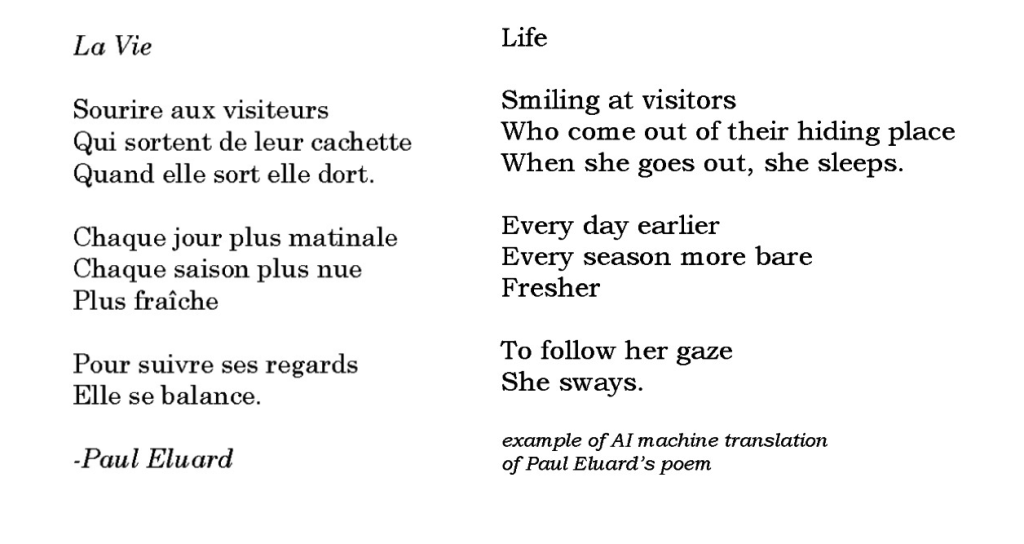
The 1926 poem in its original French, and a computer translation
.
The syntax comes out somewhat scrambled or hard to follow. As a prime Surrealist, one that knew and went through the Dada predecessors to Surrealism, this is likely there in Éluard’s original French I think. My first questions are what are the images: what does the author want me to see, or otherwise sensually appreciate? This can be hard with Surrealist poetry or the like: they often seek strangeness or even nonsense in images. All good imagery works with some degree of mystery or novelty, anything less risks cliché. Even one of those images that you read and think “I’ve never seen it like that before, but once I’ve read this, I’ll always think of this comparison” has to surprise you, cause you to take the leap of likeness. Surrealism says you need to outright react that’s impossible or outrageous to fully free and implement the imagination. So, my primary task is difficult with Surrealist poetry – they may want to be impossible or impenetrable, yet I still try to make the images clear, and this may be subject to mistakes. It’s also possible that in psychoanalyzing the poem that I may be putting things in there that the conscious intent of the original poet didn’t intend. ***
Examining the gloss, I think Éluard is describing a woman whose consciousness is either in a dream state mimicking waking life or living her waking day informed by, or as if, in a dream state. I think the image wants that ambiguity, to have it both ways. Either way, the people and things she meets are like strangers who have been hiding and she has found them for the first time.

My translation, used in today’s short musical performance
.
I take the liberty while translating this image in giving double meanings to some words, using more than one English word to stand for a single French word. I’m doing what “rescaling” a lower resolution digital image does, I intersperse additional pixels/words to bring the image out. “Neu” is rendered “naked” and “new;” “fraiche” becomes both “cool” and “fresh.” This is a judgement call, and my choice may be wrong. In making those word choices, using a French dictionary with multiple meanings and usage examples of the word used in context remains useful. Another thought, that AI will miss, but bears considering: the author may have intended a pun or other wordplay .
The final two lines gave me a word-music chance to put a rhyme in to tie things up, what with “gaze” and “sways.” I was so pleased how that worked out that I overlooked one word, a mere possessive pronoun, “ses.” I’m enough of an idiot regarding French usage that I can’t be sure if it’s a male pronoun such as “his” or a general pronoun, a “he/her/it” equivalent. Who’s gaze is it? The woman in the poem? The poet, the male Éluard? Something else, life or imagination?
In my ignorance, and as an admitted failure of craft, I just put down “her,” because at the time I finalized my translation my focus had moved from the word-for-word elements to what is the vivid image; and I thought, this woman that Éluard is admiring in the poem, living the Surrealist outlook, is confident in her own gaze as she sways in either the intoxication of fresh experience or the artistic refinement of dancing her day forward, and so I wrote in my translation “her.” I thought the poem is about the woman – even should be about the woman in the conclusion if I was writing it – but Éluard might have chosen to end it with his gaze evaluating the woman’s experience: I’m the artist, they’re just “life.”
So unintentionally a feminist recasting of the poem? Surrealism does have a problem there: open to women as muses, yet not as open as it should have been in allowing them to be concrete artists themselves. Shades of Éluard and Breton, may I call my ignorant choice a “Freudian slip?”
Today’s music? This was a little exercise on my part using a depiction of a couple of chord progressions from a Joe Pass performance as the basis for the music. Pass was a great Jazz guitarist – but for external practicalities, once more there’s no guitar in this version at all! Dada composition! You can hear my musical performance of Paul Éluard’s “The Life” with the audio player gadget below. No player visible? Not a mistake or slip, it’s just that some ways of reading this blog won’t translate into showing the player. If so, here’s a highlighted link that will open a new tab with an audio player.
.
*They don’t generate good literary prose either – producing as they do some estimate of the most probable word to be used, not the one chosen by another human’s consciousness that may not be the most common one-for-one. Moreover, with poetry the word-music issue is ignored by the AI translations, and poetry is musical speech. I generally don’t do rhyming accentual-syllabic translations, the cause of many an “inaccurate” translation, but I want the resulting translated poem to sound like poetry in modern English.
**These choices are a reason I highly recommend translation as training for poets. I don’t believe I undervalue topic, message, or prose-level-meaning in poetry, but many poets are stuck in finding the best combination of what they want to say with how it’s said. While I acknowledge the real issues with AI, for a monolingual, working with a literal/prose gloss of another poet lets one develop those selection-skills of the right word, right order, right connection, while one-step-away from their own experience and desired message.
***This may be proper since Andre Breton, another founding Surrealist, thought Sigmund Freud was on to something crucial with his recent theories and psychoanalysis. That Breton may be wrong about Freud or that Freud may be wrong about how the layers of consciousness and personality work only reinforces my stipulation that this outside consideration of the poet’s fellow consciousness is necessary for accuracy and errors.
 Frank Hudson
My spouse has the same kind of language trouble and was diagnosed with dyslexia as a child. That was in the 70s, so we don’t know if the categories are the same today, but I did notice raising kids through years of language study that one could imitate any sound readily while the other, though very good at understanding/ learning various grammars and vocabularies, had trouble getting vocalization quite right. Definitely neurological! Brains process so differently.
LikeLike
The trait embarrassed me. As midcentury kid, I don’t think there was much testing/diagnosis back then. My feelings about that are complicated. On one hand, as youngster I didn’t get the sense that I was “disabled”* or wouldn’t be unable to do something. On the other hand, for many things I was sometimes told — and in turn I’d tell myself — that I needed to buckle down and work harder.
*NeuroAtypicals nowadays probably have a different teeter-totter to balance with self and society expectations, likely with more knowledge, likely better.
LikeLiked by 1 person