Today’s piece was created from a poem written by the Irish poet Padraic Colum. Colum was born in the 19th century, then traveled through the world of 20th Century Modernism, and lived on long enough to overlap my lifetime. Looking at the outlines of his life I am pleased to report that Colum connects a favorite of this Project, the undercelebrated Irish poet Joseph Campbell* and the American mythological theorist of the “Heroes’ Journey” also named Joseph Campbell. With the American Campbell, Colum connected because he was a folklorist as well as a poet, and he wrote several young adult and children’s collections of folk tales and retold myths which I’ve not yet read. With the former Campbell, besides being Irish literary revival contemporaries, he collected folk-songs.** Like that Irish Campbell, Colum’s best-known work today is arguably a folk song.
Long-time readers here may recall that the poet Campbell is likely responsible for the song “Reynardine” being sung in a version featuring a supernatural, shape-shifting lover. At around the same time, and for the same publisher of Irish folk songs, Colum collected/wrote the lyrics to the song “She Moved Through the Fair.” Why the slash notation on the authorship? There’s some controversy if Colum closely adapted a traditional set of lyrics, or largely wrote original lyrics to an existing tune. Colum claimed he wrote the lyrics, making use of only a few floating lines that are folk song ready-mades. The challenge to Colum’s authorship strikes me as highly suspect: it’s based on another collector writing in 1970 that he came across an old man who told him he’d learned it as a traditional song before Colum’s version was published in 1909.
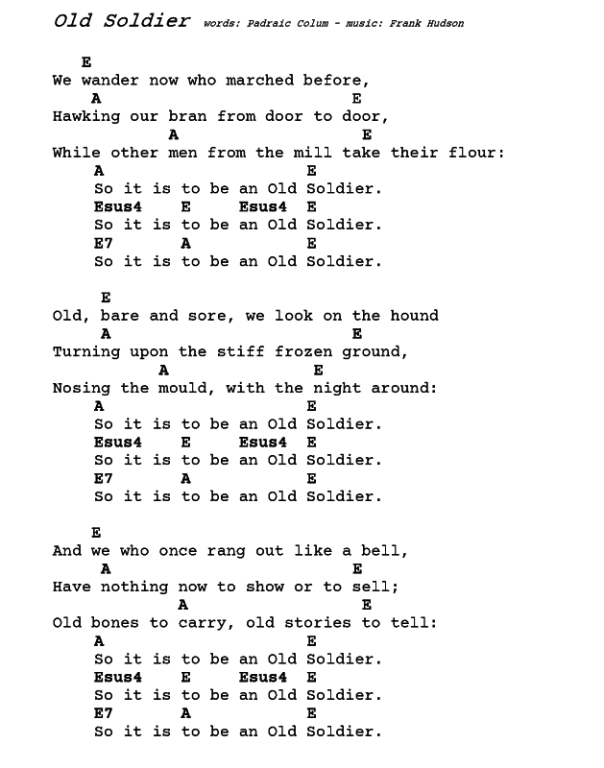
I suspect there’s someone out there who can do a better job singing this song I created from Colum’s poem.
.
“She Moved Through the Fair” was included as a poem in Colum’s first poetry collection “The Wild Earth”*** which also includes today’s poem. I note that “Old Soldier” has some similarities with the lyrical methods of SMTtF: both use spare details and leave out a great deal. Some of what is implied in the two lyrics may have become more obscure to modern listeners. SMTtF very early on speaks of the singer’s “lack of kind” which uses a now archaic meaning of “kind,” meaning family. “Old Soldier” opens with the titular old soldier going door to door. Since “hawking” (a hawker is a street-seller) is used as a verb in the second line I thought at first he was peddling, but from what I can find, no one sold flour that way. I think he’s begging for bran, which was then the discarded part of the milling of flour. That waste part after the wheat was milled or boulted, was thrown out or used as animal feed, though apparently the poor sometimes made use of it for human consumption.**** In the second stanza we meet the old soldier’s only companion, a dog, and the bran the soldier has garnered may have gathered mold.
I don’t know if “Old Soldier” has been set to music before this, but it seems every bit as singable as “She Moved Through the Fair,” and as soon as I read it, I wanted to sing it. I decided to use an arrangement soaked in South Asian musical influences, perhaps due to the wonderous extended version of the SMTtF tune played by Davy Graham. That link above includes one of Graham’s recordings of it, as well as Anne Briggs wonderous acapella version. Oh, hell, here’s that link again, click it indeed if you haven’t heard the song Colum made. Last week I recorded the basic tracks singing and playing a tune I created for Colum’s poem using my guitar in an alternate tuning driving a sitar virtual instrument though a MIDI pickup. To this first pass, I added harmonium, tanpura, tabla drums, acoustic guitar, and a final vocal.
Every one of those overdubbed passes felt good as I played them (save for my vocals, I’m never happy with my vocals) but the result was a whole bunch of tracks that would require careful mixing so that the instruments blended well. I set about doing that, working until midnight when I figured I might have a piece to present and saved a complete mix down. Awaking the next morning, I listened again, and the result wasn’t just flawed, it was a mess. A useful question for one mixing a piece of music with various instruments in an ensemble like this is “What track is the focus of the piece?” My putative mix had no good answer for that. The voicings of the chords on the sitar and the guitar didn’t mesh well. The harmonium and the tanpura were fighting over the same part of the sonic spectrum despite my efforts to give them their own sonic space. The tablas didn’t mesh with the acoustic guitar’s rhythm.
The wise solution would be to just re-track the piece. Maybe I should have more particularly considered that Davy Graham had made his impressive version of a Colum poem/song with only a solo acoustic guitar. But I would not have another opportunity to record with a sensitive open mic until this week, too late for Veteran’s Day. So last night I went to work stripping back the crud of my failed mix, leaving mostly the acoustic guitar and the vocal, with the tanpura and then the harmonium coming in for later parts of the song in turn. It’s not an ideal recording, but it’s my hope it lets one consider “Old Soldier” as song today.
The more palatable version can be heard with the audio player below. The song itself is simple, and the remixed arrangement that builds a bit as the song continues serves it better. You don’t see any audio player gadget? No, I didn’t remove that, it’s a side-effect of some ways of viewing this blog. I have a plan B for that too: this highlighted link that will open a new tab with its own audio player.
.
*Joseph Campbell, who also wrote under the name Seosamh MacCathmhaoil, was acquainted with the original London Imagist circle, and wrote what I think is some excellent short verse in the form. His life and literary career were brought low by siding with the losing side in the Irish Civil War.
**Given that I’ve been doing this project for a decade, the folklorest/singer/collector and poet is a combination near to my heart. Besides Colum and Campbell, two American poets from the same era, Carl Sandburg and Edwin Ford Piper did both things, and I’ve tried to briefly make the case that Sandburg should be more often cited as instrumental in connecting folk song with progressive politics and literary poetry in the United States, which eventually leads to the case of a Nobel laureate in Bob Dylan. Around the same time as all these others, elements of the “Harlem Renaissance” in Afro-American literature were open to melding folk song with high literature too (Fenton Johnson, Langston Hughes, Jean Toomer, Waring Cuney, Zora Neale Hurston).
I’m going to jump far afield before leaving this footnote: I’m writing this on the 50th anniversary of the release of the Patti Smith Group’s glorious debut LP Horses. The Patti Smith Group started because Smith, a poet personally immersed in colloquial music, a paramour of Fugs-adjacent musician/actor/playwright Sam Shepard, joined up with a guitarist/rock critic/crucial anthologist of garage bands Lenny Kaye, wanting to make unexpected poetry combined with electric guitar.
***Just when Colum’s The Wild Earth was published is unclear to me. My copy has a 1927 American printing of a 1922 edition. Wikipedia says “She Moved Through the Fair” was in a 1916 edition of the book, and then in their entry for Padraic Colum gives a 1907 date for the book.
****What, that’s the healthy part! Whole wheat! At the time the milled pure white flower was prized from making lighter baked goods and for a longer shelf life. The city I live in was growing rapidly at the time of this poem by finely milling the “Best” and the “Gold Medal” flour that had absolutely no bran or wheat germ at all.
 Frank Hudson
I don’t have time right now to tell you everything that your project here has meant to me over the past several years. But tonight, I particularly want to say thank you.
Get Outlook for iOShttps://aka.ms/o0ukef
LikeLiked by 1 person