Social media likes controversy, so it’s no surprise that two things have recently mingled there in provocative assertion: poet Mary Oliver and the dread “middlebrow” epithet.* It’s not a long bridge between the two: Oliver’s poems are put forward as all too middlebrow in this charge, and middlebrow is a sign of significant lack of ambition or achievement. I’m not a fan of the term “middlebrow,” for a hierarchy is implied and I don’t care for hierarchies much — but to speak of this I should define middlebrow poetry. A definition that works for me is: poems that remind us of something we already sorta-kinda know, but maybe couldn’t quite put into words. These poems are usually immediately understandable on first reading by a significantly literate reader.
Why’s this bad or lacking? If this is a singular mode it rules out poems that tell us multivalent things, or mysterious things that require more thought to comprehend, thought perhaps taken in stages. It rules out shocking, utterly surprising poems. And such poetry doesn’t feed our playful desire to puzzle-solve with clues we are proud to have acquired.**
My view? I think various modes of poetry (even differing modes of reading the same poem) have diverse values, and I’m more than OK with that. Poetry’s eye should be the insect’s compound eye, containing a hundred, a thousand, ommatidia. And so, if it was up to me, the best cultures wouldn’t be restricted to, or rewarding of, one poetic mode. This may be a visceral thing with me: I get bored with all one type of thing quickly. Building towers of hierarchies might be fun, and illustrative of what one can stably hold long enough to build such a tower, but in the end, the domain one will look out on will have a lot of scenery that isn’t in your tower. In the right mood, I can get pleasure out of looking at the commonplace apprehension poem and a “difficult” avant-garde one — and in the wrong mood on my part, or insufficient achievement in the poet, not a touch of pleasure in either mode. And beyond all this meaning and metaphor, there’s the oldest part of poetry, the part even young children understand, that poetry also has abstract pleasures like music has — poetry is the instrument on which the meaning plays.
A great many of the poems in our pair of 1920s children’s poetry anthologies are as middlebrow as any Mary Oliver poem brought up on charges in this controversy. This shouldn’t surprise us. A modern children’s anthologist looking to duplicate the task of those in the previous decade called The Twenties would, I think, do likewise. Some of those pressures would be commercial: what will sell to parents, libraries, teachers. Some would be practical: these children aren’t yet bored with the lessons of the world — those lessons are new and useful building-blocks for their youthful towers — and maybe a lesson of my old age (and a lesson of Mary Oliver) is that I shouldn’t have been bored with the lessons of the world either.
I think too of what happened as the first childhood readers of these poems in the 1920s progressed into the economic distress of the Great Depression, the rise of nationalist dictators, the Second World War, and the Damoclean Cold War. All through the middle of their lives how much time would they have for poetry that offered them the highbrow pleasure of gnostic meaning, of shocking new combinations and collisions?
The answer is: some would find the time, some went on and made their own verses in those modes — and many others would not. Some kept food on the table, kept bolts tightened on airplanes, tended the sick, kept fuel in NATO tanks facing east. Some had their yet young lives ended sans poetic envoi. Others desired, birthed, and raised my generation.
Highbrow, middlebrow, it is neither sophistication nor no-nonsense populism to forget either part of that cohort.
On to today’s poem, an example of a poem that earnestly intends to be a lesson: “Each in His Own Tongue” by William Herbert Carruth. Look! Mary-Oliver-approved wild geese make their appearance in it, decades too early! I also offer this month’s puzzle challenge: the pair of 1920’s anthologies I’m drawing from were gendered: one for boys, one for girls. So as with each post this month, you’re asked to guess in which volume did the poem appear. Answer lower down.
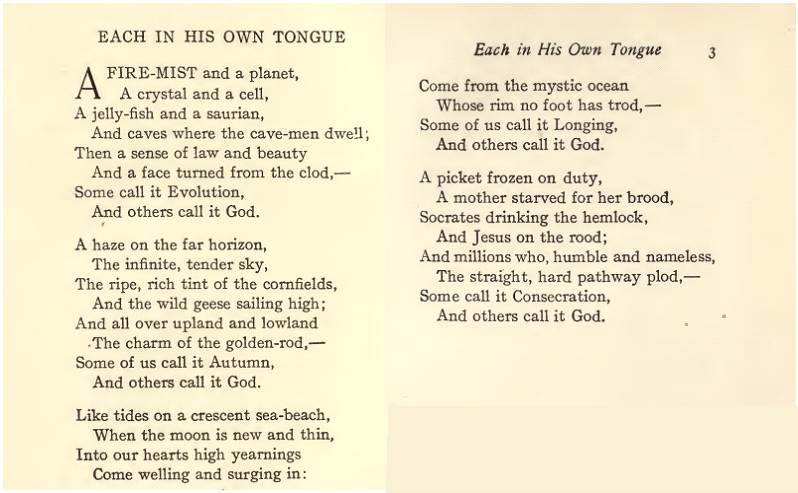

Here’s today’s poem as it appeared as the title poem in a book-length poetry collection by Carruth.. Marginalia picked up in the scan of a copy of that poetry collection. Wonder who Ina Coolbrith is? Here’s a link.
.
The brief Wikipedia stub for Carruth tells me he was “president of the Pacific Coast Conference of the Unitarian Church.” One of my preacher relatives once said of an Unitarian school he’d attended “The only time anyone would speak of ‘God’ is when someone stubbed their toe.” I read this morning a brief poetic knot of a summary of Oliver’s earnest lessons delivered by A. M. Juster who wrote that he’s “Not a big fan or a big detractor of Mary Oliver” but then sums up his impressions of her work by saying “I also think her spirit wanted to write religious poetry, but her mind wouldn’t let her.” Each in their own tongue I’d say, ungendering Carruth. Carruth wrote “His,” and his poem appeared in the Boys Book of Verse. You can hear my musical performance with the audio player gadget below. No gadget to be seen? This highlighted link is a backup which will open a new tab with an audio player.
.
*This last factor is less-often laid out as I just did, perhaps because it doesn’t seem serious when complex poetry is discussed. But let’s admit it: great portions of humanity loves puzzles and challenges in which they feel rewarded if they can progress farther than some other human.
 Frank Hudson
I enjoy reading Mary Oliver’s poetry. It seems tightly written and devoid of the kind of cultural trappings and social detritus laid by other, less engaging poets who use such images as a crutch. I agree with you that “middlebrow” is word unlikely to have a fandom. Thanks for this post!
LikeLike
Some of the poets I enjoy, Oliver included, get tagged with that phrenology-inflected “middlebrow” epithet. My late poetic colleague Kevin FitzPatrick may have been chucked in that bin by some. I see value in poets telling us something we almost knew — and after the poem. now know from their expression of it.
That’s not the only thing poetry can do. When I’m among those who are firmly in the camp of valuing only the understandable-on-the-first attention poems, I make what I think is a balanced argument for considering why a poem to unsettle or befuddle you can have value too. This may just be my contrary nature.
And in the end, it’s the voice and the music of the poet (even on the silent page) that pulls me in, regardless of how clearly or singularly the meaning is transferred. Mary Oliver’s voice works for me.
I was so attracted to Juster’s observant one-sentence summation. I suspect he may be a Thomist, as some of my teachers were. He may think “Wanting to write religious poetry but her mind won’t let her” is a minor fault, a self-misapprehension, but I think it’s a fine place to sit and write from.
Appreciate you reading and responding, and appreciate what you write at your blog too Paul.
LikeLike
Great post. I am reading Mary Oliver’s right now for the first time, and though a few of them have a kind of greeting card vibe, most are exceptional & I love her love of nature. Very much needed in these times as we move away from nature & into technology vortex…
LikeLiked by 2 people