Though poetry might aim for timelessness, time as we know it aims to hide itself in the past. For that reason, when I talk about Fenton Johnson this month, I want you to be able to step inside his time a bit. Depending on your expectations for poetry, or poetry by Black Americans, some of the elements of his poetry might seem out-of-place, but Johnson didn’t have the ability to see us — an audience of today — instead he was addressing the expectations of his time.
From reading Johnson’s first collection of poetry, 1913’s A Little Dreaming it’s clear that one of Johnson’s chief models was Paul Laurence Dunbar. Dunbar was born in 1872, Johnson in 1888. Depending on how you think of the amorphous boundaries of generations, the two are bookends of one generation or a generation apart, but two facts are important to understand in this relationship.
The leading fact? Dunbar was proudly counted as the first Afro-American poet to reach some level of general recognition. How well recognized was Dunbar in Johnson’s time? I can’t say for sure. Some established white critics reviewed his work. Public reading tours were advertised, indicating that there may have been expectations of greater than the folding-chairs in bookstore-aisles readings common for poets today. Part of Dunbar’s potential audience would be something new: an emerging Black American cohort born post-slavery who could read. Their parents might have been enslaved (as Dunbar’s were), and now they had this new broad skill, and they were allowed to indulge in it.* What was it they would read? Newspapers & magazines for sure. The popular press was growing during this time — and it was somewhat analogous to the Internet today, including the breadth of materials and parochial opinions, not all of them on the up and up. Novels and prose books? They were around, some inexpensive editions aimed at the less-wealthy casual reader’s budget. Poetry? Likely closely related to the availability of novels. Does that surprise any of you? In the Dunbar/Johnson pre-WWI era poetry was more a co-equal branch of literature than today. In our early part of our 21st century, open the books section of one of the big city American newspapers, and it’ll be rare to see any notice of new poetry collections. A literary author interviewed on TV is an increasingly uncommon event, but such guests will almost always be novelists. If you were to walk into a bookstore this year, how likely would you see poetry collections prominently displayed to tempt the general shopper?
I have no time machine to visit a circa-1900 bookstore, but my reading of the Dunbar/Johnson era indicates that to readers and the commercial side of publishing then, poetry was not consigned to a specialist interest of a small coterie of folks. Poets like Longfellow and Tennyson were as famous to the ordinary reader, if not more so, than many of the American novelists you might be asked to read in an American Lit survey course today. And there were contemporary, living, popular North American poets who were read by a general public then too: John Witcomb Riley, Ella Wheeler Wilcox, Bliss Carmen, Robert W. Service, and Edgar Guest emerge in this era. All these poets had a general audience, even if these once popular poets might not be covered in an academic survey course today.
So, Dunbar’s intended audience was broad, general. Some of his writing followed the same formal structure and practices used by the most esteemed poets of the 19th century, but not all of it. To a Black audience he may have intended to capture the newly literate while also offering a more serious solace and uplift for these men and women only recently granted rights on paper. To potential white readers of his time a parallel intent: poems at the casual entertaining level to put them at ease, but then poems in elevated literary modes expressing the beautiful thoughts in a Black man’s head or the pressing problems he and his race are encountering.
A young poet today might aim for a published collection, likely with an academic or specialist small publisher. Might aim for poetry awards watched mostly by other poets. Might aim for a teaching position. In the Dunbar/Johnson era it may have seemed possible for a poet to aim for a deeper/wider presence than today in both the literary and popular sense.
How far did Dunbar get in accomplishing that? My understanding, subject to correction from better scholarship, was that he became “Black famous.” His efforts would have been known and recognized by more-educated and culturally ambitious Black Americans, even if he would have been unlikely to be known to my (white) grandparents. To Black literary writers, whatever size that group was? He seems to have been huge.
Which brings us to the second important Dunbar fact. Dunbar died young: 33 years old, in 1906. Johnson would have been 18 and was about to go to college. If you were Afro-American, a poet, and interested in furthering the prestige of your culture in the first part of the 20th century, Dunbar was the man to consider. That Dunbar had fallen, still not meeting his highest expectations, could be seen as a standard bearer staggered short of the wall, but another young poet could pick up the flag and carry it further.
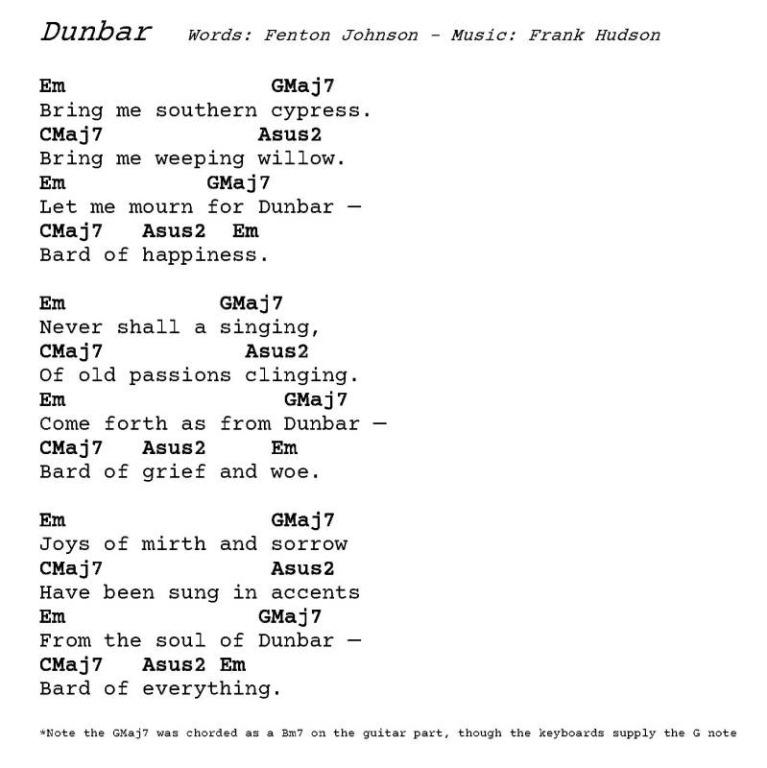
Once again, here’s a chord sheet for those who’d like to sing this themselves.
.
Long time readers here may recall that another of Johnson’s Afro-American poetic contemporaries, Anne Spencer, wrote a short poem linking the died-young Dunbar with early 19th century British Romantic poets like Keats and Shelley. Today’s piece from Fenton Johnson is a poem with similar goals. Johnson’s “Dunbar” is just 12 lines itself, but it makes a concise case for Dunbar’s broad worth. In a refrain at the end of each stanza he calls Dunbar “bard” to indicate that he as a poet is representing his culture, and Johnson is particularly interested in bringing forward that Dunbar can do the serious and be a “Bard of grief and woe” but that also he is the “Bard of happiness.” In this claim for Dunbar’s worth in comedy and tragedy he may be exceeding Spencer’s claims for Dunbar — as this best for comedy and tragedy claim echoes one made for Shakespeare.
What does Johnson mean when he writes that Dunbar’s poems were “sung in accents?” Dunbar’s rhymed metrical verse would use standard English (including a willingness to use elevated “poetic diction”). Johnson would begin doing the same. Dunbar also wrote in dialect: poems where the language is meant to portray less-educated speakers, is written in colloquial grammar, and is printed in phonetic approximations of heavy accents. Dialect was a literary vogue in the late 19th century in both prose and poetry. Of the popular poets mentioned above, John Whitcomb Riley, specialized in dialect poems reflecting common-man white speech of the rural Midwest. Dunbar wrote a poem in praise of Riley, Riley wrote a letter complimentary to Dunbar. Modern readers may have an inescapable problem with this sounding like minstrelsy.** And there is correspondence from Dunbar where he wrote that he was increasingly troubled by what he saw as the greater acceptance of the dialect poems. Fenton Johnson may not have known of that, and Johnson would also write in dialect in the mode of Dunbar.
I said at the start of this Black History Month that Fenton Johnson was a bridge between Dunbar and the Harlem Renaissance poets such as Langston Hughes. At the beginning of his writing Johnson is clearly on the Dunbar side of that bridge, so this poem in praise of Dunbar — now song with the addition of my music — is a good place to start. You can hear it with the audio player below, and if that player isn’t there, with this backup highlighted link which will open a new page with its own audio player.
.
*Dunbar’s mother Matilda was born enslaved and illiterate. She worked as a domestic servant after emancipation and took night classes to learn to read. There are stories that she had her children teach her ABCs, perhaps with the dual utility of drilling them while helping teach herself! Paul began writing poetry as a schoolchild, and she encouraged him and organized the family to allow Paul to complete high school. Paul Laurence Dunbar died so young that he was survived by his mother who lived until 1934.
**Bothers me too, and not just because it seems belittling even when it is only so by association with racist beliefs. I have little to no facility for reading or reproducing phonetic speech for some reason.
 Frank Hudson