Stars: Robert Frost and The Book Of Nature

Robert Frost. Long-time readers/listeners here will know I love to sing Frost’s early poems as part of this Project. We’ll get back to Frost, but another thing long-timers here know: for me, roundabout is the best mental journey — and there will be a piece of music at the end as we rest from our walk.

Ok, let’s stroll.

It’s a famous midcentury half-hour black & white TV episode. So famous that you don’t have to have seen it to know the recognition scene near the end of its story that has become a modern myth that SF and Fantasy fans like to point out their stories aspire to. Given that, I’m going to assume no one will need a spoiler alert for this 1962 Twilight Zone episode called “To Serve Man.”

The format’s so brief, the story must be told rapidly. We’re told that a race of other-planetary beings have landed on Earth. With retrospectable irony, their leader is described as “Christopher Columbus from another galaxy.” They go about setting things here in benign order with advanced technology. They leave behind a book in their language that seems to be a guide to the extraterrestrials’ efforts. Partway in, Earth’s code-breakers have deciphered the book’s title: To Serve Man.  And they seem to be doing just that: ending hunger, gently enforcing world peace, taking selected humans on spaceship rides to their home planet.

Many of you are now speaking — telepathically or aloud — to a device’s screen what is urgently delivered to the story’s human hero once the humans can decrypt more of the book than just the title: “It’s a cookbook!”

I’ve written here often about something I call The Book of Nature. Though not an exclusive American idea, I connect it with the 19th century American “New Thought” movement called Transcendentalism. The Transcendentalists believed that a true scripture of the universe’s higher power was transcribed in nature. By contemplating nature big to small one could discern the highest truths. Our contemporaries who are “spiritual but not (sectarian) religious” may hold to this as a core belief, but it’s likely that every denomination of religious belief can incorporate this too — after all, if The Creator made this, their authorship means there is plausibly something there to be read.

Now we can get back to Robert Frost. Frost no doubt knew Transcendentalist thought, but unlike his fellow great American poet, Emily Dickinson, Frost didn’t hold with its doctrines.*  Yes, Frost wrote seemingly “En plein air” about nature often. His early poems, some of the ones I like best, are suffused with the landscape and particulars of New England nature. Did he see a supreme being’s handwriting there?

If so, Frost would be critical of The SB’s penmanship.

stars

Chord sheet so that you can sing this one yourself.

.

If we look at this example, “Stars”  from Frost’s first book of poems, A Boy’s Will,  what do we “read” from nature’s book? The stars come out at night. What is their nature?** “Countless(ly),” we can’t even get the basic stats correct. Oh wait, Frost can see a primary Roman goddess in there: Minerva, the goddess of wisdom and strategy. No, he reconsiders: it’s a statue of Minerva he sees in the stars, a human-made simulacrum — and her marble eyes are the form of sight organs without any such function. So should we look lower down at our earthly landscape?***  Snow covers it profoundly, drifting “as tall as trees” and so obscuring even the ground-level facts. Wind is blowing — the choreographer of this landscape — yet, this dance doesn’t tell a story, it obscures it, though here at last Frost reads a message. That wind, that obscuring snow, is “our fate.” In the most mysterious part of the poem, the second stanza, we cannot see where we’ve walked or where to guide our steps. The gothic part of my nature reads Frost’s “place of rest invisible at dawn” as death. I read the image in this stanza that in such deep and overblown snow, one cannot even see the walk fate will not reveal to a farmhouse graveyard.

Nature acts “with neither love nor hate.” Robert Frost has decrypted The Book of Nature — and all the pages are blank.

Here’s that song at the end of our mental walk where I set Frost’s poem to music with acoustic guitar. You can hear it with the audio player gadget below, or with this backup highlighted link if that gadget is not shown.

.

*Frost’s friend and fellow poet Edward Thomas was an exquisite nature poet of his British Isles countryside. In regards The Book of Nature, he’s between Frost and Dickinson for he has a horticulturalist’s specific eye like Dickinson — and his consistent naming of natural details and seeing them as readable symbols indicates he finds them plausibly capable of guidance.

** Astrologers, Biblical Magi, and classical constellation dots-connectors of course are reading that sky in clear text.

***In a changeup meant to fool this writer and singer, my specific winter this year has been oddly empty of any expected Northland winter symbolism. We’ve had next to no snow, only a week or so of bitter sub-zero cold, and I look out today on a sunny brown yard over which squirrels are carelessly playing tag and tree as we rise to our predicted afternoon high of (in Minnesota! In January!) of 55 degrees F.

I’ve been riding my summer bicycle with its summer tires most every day this “winter,” where that bike normally stays hung up high in the back of my shed. Spring in Minnesota is famously snowy, my winter bike with studded knobby tires cannot be put out of the way. Perhaps as long as I leave it by the door we may continue to have a mild winter.

If all the griefs…. Emily Dickinson and also music

We’ll get to a remarkable short Emily Dickinson poem today, but first a few words about the music.

One of the things I like about this Project is not caring about what style of music I make to combine with the poetry. You see, I don’t like “silos” — those ways of viewing music as having borders, types, genres, labels. Some days I want to make acoustic music, some days I go inside computers to see what I can score and program to happen, other days I want to take an electric guitar and lean into the amp so that I can hear that guitar respond to its own screaming. Then I’ll be so audacious as to fake music that I have no right nor sufficient understanding to make. Jazz and orchestral music are fields where extraordinary musical knowledge is required — or it would be if I paid attention to the rules. When delving into those kinds of ensembles and approaches I make do with quite simple ideas.

In the music for this Project I’ve become dependent on acting as the musicians that work with my composing self, and the composer knows the musician’s limitations intimately. At least the musicians in me can depend on the composer to keep them from being bored with the same challenges all the time.

Does this variety succeed or fail? I don’t know. Perhaps I am steeled in this effort by writing poetry for years before composing music. Poets in our age generally don’t know if they’ve succeeded. Poetry’s audiences are small and what audiences poetry has may be too cowed by the pretentions of the art to allow us mere listeners footing to talk about it.

Today’s audio piece combines unlike things even before it gets to combining with Emily Dickinson’s striking short poem. I took some very old things: A Telecaster (a 1950 design, meant for bar-room and dancehall cowboy music*) and a small Fender Princeton electric guitar amp I’ve had for more than 40 years. But instead of playing birth-spanking music for dancing and carousing, I played slow, spare music, exactly stumbling though while still keeping itself upright. That part of the piece’s musical approach has a label within the catch-all of indie rock: the sub-genre is called slowcore. To this I decided to add (or perhaps preserve is a better word) some artifacts of its making that you, I, or the next recordist might think defects. The mic was picking up a lot of the pick strikes on the guitar’s strings —well sobeit, they are the crickets or the tapping implements of this soundscape. And to this I decided to mic the floor beneath me as I performed this to capture my foot stomping time as I played.**

I believe this combining pairs well with the difference of Emily Dickinson. I’m not entirely sure what Dickinson meant to achieve in the short poem we title with it’s first line “If all the griefs I am to have.”   What was her internal intent in writing this, what did it mean to its author? Was she writing something to herself? Or was it expected to be a little greeting card epigram to thank someone else for the gift of joy? The first line we use out of need for a title leads us to think it’s about grief, and a recipient of this might think it awfully strange to think this a thankyou message — yet one through-line of the poem’s two stanzas is that the poet’s present mood is so joyful that a lifetime’s accumulation of grief wouldn’t phase her at the poem’s moment, and that any imagined accumulation of a lifetime’s joys would only measure the same as what she says “happens to me now.” We might assume the poem’s occasion is some joy then, yet this poem doesn’t say that outright.

Emily often enclosed poems in letters or gifts to others. I don’t know if this was one, but can one imagine being an acquaintance or family member of Emily and receiving these 8 lines? Others might be jotting down “I thoroughly enjoyed your visit/garden party/whatnot” in bread & butter notes. You open Emily’s and it’s “If all the griefs I am to have would only come today…”  Awkward. But to her mind the thought of all that grief, all the sadness, all that pain, all taken at once — it’s something to envision and grapple with. And your cherries jubilee was scrumptious.

thank you from Emily D

A goth who loves dessert? Emily was a dessert maker of some note to her friends and family.

.

If you follow the logic, that’s what the poem could be saying. But the way of saying it, the framing of saying it*** causes one to see grief in an equivalent measure to joy. I see this poem as a Taoist statement, that there is one unified, effortless, way in things.

Is that Taoist reading an accident, an illusion I’m imposing? I’m frankly not sure. One thing I’ve learned as I’ve leaned into Dickinson this century is that her mind had within it a mode of trying to express vast philosophical points in tiny poems, and that the central thoughts that are embedded in just a few words in these poems can be difficult. She was reading Emerson and the Transcendentalists, and they were among the first Americans to try to come to grips with East Asian philosophy. Her poem does  explicitly say grief may seem an illusion to joy, which can flow around it; and that nothing (including joy) is so large that something else cannot be larger.

Well, that’s my awkwardness for today — but you can hear it with music if you use the audio player below. And if the audio player isn’t giving you a RSVP, this highlighted link is supplied for those ways of reading this that suppress showing the player, as it will open a new tab with its own audio player.

.

*A great many musicians discovered that it was good for things well beyond what it was designed for. One side-effect of Leo Fender’s guitar design was that its bridge pickup was to deliver bright, clear notes which meant that no matter how much you smeared it with reverb and ambient effects or applied fuzztones and distorted murk, it still let its intent cut through. For today’s guitar part the Telecaster had things that went against this bright, clear nature: I tuned it down a full step (D to D instead of the conventional E to E) and the motifs tend to be played on the lower strings here. And the guitar was strung with flat-wound strings. Almost all modern guitarists use round-wound strings, which let the lowest pitched 2 or 3 strings have a brighter sound and bring out more of the harmonic series above the root frequency of a note. Flat-wound strings are wrapped with a tight flat layer of wire that suppresses that, which makes them contrast with the ringing plain, un-wound top 2 strings all the more. This timbral contrast can make the single guitar sound almost like two differing instruments.

**I had intent there, even though the sound and rhythms of today’s piece were unlike its model: John Lee Hooker’s early records were often just Hooker’s voice and electric guitar, and his work-boot stomps were clearly audible as percussion on some of them. When I listen to exemplary slowcore band Low’s spare drumming I  sometimes think it has the same effect as Hooker’s sole-music.

*** In poetry, unlike say the essay or expository writing, the way of saying is brought forward to be as important as the message of what is said.

Have you tried rebooting? And Melanie, in memoriam

There’s new Parlando stuff coming. Indeed, there would already have been a new piece with words by Emily Dickinson this week if it wasn’t for a couple of issues.

Issue #1 was with a new, upgraded Macintosh computer system which handles most of the complicated recording stuff I do for this Project. After working beautifully the night before, the next day it was nearly unusable. I first noticed the mouse wasn’t working well — or a times, at all. I use wired mice, as I’d have no patience with Bluetooth gremlins — but still and all, maybe that mouse had gone bad? I swapped in an old one (I’m a packrat of old computer stuff, so I had a spare handy). Mouse back to working. But then the keyboard was nearly unusable, being extremely balky at registering keypresses. It was so bad that logging in again after rebooting the Mac was a challenge.*  Keyboard dying too? Tried a different keyboard. Same deal. I even tried booting the Mac into MacOS safe mode, which for some reason caused a kernal panic with a crash dump rather than completing a boot into that version of the operating system that’s a fall-back stripped to just the basic stuff. Was my new system demonstrating an internal hardware issue? Besides the nearly unusable keyboard, the whole system was slow, even though the system monitor showed plenty of resources available.

I wondered how much time would be wasted getting warranty service or restoring my complicated music creation environment. And then I noticed that my Time Machine backup drive was no longer mounted — or recognized as a drive in Disk Utility either. Would a warranty replacement Mac be able to transfer my stuff back from that backup? The last Time Machine backup was logged early that morning, then nothing as it had no drive to back up to. Additional worries: that drive might have checked out for good.

There’s a large overlap in musicians with folks involved with computer technology, but since that Venn diagram convergence is much slighter for poetry, I’ll cut to the solution.**  At some point I power-cycled the powered USB hub that holds most all the USB stuff that my kind of music production needs: two software protection dongles, two MIDI interfaces, a little plastic piano keyboard, an audio interface, that Time Machine hard drive, and a charger cable for my MIDI guitar. Mind you, the mouse and keyboard were plugged directly into a USB port on the Mac itself, not into this hub. And —

Everything returned to working normally. How a USB hub plugged into a different USB port from the one used for the mouse and keyboard could all but disable them, as well as causing the other issues, is beyond my knowledge level.

Large, powered USB hubs are not a common in-stock item in local stores, but just in case the issue with mine might return, I ordered a spare. It would be at a will-call desk the next morning. I’d pick it up along with my weekly major grocery run.

Issue #2. A member of the household awoke in clear emotional distress and was unable to talk about it. I thought it best to stay home. I told them I loved them and would be here if they needed me. I spent much of the day worried and concerned, but puttering around in case there were any needs that would emerge. By the middle of the afternoon they were better and talking (though not about the issue that had struck them earlier). They asked for their favorite take-out quesadillas.

I made a quick trip and grabbed the spare hub and that requested late lunch. Issues. Problems. Things don’t always work, sometimes they shut down and don’t tell you why. My late wife worked as a mental health therapist before her mortal illness. I worked decades in hospitals, then another couple of decades in IT. Some people think poetry is difficult, that it taunts you with its obscurity. Maybe so, but life does that too. Spares are difficult for us human beings. We wear and wear-out the ones we have for the most part, learning to use what we have at hand.

I would return to my studio space this morning to continue Parlando Project work. I’d read the night before that the songwriter Melanie had died, I learned of her death in a modern way that somewhat famous strangers have their fortunes told now: by folks speaking their name in past-tense on social media. As I was awaking, with my aim to record at dawn, I read a post by one of those I follow mentioning that they had a favorite Melanie song: “What Have They Done to My Song, Ma.”   Myself? My favorite Melanie is likely her cover of the Rolling Stones “Ruby Tuesday,”  or maybe even her big hit fronting a gospel group, “Candles in the Rain.”   But “What Have They Done to My Song, Ma”  is a fine song, maybe better than you remember it, if you remember it.

I sat at the mics alone, and I decided to sing that song before recording a new Parlando Project piece. In the moment I found it to be about folks attempting to fix you, or make you fit with them and their expectations or needs. That’s not always bad. That’s not always good — which is what this song feels.

This is a video as it’s my understanding that if any appreciable streaming occurs (unlikely with my fame and impeccable musicianship) that the rights owners would be paid by YouTube. Back soon with that Emily Dickinson song-setting.

.

*Yes, I worked in IT. Yes, I’m capable of asking myself “Have you tried rebooting?”

**Early in the days of home computers, SF author Jerry Pournelle had a monthly column in Byte magazine which aimed to cover the emerging field of personal computing, but more often than not, it instead dealt with some problem with a computer system in his household. In the early days of BBSes and dialup online services, there’d be lot of chatter about how this guy who got paid to write about stuff in a glossy magazine didn’t know some detail that was sure to have caused his problem right away. Best as I can figure, something inside the hub itself was “stuck” and no amount of unplugging the USB cable from the Mac, or plugging the devices in an out from the hub, helped until the hub’s own power supply was cycled.

Wanderers Nightsong II

Despite my inveterate bicycling and my wife’s love of nature walks, I’ve never been much of a hiker, and I’m very much not so in my old age. None-the-less I was charmed this winter when I saw this short poem because it appealed to my mental wandering. Walk with me: it’s not all that long a hike to a short audio piece.

When I saw today’s poem, I immediately noted that its translator from Goethe’s original German was the American poet Henry Wadsworth Longfellow. Let me reassure the poetry hardcore who might be reading this post that Longfellow was far from my interests when I started this project. While 19th century worthies Whitman and Dickinson remain staples of American poetry, Longfellow was to me only a schoolchild’s memory — and at that, not even a literary anthology schoolbook memory. My Midcentury-Modern anthologies of poetry in English didn’t concern themselves much with him, so I recalled only the Longfellow of illustrated poems for children that predated Dr. Seuss’ ascendency, Midnight rides, patriots at the bridge, culturally appropriated native Americans epics in stalwart meters. Longfellow’s Wikipedia page, reflecting critical consensus, still makes the case to downgrade him — and that’s hard to do, to downgrade someone who is now largely overlooked. The judgement handed down can be summarized: you don’t know him, and it’s probably best to keep it that way.

How did Longfellow come to me then? Part way into this Project I visited Massachusetts, planning to see the historic sites in Boston. While in Boston I decided to add a visit to the Washington/Longfellow house in Cambridge. This was a toss-in, yet it was while I was there that I heard about Longfellow’s life and I started to pay a bit more attention to the range of poetry he wrote.

While on that tour, our group was walked through Longfellow’s study where he wrote. I noticed right away that he had something that 21st century Americans would recognize immediately as a modern adaptation for intellectual work: a standing desk. If you must be deskbound, current theories hold, it’s best for your body to spend some of it on your feet during its mental wanderings.

The other thing that stood out was a statue on the desk. It’s not a small little desktop trinket that some of us keep on our own desks,* but something you could easily see across the room from behind the tour ropes. “Who’s the statue on the desk of?” I asked our guide.

“Goethe.” They replied.

If Longfellow has some incontrovertible objective value remaining, it’s that he established the idea of a preeminent American national poet. Those children’s books were thinly veiled citizenship lessons, direct appeals to America’s nationhood after all. So, what’s up with this German poet?

Longfellow, born of a generation where many living adults knew the American Revolution firsthand, was tasking himself with finding what could be an American poetry. What materials did he gather for this?

It’s likely he knew British literature of his time well, but he was officially a professor of Modern European Languages, and while still a young man he taught himself French, Spanish, Italian, Portuguese and German. He read literature in those languages, translated works from them into English. Whitman and Dickinson largely looked inward (within national and mental borders) for their remarkable American poetry, Longfellow was (as far as influences) a proper internationalist.

He could have decorated his desk with former householder: George Washington I suppose, or that other Washington who was a pioneering American literary figure, Washington Irving. Nope. The man he wanted staring at him when he stood and wrote was this formidable German poet and polymath.

Longfellows Desk 1080

Longfellow’s desk, and Goethe is right up in his grill when he wrote there.

.

Johann Wolfgang von Goethe was not a model for a faint-hearted writer, but perhaps one of the things from Goethe’s overstuffed portfolio might have interested Longfellow: Volkspoesie, “Folk poetry.” The idea here was that shared history, mythic tales, and interests of ordinary people experiencing their landscape was a nation-forming cultural foundation. Here’s a connection Longfellow might have felt: France, England, Spain, and Portugal had been nations for centuries by Goethe and Longfellow’s time: but Germany was not yet a nation in the modern sense, and Longfellow’s United States was only freshly one.**

“Wanderers Nightsong”  is not a grand, nation-building poem however. It’s a tiny little lyric, really only concerned with an internationally-known experience of being outside under one’s own power, perhaps by choice recreationally, perhaps in some outside-directed travel or need to escape, but anyway alone enough in one’s landscape that all things are silent. You can hear your own breath, feel your own accumulation of footsteps, and the landscape says: rest with us.

This means that Longfellow has a delicate task. The thoughts contained in Goethe’s German are not unique — indeed, they wish to speak of a shared experience. Nor are there striking images or clever language effects in the poem. No strange worlds or visions are portrayed. The song-sense here, even on the silent page, is the poem’s substance. Like Hank Williams’ American country song standard “I’m so Lonesome I Could Cry,”   the point here is not that the singer has seen something you haven’t seen, the point is that he sees what you’ve seen, felt what you’ve felt, and you, even reading silently, can sing it with them. Therefore, Longfellow chose to keep Goethe’s German rhyme scheme in his translation to English so that it continues to sing on the page in its new language.

wanderers nightsong

Schubert fans will tell you, I’m a follower not a lieder.

.

Longfellow’s choice here is the right one, and I’ve honored it while slightly modifying his syntax and usage. You can read Longfellow’s original text and Goethe’s German at this link. Coincidentally, the poem’s original germ was written on a wall, a fact shared by “Smells Like Teen Spirit”  and this poem presented here a few years back. My performance is not complicated — it’s folk-song like — though the chord structure uses some less-common chord extensions. I do use one of my standbys, the simple sustain-pedal piano notes which testify to my absolute non-mastery of that instrument while wanting to make use of its sonorities. Like some other poems I’ve presented here, an accomplished composer has set this before me. You can hear my simple version with English lyrics using the audio player gadget you should see below. No gadget?  This highlighted link is an alternative way that will open a new tab with its own audio player.

.

*I used to keep a sentimental ceramic rabbit that was a gift from my late wife on my writing desk. More recently, a Lego figure of Shakespeare my child assembled and gave to me.

**Yes, nationalism, and in particular German or American nationalism, has its downsides — but the case that it’s foundational to establishing a civic bond can be mooted without denying it’s plausible faults. I should also note for students: my knowledge of German literature is scant, despite my mother having been bilingual in her childhood, and her grandparents speaking German in their home and church. This is a blog written by a “layman” explorer of poetry and music, my scholarship is spotty, though my interests are broad.

The Sparrow

Paul Laurence Dunbar is most often introduced as the first successful Afro-American poet, and I guess I’ve just followed form by starting this post that way. That statement is more-or-less true. I’d suppose a case could be made for the primacy of Phillis Wheatley who published a book of poems with some notice in the 18th century even before American Independence. And then too, there’s the question of success levels. Dunbar was able to publish more than a dozen books, got praised by some white literary critics and established poets. Figures in Afro-American culture put him forward as a leading Black poetic voice: Frederic Douglass, James Weldon Johnson, pioneering Black orchestral composers William Grant Still and Samuel Coleridge-Taylor.

As noted in Anne Spencer’s elegant short eulogy poem linking him with other died-young poets, Dunbar was only 33 when he died. Carl Sandburg was just 6 years younger than Dunbar, Robert Frost was but two years younger — both of those poets survived into the 1960s. Dunbar died in 1906 after being debilitated by illness and a series of personal crises. By the time the Harlem Renaissance came around to start making Afro-American artists chic, Dunbar was more than a decade dead. How much more growth and new circumstances could have accrued for Dunbar!

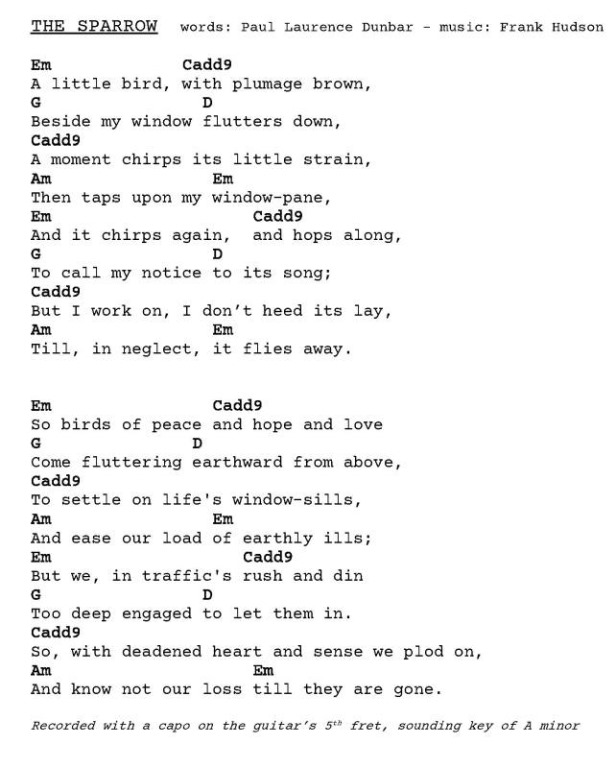
That we still remember him, that a couple of his poems, “We Wear the Mask”  and “Sympathy (I know why the caged bird sings),”  survive to be widely read and considered, should be counted as a success.*  “The Sparrow”  is not as well-known, but I’d note that it both comments on the Afro-American experience and a more generalized human experience.**

“The Sparrow”  is a poem about being sent joy, being sent song, being offered the peace of fellowship, being offered something — and being too callous, or too ignorant, or too busied with the things that aren’t joy and song. In the course of this poem, it may be simply drudgery that is keeping the poem’s singer from noting the bird. Even non-unpleasant rote life can obscure those offered gifts. And oh yes, oh yes,  it can be fear and prejudice that shuts them out too.

The Sparrow

Guitar chord sheet for those that want that want to perform my song setting of Dunbar’s poem.

.

Beyond his remembered poems, I think often of Dunbar’s own life as a sheaf of strong metaphors. His mother was born enslaved. Sensing somehow that her son had a talent as a child, she herself learned to read to help him along, so that eventually that son wrote of that caged bird and of today’s offering sparrow. After publishing his first poetry collection, Dunbar sold it while working at his job as an elevator operator in his hometown of Dayton Ohio. He would offer it to his passengers migrating a few floors up or down inside his elevator cage.***  He grew up in Dayton with a couple of bicycle mechanics, Orville and Wilbur Wright. Orville was his school classmate and helped Dunbar find a publisher for that poetry collection. After eventually attaining some notice for his poetry and public readings of it, Dunbar got a job in the Library of Congress. Around that time his mortal illness was diagnosed as tuberculosis. I read today that he thought the dust of the books in the library made him — the man who could once charm musicians with the way his poetry sung off the page — choke and cough. He descended into his illness and depression for the foreshortened rest of his life. Three years before he succumbed, those bike mechanics made and flew the first airplane, and some of mankind slipped the surly bonds.

Someone had to be the first men to compose flight — but flying or caged, we need to sing, need to hear the singer, even after they’ve flown away. As Dunbar’s “The Sparrow”  has it in its ending line we often “Know not our loss till they are gone.”

I composed the music for Dunbar’s poem earlier this week, and dedicated much of today to completing the arrangement you can hear below with the audio player you may see below. No player?  This highlighted link will open a new page with its own player so that you can hear it. You may notice that I changed a few words in Dunbar’s poem while singing it. Some of the longer sentences didn’t give the song (or at least this singer) enough space for breath — and where rhyme didn’t demand it, I unconsciously changed a couple bits of the 19th century poetic diction as I strove to bring out the poems meaning as I sung it. That’s generally considered a fault in classical song settings, but I come from a looser folk songwriting tradition where that sort of thing is allowed. Here’s a link to the poem as Dunbar published it with all his words and syntax intact.

.

*To be known for a single poem, to have that carried by others, even in part, in reader’s memory, is an achievement I’d say. I can remember having a discussion with Kevin FitzPatrick some years back when he put forward that Dylan Thomas should be weighed by only being known for one poem — or maybe just that one poem’s refrain. That’s an arguable assessment, but even accepting that, that’s more than many poets, including prize winning-poets, achieve years after their death.

**In dealing with Autism Spectrum Disorder I often think of Dunbar’s poem of Black code-switching to seek acceptance or protection from mainstream white culture, and apply it to the ASD tactic of “masking” to seem more neurotypical. Dunbar’s caged bird never has to say it’s a metaphor for Afro-American experience to Black folks, but caged hopes are not an exclusive experience. I’ll split hairs on thin ice to mix those metaphors re: cultural appropriation vs. cross-over impact.

***Further risking flippancy on my part, it could be argued that the Wright Brothers invented the airplane, but the enterprising Paul Laurence Dunbar invented the elevator pitch.

To not be scared of death that doesn’t understand us

I’m going to start off the new year 2024 with something I do less often, presenting a new piece that uses my own words. I give myself permission in part because it was engendered by thoughts of another poet, Robert Okaji, who I’ve considered as something of a kindred spirit to my efforts here since this Project began 8 years ago. Like most every blogger I can’t help but talk about myself, but when I do that I fear I become a spendthrift of boredom, so one of this Project’s mottos has been “Other Peoples’ Stories.” Yet, for all that, this isn’t Robert Okaji’s story in any summary — he’s his own poet, his own writer. I’m presumptuous, but I won’t go there. I don’t know him, though I’ve read his blog, his poetry, seen him read online once. Is that like knowing him in some way?

Many of us poets could admit that we see ourselves in a timeless guild. Homer, Sappho, Shakespeare, Emily Dickinson, Du Fu, Yeats — they’re our co-workers. We flatter ourselves at times that we now occupy their offices. By the same conceit, I could think of Okaji as a compatriot. We live in the same country at the same time, we’ve exchanged the customary short notes over the Internet. At least once before today, something he wrote caused me to write something myself. I think I started writing translations/adaptations of classic Chinese poetry before reading his, but his approach (we both need to start from literal English glosses) ratified mine in effect.

So we poets, at the moments our heads swell up so that poetry can burst forth,* may think it’s as if we know each other, because we think we know each other in poetry. To say then that it’s like companionship, that it’s as if, is to do that thing that’s called in poetry a simile.

Every simile when examined harshly knows it’s pathetic. Every poem is not the thing it represents — even the great poems that change how we look at the thing they represent. Let all in the poetry guild admit this to each other within the walls of the guild hall.

I started writing today’s words on one of my more-or-less daily bicycle rides. In spring there may be many kinds of birdsong in my well-forested city, but in winter it may be only crows — which, as the poem describes, are quite vocal about a solitary early morning bicyclist in their midst.

Crows, ravens, big dark birds, are a death symbol of long repute. And it struck me that while we might chide ourselves for not having sufficient knowledge or understanding about death, we could just as well say that death doesn’t understand us. Living in our consciousness as if the present continues indefinitely, we don’t understand death, but death doesn’t understand that moment either. And then, we poets think we can capture the flow of consciousness and preserve it in poems. Today’s poem carries on in a series of similes and then makes a final summation of the series.

Okaji has written a group of poems over the years featuring the character of a scarecrow. Perhaps he too is riffing on crows as the death symbol, but his scarecrow is at times a comic figure too. A scarecrow is just another simile, a sort of, an as if symbol for us — and so I speak of Okaji’s scarecrow in my poem.

Scarecrow takes a winter bike ride

Scarecrow rides a bicycle in early winter mornings, and the crows object. (a note: I begat these AI illustrations with Adobe Firefly, which claims it doesn’t use uncompensated artists’ work to train itself)

.

I said my poem isn’t Okaji’s story — it’s more mine partway — but if you’re like me in some ways, particularly if you want to consider those of us aged to where a compatriot’s death seems next door, then it might be as if it’s partway yours too. The admonition in the poem’s title is therefore not addressed impertinently to Robert, but to myself and perhaps others who might read or listen to this.

Woody Allen wrote a great line: “I don’t want to be immortal from my work. I want to be immortal by not dying.” We write poems, we make those “like a” statements by writing poetry. As if: in our minds we walk into those poetic offices, write our metaphors, our similes. And some day, we must clean out our offices, leaving on our desks a few sheets of paper, maybe enough to stuff a scarecrow.

Today’s performance started with two electric guitar lines I recorded early on New Year’s Day, following the tradition of trying to do things on that day that one would like to continue to do regularly the rest of the year. The two somewhat irregular riffs were spontaneous,** thinking that promise to myself required doing  as much as planning. The bass line was laid down almost a day later to try to hold things together, and the decoration of the keyboard parts arpeggiating the spontaneous chord changes which had started things off, were the final tracks. Those things done, I had my rock band to declaim my sonnet “To not be scared of death that doesn’t understand us” over.

You can hear that with the audio player you should see below. No player?  This highlighted link is a back-up method, as it will open a new tab with its own audio player.

.

*A metaphor that sounds more like a sneeze than Athena’s birth when I re-read this.

**I fancy the right channel line played on my Telecaster has some crow-call-like moments.