If you’ve noticed I’ve been gone for a while, I have as well. The last few weeks have had a lot of other things to attend to. Mostly happy things: travel, and work around the teenager’s graduation from high school. Still, I found myself picking up a book from my teetering “plan to read” pile that I thought would be mildly diverting: Donald Hall’s Old Poets. This book is a hybrid, like one of my favorite books from last year, Lesley Wheeler’s Poetry’s Possible Worlds.* Like Wheeler’s book, Hall’s book contains some memoir elements mixed with consideration of poets the writer knows, and from there the qualities and connections of poetry and poems with the poets. Hall’s memoir material covers the bildungsroman years, that life era of a few posts about my life I’ve done this spring, while Wheeler’s examines her relationship to her parents and poets well into midlife. The time settings of the two books are different: Wheeler more in this century, Hall centered around the last midcentury.
Here’s something I found striking in Hall’s accounts from his time and place. As an undergraduate he had access to not just his Harvard contemporaries** but to Robert Frost and T. S. Eliot. Since a good portion of Hall and my lives overlap, Hall being only about 20 years older, I found it strange to read that as a 20-year-old he had a series of informal interactions with these two while they were giants in a way that no poet today is. The effect was scarcely less shocking than some SF novel where the author dines and discusses poetic topics with Shakespeare, Milton, Keats, and Whitman. I suspect much of Hall’s access is due to Ivy League effects, whereas I think today’s poetry scene is more decentralized even while being more academic/MFA connected. If I was 20 in 1949, I would have been as likely to repeatedly meet the two great poets as I am to contact them by Ouija board today.
Hall’s book has 6 sections devoted to 7 poets, including ones on Frost and Eliot. Hall’s portrait of the older Frost is particularly vivid and special, while his stories of drinking with Dylan Thomas are less unique.*** Yet, within his Thomas chapter, Hall dives into why Dylan Thomas’s poetic stock fell off by the end of the century. Hall reveals that Thomas himself told him that he had only written about three good poems.**** The one Thomas poem we all think of, the villanelle whose refrain has become memeable, was not one of those three. Thomas and Hall agreed over potent-potables that “Do Not Go Gentle Into That Good Night” was only a skilled attempt to put on Yeats’ coat.
Now to get on to today’s new audio piece. Hall compares one of the poems Thomas thought was one of his best early works unfavorably to a poem by Thomas Hardy, and Hall’s Thomas chapter gives us that Hardy poem, “Transformations” in full.
If reading Hall’s book was to be a portable replacement for work on this Project, that Hardy poem was stunning enough to cause me to try to get something composed and performed in the spaces between other things this week. Hardy’s “Transformations” is an account of the experience of a non-spiritual approach to immortality — not to life after death, but life as a thing that only changes form, of which we as people are only incarnations. Here’s a link to the text of this poem.
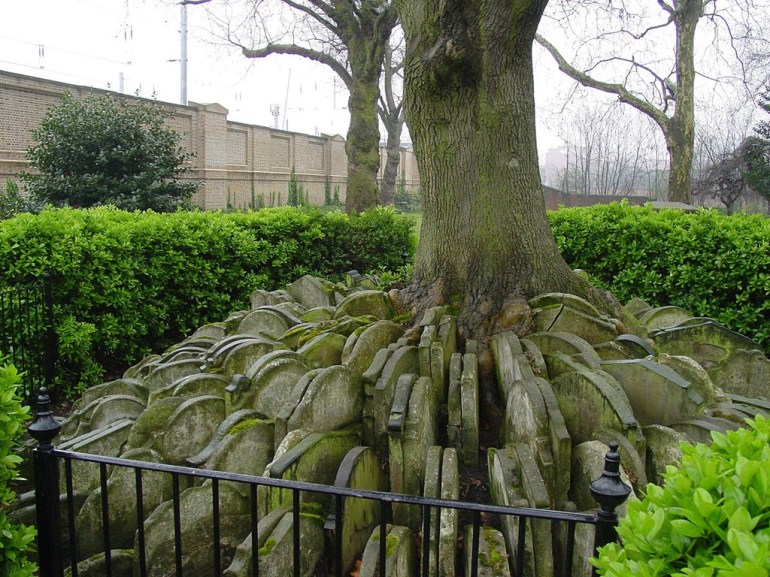
Hardy himself worked out this method of consolidating a graveyard’s worth of tombstones, and it makes a striking illustration for his poem.
.
Hardy, an Englishman born of the middle of the 19th century drops in but one or two anachronistic words in this poem — but while “grandsire” doesn’t sound natural on a 21st century American’s lips, the gist of this metrical and rhymed poem is easily singable in 2023 I thought. Down went Hall’s book and up went the efficient composer! I whipped up the music quickly. Long time listeners here will know that my music is usually not harmonically complex, but my simple cadences often try to confound the usual chords and progression resolutions. I hope I’ve done that with this one. The time to record the piece was scant, so I went with my go-to “I may have to hop a freight train shortly” folk music standby, the acoustic guitar and overdubbed a quick bass guitar part. You can hear it with an audio player below — or if you can’t see that graphical device, with this backup link that will open a new tab with its own audio player.
.
*Few click hyperlinks, so let me put this in a footnote. Wheeler’s book has these additional reasons to read it beside just being good: its story and poetry is contemporary, and as a writer and a woman Wheeler focuses on elements of our lifetime journeys that other poetic memoirs gloss over. Here’s those hyperlinks: Wheeler’s book. Hall’s book.
**Hall’s Harvard classmates circa 1951 included Frank O’Hara, Robert Bly, Adrienne Rich, Kenneth Koch, John Ashbery, and others. Eliot — and to a trivial extent, Frost — were Harvard alums. My personality, alas, is not socially skilled, but even at my most sociable, my circle of working-class Lake Street poets and state college teachers in my 20s is not as name-dropingly famous.
***It’s possible that everyone even vaguely literary in sundry metropolitan areas around this time had drinking with Dylan Thomas stories, even if Hall’s analysis of Thomas’ poetry is individually savvy.
****In his Eliot chapter Hall says that Eliot said more than once to him that no poet knows if their work is any good. When Eliot said this in an interview Hall did with him that was destined for print in a literary magazine, that statement was cut because it seemed too down-beat.


Dear Frank, Just to say – I much enjoyed your post featuring the Hardy Tree at St. Pancras. I’ve been a regular visitor to it over the years, and have even managed to bully others into joining me on such expeditions. You might well be aware of this sad fact already, but….it has fallen over. Plagued by fungus, it was threatening to do so for several years, and now it’s carried out that threat. As far as I’m aware, its collapse wasn’t hastened by that fabulous accretion of tombstones around it, placed there while T.H. was working as a young apprentice to a local architects’ firm. He helped with their transference and was apparently spooked by the process. Apt grounding, maybe, for some of the more lugubrious stuff that later flowed from his pen. Talking of collapsed trees, I wonder if you know of John Clare’s excursion into the theme: The Fallen Elm. In my humble opinion, one of his best and most heartfelt. I’m doing at talk on poetry and place at the John Clare Society’s annual convention next month, and am hence combing his (huge) output. Extraordinary man, belatedly influential. With best wishes, Alan
LikeLiked by 2 people
Thanks so much for the good words, Frank. Also, the picture and its background are fascinating, and I loved the line “If I was 20 in 1949, I would have been as likely to repeatedly meet the two great poets as I am to contact them by Ouija board today.” Indeed, although as a young person, I saw a few of the midcentury biggies on stage, with awe.
LikeLiked by 1 person