A Winter’s Tale

When I first conceived of the Parlando Project several years ago I did not plan to analyze the poems I presented. My original vision was to present the combinations of music and words directly, unmediated.

I had several reasons, including that I didn’t think I was particularly good at that, but the chief reason was that I was worried that was too easily associated with the idea that poetry was some kind of tricky riddle meant to lock out it’s meaning from the unworthy, rather than a different way to approach how things are.

For every person who is satisfied by “solving” a poem, there are twenty-times more that find the effort not worth their time or attention, and a not unsubstantial number that have been found-out for bad readings, wrong guesses, and are shamed from ever making another attempt with poetry. Or for safety and comfort,  some readers will restrict themselves only to poetry that seems to reveal itself at first sight.

The experience of poetry as rote code-breaking or writing of it like a video game cheat solution, even if you find that sort of thing engaging and fun, reduces it. Constraining your poetry experience to easily-grasp aphorisms and reassuring sentiments also limits it.

Once in operation the Parlando Project didn’t follow my plan. If you’ve been reading the more than 300 posts here accompanying the audio presentations of poetry, you’ll have seen that most of the time I present some kind of explanation of what I think the poem means. How’d that happen? Mostly because I ask questions as I experience the poems, and then I think “Why not try to find an answer?” Those answers often delight me, and I can’t help but share them.

And maybe that’s just as well. Get the puzzle part, the explain part, out of the way and we can get on with the enjoyment of the word-music, the music-music, and the innumerable costumes, persons, and ways of speaking by which the poems come walking up to us.

Why introduce today’s piece, D. H. Lawrence’s “A Winter’s Tale”  like this? Because I can’t tell you what this poem of his means to me, at least not yet. For a moment I stopped myself and asked how I could perform or present this without knowing that.

If you’d like to see the whole text of the poem, you can view it here.

Lawrence, better known as a novelist, was also a poet published in the early Imagist anthologies, and this poem fits well into that new Imagist idea of how poetry should present things. Minnesota is covered by a couple of feet of snow at this point in our particular winter this February. The winter landscape Lawrence presents is vivid and rhymes with my experience.

English planter in early spring

Early spring in England, daffodils in the grass, flowers in planters…and then snow.


It’s the other character besides the poet/speaker/singer and the landscape that puzzles me. It’s only a pronoun, “she.” And what do we know of “she?” Female. Walks out in the deep snow, no mention that there is any accompanying her. “She’s waiting.” For what? We aren’t told directly, though the lovely line that describes her waiting “Impatient and cold, half sobs struggling into her frosty sigh” is both vivid and mysterious. England isn’t as cold in winter as Minnesota, but no sane and competent person goes standing out in the rural snow alone without some good reason. Well except for hunters, and my sane statement still stands. I did give some thought about the poem being a hunting story, but I can’t think of any English game that would be large enough to sob and sigh.

The last stanza only compounds the mystery for me. She’s “come so promptly.” Huh? Sounds like there’s more than a common-sense supposition that there must be a reason for her to be there. The poet/speaker/singer steps to her, and the poem concludes before it tells us, saying only the question “Why does she come, when she knows what I have to tell?”

I read one attempt to explicate this as the story of a woman who has come to meet her lover who is about to break up with her, keying partly off the line that says she’s come promptly though she knows that “she’s only nearer to the inevitable farewell.” I don’t have anything better myself, but I’m not buying that. Another says she’s death. I could go part-way for that, although then what’s she/death doing knowing about and being constrained by farewell? Death breaks up with us, we don’t break up with death!

Could she be winter? The poem’s opening says winter has just arrived or returned overnight, so there’s a link to the “promptly” remark. That gorgeous sobs and sighs line could be winter winds. If this is so, then what the poet/speaker/singer has to tell winter is that they know spring will inevitably come.

And so my appreciation for the mystery continues, it isn’t solved now, and it was far from solved when I performed this earlier this week, singing only the question, and thinking of Mark Hollis. It was intriguing to forget certainty as I sang lines of uncertain meaning, but I could grab onto their beauty and find emotional hooks in threads even if I couldn’t view the tapestry. My earlier experiences of this poem, particularly when heard aloud and formed in my voice, are no lesser than my experiences after questions and possible answers.

It’s my hope, as it has been since I started this Project, that you can do the same, and listen to the audio pieces (perhaps several times if you are intrigued) and let meaning and the emotions that surround it accrue in its own time, for your own self. The player gadget for D. H. Lawrence’s “A Winter’s Tale”  is below, and thanks for listening, it means so much to me.
 

Self-Pity

Like Thomas Hardy or James Joyce, D. H. Lawrence is another writer remembered more as a novelist than a poet, though he published multiple books of poetry in a variety of forms in the early 20th Century.

He’s hard to place in the various “schools” of poetry of his time. He was published in Imagist anthologies, but he is also sometimes grouped with the Georgian Poets who eschewed free verse, though he often wrote free verse. He sometimes wrote compressed epigrams like the one I present today. “Self-Pity”  looks like a Modernist short poem on the page, but it doesn’t aim to work like most of those poems on the reader or listener.

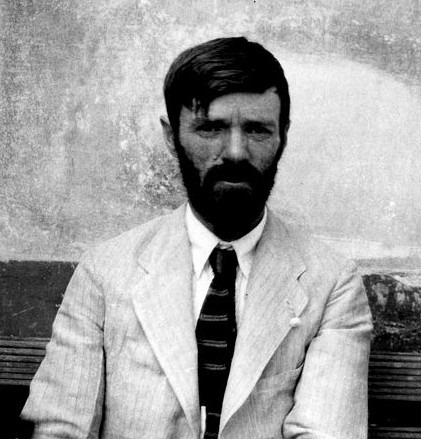
DH Lawrence  by Bynner

1923 photo of D. H. Lawrence by Witter Bynner


Oh “Self-Pity”  uses all the devices of poetry, save for rhyme. It’s loosely iambic with anapestic moments in meter, though the line lengths are uneven. This is consistent with much free verse, which still wants the beats of the words to be felt, without lock-step marching drills. It has a vivid image (the frozen, falling bird). It has a repetition (“sorry for itself”).

Why then does it seem different from other Modernist poems? Contrast Lawrence’s “Self-Pity”  to two other contemporary-to-it very short poems: William Carlos Williams’ The Red Wheelbarrow  and Carl Sandburg’s Fog”.  “The Red Wheelbarrow”  puzzles readers to this day about its message, other than it wants the wheelbarrow to be clearly real. I think it’s about the beauty and dignity of work and its tools, but perhaps I’m wrong. You may not draw any meaning at all when you first hear or read “The Red Wheelbarrow.” “Fog”  attracts immediately with its metaphor of silent fog and haunches-poised cat. It may seem to you at first a show of how metaphor cleverly works. “Wow, fog and a cat, I never thought of them together. Cool.” It’s only if you hold the poem longer in your mind and heart that you may ask why the fog/cat is at the harbor, that it’s not a pampered pet, but a feral or work animal.

“Self-pity”  is more directive. Many who hear or read it will get the point the first time. Yes, that frozen dropping bird is a vivid image, but it doesn’t lead off the poem, it comes after half-way, and it’s meant to work not as something the poet saw, but as an imagined image to illustrate his point.

Which way is the right way to go about it? That’s for you the reader/listener/writer/performer to decide. The Internet tells us some folks find the direct and pointed message of “Self-Pity”  helpful to them. I myself could stand to be reminded of it sometimes. Literary poetry of the 20th Century gradually made the decision to go with the non-directive imagery way, not with the more frankly didactic aims of Lawrence’s poem. Current writers and readers will get to re-decide this issue for our maturing, teen-aged, century.

“Self-Pity” was used in a Hollywood depiction of military training.  I imagine a Pythonesque skit where John Cleese or Graham Chapman submits other poetry to raw recruits. “I saw the best minds of my generation destroyed by madness, starving hysterical naked!” “Suppose an opponent comes at you armed with plums. So sweet. So cold. What would you do?” or “You are a pair of ragged claws scuttling across the floors of silent seas.”


What do I think? After all, this is the Internet. I must  have an opinion!

I’m eclectic. I don’t want poetry, or any art, to always work in the same way, to stop surprising me. If I could send myself back and offer advice to Lawrence on his poem, I’d tell him to spend more time on that bird before he tells us what the bird means. By not giving me the sense that a real human stood cold or bundled up or on the warm side of a window and watched that instant, that small bird, ruffling their feathers to hold what warmth was still there before the perch became its last, the poem loses potential power for me.

Thomas Hardy may have imagined his winter darkling thrush entirely as a useful image, but I feel that encounter with his bird. I’m convinced Rilke actually looked at an amputated and archaic torso of Apollo and wanted to see its present state fully before he delivered his reaction. I think Lawrence wanted to make a point, and that bird was a useful slide in his deck.

But that may be sentimentality on my part, and too much of that can be stifling and predictable. And perhaps the poem would loose some of it’s epigrammatic power. How often we see by opposition.

Musically, I spent a good deal of time on the drums/percussion for this track, trying to pull out the vibe of “Self-Pity’s”  meter. With the rest of the music I tried to balance my reaction to Lawrence’s resolution while transmitting the assertion of the epigram itself. To hear it, use the player below.


The Darkling Thrush

My teenaged son is proud of his mastery of modern youth slang and enjoys the idea that his parents and their generations will have no idea what such terms mean. This is of course part of the utility of language: it not only binds people together, it keeps them apart.*

No matter, new times and new experiences enjoy making fresh and untarnished words to describe them. Words must have their pleasures, even when we don’t quite understand everything someone is saying. Take Thomas Hardy, a man who wrote what may be one of the last poems written in the 19th Century, after he had spent 61 years in it. Published on or around New Year’s Eve in 1900, today’s piece is “The Darkling Thrush.”  In Hardy’s poem, as an old man looks at the changing of a year and century, we have the reverse of my son’s joy: old words from an old man.

Thomas Hardy Moustache wax abuser
Careful with the moustache wax Tom, you’ll put someone’s eye out!


“Darkling”, “coppice”, “spectre”, “bine-stems”, “lyres”, “outleant”, “illimited”—we meet the first one in the title, the second five words in, the third at ten words. Even if I was to quiz educated Americans, I doubt most could define the majority of these words, and I’m unsure how much better modern British residents would do.**

Coppicing is a European method of managing tree growth, in which mature trees are cut off to allow fresh shoots to continually propagate. Spectre is more known now as a trademark applied to laptops and James Bond bad-guys, but is an English word for a spirit or ghost. Bines are not vines to the knowledgeable horticulturist (bines twist their main stem around things to tangle and climb, vines use special parts of branches to hitch themselves up). Lyres are not supporters of disreputable political movements, but a stringed harp. Illimited is just another, rarer, form of the word unlimited, and I think Hardy may have chosen it because it starts with a sick word, ill, but also puns on illuminated. The titled adjective, darkling is a handy way to say it’s occurring in the dark. Although it’s a little-used word, like illimited, the sound of it brings to mind something else, the smallness of the title bird, as in duckling,  and darkling’s sound also lets us see dusk rather than deep night, when we can still see the winter thicket Hardy sets his poem in.

But outleant is the real mystery word. A short web search finds no online dictionary definitions, no examples of its use other than in Hardy’s poem. A simple deconstruction of the word’s parts would make it, inverted, saying “leaning out.” And that’s what it probably means. There’s textural evidence as it ties back to the poem’s second word, “leant upon the gate” to the coppice. Yet, did Hardy intend to infer two other close words in this word’s sound? Out-lent, a sense that the haunted and dreary winter scene of the poem is owned by the old, dying century and is lent out only to the present? Depending on pronunciation of the printed word’s “ea,” it could conceivably be pronounced out-lent (and Hardy does rhyme it with “lament.”) Does he also want us to hear a closeness to outlearnt, and that the old century’s corpus of belief has been superseded (by newer scientific discoveries?) That would be consistent with Hardy’s beliefs.

Perhaps this is my weakness as a reader, translator, performer and poet myself. If I sense an image is possible, I want to see it, hear it, perform it. Bare winter bines twisted around a copse of brush wood as a corpse leaning out of a coffin may be grisly, but it’s not to me a strong image.*** Even if it’s abstract, the second sense, that of this bare and haunted landscape being the cemetery plot owned by the old century of which we are only visiting seems stronger. For others, the sense that new knowledge has killed off the old beliefs (outlearnt) could be a choice. I can’t know that Hardy intended this ambiguity by choosing this unusual word outleant, but I, the reader, put it there.

The title calls attention to the central image, yet another messenger bird in British poetry, to go with the nightingales and skylarks of Keats and Shelley, poets of Hardy’s now dying century. I like that Hardy lets us see the bird, and it’s frail, gaunt, and -ling tiny, and that we can see feathers fluffed to best insulate its frame, which the wind is disputing.

So, there was Hardy, around New Year’s Eve, using his old and odd words at the end of an old century. For us, Hardy’s oncoming one (the 20th century) has now closed itself. Will things get better or worse in our new year? Something in us wants to foretell at every ending—yet even looking backwards, we have trouble making a simple better or worse judgement. Here, the battered bird, the darkling thrush, says better. Hardy says he knows he doesn’t know.

He knows he doesn’t know is the realist’s version of hope.

Anyway, one of the joys of combining poetry with music is that you don’t have to take a test on the words to enjoy the piece. My pompatus of a performance of Thomas Hardy’s “The Darkling Thrush”  is available with the player below.


*Right now he’s very generous in this however. He wants me to know these words so I won’t be left out.

**Before looking them up, I knew spectre and lyres for sure and I was fairly sure about darkling as an adverb, then taken to adjective. I had ideas (some from context) on the others—and in the case of coppice, my ideas were wrong. My son knew spectre and lyres and defined darkling as “a creature of the night” for which I’ll give half-credit. In the case of bines, I told him I learned how bines were different from vines, and he told me “Sure they are! Vines are 7 second videos.” (That last was a joke on his part.) My wife, a fine word-smith, also got 2.5 (“Bines, it that like a wood-bine?” got half-credit as understanding was there, even if a good dictionary definition it wasn’t.)

***Saplings and bines and “sharp landscape” would indicate a skeletal image is intended, but bare bones are not particularly scary or intense compared to rot and decomposition, much less animated brains-hungry undead. Hardy doesn’t mean scary so much as long-dead I guess. Interestingly, Hardy had a direct graveyard experience to draw on here.

Longfellow Goes Beat

I live in one of the northernmost states in the U.S., a place where winter cannot be denied, and so we must make our treaty with cold and snow. Some will even claim it makes us better persons—hardier, accepting of the Zen of difficulties. Still, if Minnesota has inherent Buddhist elements, it doesn’t lessen my attachment to a shelf of warm clothes.

When I think of Buddhism I do not think first of ancient and overseas masters, but instead of the Beat Generation writers of my youth, the mostly men who reacted to the growing abstractions and high-mindedness of High Modernism with a return to immediacy and intimacy. The Beats could be seen as beaten-down by something, past the chance of winning a warm success, but they also asked that the word be understood as short for “beatific.” Allen Ginsberg explained: “The point of Beat is that you get beat down to a certain nakedness where you actually are able to see the world in a visionary way.*”

Like many things that meet America, Beat got absorbed and its rule-breaking became a style, a fad, a fashion, a look, a required attitude received with only enough meaning to make the accessory match the outfit. Every time I read to music here, I fear I’m seen as wearing a costume, playing a role.

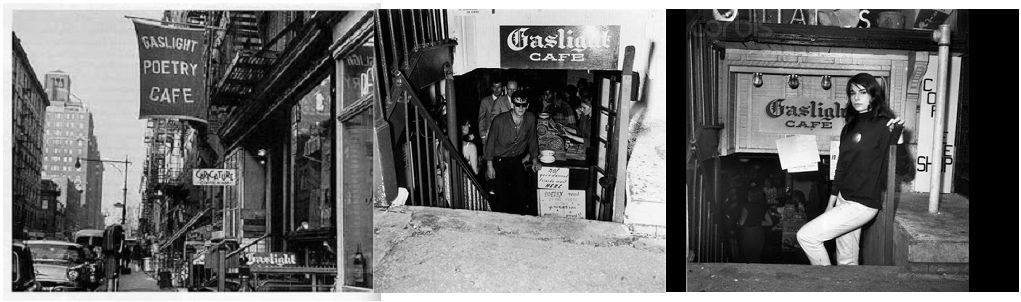
Gaslight Poetry Cafe

Not quite as portrayed on the Marvelous Mrs. Maisel, the legendary New York Gaslight coffee shop

So, what’s this got to do with Henry Wadsworth Longfellow—the square’s square—the man who wrote poetry that poets of the last 100 years find worthless?

Let me put Longfellow in a laboratory and see what we find. My lab: it’s a jazz club, probably downstairs, past the gray concrete curb turning winter white. It’s darkened enough inside the room that it’s sometime, night—but what year? The crowd is burbling, so’s the coffee machine. Wait staff are delivering and clearing tables, setting a tray on the bar for a moment to let another pass, talking of nights-off. A couple in the darker corner are nearly making out and can’t hear the band for the sight and breath of each other. A writer at a table closes a notebook, nothing more is in it today. The room is small but fairly full, about half talking their own talk and about half looking at the low bandstand, the quartet.**

The bass and drums begin, the guitar comments and the piano-player chords on the side. The bearded man steps to the mic, sheaf of paper in his hand.

“Snow-Flakes***”  he announces. Is this beatific? Is this visionary? Maybe it is, he looks that way. He is a strange cat: saying words “doth” and “bosoms”—like Lord Buckley perhaps. If he was translated into Chinese and then back to English, the Beat element would be clear; but even as it is, the words are beautiful, and he lets them slowly stay there that way, “This is the poem of the air.”

The drummer is still slapping the snare with his brushes, as the bearded man at the microphone gestures onward to the band, with a slight roll of his hand. His face changes. The vision’s past, is there a resolution? “Psalm of Life****”  he says.

This other poem is confrontation to everything we’d expect in this club for those who listen here and think about what they heard. “Mournful numbers,” are told on this stage every night, and he’s dissing them right off, and he ceases to pause his words now. The dance of the snowflakes becomes a march of “Let us, then, be up and doing.” What is this? The must be shoveling and stuck car after the beautiful, sorrowful snowfall?

He ambles off as the band riffs for another couple of minutes. What does this strange combination of poems mean? A snow-flake satori in a field, and then a command to earnestly strive. Yes, this Longfellow is a strange cat, even here.

My performance of Longfellow’s “Snow-Flakes”  and part of “A Psalm of Life,”  is available with the gadget below. Of if you are using a reader that doesn’t show the player gadget, this highlighted hyperlink will also play it.

.

*In the course of the long influences that led me to doing this project, a local Iowa rock band of the late Sixties, “Emergency Broadcast System,” would open their 1968 sets with the singer speaking a good portion of Ginsberg’s America  over the band riffing.

**I recorded this on Christmas afternoon, first laying down the drum track and playing my Bass VI, an odd instrument that adds two higher pitched strings to the conventional four-string bass, instead of adding lower strings, the more common variation. I used this higher range to play the repeating, descending riff that occurs throughout the song. I played guitar around this rhythm section and then played the block piano chords. As a last step, I figured if I’m going to impersonate a jazz quartet I might as well go all-in and put in some fake club ambience. Maybe this did come from binging The Marvelous Mrs. Maisel  this month with my wifeor from nights at the old Artists Quarter in St. Paul and listening to Sunday at the Village Vanguard  by the Bill Evans Trio too many times.

***This one goes out to Mary Grace McGeehan of My Year in 1918, who thought of this poem when she thought of Longfellow. It’s one I’d overlooked until she brought it up, and what a graceful lyric it is!

****I performed only about half of this once well-known poem of Longfellow’s here. Several phrases in it were mottos for my grandparents’ generation, and my parent’s generation passed them on to me in occasional speech under a thin varnish of irony to preserve them. As a result, both the poem’s claim that “Life is real! Life is earnest!” and it’s command to “Let us, then, be up and doing” have remained with me.

Walter de la Mare’s Winter

I know nothing interesting about the life of Walter de la Mare—other than he was a successful writer in poetry and prose for roughly half of the 20th century*. There appear to be no interesting movements or manifestos to tie him to, and though his lifetime corresponds roughly to those 20th century Modernists I often like and present here, he’s not considered one of them.

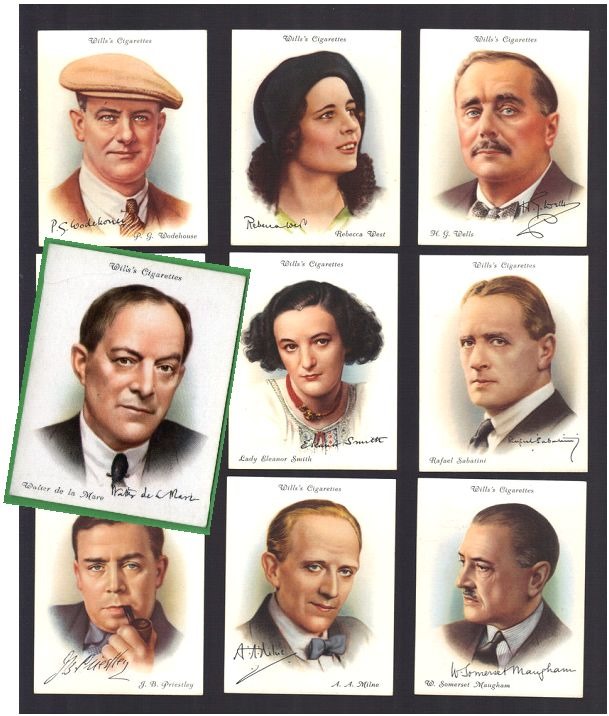
Famous British Authors Willis Trading Cards

20th century British authors who got trading cards in cigarette packs level fame.


Certainly, his poetry doesn’t sound or look like Modernist verse. It’s frankly musical, and supple yet regular musical verse of his type is not that easy to write in English. Modernists took up with free verse for a number of reasons, partly because they were likewise enamored of the wider and more fanciful rhythms of Modernist music and visual arts, and because they wanted to explore new ways of relating reality, and the tight and formal clothing of metrical forms and rhyming seemed to restrict their range of movement.

There were folks with a Modernist sensibility who worked in rhyme and more regular metrical forms. Early Robert Frost and Edna St. Vincent Millay did. Frost in particular is often writing Imagist poetry with fresh, plain diction that rhymes in the era when his fellow Modernists were immerging.

Today I use a short poem of de la Mare’s, “Winter,”  and the first thing that struck me about it is the word-music. Every line rhymes, and with perfect, not partial rhymes. Though de la Mare uses common rhyming words, the poem seems effortless, there are no lines that seem twisted to make the rhyme. But notice something else about “Winter:”  the way it treats its matter, as opposed to its music—that’s close to the Imagists credo. It directly shows a winter scene. The opening lines “And the robin flew/Into the air, the air,/The white mist through;” are solidly in the Imagist mode. That opening “and” making sure we know this is an immediate experience. The entire second stanza too is Imagist through and through. Nothing is “like” anything. This is a real, immediate scene, and we stay there. The robin** flying through white mist is a bird flying through white mist, not a mere symbol, a counter for something else. Frozen bushes waver in the slight breeze casting varying reflections from the new rising moon or last sunlight. Yes, what we are apprehending through the poet has connotations, has feelings that will be invoked, but we aren’t told by the writer what they are, he assumes we’re capable of forming those ourselves.

Only in the ending stanza does de la Mare break the rules of pure Imagism. In his last two lines he personifies a speaking star or cardinal direction which speaks the final line. For me this works largely because this contrasts with the rest of the poem. If instead, de la Mare had started with talking stars giving us messages in so many words and continued in that vein through the poem with bushes and birds telling us what the poet wants them to say, the impact of the conclusion would be lessened, and the poem would be trying to work, not just sound, in the old way.

Musically, I unabashedly say I like what I did for this one. The piece began for me with the guitar part, which I was going to play on acoustic guitar, but my family came home early and there’d be no chance to record that with an open sensitive mic, but then many acoustic guitar parts translate well to the Telecaster which I substituted. The bass guitar part is unusual in that it’s played entirely on open strings, a sound that the instrument is rarely allowed to use. But it’s the orchestral parts which really pleased me. There’s a bunch of tracks here combining “real” strings played via a virtual instrument with a somewhat overdriven Mellotron violin mixed in there which brings the string section some grit***. I gave a top line part to an English horn. Use the player just below this to hear my performance of Walter de la Mare’s “Winter.” 


English Robin in Winter

English robin showing its all-weather operational capabilities

 
*I recall reading some of de la Mare’s ghost stories decades ago, but I hadn’t really considered his poetry until I was reminded of that by Toby Darling, who does a lovely job of writing and playing music to sing many de la Mare’s poems to.

**Residents such as I who live in the Northern parts of the U.S. may be surprised that de la Mare has a robin in his winter scene. The American robin is a different species, which migrates south for the winter, and as such the robin here has a strong symbolic association with spring. English robins stay put. The same name for different North American and European species could lead one to read some promise of spring that de la Mare didn’t intend in his poem, in the same way that Robert Frost’s American winter hemlock branch may not have been a Socratic hemlock branch. Anyway, both robins have a bright red-orange breast, which even though de la Mare doesn’t state it, adds a dot of color to the white mist flight.

**The Mellotron was an early, primitive attempt to do what modern “virtual instruments” do. Typically, if a virtual instrument wants to present a “real” violin it will sample a violin playing various notes, and the notes as well with a variety of articulations which are stored and organized as digital audio files to be played later. The 1960’s Mellotron had a simple tape strip of a violin playing a note in one legato articulation assigned to each key of an organ-style keyboard. The former can sound strikingly realistic if care is taken to make use of the various articulations (vibrato, marcato, pizzicato, etc.) while the later sounds artificial despite the tape strips being conceptionally the same. Of course, “artificial” is a state of mind, and the close-but-not-quite sound of a Mellotron instrument always reads as “England” to my ear due to it use on many 1960s and ‘70s recordings by English groups.

Cold Is the North Wind, and Why Did Confucius Collect a Book of Songs Anyway?

Here’s one more musical piece from the anthology of ancient Chinese poetry collected by Confucius and his school and known as the Confucian Odes  or The Book of Songs.

This one may be my favorite, though my performance of it dates to a time before I could find literal translations to check against the extant English ones. Perhaps even more so than our last piece, “Wild Plums,”  this presents itself as an expression of lover’s desire. You might find it similar to the Bible’s Song of Songs in that regard.

When I was young and looked at commentary on the Song of Songs,  I was surprised to find that some scholars believed it to be a spiritual metaphor rather than some too-hot-for-school love poetry. My take then: those scholars must be prudes.

With the Confucian Odes,  remember that the Confucians thought their collection of folk-poetry was not just a piece of cultural curation, but required reading for advanced participation in society—not just for poets or humanities majors, but also for politicians and bureaucrats, a class the Chinese Empire needed a great many of. There is commentary on “Cold Is the North Wind”  that says then that this song expresses a hardship or grievance experienced by some province or another, or that the lover’s desire is a metaphor for political concern. After you listen to “Cold Is the North Wind”  you may think that must be willfully obtuse. “What part of the ‘I’m lonely, it’s cold in this bed alone, and I want you right here, don’t they get?” you might be thinking.

In both cases, the Song of Songs  and “Cold Is the North Wind,”  I’ve come to a slightly different view. Poetry, sometimes when it’s at its best, binds the image and what it’s representing in a way that doesn’t privilege one over the other. William Carlos Williams’ Red Wheelbarrow  isn’t some symbol which we need to decode as a handy emoji for the usefulness of tools in ordinary work, and “Aha! We’ve solved the poetry puzzle for today!” it’s also a freaking red wheelbarrow in a chickenyard and it’s wet with rain in a way we can feel and see if we allow that. Separated lovers are separated lovers, and their ache we can feel, but that ache specific to that need and pleasure is something we can feel again in other intensities. And that act of listening to these words (or listening to them on the page) binds us to the poem in the way the poet binds the image to the things the image is like.

There’s something there for future bureaucrats and politicians.

There was a time, also in my youth, when we thought songs might be able to do that. Someone who listened to Bob Dylan, Aretha Franklin, John Coltrane, Patti Smith, or other Smiths and Jones would be changed not necessarily into record store clerks or musicians but into more empathetic people whose imaginations would be wider than the immediate space around them. To what degree were we wrong? One provisional answer: “not entirely.”

Chinese Throne

“So, I’m writing this tweet. What makes the best metaphor: low IQ, sick, ugly, dumb, dog, failing or FAKE? I’m a genius myself, but poetry is an elite WITCH HUNT, and I could use a little help casting this spell. What, you can use poetry to listen, not just to speak good?”

If there was a modern Confucian school sitting somewhere in the English-speaking world, what would they collect to instruct future government members and business functionaries?

The player to listen to my performance of “Cold Is the North Wind”  is below. If you’ve been checking out the archives of over 250 other combinations of various words and original music on the right, you might notice that “Cold Is the North Wind”  appeared here several years back, before the official launch of this blog. With today’s post, it will now be available to those that follow the audio pieces via Apple Podcasts, or through other podcast services.

Does the way you view this blog not show the player? Well, then this highlighted hyperlink can play the performance.

Snow Storm on a Blank Page

Longtime readers will know that one of the principles for the Parlando Project is “Other People’s Stories.” I partly do this out of a contrarian streak, as the Internet is full of folks telling their own stories. Yet, obviously, I do not take my path due to a condemnation of personal stories. After all, without other’s stories, I would not have the ones I present and react to here.

I believe something additional happens in my process of presenting my encounters with other people’s stories. You, the valued readers and listeners here, add a third part to this. Do you see, what I see, as I am looking at, speaking someone else’s silent words; while you remain off to the side, with your ears at each side of your own mind and memory, your eyes parallel to your own mouth? No, you will see something slightly different.

Yet, this morning, let me violate my self-imposed principle, and write, as if this were a conventional blog, about myself.

I awoke today after a week that finally found promised 50 degree Fahrenheit temperatures to an utter snowstorm that had itself awakened from a night sky that fitfully dreamed rain, sleet, hail, and freezing rain. The wind outside had someplace to go in a hurry.

I am an Amateur of Velocipeaes by Leonara Carrington

Leonara Carrington dreams of bicycles with oversize tires

As a contrarian, I dressed and took to my marvelous Minnesota invention, the fat bike fitted with 4 inch wide studded and knobbed tires. A morning with few moving, yet full of noise. Snow crunching under the tires, wind restating its case more insistently over again, the typewriter of snow against my goggles.

Parked at the curbs, even the most fearsome cars were growing a white carapace, their windshield wipers stretched out, insect arms, quivering in the wind.

Windsheld wipers stretched out insect arms

“Insect arms, quivering in the wind”  wipers left out to keep them from being encased in ice

To be an old man on a bicycle is to know gratitude. Does a fierce April snowstorm tell a story? Perhaps it does. Is it beautiful, or a false and comfortable frightening that leaves others inside, deciding that internal pleasures are best this morning. But I wished to hear its story today, to see it. As I rode, the wind said yes and no in its one direction. The snow said music is frozen yet moving. The whiteness says color can only exist if you make it.

In the middle of the week I had driven two friends to the airport. They saw this sign “If you see something, say something.” I thought, isn’t that the fourth Imagist rule, one unstated by F. S. Flint and Ezra Pound? Yes, you must honor the thing and your reaction to it, using no word just because you believe you must use that word, and remember you are making music, not marching. But the first rule, which I understand now in the multitude of a blizzard: if you see something, say something.

Thaw

I like to mix up our musical encounters with poetry here, using both well-known and lesser-known poems. Here’s one you probably haven’t heard before, written by a poet who is less-known in the U.S. than in his native Britain, Edward Thomas.

In 1913, Thomas was 36 years old and was scratching out a living for his family as a freelance writer on whatever topics could generate a check, but his real passion seemed to be as an enthusiastic naturalist. He liked nothing better than to walk about the countryside reading the book of nature, jotting down notes about what he’d seen. Then he met a similar no longer young writer, a 40-year-old American who wanted a career as a poet.

The American had not found his own country in agreement with his vocational desire, and so he had flipped a coin to strike out somewhere else: Canada or England? He knew no one in either place, it was just a hunch that someplace different might change his lot. The coin came up England. He took a cottage in the Cotswolds, near to where Thomas was living. The 40-year-old American poet? Robert Frost.

Over the next couple of years, the two men developed what would be the most significant friendship in their lives. Now Thomas had a companion besides his notebook on those nature walks. Although Frost had published only a handful of poems in periodicals at this point, Thomas saw his talent, a man who could write metrical verse so supple that it didn’t seem like poetic diction. In turn, Frost saw another poet in this self-described “hack writer” with his avocational notebook.

Thomas and Frost

Nearing 40 years old and yet thinking about poetry. Edward Thomas and Robert Frost.


Frost published his first two books of poetry in England, “A Boy’s Will”  and “North of Boston,”  and Thomas reviewed them enthusiastically, helping launch Frost’s literary career. And with Frost’s encouragement, Thomas’ notebook jottings became poems.

In 1915 Frost moved back to the U. S. where publishers would now publish American editions of his poetry. Edward Thomas, and his family, were to follow. The two poets were to live near each other in America and continue their fruitful friendship.

These two men, these two friends, who each could write tremendously concise poems in which a natural drama could play out in but a few lines, had one constitutional difference. Frost was reconciled to chance and fate. He would jump oceans with a coin flip. If lost on a road by a snowy woods on the darkest night of the year—well keep on driving that buggy onward in the dark. Thomas, on the other hand, believed that introspection and judgement, an ever-closer reading of the book of nature could discern the right choice. If two roads diverge (as they would when he and Frost walked the Cotswolds) your honor derives from making the correct choice from the inconsistent evidence.

Back in the USA, Frost wrote his famous, misunderstood, poem about those two paths and sent it to his friend, still tarrying in England, and Thomas became the first person to misunderstand The Road Not Taken.”  No matter how much we honor the author’s intent, the poem exists after it’s creator. Thomas’ outlook saw the undercurrent in the poem, that choice could be important. Thomas thought: if Frost was making gentle fun of that, no matter, that was the point.

Here’s a small, four-line poem that Thomas wrote about spring, “Thaw.” As often with Thomas’ poems “Thaw”  is set on a nature’s large stage, but it’s a very short drama. Winter’s snow, as it is here in Minnesota today, is half-melted. Crows are cawing in tree tops, as the crows I saw today on my morning bike ride to breakfast were too, speaking the inscrutable language of crows. I saw one swoop down and frighten a foraging squirrel on a lawn, the black bird somewhat larger than the squirrel—and then, larger yet to it when the rook spread its wings and hammered out its hard-consonant caw.

The squirrel hopped like something had exploded underneath it and disappeared. These natural decisions could be read if one picks up the book of nature.

In Thomas’ “Thaw,”  the poet has come to understand that the crows know spring is coming, they are nesting already, and their treetop kingdom, unlike the ground beneath the poet’s feet, is snow free. They have read the book of nature more perceptively.

In Frost’s “The Road not Taken”  the comic narrator will sigh “ages and ages hence” about not having read nature right, of having lost the experience the road not taken would have given him. Edward Thomas decided not to move to New England to live next to Frost. Edward Thomas decided, though he was nearing 40 years old, and with a family to leave behind, that honor and his sense of correct decision required that he enlist in World War I, then half-way over. Within a few weeks of arriving at the front, a German artillery shell, following the arc of nature’s laws for men’s unnatural needs, killed him outright.

Thomas had continued writing his nature poems through his boot-camp training, and presumably at the front. He was still seeking to find what it knows that he doesn’t.

You can hear my performance of “Thaw”  using the player below. In the middle section I tried to give the impression with electric guitar of the sounds of a flock of crows.

If you like what we do here, particularly as we celebrate National Poetry Month (#npm2018), you may want to let others know about The Parlando Project on social media or elsewhere.


March 2018 Parlando Top 10 Part 1

It’s time for that quarterly exercise where we look back for the most popular audio pieces here at the Parlando Project over the past season. I’m going to follow the format we used last time, and break the countdown into four episodes. I base the popularity on the number of likes following their posting here, and the streams the audio pieces received directly from the blog, or on iTunes, Spotify, or other podcast sources. Let’s start the count from the 10th most popular as we move up the list to number 1:

10. Rosemary

Even though these pieces were listened to in the Winter for most of our listeners*, Edna St. Vincent Millay’s words have a kind of spring-cleaning of the heart vibe, and so may be apropos for opening the windows and letting the curtains blow around—or at least they will in a few weeks when it warms up here in the northern part of the northern hemisphere. I awoke to 10 degrees Fahrenheit and snow and polished ice myself today.

I rather liked the music I wrote and performed for this one, just as I have liked going back to Millay to reassess the strengths she brought to poetry. Millay’s popular reading audience, once substantial, hasn’t completely disappeared, and there’s a welcome re-assessment of her poetry starting in academic circles.


9. Stopping by a Woods On a Snowy Evening

I’ve featured Robert Frost’s words quite a bit here, perhaps to atone for my dismissal of him when I was a teenager as the kind of worthy poetry in our schoolbooks that we needed to move beyond. Two things were key to my learning to love Frost: his uncanny ability to write lyrical verse that sounds natural, and my finally noticing the dry wit and stoicism that underlies most of his work.

Frost, alone of his American generation, has retained a level of popular appeal and critical approval. He’s double-edged in maintaining that. Some are captured by the surface of his poetry, hearing and maintaining in their memory the catchy moral-of-the-story “big choruses” of Frost. In this poem, it’s the “I have promises to keep, and miles to go before I sleep” at the ending. Others listen carefully to the verses, the parts other than the lines we most remember, the parts we can come back to and find that we’ve forgotten were there. When I came to work musically with this poem, I’d forgotten those. There’s no lovely woods to see in this dark night. He may be lost. He’s so dark and alone that he can hear snowflakes sweeping across snowbanks between the jingle of his rig’s harness bells.

Musically, I was obligated to add shaker bells percussion to stand for those harness bells, but then, more obscurely, I decided to add a South-Asian tambura drone for the sweep of snow.


amedeo-modigliani-pierre-reverdy

Modigliani’s portrait of Pierre Reverdy


8. Clear Winter

I was a terrible French student in my little Iowa high school and my little Iowa college. I seem to have no ability with languages, and less than no ability to handle those accents and the reforming of the mouth that makes speaking a foreign language possible. But I love poetry translation. I feel like a paleontologist removing the clods of sediment from a skeleton. Slowly, painstakingly, there it is, just as it was in its moment of sudden! But then my task shifts, and I must become the process of fossilization, to find the minerals of English that can fill in for the sinew and feathers of it’s original language.

I had a great time with the challenge of Pierre Reverdy’s “Clair Hiver.” I’m unsure of the accuracy of the “tea-kettle” section of my translation, but I fell in love with it, and could not abandon it, even if the light behind Pierre Reverdy’s eyes cannot reach the little anteroom behind mine.


*web stats I get for the streams tell me I have as many recent listeners in Australia as I have in Texas—and one listener in New Zealand. Bret, please tell Jemaine that there’s a lot of good stuff to read and listen to in the archives you’ll see listed by months on the right.

The Wood-Pile

Robert Frost is every bit the master of word music as Yeats and Millay. What makes Frost stand out is that he was every bit the thoroughgoing early 20th Century modernist as any of his free-verse contemporaries, while retaining an ease with accentual syllabic meter.

Here’s an example of Frost handling a subject just as a free-verse Imagist would. His aims, his presentation, hold to the Imagists’ principles. He deals with the thing directly (as we shall see, two things, but still…), and there are no tacked-on metaphors, no stock comparisons, no extraneous “poetic” language. Context is shown, but not explained. He loosens and varies his meter, so the poem sings and never seems to be a shackled march. At 40 lines, it’s a bit longer than Yeats’ poem considering “The Wild Swans at Coole,”  but Frost’s extra detail is even more specific and concrete than Yeats, though both begin their poem with the poet walking in a rural wetland. Yeats slough is a well-known place to him, conditioned with 19 previous visits. Frost is far enough into his swamp to not know exactly where he is, and so experiences what he sees with a first-time immediacy. Yeats’ slough then contains tradition, Frosts’ the more Modernist “Make it new!” place.

Though presented as one simple rural scene and story, “The Wood-Pile”  is more at two poems, though each part speaks to the other. As Frost’s tale starts, we are in the midst of one of his characteristic journeys, just as we are in other famous Frost poems. There’s a need for decision (“Turn back” or “go on farther”) and his choice, also made in other Frost poems, is to go on regardless of whatever doubts brought the question. If he’s lost in the dark by a wood on a snowy evening, keep going. If you come to a fork in the road, pick one and go on. If you’re walking in a swamp in winter and your foot is sometimes falling through the frozen crust, well, keep going “and we shall see.”

And so, here he sees his bird. No Keatsian nightingale, not Millay’s elusive flying swans with their awkward dangling legs and cries, nor Yeats’ majestic 59 swans, but a small bird. This bird becomes a mirror to the poet. Frost’s bird too must make choices in direction, and the poet, sensibly, thinks the bird’s guided by fear. “Keep something between little me and the big lummox trodding through the winter swamp,” he humansplains. And there’s a bit of humor at human’s expense as the poet muses that the bird, like humans with their self-importance, may think that the only reason for Frost to be out in the swamp is to go after the little bird.

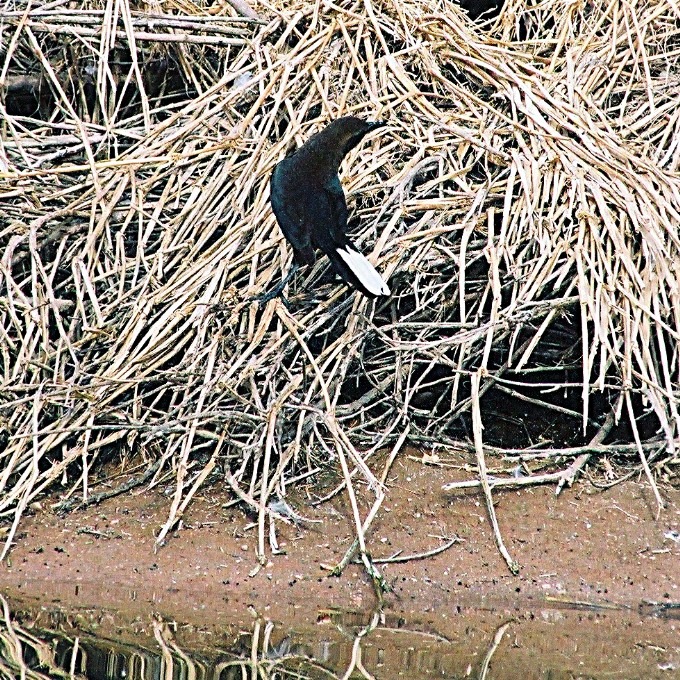
Gackle with white tail feather

“He thought I was after him for a feather—the white one in his tail”


But, we don’t know why Frost is out in the frozen swamp explicitly. The only reason he’s given, or will give, is the Imagist poets’ reason: “and we shall see.”

The bird leads Frost to the second thing the poem wants to present: an abandoned fire-wood cache. Here Frost zooms in close. Every detail of the cut wood and the once neatly stacked and propped wood-pile is stated. Frost turns forensic, like some New England Sherlock Holmes: this pile has been abandoned for years. Mature vines have grown through it.

wood-pile

“The slow smokeless burning of decay”


Here is another context left unsaid. Why would someone abandon a purposeful wood-pile in a swamp? Frost leaves it for us to be detective and to solve the mystery. This isn’t some lot of fire-wood left temporarily to be gathered later in the day, care has been taken to stack and prop it.

The only thing I can think: someone once built a shack (now completely disappeared) on the swamp land. Frost muses, sardonically, that only someone so busy with “fresh tasks” could abandon such effort in cutting and stacking. Does he mean to say, “only a fool would be so industrious to cut and stack this wood and yet not notice he was building his shack on a swamp that would not support a homestead?”

Now, the small bird with his “little fears” and oh-so-human misapprehensions of reality—and now, the steadfast Frost of miles to keep going, even if you may be lost, are set in contrast to this choice. Your fears may lie to you—but so will your optimism.

I once heard an astringent biological statement that the length of our lives can be reduced to a slow-burning chemical reaction. Frost’s last line here is a sad and beautiful analog to that truth.

Turn back or go farther? Go on, and we shall hear my performance of Robert Frost’s “The Wood-Pile”  with my original music. Just use the player below.