Today was the Autumn Equinox, which some use to mark the beginning Fall. Where I live it was very hot and muggy, hardly autumn-like at all, and even the reasonable breeze could not budge the heat. I went bicycling with my son, promising him ice-cream, which he accepted as adequate exchange, and picked up cold sandwiches for our supper, but in-between I worked on the setting for this piece, yet another by Christina Rossetti.
I wasn’t intending to return to Rossetti so soon, and I’m not sure how I ran into this poem, but it meshes so well with some others I featured here this month about summer and attitudes to love. I just couldn’t deny it.
Christina Rossetti: sadness that none-the-less sings in a lovely way
I know little of Christina Rossetti’s life, if she suffered from depression, or if this reflects a more temporary mood; but in whatever case, she fashioned a finely crafted lyric to present the experience. I find this sort of thing often in English poetry, sadness that none-the-less sings in a lovely way. Here is America we grew up some Blues, and we tend more to bargain with despair, or call it names and begin to insult its absurdity.
The title is a bit of puzzle to me, though. “From Sunset to Star Rise” has something of a “It’ll get better” connotation. Was she trying to remind herself of some wisdom that could come from this, or that there is some mystery yet to work out?
Musically I wrote this on acoustic guitar and the full arrangement retains the acoustic guitar part with some disconsolate drums and slowly building synth parts. To hear it, use the player gadget below.
Today’s audio piece is another by Christina Rossetti, connected through family with the Victorian art and literary movement that called itself the Pre-Raphaelite Brotherhood. In their painting and artwork, the Pre-Raphaelites often appeal to me. The paintings sometimes have a stunning, oversaturated palette; and they are fond of symbolic and esoteric subjects which fill the paintings with interesting details.
Eb Bb , Ab Eb , then Fm Fsus4 Fm, and Ab Eb Ebsus4 Eb—flat keys are murder
on guitar, just so Frank can play simple black key stuff on keyboards
Many associated with the PRB wrote poetry as well, but when I’ve gone looking for pieces I can present as part of the Parlando Project, the brothers in the brotherhood just didn’t do much for me. Surprisingly, the poet who did was Christina Rossetti. I don’t recall if she was even included in the “New Criticism” curated English literature anthologies of my school-age youth. She isn’t a poet with a lot of flash and filigree. A poem like today’s has not a single arresting image, and its language is simple too. Using the criteria of the Modernists who came to dominate the assessment of poetry in the 20th Century, this poem should have nothing to recommend it.
So, what does it have or do, why did I bother to write some music for it and perform it for you? Well, first it has a refreshing modesty of expression. This is a song of longing from first to last, a universal human experience. And the subject of the longing, is it for an earthly partner, the age-old “when will the right one come along” wish? Or is it for an otherworldly, completing partner, a presence beyond the moon and stars? Despite Rossetti’s homey words, it could be either, and the alteration of “near or far” with “far or near” in the 2nd and 3rd verses encourages us to see it both ways.
If one must choose which supposition, I lean to the spiritual object, and if so, the image, such as it is, if off-screen here: earthly love may stand for the longing for religious meaning and connection. The last couplet, the dying leaves falling on “turf grown green” is strangely incoherent, and it reminds me of some of images or rebirth and salvation in British folklore, leading me that way.
But if could also be a song of simple earthly longing for a suitable partner. Adding music to Rossetti’s “Something or Other” both adds decoration to the simple words and allows the listener to relax in that ambiguity without a need for an immediate conclusion.
See, E flat is so easy on piano, even saints can play it.
Today’s music for Rossetti’s poem combines acoustic guitar with some cello and strings integrated with a couple of piano parts in the background. It’s another short one, so go ahead and use the player below to listen to it.
I drove to Des Moines Iowa this past weekend for a wedding of a niece. The reception was in a tap room attached to a small indie brewery. My 12-year-old son asked “Why is it in a brewery?”
I asked my son if he knew what a hipster was. “Yes, it’s someone who always needs to have the latest iPhone the day it is released.” My son likes to remind me that he is not a millennial, and that he will have no truck with their ways.
I laughed and said that it’s more than that though. I tried my best to explain, doing badly, as I usually do when speaking. What I was aiming to say was that hipsters are interested in things that are different and off-beat, that in doing so they often revive things from the past and redo them in the now different context of the present. This kind of rebellion against the too-ordinary incumbent culture eventually changes the culture, remaking cities and what they offer. “When I was a kid and went to Des Moines, there were no small breweries serving their own beer, or restaurants that serve those Asian noodles like you like. Instead I’d get to go to Bishop’s Cafeteria.”
“What did you like about Bishop’s?” my wife asked.
“I liked that you could choose your own desert. Usually something with whipped cream on top.”
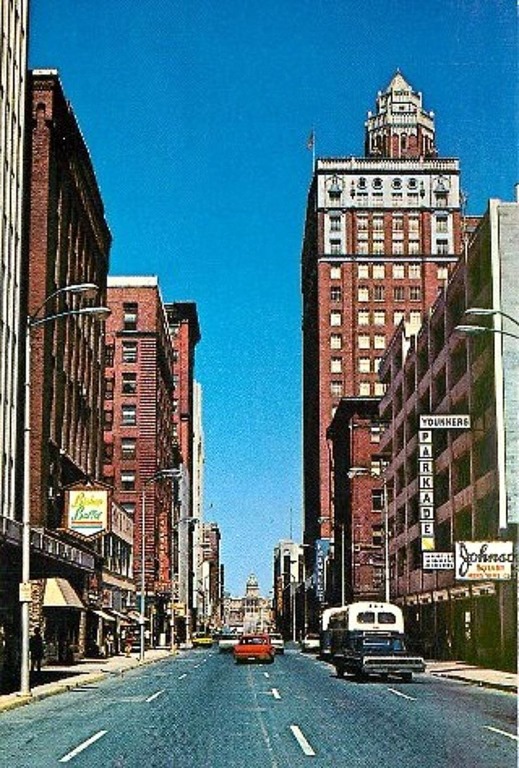
News from Nowhere: Des Moines dreams of hipsters to come. Shop at Younkers, eat at Bishop’s.
Now that isn’t a complete explanation of what a hipster is either. Nor does it tell how hipsters are seen and labeled by others, or that to call someone a hipster generally has a negative connotation. If you want a hyper-precise definition with lots of reasons to be wary of being called a hipster you can read one here.
Every cultural change movement like this gets made fun of, and provides lots of rich examples of foolishness. And unlike frankly political change movements which often generate mutual veneration between generations, many cultural rebels see the next generation of young novelty seekers as a bad, devolved outcome; while the young often find and fix their cultural novelty in rejecting the enthusiasms of their immediate predecessors. Can anyone be sure that hipsters are any more or less authentic than punks, hippies, beatniks, or swing era hepcats and so on? I can’t. Is some rampant cultural appropriation going on? Yes, and that has its foolish and even harmful side-effects for all these cultural movements—but are their benefits as well? I believe there are, and anyway, rigidly contained cultural silos seem stifling.
This rejection of immediate predecessors, doesn’t mean an inevitable total rejection of the past. Small breweries were common in America a century ago. Beards, mustaches, fedoras—the clichéd markers of the male hipster, all are revivals of past fashions.
Remember with the Christina Rossetti poem last month. I mentioned her brother Dante Gabriel Rossetti’s boys club “The Pre-Raphaelite Brotherhood?” Formed by art students, they signed their paintings with a “PRB” as secret tag for their movement. They hated the classical art and design standards of their day, and even though they were living in the original Steam Punk era, instead of fetishizing brass, well-oiled gear trains, and leather, they propagated their love for Medieval art and hand-made crafts.
Dante Gabriel Rossetti. Can he interest you in some beard oil?
Sound familiar? The Pre-Raphaelites seem to me to be late 19th Century versions of early 21st Century hipsters. If they were ironically enjoying Midwest beer in a can, would they have signed their paintings “PBR”?
Today’s audio piece is William Morris’ “Love Is Enough.” Morris was intimately connected with the Pre-Raphaelites. Like them, he was fascinated with Medieval art and culture, but he was a man with many interests—many more than I can touch on this time—including writing influential fantasy and speculative fiction. In that vein, we’re going to time-travel the Englishman William Morris like we did with Americans Walt Whitman and Emily Dickinson, so that this 19th century poet can sing a nugget of garage band blues with the LYL Band.
William Morris fading into the wallpaper. He did just about everything but start a brew pub.
This one is a good song for a wedding and for lovers. To hear “Love Is Enough” use the player gadget below.
I find it a wonderful “Parlando – Where Music and Words Meet” coincidence that one of Christina Rossetti’s sonnets and one of David Crosby’s songs share a title, “Triad.”
David Crosby is a musician and songwriter who first came to prominence in The Byrds and then as part of another triad, Crosby Stills and Nash. When I first came upon his songwriting many years ago, I was attracted to his distinctive abstract melodic and harmonic sense. Almost no one before, and few since, wrote music for songs that sound like his did then, with the exception of some Joni Mitchell tunes. Lyrically Crosby styled himself as unconventional as well. His “Triad” is a blissful ode to free love—well at least free love as long as David Crosby is the one explaining how things will be.
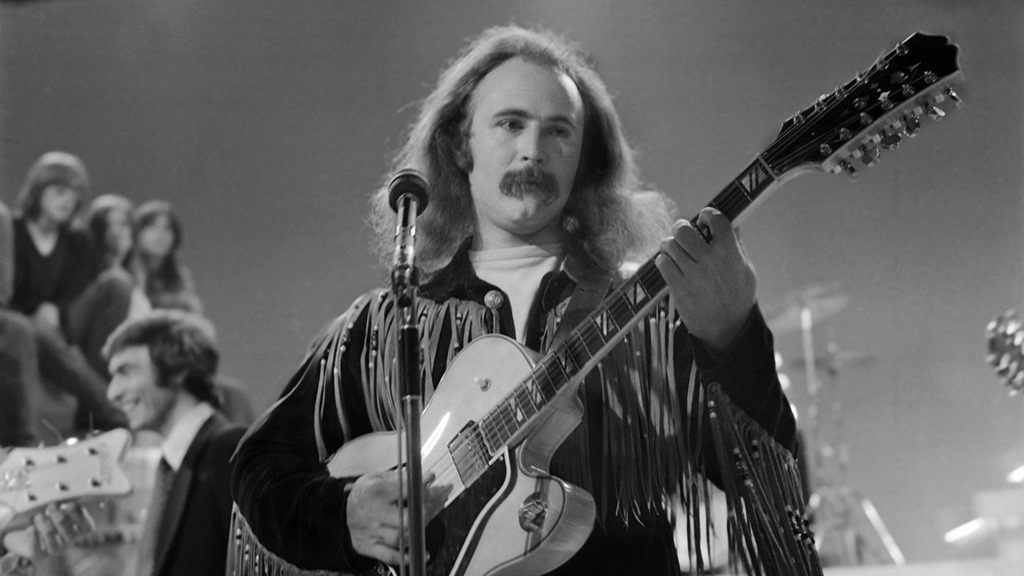
David Crosby’s song starts by asking “You want to know how it will be?” and then he mansplains it
Christina Rossetti was a pioneering British 19th century female poet. Her biographical triad was that she had two brothers William Mitchell Rossetti and Dante Gabriel Rossetti, also writers, who went on to form the Pre-Raphaelite Brotherhood. Hmmm, “Brotherhood”—I wonder if girls get to join? Not officially, though she was used a model in some of their paintings.
Her brother Dante used Cristina Rossetti as the model for the Virgin Mary, far right.
Christina Rossetti’s “Triad” is a not-so-happy look at romantic love, and the writer is none-so-sure how it should be either. Rossetti draws her portrait of three women who once sang together. One the stereotypical harlot, one the blue spinster, one the smooth compliant wife. Each of them finds the dead end of the limited paths available for passionate women. Conventionality decrees the hot harlot is shamed and the cold virgin dies for love, but Rossetti steps outside conventionality to tell us that the “temperate” spouse grew gross in her compromise until left with the devastating line droning “in sweetness like a fattened bee.” How much has changed since Rossetti’s Victorian England in this regard? Some things, not all things. New Rules are still rules, look at who makes them.
Musically here with our “Triad”, the LYL Band somewhat refer to the psychedelic vibe of Crosby’s musical style to accompany Rossetti’s sad and lovely words. To hear it, use the player that appears below.





 Frank Hudson