Rats Alley

Continuing in our April Poetry Month serialization of “The Waste Land”  by T. S. Eliot, it’s come time to perform the next section of the poem, which I call “Rats Alley.”

It just happens that this week I got a copy of Martin Rowson’s “The Wasteland,”  a 1990 comic-book riff on Eliot’s poem as if written by hardboiled-detective fiction writer Raymond Chandler and filmed like “The Big Sleep”  or “The Maltese Falcon.”  Rowson notes that in “The Long Goodbye”  Chandler had referenced Eliot’s “Prufrock”  with a character quoting “In the rooms the women come and go, talking of Michelangelo” and having the character ask his detective Marlowe “Does that suggest anything to you sir?”

Marlowe replies, “Yeah—it suggests that the guy didn’t know very much about women.”

Though that’s clever repartee, charges that Eliot was naïve about women or even misogynistic can be difficult to disentangle from his general misanthropy. A female Chandler character may be given more apparent agency than the women in Eliot’s “The Waste Land,”  but both the male and female voices of “The Waste Land”  are frankly damaged and the minor male characters, wraiths and zombies.
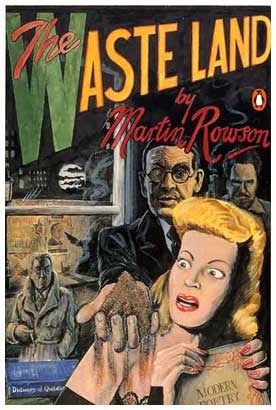
Rowson Wasteland1

Sometimes with a dame you gotta show’em some quotations in Greek or Latin.


In any case, Rowson’s comic-book/graphic novel is a lot of fun for fans of Film Noir and Chandler, or Eliot and Modernist lit. His drawings have more in-jokes than a season of “The Simpsons”  watched with a finger on the pause button. And from his notes Rowson supplies in my edition on dealing with Faber and Faber and the Eliot estate, it could have been even funnier if any of them had allowed the comedic-take to use any of the lines from the poem. I laughed often reading the Rowson, but never so much as when he recounts being refused the rights to use the ancient Greek and Latin quotes Eliot dropped into his poem, because Eliot’s rights now include them as part of a unique compilation. That may well be legally sound, but it’s also howlingly funny. Eliot as he wrote his “Waste Land”  was clearly borrowing widely from other authors’ work, because he thought it would show us something new when he put them in another context—the same thing that Rowson’s book sought to do.

Which is also what we try to do here as part of the Parlando Project, show you familiar and unfamiliar words in the context of different music and performance styles.

“We are in Rats Alley, where the dead men lost their bones”

“Rats Alley”  is a dialog, and the two speakers are clearly broken vessels. The woman dissatisfied, depressed, afraid, maybe even unstable. The man, numbed, haunted, unable to express even the short expressions of discontent the woman speaks. When he (once in the poem, three-times in my performance) breaks into the cryptic “We are in Rats Alley, where the dead men lost their bones” I decided to alter the voice, to make it a third voice. She’s asking him to speak, to tell her what’s going on, but she doesn’t seem to have heard him say anything, other than a litany, literally, of “nothing.” And so, I’m portraying the Rats Alley line as his inner torment, his monster, that is heard loudly, but only in his head.
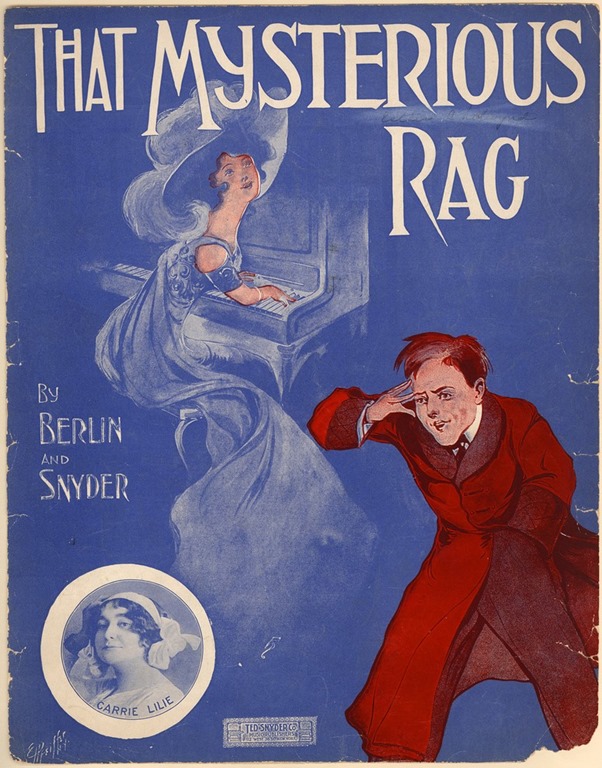
That_Mysterious_Rag_1

“In the rooms the women come and go, digging riffs from Ahmad Jamal”


Rats Alley sounds like yet another reference to some dark Jacobean revenge play, samples from which Eliot has already peppered his poem with. If it is, no one has found that work. Some speculate it sounds like the darkly humored street-signs WWI trench-soldiers hung on their subsurface battle lines. If so, then the last voice, the fourth voice of the piece, an imaginary, comic ear-worm song Eliot has made up, “That Shakespearean Rag,”  could also be an internal voice. It’s sometimes been considered to reference Irving Berlin and Ted Snyder’s “That Mysterious Rag,”  a giant pre-WWI hit with lyrics that say “Did you hear it? Were you near it? If you weren’t then you’ve yet to fear it.” In the hit parade context, the lyrics turn out to be just bragging that this rag is a killer hook “because you never will forget it.” Eliot substitutes Shakespeare in his parody, but is this male voice a soldier, haunted by the trenches and dead comrades to whom old tunes now take on a new context, a sinister edge? It’s a bit of a stretch, but could Eliot have planned to use “That Mysterious Rag’s”  mock-dangerous lyrics as a counterpoint to his scene—wouldn’t that have been a powerful sample!—but was enjoined by copyright issues?

To hear my performance of “Rats Alley,”  today’s segment of Eliot’s “The Waste Land,”  use the player below. You can hear the first section, “The Burial of the Dead”  or the first part of the “A Game of Chess”  section which I performed as “Visions of Cleopatra”  by looking in our previous posts this April as we celebrate #NPM2018.

Visions of Cleopatra

“Jewels and binoculars hang from the head of the mule.” This famous line from T. S. Eliot’s modernist epic “The Waste Land” —oops! I’ve become confused here. As part of our celebration of National Poetry Month this April, I’ve been performing “The Waste Land”  and dropping the mixtape here as I complete a section. We’ve completed the first part “The Burial of the Dead,”  and this week I moved on to the start of the second section.

That section, sub-titled “A Game of Chess”  opens with an elaborate descriptive passage with lines quoted from older literature, with paraphrases and references of stories dating back to Classical Greek. It’s opening lines are cribbed from Shakespeare’s description of Cleopatra. The section’s sub-title itself is taken from an allegorical play first performed at Shakespeare’s Globe Theater.

Throughout “The Waste Land”  Eliot does this. He’s sampling. He thinks these bits will add flavor, perhaps even to those that aren’t as well-read and as he was in 16th and 17th Century literature. But this is also part of one of his tactics in his poem, to portray the specific malaise and suffering throughout Europe after the First World War and his own personal depression and chaotic marriage as something adrift in time, an infinity echoing inside the museum of Western Culture.

In this opening section he’s describing a woman in an over-decorated room full of upper-class bling and old-fashioned mannerist art that makes only sentimental reference to searing tales. As he describes this his syntax is convoluted, his sentences run-on, his poetic line breaks disassociating. And all this is in service of a segment when nothing, absolutely and intendedly nothing, happens.

As I re-encountered this section I had that flash of metaphor that I love. Metaphor is the powerful fusion that occurs when two things unite into one expression. Eliot’s room may be decorated differently, but the room seemed familiar, the language usage brought forth déjà vu, the air in the radiator pipes rumbled, the heat pipes just coughed.

How much did T. S. Eliot, “The Waste Land”,  or this section of “The Waste Land” enter into Bob Dylan’s toolbox? The two poets share some common influences from French poetry. Both love to mix highbrow and lowbrow references. Both quote and paraphrase other writers, though in Eliot this is usually considered scholarly, and with Dylan it’s too often taken as evidence of plagiarism. Sometimes Dylan is just Eliot without footnotes.

All I have to go on is a passing reference to reading and finding some value in Eliot in Dylan’s memoir “Chronicles,”  and the line in Dylan’s own waste land epic “Desolation Row”  where “The Waste Land’s”  editor and dedicatee Ezra Pound and Eliot are fighting in the (ivory?) captain’s tower. That’s plainly thin evidence. The flash of metaphor don’t care,  these two moments of decorated stasis feel similar enough to inform this performance.

Eliot on Blonde Crop

“These fragments I have shored against my ruins—and Shatzberg, I know it’s cold out here, but can you at least focus the camera…”


I got part way into this recording of the first part of the second part of “The Waste Land”  as illuminated by Bob Dylan’s “Visions of Johanna”  before I decided I’d go with more than memory and listen to the canonical recording from the “Blonde on Blonde”  record. I’ll have to say that my memory-track of “Visions of Johanna”  is mostly a mashup of the various live versions performed solo with acoustic guitar and harmonica in 1966, where Dylan’s “you’ll like it, or you won’t” singing makes every word tell. Dylan had a hard time getting an electric band version recorded that same year, perhaps because a Rock’n’Roll song about stasis is a hard thing to make. On reencountering the “Blonde on Blonde”  version, I took some inspiration from it: the organ player who gets lost partway in, the importance given to the bass part, and the drums that follow the ebb and flow of the singing. I’m not trying to duplicate the record, just tipping my hat to its effects.

This is the sort of thing we do here, even on months that aren’t National Poetry Month, bringing music to poetry and illuminating poetry with music, reencountering familiar poems to see something new in them, finding lesser known poems and presenting them. We do that a little different each time, as a visit to our archives on the right side of the page will demonstrate, but to hear this part of Eliot’s “The Waste Land” performed, use the player below.


The Burial of the Dead

Well, the rooks were wrong about Winter passing, at least for now. As much of Minnesota is covered with a foot or more of forgetful snow, with more remembering to fall over the top of us all day, it’s a good time to return to T. S. Eliot’s landmark of Modernist poetry “The Waste Land,”  the poem that, by beginning with the famous line “April is the cruelest month” is largely responsible for National Poetry Month being set in April.

The first lines of The Waste Land

Other than the “Dead” thing and the sinister Roman numeral,  seems normal enough;
but “The Waste Land” will soon get stranger and darker than anyone expected in 1922.


We’ve been performing it on the installment plan this month, following up on our performance of the first segment of it last April. But, it occurs to me that because so many of our listeners hear us via the podcast section of Spotify, which perversely doesn’t allow podcasts to be placed in playlists, that it might be good to combine what we have completed into one longer piece.

So, here’s the more-or-less complete first section of “The Waste Land”  titled “The Burial of the Dead.”   Eliot intended his poem to be musical, so even though it’s sprawling and includes many voices, it’s been fun to make audible the musical implications in it. As I do this, I’m reminded again of my first encounter with “The Waste Land.”  I didn’t understand any of it—well, that’s not completely true, I could extract meaning from a few lines—but the whole thing could just have well have been a symphony with notes in place of words. Even now, for me, “The Waste Land”  remains a hard poem to love, and unlike many poems and poets of our current scene, it’s not asking us to love it.

So, if it’s hard to understand, and hard to love, why listen to it?

Because it is a great poem? I doubt that would work. Because it was so influential historically? Well, that influence is now largely historical. It did move things powerfully one way, and then, after decades, things moved another way, in part in reaction to it. Because there are still fresh experiences to encounter in it? Now we’re getting closer. Art isn’t immortal only because it’s great in some ideal way, an art work’s immortality happens from our mortal human actions, our human reactions  to it, and some of those become richer when the work has become strange to us from a change in fashion.

But in the end, I ask you to listen to it consistent with our overall tactics here in the Parlando Project: listen to it as music first, do not worry at the overall meaning immediately. I hope I can illuminate some meaning with my performance and music, but simply to comprehend “The Waste Land”  as this suite of voices and moods is to comprehend much.

Here’s the player gadget to hear “The Burial of the Dead.”  Since it combines what had been four pieces issued separately here, it’s longer, at 13 minutes, than our usual stuff. If you’re looking for something brief, why not take a random walk through our archives for one of the more than 200 shorter pieces we’ve available.


Unreal City

Today we continue our performance of T. S. Eliot’s “The Waste Land”  as part of our celebration of National Poetry Month this year (#npm2018). We’ve reached the end section of the first part, “The Burial of the Dead”  which started with it’s famous stance, opposite to April and Spring, before proceeding through some scattered bittersweet pre-war reminiscences and a satirically murky attempt to read the future. In the concluding “Unreal City”  we present today, we move on to an even darker scene.

In a dreary London day cast with brown fog, the poem recounts a hellish procession of desultory men walking to work over London Bridge. Compare this to Carl Sandburg’s Chicago-set treatment of a similar bridge scene written just a few years earlier. Sandburg, the working-class political radical, knows well the worldly bargain the workers face in addition to the human condition. Eliot, the conservative bank officer personally grappling with depression, will connect the weary enervation to a spiritual brokenness.

Readers differ on what level of reality we should ascribe to Eliot’s scene, which after all is labeled “unreal.” Is this a vision of the dead of World War I arising in a zombie walk? Or is this some level of Hell or Purgatory, in which urban London is only imaginary set-dressing for immortal torment? Or is it an actual observed moment in Eliot’s London living life which seems as trapped and without options as death? Imaginary gardens with real frogs in them, or real gardens with imaginary frogs?

Eliot develops this scene with the deepest gallows humor in the whole poem. One of the sighing walkers on his unvarying path is called out, greeted by the speaker in the poem as a fellow veteran of a naval battle between Rome and Carthage in 280 BC. I’m sure Eliot would have appreciated the anachronistic pun before its time, as by happenstance that Punic Wars battle at Mylae can now pun on the infamous 1968 My Lai massacre during the Vietnam war.

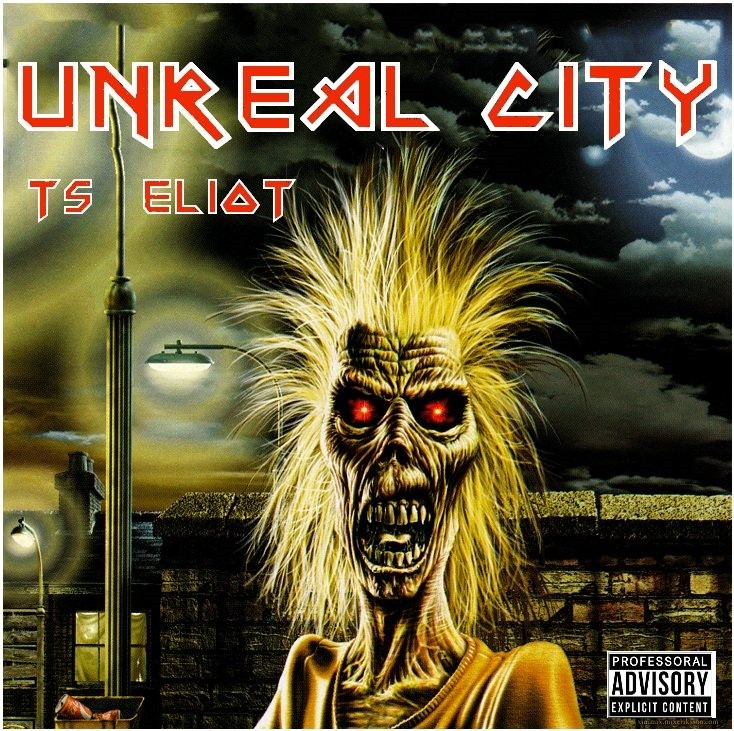
“The Waste Land,”  which had begun with lilacs bred by Spring, now speaks of a corpse planted in a garden as if it was the bulb of a prized perennial flower. Eliot’s writing this nearly a hundred years ago, but poetically his iconography has taken a step toward a late 20th Century Heavy Metal album cover. I’ve double-checked Eliot’s notes on this poem. No, he wasn’t listening to Iron Maiden when he wrote this poem.

Unreal City Cover2

Would Ezra Pound have said: Make it New! (Wave of British Heavy Metal)


The section closes with a French quote from Baudelaire that translates to “Hypocrite reader! My fellow, my brother.” Eliot is inviting us into his nightmare, asking us to come along with him. If you haven’t read “The Waste Land”  before, or recently, where do you think Eliot will go next, now that he’s put us in grisly post-World War unreal corpse garden land? Fulfilling his poem’s design, it will be somewhere completely different.

Musically, I didn’t attempt NWBHM to accompany this section of “The Waste Land.”  Instead, I combined a fat synth motif and Rhodes piano with some electric guitar stabs and burbling bass. Listen to my performance with the player gadget below.


Madame Sosostris

Look at a picture of T. S. Eliot. Chances are you’ll see a proper English gentleman looking back at you. You might suspect a teacher, or if not that, a bank officer. By the time he wrote “The Waste Land”  he’d been both, and the later job was considered by some in the Modernist circle a small scandal from which he needed to be rescued. Respectable, English, settled—you would trust him with your money or your child’s education.

T S Eliot looking very donish

T. S. Eliot in costume to play Harry Potter’s great-grandfather


Eventually Eliot became a British citizen, a confirmed Anglican Church believer, and a canonized poetic figure. So that man in the picture is what he intended to become. But the man who wrote “The Waste Land” wasn’t him yet, even if he could dress up as him for a portrait. What he was, was a thirtysomething American trying to engage a European culture that itself was now refugee after an unprecedented World War, a man also in a disastrous marriage and suffering from “doctor’s orders” depression.

Except for the World War part, one could, from some standpoints, look at this and file Eliot’s situation under “first-world problems, see also: middle-class white male.” And while WWI had profoundly changed Europe, Eliot seems to not have had any direct experience with the war, unlike many of the Modernist circle, so you could add to that “survivor’s guilt.” Let’s just center in on that depression part. That’s apropos, depressives are often told that their real situation is not as bad as all that.

I’ll blindly wager that many, probably most, reading this have suffered at some time from depression. Considered as a disease or syndrome, it’s a very common one, like aging or pregnancy—it’s not some rare, god-sent, lightning strike calamity. Yet, that’s not how it’s most often experienced. A depressed person feels trapped in themselves. One thing that is common to many in depression is the distrust of any judgement or decision. Whether it’s your own, or some outside others’, whether it’s a judgment of praise or damnation, you distrust that it’s true and fear that it is.

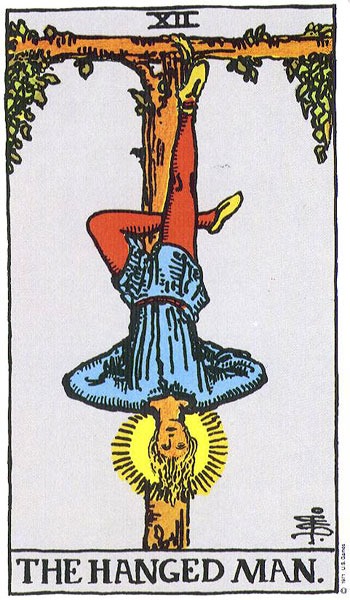
The Hanged Man

Is he being punished, or just looking at the world another way?


As we reach the “Madame Sosostris” section of “The Waste Land”  we meet a fortune teller, a line of work that should be helpful to one in this depressive trap. In Eliot’s intended scheme for the poem, she serves as a Deus ex Machina to introduce, as part of a pseudo Tarot card reading, some mythological themes of the poem. But if we are to understand the emotional core of “The Waste Land,”  which is the poetic expression of a person suffering from depression, the undercutting of her authority begins right away. If Madame Sosostris is some kind of enlightened and advanced being, she’s suffering from a mundane head cold. Her patter as she reads the cards is perfunctory, only occasionally rising to the level of oracular obscurantism, and she all to quickly jumps out of her clairvoyant trance to the details of delivering some work for the comically named “Mrs. Equitone.” There’s no relief, no reliable guidance here.

To hear my performance of  “Madame Sosostris”  from T. S. Eliot’s “The Waste Land,”  use the player below. We’ll be returning to “The Waste Land”  as April, National Poetry Month (#npm2018) continues, but our next post will be celebrating a special milestone in the Parlando Project.


Hyacinth Girl

Since April is National Poetry Month, let us return to that April epic of  High Modernism, T. S. Eliot’s “The Waste Land.”  Readers here will know that I’ve made great use of the works of the pioneering Modernists, that generation that formed itself on both sides of the Atlantic in the years before the outbreak of WWI.

We’ll continue to talk about them later, but for now I’ll point out that one thing they all shared was a commitment to shorter works with new imagery often drawn out of immediate contemporary experience. Given how I later encountered Modernism in Mid-20th Century American schools, I have been surprised at how simple, how commonplace, were the materials they used for their fresh imagery. Subtlety and ambiguity were not forgotten, but they were not belabored.

To “make it new” in this pre-WWI era, it was often to radically simplify. If traditional poetry was referred to, it was not the grand epics or the most serious verse of the past centuries, but the highly compressed Chinese and Japanese forms, Greek lyric fragments, or vernacular verse from folk traditions.

Modernism as it mutated after WWI had no such concentration. Grand themes and grand works were once more the best goal. Allusions to tradition abounded. As High Modernism marched forward toward my own Mid-Century youth, its poetry began to take an air of post-graduate knowledge as a pre-requisite to understanding or enjoyment.

Eliot’s “The Waste Land”  is a landmark for this change. I’m not an Eliot scholar. I won’t presume to psychoanalyze him accurately at the biographic point where he wrote this, with some key editorial re-shaping by Ezra Pound. As I said when I presented the opening section of “The Wasteland”  here last April, the poem is clearly informed by personal depression. Since a large percentage of contemporary people have experienced depression and grappled with it, parts of “The Waste Land”  communicate with us on an emotional, associative level even if we don’t understand it in a “pass the exam” way. This is good for the poem.

T S Eliot at the blackboard

I’ll show you fear in a handful of chalk dust! Evidence of T. S. Eliot trying to invent Sudoku.


Eliot’s complex, even maddening, use of distancing tactics in “The Waste Land:”   the rapid dislocation of location, time, speakers, and national language, along with a plan to make everything a possible reference to something else—usually something old and not mundanely immediate—is not at all like the pre-WWI Modernists. Still, that didn’t keep that sort of older Modernist style from breaking in every so often.

Today’s piece “Hyacinth Girl”  is one such part of “The Waste Land.”  If it had been presented as a standalone poem in one of the early Imagist anthologies it would have fit right in. There’s no post-graduate work necessary here, as was demonstrated by an 80s college-rock band who conceptionally used the same trope with no need for footnotes.

Not Eliot’s, nor my “Hyacinth Girl,” and not Winter Hours’ either. This is the original version by Ward 8, a predecessor band that make it sound more like the Velvet Underground.

Studied academically and considered as a part of the rest of the poem, Eliot’s “Hyacinth Girl” section needs not to be experienced this way, directly. One can consider any intended connection to the Greek myth of Apollo and Hyacinth and their tragic Frisbee accident with homoerotic overtones. I did so just yesterday, reading some papers and summaries of papers which if nothing else made me conscious of how often gender is unknown and shifting in “The Waste Land”—but I did this long after recording my performance of “Hyacinth Girl.”  I didn’t feel the need to revise it in the light of the papers or the classical reference, no more than I needed to know if it refers to Eliot’s girlfriend, or his wife, or a young man who was killed in WWI. Pound had once said that the image is “that which presents an intellectual and emotional complex in an instant of time.”  Eliot seemed unsure that it should be only that, if that was enough, which lead him and Modernist poetry to some strange places and practices, but it didn’t stop such direct poetry from breaking into “The Waste Land’s”   manifesto of High Modernism.

To hear my performance of this part of Eliot’s “The Waste Land,”  use the player below or with this highlighted hyperlink with will open a new tab window and play it. It starts out with just acoustic guitar and voice, but eventually some bass, strings and piano arrive. What would additional parts of “The Waste Land”  sound like if combined with eclectic original music? Stick around during #npm2018 as we’ll be letting you find out.


.

When Lilacs Last in the Dooryard Bloom’d

We’re about to begin April’s National Poetry Month in the U. S., but I’m going to begin celebrating #NPM2018 today with a piece that’s a good way to start things off, the opening two sections of Walt Whitman’s “When Lilacs Last in the Dooryard Bloom’d.”

Large-Blue-RGB-National-Poetry-Month-Logo
We’re aiming to present even more audio pieces than usual this April
Use the Follow button to make sure you get a notice as they drop


National Poetry Month isn’t just for American poems or for American poets, but if it was, Whitman would be all the more inescapable. In the middle of the 19th Century, he and Emily Dickinson forged two original styles whose sounds and tactics can still be found in contemporary verse—Dickinson, with small lines in small poems that bind-up with puzzles immensities; Whitman with long lines and epic poems that offer a catalog of exultation. One sees a single, small thing and says it represents the universe, the other beholds the diversity of the world and says it’s really one thing. Complementary opposites.

Both were working at a prodigious pace during the 1860s, during America’s great Civil War. On April 14th of 1865 Abraham Lincoln, the US President during that war, was shot. The next day he died. Within weeks Whitman had produced the first published version of this poem along with other poems about Lincoln and the ending of the Civil War which he published as “Drum Taps.”  It would not be like Whitman to hold his thoughts on those great events inside. In contrast, Tennyson’s epic elegy on the death of a beloved friend, “In Memoriam”  took him more than 15 years before he published it.

At over 200 lines in its entirety, “When Lilacs Last in the Dooryard Bloom’d,”  taken as a whole, would exceed my usual mode here. I prefer my audio pieces more the length of the 45 RPM single records of my youth. So today, I present only the first two sections of Whitman’s poem. Whitman’s voice changes over the course of this long poem, but in these opening sections Whitman (albeit in free verse) is sounding somewhat like the poets his modernism would break from. Save for the absence of rhyme, his language here would not sound out of place in Tennyson (or even the earlier Romantics, like the Shelley of “Adonais.”)

Whitman's Parent's House

Is this the dooryard? Whitman was visiting his mother’s house when he heard Lincoln had died.
He stepped outside and saw the spring lilacs in bloom.


I did the same thing, presenting only the intro section, last April for the poem I believe is most responsible for April being National Poetry Month, T. S. Eliot’s The Wasteland,”  which begins memorably “April is the cruelest month…” Those that can finish that first sentence may recall it continues “Breeding lilacs out of the dead land.” So, Whitman’s elegy and Eliot’s poetic apotheosis of High-Modernism written over 50 years later, both begin in April, and with lilacs.

We’ll be revisiting territories in “The Wasteland”  later this April, but today you can start where Whitman started his poem, and from where Eliot got some of his inspiration for his. Musically, this one is fairly simple, but I hope effective: acoustic guitar and piano with a little low synthesizer groan eventually joining in. Use the player below to hear it.