Smells

Traffic for the blog has picked up again a bit after its summer slump, but I’m still going to be presenting a few more of my own poems before returning to our usual presentation of other authors’ words. One thing that this does is allow me direct access to the poet’s intent, so today let me pull back the curtain and discuss what choices I made and what I was trying to convey in this sonnet that is part of a series I’ve done this year about a family dealing with one of their members with Alzheimer’s disease. The main characters so far are the older woman with dementia and her middle-aged daughter. The mother has transitioned to a Memory Care Unit as her dementia has increased.

Here’s the text of today’s poem, “Smells,”  so that we can follow along line by line as I discuss what I was trying to do and how I chose to do it. For today, for length reasons, I won’t talk as much about sound-music choices. Maybe another time for that.

Smells

The August after-rain smelled of rot and growth
where it dropped drought leaves on the lawn.
And by the garage door a bug had left its
solar-boat sarcophagus molt on the door frame,
implacable as any statue. Then down the block
the young dog walker looks at their phone
while the dog sniffs longingly at the weeds
tufting a stop sign. On to the MCU.

It smells today of urine just in the door;
and the mother asks again if she can leave —
which they do only for a walk. They pass
a bee garden, which has a sign “bee safe.”

The mother laughs. The daughter smiles.
She can still recognize a pun — its
accident.

Even though the poem follows the consciousness of the daughter character, the first three images of the poem were taken from things I observed myself on August mornings this summer. It can be chancy imbuing personal thoughts on a character when the character may jump across gender, age, or other boundaries from the author — but the alternative of not making that leap and to attempt to invent outside of the body and consciousness the author lives in risks as much if not more.

The first two lines discuss a dichotomy or dialectic: in this summer’s drought, when we had a short rain, it actually stripped the just hanging-on leaves off of some trees rather than greening their canopies up. Oddly, there was an autumn/spring smell from this, that, as the poem says, included a bit of decay and a bit of fertility in the air. The poet here hopes the reader can feel this moment of loss and change from these images, and as the poem develops remember how they may reflect on the other events.

Cicada Molt 1024

It’s remarkable how the winged cicada can emerge and yet leave this detailed casing behind so intact and empty.

.

Lines 3-5 include the second image, another dichotomy, an inert and lifeless thing left from an insect’s life-cycle and change. I sort of piled on here with the Egyptian allusions in line 4, and I questioned that. First off, not everyone has any interest and knowledge of those historical myths, and I’m calling them in without deep expertise in that. My hope here is that neither does the reader need more than superficial knowledge. As an inconsistently educated American I see these leftover bug shells, so lifelike and yet empty, and marvel as they often call to mind the Egyptian use of insects in their iconography. Once more this is nature’s change, even growth, though with evidence of loss intentionally invoked. I think too that subconsciously I was referring to the Jewish tradition of mezuzah devices on doorposts. The traditional mezuzah contains verses from Deuteronomy invoking the supremacy of the godhead, meant to remind all that pass through doors that we may come and go, but that something else is eternal.

As an author I often find that images like these present themselves to me as images first, and I need to ask myself what they mean or potentially mean. I collect the image, and the poem to use them in follows. My expectation here is that such images are richer than ones simply ginned up to decorate or explain by simile something in a poem, but the risk here is that they may not seem similarly meaningful to a reader. How many notice something as odd as leaves falling in August instead of later Autumn, or intact cicada shells except empty of their insect, or recalls particulars of old Egyptian or Hebrew iconography?

A casual, quick reader will just see these things as time-wasters, dawdling until the poem says something. I’m putting some trust in my readers here.

The final image of the sonnet’s octet is perhaps more universal. I could see it as a New Yorker cartoon or cover, and it’s common enough that I suspect that someone has drawn a cartoon meant to make us smile at this combination: a dog smelling for scent markings left by other dogs’ urine while the human at the other end of the leash is checking something else for connections to others of their species. The opening two images are ambiguous, growth and loss. I’m hoping the reader smiles a bit at the third, assuming they pause a bit to consider this combination of the dog and human.

The octet ends with the information that the daughter is seeing this while getting into her car and then driving to the MCU, the Memory Care Unit. I worried that by itself the abbreviation will be puzzling but saw no way out inside the structure of this sonnet. In the series,* the MCU acronym should become familiar.

At line 9 we link from the comic scene before it to a more concerning one regarding the message that the MCU smells of incontinent folks further along in their dementia. Line 10 introduces what will be a re-occurring motif in the sonnet collection: the mother wants to leave the MCU, but her increasing confusion while still being active and mobile makes it necessary that she be in a constantly supervised, structured, place for her safety. The daughter and mother get a walk and make yet another nature observation: a garden intentionally meant to attract pollinators with a whimsical sign. When the mother laughs, the daughter is reassured that at least for now, the mother still understands the concept of a pun, and once more the tension of the situation is sweetened with humor.

Just as I was making the version of the sonnet shown above I decided to leave the poem’s final word on an indented line continuation. My intent here was to make the reader stop and consider why the poem ends with “accident.”

What does this poem mean by that or mean in its entirety? I occasionally get asked that and I’m embarrassed to find myself tongue-tied, unable to do anything more but burble something inane. I am somewhat aware and can articulate (as I did above) what each image or event in the poem is intending to convey, but the whole thing? Ah, err, well, a….

A confident artist would say that if I could convey the combined intent of a poem, even a short poem —perhaps even more so with a short poem — what the combination of words and their sounds and sequence means with a prose paragraph or three, that I wouldn’t have written it as a poem. I’m not being coy or secretive when I say that — it’s just that a poems indirection and sound music undercurrent means differently than a prose explication means. The foreshadowing nature images here should mesh with the events of the last six lines, and the juxtaposition allow each to illuminate each other and the reader.

“Accident” is the end word to make us consider that just as a pun makes us laugh at the coincidental double meaning of a word-sound, that the infliction of the indignity of Alzheimer’s and our accommodations as sufferers or caretakers to deal with it are not punishments or acts of evil.

My performance of my sonnet “Smells”   is available with a player gadget below, or if you don’t see that, with this highlighted hyperlink that will open a new tab window to play it.

.

*Another sonnet in this sequence was presented earlier this summer in this post here.

Silent Steps

Rabindranath Tagore is surely one of the most remarkable writers ever to win the Nobel Prize for Literature. If you’re a veteran of this project you might recall that a few years back when Bob Dylan won the same Nobel there were objections from poets and novelists that song-writing wasn’t literature, and that giving such a Nobel to Dylan was unprecedented and wrong.

While “Wrong” is a debate, unprecedented was an error on the part of the objectors, even though they often stated their objections from a stance of knowledge, craft, and learning. I was explaining this to someone earlier this summer, who had innocently asked your hosting windbag here if songwriters hadn’t taken over some of the place that poets occupied a century or more ago. The concise person would have just agreed with a “Yes,” but I wanted to tell him the story of the 1.5 songwriters who like Bob Dylan had already won a Nobel Prize for Literature.

The .5 songwriter in my tale was William Butler Yeats, a great poet who once decided that if the ancient bards presented their poems with music, that he should revive that practice. He went so far as to commission the building of instruments to accompany his poems and setup a tour from a professional performer* to realize this aim. “Yeats, The Musical” was not a success, and when Yeats won his Nobel it was largely for his poetry printed on paper.

Tagore was a much more significant songwriter than Yeats’ case, though Tagore wasn’t just a songwriter. He made other 20th century polymaths like Albert Schweitzer look like pikers, with copious literature in all forms, political activism, painting, teaching in several areas, social reform work, and more. But for those who spoke his native language, Bengali, he was a very well known and liked songwriter. Nor was he just a poet with a sideline as a lyricist. Tagore the composer had his hand in not one, not two, but three South Asian national anthems.

When Tagore won his Nobel for literature, there was one book most Westerners could read of his: Gitanjali,  a work he had translated himself into English. That title references songs, and from what I’ve read it consisted of Tagore’s prose-poem-ish adaptations of his song lyrics. Yeats himself knew this, remarking in an introduction in the 1912 English edition of the book that because Tagore was a songwriter all strata of his society knew his work intimately.

Today’s song is my adaptation of the 45th piece in that 1912 collection, using my own music. “Silent Steps”  may seem familiar even if you are not familiar with Tagore or his beliefs. I hear echoes of Hebrew psalms and prayers, and the other Middle-Eastern-origin religions such as Islam and Christianity too. Are you instead secular? I’ll come back to you.

I lightly adapted Tagore’s phraseology for much of this piece to make it more singable in English, because one of Gitanjali’s  chief issues is that it often doesn’t sing in our tongue. I departed more widely for the final verse. Tagore’s image there is hard for me to follow, and even if I haven’t clarified it much, I was moved to modify the image.

Tagore originally wrote this in English as the final stanza:

In sorrow after sorrow it is his steps that press upon my heart,
and it is the golden touch of his feet that makes my joy to shine.

See what I mean about hard to sing? But let’s get to the overall issue. What are, or whose are, the poem’s titular “silent steps?” To those familiar with Tagore’s beliefs, it’s the godhead, manifesting itself through nature and human consciousness attuned to it. Tagore is saying that human awareness that the godhead is present and manifest in its creation is consolation in times of sorrow. His “press upon my heart” is perhaps more at “seal,” as in the Hebrew Song of Songs  “Set me as seal upon thine heart, as a seal upon thine arm.” And the touch of the feet more at something like the Christian “If I could touch the hem of His garment, I know I would be made whole” line that has been used in many Christian song-settings.

Silent Steps

The text of my adaptation used for today’s song-setting of Tagore.

.

To be audaciously critical of the great man Tagore, his concluding stanza lacks visceral power. I thrashed around a bit to come up with a different image that may be adjacent to Tagore’s. My last stanza says in effect: as we walk in the footsteps of our life, trying to follow our precepts and finding in that journey the inescapable sorrows of infirmities and imperfection, we feel not only our own lowly footsteps on the path, but the pressures of (unrealized) perfection and completeness pressing on ourselves. All of our footsteps polish the surfaces of the paths we trod — and that the higher consciousness (the godhead consciousness for believers) does the same to us. We try to make life shine in our footsteps — and the limits of trials, troubles, and tribulations that press down upon us in turn polish us. Our joy shines because of those pressures, those rubs.

I said I would get back to the secular among this readership, because I don’t think the poem requires agreement with Tagore’s beliefs, or any adjacent religious beliefs either, to retain power. The godhead manifesting in a chariot would please the Biblical prophet Ezekiel, or 20th century Midwestern Afro-American Fenton Johnson, and so too the onrushing, unstoppable “time’s winged chariot” of 17th century English poet Andrew Marvell, who recasts that cosmic sound as a booty call. In American sports idiom, “hearing footsteps” is when a player senses a play-ending tackle is forthcoming. The successful player knows that, just as the unsuccessful one does — but the successful ones are able to continue to complete their task despite that knowledge.

For all I know, the heaven of death and reunion with the godhead and the heaven of oblivion may be two neighborhoods of the same city.

The small graphical player will appear below for some of you to hear my adaptation and performance of Rabindranath Tagore’s “Silent Steps.”   If you are reading this where that player doesn’t appear, this highlighted hyperlink will also open a new tab window to play it.  Thanks for reading and listening!

.

*From accounts Yeats was (like myself) somewhat pitch-challenged as a singer. And he didn’t exactly want his poems sung, thinking that a complex melody might detract from the words. Yeats instead choose some kind of middle-ground for the vocalist of which we have no extant recordings to demonstrate. From some research I did a few years back, the closest we may have to understanding what he was proposing was his “Song of the Wandering Aengus”  which Burl Ives and Dave Van Ronk and then Judy Collins performed back during the midcentury “Folk Scare.” Van Ronk said in performance that he learned it from an actor Will Holt who was also a folk singer, and it’s speculated that Ives and/or Holt may have learned the melody he used from another actor (Sara Allgood) with connections to the Abbey Theater, where Yeats was a foundational force. Here’s how I recounted that story a few years ago back here.

Helen Hunt Jackson’s August

Let’s start another roundabout Parlando story. We’ll move from one less-famous poet to another lesser known one through a third one. You’ve heard of the third one.

When I was a teenager and started writing poetry I was quite surprised that I did that. Surprised, and impressed with myself. Writing poetry wasn’t something anyone else I knew did; that meant that the nature of my achievement was clouded, obscured. That singleness added to my sense of achievement with those first poems. I recall sending off a poem to something that presented itself as an Iowa poetry contest. My expectations with that weren’t clear either, but eventually I noted that I wasn’t contacted as the winner.

I considered that result. I thought I was writing poetry and was therefore in the cohort of the greats in poetry anthologies and textbooks. Yet, apparently, I wasn’t even the best poet in my small lightly populated state in a random year. Puzzling.

Well, I was  in the cohort of those that wrote poetry, I just didn’t grasp then how large the numbers that unusual choice would total up cast against the population of the world. I have the same blank opportunities to solve when writing a poem — then as well as now — as prize-winning poets, or those who have reached the minor levels of success poetry is allowed in our culture. What achievement the result reaches — or the different, more quantifiable, question of what level of recognized achievement it reaches, that’s what differs. Still, I’m their equal before I begin.

Emily Dickinson may have had similar questions. When she reached out to Thomas Higginson, the Atlantic magazine contributor, with her packet of verses, she presented herself as wondering about the level of achievement she had reached. Many wonder now if she was being coy, but do we know what she knew, or what she suspected about her poetry? Dickinson’s situation was different from mine* in that though she lived in a smallish town, it was a college town, and so we know that some others in her circle had literary interests, even if her immediate family apparently didn’t. Her friend, eventual sister-in-law, neighbor, and increasingly suggested love interest Susan Gilbert wrote poetry and read Dickinson’s verses. Dickinson also made a habit of sending some of her verses in letters and with gifts to others, though I don’t know enough about how they reacted to that verse. Higginson testifies that she tended to wear people out.

But Emily Dickinson was not the most successful poet from her small town during her lifetime. Another woman, almost exactly the same age, eventually became a well-known writer and poet in her time.

That writer, born Helen Fiske, was a grade school classmate of Emily. Unlike Dickinson she fell into the usual path of marriage and motherhood, marrying at 22. Her first husband Edward Bissell Hunt may have been a remarkable person himself. Dickinson herself thought so. Dickinson wrote in a letter after meeting her friend’s husband that he “Intrigued her more than any man she had ever met.” Edward Hunt was a military engineer, and when the Civil War came, Edward Hunt set to developing some sort of self-propelled torpedo. It was while working on that secret weapon he was killed in an explosion at the Brooklyn Navy Yard. Eventually she remarried, adding the second married name as Helen Hunt Jackson, and became a successful writer. Among those that spoke well of her poetry was Ralph Waldo Emerson and that same Thomas Higginson who Emily Dickinson reached out to.

Wikipedia says that Louisa May Alcott, Sidney Lanier, James Russell Lowell, and Christina Rossetti all had poems anonymously included in this collection too.

.

In 1876 while visiting Amherst Fiske sought to encourage her childhood friend to submit a poem to an anthology she was working on that was to be called “A Masque of Poets.”   This anthology had a gimmick: none of the included poems was to have an identified author. The reader was going to have to encounter the poems each without the authors reputation or a preconceived notion of what that author would be on about. As it turned out, Helen Hunt Jackson had to work hard at convincing Dickinson to allow one of her poems to be included. In the end, Dickinson’s poem was given a special place in the order of this book, as the last poem in the collection (other than a long verse novel that makes up the last half of the book).

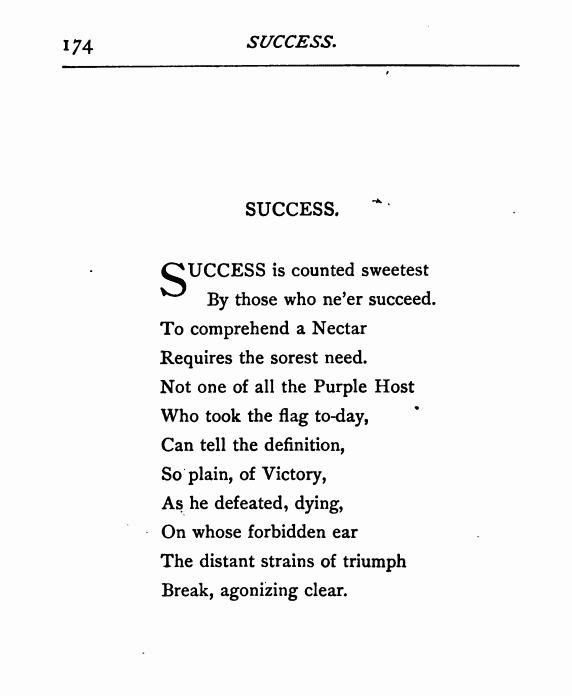
We leave this part of our story with an oddity: Emily Dickinson almost never saw her poems in print while living. Perhaps the most widely seen exception to this was her poem that appeared without her name in The Masque of Poets, and this happened because of the efforts of her friend and successful poet who we now have forgotten. What Emily Dickinson poem was it? The one that begins “Success is counted sweetest/By those who ne’er succeed…”

Sucess is counted sweetest in Masque of Poets

Here is Emily Dickinson in print. But no name.

.

So now let us return to Helen Hunt Jackson and her poetry, now little known and even littler read. Today’s audio piece, “August”  is from her sonnet sequence containing a poem for each calendar month. Here’s a link to the text of the sonnet.

Jackson’s view of August is distinctive, and it’s far from upbeat for this last month of summer splendor. She starts by calling it silent** (save for the somewhat sinister connotation of insect hums). She calls what color August has “pathetic,” “vain,” and “artifice.” And loss of summer is at hand. Besides being widowed at a young age, Jackson had more than the usual 19th century history of young death of siblings and children. Perhaps that undercurrent of loss informed this cold pastoral of a warm month.

Content aside, this poem’s sound is exquisite, with assonance and internal rhymes richening it. Many lines break, or can break, in the middle, which I decided to accentuate in my performance. I found it a better poem than its forgotten status and elements of 19th century poetic diction would have it be.

The player gadget to play my musical performance of Helen Hunt Jackson’s “August”  is below for some of you. If you don’t see that player, this highlighted hyperlink is another way to play the performance. I’ve been working with some larger arrangements and noisier stuff in the past week, so it was a nice change for me to perform this piece with only acoustic guitar and a little subdued bass. Besides my music, I added one extra line of my own at the end of Jackson’s sonnet, my small exchange writ in water from one unknown poet to another.

.

*Oh, there’s those little matters of differences in talent and level of innovation. But let’s leave that off for now.

**I am noticing much less birdsong in this dry August from the dawn choirs of let’s say June.

A July Afternoon by the Pond

I’m much enamored of this clip where Jack Kerouac appears on Steve Allen’s show on network television. This happened in 1959 when there was only triune TV culture in America —and less than that, there were often only two sides to things. Allen is going to open here by taking the side that Kerouac was an authentic writer of merit. The other side? Kerouac was a tiresome imposter best able to fool young people, who of course didn’t know any better.

Nobody knows what’s going to happen to anybody besides the forlorn rags of growing old. I think of Walt Whitman. I even think of old Walt Whitman the father we never found. I think of Walt.  Whitman.

.

At around two and a half minutes into the clip, Allen and Kerouac have this interchange:

Allen starts it by asking “Who else writes poetic type prose, Thomas Wolfe I guess…”

“Walt Whitman” Kerouac quickly responds.

“Uh, huh.” Allen laughs, perhaps thinking Kerouac was making ironic reference to the criticism that free verse was really prose not deserving of being called poetry.

“His Specimen Days…”   Kerouac then repeats this for emphasis. He really wants to get a plug in — not for his book, but for this lesser-known Whitman book.

“Oh, I thought you were putting me on there. All right, we’ll look into that.” Allen says.

This is all prelude, what follows is Kerouac reading to a jazz combo backing with Allen apparently playing live on piano and meshing well. You may or may not like that sort of thing, but if you’ve stuck around here, you probably at least tolerate it. Me? It gets me, every time I view it, when Kerouac comes to the part where he reads “In Iowa I know by now the children must be crying in the land where they let the children cry, and tonight the stars’ll be out…” Kerouac, the East Coast guy who traveled back and forth to the West Coast, had some notice, some feelings of that state in-between* that was not either/or. It’s a coincidence, but Iowa is where I would have been in 1959, not necessarily crying — or not, for sure, not. I’d be looking then at those night stars from Iowa ground, the sky that Kerouac says he can see in New Jersey, remembering his Iowa nights.

So, as that filmed interchange left off promising to do in 1959, let’s look into Walt Whitman’s Specimen Days. Today’s piece is Whitman, looking at his ground, his water, his skies, on a hot summer day in a section of his book titled “A July Afternoon by the Pond.”   Here’s a link to the full text on which I based my performance. One can easily see what Kerouac drew from Specimen Days.  Whitman’s consciousness is free-flowing** and seems informal, off the cuff. Yet it takes care to catalog a lot of the moment it’s describing at length. There’s no legendary telegraph paper roll, but Whitman does roll on without pause or paragraph. Spontaneous Bop Prosody before its time? Close enough.

I’ll leave you with one more light by which you can read or listen to this piece. Whitman wrote and collected Specimen Days  while he was dealing with the aftereffects of a stroke. As I’ve mentioned, I’ve been working on a theme of infirmities recently. That infirmity is not indicated in “A July Afternoon by the Pond,”  but Whitman, in his convalescence, prescribed for himself a heavy dosage of nature observation. A young person could have seen this pond, but the man who included this piece in his late-career book, was an older man. The eternity the Whitman here sees in the natural world is not the eternity of innumerable afternoons to come as it might be for a young person, but instead the observation of age and infirmity, that of an ongoing nature that will be there after he’s gone, mysterious and as yet unsolved. I love Whitman’s final two words here: “Who knows?” He doesn’t expect you to solve it either, only to share the mystery with him.

You can hear my performance*** of “A July Afternoon by the Pond”  either of two ways. There’s a player gadget embedded below for some of you. But some ways of reading this blog will not show it, and so I also provide this highlighted hyperlink that will open a new tab window to play it.

.

*One summarized view of Kerouac’s vision of Iowa is collected at this blog link.

**More so than my performance includes, for reasons of length and production schedules. I had one musical track down when I recorded my performance of Whitman’s words, and found that I had to rush the text too much to get it all in. Rather than re-record the musical foundation or damage the groove of the words, I ended up editing Whitman’s text on the fly, leaving out some of the digressions.

***As it happens, in the end I didn’t use the musical track that caused me to trim back some of Whitman’s digressions. What you will hear is a two-part improvisation (based on the chord structure of the excluded track) that I recorded to respond to my reading of the words, much as Steve Allen needed to respond to Kerouac in the video clip above. The two instruments are a hollow-body electric guitar and the distinctive voice of my Fender Squier Bass VI, an electric bass that includes two higher pitched strings above the usual four for a bass, giving it access to a baritone guitar range here. Using that facility, there are some high F notes in this piece, played on this bass, that are not available (other than as harmonics) on a conventional bass.

Answer July

It’s time once more to perform the brilliance of Emily Dickinson. Today’s text, “Answer July”  is Dickinson in her seeming simple mode. Read quickly, it might strike one as almost a nursery rhyme or maybe as one of those playful listing or counting folk songs. Here’s a link to the full text of the poem.

But when I looked again, “Answer July”  appears to be a debate or interrogation between nature’s seasons and the consciousness of souls, a rather strange thing to put into such a brief and unfancy piece of poetry. Emily Dickinson loves strange, and if you’re a reader or listener who’s stuck around here, you’re comfortable with it too. What’s being debated here?

It starts with the poem’s speaker — let’s call them Dickinson, though obviously, it’s a creation of Emily Dickinson, and as its creator she knows more than this character — demands of nature’s mid-summer month of July just where certain summer things are. July, like a party in a legal dispute or sidestepping debater replies that the things that would allow it to produce those summer things are not in its control. There could be a supply chain issue, and maybe the real problem is with its supplier: the spring month of May.

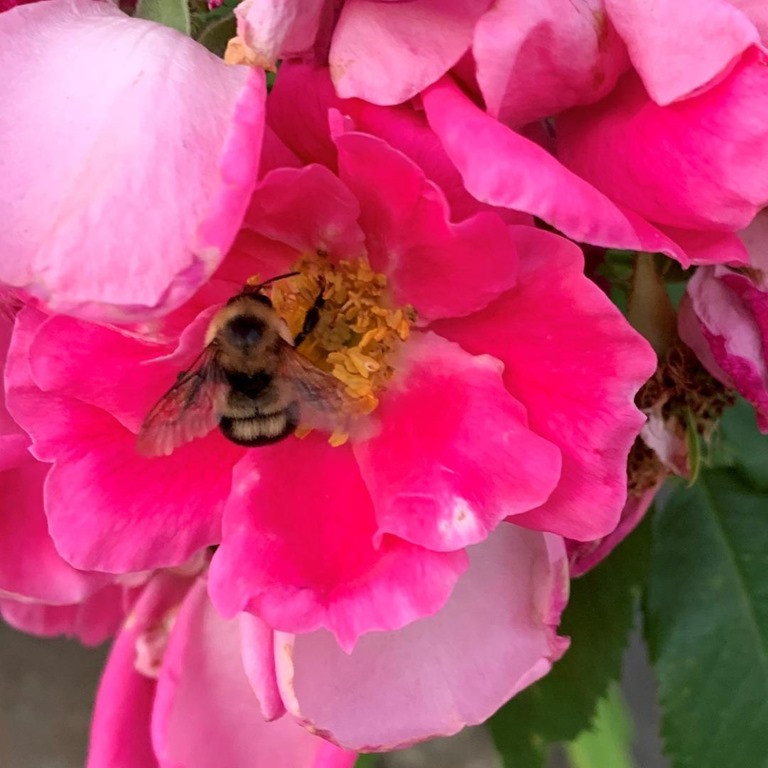
Bee in Flower by Heidi Randen

Where is the Bee — Where is the Blush? Got it right here Emily.

.

May is called in. “Nay,” says May. Tell me about supply chain issues! I’ve got suppliers too, like winter. Subpoena the jay, a winter bird.

The jay is sworn in. Look I need food in the winter they testify. Where’s the leftover autumn corn, the periods of hazy-thaw less-severe cold, and those burred seeds still in their protective casing? The implication here is that we could next look to question fall, though by now we suspect fall will blame summer. And round and round we would go.*

Dickinson gives us two lines that may be a break in the circle. When July, the first month/season to be questioned ends their reply, I think July suggests that May/spring is not a calendar month, but instead a creature of the questioner in the poem. The syntax is broken and unclear here, so who speaks each word is uncertain — but at the time I performed it, I went with this understanding (in paraphrase): July replies (answering to Dickinson’s opening line of questioning) “You’ve called on me to answer. Well, I’ve got one for you, ‘Where is May?’ Come on, you (thee) answer! Because I know what you should answer when asked about where things spring from: ‘It’s me.” That is, Dickinson, July questioner, is responsible.

I could be wrong on that somewhat convoluted reading. It could also be July saying “If May was here, they could answer your question for you (thee) and for me too.”

And then again, as the poem ends, the jay has a cryptic answer to where it can find its winter sustenance: “Here — said the Year.” Unlike summer, winter seems like a time of scarcity, but nature provides the jay what they need. There the implication is that Dickinson’s original complaint to July about where are the summer things she wants is being answered by the jay saying that nature will provide, if your soul seeks for things rather than asking for it to be summer ample and at every hand. This reading of the last line is what drew me to my more complicated reading of the earlier “Answer Thee — Me —” line. The poet Dickinson is telling the character of the questioner in her poem that it’s not the seasons that provide, it is the soul that seeks that finds. She is her own spring, summer, harvest and survival.

Musically I had some fun with this one. On one hand the harmony is simple, a I V progression, but I used some less-common voicings for the Ab (it’s an AbMaj13) and Db (a DbMaj7) and I played sitar.**  Why not! Emily loved strange, and if you’ve stuck around here this summer, you have to have some tolerance for that. The player gadget will appear below for some of you, but don’t ask July where it is if you don’t see the player. Instead, click this highlighted hyperlink, which will open an new tab-window and play my musical performance of “Answer July.”


.

*Once again, I’m working on my theory that Emily Dickinson’s sharp intelligence was surrounded by a family that worked as lawyers, and that may have provided a frame for some of her poetry. As I write this there happen to be many supply chain issues ascribed to the impact of the Covid-19 pandemic and other causes, but neither legal precedents nor logistical savvy is the real subject for this poem, rather it’s about a Transcendentalist understanding of how the soul must partner with nature.

Emily Dickinson herself was also a gardener and the Dickinson household raised a wide variety of food and feed crops. Any farmer or gardener knows that it’s not just the calendar page that brings in food and crops, but effort and seeking.

**Well, not exactly. I’ve never owned a real sitar. I have owned an electric sitar with a plastic rounded bridge that sought to emulate their buzzy sound. I’ve used MIDI “virtual instruments” that allow a guitar or keyboard to play sitar notes with attempts at following sitar articulations. Today’s piece uses a Line6 Variax guitar that has a sitar sound setting, and it tracks guitar string vibrato precisely, a necessity for this piece’s main sitar line motifs.

The Dragonfly

This summer, amid the seasonal lower traffic volumes for The Parlando Project, I’ve been featuring some uncharacteristic pieces where Dave Moore or I have written the words as well as the music. But today we’ll return to the proper mix, using a text by English Victorian poet, Alfred Lord Tennyson.

I saw today’s text first over at Kenne Turner’s blog, where it was included as a short stand-alone lyric poem entitled “The Dragonfly”  in the midst of a series of excellent  photos of varieties of this creature.  Here’s a link to that post which will also let you read the text I used. Other blogs have published the same text under this title, and I assumed it was a uncharacteristic very short nature poem by Tennyson. Let me thank Kenne for bringing this poem to my attention.

Long-time readers here will know I like concise poetry, and this one, so concentrated in its charged notice of this strange yet charismatic insect in a moment of transition captured my interest immediately. Earlier this month I performed “The Dragonfly”  along with Dave playing keyboards, and you’ll be able to hear how it came out below. Sure, it is a Victorian poem, though not excessively so. Just a few words might need 21st century explanation. That “sapphire mail” is the insect’s chitin exoskeleton portrayed as if armor, not a blue envelope delivered by some postman. “Crofts” is something of a Britishism and means a humble field. The moment Tennyson seems to be describing is the ending of the years-long nymph stage of the dragonfly, as the mature winged insect splits open its old hard exoskeleton emerging a moist new winged creature. In checking on the zoology of this, I read that dragonflies spend the majority of their life as immature, wingless, nymphs before becoming the strange fascination that we see, and only then think: dragonfly.

I’ve mentioned infirmities and transformations a good deal this summer, and I thought this transformation more clearly ecstatic in nature, and that it would be a good break from the more gothic material I’ve been working on recently.

So there I was, I had this text, cloaked in language and poetic diction that said “Victorian,” but also prophetically Imagist in its concise approach. I had music to perform it with, and then a decent recording that brought it into existence.

Dragon at the Door 1080

Summer, time to fly thro crofts wet with dew, and not just more screen time.

.

Then today, I decided to see what else I could say about this poem when I present it here. It was then that I found that it may never have been intended as a short poem, but was instead part of a long, very philosophic poem by Alfred Tennyson called “The Two Voices.”   Here’s a link to that text. When I say philosophic, that might sound a bit bloodless, but Tennyson’s own working title was “The Thoughts of a Suicide”  — and no, that’s not a literary plot, like “The Lady of Shalott.”   It appears* that “The Two Voices”  is something of a less-favored and less fully-achieved early attempt at the matter that produced what is thought of as Tennyson’s masterpiece “In Memoriam AHH.”   So, “The Dragonfly”  a simple nature poem? No, nature isn’t simple, even if beautiful. The matter Tennyson was grappling with was the unexpected death of his friend, supporter, and literary compatriot, Arthur Hallam, at the age of 22.

It would be appropriate to insert your favored curse word here. I’m an old man. The death of folks I know, then knew, is a commonplace of age, and painful, though touched too by a strange partnering with an idea that death is closer to me — if only demographically at this moment. But young, brilliant, helpful, a man with whom, it is recalled, would fall and roll down in the grass with the similarly young Tennyson, overcome by paroxysms of laughter at some bit of passing humor — how can one express that kind of loss?

Imagism says that you can enclose that unexpected death of a vibrant and cherished youth inside a short poem, made up of a moment of exacting and clarifying observation; a poem that is furthermore modest in its emotional expression and that doesn’t say what something like that event feels — showing instead what one examines with our two, small, dark eyes, our meager allotment compared to the giant multitudes of eyes that make up most of the dragonflies’ head.

Can it do that? I don’t know. Interesting to try. I sensed only this mysterious/glorious transformation when I first read “The Dragonfly”  excerpted from it’s longer setting in “The Two Voices.”   I really did intend for it to be a bit of a break here, but I’m left with informing you of my honest experience of this poem as I do regularly in this Project.

For some, the player gadget will appear below to hear The LYL Band perform Tennyson’s “The Dragonfly.”  Don’t see a player? Turns out a lot of ways to read this blog won’t show that, so I provide this highlighted hyperlink to open a new tab window and play it as well.

.

*Given that I’ve only seen Tennyson’s “The Two Voices”  in its entirety this afternoon, I’m not able to tell you more about it other than what I’ve quickly gathered. Victorian poetry doesn’t generally attract my attention, even if most of the Modernists that do attract me grew up during the Victorian era, and, even in rebellion, would be impacted by it.

Hortensia

This has not been a month conducive to producing new content for this project, and I’m not sure about July and August either. At some point I’ll probably talk about some of the reasons for that, but I thought it’d be good to leave you with one more June piece, and it’s a fine summer song by a voice this project hasn’t heard from enough lately: Dave Moore.

Dave and I first performed as The LYL Band about 40 years ago, and we’ve kept at it over the years. Our typical encounters this century have been a sort of two-person song circle with each of us alternating in presenting a song, a piece most often completely new and unknown to the other. These first takes* get recorded, and one of them is today’s audio piece.

First takes with unknown material is not the way most bands work, and certainly not how they record. Bob Dylan worked with unknown, fresh material and new-to-it musicians in his classic years (and may still now, there’s just less documentation), often providing at best chord charts for assembled musicians or brief run-throughs. But Dylan would do multiple takes even trying different studios or musicians over time, trying get the right take.

It’s not uncommon for jazz musicians to do the same thing we do in their recording studio dates, though some feel that even with Jazz’s reverence for spontaneity that this is a practice brought forward for logistical and lowered recording-budget overhead reasons, not as a considered artistic choice. Miles Davis seemed to find this practice a considered choice though, and when one listens to a record such as Kind of Blue  we are likely to give some credit to that choice, which Bill Evans likened to spontaneous Japanese painting in the original LP liner notes. Later on, Davis took to the pentimento-practice of having everyone improvising on themes and then letting later audio editing assemble from the mass of recorded playing a post-recording compositional structure. A record like Davis’ A Tribute to Jack Johnson  assembled that way has a different vibe and timbre from Kind of Blue,  but it works for me in its different way.

Are Dave and I musicians like Davis and his band members? No. Nor are we musicians likely to be called to a Bob Dylan session (note to Bob: call us anyway). Most of what we record on any one day isn’t worth more than a self-critical listen on our own parts. And of the rest? There are usually rough spots that even a bit of focused audio editing can’t excise. And then, sometimes something like “Hortensia”  arrives.

If you accept (as I say often here) that all artists fail, then it can sometimes behoove one to make peace with failure. Do that, and then allow, then make possible, for the limited successes to arrive.

I often tend to overstate my guitar parts. I didn’t here. Dave’s keyboard skills at the time of the recording get some space, and while he’s not going to kick Bill Evans or Herbie Hancock to the curb, what he plays works. Dave’s vocals are usually more consistent than mine by a long shot, and his performance serves the song. I think Dave may have even improvised some of these lyrics during the performance — and this is the only performance of this song ever.  And that serves the song too.

You see, I hear this as a summer song, a song of long days, rich days, that are still days,  and must end in earth’s and fortune’s rota. “Now, sweet now” Dave sings. Yes.

Hortensia

I think I asked Dave what the song was about shortly after we recorded it. “The summer flower or the Roman woman?” I think he replied that it was more at something intuitive.

.

You can hear it with the player gadget below. Don’t see a player? This highlighted hyperlink will also play it. “Hortensia” is longer than most of our pieces here, but sit back with a cool drink and listen. Thank you hearty listeners and readers for sticking with this project!

.

*First, and in most cases, the only take. Since we haven’t focused on live performance much in our old age, we aren’t working up material for performance or developing a repertoire for that. Dave has been as prolific with words and with songs with his own music as I have been with musical pieces over the past few years. This means that there was always new material to be tried out, to be brought into existence, even if briefly and for one take.

Parlando Summer 2020 Top Ten, numbers 4-2

4. A Mien to Move a Queen by Emily Dickinson. My teenager, who suspects my musical output as being less than relevant, taunted me gently by asking as I started writing this post if I was presenting Winnie the Pooh. By “Pooh” we may decode: something simultaneously old and immature.

“No I said. I’ve never done any A. A. Milne.”

“Who’s A. A. Milne?”

“He wrote Winnie the Pooh—oh wait, I have  put Milne in a post. I was comparing an Emily Dickinson poem to Sixties psychedelic rock lyrics. I compared a poem of hers to a Milne/Pooh poem that was used by Jefferson Airplane in a song: ‘If I was a bird and flew very high…”

“Bored already.” He playfully rejoindered.

I can’t quite give you the flavor of this, but there’s a quicker wit in my house than mine even when my wife is out of town.

Well that post just happens to be the one that introduced the 4th most liked and listened to piece here this summer: Dickinson’s “A Mien to move a Queen.”  And yes, it is a strange poem, though it draws me in none-the-less. It may be one of Dickinson’s riddle poems, like “May-Flower”   though I can’t solve its riddle. Dickenson may be looking at another flower, or a bird or insect.

Well sometimes one can just let the mystery be.

.

3. Long Island Sound by Emma Lazarus. One of the least-famous poets with one of the most-famous poems ever presented here, Lazarus is the author of a sonnet associated with the Statue of Liberty: the “Give me your tired, your poor, your huddled masses…” one. That was a poem of hope, and I’d say to, so is this one that she also wrote. Therefore, I made “Long Island Sound”  into a happy little summer song.

Did a carefree song seem out of place in our 2020 summer? Or was it something we wanted to visit, if only for the minute and 46 seconds the performance lasts? Well, in any season there is happiness. Seething anger, somber reflection, these may seem to be the noble emotions this summer, but joy is not an ignoble emotion.

.

Black Joy Lives Here crop

The American Midwest loves lawn signs. I ride by many each morning in my neighborhood: election candidates, Justice for George Floyd, roofing contractors, high-school sports teams, and a couple of these too.

2. The Poet’s Voice from speeches by William Faulkner and Bob Dylan.  Our current American age is suffering much from insufficiency of empathy. What kills or mutes empathy? Fear is one thing. One sentence in William Faulkner’s Nobel Prize acceptance speech struck me so strongly when I read it this year. Not the one I was quoted so often by teachers then my age now, back when I was nearly 20, the one that went: “Man will not merely endure: he will prevail”—this, somehow, they seemed to be saying would come from literature, of all things, stuff written largely by dead men. Thanks pops. Now let me return to being worried about which of us is going to run out of tuition money or the will to continue this hidebound education, and get drafted. No, that one was Faulkner’s hopeful future, a future we haven’t yet made obsolete. Instead, it was this sentence, earlier in the speech, the one that should make you sit up and take notice:

Our tragedy today is a general and universal physical fear so long sustained by now that we can even bear it.”

Old man Faulkner, though he may be as imperfect as the brightest and most perceptive person today, is really saying something there. In the context of his entire speech he appears to be referring to the particular fear of a nuclear war, but then how strange that he calls this “so long sustained” when nuclear arms were around the age of our current Presidency’s term when he gave this speech in 1949.

So, if fear mutes empathy, let us acknowledge that carrying someone else’s song in your ear, your mind, your mouth, is the pathway through which it can infect your heart with empathy.

.

I’ll return soon with the post revealing the most popular piece here this past summer. That’s going to be a somewhat complicated story.

Parlando Summer 2020 Top Ten, numbers 10-8

It’s time to look back over the summer and see which pieces you liked and listened to the most during this season. As always, I’m going to count up to the most popular in a series of posts here over the next few days. Each bold-face listing is a link to the original post, in case you’d like to read what I said when I first presented it.

10. Before Summer Rain by Rainer Maria Rilke.  Long time readers here will know that I like to take a crack at original translations, and I even wrote a post this summer about how I, a person with only a little French in high school over 50 years ago, goes about this—and why you might want to try this too. Regardless of your level of language mastery and your obligations to the original writer, a public translator must also take up an obligation to produce an impactful, living poem. It may be unavoidable that you bring your own gifts as a poet to this task—or even up your game to be able to do that while using another poet’s inspiration as your matter.

Rilke currently has a reputation as a poet of spiritual uplift, a man whose lines get Pinterested over photos, quoted in journal entries, and immortalized on refrigerator magnets. In short: the self-help poet of spiritual self-improvement. I’m not going to knock that. There’s a hell of a lot of lesser things that a work of art can do than to make someone feel better, less lonely in their thoughts, or to help them think that they can better themselves. Sure aesthetes, that’s not all poetry can do, and while I’m no Rilke scholar, I think that isn’t all Rilke can do either.

My translation focused on Rilke’s images in his poem, trying my best to make them understandable or at least striking, and to give the poem a working English word-music.

.

9. Huazi Ridge after a poem by Wang Wei. More translation. The cultural and linguistic audacity to translate classical Chinese poetry has to be a few orders of magnitude greater than translating 20th century German (a language I don’t speak, but I had grandparents who did).

I decided to term what I derived from the sparse literal translation I had of this poem “after Wang Wei,” which is likely more accurate than calling it a translation. But if you are going to use what is more frankly your impression of a poem, the charge remains the same: give us something vivid and give it some word-music that works in English.

The music music here includes my simple approach to the Chinese lute, the pipa. While guitarists might think they have some grounding with this not unrelated string instrument, the pipa, like the western lute, has almost no sustain compared to the modern guitar. Great players can wring a wide range of sophisticated effects from the pipa, but a naïve player like myself just hopes to add a little bit of a different timbre that reflects the culture that produced such distinctive and highly compressed lyric poetry.

.

If you like to hear what the pipa is capable of, Gao Hong demonstrates it’s range while performing her composition “Flying Dragon” in this video.


8. Government by Carl Sandburg. Carl, whose parents spoke Swedish, makes things easy for me by already writing his poem in informal modern English. Sandburg worked for the Socialist* mayor of Milwaukee before he started his career as a poet in Chicago and published his first collection, Chicago Poems, where this one appears. His day job in Chicago was working as a newspaper journalist in the era made famous by the play and movie The Front Page. These things mean that when Sandburg writes this poem and says repeatedly “I saw…” it’s not just some poetic trope.

His final stanza is a fairly sophisticated analysis of politics. Interestingly it’s not—in this poem—a ringing call for change. The statement here that government is made up of humans, and that it therefore inherits human characteristics, is on the face of it an explanation of the political failures this poem testifies to. But nested in this also is the idea the government can change as people change (and change it). No, it won’t be perfect, but it can be better.

.

*Midwestern Socialists of Sandburg’s time reached the highest level of Government administrative responsibility in US history.

Breakfast in a Pandemic

Can we accept a little fall-off from Rilke last time to something I wrote?

As long-time readers here know, the Parlando Project is about “Other People’s Stories.” Dave and I both write words as well as music, but I find it interesting to examine how I experience other people’s words, other people’s outlooks and visions. This project’s focus for the past four years  has been an exploration—often into writers I didn’t know, or writers that I, and perhaps you as well, think we know because of what we have been told about them.

I was able to run this piece past a fine poet Kevin FitzPatrick,*  before it reached the form you’ll read/hear today. He noted that I was working in my Frank O’Hara mode, and he’s right. For me in my 20s, O’Hara helped me integrate the French Surrealists with the American mode of Carl Sandburg,**  with a Modernist touch of exoticism I’d retained from love of the English Romantics.

I had to remind Kevin that a big influence on this poem was his own poetry, about which a reviewer once said included so many “poems with other people in them.”  Why, oh why, is that so rare? How many poems are about the poet’s own head space or solitary meditation on nature? Of course, that landscape can’t be avoided. And yes, some very good poetry can be written in that less populated country. Readers here will know how much I’ve come to admire what Emily Dickinson did. Though we now know that her life was not entirely that cloistered myth that once was used to define her, does her extraordinary corpus of poetry ever include another human character speaking for themselves?

So, my poem starts out like a nature poem, albeit in an urban setting, and then another character breaks in and changes the poem. The music I composed and performed seeks to underline that. And a disease pandemic is, after all, a natural metaphor for our separation.***

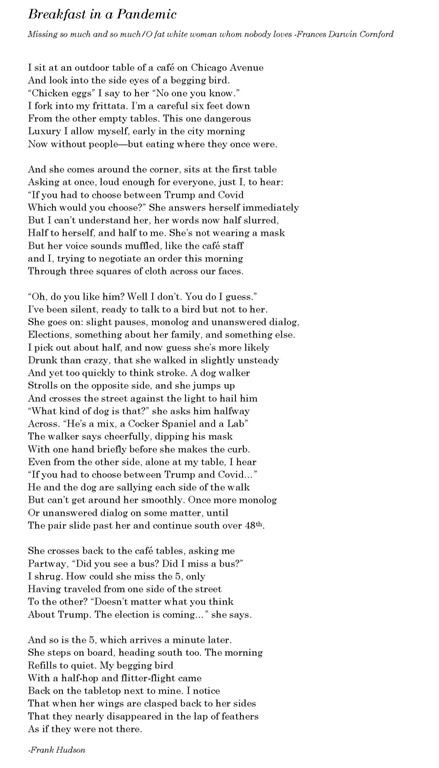
Breakfast in a Pandemic

A long poem for me these days. Some thought it could be shorter and some thought it could include even more detail . They’re both right, but that’d be another poem I decided.


In the text of the poem I use an epigraph from Frances Darwin Cornford’s “To a Fat Lady Seen from the Train.”   Dave wondered if that might put off some readers. His concern has merit. Cornford’s poem (better known in Britain) is an earworm best known for being disliked. I have not seen anything from Cornford about what her intent was with the poem, and perhaps she had little conscious intent, thinking of it only as a catchy triolet. However, I think it’s a kind of pointed  failed encounter and is written as such.

As I said above, the music here tries for contrast, with acoustic guitar and then drums and bass with a smattering of woozy strings and distant woodwinds. The composer in me isn’t sure the composition or the performer achieved all of his intent. The middle section may be taken at too fast a tempo. My late father who hated poetry read too fast would certainly think so. But I remind myself that plenty of modern spoken/chanted word is taken at a rapid pace, so maybe not.

The player gadget is below, so you can listen and decide for yourself. Stay well, valued readers and listeners!


*Alternative Parlando voice and keyboardist, Dave Moore had some helpful suggestions on it too.

**I don’t know what O’Hara thought of Sandburg, but I wouldn’t be surprised if it wasn’t favorable. Sandburg might have seemed too straight, and too yokel. But Sandburg was working often in the mode of Whitman and Hart Crane which O’Hara also was (along with O’Hara’s French language influences).

And did you know that Whitman’s oh so American ‘barbaric yawp” was a formative influence on French Vers Libre? I didn’t either until this project’s exploration.

***At least the existence of this poem means that this pandemic of our age won’t be as little covered by poets as the big 1918-1919 flu pandemic that poetry ignored.