The Day Undressed Herself

Next week I’m going to be attending a number of events online that are part of the Emily Dickinson Museum’s annual “Tell It Slant” festival.*  While I’m not sure how this will change my production schedule for new pieces here, I’m hoping to present a series of Emily Dickinson musical settings before September ends.

The first of these pieces is Dickinson’s “The Day undressed Herself” — and what a charming poem it is. As my reading of Dickinson has expanded, I’ve become aware that some Dickinson poems are so compressed and abstract that extracting a clear meaning is very difficult, but despite this poem’s use of an un-introduced conceit throughout, it’s clearly a poem depicting a sunset. If something of a riddle, the subject is one most readers will “get” easily.

But poetry isn’t just plot and foreground. I don’t mean to replace the direct evidence of hearing the words sung in my performance, but the sounds here are so lovely, and the poet here is clearly choosing words for sound, starting right off with the fabric swish of the poem’s first line and continuing in the 1st verse with the now antique word “Dimities” (which are undergarments.) And Dickinson’s metaphoric details aren’t just sounds, they set this sunset, this emblem world and its cosmic time, in an intimate female universe.
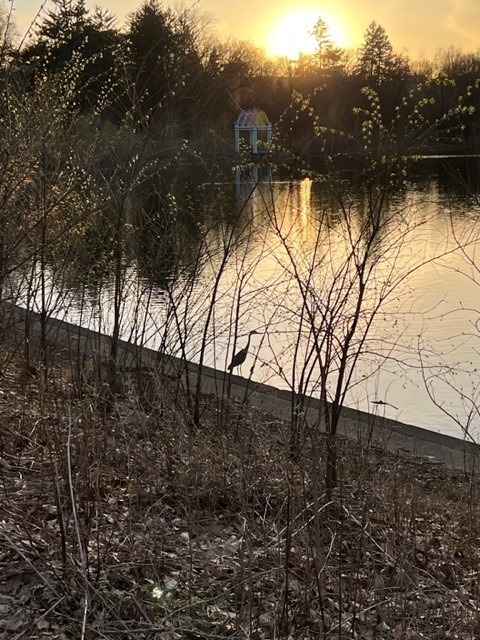
Heron at sunset

The window next to me as I write this faces west too, but it’s only an urban alley. Here’s a sunset a few blocks east, the heron doesn’t seem to know they’re in a city.

.

It starts with a woman undressing, where in art a long tradition of erotic gaze comes with that choice. If that’s so here, it’s a deep and unstated undercurrent. Is she just readying for bed, for dreams perhaps? Or something else? By accounts, Dickinson wrote often at night. I don’t know if she wrote after a change into her bedclothes or not, but this possibility: the sunset’s heralding of an opening to the looser dress of imagination may be in Dickinson’s mind.

The 2nd stanza expands from Earth’s sunset, to let us know, as scientifically educated Dickinson did, that the Sun is but a single star — and if I read her right, that stars are being born daily in the universe.

Another trope that comes with the sunset: day’s end meaning life’s end. The poem’s 3rd verse indicates this is considered and taken as a side issue of this sunset — sunset’s ars longa isn’t so concerned with that — and as it happened, Dickinson’s night-scribed poetry became more than a lifetime-lived. In some mythologies, the sky gods are male —in this one, our western, setting sun is a “Lady of the Occident,” female.

The final stanza starts with a line: “Her Candle so expire” which if considered more fully isn’t just sunset extinguishing the last light before bed. My ear may be over-pun-sensitive, but I hear the rhyming word “fire” in “expire,” and once more the cosmologist is saying in that line that stars themselves have lifetimes.

Someone has been sailing on frigate-books in the closing two lines. I’m surprised at her knowledge of the truck in a sailing ship’s rigging, a ball where the halyard’s pass. It’s an unusual word, no-doubt chosen to consonante with Bosporus, the water separating Europe and Asia next to Constantinople/Istanbul. The dome in the final line is then the Hagia Sophia (“holy wisdom”) church in that city. And the final words, “Window Pane.” What’s this definitive, capitalized pane of glass? Dickinson’s bedroom faced west, her little writing table at a western window.

The Day Undressed Herself

Here’s a rough chord-sheet of today’s musical Dickinson.

.

I wanted to do something featuring a lush sounding steel-string acoustic guitar for this one. With luck I was able to just squeeze in the final take you can hear below as my studio space time so expire. You can hear that performance with the audio player gadget below. No player seen? This highlighted link is an alternative that will open a new tab with its own audio player.

.

*This Festival features a multi-day round-robin reading of all of Dickinson’s 1789 poems, and each time I go through that experience I’m reminded that it is as impossible to comprehend all of Dickinson’s poetry as to remember all the stars in the night sky. Each time through, “new poems” seem to have been inserted — which are in reality ones I had heard in previous years but wasn’t ready to feel until now. Just sitting through a small portion of the readers’ reading — an hour or even a half-hour — can change your appreciation of what Dickinson offers. Busy people might want to choose only one of the reading sessions that has a convenient time for them, and maybe do some hand mending, cooking, or housework as the variety of readers speak the poems in turn. Let the poems that you are ready to feel come to you in your household, as their author composed them in hers.

There are also a variety of programs discussing other aspects on this year’s schedule. It’s all free to attend, but you should sign up at this link.

Stars: Robert Frost and The Book Of Nature

Robert Frost. Long-time readers/listeners here will know I love to sing Frost’s early poems as part of this Project. We’ll get back to Frost, but another thing long-timers here know: for me, roundabout is the best mental journey — and there will be a piece of music at the end as we rest from our walk.

Ok, let’s stroll.

It’s a famous midcentury half-hour black & white TV episode. So famous that you don’t have to have seen it to know the recognition scene near the end of its story that has become a modern myth that SF and Fantasy fans like to point out their stories aspire to. Given that, I’m going to assume no one will need a spoiler alert for this 1962 Twilight Zone episode called “To Serve Man.”

The format’s so brief, the story must be told rapidly. We’re told that a race of other-planetary beings have landed on Earth. With retrospectable irony, their leader is described as “Christopher Columbus from another galaxy.” They go about setting things here in benign order with advanced technology. They leave behind a book in their language that seems to be a guide to the extraterrestrials’ efforts. Partway in, Earth’s code-breakers have deciphered the book’s title: To Serve Man.  And they seem to be doing just that: ending hunger, gently enforcing world peace, taking selected humans on spaceship rides to their home planet.

Many of you are now speaking — telepathically or aloud — to a device’s screen what is urgently delivered to the story’s human hero once the humans can decrypt more of the book than just the title: “It’s a cookbook!”

I’ve written here often about something I call The Book of Nature. Though not an exclusive American idea, I connect it with the 19th century American “New Thought” movement called Transcendentalism. The Transcendentalists believed that a true scripture of the universe’s higher power was transcribed in nature. By contemplating nature big to small one could discern the highest truths. Our contemporaries who are “spiritual but not (sectarian) religious” may hold to this as a core belief, but it’s likely that every denomination of religious belief can incorporate this too — after all, if The Creator made this, their authorship means there is plausibly something there to be read.

Now we can get back to Robert Frost. Frost no doubt knew Transcendentalist thought, but unlike his fellow great American poet, Emily Dickinson, Frost didn’t hold with its doctrines.*  Yes, Frost wrote seemingly “En plein air” about nature often. His early poems, some of the ones I like best, are suffused with the landscape and particulars of New England nature. Did he see a supreme being’s handwriting there?

If so, Frost would be critical of The SB’s penmanship.

stars

Chord sheet so that you can sing this one yourself.

.

If we look at this example, “Stars”  from Frost’s first book of poems, A Boy’s Will,  what do we “read” from nature’s book? The stars come out at night. What is their nature?** “Countless(ly),” we can’t even get the basic stats correct. Oh wait, Frost can see a primary Roman goddess in there: Minerva, the goddess of wisdom and strategy. No, he reconsiders: it’s a statue of Minerva he sees in the stars, a human-made simulacrum — and her marble eyes are the form of sight organs without any such function. So should we look lower down at our earthly landscape?***  Snow covers it profoundly, drifting “as tall as trees” and so obscuring even the ground-level facts. Wind is blowing — the choreographer of this landscape — yet, this dance doesn’t tell a story, it obscures it, though here at last Frost reads a message. That wind, that obscuring snow, is “our fate.” In the most mysterious part of the poem, the second stanza, we cannot see where we’ve walked or where to guide our steps. The gothic part of my nature reads Frost’s “place of rest invisible at dawn” as death. I read the image in this stanza that in such deep and overblown snow, one cannot even see the walk fate will not reveal to a farmhouse graveyard.

Nature acts “with neither love nor hate.” Robert Frost has decrypted The Book of Nature — and all the pages are blank.

Here’s that song at the end of our mental walk where I set Frost’s poem to music with acoustic guitar. You can hear it with the audio player gadget below, or with this backup highlighted link if that gadget is not shown.

.

*Frost’s friend and fellow poet Edward Thomas was an exquisite nature poet of his British Isles countryside. In regards The Book of Nature, he’s between Frost and Dickinson for he has a horticulturalist’s specific eye like Dickinson — and his consistent naming of natural details and seeing them as readable symbols indicates he finds them plausibly capable of guidance.

** Astrologers, Biblical Magi, and classical constellation dots-connectors of course are reading that sky in clear text.

***In a changeup meant to fool this writer and singer, my specific winter this year has been oddly empty of any expected Northland winter symbolism. We’ve had next to no snow, only a week or so of bitter sub-zero cold, and I look out today on a sunny brown yard over which squirrels are carelessly playing tag and tree as we rise to our predicted afternoon high of (in Minnesota! In January!) of 55 degrees F.

I’ve been riding my summer bicycle with its summer tires most every day this “winter,” where that bike normally stays hung up high in the back of my shed. Spring in Minnesota is famously snowy, my winter bike with studded knobby tires cannot be put out of the way. Perhaps as long as I leave it by the door we may continue to have a mild winter.

They’re Not the Grateful Dead

Is it time to take a break from our sometimes intense presentations of poetry combined in some way with music? Well, here’s a little ditty about the lighter side of death, or rather the worship of dead rock stars.

My observation is that though there are still the occasional premature music casualties in the current environment, that the worship of “The Greats are Taken from Us Too Soon” variety is reduced among young people today. Perhaps that’s a healthy sign, or it could be secondary to the casualties not having the right mix of fame to burn brighter at the graveside. And in the past, the other half of this project’s concern, poetry, has not been immune to the praise of dead talent, particularly dead, young talent, either.

Sure, it can be a honorable thing to give respect to those who’ve gone, to carry their artistic flag further when they can’t, but there is another side, the romantic admiration for the risks and the access to excess that often precedes the early death of musicians, writers, and other artists. The first duty of an artist is to survive. Society is not generally on the artist’s side until they become successful commercially, and even when it grants them that success, it can withdraw it and their support quickly too. To add to that burden with one’s own self-medication and distractions seems like a compensation to that state, but it doesn’t always work that way.

Poet, songwriter, alternate voice, and frequent keyboard player here Dave Moore wrote a short poem about how an older person might view with a strange kind of envy the tentative fame and unbounded experiences that others in our musical/generational cohort enjoyed. Sex, drugs and Rock’n’Roll once seemed to be jobs on offer in the want ads in our youth, even if it turned out the positions were already filled and the items already sold. I adapted Dave’s words, added a verse of my own, and wrote music for my performance of “They’re Not the Grateful Dead”  some years back and thought you might enjoy it here. Oh, that “Grateful Dead” in the title? Translated folkie Jerry Garcia knew that this was a trad folk song trope where the dead magically and musically express some gratitude.

They're Not the Grateful Dead

Who’s who for any crate digger obsessives: Hopkins, Hendrix, Moon, Jaco, Saxon, and Thaxton are hereby linked.

.

One thing I like about Dave’s lyric is that, outside of Jimi Hendrix he doesn’t pull in the big names, the Boomer rock’n’roll Shelleys and Byrons, the ones that are still featured faces in the rear-view mirrors looking at the music and times. Starting right off with Nicky Hopkins* is a bold move, but then Dave is  a keyboard player.

The song’s conclusion has a little fun with the sentimental “If there’s a rock’n’roll heaven, you know they’ve got a hell of a band” thing. Keats’ unheard music may be sweet, but it’s still hard to hear.

My performance of this has a few flubs, but it’s hard for me to get more recording in right now, so we’ll make do with this older recording as is. The player gadget is below for many of you, but if you don’t see it, this highlighted hyperlink will also play my performance of “They’re Not the Grateful Dead.”

.


*Huh. Who? Those who didn’t ruin their eyesight fantasizing about debauched after-parties but by reading all the liner notes on every LP will know who Nicky Hopkins is.