It Is Not Always May

I cannot start any presentation of a Longfellow poem here without noting his extraordinary fall from esteem and fame. Once, through a combination of the historical moment in the growth of the United States, his talents, and a desire to write earnestly meaningful poems, Longfellow seemed our national poet. Did it seem, when that was so, that this would be for all time—or at least for an age longer than a decade or two short of a century?

Any reading across this project’s nearly three years will show that I find worth in the less-well-known, the overlooked. But nothing that is honestly popular can be unworthy of examination—after all, even manifold problems and failures of art in that which drew a large audience tell us something about that audience, our fellow human beings. Which case now, overlooked or popular, is Longfellow?

Choice Thoughts from Longfellow

Imagine a current poet whose rep could generate a board game where one wins quotes from their poems (image from Maine Historical Society collection)


If Whitman, Dickinson and Frost—or their unseen ghosts in our zeitgeist—still motivate our inner singing muses, can we understand that trio—our current national poets—as reactions to Longfellow, making him still a prime-mover of some interest?

So, let’s listen to “It Is Not Always May”  today. Rhymed metrical English language lyric is not easy to do, and harder to do if you want it to sound easy, and this one is pretty good. Yes there’s a bit of “poetic diction” here, words and word-order that we’d never say in actual speech, and I suspect that would be true even in 1842 when this poem was published, but it doesn’t greatly harm the poem.

The imagery is largely conventional, though as a seasonal poem we may expect some of these ready-mades to be checked off: birds, bird-song, budding trees, the young, the frolic. Can one do a winter poem without snow and stasis, an autumn poem without colored falling leaves, and so on? Yes, this is possible, and originality can be a great strength—but there’s a certain resonance with the choir of poets to sing those ancient notes in one’s own song. Conventional and outdated it may be, but I rather liked the clouds as sailing vessels in a river-fed harbor awaiting a west wind to up-anchor from New England for the “Old World.” And the poem’s refrain: “There are no birds in last year’s nest,” which Longfellow identifies as a Spanish proverb, has its vividness too.

Oh in my soul, I think the Imagists were right, that too many poems use conventional images as mere counters, pro-forma symbols, not real vivid objects we can consider as existing outside the poetic line. But I could just see Longfellow and the sea-side clouds as an actual charged moment.

And how about this poem’s sentiment? Well many acceptable modern poems have opinions, outlooks, sentiments, and so the charge against Longfellow isn’t really that, rather it’s sentimentality, the idea that he has no original outlook, no fresh take. What would his readers in the days of his fame have thought? A feature, not a bug? Longfellow was the premier “Fireside Poet,” suitable for reading to the family, suitable for school-books and children’s illustrated early readers. Did they view this poem as a basic truth to be reminded of, or did they view this as sufficient in itself? I assume some thought each.

Yes, I want more than that from poetry. Reassurance and singular conventional answers aren’t even what children want and need exclusively. But this poem is balanced in a way that I can admire. It’s a carpe diem poem without a smarmy pickup line, a song of the life-death cycle that plays the undertones, a poem that asks subtly for youth to be irresponsible, or responsible to their youth not earned wisdom (“to some good angel leave the rest”).

Do we need a new Longfellow today? I’m not sure. I would be pleased if more people appreciated poetry more widely, and as I’ve argued elsewhere here, that “not great poetry” does no harm, and might even do some good for more unusual or challenging poetry. I think I forgot to say clearly enough in my recent series on “Are Song Lyrics Poetry” that to a large degree we’ve asked song-lyrics to fill this role of poetry in my lifetime. But I do believe we needed a Longfellow at least once to establish the ground on which our foundational modern poets erected their structures.

So, it’s fitting that I chose to sing this May poem of Longfellow’s, even given the limitations of my singing voice. Once more I was drawn to using the less and more than realistic Mellotron flute and cello sounds to signify a pastoral scene. Even with my limitations, “It Is Not Always May”  sings well and easily, and I urge you to hear it with the player below. The poem’s text is available here if you’d like to read along.


See Emily Play: May-Flower

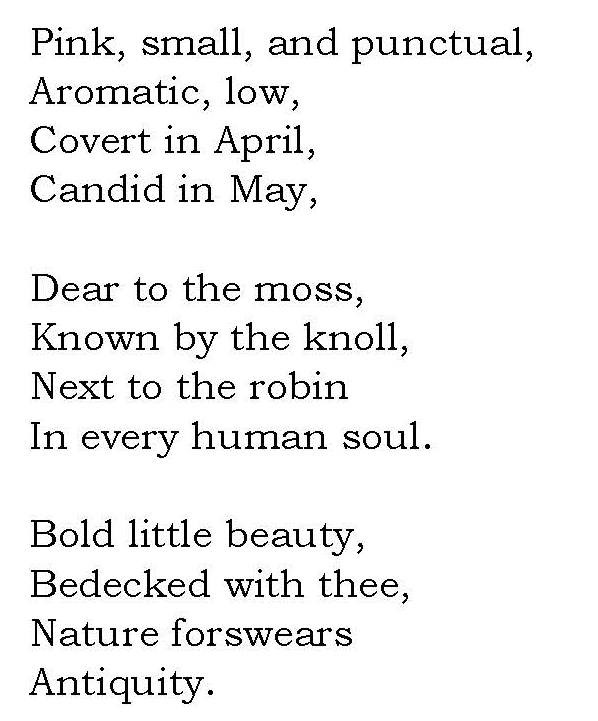
The great thing about Emily Dickinson and her around 2000 poems is that there’s always one you haven’t experienced yet—and just this week over at the Interesting Literature blog I saw this Dickinson spring poem. “May-Flower”  has Dickinson doing her most subtle music to accompany her most Blakean attention. Just like it says itself: it’s a “bold little beauty.”

It’s short and compressed, and if you read it quickly and silently it may seem slight and slide right by you. Spring, May, flowers, check. Robins. Yup, spring. Its abrupt ending might stop you for just a moment. It ends: “Nature forswears/Antiquity.”

Oh, I get it, the flowers in early May are new, there isn’t such a thing as antique flowers. Easy enough to see that—but the undercurrent is deeper, because this is another carpe diem poem, though this time without much bombast and no overt hey-baby-what-about… pickup lines. Yes, there are no old flowers, and so this flower will come and go with May.

Not many words in this poetry-machine, but without choosing any esoteric ones, Dickinson has made some choices that may arrest you the second time you read it. “Punctual,” the flowers know right when to be there. “Covert” those early signs of spring, like some advance spies. “Candid” for May, and spring fully here, no need to hide as a generic bud. Even “Dear” in “Dear to the moss” is a choice I wonder about. I’ve even read it incorrectly as “Near to the moss” once or twice, and sound-wise “near” works very well and is clear in meaning.  Does Dickinson want to pun on deer, another spring poem perennial? Does she want to pickup and connect that D sound from “Candid” in the line before it rather than predict the upcoming N sounds of “Known,” “knoll” and “Next?”

Which brings me to this: if you listen to the poem, or plant it in your own mouth, the sound is exquisite. Rhymes and near-rhymes abound without locking down to a scheme: “small/punctual/low/April/knoll/soul” and “every/beauty/thee/Antiquity,” and consonants and vowels are echoing each other too.

See Emily Play Games for May HD

Foreswears antiquity: I’m not sure if anyone who reads this will remember the poster I’m referencing here.


To perform “May-Flower”  I made some choices. First, to slow the listener down, and to give extra chances to hear that echoing sound-play, I repeated each line. And to emphasize the moment rather than its passing, I interleaved the first and second stanzas as responses to each other. In the last stanza, the responses are just additional echoes of that stanza’s lines.

For the music, I decided to refer to The Pink Floyd. No, not the auditorium and eventually stadium-filling rock band, but the original 1967 Syd Barrett-fronted line up, which was based more around the sound of that era’s electric organs with a taste of Barrett’s unique take on slide guitar. So, time to dabble and wobble organs and break out the Telecaster and a finger wrapped in a vase of glass.

Emily’s poetry-machine obliviates the need for dodgy recreational chemicals. Attention is the drug. This is not the first time I’ve referred to Emily Dickinson’s visionary side here. I see it coexisting with her skeptical wit. And this poem, for all it’s Blakean a heaven in a wild-flower aspect was also intended by the botanically knowledgeable Dickinson as a riddle, the correct answer is a particular New England wild-flower, the trailing arbutus.  See Emily play. There is no other day. Free games for May….

Here’s the text of Emily Dickinson’s May-Flower if you’d like to read along.

May-Flower text

This is the regularized version with conventional punctuation. Emily’s own was full of her dashes.

And here’s my performance of it with original music. Use the player below.


The Aim Was Song

Let’s give the lyrical reins over to Robert Frost one more time for another electric guitar driven piece. “The Aim Was Song”  is a poem from Frost’s 1923 Mountain Interval  collection, and not only is it a reasonably straightforward poetic credo from Frost, it speaks a little to Parlando’s goals too.

I put forward a definition of poetry as I was starting the Parlando Project as “Words that want to break into song.” I don’t recall where I read that definition, but when I searched this afternoon, all I can find is myself, so the source of that phrase may remain a mystery.

Careful with that axe Eugene. Robert Frost prepares to kick out the jams.

Unlike Sandburg and Yeats, Frost himself had no desire to sing or perform to music that I’m aware of, but his desire to use metrical/rhyming verse goads me to use him often here. And Frost had his own theory about how meter and language worked in poetry. He called it “The sound of sense,” and he once described it in a letter as akin to what comes through if you listen to talk in another room from the other side of a door. I don’t think he’s writing there about meter as commonly scanned in metrical poetry, I think instead he’s talking about human vitality that arrives through the panels of a door, the rise and fall, the breath and repetition. Frost’s theory was that you then laid that over the structure of metrical/syllabic prosody, so that each side pushes and pulls on each other. Too much evenness and it’s a motorik machine. Too little and you have only thoughts scattered on the page where only a silent and uncycling eye can gather them. You find that balance with one’s ear and heart.

Perhaps what Frost is aiming for here is the thing musicians call phrasing, but one thing that’s sure is that Frost believes poetry, even poetry of complex meaning or subtle rhetoric, is received through the ear and not the eye. So, even if Frost was not thinking directly of his poetry in association with music as we present things here, he is thinking of poetry as suffused with orality.

In “The Aim Was Song”  Frost develops one image throughout: how the human being captures breath, moving air in waves, the essence of that natural force of the fierce spring wind, and shapes it into a smaller but more intimate thing. That is the work of musicians and poets. I could almost hear Lord Buckley read this one, as Frost repeats some words in his short poem that seem to pun on musical terms, to “blow,” “how it ought to go,” and “measures.” I didn’t go that route (if I could) but consider that an undercurrent in this.

To hear my performance of Frost’s “The Aim Was Song,”  use the player below if you see it. Don’t see a player? This highlighted hyperlink will also play it.  U. S. National Poetry Month is coming up in a few days, and I’m hoping to have a good number of encounters between music and words here in April. Please check back or subscribe, and spread the word.

.

A Spring Song with Some Winter In It: Frost’s “A Patch of Old Snow”

A bit earlier this month we presented a landmark very short Imagist poem, Ezra Pound’s “In a Station of the Metro.”  14 words, and a prime example of the Modernist’s reaction to the rhetorical flourishes of a worn-out 19th century. Today I’m going to release a Robert Frost response, a 47-word rejoinder, a spring poem with some winter snow left in it.

Frost was born 145 years ago this week. His relationship with Pound is complex. On one hand Pound could view himself as responsible for launching Frost’s career, writing the first substantial review of Frost and seeing to it that his poems were published in Poetry  magazine. Without Pound’s endorsement, Frost had submitted poems there which had been rejected.

Frost tells the story of their initial meeting, with Frost’s first book A Boy’s Will  so newly published in England that he himself hadn’t gotten a hold of a copy. F. S. Flint (a too-often-forgotten pioneer of British Modernism) had met Frost at a bookstore reading, shortly after Frost had moved to England. Flint noticed Frost’s American shoes and insisted that he must meet his countryman Ezra Pound, now also residing in London. Frost later went to Pound’s apartment, and this is how Frost recounted their meeting:

[Pound] said, ‘Flint tells me you have a book.’ And I said, ‘Well, I ought to have.’ He said, ‘You haven’t seen it?’ And I said, ‘No.’ He said, ‘What do you say we go and get a copy?’ He was eager about being the first one to talk. That’s one of the best things you can say about Pound: he wanted to be the first to jump. Didn’t call people up on the telephone to see how they were going to jump. He was all silent with eagerness. We walked over to my publisher; he got the book. Didn’t show it to me—put it in his pocket. We went back to his room. He said, ‘You don’t mind our liking this?’ in his British accent, slightly. And I said, ‘Oh, go ahead and like it.”

Even in prose, there’s some Frost-ian ambiguity it his account. He notes in passing that the American Pound was putting on a British accent. And his sly quote of Pound “You don’t mind our liking it” before Pound has read it—a subtle dig at poetic politics that—and who’s the “our” here. Pound (and Flint too) were promoting a poetic movement, Imagism—poetry that used direct, concise treatment of “a thing” without any extra words whatsoever.

Frost never liked a movement that included more than him.

And to some degree this soon led to a break between the two poets. Pound thought that Frost fell short on the “use no extra word” dictum of Imagism. He apparently offered to help Frost learn to excise those surplus words—and though similar offers from Pound were taken up by literary giants like T. S. Eliot and Ernest Hemmingway, Frost refused it.

There was a second catch. In Pound’s review that launched Frost, Pound wanted to make a point of Frost’s rejection by American editors, and he was loudly saying this in an American magazine (one of those that had, in fact, rejected Frost). Many musicians and music fans will quickly recognize Pound’s move here. This is the punk/indie/”street cred” claim. This artist has too much honesty and individualism and lacks the subservient guile to please the suits and the mainstream! The problem here was that Frost was a middle-age man with a family—he wanted to cross-over to those editors. Frost thought Pound was pulling this move to show what a discerning critic he was more than to promote Frost as an outsider artist.

But note too in Frost’s account of his first fateful meeting with Pound, the subtle admission he makes about himself. “Oh, go ahead and like it.” He wanted, needed the help—by any means necessary.

Oddly, if you were to read Pound’s short review today, you might be surprised that it worked to launch Frost at all. There are condescending elements, Frost is almost treated as some idiot-savant country bumpkin. And worse for Pound, he goes on record as the first man to misread Frost as simple and earnest (the same mistake that I made as a teenager, but then I’m not Ezra Pound).

A Patch of Old Snow_1080

A patch of old snow, blossoms on wet dark bough not included


Here’s the text of Frost’s poem I use today and here’s Pound’s 14-word Imagist flagship. Look at Frost’s first stanza. Sure, Frost’s is rhymed and metrical, though Pound uses a near rhyme that many miss. If Frost ended there, his poem is purely Imagist. “Old” in front of snow isn’t a wasted word. We need to know it’s spring now, and that the snow is past its sell-by date. And it’s an interesting choice to say “blow-away paper” instead of blown-away—more immediate, and it indicates that its transient nature is inherent, not something acted upon from without.

Frost’s second stanza? Pound’s editor’s pencil might have suggested he’s restating the image from the first stanza, but Frost might have countered by noting that he’s making clear this isn’t just any crumpled scrap paper the snow is being made equivalent to, but a newspaper or other publication, with “small print.”

Here’s the Imagist difference. In conventional poetry, the images, the similes and metaphors, are only decorative—look, clever I can compare this to this. In Imagist poetry this comparison shouldn’t be just decorative—it’s the meaning of the poem.  This last edition of winter is “yesterday’s papers.” And bilaterally, wrong-headed reviews in Poetry?  They will pass like the lonely grimy snow-bergs.

The last line, “If I ever read it,” is Frost’s touch. Pure Imagism doesn’t like to draw conclusions, even enigmatic ones. Does it mean one thing? I think it predominantly says, it’s the past, I’ve endured, it’ll soon be gone completely. The poem first appeared in Frost’s third book, the first to be published in America not in England. Frost was on his way. But there’s an undercurrent—with Frost there always is.  Is that small print an edition of The Book of Nature? After all, we also know this: winter will return, and should we not read what it has written to us?

Frost will do that too in many of his greatest poems.

This morning I ask myself, what a strange way to spend a weekend full of news and melting snow, reading the small print about two poetic innovators at cross-purposes to each other.

Musically, I wanted to let loose a bit for this one. I’ve been playing acoustic guitar for many recent pieces, so I wanted an unleashed electric guitar. The wild spring bird-whistles near the end are feedback between the guitar’s pickups and the amplifier.


The Parlando Winter 2018-19 Top Ten part 1

It’s time to look at the most liked and listened to pieces here during our just ended winter. Overall, listenership was down in December and January, and I was a little discouraged by the drop off from the growth I was seeing throughout the rest of 2018. But then February was one of our most listened to months and March has started off strong too while readership of the blog posts here continues on a general upward trend.

As I’ve done for the past couple of years I’m going to count up our Top Ten audio pieces from 10 to 1 the rest of this week. I always enjoy tabulating these totals, as just like the Parlando Project in general it’s usually a mix of the “big names” as well as the lesser-known writers who I come upon looking for material we can use.

10. There Came a Lion into the Capitol. And we don’t have to wait long for a lesser-known. Walter J. Turner was a friend of Yeats who I hadn’t heard of until I read a book from 1920 seeking to summarize the British poetry scene, and saw Turner’s name. This one seems full of occult symbolism, something that links Turner to some of Yeats work as well. Since the lyrics mention the lion coming to the “blare of a great horn” I tried my best to play a trumpet line using a synthesizer “virtual instrument.”


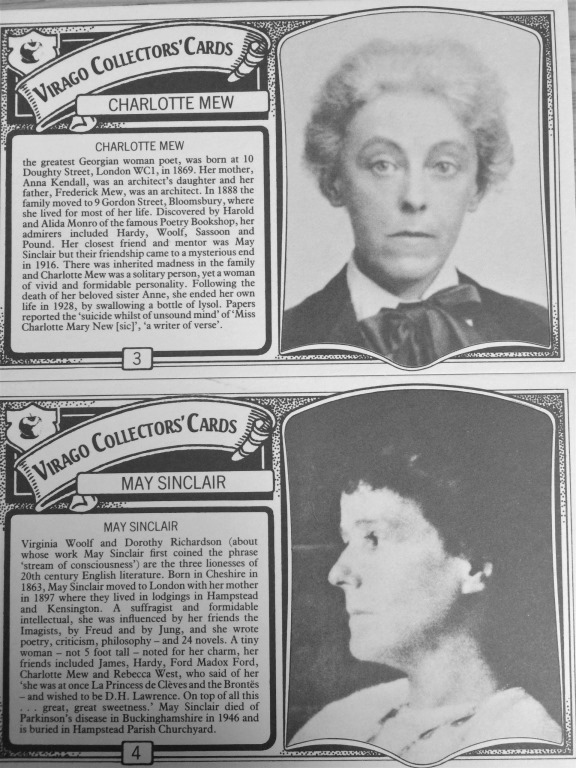
Mew and Sinclair Virago Collectors Cards 16

A Lioness Comes to the Capitol, or ‘Shipping the Poets. At least by the accounts I’ve read, Mew and Sinclair’s relationship was more troubling than these trading cards have room to recount. The “sudden end” involves May unexpectedly chasing Sinclair around a bed


9. The Trees are Down. The same 1920 book that mentioned Turner had considerable praise for Charlotte Mew, who’s become a personal “talent deserving of greater recognition” cause  for me this year. You can see some similarities to Emily Dickinson, Thomas Hardy or Christina Rossetti in Mew, but she’s got her own sensibility that immediately stood out as I started to read her work. She seems to have been an eccentric person in her life, but one of the joys of art is that different often attracts. This one’s a surprisingly modern meditation on a group of urban trees and spring. I liked what I was able to do with the bass and guitar parts following each other as Dave’s piano playing filled up the middle of this LYL Band performance.


8. Archaic Torso of Apollo. Even though he wrote in German, Rainer Maria Rilke is, on the other hand, well-known even to English speakers. There’s a spiritual/philosophical element to his writing that seems to attract many seekers, whatever language they read him in. Several translators have tackled transmogrifying this poem from German to English, but I try to do my own translations here.

In the process of doing this project I find I have to dig into the words I use and try to figure out what they’re asking for in terms of music and presentation, but doubly so when I attempt translations to English. I’m not sure how good I am at the translation task, but it’s a very intimate experience, trying to see, sense and think like another poet. I highly recommend doing your own translations to poets seeking to stretch their literary muscles.

Musically I spent even more time than usual on getting the drum part right, as the opening of my performance is all spoken word over percussion.


I’ll be back next with numbers 7-5 in our Top Ten Winter Countdown.

There Will Come Soft Rains

A single work of art can inspire and be reformed by others as it lives—or rather, if it lives, as there is no choice in the matter. No work of art once it has escaped its creator lives for one moment more except by this process.

There’s a fair chance that someone coming upon this post via search for its title will believe it’ll be about Ray Bradbury’s work of the same name, and I will touch on that story, but short as Bradbury’s 1950 story is, this project is about the compression, sound, and stepping-order of words, as in poetry; and Bradbury’s story is also not clearly free for us to reuse. But Sara Teasdale’s poem, “There Will Come Soft Rains”  meets all our requirements.

There Will Come Soft Rains - Wood

Ray Bradbury’s story that used Teasdale’s title was adapted by Wally Wood for a Weird Tales comic book. Read the whole thing here.

.

I’ve presented Teasdale’s words here several times, and it’s possible that I could have discovered her work (as I have many others) because of the Parlando Project. But it just so happens, I discovered Teasdale on a Tom Rapp record, long before this project began. Rapp sang Teasdale’s “I Shall Not Care”  in company with a passage of Shakespeare. Yes, as a short-lyric poet, Teasdale can stand up in that kind of company.

I probably need to turn in my SciFi credibility badge, but I don’t recall reading Bradbury’s famous story before today, so I now know Bradbury’s story because of Teasdale’s poem.*  I’m sure this is in reverse of many.

I suspect Bradbury is also the vector by which Teasdale’s poem was included in the Fallout  video-game universe. As with Bradbury’s “Soft Rains,”  Fallout  is set in a midcentury-modern sense of the future, and it’s not hard to fit Teasdale’s 1918 poem into that. Indeed, many read Teasdale’s poem and assume that it’s explicitly post-apocalyptic. However, Teasdale wrote and published this poem near the end of World War I, and the poem’s final sentence conditions itself with a “would,” however definite it is about that natural world’s indifference to mankind’s existence and its wars. She could  only be speaking of the landscapes of the WWI battlefields—settings that still bear the scars of the trenches, tanks, bombs, and burial grounds of that war still a century later. WWI’s depersonalized industrial warfare, aerial bombardment, and chemical weapons did open up some thoughts of wider casualties from modern war, even in a pre-atomic age.

Teasdale’s WWI poem is now read as something of a pioneer in presenting that idea of an apocalyptic post-war future. Several years later, but still pre-World War II, came H. G. Wells Things to Come  a novel and then movie, and Stephen Vincent Benét’s story “By the Waters of Babylon,”  and that later could have been part of the inspirational universe Bradbury drew from for his own story that adds another I to the post World War series.

All these: Teasdale’s poem, and Bradbury’s, Benét’s, and Wells’ prose, explicitly use war’s casualties as the measurement of mankind and his civilization’s impermanent nature. Today we might add our insults on nature itself as another potential cause for self-destruction.

So today, let’s revisit Teasdale’s spring poem of indifferent beauty. It’s short, as is my musical presentation of it. The player to hear it is below. After you click on it, can I remind you, just as briefly, that this project would appreciate more readers and listeners. I’ve focused my energies on researching, creating, and writing about these pieces—and so a great deal of the audience growth over the past few years has come from folks like you passing on the word about this.

*One thing that puzzles me is the explicit days that Bradbury sets his story in, their calendar-ness framing his narrative: August 4th and 5th. Bradbury’s story (set in the year 2026) seems very much based on the particulars of the 1945 atomic bombings of August 6th and 9th that ended WWII, and I see that the dates were subject to some rethought on his part (the original publication had the story begin on April 28th.) Teasdale only set her poem in spring, but in his specificity did Bradbury want to imply some the-last-days-another-choice-could-be-made point in choosing August 4 and 5?

In a Station of the Metro

As we were going to school this morning, my son and I were listening to reports from the South by Southwest event in Austin this week. The guy on the radio was explaining that while SXSW has broadened over the years, it’s still the place to go for Alternative Music.

“I wonder where you go if you’re looking for an alternative to Alternative Music?” I asked out-loud. Not the most original thought, but I’ve never liked labels even though we all use them.

My son—who’s reminded me for several years now that he is not a Millennial—replied “Well, I only listen to lowercase!”

Proud of that boy.

Well of course, Alternative Music or Indie music, or whatever you call it isn’t really a Millennial thing. It’s more of an outgrowth of Generation X* in the last century. And that in itself was just the next name stuck on whatever Dave and I were doing 40 years ago when someone thought Punk was the label. And then, scratch-off the sticky paper from a Punk from those days and most likely you’d find someone who was once a young Hippie. And Hippies were just kids that Beats thought hadn’t wised up yet.

I don’t know all that much of what Ezra Pound thought of the Beats, but I recall in the 1950s Allen Ginsberg wrote Pound in St. Elizabeth’s hospital where he was serving his commitment as crazy, the alternative to his prison cage for WWII treason.**  Ginsberg later met him in 1967 and Pound sorta-kinda apologized for the—you know, anti-Semitism and stuff.

But back in 1913, before either world war, Pound was trying to figure out modern poetry in English. If it would be, what it should be. He had some materials to reuse: medieval vernacular poetry, classical Chinese and Japanese poetry, some of the modern French poets, and he wasn’t the only smith at the poetry-forge either, Brits T. E. Hulme and F. S. Flint were working at this too.

Late 19th Century English poetry tended to be enwrought in the cloths of heaven, lofty abstract metaphors and repetitions of what were considered the usual Romantic poetic sentiments. Those poems sounded poetic, sure, but were they? But if so much of that was thrown out, what would be left, what could replace that?

In such a mood, in such preparation, Ezra Pound stepped out of a subway station in Paris. Something in the urban crowd he saw there struck him and he wrote a modest 30-line poem that is unknown to you and me. Pound did not like his 30-line poem. It may have sounded poetic, it may have looked poetic, but it seemed false. He wrung out the false and the result was two lines, the famous Imagist poem “In a Station of the Metro”  that begins “The apparition of these faces…”

Young Ezra Pound bundled up

Ah dude, nice marmot! The young Ezra Pound


I’ve used an excerpt of an account that Pound published three years later about his experience and aims in creating “In a Station of the Metro”  to begin today’s audio piece. I sometimes think of Pound as gruff, inward looking, full of unusual words and quotes from various languages I do not speak, a portrayal of a learned hermit that both of us want to leave alone. But if I’m to take him at his word as he tells this story, he is the transit-riding 20-something Pound, struck by ordinary daily beauty and not wanting to betray it with ordinary poetry.

What do the 14 words of “In a Station of the Metro”  tell us? It’s spring—for tree blossoms, like Meng Haoran’s famous short Chinese poem, are the central image. Perhaps there’s been a rain-shower while Pound was in the subway. He climbs up the stairs and unexpectedly the faces in the street are not cast down out of the no-longer rain. Perhaps the sun is peeking through. They are beautiful without saying, as blossom flowers are. As blossom flowers are, some would have been knocked down by rain, some nourished, and none will be even spring-forever.

To hear my performance of Pound’s account of how he came to write it, followed by the poem itself, use the player below.


*Has anyone fully blamed Billy Idol for that name? Idol claims he took his first band’s name from a 1950s book, but conceptually I’ve always wondered if Richard Hell and his song “Blank Generation”  was the fountainhead.

**Pound had remained in Italy where he had settled before WWII. Enamored of various esoteric theories he thought congruent with Italian Fascism, he recorded radio broadcasts which were characterized as propaganda for the enemy during the war. Captured after the fall of Mussolini, he was at first imprisoned as a traitor in an outdoor cage.

A Winter’s Tale

When I first conceived of the Parlando Project several years ago I did not plan to analyze the poems I presented. My original vision was to present the combinations of music and words directly, unmediated.

I had several reasons, including that I didn’t think I was particularly good at that, but the chief reason was that I was worried that was too easily associated with the idea that poetry was some kind of tricky riddle meant to lock out it’s meaning from the unworthy, rather than a different way to approach how things are.

For every person who is satisfied by “solving” a poem, there are twenty-times more that find the effort not worth their time or attention, and a not unsubstantial number that have been found-out for bad readings, wrong guesses, and are shamed from ever making another attempt with poetry. Or for safety and comfort,  some readers will restrict themselves only to poetry that seems to reveal itself at first sight.

The experience of poetry as rote code-breaking or writing of it like a video game cheat solution, even if you find that sort of thing engaging and fun, reduces it. Constraining your poetry experience to easily-grasp aphorisms and reassuring sentiments also limits it.

Once in operation the Parlando Project didn’t follow my plan. If you’ve been reading the more than 300 posts here accompanying the audio presentations of poetry, you’ll have seen that most of the time I present some kind of explanation of what I think the poem means. How’d that happen? Mostly because I ask questions as I experience the poems, and then I think “Why not try to find an answer?” Those answers often delight me, and I can’t help but share them.

And maybe that’s just as well. Get the puzzle part, the explain part, out of the way and we can get on with the enjoyment of the word-music, the music-music, and the innumerable costumes, persons, and ways of speaking by which the poems come walking up to us.

Why introduce today’s piece, D. H. Lawrence’s “A Winter’s Tale”  like this? Because I can’t tell you what this poem of his means to me, at least not yet. For a moment I stopped myself and asked how I could perform or present this without knowing that.

If you’d like to see the whole text of the poem, you can view it here.

Lawrence, better known as a novelist, was also a poet published in the early Imagist anthologies, and this poem fits well into that new Imagist idea of how poetry should present things. Minnesota is covered by a couple of feet of snow at this point in our particular winter this February. The winter landscape Lawrence presents is vivid and rhymes with my experience.

English planter in early spring

Early spring in England, daffodils in the grass, flowers in planters…and then snow.


It’s the other character besides the poet/speaker/singer and the landscape that puzzles me. It’s only a pronoun, “she.” And what do we know of “she?” Female. Walks out in the deep snow, no mention that there is any accompanying her. “She’s waiting.” For what? We aren’t told directly, though the lovely line that describes her waiting “Impatient and cold, half sobs struggling into her frosty sigh” is both vivid and mysterious. England isn’t as cold in winter as Minnesota, but no sane and competent person goes standing out in the rural snow alone without some good reason. Well except for hunters, and my sane statement still stands. I did give some thought about the poem being a hunting story, but I can’t think of any English game that would be large enough to sob and sigh.

The last stanza only compounds the mystery for me. She’s “come so promptly.” Huh? Sounds like there’s more than a common-sense supposition that there must be a reason for her to be there. The poet/speaker/singer steps to her, and the poem concludes before it tells us, saying only the question “Why does she come, when she knows what I have to tell?”

I read one attempt to explicate this as the story of a woman who has come to meet her lover who is about to break up with her, keying partly off the line that says she’s come promptly though she knows that “she’s only nearer to the inevitable farewell.” I don’t have anything better myself, but I’m not buying that. Another says she’s death. I could go part-way for that, although then what’s she/death doing knowing about and being constrained by farewell? Death breaks up with us, we don’t break up with death!

Could she be winter? The poem’s opening says winter has just arrived or returned overnight, so there’s a link to the “promptly” remark. That gorgeous sobs and sighs line could be winter winds. If this is so, then what the poet/speaker/singer has to tell winter is that they know spring will inevitably come.

And so my appreciation for the mystery continues, it isn’t solved now, and it was far from solved when I performed this earlier this week, singing only the question, and thinking of Mark Hollis. It was intriguing to forget certainty as I sang lines of uncertain meaning, but I could grab onto their beauty and find emotional hooks in threads even if I couldn’t view the tapestry. My earlier experiences of this poem, particularly when heard aloud and formed in my voice, are no lesser than my experiences after questions and possible answers.

It’s my hope, as it has been since I started this Project, that you can do the same, and listen to the audio pieces (perhaps several times if you are intrigued) and let meaning and the emotions that surround it accrue in its own time, for your own self. The player gadget for D. H. Lawrence’s “A Winter’s Tale”  is below, and thanks for listening, it means so much to me.


A Visit from the Angels

Back more than 200 years ago, poet, painter, engraver and mystic William Blake was reported to be conversing with angels in English trees. Last episode we had William Carlos Williams celebrating celebrity scientist Einstein in a blooming New Jersey night early in the 20th Century. Today we have Dave Moore in his backyard garden in Minnesota in our present century.

Blake Angels on spiral

William Blake illustration of Dave’s Minneapolis garden night, sort of.

Is this poetry, song, or story-telling? It might be a little bit of all of them, but then labels are just sticky paper. Let me refrain this time from talking so much about the piece, but I encourage you to just listen to the LYL Band and Dave Moore tell the story. Use the player gadget below to hear it, or this highlighted hyperlink.

St. Francis Einstein of the Daffodils

Metaphor, that stuff that helps make the music of thought in poetry, is the linking or liking of things. This is like that. This stands for that. The sensation of this is like the sensation of that. This reminds us of something else. The way I say this recalls the way one says that. Metaphor recombines the stuff of our world even though it’s a combination that only exists in the imagination.

Metaphor can make something clearer to an audience. It’s so useful in that way that one can barely explain anything challenging to an audience, even in the most prosaic day-to-day business world, without falling into metaphor. In poetry however, the bounds of increased clarity can be stretched, broken, and abandoned. Depending on one’s mood as a reader, this can be frustrating or a pleasing play of the mind. With the Parlando Project we perform the poems with music. One hope from this is that you can relax and let the beauty or strangeness of the words carry you over gaps in meaning. Sometimes you can enjoy a poem before you understand it.

William Carlos Williams who wrote the words in today’s piece, gives us Spring weather with Spring flowers and fruit blossoms, gardens and orchards, and all under a title that combines a famous saint with his era’s most famous scientist. He gives us almost no help in combining that title with the poem, other than yoking them together. The linkage of metaphor is much strained here, even when he further explains his title by adding a sub-title: “On the first visit of Professor Einstein to the United States in the spring of 1921.”

How are we to make the connection that will construct the metaphor?

William Carlos Williams with typewriter

Just another hipster with his typewriter. William Carlos Williams throws off his covers.


My best understanding so far is that the connection is wonder and change. Recall our last post, where in his “Queen Mab”  Percy Bysshe Shelley, the Romantic early-19th Century poet, gave us a vision of the wonder of an immense cosmos, which Shelley’s own notes tell us he could also sense through the poetic/mathematical meter of the speed of light. The theoretical scientist and the visionary poet each seek to grasp some new metaphor of the world. Einstein was changing physics in the time that Williams and his fellow Modernists were seeking to change the apparatus of art. Williams elaborates on this theme mostly by vivid descriptions of the change of Spring. In the only mention of Einstein in the body of the poem, Einstein is “tall as a violet.” He is the Spring’s new growth.

There are a couple of obscure literary references in one section, the sort of thing T. S. Eliot or his imitators would have used. Who is “Samos, dead and buried?” I’m not sure, but my guess is that it’s Pythagoras of Samos, the famous classical Greek philosopher for whom science and the arts were one. And Lesbia? Catullus’ Roman poetic beloved, who we’ve met here in Elizabethan guise. It may be enough that they have ancient sounding names, and of such ancient classical modes, Williams, who is in some ways the Anti-T. S. Eliot, says “Sing of it no longer.” He moves right back into a present day of Spring. Pythagoras is dead, Catullus’ Lesbia is dead, and so is a black cat buried in a newly planted garden. Awhile later in the poem we may get one more connection to that cat part of this buried trio. A chicken-raising man who puts out poisoned fish-heads to keep the cats from his chickens. That man becomes like the Modernists, needing to kill the ancients to protect the new flock he’s raising.

As a side note, this poem’s chicken farmer, the white-haired negro, was quite likely the man whose rain-glistened red wheelbarrow sat next to the white chickens in William’s famous poem of admiration.

The poem closes with a sensuous image of Spring change, a night that grows warm as an orchard owner opens his windows and throws off the covers that were needed in the cold. In an earlier version of the poem, Williams had woven Einstein by name in and out of those Spring images explicitly, including this last one where Einstein was named as that man with the blossoming orchard, another grower of renewed things. In this later version, all these stated links to Einstein are removed (save for that one Einstein as a violet).

Professor Einstein Narcissus

Not a violet, but the “Professor Einstein Narcissus.” Has “great curb appeal” and “deer won’t eat” says this garden center.


Was that a right choice? The resulting poem is shorter and more mysterious, but it also doesn’t make it easy to see what Williams is getting at. He’s using metaphor, but he’s removed all the connections. I decided to perform the later version. I think it performs slightly better, and perhaps the music makes the obscurities less taunting.

A simple musical arrangement this time, just acoustic guitar and subdued electric bass. To hear my performance of William Carlos Williams’ “St. Francis Einstein of the Daffodils,”  use the player below.