Rilke’s Black Cat — and expanding the pie in the face of translations

Is today’s piece the Parlando Project’s surrender to the Internet’s pervasive cat fancies? No, this is a very serious piece of cultural distribution — and it’s Halloween fans, that grave and gothic lot, that we’re serving with content this month.

I do fresh translations into English as part of this Project semi-regularly. Translations bring benefits, important ones that would fulfill that serious…cultural  claim. Since poetry exists in nearly every society* no matter the language spoken, translation allows us to casually absorb more outlooks as readers. And as proud as English speakers can be about the home-team’s innings in verse, a great many poets have taken tactics, forms, and inspiration from writers that wrote in other languages. Adding to the corpus of translations then, is a service to readers and poets.

A couple of the poets I’ve translated here have almost nothing available online in English, a few more, little. Rilke, who wrote today’s piece in German is not such a case. He’s a favorite poet of many English-speaking readers, and has had many well-known translations. But even so, adding another Rilke translation is like adding another human perception of a piece of his writing. All translation comes with a viewpoint and a path taken by the translator to the point of translation. My viewpoint is not particularly learned. I’m not an expert in German literature, and I don’t speak German beyond a few phrases. While I happen to like my approach to writing or performing poetry (most poets get little love for their verse other than self-love, so we’d better have that regard to do the work) that’s about all I bring in qualifications to translating.

My translation approach is primarily image-centered. I want to try to absorb what the poet is seeing, and feeling and transfer that portrayal of sensation into contemporary English. I usually don’t try to convey the parallel sensation of the poems word-music in its original language, but I will give some weight to a sequence of the images as they convey the poem’s argument, the thing I call “the music of thought.” I do like there to be some English word-music in the end result, but as with my original poetry in English the images shouldn’t suffer much just to make some formal lock-step.

Which brings me to the other benefit of translating, the reason I recommend translation to every poet, to every creative-writing class: translating forces you to consider choices made by the original poet intimately, and to make subsequent English-language choices that are not dictated at origin by your  desire to tell your life-story or outlook. This separation allows you to practice, in separation, the craft of poetry.**

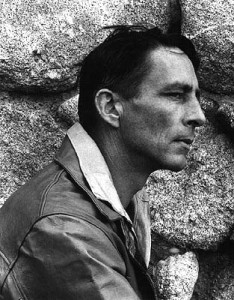
I took on Rilke’s “Black Cat”  because it seems like an apt Halloween poem — after all, it does start out with the cat being described as an apparition of mysterious supernatural powers.***  As I dug into the poem there was one mystery I didn’t solve: how much is Rilke joking with us? Is this cat a dark vision, a domestic cosmic black hole with a gravity that absorbs light? A real Rilke scholar might have a learned opinion on this, but I am not that person. The Rilke poems I know, and famous Letters to a Young Poet  essays seem utterly serious — I’d say almost to a fault as weighed by my own tastes. There’s a certain kind of Rilke fan, like a certain kind of Robert Bly fan, that makes me wary of the seriousness with which they take their precepts and scriptures.

Black Cat

The Internet was designed so that scientists, the military, and government could exchange ideas. And cat pictures like this one I found there. Well, the cat pictures came later, but I’m sure it was in the design. Now, who’s my dark little existential vision of non-being that meets my gaze…

.

But as I translate Rilke I occasionally find images that seem to fall into slapstick. Did Rilke intend this, or is that my own path, my outlook, reflecting off the surfaces of poems? Seriousness is indispensable to slapstick after all. My favorite part of this poem is when the frustrated viewer of the black cat resorts to enraged stomping about. Last time we had a poem about the pathos of black & grey ghosts seeming to manifest in a dark house. Is this dark cat a solemn symbol of ever-so-serious human-condition dread — or an excuse to burlesque the frustration of life we cannot fully control, things we cannot perceive clearly, yet are stuck trying to figure out anyway?

Black Cat Translation

This is what I came up with for today’s performance

.

It may not be what we’d wish, but as Rilke gets to his last line, I smile. We try to see in the darkness, we might try to command capricious cats, but in the end we’ll all be extinct as prehistoric insects captured in amber crystals — but at least by translating Rilke (or other poets) we can see our gaze in their gaze.

To hear my spoken word performance of my fresh translation of Rilke’s “Black Cat”  you can use the audio player below. What, has a black cat crossed your screen and obscured any such audio player gadget?  This highlighted link will open a new tab with its own audio player.

.

*Do historians and anthropologists know of any documented society that didn’t have a form of poetry? I’m neither — but I don’t know of one. If so, this seems a strange fact in the face of poetry’s peripheral place in modern American culture. Is poetry just an archaic skill, like how to make a stone knife or knowing which fungi are safe or sacred to eat?

**Current online language translators (Google’s seems particularly good) are generally adequate at giving you an English-language gloss to start with. For key words conveying images in a poem, online foreign language dictionaries can drill down into further insight. The translator’s job isn’t just turning some decoder ring though: the job is to find effective English language poetry to hold the poem you’re translating.

***Admitting my lack of portfolio to do so, there’s a third reason to do my own translations: I want to avoid — even for my “absolutely-no-profit” Project — taking other writer’s work that isn’t free for reuse. Rilke’s work is in the public domain in the U.S. — but this isn’t true of most English translations of it.

Heaven and Hail

I sometimes think I’m working against gathering a larger audience for this.

Twice in the past month or so I’ve had an opportunity to speak in passing with poets about what I do with the Parlando Project. I’ve got my elevator pitch carved out: “I combine poetry, usually literary poetry not intended to be performed, with original music in different styles.” Both poets came back with this replying question: “What kind of music?”

Maybe I should start hitting that word “different” with hard emphasis — but Midwesterners know that kind of spoken underline could be parsed in our regional argot as cloaked disparagement. If I was to say:

“I’ve written a piece for a string quartet in which the instruments are placed on the floor and filled with nuts and seed. A herd of squirrels is then unboxed and will proceed to chew through strings and tonewood for the course of the musical evening.“

The Midwesterner is bound to reply “Oh, that sounds different.”

Squirrel Quartet 3

For Friday the 13th: presenting the unexpected, not gnawful, just “different,”  the Squirrel String Quartet.

.

Now, I believe both of those poets this past month are perceptive, I read it in their admirable poetry. If they miss the word “different” it’s because many people have strong feelings about the music they care about.* Long before reaching the age of those poets most listeners have strong affinities for some music and equally strong dislikes for the sounds that they don’t wish to put in their ears. The idea of combining poetry with music is attractive, but what kind of music is an unavoidable point in describing the Parlando Project, and I can’t encapsulate that. Elevator pitch? If I tried, I’d be out of breath and walking up flights of stairs. To both poets I was reduced to trying to start my response with “That’s my problem: it varies.”

Readership of the blog posts here continues to increase through the years, while listenership to the audio pieces has been for the last half of this Project’s life flat to somewhat lower. This bothers me, and I have theories, but one that seems particularly plausible is that the variety itself turns off listeners. One day acoustic guitar folk-scare strumming, the next day some kind of synthesizer sound, a garage-rock quality electric combo, something like Jazz, small orchestral ensembles, Blues slide-guitar, or alt tunings in a matrix somewhere between John Fahey, Joni Mitchell, and Sonic Youth. And then on the third day, a combination of one or more of the above.**

How well do I (who much of the time needs to play or score all the parts) present that variety? I think my own judgement approximate, but it goes like this: on good days I think I do it well enough, on bad days I feel embarrassed by the faults in execution and conception I hear. So, my limitations are a factor here, but even if I was a master of all these forms, I think the problem would remain. In this theory it takes only one or two “bad fit” musical pieces for a new listener’s taste to judge the work has no value, and no further listening occurs.

What will I do about this? I don’t know. I can’t help the eclecticism — it’s been in me since my youth*** and I don’t think I want to try to scrub it out.

Today’s musical piece comes from that “We’re a garage band, We come from Garageland” mode — looser still in that like most of the LYL Band pieces presented here over the years it’s spontaneous, not the execution of parts each instrument is supposed to play. As keyboardist Dave Moore says at the end, the words are “a personal experience story,” an exception in the Other People’s Stories texts the Parlando Project finds, experiences, and presents. Just over a year ago a storm with 60 mph winds and golf-ball sized hail struck Minneapolis. Overall, it caused 1.1 billion dollars in damages. On my roof, my shingles were totaled (the classic hail-storm result), windows were shattered, and there were plenty of cracks in the siding from the wind-driven hail. As “Heaven and Hail”  tells it, it took months, well into the winter, for overwhelmed builder crews to get all the home damage repairs completed in my neighborhood.

Last year at this time work started on fixing the damage at my place. One experience amid the hammers, ladders, and supply pallets: hearing one of the crew’s boomboxes playing a record of garage rock classics all sung in Spanish. Another Rosetta Stone moment, like reading those cereal boxes in French.

To hear this short account of the storm and aftermath you can use the audio player gadget below. No player? This highlighted link is an alternative that will open a new tab with its own audio player.

.

*Neither asked me —and few people ask me — “What kind of poetry?” With non-poets, I ascribe that to the lesser interest in poetry as an art and therefore a lack of strong likes and dislikes.

**This leaves out the subjective qualities of my voice, something which I recognize is of overwhelming importance to most listeners.

***”Top Forty” rock’n’roll radio was extraordinarily broad in “The Sixties™” and I was listening to the classical music station and a country-western station along with that format. Hootenanny was on TV, folkie music was part of church camp. Other than the occasional cross-over hit I’d hear on the radio, the Jazz waited a bit to creep in late in my youth. Eventually the smart programmers figured out that a pop music station that played a “button pusher” record would cause the listener to switch to a competitor. I’m the odd-duck that when I hear a record I don’t like, right after one I do like, I want to hear the third and maybe fourth or fifth record played, particularly if any of the small sample (liked or not-liked) is something I don’t think I’ve heard before.

The Mote: a 19th century SciFi prose poem

So, what else did our two young late-19th century North Americans Bliss Carman and Richard Hovey put in their 1894 Songs from Vagabondia  book? How about this one: a SF prose poem adrift in wine and the universe?

I’ve already mentioned that Hovey’s poetry is easy to link to the French language poets* that were a strong influence on English language Modernism that was just over the horizon in 1894, but perhaps pioneering Canadian poet Carman had obtained a copy of Rimbaud’s Illuminations  when it was issued just a few years before the pair’s Vagabondia book. The form of the prose poem was still fairly novel, but this experiment in that form adds another, fantastic, element too.

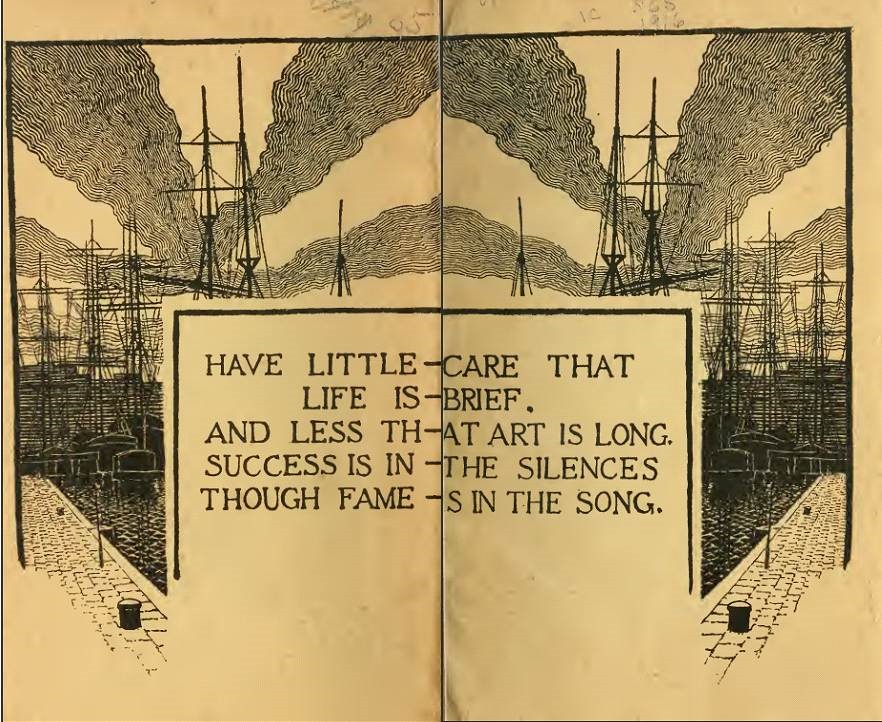
Vagabondia Front Piece

The front piece in Carman & Hovey’s “Songs from Vagabondia.” Here’s a link to the text of “The Mote” included in it.

.

The first time I read “The Mote”  I thought it the story of a short slightly tipsy conversation between two young men in a bar. For young men with loosened tongues to talk of the universe, its unfathomable scope and mysterious connections, is a comic commonplace after all.

As the mote flies into the wine cup of one of the young tavern drinkers and the conversation starts, it’s easy to overlook the way Carman set the scene: the pair entering the tavern are of “august bearing, seraph tall.” Are Rudy Gobert and Karl Anthony-Towns having a post-game libation? “Seraph” isn’t the most common form of an esoteric word, “seraphim,” but it’s a name for the highest order of angels.

If one reads it again, taking that seraph literally rather than figuratively, then the mote which is called “Earth” isn’t a parable, but the plaything of two indolent angels! This ambiguity seems cleverly designed-in by Carman.

You can hear me perform Bliss Carman’s “The Mote”  with the audio player below. The guitar part was played with my Squier Jazzmaster, an affordable rendition of a once unsuccessful Fender electric guitar design. One of the knocks against the Jazzmaster was that it had too much open string-length between the tailpiece and the bridge, a fault that could generate extraneous noises when one uses the vibrato bar. Some modern players see this and figure: “Feature, not a bug!” So, in that manner, some of what I recorded here has me intentionally playing the outside noises that a Jazzmaster can make.

If you don’t see the audio player gadget, I provide this highlighted link that will open a new tab with its own audio player.

.

*Here’s an odd thing: the 19th century French poets that were stretching the subject matter, outlook, and prosody in advance of their contemporaries in England took influences from American poets like Whitman and Poe. Carman and Hovey wouldn’t have needed to go across the ocean to France to read those Americans — but still, there’s a field of echoes going on in this pre-Modernist era. There’s another cosmic joke here too: Brits may have needed to hear some American-originated poetic ideas spoken in French before they could recognize their value!

Be Angry at the Sun

I completed the off-the-cuff recording of my musical performance of this Robinson Jeffers poem a few days ago, but it’s taken me awhile to figure out what I wanted to say about my encounter with it, and secondarily how you, my valued readers and listeners, might receive it. In “Be Angry at the Sun”  Jeffers is ostensibly writing a poem, but it seems he wants to give a political speech about political speech. TL:DNR, he’s not a fan. Here’s a link to the full text of Jeffers’ poem, but since he’s writing about speech, I thought it might best be heard.

I sometimes make rock music, but like my spouse, Jeffers knew how to build with stone, constructing his own castle-like home from local seaside rocks.

.

Politics and poetry mix and don’t. Politicians will quote poems. A few poets (or diverted poets) have run for, even obtained public office. Personal political engagement by poets is likely no more rare than political engagement by nurses, baristas, bookkeepers, or shopkeepers. In my foray into social media* during the past year or so, I’ve often found an expectation that any posting poet or writer should declare their stance and allegiances.

Let me admit a reluctance to do so. My reaction is internal and perhaps odd: it feels like those calls to the pulpit at a Protestant Christian tent revival or Billy Graham’s mid-20th century adaptation of them to the TV age. It’s not oversimplified to be summarized thusly: make a simple public declaration in your acceptance of Jesus as your savior, and by that simple act, your soul’s continuous existence and the worthiness of your life has been assured. There are usually sub-clauses to that declaration: you will be expected to perform acts consistent with it. How consistent must those acts be with the declaration? Empirically, it varies considerably, which to my outlook makes the insistence and importance of the declaration problematic.

Now, some who read this may be Protestant Christians. You are welcome here. Your outlook, your understanding, your lives, may find nothing troubling about that act. I believe I understand your beliefs there fairly well. Long time readers here will know that myself and two other voices you’ve heard here are “PKs” (Preacher’s Kids). We literally grew up with variations of Protestant Christianity.

I also grew up with politics. I proudly wore my Stevenson campaign button as a grade-schooler. I participated at low-levels with campaigns for office and issues quixotic and successful for decades. I’ve been to political conventions. So, to you the readership here that are politically engaged: I have some understanding of your actions there.

So why this particular Robinson Jeffers poem, and why do I find it problematic yet worthy of considering today? Long-time readers may recall one of the poetic maxims I’ve expressed here: poems aren’t just about a message, an idea the poem wishes to express — they are more about how it feels to experience that idea, the sensations of the moment.

I was attracted to the Jeffers poem because I recognized that moment, that feeling. Perhaps you do to. I’ve been living in it this week: politicians and jurists seeming to speak as political operatives have increased my disgust. And this is not because (as Jeffers, the poet I’m voicing today, might believe) that politics is essentially dirty, though Jeffers and I will agree it’s humanly imperfect. Jeffers wrote this poem in the run-up to WWII. Unsaid within the poem, he’s specifically knocking Franklin Roosevelt,** a great and consequential American President, but he’s another of those Modernists who seems to have had, if not full-fledged admiration for fascism, at least a belief that it was no worse than other existing political schemes. There’s a lesson here: those who believe that politics is exploitative, dirty, always disreputable, will be drawn to or tolerate the belief that it’s best handled by leaders who revel in that themselves — the dirty men who will handle the dirty job, while we can stay clean sweet-smelling artists. Stone, not ivory tower in Jeffers case, but the same idea.

So, as you listen to my performance of Jeffers poem about politics and political speech, know my aim is to say that if you feel pain and disgust at what you’re hearing and seeing, I feel it too. Best as I can tell, I don’t share Jeffers prescription and proscription for politics, but in the world of today’s poem and my expression of it, I’m saying if you despair: you’re likely just one person, one citizen, someone without extraordinary powers. Your choices, your actions alone didn’t cause our country and our world to be in this state. How do we turn our nation away from letting the dirty men to do dirty jobs from being left unfettered? I’m a composer and writer, I can’t say I know more than a nurse, barista, bookkeeper, or shopkeeper.

Audio player gadget below for most of you. Is your sub-caucus not seeing any player? This highlighted link will open a new tab with it’s own audio player.

.

*I’ve given in and now post on short-post-format social media after eschewing it for a decade or more. It’s been good and bad. Like poetry, it lets me practice reigning in my long-windedness; and I can engage in it when distractions abound. Alas, it becomes its own distraction when I do have longer blocks of time or energy. In theory, like poetry, it could be complex while being concise. In practice, it’s mostly superficial —something one can relax with when needed —but that “just give me a momentary diversion while I scroll through my timeline” expectation stunts it.

**To those who might want to remind me of FDR’s faults and bad acts. I have long had a strong interest in history. I know of them.

For Father’s Day: Kevin FitzPatrick’s “Bicycle Spring”

It’s been an eventful June so far for me, and I plan to be writing like a real blogger about what I’ve experienced in the last couple of weeks shortly. Then too, just this week I started working on a few further Parlando audio pieces. At least one may make the cut to appear here in the next few days.

This weekend is Father’s Day, and a new musical piece that I thought I’d present for that turned out too rough, even for my tastes. So, here’s a well-loved poem by Kevin FitzPatrick that alternate Parlando Project voice Dave Moore performed with The LYL Band a couple of years ago. It seems apropos. Kevin’s books of poetry are available from this website: kevinfitzpatrickpoetry.com Today’s poem appears in his 1987 collection Down on the Corner.

“Bicycle Spring”  was first presented here in 2022, but for today’s post I remastered it and made this little video for it. Here it is:

.

Wishing my versatile readers and listeners a happy Summer.

John Sinclair writes two poems of Thelonious Monk

John Sinclair lived an eventful life. He’s likely still most well-known for his “10 years for two joints” marijuana sentence, and secondarily for his connection with Midwestern 1960s high-energy rock music as a manager and promoter. Maybe you know too of his founding of a White Panther Party, the quixotic attempt to translate the charismatic radicalism of the Black Panthers to young white hippies.

He was a provocative guy, and he seems to have had a promotional streak to go with that. As I often say about folks like Sinclair: no sane person can likely agree with everything he said and did. Feel free to feel about him however you did before you read this, but there’s a particular reason for a piece using his words today.

This is the last day of (U.S.) National Poetry Month, but it’s also International Jazz Day. The connection of poetry with Jazz seems to have gone back to the very beginnings of Jazz. While Jazz is a predominantly instrumental music, it grew out of a sung Afro-American music that got called Blues. Besides accompanying Blues singers, Jazz musicians often used instruments to evoke the vocal parts of Blues even when the singers weren’t present. And just as Jazz music can use abstract sounds to stand for speech, a lot of Jazz musicians infuse music into the way they talk about their life or their art. The formula of music + words is the formula of poetry.

Long time readers here may recall that I’ve made a point that lyrics in the Blues tradition are Afro-American Modernist verse, and that we can choose to frame them as such — but it’s not so novel for cultural historians to note Afro-American Jazz as an important part of Modernism in music.

Given these connections, it should be no surprise that Jazz Poetry is a long-standing flavor of American verse. Carl Sandburg and Langston Hughes wrote it early in their careers. Sandburg even sang Blues-adjacent songs. Beats adored Jazz, often thought it a literary model, and the mid-century commonplace of bohemians intoning poetry beside a Jazz combo is a influence on this Project that shouldn’t be hard to see. The Black Arts movement welded itself to Jazz too, its poetry often spoke of that music’s artists while Jazz music played.

It turns out that alongside the other things John Sinclair was, he was also a Jazz fan particularly intrigued by Jazz’s rebels. He wrote Jazz criticism, and Jazz poetry before doing anything else he was remembered for, and he kept writing that Jazz poetry throughout his life. When I read that Sinclair had died during the first week of this April’s National Poetry Month, I sought out some of that poetry of his.

The examples you can hear today may surprise you. They did me. For all Sinclair’s association with high-energy music and radical politics I expected some rantings of a passionate sort, strong declamations. He may have written some of that, but these two you can hear me perform were the ones that intrigued me the most. They might seem too casual to be poetry or even public speech, save for his intent to frame them so. They don’t even contain his own words for the most part. Instead, they are statements attributed to Jazz pianist/composer/bandleader Thelonious Monk.

Monk’s a unique creature, even in the highly individualized world of creative Jazz musicians. He was present at the creation of Bebop in NYC in the 1940s, but unlike many of that style’s pioneers there was puzzlement at his skills. To not put too fine a point on it, many connoisseurs weren’t sure he was a good musician. His piano technique was unorthodox, his note choices seemed odd-to-wrong even within the extension of harmonic language that Bebop was proposing. Was that a misunderstanding by (largely white) outside authorities? There’s more: Monk confounded other skilled Jazz musicians who thought he was erratic, not always a steadfast partner in their musical combos that could give the other soloists a predictable foundation to solo over. And on stage he would sometimes extend his eccentricities by leaving the keyboard to sort of dance and wander about the stage.

A remarkable thing happened over a decade or so of this limbo. His compositions became more and more accepted by other musicians, and with wider repetition what once seemed peculiar now seemed irresistibly catchy. Eventually they were deemed masterpieces. Other players started to understand Monk’s unique off-kilter phrasing and rhythm sense. And those odd stage antics became lovable, even if they also could have been worrying. As they would say today, Monk wasn’t neurotypical — and there’s been posthumous talk of schizophrenia-like psychosis. For a Black man working on the fringes of an increasingly marginalized art form in a mid-century America, that Monk eventually achieved so much is a monumental achievement.

Sinclair knew all this. I suspect he trusted you might know this too, and that’s why I’m taking your time to give you this capsule history of Monk. What Sinclair does collect and write down of what Monk says about his art and being an artist seems so modest — both for the poet and the musician. In the first poem, “recollections for allen ginsberg”  Monk claims in effect that he’s discovered the pluperfect American music as just being in this America, ready to be gathered and heard. And the lack of esteem and appreciation he’d received by fans, esteemed critics, and other musicians? The second poem Sinclair gathers (gathers like the Jazz that’s everywhere) and titles “worry later – san francisco holiday – for my mother”  says he intends to persevere trusting himself, eschewing worry about the lack of understanding. Why does he think that, how does he go on making art? The making itself: “my playing seems to work!” he says. Is he saying that he himself understands the achievement of his own work based on his goals, and so is glad he made it — or is he saying that the concreteness of making something that integrates into a something that didn’t exist before is the best therapy for a life that could otherwise be consumed with worry and doubt? My understanding is that he’s saying both.

A lyric video of today’s piece

.

The Valerie Wilmer that Sinclair credits for the Monk quote in the second poem made a series of invaluable photographs of Afro-American Jazz musicians toiling on in the creative fringes of music after their music became even more marginalized than it was in Monk’s time. Her book As Serious as Your Life  is a document of making that work and the musical artists it depicts.

My performance of Sinclair’s two poems features my best attempt at realizing a Monk-ish composition to accompany it. There are two unfinished drafts of this post where I tried to come to confessional terms with my feelings about that process of realizing the piece and my audacity to present myself in the context of real musicians with lives devoted to their craft. I decided to spare you all the breast-beating since I came to see that as boring. As a composer, I guess I could conclude with a variation of that Monk quote “I’ll tell you one thing: my composition seems to work.” You likely saw the video link above, but if you prefer just the audio, there’s a graphical audio player below, and this backup highlighted link for those who don’t see the player.

.

Dover Beach

This April I’ve been looking at a pair of volumes of poetry for children published in 1922/23 The Girls and The Boys Book of Verse.   One of the things I think about as I read the poems and consider the editor’s selections is what’s ahead for the kids that will read these books. Depending on your age, this is your parents generation, or your grandparents, or even in some cases great-grandparents. Those then-children are highly likely to now be dead, but their grownup results may be in the boundaries of our memory.

Here in a children’s book for them is this dead solemn poem. Its mood, however earnest and perceptive is downbeat. That it was written on the occasion of Matthew Arnold’s honeymoon* makes the poem’s downcast directed look at the sea as the emblem of erosive time and wear even more outlandish. Arnold wrote this in 1851, and I’d assay that the futures for a middle-class English cultural critics and civil servants like Arnold were not extraordinarily dire.

Dover Beach and Matthew Arnold

Honeymoon material? Want to discuss Sophocles in the original Greek? Do you think the editors put this poem in the girls or the boys volume of their gendered pair of anthologies? Answer below.

.

What would we say for our Greatest Generation’s future, the kids for whom this poem was selected by the editors? Let me narrow that audience in a bit — acknowledging that there will be dear exceptions — a white middle-class or better audience of American tweens to younger teens would be these books most likely readers. Most of their families will have the means to not make the Great Depression a test of survival. WWII will deeply change four years of their lives, ending some, swerving others. The Cold War years afterward are held in memory as a complex mix of unconnected simplicities — particularly the first two post war decades. When the rich landlord’s son talks about the Great America to be Againing, there’s where he thinks we want to live.

I’m not a young man on a honeymoon, the sea is calm tonight, and I live in this moment in gratitude to be able to exercise my “art or sullen craft.” My mind has learned to question any unalloyed mood, but I’ve written here a few years back that the current young generation may need to be a greater Greatest Generation to face the challenges I read out my window.

Will Arnold’s poem help them. Is that likely for any poetry? I doubt I’m wise enough to say. I will say this, the music in this poem of dread carries it through, a strange energy of words forming into antiphons. Its concluding naming the fears, singing the fears, in the poem’s powerful ending: that world not committed to joy, love, light, certitude, peace, a solace for pain placed amidst a personal choice to closely realize those things.** Is that enough? I don’t know, but I can put it to music.

You can hear my musical performance of Matthew Arnold’s “Dover Beach”  with the audio player below. What — has such a player retreated like the Sea of Faith? Draw back and fling your click to this highlighted link which will open a new tab with an audio player for my tremulous cadences.

.

*Anthony Hecht’s “Dover Bitch”  remains the incisive dis poem to Arnold’s.

**Just this month I’ve been reminded again of The Fugs, an anarchic and utterly sex-positive band of poets that should be considered as pioneers alongside The Mothers of Invention and The Velvet Underground instead of being memory-holed by musos for being musically shambolic. The Fugs performed “Dover Beach”  by only refraining the final section, and I’d suppose in the depth of The Sixties, just as today, we are ready to sing where ignorant armies are clashing by night. Gender fun-quiz answer: Arnold’s mansplaining honeymoon ode was published in The Girls Book of Verse.

Cool Tombs

It’s been too long since I’ve presented a poem by Carl Sandburg here, and awhile since I had the time to make one of my “punk orchestral” pieces accompanying one of the poems.

Carl first.  Unlike Frost (birthday boy today, happy birthday Robert!) I appreciated Carl Sandburg as a young person. A poem like today’s “Cool Tombs”  doesn’t appear to truck with irony or express its perceptions subtly. It appears to say what it means to say. Those schoolchildren sure that poets and their literature teacher accomplices are seeking to make fools of us dense and under-lived students can rest easy with what this poem seems to be. Here’s a link to the full text of the poem, if you’d like to follow along.

I’ve made my point elsewhere in this Project that Sandburg, likely with intent, had other poetic modes. Like Frost (which Sandburg was once considered a peer to in literary merit) he’s always plain enough speaking that one can be fooled into thinking his thoughts are always straightforward. Read quickly enough, seeing only the plain-talking, “Cool Tombs”  has just one thing to establish: that our selves lose and are left-loose from our deaths. Great accomplishments, great enemies, great failures — eventually, nothing.

Where’s the ambiguity? Where’s the deep reading that great poems reward?

My answer, my reading of Sandburg here, is that is to be found in American history — that history a denser poem full of every Empsonian ambiguity — and Sandburg clearly is roping in American history here.   Are his choices incidental/accidental? Well, they do include things that disappear, even if like love they remain inescapable, returning things.

Other than American historians, few readers today will understand what a “copperhead” is referring to when Sandburg speaks of Lincoln, other than perhaps knowing it as a species of poisonous snake. That it was, and is — but in the American Civil War those in the North opposed to fighting the secessionist slave-holding rebels took to using an incised liberty head carved out of the mid-19th century American penny coin as an emblem of their sentiments. If you reach into your pocket now and note who’s on the current copper penny, you’ll see the head of Lincoln.*  Did history write some irony there?

Civil War hero and post-war President Grant suffered from corruption among businessmen in and surrounding his administration, details now lesser-known outside of historians today. The Sandburg that wrote this poem, ex-political operative and then still daily newspaperman, knew that government corruption hadn’t disappeared conceptually. Perhaps he also knew that Grant intended to — to some degree did — try to set up a fairer settlement to those newly emancipated from slavery. In the cool tombs of history, perhaps we remember Lincoln and Grant for those efforts, even if imperfect and eventually abandoned, they were.

Pocahontas’ story, as much as can be deduced from records and oral histories, is complex, and subject from the beginning to substantial romanticization by English settlers.**  An indigenous American, she married an early English-American settler, and legends of this marriage and other friendliness of Pocahontas to the English settlers are the prime reason she became a historical character to the eventual conquerors. From the First Nations standpoint, one can easily see this story rests on a vibrating matrix of love, coercion, or treason. As her story leads into Sandburg’s voice claiming for the lovers in the concluding section, perhaps Sandburg holds primarily for the first of that trio — but he and I were not there, we cannot really tell. I also don’t know Sandburg’s intent, but the previous two situations are suffused with crimes and evil: slavery, murder, corruption, and greed. Is Pocahontas’ story contrast or continuance? The poem’s text allows either reading. Perhaps the fairest reading, the one that was in my sense as I read it, is that Pocahontas’ love was tragic given how the conquest continued with so much killing and subjugation. Note too that Sandburg says a hail-the-conquering-hero parade (perhaps to the tomb?) should be examined as a vainglorious exercise.

Lincoln, Grant, Pocahontas cool tombs

Lincoln’s tomb in Illinois, Grant’s tomb in New York, and Pocahontas’ burial site in England.

.

Is all this external exegesis based on unintended things that I’m artificially assigning to a simple or at least single-minded poem? Most modern academic readers of Frost understand him to be a poet comfortable with intentionally invoking subtext. Certainly, if this were a set of incidents in a T. S. Eliot poem with reference to metaphysical poetry, with passages in Latin and Greek referencing classical history and legend, we’d know he wanted us to consider those connections.***

But Sandburg? I’d caricaturize my sense of how Sandburg’s viewed today like this: he’s written off as a superficial popularizer of unremarkable intellect and talents. He fooled some folks earlier in the 20th century into thinking there was something there, but now we have a better vantage point.

I obviously don’t see it that way. I could be mistaken — in which case it’ll be forgotten in the cool tombs.

Carl Sandburg's grave

Carl Sandburg’s grave in Illinois. Not so grand, but it also asks us to add history to the grave. There’s a little plaque on the footing bearing the legend “For it could be a place to come and remember.”

.

Alas, now again I spent more time spent writing on the words, leaving less time for the music. I recently had enough energy and assured time to try to do something with a larger group of orchestral instruments. Let me be brief. I wrote this originally as a non-harmonized melody, but transformed it into a harmonized piano part via some software that extracts harmonic ideas from a monophonic line, choosing the one that interested me the most, and tweaking it from there. The piano part then became the orchestration by another translational process of placing the piano’s range of notes with various other instruments.

If I had the focused energy or assured time, this could be a movement of a larger piece with other themes, variations, contrasts in color — but that doesn’t fit my life. I’ve come to call these short pieces, often expressing a simple musical idea by whatever means I can bring to hand “punk orchestral.” You can hear the recording of my performance of Sandburg’s words with this orchestral music using the audio player gadget you see below. No player?  This highlighted link will open a new tab with its own audio player.

..

*That liberty head cent had been replaced with a new design just as Lincoln was elected, though still in circulation. The new 1859 design replaced the classical liberty head profile with what? An American Indian in native feathered headdress. The current Lincoln profile penny was adopted in 1909, less than a decade before Sandburg wrote his poem.

**A couple of obscure horticultural details occur in the Pocahontas section. “red haw” is a tree that produces a crab-apple in Autumn. So too is the pawpaw, a fruit widely raised and eaten by native Americans. Sandburg oddly refers to the “pawpaw in May” which would not be a sweet, edible fruiting time for the plant in North America. Is there intentional metaphor there, or a mistake?

***I don’t know if Sandburg had this poem by Thomas Campion, which in turn was a loose translation of Catullus — but the lovers getting as much as they can while tomb-wise element was brought to mind as I newly considered Sandburg’s tomb poem.

Two Aunties: Fenton Johnson’s transition to Modernist free verse

There’s a great deal that remains unknown about the poet I’ve been featuring here this month: Fenton Johnson — but then again, there are some things that I’ve been able to learn about him since I first began performing his poetry as part of this Parlando Project in 2018. Today’s piece, though late in my month-long series on this pioneer American Black poet, comes around to where I first encountered Johnson: as a Modernist, free-verse poet.

The previous posts this month are from two book-length collections Johnson published in 1913 and 1915. While it’s only speculation, it’s not uncommon for poets to collect work done over a few years, particularly for a first book. Accounts I’ve read say Johnson wrote poetry (and at least one locally produced play) while a student, so it’s plausible that some of the poems included in his poetry books could have been written even earlier in the century. English-language Modernist poetry started to be published around 1909. Within the next decade we see new forms begin to spread out based on concision, fresh imagery, unusual or prismatic scene-focus, and freer and non-regular rhyme and meter. Americans are conspicuous in this new movement. In 1912 Ezra Pound published his famous ultra-short poem “In a Station of the Metro.”   Living overseas, Pound starts promoting the new style as the foreign editor for the new Poetry  magazine, and he submits to them short poems by Hilda Doolittle (freshly renamed as H. D.)  In 1913 Pound and F. S. Flint compile “A Few Don’ts by an Imagiste”  which was published as a manifesto of the new style in Poetry. The next year Midwesterners Carl Sandburg started publishing the new free-verse style in Chicago and Edgar Lee Masters placed his initial Spoon River epitaph poems in Reedy’s Mirror out of St. Louis. In 1915, T. S. Eliot, another American ex-pat, publishes Prufock, and in New York a young poet Alfred Kreymborg gathers his friends to start a small literary magazine explicitly dedicated to the new forms. He titles it, in honor of the insurgent outsiders, “Others.” These others included William Carlos Williams, Wallace Stevens, Marianne Moore, Man Ray, Mina Loy, Orrick Johns, and Lola Ridge, all of whom were U.S. East Coast based. Also in Others:  Pound, Sandburg, and Eliot — and eventually, our Black man from Chicago, Fenton Johnson.

If Fenton Johnson is lesser-known, it’s possible he’d be on an even greater level of historical obscurity if he hadn’t been published in Others.  Sitting here in 2024, I can retroactively maintain that some poems from Johnson’s books of 1913 and 1915 are proto-Modernist through using Afro-American oral and musical forms, even though the bulk of his books are like the poems I shared early this month: poems in 19th century forms.* From what I can see, Johnson’s work came to the attention of New York based Afro-American focused cultural critics and anthologists not because of those two book collections, but because of how strikingly different this 1919 free-verse little-magazine published poetry was, and the visibility of the cutting-edge Others  to NYC-based critics. When James Weldon Johnson created his first-of-its-kind collection The Book Of American Negro Poetry  in 1922 he included several poems by Fenton Johnson — but instead of the paragraph or two praising their strengths offered for many of the poets in his introduction, he says only this: “Fenton Johnson is a young poet of the ultra-modern school who gives promise of greater work than he has yet done.**” I read that hands-off briefness as meaning “Well, he’s doing something different, some are noting that, so I include him.” Despite that lack of enthusiasm by this early Black anthologist, one of the included poems, “Tired,”  has become Fenton Johnson’s most anthologized poem — the one that to this day is included in many Afro-American poetry anthologies. Besides being an early Afro-American to write in free verse, “Tired’s” prominence and Johnson’s mysteriousness has also given Johnson the air of a fierce political radical. In the next post in this series, I’ll tell you what I’ve found out about that.

Since it’s such a striking poem, and because “Tired’s”  free verse has become the predominant literary poetic style as the century progressed, that mode of Johnson’s poetry remains fixed in cultural memory to represent him. You can view a “lyric video” of my musical performance of “Tired”  at this link.  All of Johnson’s 1919 Others  poems (eight in total) are also in free verse, and today I’ll present two of them combined in one performance: short poetic portraits of a pair of older Black women that would be invisible to the society and the culture. “Others” indeed.

Fenton Johnson Two Aunties

Here’s how the two poems appeared in the February 1919 issue of Others

.

This time my accompanying ensemble is a rock quintet. You can hear it with the audio player gadget likely available below. No player? This highlighted link is a backup, and if you click it, it will open a new tab with its own audio player.

.

*Other Afro-American poets retained traditional metrical-syllabic and rhyming prosody used by Johnson’s original model Paul Laurence Dunbar. Jamaican Claude McKay who moved to the US after WWI published excellent formal verse, as did the younger poet Countee Cullen. Other less-remembered Black poets of this WWI through the 1920’s era worked largely in the older, established prosody. Just as Fenton Johnson was early in adapting Afro-American preaching and musical styles into his poetry, his early use of free verse predates the Harlem Renaissance.

**In a later 1931 edition there are apparently more extensive remarks by Johnson on Johnson, but I have yet to find anything other than excerpted quotes — but from those excerpts it seems James Weldon Johnson was troubled by what he saw as radicalism and despair in Fenton Johnson’s poetry.

To not be scared of death that doesn’t understand us

I’m going to start off the new year 2024 with something I do less often, presenting a new piece that uses my own words. I give myself permission in part because it was engendered by thoughts of another poet, Robert Okaji, who I’ve considered as something of a kindred spirit to my efforts here since this Project began 8 years ago. Like most every blogger I can’t help but talk about myself, but when I do that I fear I become a spendthrift of boredom, so one of this Project’s mottos has been “Other Peoples’ Stories.” Yet, for all that, this isn’t Robert Okaji’s story in any summary — he’s his own poet, his own writer. I’m presumptuous, but I won’t go there. I don’t know him, though I’ve read his blog, his poetry, seen him read online once. Is that like knowing him in some way?

Many of us poets could admit that we see ourselves in a timeless guild. Homer, Sappho, Shakespeare, Emily Dickinson, Du Fu, Yeats — they’re our co-workers. We flatter ourselves at times that we now occupy their offices. By the same conceit, I could think of Okaji as a compatriot. We live in the same country at the same time, we’ve exchanged the customary short notes over the Internet. At least once before today, something he wrote caused me to write something myself. I think I started writing translations/adaptations of classic Chinese poetry before reading his, but his approach (we both need to start from literal English glosses) ratified mine in effect.

So we poets, at the moments our heads swell up so that poetry can burst forth,* may think it’s as if we know each other, because we think we know each other in poetry. To say then that it’s like companionship, that it’s as if, is to do that thing that’s called in poetry a simile.

Every simile when examined harshly knows it’s pathetic. Every poem is not the thing it represents — even the great poems that change how we look at the thing they represent. Let all in the poetry guild admit this to each other within the walls of the guild hall.

I started writing today’s words on one of my more-or-less daily bicycle rides. In spring there may be many kinds of birdsong in my well-forested city, but in winter it may be only crows — which, as the poem describes, are quite vocal about a solitary early morning bicyclist in their midst.

Crows, ravens, big dark birds, are a death symbol of long repute. And it struck me that while we might chide ourselves for not having sufficient knowledge or understanding about death, we could just as well say that death doesn’t understand us. Living in our consciousness as if the present continues indefinitely, we don’t understand death, but death doesn’t understand that moment either. And then, we poets think we can capture the flow of consciousness and preserve it in poems. Today’s poem carries on in a series of similes and then makes a final summation of the series.

Okaji has written a group of poems over the years featuring the character of a scarecrow. Perhaps he too is riffing on crows as the death symbol, but his scarecrow is at times a comic figure too. A scarecrow is just another simile, a sort of, an as if symbol for us — and so I speak of Okaji’s scarecrow in my poem.

Scarecrow takes a winter bike ride

Scarecrow rides a bicycle in early winter mornings, and the crows object. (a note: I begat these AI illustrations with Adobe Firefly, which claims it doesn’t use uncompensated artists’ work to train itself)

.

I said my poem isn’t Okaji’s story — it’s more mine partway — but if you’re like me in some ways, particularly if you want to consider those of us aged to where a compatriot’s death seems next door, then it might be as if it’s partway yours too. The admonition in the poem’s title is therefore not addressed impertinently to Robert, but to myself and perhaps others who might read or listen to this.

Woody Allen wrote a great line: “I don’t want to be immortal from my work. I want to be immortal by not dying.” We write poems, we make those “like a” statements by writing poetry. As if: in our minds we walk into those poetic offices, write our metaphors, our similes. And some day, we must clean out our offices, leaving on our desks a few sheets of paper, maybe enough to stuff a scarecrow.

Today’s performance started with two electric guitar lines I recorded early on New Year’s Day, following the tradition of trying to do things on that day that one would like to continue to do regularly the rest of the year. The two somewhat irregular riffs were spontaneous,** thinking that promise to myself required doing  as much as planning. The bass line was laid down almost a day later to try to hold things together, and the decoration of the keyboard parts arpeggiating the spontaneous chord changes which had started things off, were the final tracks. Those things done, I had my rock band to declaim my sonnet “To not be scared of death that doesn’t understand us” over.

You can hear that with the audio player you should see below. No player?  This highlighted link is a back-up method, as it will open a new tab with its own audio player.

.

*A metaphor that sounds more like a sneeze than Athena’s birth when I re-read this.

**I fancy the right channel line played on my Telecaster has some crow-call-like moments.