The Poplar

We’ve already met most of the small circle of poetic Modernists that assembled itself in London before World War I. From the United States, H. D. (Hilda Doolittle) and her one-time fiancé Ezra Pound; and from England, the combative and influential T. E. Hulme, and the risen from poverty F. S. Flint. Other poets, William Butler Yeats, T. S. Eliot and Robert Frost, touched them tangent in England, but were still bent with the gravity of what Flint called, and Pound promoted, as Imagism. If you’re new here, you can check our archives (now almost 200 audio pieces) and you’ll find all of them represented.

Today we use the words of the man we’ve left out, Richard Aldington. Another Englishman, he married the American H. D. in 1913. He worked with Pound to promote T. S. Eliot. Unlike T. E. Hulme, he survived WWI, but many said his combat experience changed Aldington, and retroactively the diagnosis of PTSD has been associated with him.

His long career had more than a few bridge-burning episodes, all disputes which I know not enough to have an opinion on. Partially because of this, Aldington is not well-remembered as a poet, even though at the start of the Imagist movement he was universally considered a principal.

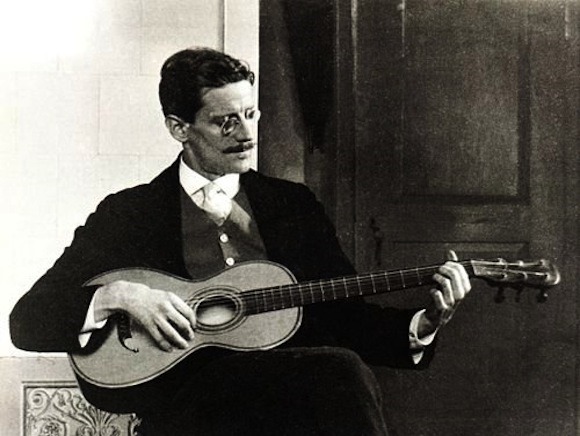
Richard Aldington in sweater

Aldington, wearing an example of regrettable fashions of the early 20th Century


Like his partner H. D., Aldington looked to, and translated, classical Greek poetry; and like Pound he was fascinated by Chinese and Japanese compressed poetic forms, and produced work connected with these traditions. Today’s piece, “The Poplar”  isn’t one of those poems. In some ways “The Poplar”  reminds me of F. S. Flint (that other too often forgotten early English Modernist), as it’s free verse in Flint’s “unrhymed cadences” mode. It’s blissfully easy to read. It’s homey and unfussy images remind me of T. E. Hulme. It’s odd now that we think of Modernist poetry as requiring obtuse and learned images, when it’s founders like Hulme and Aldington in this poem have no images that wouldn’t be clear to a grade-school student.

Musically, today’s piece has a core guitar part that I played on a small acoustic guitar I’ve owned for 35 years now, but instead of “real strings” (which in my case would be “virtual instruments” where various notes and articulations of actual acoustic string instruments are sampled and then played by a keyboard or a guitar MIDI controller) I used a virtual instrument which sampled a 1970’s vintage keyboard “strings” instrument. I feel the dual falsity of this instrument, a simulation of a simulation, produces something that has its own validity. I also wanted to use a harmonium, but I don’t have that available as a real instrument or a sampled one. The closest I could come was a slightly modified “toy organ” patch which had some of the wheezy reed timbre I wanted.

Enjoy “The Poplar”  by using the player below. Even though it’s from the dawn of modern English poetry, it remains fresh because it’s not that well-known; and it doesn’t ask you to enter some dimly-lit labyrinth of images you cannot decipher. Yes, elusive images can have their pleasures, but so do these.


March 2018 Parlando Top 10 Part 3

We return with the next three in the count-down of the most listened to and liked audio pieces of last Winter. Like last time, all poets who worked in the 19th Century, but in this group, all men.

Two out of the three today are from the British Isles. In may be no surprise, given its head start in English literature, that Britain is an outsized contributor both in words to be used and the Parlando Project’s reader/listenership.

I’ll be taking my second, short low-budget trip to London this month, and I’m frankly not sure what I will find this time, other than planning a side-trip to Margate to see the Turner art museum there and its small exhibition commemorating Eliot’s “The Wasteland” which was partially written in Margate. I’ll no doubt re-visit the Blake room at the V&A, and who knows, maybe I should try to find that alley beside the Savoy Hotel?

JMW Turner Waves Breaking on a Lee Shore at Margate

The London forecast calls for rain, hopefully not JMW Turner stormy though!

4. Ring out Wild Bells

When I posted this for New Year’s I noted Tennyson’s level of fame when alive, something that even the most popular Instagram poet cannot reach now. What I found out afterward was even more intriguing, that this section of his long poem “In Memoriam A.H. H.”  has become a tradition in Sweden to be read at the turn of the year, sort of how the Times Square ball-drop is ceremoniously repeated in New York, or how Guy Lombardo would once appear with his Royal Canadians near the top of the hour on TV to play a Scottish tune.

As evidence of Tennyson’s fame, I noted that my little Iowa hometown had a major street named for him when it was platted back in the 19th Century. Eventually the town and it surrounding farms were settled largely by Swedish immigrants. The Tennyson and bell-ringing tradition in Sweden started in 1927, long after the town was founded and settled, but wouldn’t it have been good in the town’s heyday if the farmers, shopkeepers, and schoolchildren had gathered on the sides of the street on New Years Eve to hear a poem?

Instagram poets get knocked for the shortness of their verse and it’s focus more on remediation than demonstrating literary skill. Tennyson built “In Memoriam”  into a book length series of poems, but his focus too was on remediation, in his case, of grief.


3. The Wild Swans at Coole

Yeats was Irish, and for decades I’ve met monthly with a group of poets the majority of whom were Irish-Americans. Yeats seems to have seamlessly transported himself between the 19th and 20th Centuries, changing so smoothly that he could not be observed changing. Somewhere around the turn of those centuries he decided that poetry should be chanted (not sung) to music, and yet we seem to know little about how exactly that sounded. Contemporary reports (and that’s what we have, there are no recordings I’m aware of) were decidedly mixed, even derisive, and Yeats eventually set that quest aside. The recordings of Yeats reading that we do have are from decades later, and in them there may still be traces of that concept audible in his, by then unaccompanied, reading style.

Yeats warns listeners that his chant may not necessarily enchant.

Reports also tell us that Yeats suffered from a difficulty carrying a tune, much as I do. His chanted, not sung, idea did not come from that he tells us, rather it came because conventional art song had too much ornament and melodic elaboration, deducting from the inherent music in the words.

In the course of the Parlando Project I take various stabs at what Yeats was trying to do, recreation in the literal sense, trying to create from the ancient and natural connection between music and poetry some combination that doesn’t privilege one over the other. Sometimes it’s spoken word, sometimes it’s “talk-singing,” and sometimes I think it necessary to sing.

I avoid apologizing for my musical shortcomings. It never mitigates anything anyway, and I’ve always found the humble-brag distasteful. I’ve hesitated at—and decided against—releasing performances most often because of failures of my singing voice. This performance came close to staying in the can. At times it works, not from my skills, but because there’s a certain match in the failings in the voice and the meaning of the poem.


2. My Childhood Home I See Again

One last 19th Century poet, an American. Long-time readers here will know that US President George Washington’s teenage love poem “Frances”  has been a surprisingly persistent “hit” with listeners here. It didn’t make the Top 10 this season, but we now have another Presidential/Poetical contender in Abraham Lincoln. If Washington was all youthful alt-rock persistence, Lincoln is more goth, with a downcast you-can’t-go-home-again tale of all he finds missing when he re-visits his hometown in his thirties.

Lincoln’s “My Childhood Home I See Again”  was very close to the popularity of the Number 1 this season. If didn’t count the substantial Spotify plays the Number 1 received, Lincoln would have topped this season’s list.

I posted this for what was once a common U.S. holiday, Lincoln’s Birthday. Also on this season’s Top 10 are the Tennyson New Year’s post and Rossetti’s Christmas song posted on Christmas Eve. Not sure if this is a trend, but listeners did like the holiday poems this winter.


Tomorrow, the most popular audio piece.

March 2018 Parlando Top 10 Part 1

It’s time for that quarterly exercise where we look back for the most popular audio pieces here at the Parlando Project over the past season. I’m going to follow the format we used last time, and break the countdown into four episodes. I base the popularity on the number of likes following their posting here, and the streams the audio pieces received directly from the blog, or on iTunes, Spotify, or other podcast sources. Let’s start the count from the 10th most popular as we move up the list to number 1:

10. Rosemary

Even though these pieces were listened to in the Winter for most of our listeners*, Edna St. Vincent Millay’s words have a kind of spring-cleaning of the heart vibe, and so may be apropos for opening the windows and letting the curtains blow around—or at least they will in a few weeks when it warms up here in the northern part of the northern hemisphere. I awoke to 10 degrees Fahrenheit and snow and polished ice myself today.

I rather liked the music I wrote and performed for this one, just as I have liked going back to Millay to reassess the strengths she brought to poetry. Millay’s popular reading audience, once substantial, hasn’t completely disappeared, and there’s a welcome re-assessment of her poetry starting in academic circles.


9. Stopping by a Woods On a Snowy Evening

I’ve featured Robert Frost’s words quite a bit here, perhaps to atone for my dismissal of him when I was a teenager as the kind of worthy poetry in our schoolbooks that we needed to move beyond. Two things were key to my learning to love Frost: his uncanny ability to write lyrical verse that sounds natural, and my finally noticing the dry wit and stoicism that underlies most of his work.

Frost, alone of his American generation, has retained a level of popular appeal and critical approval. He’s double-edged in maintaining that. Some are captured by the surface of his poetry, hearing and maintaining in their memory the catchy moral-of-the-story “big choruses” of Frost. In this poem, it’s the “I have promises to keep, and miles to go before I sleep” at the ending. Others listen carefully to the verses, the parts other than the lines we most remember, the parts we can come back to and find that we’ve forgotten were there. When I came to work musically with this poem, I’d forgotten those. There’s no lovely woods to see in this dark night. He may be lost. He’s so dark and alone that he can hear snowflakes sweeping across snowbanks between the jingle of his rig’s harness bells.

Musically, I was obligated to add shaker bells percussion to stand for those harness bells, but then, more obscurely, I decided to add a South-Asian tambura drone for the sweep of snow.


amedeo-modigliani-pierre-reverdy

Modigliani’s portrait of Pierre Reverdy


8. Clear Winter

I was a terrible French student in my little Iowa high school and my little Iowa college. I seem to have no ability with languages, and less than no ability to handle those accents and the reforming of the mouth that makes speaking a foreign language possible. But I love poetry translation. I feel like a paleontologist removing the clods of sediment from a skeleton. Slowly, painstakingly, there it is, just as it was in its moment of sudden! But then my task shifts, and I must become the process of fossilization, to find the minerals of English that can fill in for the sinew and feathers of it’s original language.

I had a great time with the challenge of Pierre Reverdy’s “Clair Hiver.” I’m unsure of the accuracy of the “tea-kettle” section of my translation, but I fell in love with it, and could not abandon it, even if the light behind Pierre Reverdy’s eyes cannot reach the little anteroom behind mine.


*web stats I get for the streams tell me I have as many recent listeners in Australia as I have in Texas—and one listener in New Zealand. Bret, please tell Jemaine that there’s a lot of good stuff to read and listen to in the archives you’ll see listed by months on the right.

Before the Feast of Shushan

Choosing to make even one arbitrary choice can be a great aid to creativity. After all, though many of us are driven by various and powerful urges to create art, the choice to do that is arbitrary itself.

Today’s piece comes from several, singular, arbitrary decisions.

Coming upon the author of today’s words was a two-step process that has no A and B to it. First, knowing that the change from the 19th to the 20th Century impacted everyone, I wanted to see how African-American writers moved across this change. I was already somewhat familiar with how they moved musically in this era, a momentous cultural act that made American music, to an impressively disproportionate degree, Afro-American music. I was less familiar with the early 20th Century Afro-American poets. I started with Wheatley and Dunbar, as many did then. As our copyright laws effectively forbid me to utter on the Internet most any work written past 1922, I was heartened to find James Weldon Johnson had published a collection of Afro-American poetry just before that.

I read it, and Anne Spencer’s contributions included there didn’t grab me.

That too is arbitrary isn’t it? The poetry (or music, or anything) that can impress you on first encounter is only one element of how it might work.

Then a few weeks later I read a small piece online highlighting a long life of service and art that Anne Spencer had lived across part of the 19th Century and ¾ of the 20th. That moved me immediately. I re-read her poetry.

Did I appreciate her poetry more because she seems to have been such an admirable person? I tell myself, no, that by the time I combine it with music and place it on the Internet, few listeners will have any inkling of that. But I’ve just told you how I encountered her, and yes, that has arbitrary elements.

How did Spencer decide to write “Before the Feast of Shushan?”  Were there arbitrary choices? If you’ve followed me so far, you’d suspect there were. The subject is taken from the Hebrew scriptures, and she could have encountered it in any Bible at the start of the book of Esther.  In the sum of cultural appropriation, those ancient Semites have been borrowed from an impressively disproportionate amount, haven’t they?

As I finished the audio piece around sundown last night, it was the beginning of Purim, the Jewish holiday based on the events in Esther.  For a large portion of my life I lived in what could arbitrarily have been called a Jewish household; but family and religious traditions are varied, and I never took part in celebrating Purim. From what I gather that might include elements like unto a Jewish Halloween, with costumes, food, parties, and burlesquing of evil. My wife once summed Purim up as “They wanted to kill all of us. They failed. Let’s eat!”

But Spencer took her story from the beginning of Esther,  a part I’d forgotten, and shouldn’t have. The book of Esther  is a woman-centered book, but before the heroine comes on stage, the first woman we meet is Vashti. Go ahead, and read Vashti’s story if you’d like, but here’s the summary. Xerxes/ Ahasuerus (the former is his Greek name) is ruler of a great world-spanning empire. He’s throwing a multi-day party to surpass all before or since. All his princes, bros and vassals are enjoying the week-long open bar at his palace in Shushan full of absolutely top-line, first-rate stuff his power has obtained. At some point in this sausage-fest, Xerxes (rhymes with jerk-sees) figures what this party needs is for his queen to show up wearing the crown he’s bestowed on her, so everyone can see what a fox he has for a Queen, as she’s a certain 10, if the Persians had been using a base-ten system back then. Some commentary even suggests that his command is to be understood for her to show up wearing only the crown.

Vashti refuses the emperor’s command. Xerxes, a stable genius type, modestly agrees to ask his advisors what to do, no doubt so that he can blame them if anything goes wrong, and they tell him that this is a huge  deal. Not only has the Emperor been disobeyed—it’s like someone didn’t clap at his speech, only worse—because if this gets out, every wife will feel that she can disobey her husband.

O Banquete de Assuero (c. 1490)

In the archway, Xerxes ponders what’s up with Vashti not wanting to show everyone how hot she is


Clearly, this won’t do. Vashti is cast off, and that arbitrary action sets in motion the rest of the story of the book of Esther  that results in the celebration of Purim.

The Bible itself offers no commentary on this. The book of Esther  is also unusual in that there is not even one mention of God in it. You are asked to decide yourself.

Anne Spencer doesn’t want us to forget Esther’s  opening, and in “Before the Fest of Shushan”  she writes a very Robert Browning-like monolog for Xerxes to speak. As Xerxes would want it, no one else gets a word in edgewise. Browning was one of the eminent Victorians that Spencer had read in her 19th Century dominated youth, and because it hews so closely to Browning as an influence, it’s considered one of Spencer’s first poems.

Spencer’s prequel scene (it’s “Before the Feast…”) has Xerxes in an explicitly randy mood and he’s somewhat puzzled that Vashti seems to want something more. Spencer’s is a more intimate scene that the coldly political world of the book of Esther.  Likely written before 1920, it shows that Anne Spencer had a clear feminist eye. At that time, if Spencer had overcome the hindrances widely used to deny Afro-Americans the right to vote, granted on paper in 1870, she still would have been prevented from voting—because, she was a woman.

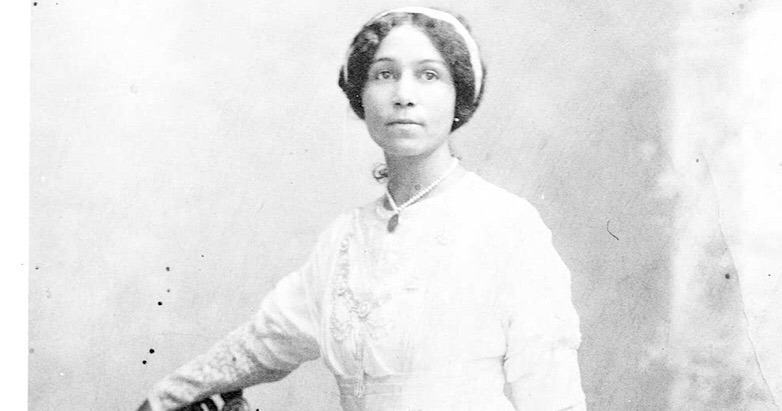
Anne Spencer Wedding Picture

Anne Spencer’s wedding portrait, at the beginning of the 20th Century, 1901.


Arbitrary choices—useful sometimes in art. Likewise, they might help people to create businesses or new testable scientific propositions. In art we might own up to them, examine them. Can we do the same in life?

I made an arbitrary choice to lay off the string parts for today’s audio piece—organ, piano and acoustic guitar instead. To hear “Before the Feast of Shushan”  use the player.


The Fox

My son, now a teenager, is aware that I have a blog, and that it deals with poetry somehow. Limited by his parents in his computer time, and pressingly interested in the other things he’s discovered, he doesn’t listen to it.

But he does want to be helpful. Earlier this month he suggested by asking: “Have you used any poetry by Kahlil Gibran? Have you heard of him?” One of my son’s teachers is from Lebanon, where Gibran was born, and Gibran has come up as a famous Lebanese-American.

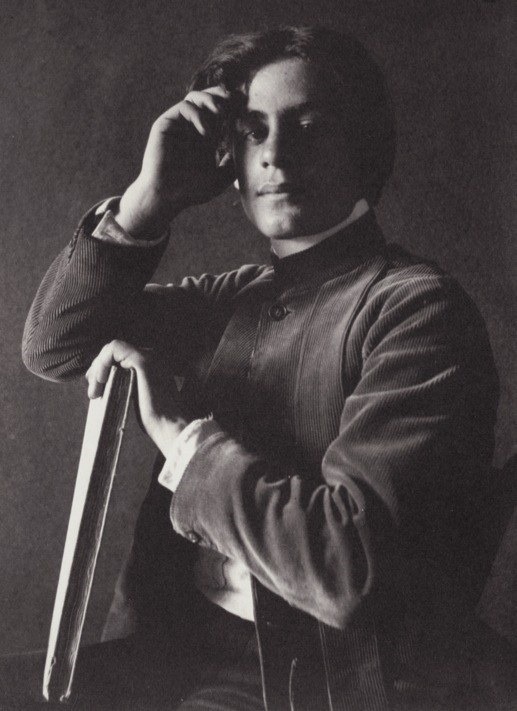
Khalil Gibran by Fred Holland Day

Note the art portfolio, the young Gibran’s aims were as a visual artist


Had I heard of him? Yes, I recall buying a copy of “The Prophet”  as a somewhat older teenager in a bookstore. I think the edition may have included a now disputed quote comparing him to William Blake, and that may have accounted for my purchase then.

Over the decades since it was published in 1923, my decision to purchase “The Prophet”  has been replicated millions of times. It’s an extraordinarily popular book, and not one that achieved its popularity by a burst of sales, but by remaining intriguing to readers for 95 years. Nor am I alone in seeking to combine Gibran with music, as it’s been done more than once already, with everything from a borrowed Gibran line making it into John Lennon’s “Julia”  to the as far as I know unacknowledged connections to Queen’s masterpiece The Prophet’s Song.”

I remember reading that copy of Gibran’s “The Prophet”  in an hour or so later that day. My dorm-roommate read my copy too, but I remember he was puzzled that I had read through it so fast.

Unlike many readers of “The Prophet”  I had some background. As a young person I had substantial interest in various kinds of occult, spiritual and mystic writings. Gibran in “The Prophet”  didn’t impress me as being very good of type. The stilted sort-of King James Version English seemed effected, the matter it tried to convey seemed newspaper horoscope vague, and the typical trope used to express that matter was a litany of everything is it’s opposite.

That was my opinion as an 18-year-old. It has changed slightly as I briefly revisited Gibran this month in search of something I might want to use. First, I have a much greater appreciation for the struggles of those that try to bridge the culture and language of their birth to the culture and language of their new homes, and in the sections of Gibran that dial-back the hazy mysticism I can now read some elements of humor and satire that I missed on first encounter. I wonder how Gibran’s works in Arabic read to a native speaker. Did he present a different face and voice there than he did to English speakers in America? And what I’ve seen of his artwork does have a Blakean tinge, a combination of classical line with esoteric and romantic subject matter.

Illustration_from_The_madman by Gibran

One of Gibran’s illustrations for “The Madman”


Today’s audio piece, “The Fox”  comes from Gibran’s first English language collection “The Madman.”  As parables go, it’s quite applicable to the daily grind of creating these pieces. It may not be the camel I set out for, but hopefully it’s a delectable mouse.


Poetry in Translation

I remember reading about this some years back, and found it fascinating then. In my memory it was the American poet and critic John Crowe Ransom who was the teacher, but in searching this week for more detail, the perpetrator named was English poet and critic I. A. Richards. My memory still says Ransom did something similar, but let’s stay with Richards since I can verify it.

The time frame is the 1920s. The Modernists (due to painful copyright laws, the newest poets whose work can be freely used here by the Parlando Project) had begun their ascendency into the mainstream of English language poetry. But the Victorian era, including the later work of the Romantics and the whole of the William Morris/Pre-Raphaelite revival that preceded the Modernist revolution was not that long ago, within the memory of teachers and critics alive then, like the post WWII era or “The Sixties” would be today. The Romantics had been a revolution in how poetry speaks, and those that followed them took different paths from that revolution, and now the Modernists proposed a counter-revolution, once more changing how poetry speaks.

Had poetry, in some Platonic ideal state, it’s essence, changed; or had only the language and form it took to express its inner nature changed?

In such at time, the question of aesthetics, of what constitutes poetry and what are (or should be) its goals and effects, would naturally come to the fore. If one is a teacher, one might examine this by teaching, and so Richards devised an experiment. He gave students at Cambridge, a leading English university, a packet of poems which were without the names of their authors or any context about when they were written—they were even without their titles—and asked the students to write about them, to interpret them. I’m not sure if he presupposed what the results would be, but summaries of the experiment report he was surprised at the results. Their interpretations were poor, and often included what he knew to be misinterpretations. The students often resorted to personal experiences or rote sentimentality to explain the poems. As a result, the interpretations of the poems varied considerably as they missed their mark in different directions.

You might think, “Well, duh!” In subsequent theories of literature all these effects have been explained and codified in multiple ways, but at the time, in the 1920s, this was a new finding. Richards thought this showed a failure of literacy, defined as a kind of higher literacy; not the inability to read basic English, but to read and understand the kind of associative and musical language used by poetry. He spent his life trying to remedy this by teaching. In 1979, while in his eighties, he was still teaching, in China, when he fell ill and died. He wrote a book, titled “Practical Criticism”  setting out ways to properly read and derive the effects of a poem.

John Crowe Ransom and I A Richards

Know your Modernists: John Crowe Ransom, I. A. Richards, and two other blokes who don’t know from The New Criticism


But the way I heard of the experiment (and this may have been a subsequent experiment, inspired by Richards, perhaps by Ransom) the packet of unattributed poems given to students to interpret included a range of “not great poetry,” pop poetry as printed in mass-market publications as well as the work of more esteemed poets. And the result was the students couldn’t reliably distinguish the great poets from the hacks.

The challenge of the new poetic language of the Modernists, and the experience of teachers like Richards and Ransom demonstrated in this experiment with unattributed poems, lead to what was called “The New Criticism.”

When, a generation later, I began to encounter poetry in school, “The New Criticism” was by far the predominant idea of how poetry should be taught. At the end of my scattered schooling, new theories were arising, Deconstructionism and the like, and I can still recall professors muttering about its willful misunderstandings and mistaken goals as I struggled for money to pay for one more class that would fit into my work schedule.

Now in this century, I know less what happens in schools, but I sense culturally we’re concerned increasingly with the poet as the container that holds the poem and its experience. Some worry about “Identity Politics” and its correlate would be “Identity Poetry,” where the background, ethnic and otherwise, of the poet is integral to the poem. I’m too busy making art to have a coherent philosophy on this. I can easily envision problems arising from a division of poetry into ever smaller spheres where only the right combinations of ingredients can make or appreciate some work. On the other hand, I’m also suspicious of the motives of anyone who claims to hate Identity Politics or Identity Poetry, while showing no interest otherwise in smashing the walls and peeling off the labels from artists for whom those “stick to that” labels and barriers may not be self-chosen.

Oh my, what a long introduction to today’s audio piece! In honor of Richards and Ransom and their experiments, here’s a piece I call “Poetry in Translation”  for the purposes of the experiment. I’m not going to give you any more context for the poem used, the author’s name or their ethnic identity. I assure you I’m not in this for “gotcha” or obscure literary one-upmanship. It’s short, so give it a listen and see what you think. I’ll be back later this week with more.

Help grow the audience and alternative ways to get the Parlando Project

I enjoy making these pieces and talking about the process that leads to them. If you’ve ever come across a post here and pleasantly thought “I didn’t know that,” well, I likely had that same experience, sometimes just a few days before you did. Similarly, if you’ve ever listened to one of the audio pieces and enjoyed music and words illuminating each other; well, I’ve spent hours composing, playing, recording, and mixing it—heard parts of it up to a hundred times—and I enjoyed doing that. I’m not bragging there. As my own “producer” I’m well aware that I’m pushing my limits as a musician in making these pieces—but why go to the trouble if you aren’t making music that you, the musician, want to hear?

Well yes, I know one answer to that question, but we’re not a commercial enterprise. We don’t do sponsorships or ads. I do this to hear these poets and writers in a new way and because I’m attracted to the stories surrounding the words. But when I do those things, I’m often thinking about you too,  listeners and readers, the folks who pay us not with money, but with your attention.

I can’t say enough about how much I appreciate that.

As we near 200 audio pieces published, I’m looking for that audience to increase this year. I know we’re quirky, but so’s this modern world. Variety has been a goal from the start, so I expect that some episodes/posts/pieces will be more interesting than others to any individual reader/listener. I intentionally do that, because I find there’s often no delight without surprise.

So how can you help this audience grow?

Well, read and listen, though you’re already doing that, and you don’t need to do anything more.

Hit the like button if you like something. It’s a little thing, it’s become an Internet cliché, but it may help some for folks finding us, and it always gives me a good feeling when I see those icons at the bottom of the post.

Subscribe. There’s another term that’s become cliché, but there’s no cost or obligation to do it. I use the subscribe feature for blogs I’ve found interesting even for a portion of their posts, because it helps me find those posts of interest more easily.

Subscribe part 2. The Parlando Project started out as a podcast, where the audio pieces you see at the bottom of most posts can be automatically downloaded to your smartphone, tablet, or computer. Again, there’s no subscription cost. As a reader of this blog you’re “insiders,” and you get more information on the audio pieces, but we still have more listeners via the podcast than listener/readers here on the blog. The podcast audio is the same as what you get on the blog, but it comes to a subscriber automatically. You can find the Parlando Project on Apple Podcasts/Itunes, Stitcher, Google Play Music, player.fm, and many other podcast sources/apps.

Subscribe part 3. Since the beginning of 2018 we’re on Spotify, though with a footnote. The Parlando Project is in Spotify’s podcasts section, which is gradually being rolled out to the various Spotify apps. Only the most recent Parlando Project pieces are in Spotify’s listing, but it looks like you can add a Parlando Project audio piece to a Spotify playlist.

Yes, I’ve considered getting at least some of the audio pieces on “regular” Spotify or other popular streaming music services, but so far the costs and time to do that are stopping me.

Use the social media buttons. At the end of each post there are buttons to use a variety of social media platforms. The time producing the Parlando Project keeps me from all but minimal time on these platforms myself, but when someone does do this, it seems to help other people find us.

There. Now back to what we do regularly. Here’s one of the first audio pieces posted here back in 2016. “Angels in the Alley”  is a bit longer than what’s become our average, and I like to think our audio quality is getting better since then too;  but “Angels in the Alley”  is also more of a narrated spoken word story than others. What’s the  story? The death of English poet and artist William Blake, and how it connects with this famous rock’n’roll video clip. Ever wonder what Allen Ginsberg is gesturing about in the background at 1:35 into this?


And here’s the LYL Band with one theory:

Dunbar

Here’s a piece using an outwardly modest poem by a modest poet, Anne Spencer. It spoke so quietly to me, that at first I overlooked it when I was reading James Weldon Johnson’s seminal “The Book of American Negro Poetry”  anthology, which included it. Just a few weeks later I saw a small story online about her exemplary life as a behind-the-scenes civil-rights activist, which mentioned that she was also a poet.

From it’s title we know she is following one of the Parlando Project mottos: “Other Peoples’ Stories.” When the poem utters its refrain “Chatterton, Shelley, Keats, and I…” that “I” is to be understood as Paul Laurence Dunbar, who was at that time a decade dead at the age of 33, but who was still the most famous Afro-American poet.

Long-time readers here have already met up with Dunbar, and Shelley and Keats require little introduction to those acquainted with English verse. That first name, Chatterton may draw a blank however.

Thomas Chatterton was the most famous failure in 19th Century English literature. A poor boy with pluck he had tricked his way into a modicum of fame by pretending to be the discoverer of a tranche of medieval poetry by a Thomas Rowley. To keep the pot boiling and to engage in the roiling politics of the day, he wrote journalism and opinion pieces under more than one pseudonym, as well as further literary works. The gig economy of his time was not kind to Chatterton. At the height of his career, he would earn about $9 in current dollars for his longer articles. In contrast, writers of our last post’s Burma Shave’s jiggles were paid over $800 in today’s money.

So how does Chatterton make it onto Anne Spencer’s words for Dunbar?

Chatterton was doing all this as a teenager. Fatherless, broke, starving, seemingly at the end of his resources, he took a fatal dose of arsenic and died in his garret. He wasn’t yet 18.

Death of Chatterton by Henry Wallis

Morbid it might be, but “The Death of Chatterton” was a popular and often reproduced 19th Century painting
Given its time, social media was not blamed for his death, but political and class prejudice was.

.

A few decades later, the British Romantics grab on to Chatterton’s case as the perfect example of rejection of the beautiful by the unperceiving. Keats, who was himself tagged as a low-born pretender writing “Cockney poetry” in “uncouth language,” wrote a sonnet to Chatterton. The too-little-appreciated-in-his-short-life Percy Bysshe Shelley, exiled from his culture for radical political and social views, writes “Adonais,”  the now famous ode on the death of Keats at age 25. In it, Chatterton is met on a heavenly throne “Rose pale, his solemn agony had not yet faded from him” as he greets the now dead Keats/Adonais.

Note here the unperceiving in each case has something to do with politics and class prejudice.

And now we return to Anne Spencer. At age 11, the legend has it she was barely literate, six years later she was the valedictorian of her graduating class. Two years later she married and settled in Lynchburg Virginia. Eventually she wrote while raising children and working as a school librarian. In 1918, she helped found the local chapter of the NAACP. Her home became a waystop for numerous notable Afro-Americans traveling in Virginia (“Jim Crow” laws would have segregated public accommodations). James Weldon Johnson (one of the founders of the NAACP) was one of those visitors, and finding that Anne wrote poetry, he helped her work get first published in 1920.

whites only smaller

Two “Whites Only” signs from the Diane and Alan Page collection.
Homes like Spencer’s were important facilitators for Black American travel.

.

Spencer was nearly 40 years old before that first publication. Clearly not the live fast/die young sort. In 1922 when Johnson published the first ever anthology of Afro-American verse, Spencer was included, along with the obvious choice of Dunbar himself. Concluding his introduction to that collection, Johnson said of Spencer’s verse that she was “The most modern and least obvious in her methods.”

“Dunbar”  demonstrates that. Shelley’s “Adonais”  is hundreds of lines. Spencer’s “Dunbar”  is five. Shelley will tell it, repeating and restating his theme in stanza by stanza of glorious English Romantic verse. Spencer’s “Dunbar”  sits quietly, in the midst of this history of poets who died young, whose voices were muffled by prejudice before they were stilled by death. It’s just one chorus. She groups them, tells us Paul Laurence Dunbar found himself with them, a statement of quiet, powerful, assertion.

Perhaps you need to know this history to appreciate the power of that, that “Chatterton, Shelley, Keats, and I” isn’t some arbitrary listing, a line that happens in a small poem talking about a poet—but it’s good to know history, it’s good to have a Black History month, it’s good to know that Keats and Shelley, who now are hallowed in our textbooks, weren’t greeted as worthy poets by their times. It’s good to know that one woman around a hundred years ago in segregated Virginia, quietly but eloquently wrote, and steadfastly worked, to assert a different world.

To hear my performance of Anne Spencer’s “Dunbar,”  use the player below. Don’t see a player? This highlighted hyperlink will also play it.

Shattered Visage

The place of short epigramic poetry in our culture, and just a touch of Percy Bysshe Shelley, combine in today’s piece.

When people seek to stop the expansion of poetry in definition or in practice they will aim and fire at certain targets. If you look closely and slowly, you may see the bullet holes with their worn, rusting lips frozen in mid-kiss.

“Song lyrics? When you see them on the page, you can surely tell they aren’t poetry. And what about advertising jingles then?”

I’ll reply that it’s true that we don’t know if Sappho was a copywriter for hire, or worked independently—and frankly, the advertising jingle has passed into disuse anyway. One benefit of aging is that one can remember lost, golden ages when the rustic bards of old sang along the roads.

I speak of course of that mid-20th Century, Midwestern American Greek Anthology presented by Burma Shave. We know only the fragments of their work that scribes have preserved in illuminated HTML, but did these jingles really harm mid-20th Century poetry much?

I think not.

Here was the scheme: an insurgent company that made shaving cream in Minneapolis Minnesota took to the idea of a series of small signs, enjambed with the broken lines of an epigramic poem, signed-off at the last sign with the company’s logo: its name in white flowing script. Cars sauntered on narrower roads in those days, roads that went farther between cities that had yet to leak out suburbs and housing projects. Car radios were an option not ticked off by every frugal buyer, and the boredom on the two-lane was an advertiser’s opportunity. Huge billboards, the epics of the roadside, might have pressed the budget of the Burma Shave company, but those little signs in series were another matter. Poetry, then as now, is a bargain.

Burma_Shave_Signs_by_highway

Poetry in motion, Burma Shave signs in use, circa 1940.


And to us, the naïve backseat riders with no tablets or Gameboys, we could hope then the horizon might give us that initial red sign and line of verse, followed by their episodic reveal, their enforced caesurae.

Perhaps the poems imagery or significance did not equal Elizabeth Bishop or Wallace Stevens, but the experience—yes!—was exactly what poetry should deliver. It comes on us, with expectation, but unpredictably. It reveals itself, in time marked with intervals that tell us it is indeed time. And in the end, it pleases us in a way that the passage of a mere Pioneer Seed Corn placard or another end-of-lane mailbox cannot.

Its motives may not have been artistically pure, but we didn’t care.

Commercial motives are as fragile as Olympian ones. Around 1960, Burma Shave was sold, and the brand discontinued. The placement of new signs stopped, and only in places where no one cared to groom the roadside did they remain to gradual ruin.

Years later I would move to Minneapolis, and eventually I would fall in with some folks who created a literary magazine that wanted to celebrate the inescapable, unpretentious—yes, sometimes commercial—main drag down Phaeton’s east-west path of the city. They called the magazine “The Lake Street Review.”  Down that street I would often bike or drive past a nondescript building, just before the freight-railroad tracks, just before the shopping-and-buying mall built were Minneapolis-Moline once built tractors. When it was built, this building had been a church, but as the area became industrial in the early 20th Century, the building became, for awhile, the headquarters, the factory, the Parnassus of Burma Shave.

Save the (Burma) Shave

The ex-Burma Shave building on Lake Street as it appeared in the 21st Century


I don’t know if any of us knew that. I only found out as they planned to tear it down, which they did. As the workman did a workman’s job, in the midst of the ditch of lathe and beams, a red sign with cursive white letters was found at the end: “Burma Shave.”

Weckage of Burma Shave Building

“on the pedestal, these words appear…” After the Burma Shave building was torn down.


Musically, the LYL Band performed “Shattered Visage”  a couple of years ago, but I share it now after this week’s presentation of Shelley’s “Ozymandias.”  As I said Monday, I read “Ozymandias”  without bringing out the pathos in the the impermanence of human achievements, choosing instead to emphasize time’s judgement on tyrants, but in “Shattered Visage”  my parody turns to the former. One other link to “Ozymandias:”  remember Horace Smith, the second-place sonneteer who also wrote an “Ozymandias?”  He entered into literary circles with a spoof he authored along with his brother, where they imitated all the most famous poets and orators of their time, including Lord Byron, who supplied an admiring blurb when the collection was published.

To listen to “Shattered Visage,”  use the player below.


I mention Rupi Kaur in an attempt at getting more followers

I refer to it less, but this ongoing Parlando Project actually causes me to spend more time with music—composing, playing, recording, and mixing it—than with the words. The words, of course, are mostly poetry, as condensed expression is so often found there mixed with musical devices in word form.

I’m not alone in thinking there’s a natural connection there. Perhaps that’s why you’re reading this, rather than a blog on cinema, graphic novels, or the interesting things I did last night. From what comments I get, the words, mostly poetry, are the larger draw and concern—or it may be that it’s easier to talk about words and their potential messages than it is about music.

But speaking now of America and the English-speaking musical world, what if it largely functioned in this manner…. Insert woozy musical cue here indicating we’ve moved away from our mundane current world into some speculative alternate reality as a new voice takes over this blog:


Music is a sublime art, which alas is much ignored and misunderstood by most people. Oh yes, there are occasional times when folks seem to pay some attention to what they think is music, but in fact it’s not really music they are listening to. For someone younger than I, it seems it’s always been so. How did this happen?

In my youth there were people who listened to a highly commercial aggregation of “musicians” who went under the name “The Beatles.” In their unsophisticated way The Beatles would bash away for a couple of minutes, never showing the development and dynamic range of actual music, and then they’d publish their “songs” on recordings that would be played on abysmal “record players” that were aptly named because they could only spin the vinyl record at something approximating the correct speed and could only transduce the rude noise to an even cruder racket. The Beatles, to be honest, weren’t the worst of those “pop musicians”—they were Stravinsky compared to some others in their field—clearly actual musical quality was beside the point.

Perhaps I shouldn’t object too much now to this commercial enterprise once undertaken by those naive or craven young men back in the 1960s, but what happened next was worse. Some actual musicians and musical critics started to give them big heads, and as a result, even worse crimes were committed. Throwing aside centuries of established artistic criteria, these commercial appeasers called what The Beatles and “pop musicians” were doing music. They would search for even a hint of actual compositional intent or accomplishment in these works, and praise them if they could pretend they found it.

Soon, The Beatles started to tack on elements used by actual musicians in their recordings. It was all transparently fake, and perhaps I should find it strange that even audiences ignorant of what real music is and can accomplish allowed it was art rather than pathetic pretense. And so, they presented recordings with string quartets, when none of them knew so much as which side of the bow to apply to the strings. They made fraudulent representations of actual music, using paid studio technicians who modified their feeble attempts at playing music so that they sounded profound to those “listeners” who didn’t know any better.

And now as I survey what could otherwise be our musical landscape and see young people who “listen” to what they “think” is “music” while playing their “video games”, dancing their interminable “dancing,” “streaming” it on their “phones” ( that they actually don’t use to make phone calls on), while “Tweeting” and “Instagraming” with tiny screen keyboards that make it hard to enclose every other word with quote-marks like an intelligent person.

I said I should be surprised. I take that back. In a world that has given us Donald Trump and Brexit and inconsistent intra-city train service, we cannot count on most people to have an authentic understanding of what they’re missing when they call such things music.

7-8th of Alban Berg is invisible

Now you know.


But let us, the intelligent critics who understand art and its important criteria, acknowledge the consequences of this commercial folly. Now we have people claiming to be musicians who do not play instruments, save perhaps for something called a synthesizer (a name like something from Aldous Huxley), a sequencer (gene therapy?), or drum machines (oh, such industrial nomenclature invades art in our year of Ford). They don’t know that 7/8ths of an Alban Berg is invisible, they can’t tell their krummhorn from their sackbut. When asked to defend this false and phony “art,” audiences say they “enjoy” it.

And while this pretense continues, actual musicians—people who create and perform complex compositions that take years of study to create, and nearly as many years of study to understand, are ignored.

Since when did enjoyment have anything to do with the sublime art of music?


Reprise that spooky musical cue that says we now return to our real world, and to Parlando – Where Music and Words Meet. Yes, our real world has musical snobs and exclusive musical passions, but in general, those haven’t harmed the ubiquity of music in our culture. Yes, musicians who produce music that challenges your expectations, usually have a harder time finding an audience, but a broad-based, vibrant musical culture has always allowed some of them to sneak in to a wider listenership, not prevented it. And musicians tend to be sensualists more than aesthetic puritans.

What can poets and literary critics learn from musicians?


(As to the title and occasion for this satire, an article has caused some discussion lately in poetry circles.)