Parlando Spring 2018 Top 10-Part One

As I’ve done most quarters, I like to look at the most played and liked pieces during the past season and report back here. Usually a few of the results surprise me, they aren’t always my favorite pieces or even the ones that I think came off best.

I do this in classic countdown fashion, so we start off with number ten and move in the next few days up to the number one. The audio pieces for the Parlando Project can be consumed a number of ways. Some listen to them here using the audio gadget on the blog, but others listen by subscribing to us through any of the leading podcast services. The audio pieces are the same, but the blog allows me to write about the pieces in a much richer manner than I can with any of the leading podcast services. However, if you, or someone you know might be interested in just the music and words, this is a handy way to get them on your phone or other handheld. So, if you just want the tuneage, search for Parlando – Where Music and Words Meet on iTunes, Spotify, Google Play Music, or any of the other podcast services. You should find our audio pieces in their podcast sections.

On to the countdown…

Coming in at number Ten is one of the two pieces from May that gathered enough likes and listens to make it, despite having a shorter time frame to do it in, “Letters to Dead Imagists and A Pact.”  I often like to look at who influences the writers we feature here, and this piece lets me do that with short poems from two poets: Carl Sandburg and Ezra Pound. Sandburg tips his hat first to Emily Dickinson and Stephen Crane, while Pound, rather grudgingly, acknowledges Walt Whitman. Despite being contemporaries with similar lifespans, despite both having connections to the American Midwest, despite Sandburg’s use of the early 20th Century Modernist/Imagist poetic practices as promoted by Pound; these are two very different men outside of their work with pen and typewriter. Interestingly, it’s Sandburg’s work that has an obvious Whitman influence though it’s Pound that points to him. Though Pound thought Whitman too careless in his craft, he’s the one that chose to give Whitman his due here.


Speaking of Imagists, at number Nine, we have the poet Hilda Doolittle and her “The Pool.”  Pound acted as a high-handed branding consultant would with  her, reading her poetry and then scrawling at the bottom of her manuscript her new brand: “H. D. Imagiste.” Doolittle writing henceforth as H. D. went on to a long career, and I’ve read that Hilda herself didn’t care much for the connotations of her family name anyway. Maybe that marketing advice helped, but early H. D. work like “The Pool” is  striking short poetry mixing concreteness and mystery, so maybe it was an inspired choice to use the short and less defined H. D. for a pen name.

Musically, I really like what I came up for this one too.


censor smelling woodcut

“Now is a time for carving…” Pound once decried “the exceedingly great stench” of Whitman’s poetry

At number Eight, let’s welcome to our stage the man who Pound said in our number-ten-holding poem “broke the new wood” in free verse poetry: Walt Whitman. What an odd image for Pound to use! In looking at why he might have chosen that image I found out that Pound’s family established itself in Wisconsin by building a thriving sawmill there, so it may be that Pound is liking Whitman to a pioneering lumberman, bold in seizing the ground and resources he found there, while Pound seems to say he pictures himself more as a William Morris style furniture craftsman or perhaps even as a skilled woodcarver.

Three Session men with Carolyn Hester

Straining at connections, because I love this photo so much: folksinger Carolyn Hester once recorded Whitman’s “O’ Captain,” but the 3 session men behind her appeared on many great folk records of the 60s: guitarist, Bruce Langhorne; bass player Bill Lee, father of filmmaker Spike Lee, and in the middle. the harmonica player with the shayna punim cheeks is known to trivia buffs as the father of Jakob Dylan, the leader of the 90’s band The Wallflowers.


Whitman’s “When Lilacs Last in the Dooryard Bloom’d”  is one of a pair of elegies Whitman wrote responding to the assassination of President Abraham Lincoln, and the one I prefer to the other: “O Captain! My Captain!”  regardless of the feelings some have for that other Whitman poem’s use in the movie Dead Poets Society.  Furthermore, Whitman’s lilacs here are one of the reasons that T. S. Eliot’s landmark of High Modernism “The Wasteland”  begins in spring with that very flower blooming “out of the dead land.”


We’ll have numbers Seven, Six and Five coming back here soon. So don’t touch that dial—wait, this is the Internet, you can touch the dial any time you want—but do check back, as we continue our countdown of the most listened to and liked audio pieces combining various words  with original music here over the past season.

The Destruction of Sennacherib

“The Assyrian came down like the wolf on the fold…” This, written by Byron, is one of the catchiest first lines in a 19th Century filled with catchy lines. It’s so good that I remember reading it in high school many, many years ago—and so good, that ironically I recalled nearly nothing else of the poem, not even its title.

I, like many others since, have informally used that image of a mighty force, that wolfpack, totally overwhelming a weaker force, cast as a fold of sheep. So, even though I did not remember the poem, when I read it again this month I thought that opening line summarized what the poem described. In that first re-reading I had trouble following the poem’s plot entirely, though the poem’s rhythm, rhyme scheme, and irresistible forward motion carried me through it with some appreciation. “OK, big bad Assyrians are going to sweep all before them, destroying everything in their path, including, I guess, that ‘Sennacherib’— must be the name of a city.” The poem’s flow moves relentlessly forward, like those Assyrian horse-drawn chariots I think; and there’s death and its all-quiet-afterward corpses—but no real battle, however one-sided, that the famous first line leads us to expect. Did Byron leave something out? And what’s exactly with that last stanza?

Lord Byron plays dress up

Lord Byron in an outfit that only Prince Rogers Nelson could pull off


Turns out, I was misreading the poem. It’s also been a long time since I’ve read the Second book of Kings in the Bible, where Byron borrowed his story. Sennacherib isn’t a city, he’s the king of the Assyrians. In the Bible story, the Israelite king, about to be swept away like his kingdom by Sennacherib’s Assyrian army, prays for God to intervene to save the kingdom, and God RSVPs with supernatural force, wiping out that supposedly unstoppable horde from the famous first line.

Sennacherib

Sennacherib goes out to get some more of that Stronginthearm’s Armour Polish for Gleaming Cohorts


Once I realized that, I could properly appreciate Byron’s middle section, with it’s spooky Angel of Death sensuously breathing in the faces of the Assyrian army as it flies through it faster than any charioteer. And the gloriously grisly image of the dead warhorse whose spume from its last furious race to escape is stretched between its stilled nostrils and the dirt it now lays in.

Yes, Byron races through this story because the mysterious “glance” of God defeating the Assyrian army might be diminished in a mortal’s attempt to describe it, and when Byron jumps to the aftermath, he keeps moving fast, but each detail he chooses to notice tells.

Unexpectedly to me, this wasn’t a story about how the smart money bets, how the unstoppable force is, as we’d better well realize, unstoppable. It’s instead, the story of a miracle.

Besides my initial misunderstanding, I found the poem has another problem in modern performance. Its poetic meter is anapestic, two unaccented beats followed by the strong beat. This is a jaunty rhythm, which whether for natural reasons or from association, sounds to me either like “A Visit from St. Nicolas”  or Dr. Seuss—and neither assists with the mood of this poem! So, I attempted to break up the metrical feet, and read “against” the meter a bit, while keeping the momentum going.

Musically, it’s some guitars mixed with warbling synths, and a keyboard electric-piano bass line this time. To hear the performance of “The Destruction of Sennacherib”  by George Gordon, Lord Byron, come down like a wolf on the fold onto the player gadget below.


Long Guns

Here’s Carl Sandburg again, this time from his 1920 collection Smoke and Steel.   Today’s piece “Long Guns”  is a protest poem of a kind. A few decades later, around midcentury, the folk-song revival in America (which Sandburg had helped to kick-off with his pioneering American Songbag  collection of folk songs) grew a wing that wrote protest songs. Bob Dylan, a man who thought enough of Carl Sandburg to want to visit him as he was revolutionizing songwriting, wrote a few of them himself, even though Dylan once categorized the usual efforts of the protest song genre as “finger-pointing songs.”

So how does one go about writing a protest song or poem? There are probably lots of ways, and some work more often than others. Sandburg, the early Modernist, would sometimes write Imagist protest poems, which is quite a trick to pull off, though the classical Chinese poets that influenced Imagism had figured out how to do this centuries before. “Long Guns”  however, is more in Sandburg’s Walt Whitman mode, what with its parallelism and lists.

Sandburg wants to call attention to the disorder of order established by armaments and guns, but rather than doing this as an essay would, or by leading off with some singular event that will arrest our attention, he starts by addressing an otherwise unidentified someone named “Oscar.”

This is a puzzling way to begin, and I have no idea why Sandburg did this. My guess is that most current readers will just figure Oscar is some random name, and stumble past this, but since I hate to leave specific things unexamined, I eventually had to try to figure out who Oscar was.

It’s likely you’ve never heard of him, but I think it’s Oscar Ameringer, a radical humorist who was styled “The Mark Twain of Socialism.” Ameringer was Sandburg’s contemporary, and both spent time working for Socialist candidates in Wisconsin, though their time in Milwaukee missed overlapping by only about a year. At least to fellow Midwestern Socialists, this call out to Oscar may well have been recognized when “Long Guns” was written.

After this mysterious opening, Sandburg lays out a condensed history of the world, a Genesis story of armed nationhood, a litany of the primacy of guns, speaking too of the long-range artillery that had been part of the new warfare of WWI.

And then, just past midway, Sandburg jumps somewhere else entirely—which is the freedom we allow poetry (as we allow it in music)—to a twisted fairy tale, the payoff. In the end, this is how Sandburg makes his protest point. We are like that child, and we are creating the child in that story.

howlin-wolf

How would Howlin’ Wolf comment on this Carl Sandburg poem?


In performing and presenting “Long Guns”  I decided to throw a frame around it. A couple of posts back I mentioned some other Modernists, largely, but not entirely, separate from the recognized literary Modernists. In the same early decades of the 20th Century, some Afro-Americans were “making it new” with a different lyric language and music, which was labeled “The Blues,” and from which Jazz and Rock’n’Roll and modern popular music draw even to this day. There’s no Ezra Pound or T. E. Hulme to point to here, a name that we can say sparked things off. The Blues’ 19th Century Emily Dickinson or Walt Whitman-like predecessors are barely known as names. I still want to say more on this later, but as a frame for “Long Guns”  I used a blues line I know from the singing of Chester Burnett who performed as “Howlin’ Wolf:”

I wore my 44 for so long, it made my shoulder sore.

What a striking and original line! If Li Po or Pound had written it, we might read it in a literary anthology. A man whose fear or anger he must carry, like a heavy revolver, painfully, always. As it happened, I know this poetic line from Burnett singing it, as the Wolf; where as part of his performance style his voice is unnaturally raspy, his delivery as if spoken by a spirit, perhaps not a normal man. A man who lives where the running of the world was all in guns. Is that a normal man?

To hear the LYL Band perform Sandburg’s “Long Guns”   framed with music in the style of Howlin’ Wolf, use the player below.

Letters to Dead Imagists and A Pact

A few posts back I dropped a performance of Walt Whitman’s “Poets to Come,”  a piece where Whitman precisely states his understanding that he’s shown a new mode for poetry and allied arts, but that this new mode of expression will only be fully exploited and explored by artists in the future.

And of course, as Americans we’re still living in his future. And Emily Dickinson’s future. And Ezra Pound’s future. And to a degree we have yet to acknowledge, we’re living in Charley Patton’s future as well (more on that last one later).

So, in “Poets to Come”  Whitman foretold his legacy, but did Pound and the other founders of modern poetry in English fully acknowledge their American predecessors? I’m not sure, this is an area I haven’t studied yet. I’ve already mentioned in earlier episodes that Pound and his British allies seemed eager to point to modern French as well as ancient Greek, Chinese and Japanese influences in their Modernist verse.

Could Pound have been embarrassed by his American origins? Could could Englishmen T. E. Hulme and F. S. Flint have sought to emphasize the continental sources of their new aesthetic to compensate for their decidedly non-posh class status? That would be rash for me, who is not a scholar in this field, to claim on speculation. The strongest evidence in Pound’s case would be that as a man living outside the U. S., his cosmopolitan outlook was well-earned by his travels. Being drawn to the work of LI Bai or Sappho, or the French Symbolists requires no apologies.

Modernists who remained in America may have voted with their (metrical?) feet to more frankly explore the 19th Century American roots of modern poetry. A personal favorite of mine, Carl Sandburg certainly did this. That some of Sandburg’s longer poems sound too much like Whitman’s word-music has, I believe, disguised the degree that Sandburg was a committed Imagist, capable of writing spare, no-wasted word examinations of present objects in the Imagist manner. In his no-less than duality, Sandburg was the first successful poet to combine the innovations of Dickinson and Whitman.

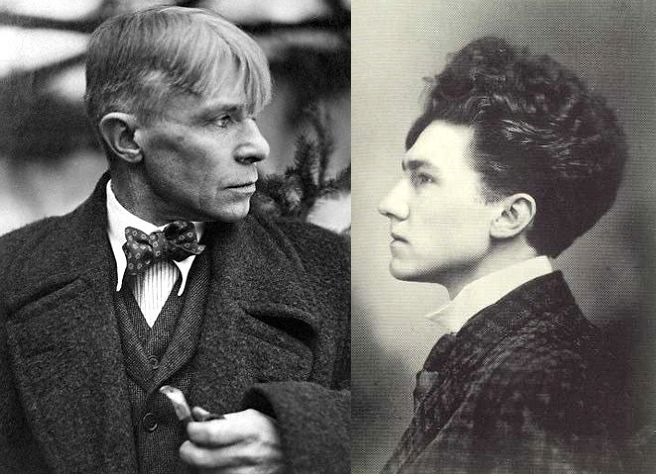
Young Sandburg and Pound

Young Modernists in suits: Carl Sandburg and Ezra Pound


Today’s piece combines two short poems, the first by Carl Sandburg and the second by the indispensable Modernist promoter Ezra Pound. Sandburg’s part “Letters to Dead Imagists”  speaks fondly and perceptively about Dickinson and then moves on to tenderly remember Stephen Crane as a poet, who, like Sandburg, tried to combine Whitman with Dickinson. By calling them Imagists, the term Pound used to promote his “make it new” style of poetry, Sandburg is directly endorsing their claim to being pioneering Modernists.

In the second part “A Pact”  we move on to Ezra Pound’s altogether more cranky voice, where he allows that Walt Whitman had broken “the new wood”, as if Whitman was some sawmill man who had roughly hewn some timber, which he contrasts to his, Pound’s, task and skill, which is to carve it artistically.

Chipewa Falls Water

Know your Modernist family trivia: Ezra Pound’s grandfather started this bottled water company


I’m unsure how much Pound knew about Whitman’s background, so when Pound talks about the “pig-headed father” I at first assumed that famously stubborn Pound was only projecting his own considerable intransigence onto Whitman. But the poem’s closing image, an extended riff on wood and timber, indicates that he may have known of Whitman’s father’s trade as a carpenter. Pound’s own family had connections with the lumbering industry. So in the end, when Pound proclaims that he and Whitman share “one sap and one root” he’s allowing they share the American grain.


The Black Riders XXXIX

In my episodic way here, I’ve touched on the rise of Free Verse in Modernist poetry. Free Verse poetry may still be rhythmic and musical, but it follows no strict meter, nor does it use any rhyme scheme. Now an established tradition, it came to poetry written in English in a non-straightforward way.

I think we can largely assign this happening to Walt Whitman, the American who was writing verse with eccentric line lengths and no rhymes by the middle of the 19th Century. Whitman did not immediately gain imitators in English, but French poets like Jules Laforgue took up the cause of Vers Libre later in the century. In Laforgue we can see a direct link from Whitman through his pioneering French translations of the American’s work.

The main thread of the Free Verse revolution for poetry in English then jumps to England, where before WWI Britons F. S. Flint and T. E. Hulme made common cause with American ex-patriot Ezra Pound. Pound must have certainly been aware of Whitman (more on this later) and though I’m unsure if Flint or Hulme knew of the American poet, all three shared an interest in Modernist French poetry.

I can only surmise, but in starting their Free Verse revolution, it may have been advantageous for this small group to present this as a French idea rather than as an American one. At the beginning of the 20th Century, France was an established cultural force, a place from where new intellectual and artistic ideas were expected to emerge—and in painting and music Frenchmen were the leading edge of artistic Modernism then in a way that Americans were not yet.

This strange path, from America to Paris to London misses one poet, a too often forgotten writer of Free Verse before the 20th Century, Stephen Crane. As a young man in his early 20s he was introduced to the just-published first collection of Emily Dickinson (1890), and mixing his take on Dickinson’s compressed musings on the infinite with the just-died Whitman’s Biblical cadences and love of parallelism, Crane in 1895 published a collection of short Free Verse poetry “The Black Riders.”  Today’s piece uses the words of one of those short, untitled poems from Crane’s book.

Stephen Crane

Stephen Crane:. He’d written Free Verse when Ezra Pound was still weighing in with sestinas

If, a couple decades later, one of the short poems in “The Black Riders” was to appear in an Imagist anthology, on a quick glance or reading it wouldn’t look or sound out of place, but the pieces in Crane’s collection are not really Imagist poems, not even in the same way that sections of Whitman or Dickinson are. Crane’s “Black Riders”  pieces are too full of abstract concepts and romantic notions—and even though Crane is questioning or mocking these concepts, he’s not presenting the issues through concrete new images as the Imagists would.

It’s interesting to wonder how Crane might have developed if he’d lived a full life, rather than dying at age 28 at the end of the 19th Century. Still and all, here was an American, in America, writing Modernist verse with Modernist attitudes while still a young man and with the 20th Century still on the horizon.

Musically, today marks a return of new pieces recorded with the LYL Band and Dave Moore. The music I compose and play myself can be created over a varied length of time, and in whole or in part, reconsidered and redone. The LYL Band on the other hand, just goes.  When we did some recording this week, Dave told me he was waiting for another instance of us starting off something with no more than my announcing  “G Minor.” Today’s Crane piece “The Black Riders XXXIX”  is not particularly complex or unpredictable musically, but we needed to knock off the rust. To hear it, use the player below.

Anglers

Next weekend is the Minnesota sport fishing opener. Today’s piece, “Anglers”  is appropriate for that—but to that opener I’ll bring 8th Century Irish monks, a strange airship cosmology, a Nobel prize winner, and tenderly, a pair of brothers.

I wrote the words for “Anglers”  combining two things, one biographic and one literary, mixed with some phrases that occurred to me.

The biographic? My grandfather died when my father was a young man, shortly after I was born. My father had four brothers and a sister, and the youngest of his brothers was only a few years older than I was. My grandfather never lived long enough to teach him much, and so my father helped teach his youngest brother some things their father did not live long enough to do. One of those things was sport fishing. As my young uncle grew up, he and my dad became fishermen of the most avid kind.

Over the next fifty years, the two men fished many places in Minnesota, but most memorably for me, in Canada. Not just on the border lakes like Lake of the Woods, but halfway up Ontario to lakes above the little town of Redditt. Their base there was a rustic fishing lodge: log cabins, outhouses, small aluminum rental rowboats to which they’d attach a 1930s Johnson Sea-Horse outboard their father had bought decades ago onto their flat stern. Their routine: out with the dawn, fish until noon, pull in some inlet, fry up some fish for shore lunch, then fish again until late solstice dark. The poem I wrote doesn’t mention it but I was with them as a child on some of these trips, though fishing was not something I kept up with as I grew up and went East. The two brothers though continued their angling until my father before his death became too frail and sickened with senility to continue.

Johnson SeaHorse outboard motor

“Uncoiling the Sea-Horse.” My grandfather’s Johnson Sea-Horse outboard used by his sons


That’s the biographic. The phrases? I often write, at least in part, in my mind’s ear. Sometimes it’s entire first drafts of shorter poems that are composed there, other times it’s only beginnings or endings, or even phrases that somehow seem to mean to be in a poem. I’ve told myself an advantage of writing this way is that poetry often works best if it’s memorable speech, so composing this way pre-tests things by holding them in memory and seeing if they adhere.

As I get older it’s harder for me to memorize works in process, and this piece had only phrases and parts of the beginning and end stanzas in my head before I started my first paper draft. One of the phrases was the idea of the sport fisherman, the angler, being at right angles to the surface of a lake. Another was a phrase which occurred to me, “lattices of fishes,” which I simply loved the sound of, but it also seemed like unto the vertical angle from the surface of the anglers in their boat.

It was that angle word-play that brought in the literary. The anglers point up and down in their angle from the surface. What do they point to? And lattices, obviously there’s another level under the water-surface plane.

The literary? Seamus Heaney, the Irish poet, wrote a poem I much admired about a story from the medieval Irish annals. The story was some monks at Clonmacnoise in 749 A. D. observed an airship snagged on the tower of their monastery and a crewman of that airship who climbed down from it to free his ship.

Clonmacnoise tower

Clonmacnoise tower. Don’t snag your anchor on the weeds or rocks.


In combining the two, I created a cosmology where the air breathing anglers on the surface of a lake are like angels, or the crewman of that medieval airship, to the barely comprehending fish who are brought across to the airy world. And that echoed the idea I had developed in my head from the anglers pointing up 90 degrees from the surface of the lake in their boat. They are pointing to the heavens, a place we can no better understand than the fish can know about the world of our air-breathing.

And there you are, that’s the entire poem’s metaphoric magic-trick revealed. Yet that isn’t the poem, much less this audio piece that presents it. I still had to work on the language through several drafts, and I may work on it more after this presentation—but the poem and the audio piece is more than its images or its ideas, because a poem and a musical composition are both machines that think with sound.

So, listen to “Anglers”  using the player below. And please, let others know what we’re doing here. I would so much appreciate that.

I Shall Not Care

Here’s a poem by Sara Teasdale, an American poet of the first part of the 20th Century. I was actually planning to drop another piece using words by Teasdale today as part of my April National Poetry Month celebration, but I changed my plans and quickly worked up this one when I found out belatedly that Tom Rapp, songwriter and founder of the “transcendent folk” band Pearls Before Swine had died.

Sara Teasdale. Photograph by Gerhard Sisters,  ca. 1910 Missouri History Museum Photograph and Print Collection. Portraits  n21492

I’ll need to say more about Sara Teasdale later this spring


Rapp loved this poem, and set it to his own music in the 1960s. It was performed on Pearls Before Swine’s first album on ESP-Disk when he was still a teenager, and he later performed it along with his setting of Shakespeare’s “Full Fathom Five”  on another LP in the Seventies. I’ve always loved his version, and Rapp’s work in general, so this is a tribute to him. I didn’t use his music for my version today, nor did I sing Teasdale’s words, as Rapp did beautifully. His version is of course better, but I wanted to do this today anyway.

Musically, classical guitar, two simple cello parts, and a number of South Asian instruments in the background mixed low. They’re there to resonate with the main tones of the guitar and the cellos the way a sitar or Hardanger fiddle does.  The player to hear my version of “I Shall Not Care”  is below. One of Rapp’s versions is linked in in the post before this one.


Good Night Ladies

While performing and posting about T. S. Eliot’s “The Waste Land”  bit by bit this month, have I mentioned enough how artistically revolutionary it was? For today’s section let me talk first about form and then about subject, and I’ll share a little-known episode in Eliot’s life that may have contributed.

I call today’s part of “The Waste Land” “Goodnight Ladies.”  Formally, even today, nearly a century later, a section of a major poem written like this would be provocative. First off, it’s not “poetic” in its language. While there’s a minimal irregular structure from the interjected closing-time refrain of the bartender’s call, there’s no striking images, meter, rhyme, melodic flow, and certainly no “poetic diction” in it. It’s part in the musical structure of this very musical poem is to present a section with no music in its words. While politically and culturally apart from the Dadaists working at the same time outside of England, Eliot’s structure for “The Waste Land”  is to throw in jarring and unannounced cuts in voice and setting. Even sophisticated, educated readers cannot agree how many voices and scenes are present in the “A Game of Chess,”  which this passage concludes. I made it three pieces, three scenes, others think differently. Eliot has already used plenty of high culture references in the “A Game of Chess”  section of “The Waste Land”  before today’s scene: Shakespeare, Ovid, and obscure Jacobean playwright Middleton—but he’s also thrown-in a pop song parody. Now he concludes “A Game of Chess”  with a bit of working-class pub dialog absent of any literary allusions (until the very end).

The speaker, an unreliable narrator, as well as her subject are working-class women. There is no sentimentality. This isn’t a “salt of the earth” bit of condescending or ennobling praise. The speaker is unkind and perhaps duplicitous (the implication is that she will, or has, put a move on the subject’s husband), and her subject, Lil, is a woman described uncharitably as looking “antique” at age 31, after multiple difficult pregnancies and an induced abortion.

The monolog, if not poetry, feels authentic. The depiction of class and sexual politics, is sharp and unstinting. A poet like Carl Sandburg, the radical and newspaperman, could have heard such dialog—but where the hell did T. S. Eliot, upper middle class raised, prep-schooled, Sorbonne and Harvard (legacy) educated, international banking officer, and furthermore, a man with a reputation as stand-offish and diffident toward women—even those of his class and cultural background—get informed enough to write this passage?

I couldn’t let that question go without some research, and I think I found an answer. It’s one of those “this would make a great movie” moments in literary biography. I knew Eliot had taken a crack at teaching school at a boys-only school in Highgate. That’s the start of the story, he taught French, Latin, math, history, drawing, beside duties coaching baseball (!) and swimming. One of his students: a 9-year-old John Betjeman.

Schoolteachers will know what kind of workload that entails. The bank officer job that followed was a relief to Eliot.

Here’s where it gets interesting. Through some connections, he was introduced to the Workers Educational Association. They were organizing college-level night school classes in Southall. Eliot applied to teach Modern English Literature there, and he continued to do this from 1916 through 1919. Since WWI was on, with many men overseas, the classes were ¾ women.

The weekly classes were a lecture followed by an hour of discussion. Regular papers and reading were required of the students.

What was the experience like for Eliot and his working-class students? Surprisingly rewarding for Eliot, and (as far as we know) for the students. In letters home to America, Eliot praised the minds of his best students, singling out several women. In an account he provided for the Association’s 50th Anniversary in 1959, he could still recall one in particular:

“There was one poor young woman who was one of my best students, but was an elementary schoolmistress with a very large class of little children in the daytime and (she)…died, I am sorry to say, of overwork.”

Was Eliot being polite in both his contemporary letters and his remembrance letter to the Association? Perhaps he did gloss over, or was unaware of, the difficulties one could imagine between himself and his students—but he did this for three years, as a second job that was presumably not his main source of income, and each year, he asked to do one more. Each year, he developed a new syllabus covering additional authors for his literature night-students, some of whom stayed with him for his entire run.

Students-inscription-to-T S Eliot 1919

Inscription on a gift copy of The Oxford Book of English Verse signed by his students on the day of Eliot’s last lecture. The longer article about this is a must read for those interested in this little-known period of Eliot’s life.


Was that worn-out school-teacher, or some other night-school student, a model for Lil in today’s portion of “The Waste Land?”  It seems possible. After reading this, my thoughts went to those students, hungry to learn and experience more about literature in the London night speculating of Zeppelin raids. How I wish we had accounts from the students as well! In “The Waste Land,”  Eliot wasn’t going to give us anything he learned about their joys, or any compensations they found for the travails of their lives, anymore than he gives anyone that. We’re left, in today’s piece, with this mean girl’s account of Lil, unsparing in scorn, revealing Lil’s burdens as more of the weight of the timeless waste land on post-WWI Europe. Eliot doesn’t even give her story, told so meagerly, any ennobling literary references, nor any poetry, does he? Just a story in a bar.

Wait. Her name’s Lil. Lillith? Possible, but I think not. How did this poem begin? “April…breeding lilacs  out of the dead land.” And the last line, the one I use for the title of this performance? It’s no longer the recounter of Lil’s life speaking (she who says it “goonight” not “good night”). The voice has shifted again, without warning in this unpredictable poem. It’s the voice of Ophelia exiting to her death by water in Hamlet.

Ophelia by John Millais

Ophelia by John Millais. Almost nothing to do with Eliot and “The Waste Land,” but it’s been too long since I’ve been able to put a Pre-Raphaelite painting in a post.


The reader in this performance is Heidi Randen, who does a great job with the words and keeps me from having to inflict my voice in too many pieces here. To hear it use the player below.

Students Making Audio with the Wordsworths

I do make something of an effort to look for other folks doing something interesting with poetry and music online, and to check out the blogs of folks who’ve commented or otherwise contributed here. I really should be more consistent in doing this, but particularly this month as I’ve attempted to ramp up production of Parlando Project pieces as part of the National Poetry Month celebration, I’ve fallen behind. Come May I’ll have a lot of blog reading to catch up on!

But this one caught my ear just after posting my own attempt at presenting a Wordsworth nature poem. A group of Keswick School students working with Durham University in England have posted a couple of audio pieces connected with William Wordsworth and his sister and collaborator Dorothy Wordsworth’s Lake District observation of nature and the resulting landmark poems. This one has the students speaking about the book of nature and some of Dorothy’s journal entries on the siblings walks. There some nice, spare music added to this one as well.

A second one has an audio piece using spoken word alone to convey William Wordsworth poetry combined with Dorothy’s prose. The blog talks about how the students have noticed new, modern diversions from the contemplation of nature:

As we read over the poems composed by the students, it was fascinating to see how many of them – the majority of the group, in fact – had fixated on the idea of more modern distractions from nature, and in particular, the role of smartphones in quite literally ‘filtering’ nature for us. While William’s poem admonishes its addressee to abandon books and ‘hear the woodland linnet’, the year ten pupils from Keswick School used their poems as a chance to reflect on the need to abandon their phones and enjoy nature in its own right.

I keep asking my middle-school aged son what his generation has decided the rapidly aging Millennials don’t understand and that his generation will have to fix. He looked at me funny when I asked him again this week

. “Is that some kind of Dad joke?”

Perhaps he just doesn’t want to divulge yet his generations secret plans to fix the worst mistakes of those who came before, or maybe he’s still formulating the answer. But one of the time-tested ways to look for answers or better questions is to skip back a few generations and see what someone observed and thought before those now running things made their decisions.

Rats Alley

Continuing in our April Poetry Month serialization of “The Waste Land”  by T. S. Eliot, it’s come time to perform the next section of the poem, which I call “Rats Alley.”

It just happens that this week I got a copy of Martin Rowson’s “The Wasteland,”  a 1990 comic-book riff on Eliot’s poem as if written by hardboiled-detective fiction writer Raymond Chandler and filmed like “The Big Sleep”  or “The Maltese Falcon.”  Rowson notes that in “The Long Goodbye”  Chandler had referenced Eliot’s “Prufrock”  with a character quoting “In the rooms the women come and go, talking of Michelangelo” and having the character ask his detective Marlowe “Does that suggest anything to you sir?”

Marlowe replies, “Yeah—it suggests that the guy didn’t know very much about women.”

Though that’s clever repartee, charges that Eliot was naïve about women or even misogynistic can be difficult to disentangle from his general misanthropy. A female Chandler character may be given more apparent agency than the women in Eliot’s “The Waste Land,”  but both the male and female voices of “The Waste Land”  are frankly damaged and the minor male characters, wraiths and zombies.

Rowson Wasteland1

Sometimes with a dame you gotta show’em some quotations in Greek or Latin.


In any case, Rowson’s comic-book/graphic novel is a lot of fun for fans of Film Noir and Chandler, or Eliot and Modernist lit. His drawings have more in-jokes than a season of “The Simpsons”  watched with a finger on the pause button. And from his notes Rowson supplies in my edition on dealing with Faber and Faber and the Eliot estate, it could have been even funnier if any of them had allowed the comedic-take to use any of the lines from the poem. I laughed often reading the Rowson, but never so much as when he recounts being refused the rights to use the ancient Greek and Latin quotes Eliot dropped into his poem, because Eliot’s rights now include them as part of a unique compilation. That may well be legally sound, but it’s also howlingly funny. Eliot as he wrote his “Waste Land”  was clearly borrowing widely from other authors’ work, because he thought it would show us something new when he put them in another context—the same thing that Rowson’s book sought to do.

Which is also what we try to do here as part of the Parlando Project, show you familiar and unfamiliar words in the context of different music and performance styles.

“We are in Rats Alley, where the dead men lost their bones”

“Rats Alley”  is a dialog, and the two speakers are clearly broken vessels. The woman dissatisfied, depressed, afraid, maybe even unstable. The man, numbed, haunted, unable to express even the short expressions of discontent the woman speaks. When he (once in the poem, three-times in my performance) breaks into the cryptic “We are in Rats Alley, where the dead men lost their bones” I decided to alter the voice, to make it a third voice. She’s asking him to speak, to tell her what’s going on, but she doesn’t seem to have heard him say anything, other than a litany, literally, of “nothing.” And so, I’m portraying the Rats Alley line as his inner torment, his monster, that is heard loudly, but only in his head.

That_Mysterious_Rag_1

“In the rooms the women come and go, digging riffs from Ahmad Jamal”


Rats Alley sounds like yet another reference to some dark Jacobean revenge play, samples from which Eliot has already peppered his poem with. If it is, no one has found that work. Some speculate it sounds like the darkly humored street-signs WWI trench-soldiers hung on their subsurface battle lines. If so, then the last voice, the fourth voice of the piece, an imaginary, comic ear-worm song Eliot has made up, “That Shakespearean Rag,”  could also be an internal voice. It’s sometimes been considered to reference Irving Berlin and Ted Snyder’s “That Mysterious Rag,”  a giant pre-WWI hit with lyrics that say “Did you hear it? Were you near it? If you weren’t then you’ve yet to fear it.” In the hit parade context, the lyrics turn out to be just bragging that this rag is a killer hook “because you never will forget it.” Eliot substitutes Shakespeare in his parody, but is this male voice a soldier, haunted by the trenches and dead comrades to whom old tunes now take on a new context, a sinister edge? It’s a bit of a stretch, but could Eliot have planned to use “That Mysterious Rag’s”  mock-dangerous lyrics as a counterpoint to his scene—wouldn’t that have been a powerful sample!—but was enjoined by copyright issues?

To hear my performance of “Rats Alley,”  today’s segment of Eliot’s “The Waste Land,”  use the player below. You can hear the first section, “The Burial of the Dead”  or the first part of the “A Game of Chess”  section which I performed as “Visions of Cleopatra”  by looking in our previous posts this April as we celebrate #NPM2018.