Before the Snow

Long time readers know that the Parlando Project is largely about our encounters with other people’s words – usually their literary poetry. Poetry, even impersonal or hermetic poetry, is a rich way to transfer experience between consciousnesses. Poetry’s strengths in this transference over memoir, blog post, or informal conversation are largely the strengths of focused beauty – that thing that attracts us even before knowledge, expressed as sound or by novel connections.

Still, these beautiful elements of poetry come with costs, which is why many, most of the time, prefer other modes. Yet, I think the shortness and the compressed incidents of lyric poetry offer a possible compromise. We’re asked to share a little burden, a few minutes of reading or listening, subconsciously absorbing the word-music and linkages, which may in leisure or with mood be extended by re-reading and re-thinking such a small number of lines.

One of the things that caused me to begin this Parlando Project was thinking that a short musical accompaniment might add pleasures to possible serial re-encounters with the words. Is this so? I’m not sure, though I persist in doing this.*

That preamble out of the way, I’m going to look like I’m violating the “Other People’s Stories” maxim that is a principle of this Project, because I’m presenting today words I wrote to go with the music I compose and record – but hold on, I’m going to tell you this is still about a poetic transference across a gap.

Here’s why: once again I’ve been running into things from decades ago as I do my “death cleaning” reduction in things stored away or unlikely to be of foreseeable use. Just last week I moved aside a drum set that had been played by Dean Seal when he was in the LYL Band,** and found under the bass drum a plastic carryall tub with things hurriedly packed up after some gig: a Radio Shack battery-powered mixer, cables, a guitar strap, a cassette recorder, and a few tambourines we’d hand out for audience participation. And more spiral, college-ruled notebooks have come to light. Glancing through one I found a page with 9, untitled, lines – the start of a poem. From the style of the poetry in the fragment I think it’s from the 1990s, but it might be earlier or later. It caught my attention because it seemed to be talking about November in Minnesota in that interval right before the first snows come.

I remember nothing about writing this poem, or what prompted it, but it had some nice word-music and was roughly pentameter. That pentameter made me think I was writing a sonnet, and for some reason left off at this incomplete draft. That night, before bed, with my aching muscles and joints from twisting, bending, and hauling I decided to complete a full 14-line draft.
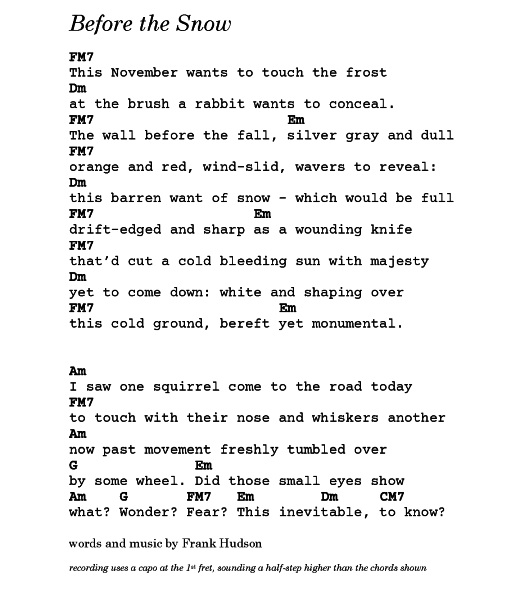
Before the Snow

More musical perversity: the difficulty in finding times to record acoustic guitar with sensitive mics in the past year or so has increased the number pieces I’ve done with that instrument.

.

For the final 5 lines I used an incident from a recent bike ride. Rolling down to a favorite breakfast destination at the borders of my wooded city I’m usually met with a rewarding bit of wildlife (outside of deep winter): constant squirrels, rabbits, small rodents, birds, including waterfowl by a pond and creek I pass, insistent crows, and so forth. If Keats wrote his “Ode to Autumn”  on Hampstead Heath in the Highgate section of the city of London, these near-daily rides of mine with this contrasting nature in the midst of modest single-family houses and parkland is my equivalent. What I saw this day was a little epiphany – a squirrel had been quite recently struck down crossing the road. Not smack dab run over, for it was not squashed, and there was only a little blood – yet it was clearly not moving or breathing, and even from the height of my bicycle its eyes could be seen fixed and dead. And then, as I was approaching, carelessly another squirrel scampered out onto the road and up to the corpse. Though I was riding onward, and only slowed a bit moving to the side, this squirrel bent down right to the head of the dead one, close enough to touch it barely with whiskers, clearly looking closely at it, for a moment regardless of my vehicular approach.

And then, just as I was beside them, it scattered off, missing by accident or close design, my slowed, but rolling, bike wheels. What was that squirrel after, what was it thinking in those few seconds with the dead one? This  was the matter to finish the poem that had started years ago with a rabbit finding scarcely-leaved autumn bush and brush to hide in. And I too had had my customary Parlando encounter without firm context, working with the part of the poem written by someone I hadn’t seen for decades: though in this case, it was my younger self. Not really that different from the usual encounters here with Frost, Dickinson, Sandburg, Millay, Stevens, Hardy, et al.

I originally gave the resulting sonnet the title “Before the Rapture of Snow,”  because I thought that tied-in the rabbit’s anxious waiting and the dead squirrel. I drew back from that thinking it too grand a reach, and because the theological implications of “rapture” would repel, puzzle, or draw in too-determinant reactions.

I was lucky enough to have a Monday to record this, finishing what felt like a good take of the vocals and acoustic guitar just before I had to leave my studio space. I added piano yesterday and mixed the tracks. As a non-pianist I’ve fallen into using that instrument simplistically as I do here, and I’ve grown fond of how these pounded single notes mesh with the timbre of acoustic guitar. You can hear “Before the Snow”  with the audio player below. Has the player been raptured up to heaven? No, it’s just that some ways of reading this blog suppress displaying such a thing, so I provide this highlighted link that will open a new tab with its own audio player.

.

*Besides my lack of talents for promotion, I sometimes feel what I do with this Project presents a number of detriments to gathering an Internet-scale audience. Poetry, as I write above, is not something sought out by modern Americans in great numbers. And then the music I make suffers from these things that reduce audience interest: I’m not a singer with a beautiful voice, nor do I think of myself as a performer with charisma or erotic appeal, and the music I make despite that is both too varied and too limited.

Many potential listeners or readers, presented with an infinite library of options in our modern age, will avoid things that have but one of those strikes against it – and to add another one or two against the Parlando work wouldn’t be rare either.

All this isn’t breast-beating or humble-brag, and I’m even hesitant to waste your time writing this. I am proud of much of the work I’ve done over the last decade here. While my audience is Internet-small, I believe it’s not all that small by poetry standards, and increasingly, not completely outsized by the audience for much non-Pop Indie music. Thanks to my hardy listeners!

**Dean was working elsewhere in comedy, and with at least one other partner in music, when he played in the LYL Band in the 1980s. He was talented and creative, we were looking for a drummer or bass player, and we perversely came upon him as both – unconcerned with the challenges of one person filling both roles! He may have grown to think of us as less professional or ambitious than he was, I don’t know, or events of his life may have intervened, but for reasons unknown to me we just stopped playing together – but this happened without him picking up the small drum set he played with us, and stored at my place. While working on my cleanout this fall I briefly tried to find contact info for Dean to see about the drums, but the trail ran cold after finding articles about him being part of the pastoral lineup at a church that no longer listed him on staff.

Wild Peaches, an Eden with undercurrents

There’s an undercurrent of grief beneath life. I don’t say this as a sentimentalist, it’s just there. This doesn’t preclude joy – it may in fact demand it.

I awoke at dawn today, August drizzle falling. I connected briefly with a livestream of the candlelight anniversary memorial service in Hiroshima,* and then shared a few tears with my living wife. Tears from each of us mixed on my face, shed for my late wife now dead for 24 years this morning. After she left for work, I took to my daily joy and hopped on a bike and rode to breakfast under gray skies without remaining rain.

I usually read the news with breakfast, a long habit – and I still do, though there’s little joy and much sense of loss in it these days. I took an old pocket music player with me (which no longer works except for the radio)** so that I could listen on air to the children of a recently assassinated state legislator memorialize her and her husband killed alongside her. They played their parent’s favorite songs mixed with sharing stories of hearing those songs in the back seat of a minivan while all sang along in flagrant voices. See what I mean: grief demands joy.

Perhaps you don’t. I express myself awkwardly, some will wonder what I’m on about. Let me look at it from the perspective of absent connection: the man who has gained some wealth by bamboozling someone or by force of power, often has the briefest of joys. The one who seeks joy in the suppression of others, has a meagre joy constructed out of a comparison to other’s pain inflicted. Grief for them might be a weakness, a sure sign of submission. I, a nobody in this world of power, can laugh at myself writing this and tell myself I should stop trying to be mistaken for Kahlil Gibran.

Today’s musical piece came about when someone shared a poem by Elinor Wylie called “Wild Peaches.”  Wylie, a contemporary of Edna St. Vincent Millay, gained an audience during the last decade to be called The Twenties. She was born into a successful family steeped in political rectitude, but her love life became a national scandal. She eloped with the son of an admiral at age 20, but soon left him for a married, older lawyer by the name of Wylie.***  The abandoned husband committed suicide after she left him, and the lawyer Wylie and Elinor fled to England and lived undercover under an assumed name. Eventually the couple married and were able to return to the U.S. in time to have that relationship too fall apart.

Hanging out with the East Coast Modernists, the now Elinor Wylie launched her poetry career. The scandals likely helped and hurt that career, but Millay and some other women poets were writing with complexity in melodic verse about eros (and what surrounds it) – and for a while they found readers hoping to understand “the New Woman” of the 1920s. As it turned out their careers were helped and hurt by many of them writing rhyming verse in metrical forms. Even before Modernism, rhyming verse was already becoming associated with less serious poetry, and women writing about eros were judged less substantial than men writing about the supposed important things. The oncoming middle of the 20th century was to be very concerned with important things – many deadly through new bombs or other means.

“Wild Peaches”  was published as a series of four sonnets, and I’ll link the full text here. My performance is only of the first one, which I think can stand alone and is representative. Rewardingly musical, the first impression one might have is of a poem that’s kin to the famous Yeats’ poem “The Lake Isle of Innisfree.”  Instead of an Irish bee-loud glade and house of wattles made, the poem’s voice is describing an Eden, a locus solus, a blessed arcadia, in the south-eastern coast of the U.S.**** But wait, there’s an undercurrent.

This is the poem of a woman who had twice eloped – the second time was subject to an international “womanhunt” – and neither partner stuck. The voice of the poem knows full well flee and exile may the entry and exit point of such an Eden. I love the ironic turn the sonnet takes even within its octet when it goes all Frank O’Hara – though written before that poet or Disney’s Davey Crocket had come into existence – with the man taking to wearing a coonskin cap and the fleeing couture-debutante clad in homespun. The exultation of “We’ll swim in milk and honey till we drown” is delicious, moving from Exodus past the parted sea to drowning.

Wylie in elaborate dress

Elinor Wylie, not wearing homespun fabric


The sextet seems to offer more Eden – but wait, the best season is Autumn, the season of The Fall, and we are left with the abrupt movement from wild fruity abundance to a subsistence bringing death, and a hunter whose shot will not miss.

Oh mercy, I’m going to go all Gibran again: death will surely win one battle, though love can win many battles. That’s what I’ve found – and though she died young, Elinor Wylie later seems to have found her most successful marriage the third time around.

After our last piece where I accompanied my speaking ghost with lots of electric guitar, today’s piece is full of bowed strings: cello, violin, and viola da gamba. In secret I’ll tell you I played most of the string parts for my Carolina Eve in Exile with my MIDI guitar. I’ve taken to calling pieces such as this “Punk Orchestral,” in that I’m not getting overly fancy with the rank and order of calling these instruments up. You can hear my song made from the first sonnet in Elinor Wylie’s “Wild Peaches”  with the audio player below. No player? You’ve not been driven out of the garden, it’s just that some ways of viewing this blog will suppress it, and so I’ll supply this highlighted link that will open a new tab with its own audio player.

.

*For several years after my late wife’s death, I didn’t notice that it happened on Hiroshima Day, but I’ve found that linking a single death with the death of thousands underlines my point about humanity’s shared undercurrent of grief and loss.

**I could have Internet-streamed the children’s memorial radio program of course, but I decided to use the old device because it reminded me of the era I shared with my late wife.

***The imp of the perverse in me can’t help but think of the lawyer’s family name with the animated coyote and his well-funded Amazon Prime account who is none-the-less doomed. We find that funny.

****We can locate this poem’s Eden from its fruits. The wild peaches indicate it’s southeastern as that non-native fruit is only cultivated below the Mason-Dixon line. Wild peaches are the remains of abandoned orchards or animal-carried/buried/excreted seed-pit refugees of cultivated fruit. The poem’s other fruit, scuppernong, is a wild white grape native to the Carolinas.

The Sound of Sense

Today’s piece is kicking off a Summer where I’m going to be doing some different things here than what the Parlando Project usually does. Though the Project’s “usual” varies, the capsule description typically applies: “Combines various words (mostly other people’s literary poetry) with original music in differing styles.” What’s coming this Summer?

I’m not entirely sure yet. There may be more behind-the-scenes stuff, even some “inside baseball” topics about recording, composition, and musical instruments. I think, some personal memoir, a few more peculiar “cover versions” of other folk’s music — we’ll see. I’ve never emphasized those things, so I don’t know how this will work yet. Come September, I intend to return to our regular stuff: writing about my experience of other poets and their poems as the Project moves toward its 10th anniversary. I hope there will still be some things of interest to those who come here for that. For regular readers, particularly those that have followed this Project for a while, I’m hoping you’ll enjoy this Summer’s personal digressions.

I recorded music with Dave Moore last week. Dave and I have known each other since we were teenagers, and we’ve made music as the LYL Band for 45 years. For much of that time Dave was a driving two-handed keyboard player, pounding first an upright piano, then a Farfisa combo organ and electric piano. The Farfisa had grey keys for the bass register, and Dave was often effectively the bass player in the various LYL lineups. Two-handed keyboard players are a tough thing to integrate into the typical Rock band. That kind of playing can fill a lot of the harmonic space — but in some of Rock’s history, guitar voicings are expected to outline the chords. As it turns out, this was OK for me, as I was never a competent conventional rhythm guitar player. Though LYL had an additional guitar player sometimes, I worked out an unconventional role, most often playing single notes and double stops that decorated the chords that Dave laid down, or adding timbral color with guitar effects.

By the turn of the century, we fell into a regular pattern: around once a month we’d set a date. Just before the appointed time, I’d be ready in my studio space and would start to play a little melodic line or spare pattern. Dave would come by a few minutes later, let himself in, and he’d walk up to the keyboard position in the studio space as I continued to play. I’d lean over and reveal the key I was playing in, and off we’d go. I’d have some words ready, a literary poem for Parlando perhaps. Our familiarity bred musical content: I was accustomed to Dave’s keyboard moves, he likely knew mine after all this time too. We’d extemporize a weaved top line. In 2-6 minutes I’d wind it up. We’d say hi to each other. Dave would next hand me a sheet of lyrics. Sometimes with chords, sometimes just some jottings as to predominant ones or key, sometimes just the words. He’d start to play and sing and I’d find my way to play something that I hoped would fit in. That piece would end, and then I’d hand Dave a chord sheet with lyrics to something I had put together. Though sparse, my sheets would be more organized, allotting info for Dave to drive the basic harmonic content for what I would sing and play along with him.

The alteration proceeded as such from there.* After about an hour we’d take a break, talk a bit, and then we’d pick up the rotation for another hour. There would sometimes be partial takes, even (rarely) a “let’s play through it again” request. There’d be short delays as we shuffled through papers, or switched instruments or keyboard sounds, but there wasn’t much deliberation.

What did the recordings reveal afterward? Some trainwrecks certainly. Some searches for inspiration that snoozed off. Particularly in my case, a lot of poor attempts at singing. None-the-less, there’d also be some stuff I’d think worth working with. You’ve heard some of those spontaneous live-in-the-studio takes here.

As it happens, other than their being two alternating songwriters, this is close to how Bob Dylan worked in the studio throughout much of his career — though he worked with trained studio musicians for the most part — skilled folks who could bring a lot more facility that Dave or I can supply.**

Why’d Dylan do that? Well, I’ll have to ask him, though somehow, I haven’t had the chance. My guess is that when it did work, a real sense of something happening in the room among a group of people was transmitted. An exploration. An edge of the seat, this hasn’t yet been formed, a how will it turn out feeling the listener can share.***

Let me repeat myself for necessary clarity: my skillset as a musical instrument operator is such that I think that it doesn’t fulfill the job description of a musician. I won’t impose a summary on Dave, but I think he’d be unlikely to claim high-level musical skills. I do call myself a composer, and Dave has started to call me a producer. I wish I had more skills, but I work artistically with the ideas and actualities I have.

New Studio Space MIDI keyboard

One thing was different last week. For nearly 20 years Dave usually played an older non-MIDI keyboard at my studio space. I may write more about the context later, but I’m thinking it’s time to move to MIDI. Dave has no experience with MIDI and computer instruments, so this will be a journey. I was able to find a good open-box example of this affordable, semi-weighted MIDI keyboards with aftertouch.

.

So, last week, after decades of this, when Dave and I met, I was in progress, playing a guitar riff, and he, on arrival, began playing electric piano. I had set out a drum loop and had a bass track running that hung around the key center. The piece I read as I played my electric guitar was a sonnet, a recent one in my sonnet-series about Alzheimer’s disease and a care-home for those suffering from it — and how we, outside the disease, interact with those within it. “The Sound of Sense”  doesn’t lie: Robert Frost actually did think there was a basic undercurrent in how poetry works — that it’s like how we hear others speaking just out of earshot.

Dave’s not Bill Evans or McCoy Tyner. I’m not John Coltrane or Mike Bloomfield. Some people say I sing like Bob Dylan, but I think on a good day I might sound something like Bob on a bad day. Here’s something I’ve been thinking lately, as successful music gets more produced and marketed from the moment of conception on: it’s still good to have some notes made that don’t know what the note to follow will be. If that next note is unexpected, even “off,” — well that’s better than always knowing what the next note is. And that latest artistic worry: Artificial Intelligence and LLMs? They’re programmed to work-to-rule, creating statistically what you’d expect next.

Two old guys playing live in the studio together. I perform a sonnet I recently wrote that Dave hasn’t heard. He and I weave together in a loose, homespun warp and woof, and unlike a lot of poets reading to music, I spend a minute playing electric guitar at the end, trying to not play the next note that you’d expect. You can hear that performance with the audio player below. No player? You aren’t out of AI credits or something — this highlighted link will open a new tab with its own audio player.

I hope we’re going to have an interesting summer.

..

*When other musicians played with Dave and I, I tried to continue that strict arbitrary rotation — everyone got to start a piece in turn.

**A few years back a huge box-set including alternate partial and unsuitable takes from Dylan’s classic Sixties period was issued. Fascinating, listening to and hearing the outright failures or “just not it” attempts. Given what I know those musicians involved could  do, knowing those failures keep me from utter despair when I listen to a busted LYL take uttered from my limited skill-set.

***Some classic Jazz recordings of the LP era were done this way, though often with a substantial shared mental “book” of structures and cadences for the skilled musicians to rely on. It may be one of those shared illusions, as there’s no strictly technical reason that Kind of Blue  or A Love Supreme  couldn’t have been recorded as most modern pop music is recorded: many instrumental tracks played separately and laid behind featured top-line tracks constructed of many passes collaged together. Those old Jazz records feel like the musicians are breathing together in the room to me, in my mind’s eye I can see them glance at each other — but we can be fooled.

I Dream I Am Falling

This August 6th is the 8th anniversary of the Parlando Project — but it’s also the 23rd anniversary of my late wife’s death and Hiroshima Day. This isn’t the first time I’ve linked these three observations with a single post and musical piece.

Given two-thirds of this anniversary, it’s not surprising that “I Dream I Am Falling”  is about grief and remembrance. It is a departure from the Parlando Project’s focus in that this freshly completed song uses a poem I wrote rather than our regular use of others’ words.

I continue to write poetry, though less often as I’ve aged. I think sometimes about prize-winning poet Donald Hall revealing in old age that he’d given up writing poetry. I don’t recall if he knew why he stopped writing poetry, or if he revealed the reasons for stopping if he knew them. For myself, there are elements of regular life interfering, but throughout my life the writing of poetry was the easiest art to interleave with other busyness. I would compose stanzas in my head, trusting memory retention as a good test of their value until they could be transcribed. Or like William Carlos Williams, I might jot down first drafts on prescription pads in slow worknight moments in the Emergency Department of a hospital.

Remembering that, I think writing poetry is unlike musical composition and recording, which for me is constrained by my life’s current contexts. Looking back I recall that as a younger person I was eager to write down observations from life which seemed to me to be important and unique. Now, in my older age, when I see similar things they seem less unique, and my expression of them less apt, for I sense that life I was once observing has all along been watching me too — watching me as the hunter does.

Still, the reason I set the official launch of this Project on my late wife’s death anniversary was to counter that. Life, the actuary, knows something, but I can sing in the meantime. The reason I sing others’ words in my unkempt voice is that the writers here are already dead, and I can stick my thumb in death’s eye by making their words current. Given that death’s eye socket is empty, that there’s no sensitive eyeball there, this does not stop Death — but it feels good to do it anyway.

Partway into this Project’s course I started to include Hiroshima Day, the anniversary of the first use of atomic weapons, in my August 6th observances. Death of one’s specific partner has an intimacy that sears because it’s so personal, but it’s not unique nor fully shareable. The death of thousands in a way that still threatens us by the millions or more — well, shouldn’t we share that?

Let me take then a tiny digression to this presentation of today’s musical piece. This summer I’ve been watching a 10-hour multi-episode documentary on Netflix titled Turning Point: The Bomb and the Cold War. I’m only about ¾ done with it, and maybe there’s something at the end that I should have waited to observe before writing about it, but I’ve found it so good I want to mention it today. For something of this length, its storytelling is compelling, and it often takes the sophisticated choice of leaping out of time’s lockstep to connect things. OK, it is 10 hours, but also roughly equivalent to a graduate-level course on the Cold War and atomic weapons strategy in the breadth of its concerns and detail.

I Dream I Am Falling

This is an American Sonnet, following my longstanding practice of breaking up the 14 lines in different ways.

.

Now, returning to the new song. I hope it speaks for itself. Many of you, my treasured audience, will have their own experience of grief to resonate with what it sings. I was able to compose and realize it without access to a studio space where I could use acoustic instruments and sensitive microphones. Only the vocal, through a less-sensitive microphone* recorded sounds vibrating in the air as I played the block chords appearing in the left-channel that established the song’s harmonic structure on my little plastic MIDI keyboard. You can hear “I Dream I Am Falling”  with the graphical audio player below. No player seen? This highlighted link is an alternative.

.

*ElectroVoice RE-20. Worth considering for anyone needing to record vocals in a space that is not acoustically proper for recording, where low-level unwanted sounds would otherwise end up on the recording. For my budget level, expensive, but it’s been an important tool for me. No, it’s not magic — louder sounds will still intrude — but the sensitive condenser microphones I use to record with acoustic guitar in my studio-space hear everything: HVAC sounds, louder computer fans, outside traffic, even sometimes footsteps on another floor of the building. In my converted bedroom home office where this was recorded, the studio-space condensers would be highly problematic.

Summer She Has No Lover

I’m presenting a song of summer desire today even as that season ebbs away, but first a little catching-up on the status of this Project for those who follow it regularly.

I planned to produce fewer Parlando Project pieces this summer for a number of reasons. It’s become harder to find composing and recording time, or to focus when it can be found. Audiences drop off markedly every summer anyway, and I had some long-put-off tasks that I thought needed to be attended to. Those tasks? Not even half complete, but a couple of things got done.

I felt I needed to replace the nine-year-old computer I use to write what you read here as well as the final audio mixing and polish for things recorded in my studio space.*   I wanted to keep to a reasonable cost for this replacement, but I also wanted to spec it so that it could last in the roles I use it for, for the rest of whatever this Project’s lifespan will turn out to be. To accomplish this I stayed with my usual tactic over the past 30 years in selecting parts and assembling the replacement computer myself. I did a Ship of Theseus build using some old parts I had, which reduced the cost.**  This new machine is now in service once I installed, configured and re-registered a whole bunch of software that this computer needs to run.

Another task? For more than a year I’ve wanted to deal with nearly 3000 song sheets that had accumulated in my studio space where I record with others as well as my own acoustic instrument recording. Poet, keyboard player, and alternate voice of this Project Dave Moore has been amazingly creative this century, and when I record with him I most often get sheets of lyrics with some hand-written chord symbols. You’ve heard a smattering of his original compositions here, but over the past two decades we’ve attempted hundreds of pieces of his. I’ve nearly matched Dave, as the more than 600 completed pieces I’ve released here show. With orchestral instrument scores I don’t notate by hand, working instead on the computer — but my guitar-based pieces tend to be not-unlike Dave’s, except that my paper sheets usually have neater printed chord symbols. Still, there’s my marginalia of chord voicings and capo positions etc. Thus, the thousands of sheets of paper. Late this summer I sorted through the whole bunch, determining the half or so that would be good to convert to computer storable files, and then scanning them.

Today’s piece is a result of that second large task, as I was often running into pieces on the paper sheets that I hadn’t thought of in years — and even a few that I don’t recall even attempting to perform. “Summer She Has No Lover”  was a sonnet that was written in 2010. I’d written it as a literary page poem but seeing it in the studio space pile of papers made me think that I must have once considered creating music for it — and so that’s what I proceeded to do. The recording was quickly done (studio space time is still limited), but I think the results convey something of the flavor of the piece as our summer ends.

Summer She Has No Lover

Sonnet means “little song” and so why not sing it? “Bechirp” is my own word.

.

You can hear my song performance of “Summer She Has No Lover”  with the graphic player gadget below, and if you can’t see that, with this backup highlighted link. I can’t say what level of productivity I will be able to wring out of this autumn for the Parlando Project, but my present intent is to increase the number of pieces and posts from what I was able to do this summer, so look for new pieces soon. Another question remains to be answered: will I have time to do more complex compositions? We’ll just have to see.

.

*The old one was still working fairly well, but some components on computer motherboards can start to fail after a decade or so of service. I’d intended to accomplish its replacement early in the summer, but to show that expected service life is worth considering ahead of failure, I had to replace an aging water heater and washing machine that both stopped working in June and July.

**Given that this Project is assuming a Venn diagram audience that has interests in poetry and often non-commercial musical genres, it’s probably pushing it to think that anyone reading this is interested in computer parts too, and choices here are just as controversial as music and poetry can be among the cognoscenti. I decided it would reduce costs and still be safe for future roles by using an 11th generation Intel I7, and an ASUS Z590-Plus motherboard which uses the inexpensive/widely available DDR-4 memory and PCIe 4 solid-state-storage drives, and for video I bought a Nvidia Quadro card which is not worthwhile for gaming that I don’t do, but which can drive up to 3 QHD screens if I ever upgrade to those in the future. I went for 32 gigs of RAM and a 1 TB PCIe 4 SSD. The one truly “lux” component I bought was a Seasonic power supply, based on good experiences with them over the years. Total: $785.95. I was able to use an existing Antec Silencer case that weighs as much as an e-bike, an existing CD-DVD drive, and a year-old mechanical hard drive used for audio and video project storage which I simply moved over from the incumbent computer. My keyboard, mouse, and screen remain unchanged.

Shakespeare’s Sonnet 18 for National Poetry Month

This Saturday is Shakespeare’s day: the day he died, and by counting roughly from his christening, the best estimate of his birthday — and so as I revisit the early years of the Parlando Project, it’s a good time to re-release my first performance of a work by Shakespeare. It’s one of his most famous sonnets, number 18, “Shall I compare thee to a summer’s day?”

Short poems, and sonnets are short poems, can have a prismatic character: shifting light, new facets. As I wrote when I performed it back in 2017, I then mostly picked up on the boasting nature of it. While it starts off flattering the “fair youth,” all that lovely flash is really about Shakespeare the wordsmith and prolog to the final turn where the poet brags that he’s going to make the youth immortal with his “eternal lines.”

I concluded back then: “It’s not bragging if you can do it.” Immortal is a bit beyond guarantee, but a few centuries is practically close enough to settle that matter.

This morning as I thought again about Sonnet 18, I see another side. Since this is April Poetry Month, I’m perhaps led to think more distinctly about poetry’s evidence for the worth of poetry. Read in that frame, one can take the opening line as more than a rhetorical flourish. It’s asking a real question about the worth of metaphor, a prime component of poetry’s way of experiencing.

If it’s a real question, then it’s all but asking “What’s the worth of a poem?” The fancy language that completes the sonnet’s first 8 lines give some reasons just by being a word-music aria on beauty. Any IRL summer’s day varies, changes — often away from our desired day. It’s been a cold, dark April where I live. I look forward to May or better yet June, when it’s warm, when snow and ice isn’t plausible, when I can go with bare arms and legs into air without it carrying off my body’s warmth. But then comes a week or more of humid highs-in-the-90s weather, and I’ll want a crisp spring or fall day, even with some spitting rain.

The poem says the fair youth it addresses isn’t like those inconsistent days: they’re always temperate and sunny. I call BS. It’s not possible to know if Shakespeare’s sonnets are poetry as memoir, real events from his life captured in verse, or if they are characters and situations created by a wide-ranging dramatist — but here, as in some other “fair youth” sonnets, I see inequalities of class and caste being exhibited. Do newly beloveds seem perfect, always compatible? I’ll grant that. I’ve been in relationships with some pretty good human beings over the years, but as a short speech in verse, this rhetorical portrayal of the perfect fair youth who in power analysis seems to be of a higher social standing than Shakespeare and his family, is (in character or reality) pandering to vanity, and I would consider it a wink and a nod to those who’d share Shakespeare’s aspiring-to-be-middle-class background that “we all know this.”

There’s a visual pun in my “Shall I compare thee to a summer’s day?”  lyric video’s first dissolve.*

.

Have I spoiled this poem for those who have read it, or shared it, as a sincere poem of love? I hope not. But that’s the facet I see today of this famous sonnet — but I said above I was seeing Sonnet 18 as being about poetry’s worth. How’s that? First off, it gives pleasure. If the opening 8 lines flatter too much to make me read them without context, they are  word-music. Sing me silly love songs! I think the poem’s conclusion to the opening question is “Yes! You should  compare. Do make metaphors. Do sing word-music.” Some of these poems will be close-enough to be immortal. Some will be about as short-lived as the shortest relationship; some will have a combined readership of 1.5. Even if those poems are not immortal, the desire to make poetry and the hope of reading poetry with pleasure is immortal as “long as men (editorial comment: and women too you gender-exclusionist-pig Billy) can breathe or eyes can see.”

You can hear my 2017 performance three ways. There’s a new lyric video above, and for some of you an audio player gadget below. Just want to hear the audio of the performance but don’t see the player? This highlighted link will do that. Listening again to that performance recorded from the feeling of the poet bragging on his words, I think it also works to portray my feelings about the poem today.

.

*I value the audience this Project has: people like you who are interested in some pretty odd corners in a variety of poetry and a variety of music are rare. That’s not flattery, just fact. So, I have faith someone out there will laugh. The rest, forgive me the indulgence.

Unrequited March

Here’s a sonnet of my own about the oncoming spring. I live in Minnesota, and here that season’s arrival is something of a lottery ticket. Oh, it’s likely that by sometime in February a Minnesotan is tired of winter, and we know that somewhere around May Day we’ll not have snow or cold to deal with for a few months, but when today’s high got to 40 F, we know no more than that. When I moved here, I was told that on days like today we might see folks wearing T-shirts outside — and yes that’s so. We are so in a hurry for spring that what would be a 5-degree Celsius winter day in more temperate regions seems time to ditch the jacket. Yet we are still likely to have more cold, and even more likely to get substantial snowfall, particularly in March.

So it is, from late February to late April is a two-month season of “what d’ya got” in our state. That’s what my poem performed today deals with.

Things are still snow-covered around here, but it’s not fluffy, Christmas-card snow— more at rugged crusts. I still ride a bicycle nearly every day year-round, and so winter means that I pay special attention to the surface conditions of the side-streets that I most often ride. You know the old factoid that Inuit peoples have a multitude of words for snow in their vocabulary? A day or two after a snow what’s often found is compressed and polished snow with some patches of white glaze where tires’ friction has buffed a gloss.*  A few days later there will be areas where that surface further abrades and patches of dull-brown porridge-like snow aggregates are scattered on the roadway. I call the later “brown-sugar,” and the earlier hard white surface looks to me like the smooth inside of a shell.

Spring-time bike rides in Minnesota aren’t necessarily what you think.

.

Low-pressure studded bike tires work pretty well on the hard shiny stuff, and large knobby treads are the thing for the loose brown sugar. My deep-winter bike’s tires are a pair of Venn diagram hoops circling both.

That’s a poet’s bike ride for you: metaphors per hour.

Unrequited March

The meter’s a bit loose, yet not loose enough to cry “Kings X — Free Verse!” either.

.

Does any of this help “translate” my poem for those without my climate? That’s my hope anyway. Though the title of my poem is “Unrequited March,”  my wish for you, curious or stalwart reader/listener, is that spring will love you back this year. The player gadget to hear about the uncertainty of that is below for many readers, and for those whose way of reading this blog won’t show that graphical player, this highlighted hyperlink will open a new tab to play the performance just as well.

.

*The large, knobby, low-pressure tires are also capable of riding on fresh snow before cars get to it. Un-rutted light and granular cold-weather snow is kind of fun to ride in. The wetter and clumpy snow that will likely come in any heavy storms for the rest of the season is much less joyful. That stuff is like riding in deep mud. The tires’ knobs will get traction — it’s not the tires, it’s an old out-of-shape guy like myself who’ll get tired quick riding through that.

Every Day Is A Moving Day

The Parlando Project has been featuring a few more self-written pieces this summer, and here’s another sonnet continuing the story from last time about a daughter who’s caring for a mother with Alzheimer’s disease.

Every Day Is A Moving Day

Each afternoon she takes the pictures down,
stacks them neatly against the wall.
Less neatly, she gathers up her clothes
And stuffs them overflowing in a small basket.
When her daughter arrives, she’s ready
to move. “I put most everything together.”

Daughter answers, “No. We moved you to
Memory Care last month. You stay here now.”
“Here? Is this where I stay until they take me
out in a wooden box?” She says between
puzzled and stern. The daughter explains again —
though it may well be what her mother says.

And then they take their walk in August flowers —
hot, colorful, bee-busied, fruitful, short-lived, flowers.

– Frank Hudson

Last time I wrote how I composed a sonnet beginning with images I collected while obliquely considering the story. In this one, the nature image comes at the end, and the process of composition was different. This sonnet was composed through a more journalistic method.

Maybe 50 years ago I once considered a career as a journalist. I had, probably still have, some traits useful for that: curiosity, some research skills that can be applied to most anything, a commitment even then to “Other People’s Stories,” and an ability to write faster than some writers.*  But then I had some weaknesses that more than outweighed those skills: shyness combined with the inability to appropriately shut up sometimes chief among them. Journalism requires a lot of meeting new people, and when I do that I’m not only shy, but self-conscious that I may just start blurting out way too much self-blather. Awkward.

The story inside this sonnet was told to me, including most of the telling details. Good story, I thought. In my experience of daily journalism, one learns the inverted pyramid, good lede writing, and what should follow, and then pours the information and events to be covered into that form.

Sonnets don’t work exactly that way, but they are (however loosely their forms are treated by American poets) structures. You know you’re going to tell your story or chapter in 14 lines. Every poet, like every writer, has to decide how much story are you going to relate and how much are you going to go on about it. It just so happens that 14 lines is somewhat of a perfect length with poetic compression. Then, though you probably want something enticing in the first line or two, you aren’t going to use the lede/inverted pyramid narrative order — you’re going to reverse that. Particularly in the English/Shakespearean sonnet, “burying the lede” with a concluding couplet is your task. Somewhere in the sonnet you will probably want to present a turn, a twist, or as Petrarch would have had it, a volta.

I myself love to play with factoring the 14 sonnet lines every which way. This one decides that instead of an eight and then six lines Italian Sonnet organization or the three quatrains and couplet English sonnet, to do it with a six then six ending with a couplet. The poem’s first turn happens at line seven as the daughter tries to reorient the mother with dementia, but then the final couplet nature image is in effect another turn, another volta, as I attempt to leave the mundane journey of Every Day and move it to another level.

Two Pages from Heidi's Calendar

My talented spouse created her own daily calendar for the year using some miscellaneous quotes and her own photography.  Here are two days from August.

.

The player to hear my musical performance of “Every Day Is A Moving Day”  is below for some of you. Not seeing it? Some ways of reading this blog won’t display that, so I’ll give you this highlighted hyperlink that can also play it.  Do you like the audio files of the musical performances and want a handy way to listen to those other than inside this blog? Did you know that the Parlando Project has been available as a podcast** since it began in 2016? You can subscribe to it by searching for our tag line “Parlando – Where Music and Words Meet” on most any podcast service, including Apple podcasts.

.

*I write faster than most “creative writers.” On the other hand, if you think my posts here contain awkward writing (I do) you wouldn’t want to see my first drafts. Good work-a-day journalists I’ve been around can produce reasonably good copy a lot faster than I can.

**No, you won’t hear me reading this post on our current podcast episodes. The existing Parlando Project podcasts are just the audio file of the performance. Which brings me to a question: would you like to listen to a podcast with the text of the entire post read and with the musical performance at the end? This might reduce the number of episodes I could issue each month, but if my voice holds out, I could offer that. What do you think?

Smells

Traffic for the blog has picked up again a bit after its summer slump, but I’m still going to be presenting a few more of my own poems before returning to our usual presentation of other authors’ words. One thing that this does is allow me direct access to the poet’s intent, so today let me pull back the curtain and discuss what choices I made and what I was trying to convey in this sonnet that is part of a series I’ve done this year about a family dealing with one of their members with Alzheimer’s disease. The main characters so far are the older woman with dementia and her middle-aged daughter. The mother has transitioned to a Memory Care Unit as her dementia has increased.

Here’s the text of today’s poem, “Smells,”  so that we can follow along line by line as I discuss what I was trying to do and how I chose to do it. For today, for length reasons, I won’t talk as much about sound-music choices. Maybe another time for that.

Smells

The August after-rain smelled of rot and growth
where it dropped drought leaves on the lawn.
And by the garage door a bug had left its
solar-boat sarcophagus molt on the door frame,
implacable as any statue. Then down the block
the young dog walker looks at their phone
while the dog sniffs longingly at the weeds
tufting a stop sign. On to the MCU.

It smells today of urine just in the door;
and the mother asks again if she can leave —
which they do only for a walk. They pass
a bee garden, which has a sign “bee safe.”

The mother laughs. The daughter smiles.
She can still recognize a pun — its
accident.

Even though the poem follows the consciousness of the daughter character, the first three images of the poem were taken from things I observed myself on August mornings this summer. It can be chancy imbuing personal thoughts on a character when the character may jump across gender, age, or other boundaries from the author — but the alternative of not making that leap and to attempt to invent outside of the body and consciousness the author lives in risks as much if not more.

The first two lines discuss a dichotomy or dialectic: in this summer’s drought, when we had a short rain, it actually stripped the just hanging-on leaves off of some trees rather than greening their canopies up. Oddly, there was an autumn/spring smell from this, that, as the poem says, included a bit of decay and a bit of fertility in the air. The poet here hopes the reader can feel this moment of loss and change from these images, and as the poem develops remember how they may reflect on the other events.

Cicada Molt 1024

It’s remarkable how the winged cicada can emerge and yet leave this detailed casing behind so intact and empty.

.

Lines 3-5 include the second image, another dichotomy, an inert and lifeless thing left from an insect’s life-cycle and change. I sort of piled on here with the Egyptian allusions in line 4, and I questioned that. First off, not everyone has any interest and knowledge of those historical myths, and I’m calling them in without deep expertise in that. My hope here is that neither does the reader need more than superficial knowledge. As an inconsistently educated American I see these leftover bug shells, so lifelike and yet empty, and marvel as they often call to mind the Egyptian use of insects in their iconography. Once more this is nature’s change, even growth, though with evidence of loss intentionally invoked. I think too that subconsciously I was referring to the Jewish tradition of mezuzah devices on doorposts. The traditional mezuzah contains verses from Deuteronomy invoking the supremacy of the godhead, meant to remind all that pass through doors that we may come and go, but that something else is eternal.

As an author I often find that images like these present themselves to me as images first, and I need to ask myself what they mean or potentially mean. I collect the image, and the poem to use them in follows. My expectation here is that such images are richer than ones simply ginned up to decorate or explain by simile something in a poem, but the risk here is that they may not seem similarly meaningful to a reader. How many notice something as odd as leaves falling in August instead of later Autumn, or intact cicada shells except empty of their insect, or recalls particulars of old Egyptian or Hebrew iconography?

A casual, quick reader will just see these things as time-wasters, dawdling until the poem says something. I’m putting some trust in my readers here.

The final image of the sonnet’s octet is perhaps more universal. I could see it as a New Yorker cartoon or cover, and it’s common enough that I suspect that someone has drawn a cartoon meant to make us smile at this combination: a dog smelling for scent markings left by other dogs’ urine while the human at the other end of the leash is checking something else for connections to others of their species. The opening two images are ambiguous, growth and loss. I’m hoping the reader smiles a bit at the third, assuming they pause a bit to consider this combination of the dog and human.

The octet ends with the information that the daughter is seeing this while getting into her car and then driving to the MCU, the Memory Care Unit. I worried that by itself the abbreviation will be puzzling but saw no way out inside the structure of this sonnet. In the series,* the MCU acronym should become familiar.

At line 9 we link from the comic scene before it to a more concerning one regarding the message that the MCU smells of incontinent folks further along in their dementia. Line 10 introduces what will be a re-occurring motif in the sonnet collection: the mother wants to leave the MCU, but her increasing confusion while still being active and mobile makes it necessary that she be in a constantly supervised, structured, place for her safety. The daughter and mother get a walk and make yet another nature observation: a garden intentionally meant to attract pollinators with a whimsical sign. When the mother laughs, the daughter is reassured that at least for now, the mother still understands the concept of a pun, and once more the tension of the situation is sweetened with humor.

Just as I was making the version of the sonnet shown above I decided to leave the poem’s final word on an indented line continuation. My intent here was to make the reader stop and consider why the poem ends with “accident.”

What does this poem mean by that or mean in its entirety? I occasionally get asked that and I’m embarrassed to find myself tongue-tied, unable to do anything more but burble something inane. I am somewhat aware and can articulate (as I did above) what each image or event in the poem is intending to convey, but the whole thing? Ah, err, well, a….

A confident artist would say that if I could convey the combined intent of a poem, even a short poem —perhaps even more so with a short poem — what the combination of words and their sounds and sequence means with a prose paragraph or three, that I wouldn’t have written it as a poem. I’m not being coy or secretive when I say that — it’s just that a poems indirection and sound music undercurrent means differently than a prose explication means. The foreshadowing nature images here should mesh with the events of the last six lines, and the juxtaposition allow each to illuminate each other and the reader.

“Accident” is the end word to make us consider that just as a pun makes us laugh at the coincidental double meaning of a word-sound, that the infliction of the indignity of Alzheimer’s and our accommodations as sufferers or caretakers to deal with it are not punishments or acts of evil.

My performance of my sonnet “Smells”   is available with a player gadget below, or if you don’t see that, with this highlighted hyperlink that will open a new tab window to play it.

.

*Another sonnet in this sequence was presented earlier this summer in this post here.

Until Memory is Only Forgotten

Just last month I was writing here about how alternate Parlando voice Dave Moore and I used to perform pieces live and unrehearsed. Infirmities, personal matters, and a little thing called the Covid-19 epidemic meant we haven’t been able to do that for 18 months — but today we did that again.

Rusty? Yes. We’ve always been rough and ready, which means we persevered today because we love our common attempts at spontaneous performance, even though your ears will be spared most of them. Personally, I’m overjoyed to hear Dave’s keyboards mixing in with my guitars again. Perfect or imperfect is another, subsidiary, matter.

Here’s the very first piece we performed today, using for a text one of the sonnets I’ve written this year about infirmities. My sonnet, “Until Memory is Only Forgotten,”  tells about an older woman with Alzheimer’s disease which has removed, and is removing, many of the layers of her memory, and who is traveling from the Memory Care Unit where she is presently living to visit siblings back in the farming community where she grew up.

Jerseys!

Pictures of the Gone World. The young woman who raised blue ribbon dairy cows.

.

Long time readers here will know this Project normally features us presenting and performing texts by other authors, but since summer tends to bring in a smaller audience, I may be using more of our own texts when I can find time to present work here this season.

I chose to tell this woman’s story without following a time-line, because as with memory (even a degraded one) the scenes aren’t linear. Dave and I repeat some motifs in our playing, just as the subject of the poem sees different crops in the fields and can only see corn and speak again to her daughter-driver of that crop; yet in unmarred memory she recalls her Jersey dairy cows like the other Memory Care Unit resident who can still tout his Holsteins. Structurally this is a free-verse sonnet, though I think the old patterns of iambic pentameter remain rustling distantly in the fields.

Until Memory 800

Here’s the sonnet used as the text for today’s audio piece.

.

The player gadget to hear The LYL Band performance of “Until Memory is Only Forgotten”  will appear below for some of you. If you don’t see it, you haven’t forgotten, you’re just reading this in a mode or reader that won’t show such things. That’s OK, this highlighted hyperlink will also play the performance.