Songs to Johannes 9 & 10

Sometimes we don’t know there are heroes in our world, for adventurers don’t always move and report themselves in the most well-seen spaces. I think of Mina Loy as I write that. Early in the 20th century this London-born young woman began an odyssey that carried her from the St. John’s Wood art school, to the Munich Künstlerinnenverein, to Paris and the left-bank Montparnasse, to the Florence of Mabel Dodge Luhan’s circle, and then into the center of the Italian Futurist movement.

And she was just getting started filling up her passport leaves. Up to this point she seemed mostly working in visual art, having started as a girl as an admirer of the Pre-Raphaelites and William Morris, but by her early 20s she was writing fierce Modernist poetry. She’d met Gertrude Stein while in Italy, and like the Pre-Raphaelites, the Futurists wrote as well as painting. After leaving Italy she moved to the extraordinarily vital 19-teens Modernist scene in New York City. If one was to survey those in the Western World’s avant-garde in their artistic hot spots in 1919, Mina Loy would likely be as prominent as any woman creator — but that’s one point in time, and far-flung doesn’t mean widely-known or lastingly famous.*  She was there at a lot of “theres,” a person on the scene when Modernism was being shaped, and then largely forgotten.

Loy had a complex love-life during this time, casting into alliances with several men. Involved for a time in a triangle with two Futurists principals, about which she wrote a series of poems that became her best-known/yet still under-known work, “Songs to Johannes.”  A version of it was first published in the landmark NYC based Modernist magazine Others**  in 1917, and subsequent editions of the poetic sequence were included in a couple of later book-bound collections of Loy’s work.

So, what’s the catch, why isn’t Loy as known as William Carlos Williams, T. S. Eliot, Carl Sandburg, Wallace Stevens, Ezra Pound, et al? Can we chalk it down to “The Patriarchy?” Yes, that’s a factor, but until recently Loy also didn’t have the footprint of Marianne Moore or Gertrude Stein — Modernist poets to whom she was compared to in her heyday.

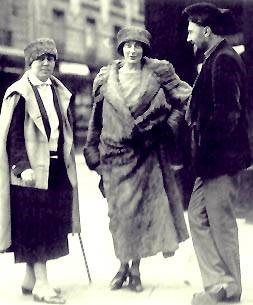
Jane_Heap,_Mina_Loy,_and_Ezra_Pound

The Freewheelin’ Mina Loy standing next to Ezra Pound in Paris. The woman on the far left is Jane Heap who edited The Little Review in which Pound wrote of Loy’s Others published poems “In the verse of Marianne Moore I detect traces of emotion; in that of Mina Loy I detect no emotion whatsoever.”

.

Part of it may be a smallish corpus of work. Part of it may be due to her leaving active literary circles about 100 years ago, even though she lived until 1966. Key critic Pound thought her work however skilled was cold and without emotion.*** But more importantly, there’s this factor: her work, in particular “Songs to Johannes,”  scared people. Not just the un-hip general public (which never widely considered her, unlike Stein), but other Modernists. Harriet Monroe of the influential Poetry magazine thought Loy’s work unpublishable. The “Johannes”  poem sequence subject matter and her treatment of it was problematic.

Men for ages have been prone to “kiss and tell.”  Propriety might lead them to disguise the names of the paramours, even if insiders would know. Yet women arising from the prone to write about their experience might be on shakier ground. Edna St. Vincent Millay and Sara Teasdale were  able to do this in the 1920s with popularity and prizes, but their poems of female desire were written within conventional romantic poetic tonality. Loy? Not so much. “Songs to Johannes”  can be frankly carnal. If Modernism was to speak otherwise and often of direct treatment of the thing, of charged moments, of images depicted in all their dimensions, this wasn’t something that automatically extended to women talking about sexual relations within the fine art of poetry. Boys will be boys when they do it —  and the boys become prim fuddy-duddies when a woman adventurer writes from her perspective.

So all this. Decades passed with Loy largely forgotten.

Feminism and now the 21st century has re-opened the case of Mina Loy, and now she’s considered a rising subject for academic study and consideration. What’s my consideration? I’ve always figured if someone writes a literary poem and calls it “Song…” that the poem is challenging the Parlando Project to realize that element. I chose two short poems from the sequence to fit things to my schedule and preferences; and for instrumentation, I used an acoustic guitar challenged by some keyboard ghosts. You can hear my performance of the segments of “Songs to Johannes”   numbered IX and X with the audio player gadget below. What, has the audio player ghosted you? No, it’s just that some ways of viewing this post will suppress showing it. This highlighted link will open a new tab with its own audio player.

.

*I’d suppose H.D. would be in the running in such a mooted 1919 survey too.

Curiously, Mina Loy’s Wikipedia article mentions that the delightful and highly popular classic Hollywood actress Myrna Loy may have gotten her stage name from our poet/artist Loy. Wikipedia footnotes that claim with two books I haven’t read. Mina Loy did act on the NYC stage at least once, in a Provincetown Playhouse play where she co-starred with William Carlos Williams.

**As its name implies, Others  saw as its purpose to publish outsider Modernist work, and in its short life it was troubled as many such publications are by shaky revenue and artistic factionalism. Long-time readers might remember that three traditionalist poets contemporary with Loy pranked Others  by concocting the Spectra hoax and wheedling the magazine into a special issue dedicated to the made-up Spectra movement poets who wrote parodies that they thought might pass as real Modernist poems. One of their pseudonymic poets, Anne Knish, may have been an inside dig at Loy.

***Pound’s critical blurb where he’s pairing Loy with Marianne Moore seems a strange judgement to me, though the quote I’ve seen says he meant it as at least a mixed complement. Work like Loy’s “Songs to Johannes”  seems quite charged with feelings. Reading the whole thing in one sitting — even given its Modernist fragmentation of narrative and proto-Surrealist metaphoric freedom — can exhaust one, buffeted from the range of conflicting states of emotion being depicted. You can read one version of the entire “Songs to Johannes”  sequence here.

And in the woman-poet’s “you can’t win” department: in the post-Eliot world of High-Modernism some of Loy’s female contemporaries like Teasdale and Millay were down-rated for writing extensively about love, desire, and romance as subjects to be examined in their poetry, rather than the big-boy themes of culture and philosophy.

A Face Devoid of Love or Grace

Today is the anniversary of Emily Dickinson’s birthday. Let’s open a small present.

Her poem cataloged by its first line “A face devoid of love or grace”  transmits clearly on first reading. I hear it as describing a widespread human feeling: the disgust one might feel looking at a confidently self-satisfied face. So, a simple poem?

Simpler than some of Dickinson’s work, even though we should always consider that she can cloak unique thoughts in cottage-core embroidered-sampler language. The thing I think described is a bit of an odd emotion though. Why can we feel such disgust at sensing resolve and rest on the face of someone we dislike? Is it just our hate transferring to some visage a hate we’re sure we find behind the surfaces? Not if our judgements of the person behind the visage are valid — if what drives us to fury are the actions we know the expression covers.

A face devoid of love or grace

That’s an F Major 7, mixed in with all those minor chords. That’s been a favorite chord of mine for more than 40 years.

.

This week’s news includes the overthrow of a dictator, an event that brings obligatory photos of newly mutilated portraits of the disposed tyrant, and videos of the toppling of statues — enthusiasts performing the pre-requisite of “Ozymandias.”   While in my country, many see the calm, regularized-in-demeanor news-slug faces of our upcoming national administration while reading alongside them their announced motives and plans which horrify — the “sneer of cold command.”  There’s a disconnect there that many feel. “He looks so righteous, while your face is so changed” as yet another writer put it. So, the self-absorbed bureaucrats of disorder and disregard look unconcerned behind their hard successful faces.

In Dickinson’s verse I note a choice: she could have described the unconcerned face that stands for someone that disgusts her in a variety of ways. The one she chose, stone-like, brings along with it that idea of heroic statuary. And there’s an unexpected double-twist from her pencil at the end: that face and its metaphoric linkage with stone. Stone is rhymed* with “thrown.” It’s like stone, and like the stone that the angered would want to throw, rock against rock. And then too, something I didn’t notice until I was singing this, a possible intended pun: thrown/throne.

Am I dissecting a bog-simple nobody-frog of this short poem here? Could be. But even if this is a short birthday gift, it’s the thought that counts.

You can hear my musical performance of Dickinson’s “A face devoid of love or grace”  with the audio player below. It’ll only take 90 seconds of your time, about as much time as it takes to sing “Happy Birthday.”  No audio player to be seen? It hasn’t been blown-out and removed with frosting-feet, it’s just that some ways of viewing these posts won’t display it.  This highlighted link will open a new tab with its own audio player.

.

*Speaking of rhyme: I love the off-rhyme of “ease” and “acquaintances” in this poem.

The Fade, a Rock song about aging and loss

So here it is, our 800th officially released audio piece from the Parlando Project. Perhaps it’s not representative: it’s not by a dead poet, and unlike almost everything else we do it may not have been written for the page without thought of it being sung. “The Fade”  was written and sung by the leading alternate voice of the Project and all-around inspiration Dave Moore. Dave and I go back to when we were leaving our teenage years. I met him then when he read two pieces in a church: one was his own poem, a cheeky number that mixed eros and agape, and the other was a reading (as if it was page poetry) of Bob Dylan’s “With God on Our Side.”   A decade later we started doing music together as the LYL Band, and some of what we were doing has become melded into what became the Parlando Project.

So, as I think again — is there any way to have a representative Parlando Project piece? Maybe not, and if so, by design. Variety and seeking something unexpected are founding goals.

Dave’s writing here, and our common efforts in making it the song you can hear below, strikes me as something too little done. Rock, whether it’s Rock’n’Roll, punk-rock, Alt-Rock, Indie-Rock, has tended to speak from a youthful perspective. Even the Classic-Rock acts that are still treading the boards at Dave’s or my age hew to topics that would interest those younger than they are. “The Fade”  is far from those common tropes: it’s about the diminishment of aging and particularly about the fogging and loss of memory.

Early this morning I watched an old documentary, a British South Bank Show done in the mid-1980s about the Velvet Underground, a band that was more than a decade defunct at that point, but all the principals (several dead now) were alive then, only entering into middle-age in the 80s, and of a mind to answer questions about the band’s influential work. The topic most covered as they spoke about their former joint project was what made the songs the original lineup put out of lasting importance when the idea of 20-year-old Rock songs having currency seemed novel.

Chief songwriter Lou Reed had it that he wrote about the things he saw around him rather than using the regular subjects of pop songs. True enough, but he chose subjects decidedly less ordinary in song in the times when he wrote them. He specifically wrote about things that frightened people enough that they left them out of the songs they wished to listen to: drug dependency, gay and gender issues, less-vanilla sexuality, and mental variations. And then several others, including the band’s PhD, Sterling Morrison, took pains to note that Reed presented those stories without editorial comment or stance, without sentimentality.

I’ll note now, that later in his career, past the times of that now 40-year-old documentary, Reed wrote one of the few Rock albums about aging and its disabilities: Magic and Loss.  It still stands pretty much alone. It’s also unlikely that even the adventurous readers and listeners that this Project has have heard it.

Dave and I recorded “The Fade”  this past spring. When I talked to Dave this morning we exchanged info on folks we know, folks our age or even a bit younger, who are moving into assisted living or who are suffering from dementia. I don’t know, there are probably a few songs about how sad Alzheimer’s and the like are, probably some songs that try to mitigate it with a chorus that mixes in the memories the sufferer no longer maintains. Dave’s song isn’t like those songs — if they exist — and I’m glad I helped make his song exist, and that I get to share it with you today.

The Fade

This is the sheet Dave handed me with brief scribbled chord notes on the day we recorded this. As you listen to the performance you may see that he did a masterful job of revising his typed words. I think the song gained power from the verses he left out.

.

You can hear that recording of “The Fade”  with the audio player below. I think Dave gets a bit of the VU-ara John Cale sound with the keyboards in it. I’m using feedback in it too, but not quite as the Velvet’s did. What? No player visible? No, you didn’t forget it along with where your keys are or what you came into the room for, it’s just not shown in some ways of reading this blog.  You can use this highlighted link as an alternative.

.

Records In Childhood

As December begins, I’m going to be taking some time to celebrate and elaborate the roots and concepts of this long-running Parlando Project as we reach our 800th-released audio piece milestone.

For those who are new here, let me restate again what we do: we take various words, mostly literary poetry that was never intended by its authors to be performed, and combine them with music in differing styles. Sometimes the page-words are sung, sometimes they’re spoken or chanted. Sometimes the music will patently match the text, sometimes not. The latter class are some of my favorite pieces: Emily Dickinson as blues singer or psychedelic ranger, Robert Frost with EDM, Longfellow at a beatnik coffee-house, Li Bai with western orchestral instruments, Jean Toomer or John Keats as performed by an indie-folk combo. I expect long-term listeners to scratch their heads at times, though I also fear that some will sample a piece that they don’t much care for and leave off from future listening here.

No one idea or artist inspired this all, but today’s piece is about the farthest back I can recall anything that might have inspired the Parlando Project. I think this happened when I was around age 10.

I grew up in a mid-century Iowa town of 700 folks, and it wasn’t a particularly musical place. There was a small high-school marching band, a handful of children probably had piano lessons of some kind, if only in hopes there’d be someone to play piano in the three Protestant churches in town. The two best musicians in my childhood cohort played trumpet and accordion. The former was surprised to admire Louis Armstrong despite having personally absorbed dismissive racial stereotypes, the other might aspire to Myron Floren level of showpieces on the stomach-Steinway. The same little town might have over-achieved in literature though. It was named by its 19th century town-platter “Stratford,” and its streets were named for British poets and Longfellow — main street being Shakespeare Avenue. If you grew up on a street that was merely numbered, or an avenue named for some animal or geographic feature, such things never had a chance of shaping your worldview. I grew up thinking of Milton or Shakespeare as being a local possibility.

My father sang, mostly in church. My mother thought he had a good voice (“better than Perry Como” she once said) and I recall it having a very nice timbre when I was a child, but there was no piano or other instrument in the house, and he didn’t sing a cappella that I recall. We didn’t have a TV until I was 7 or 8 (and even then it was a chancy fringe-reception, rabbit-eared, used set that would send its display to snow or tumbling whenever it felt like it). There was some kind of radio, for which I’d hurry home from school to listen to the Lone Ranger on, though I can’t recall what the radio looked like. And at least some of the time there was a phonograph. I recall it was one of those that looked a bit like a portable typewriter with a luggage-finished case that could be clasped-closed. It may have been one of my parent’s from their college years. It sat in a little side room off the kitchen at home that we called “the breakfast nook.” And with it was a small cache of records. And here it gets odd — specifically odd — but applicable to the Parlando Project.

I clearly recall four 78-rpm disks, an unexpected set for a Fifties, small, rural-town-in-Iowa record collection. Two were commercial spoken word recordings, the sort of thing that was a viable genre then.** Record one: Robert Frost reading his poetry. My recollection that the featured poem was his “Two Tramps in Mud Time,” but so far I’ve found no Frost recording of that poem to refresh my memory or share here.*** The second was Vachel Lindsay reading from his “The Congo,”  which has an insistent, chanting, rhythmic flow. The fact that I can remember them would be clearly meaningful, but to be honest I have to say that I didn’t like either of them. I’m not sure what I expected from poetry that came from poets more recent than those whose names were on my streets, but Lindsay seemed overwrought to me, and even at a young age I might have been put off by the whole white-guy-doing-primitive-African vibe of his poem. And Frost? I’ve often written here that I didn’t care for him until I started to explore things musically that became this Project in the 21st century. Only then did I discover that he was a supple lyric poet — and furthermore, a much more subtle observer of humanity than I had appreciated in my youth.

The fact that I didn’t really dig these two poets didn’t keep me from playing the records. Experiencing them felt exotic then, and I liked that even if I didn’t admire what was engendering that feeling.

The third record didn’t match suit. It was a recording from the 1940s of a song called “Open the Door Richard.”   I didn’t know then, but this was an unusual “Novelty Record” piece, charting in versions by as many as five different musicians within one year, 1947. All those musicians were Black, and before it was one of their recordings it apparently was a Black Vaudeville comic number that the musicians spruced up with swinging jive-cat musical settings and choruses. The musical versions all differ in detail while sharing the chorus. Some of them are largely drunk-act comedy,**** while others are more at down-on-one’s luck frustration and focus on the riffing, musical, chorus-hook. From listens today I suspect the recording I listened to back them could have been the Count Basie Orchestra version or (best guess) this one by the Three Flames. I liked that record, though I thought it a little odd, and I probably didn’t fully understand it. If these first three records have a link, that’s it, isn’t it? I enjoyed the strangeness, the difference.

Open_the_Door_Richard_sheet_music_cover

Tortured Poets Department, but my childhood: disks containing a psalm of comfort, a song of misapprehension,. and two early 20th century Modernist American poets.

.

The final record was the one I listened to the most. It was not a commercial 78, but a recording, perhaps from a record-yourself booth (or offers like that) which provided the earliest Elvis Presley recordings. It was my father reading “Psalm 23,”  the famous psalm of David. The voice was someone in my life, no exotic stranger, but I was totally mesmerized. If no one is more mundane than one’s own parents, this everyday, ordinary person had their voice on a record!   And the text, in familiar English translation, is one of the most comforting pieces of poetry in the canon. When I’ve revisited the Psalms periodically as an adult I’m sometimes shocked at violent and authoritarian themes I find weaving in and out of Psalms’ religious rapture — but if “Psalm 23”  implies frightful things, it does so to say that they pale in comparison to a connection with a godhead.

Parents sometimes comfort their children, do so by saying “it will be all right, we’re here to protect and care for you.” My parents weren’t much like that in expression however, though by action in life they were being that with much effort. This object, this record, did that, using someone else’s words translated from a Bronze-Age king, poet, and musician.

I think I asked about the “Open the Door Richard”  record and the “Psalm 23”  record. I can’t recall what my dad said about the Psalm recording, though I wish I did. I have a vague memory that he said the “Open the Door Richard”  song was something of an in-joke between his brothers. I didn’t get, or can’t remember the full story, but one of my father’s brothers went by the name Richard (one that became a successful Protestant minister). Another brother was named David, though he never talked to Leonard Cohen about secret chords or sling trajectories.

So there you go, in summary: I had formative exposure to poetry on recordings. One case with my own father’s voice offering comfort; and another, an Afro-American tale of misapprehension. It would be years before I had any idea to do likewise, and decades before I could do something from this early experience regularly in ways that you could hear.

Longish post, but here’s a short musical piece called “Records in Childhood”  using a sonnet I wrote this year casting some of that remembering my early experience with recorded words. You can hear it with the audio player below. No player?  This highlighted link will open a new page with its own audio player

.

*There may have been other records, though it was not any kind of large stack. The fact of memory that these four are the ones I recall testifies to their impact.

**Besides poetry recitations, sermons, and even some secular speeches were released on disk — and spoken-word comedy records were often big general-interest sellers. In a previous post I talked about how vividly I experienced Hal Holbrook’s one-man stage show of Mark Twain Tonight on an LP record in a library in Iowa.

***I did find this professional recording of Frost reading some of his “greatest hits,” and was surprised to hear quiet piano backing was used in a way that could be compared with some Parlando pieces.

It’s possible that my home’s Frost recording was a separated part of a set. 78 RPM records were sometime sold in a bookbinder of page-sleeves holding multiple disks, which is the reason we still call a longer form vinyl LP, CD, or issued-together set of digital files “an album”

****Drunk act comedy goes back to at least Shakespeare’s Falstaff, and in an earlier personal history Parlando piece I found out how my teetotal great-grandfather might have perceived the sometimes brutal alcoholic folk-song “Rye Whiskey”  as stoner comedy.

One benefit of having an acquaintance with this largely forgotten song was that when I first heard the Bob Dylan Basement Tapes song “Open the Door, Homer”  I knew the reference.

When the Year Grows Old

Here in Minnesota, the weather is turning, as it does at a time of its choosing in the Fall. Tomorrow morning the Fahrenheit temperature will be in the teens when I get up, and the forecast says single digits will greet me by Friday.

I began work on setting this poem by Edna St. Vincent Millay last week after seeing it at the Byron’s Muse blog. Two things grabbed me when I saw it: sitting there as silent words it begs to be sung, and it’s tantalizingly ambiguous.

This poem was from Millay’s first collection, published (1917) as Modernism was starting to find an audience in America. Americans in the last decade to be called The Twenties saw Millay as a Modern, though her prosody wasn’t like the free-versifiers, and her lyric’s narratives weren’t fragmented word-Cubism. So, a more comfortable Modernist to those whose expectations of poetry still flowed from the 19th century? Somewhat. Still, though not so much in her first book, but soon, Millay began to stand for The New Woman, a character that took up the prerogatives of independent thought, act, and agency in love and desire. A William Carlos Williams might have absorbed radical Modernist visions in Modern Art into prosody. A Carl Sandburg may have taken his Imagist eye and cast it toward workers and immigrants in his poems. But soon after this poem, Millay was using somewhat traditional verse to speak about female independence in life and desire. Cubism and Socialism were controversial, sure, but the kind of change Millay was covering in her poems was large in scope. Man Ray or Monet, Debs or Debussy, Pound or Reverdy — change was in the air — but as far as art such as poetry was concerned, the charge for change from women (and Afro-American artists) in the Last Twenties is a big deal, not something to shelve off as some sideline.

OK, so what does this early poem have to do with that? I’m not entirely certain. Yes, the overall scene of the poem is clear to any Northerner — but even as the poem starts the seemingly simple language has faceted surfaces. The poem is titled “When the Year Grows Old,”  but I’d suspect you might mistakenly remember it as “When the Year Grows Cold.”  It’s not just the rhyme, the poem is clearly about the weather getting colder, all the images intensify that. Intensities of anything old are not there directly at all. And then, I can’t say how idiomatic the opening statement (refrained at the end,) “I cannot but remember,” would be in 1917 — but it’s easy to read it (out loud, or in understanding) more than one way: “I will reflexively remember,” “I have only memory of this,” or even “I can’t do this, but I am forced to remember.”

And who’s the “she” in this poem? I had a thought in early-days with the poem it might be a pet, likely a housecat. Beside a generalized factor of love for warmth, cat owners might recognize the bird watching vocalizations — that, and a reference to “the warmth of fur” led me to that consideration. One reader’s reaction I read online this week thought “she” was a mother. I’m not sure of Millay’s mother’s (if that would be the mother here) characteristic feelings for tending a fire or even the specific kitchen task of making tea. My cursory non-scholarly thoughts are: not likely her happy place.*  Still, I could imagine that a general poetry reader in 1917 (like the Internet contemporary I came upon this week) could think that, or that the “she” is a friend of the poem’s speaker (which we might expect to be Millay), and so find this poem Millay’s predecessor to something like the young old Bob Dylan writing “Bob Dylan’s Dream”  about his remembering lost friends who’d once gather around a wood stove.

When the Year Grows Old

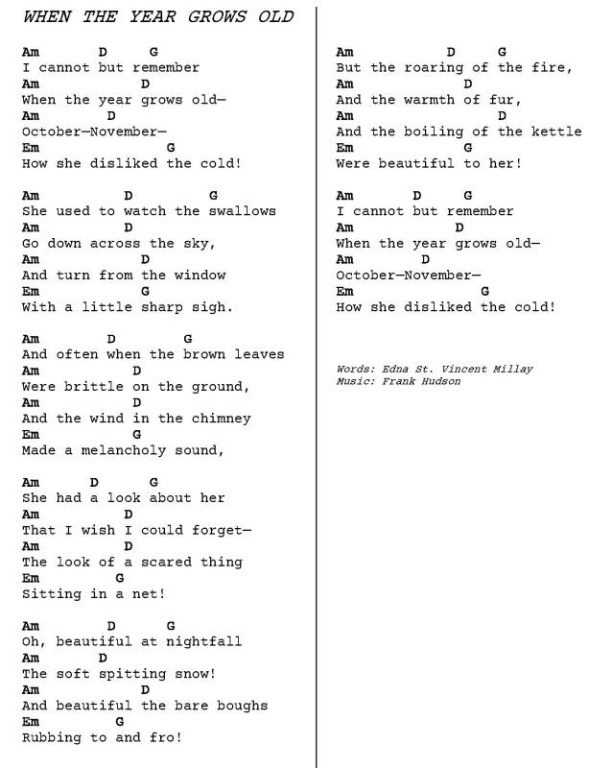
Simple chords for today’s piece, presented here as chord sheet  in case you’d like to sing it too.

.

Living with this poem as I set it to music and performed it, I came to think of it more at “Girl from the North Country” — a song about a lover who is longingly thought of lovingly, but who is now separated. By the time of the performance that you can hear below, that was how I was singing it. Why did I think that?

Partly from reading later Millay poetry, partly in biographic clues of Millay’s sexuality. There’s a definite undercurrent in the poem of the “she” feeling ambivalent: the sighing look at the flying birds, the melancholy chimney wind, and most directly in the abrupt “look of a scared thing/sitting in a net!” And what follows that line feels lustily sensual to me: those rubbing “bare boughs,” that fur by the fire verse.

That reading also answers the why the year being “old” is the title, not “cold,” other than just seeking variety. A once passionate attachment has been reconsidered by the other party, has grown old/cold.

Millay could have made other meanings (“cat lady,” “dear old mom.” etc,) clear with no commercial readership risks, but following my understanding, this presentation is coded so those who know will see that, and others will see a vaguer poem while recognizing late autumn weather. If I’ve misread it, or if Millay ever explained what she was intending — well, it wouldn’t be the first time — but it worked for me to find an experiential place to inhabit the poem.

You can hear my performance of Edna St. Vincent Millay’s “When the Year Grows Old”  with the audio player gadget below. No gadget? It’s nothing personal, just that some ways of viewing this blog suppress that. This highlighted link will open a new tab with its own audio player.

.

*As poetic testimony: tender as Robert Hayden’s well-loved poem “Those Winter Sundays”  is, it’s not a story of a parent finding happy beauty in loading up a household’s fire box.

Ducks, as if Teenagers

This month my teenager, who I don’t write about much out of the belief that they should tell their own story, ceased being a teenager. They’re working full-time hours now, hoping to save enough to move to their own place, sharing hopes and connection with others who are likewise migrating across the border of growing up.

Late this summer, while on one of my bicycle rides down an urban residential street I saw an odd sight: a line of young ducks in their proverbial row waddling across the street. They seemed unconcerned with the intermittent traffic, and there was no mother duck leading the line. I could guess they thought an aged man on a bicycle was not an instinctual, usual threat — but it was grade-school pick-up time and the school buses were rumbling on their routes accumulating backpacked kids. Yet these young ducks, in their new adult colors, just waddled across anyway, as if their orderly line and intent were protection, as if it still was that some parental watch had checked the way clear.

Ducks as if teenagers

Here’s a chord sheet for the song made from the sonnet I wrote.

.

I jotted down a draft of a sonnet soon afterward, and this month as my child becomes less my child and more the cohort of others on their own, I produced a new draft, deciding to set it to music and sing it here. Longtime readers will know that one of The Parlando Project’s mottos is “Other People’s Stories” — my statement that I’ve chosen to not use this place to promote my own poetry, but rather to inhabit other’s words (usually words from literary poetry) and to write about my encounters with those words and what it feels like to sing them.

Maybe today’s piece is a symptom of my age, but I barely think of this poem as my own in the greater context of learning to think of my child as less my own. I anticipate a separated hope and worry, an elsewhere joy and adventure, when they move off as if we’ve taught them enough.

Which we never have.

You can hear the song made from the sonnet with the audio player below. No player? Don’t call home, it’s likely just the way you view this blog, some of which ways suppress showing the player gadget.  This highlighted link will open a new tab with its own audio player for you.

Let No Charitable Hope

Elinor Wylie once was a reasonably successful poet, back in the last decade that was called The Twenties. I informally group her with some other American women poets of that time: Sara Teasdale, Edna St. Vincent Millay, Dorothy Parker, each of whom wrote often about the complexities of love and relationships. Though none of this group had careers of extended success,* Wylie’s poetry career arc was exceptionally short, contained entirely within the 1920s — though it was preceded by a few years of being a gossip item for a series of romantic elopements and divorces. I wrote a bit about that element of her life a few years back, but it seems that Wylie was playing at the Kardashian-family level of tempestuous celebritydom in her time. Read my link if you want a summary of the tea.

Young Elinor Wylie

Elinor Wylie. Runaway socialite and 1920s poet.

.

So how good was her poetry? Clearly better than the usual celebrity with a book of poetry. She’s highly musical and concise, an irresistible draw to my Project, and while ranking art is a foolish game, her best work stands up well against the trio I associated her with. Today’s piece uses a poem that was called one of her best works when I first read it as poets.org’s Poem-a-Day a year ago. Here’s a link to the poem’s text if you’d like to read along. I myself wouldn’t rank it that high if I somehow needed to rank her poems, though the musicality alone compelled me to set it with music this week. Why do I prefer, for example, her “Velvet Shoes?”  “Let No Charitable Hope”  is a bit abstract, despite the eagle and antelope that are cited in passing and the woman trying to get substance from a stone,** while “Velvet Shoes”  is as sensuous an experience in imagery as in sound. But as a complaint, “Let No Charitable Hope”  probably still connects. Many of us, maybe more for those women reading, are familiar with being misapprehended, of having a hard enough time maintaining one’s own hopes, and to then be asked to try to match the hopes of others. What does Wylie mean by her ending smile in the poem? Is she smiling at how mistaken the apprehension was, or is she allowing herself to smile at her own small lofting of her own hopes?

You can hear my musical performance of Wylie’s poem with the audio player below. I went all-out on the weird chords for this one, so it may not be to all tastes. Is your screen so woozy from fear of odd voicings that it’s obscured any such audio player? No, some ways of reading this blog suppress that player gadget, so I provide this highlighted link that will open a new tab with its own audio player.

.

*Like Wylie, Teasdale died young. Parker and Millay’s political commitment damaged their later careers. The New Morning of the The New Woman of the 1920s had its backlash as well — but this isn’t simple. It’s hard to maintain an artistic career in general, Parker suffered from writerly alcoholism, and some who shared Milay’s politics didn’t think her later work was as good as literature.

**One more concrete image occurs in the poem: masks. The line “Masks outrageous and austere” was sonorous enough for Tennessee Williams to cop it later on. As if sometimes does for me, I thought of masking as in autism, though the syntax of the poem’s last stanza seems to have masking being applied to the years, not the poem’s speaker’s smiling face. Still, I’d expect some ASD readers would see the disconnect of the “charitable hopes” of others viewing them verses their own internal reservoirs of hope and intent.

Let Me Call It Remembrance Day

A post today for a holiday with complications. In the UK, Canada, and the former Commonwealth, today is Remembrance Sunday and tomorrow is Remembrance Day. In my United States tomorrow is Veteran’s Day. Remembrance Sunday/Day is a bigger deal. Here in the U.S., it’s one of two holidays set aside to honor the armed forces,*  and the Spring Memorial Day gets more observance. America moves it around as a Monday workday holiday, so it now rarely occurs on November 11th, the day it was originally meant to commemorate, Armistice Day, the day that WWI ended. In the American observance, the day and the moment being observed are no longer there as they happen to be this year.

But then, all the events of WWI have now passed out of the living’s remembrance, and WWII is entering the time of that leaving — while in England the wound and loss are still felt by a generation that themselves only recall the generations that personally experienced it.**

Historically, poets suffer, fight, and die in wars. Presently in the U.S. this may be less true than was traditionally so, our soldiering ranks now coming from a different cohort than those with MFA and workshop attendance. That too is complicated, and I’ll choose to honor your time today by not going into all of that. Yet I’ll maintain that the experiences of service to country, of organized protection and organized death, of comradeship and loneliness — these words of history aren’t so far away if we only open ourselves to listen to them.

Here are five poems for this complicated holiday that this Project has presented over the years. In honor of the UK preservation of the original reason for the holiday, four of them will be British to one American.

Gone, Gone Again (Blenheim Oranges)

British poet Edward Thomas is too little considered in the United States, but in the run-up to WWI this overworked and underpaid freelance writer started to expend his writing efforts to the least commercial of literary forms, poetry of individual honesty — urged in that endeavor by his expatriate American friend, Robert Frost. Frost left England for America as the war began and he asked his friend to follow him and emigrate to the United States.

Thomas didn’t accept his offer. In Britain Thomas is remembered as a War Poet, as one of the casualties of The Great War, but his poetry doesn’t speak of his trenchside times in the conflict — instead it sings with lovely precision and concision of the British countryside as he is making his decision to take the road well-traveled to enlist to the front. “Gone, Gone Again”  is one of his masterful poetic verse-essays on this time of decision, as he observes an England depopulated of its workmen. Why did he go to the front? He explained it mostly as being unable to shake his patriotic connection to the very soil and experience of Britain that his poetry sings of, but I said today’s post would be about complications. Thomas was also a troubled soul, looking for meaning in his life not captured by certainty, and some have speculated that a soldier’s pay was a better economic offer for his family than his Grub Street freelancing. He packs every bit of that into this short poem.

.

Shadwell Stair

Wilfred Owen is another Brit who took up poetry in the context of serving in The Great War. He’s known for his scathing anti-war poems, which to Britain’s credit doesn’t keep him from being honored nationally as a War Poet. But here’s a lonely poem written on the banks of the river Thames, likely during the time he was back from the front being treated for what was then called “shell-shock.” Folks today can experience the poem in a context pointed out later, that the Shadwell Stair location was a gay cruising spot at that time. Historically, there’s a blindness in some eyes to see that not just that poets and artists serve, but that they aren’t all straight.

.

On the Troop Ship to Gallipoli

Rupert Brooke was a rising young poet before WWI started, and even at his young age, great things were predicted for him. Unlike Owen, his war poetry is conventionally heroic, conventionally patriotic. Unlike Thomas, he was under no economic pressure when he enlisted. Would that tone have continued, could he have written glorious battlefield odes, or would the war have turned him into a skeptical Modernist? In an irony that only the Fates could have woven, he was detailed to be part of the disastrous attempt to land at Gallipoli. While on the troop ship steaming there, he fell sick from what I’ve read was an infected insect bite, and died before reaching the deadly front.

I took a fragment Brooke composed on that fatal voyage, and audaciously decided to take a Modernist blue pencil to trim and rephrase it the way an Imagist might. That was a complicated act, one that I’m not sure I can justify, other than to say that I wanted Brooke’s moment on that troopship to stand out more vividly, riding roughshod over his verse to honor that.

.

The Cenotaph

I don’t believe there are any women on WWI War Poet plaques in Britain, but of course they were asked to and worked with the war effort, and were there to tend, mend, and mourn the casualties during and afterward. Here’s a complicated poem of mourning, written as the original Cenotaph*** was erected in London. Its author Charlotte Mew is another British poet little-known in America. From what I’ve read she was seen as eccentric by other artists of her time, and her poetry doesn’t fit easily into any movement or style. Every Remembrance observance in Britain to this day has a ceremony at the London Cenotaph where the current government pays solemn homage to the soldiers’ sacrifice. If I read Mew right, she’s the ghost-at-the-feast here, and has some particular wailing to do.

.

.

Grass

Lastly, for Remembrance Day, here’s the American — and non-more American than the child of immigrants Carl Sandburg. I would post his poem “Grass” every Memorial Day, every Veteran’s Day — and yes, even every Remembrance Day. Yet, this is a poem that sings about forgetting. Is forgetting wars, forgetting soldier’s service and sacrifice, a callous thing? Is forgetting the follies and cruelties of war dangerous ignorance? Is it better to forget wars than to suffer them forever in endless horror? Is forgetting just the way things are eventually, an erasing sigh that fades into new present days — as what humans do that humans can never fully comprehend?

Look, I said it was complicated.

.

*In the US, there’s fine print sometimes invoked to separate the two: Memorial Day for those who died in service, and Veteran’s Day to honor all that served. The UK Remembrance Day is more like American Memorial Day focused on wartime losses and sacrifice.

**Proportionate to population, the US casualties in WWI were much lower. And England’s cities suffered under bombs during WWII. I was going to write too about the World Wars and their effect on the British Empire and colonialism, and America sliding in as a replacement, but that subject is too big for any footnote.

***So great were the WWI deaths that logistics couldn’t see to repatriating all the bodies of British war dead back home, and unidentified dead and missing in action mysteries clouded the situation too. Regional cenotaph memorials, including a great one in the national capitol, would serve as a consolidated gravesite to lay flowers and visit in remembrance.

A Sonnet of Two Letters

It happens to us alone, but it happens to so many it’s a trope we share. It goes like this: you have one of those bad dreams. Something terrible has gone wrong — and you, inside the dream, feeling it is real, try to fix it — but you can’t because the other people in the dream are oblivious to the terrible and are acting stubbornly in odd, irrational ways. While dreaming you’re trapped in this desperately unsolvable situation only you can clearly see and try to act rationally on, running in place, thinking in circles.

I had one of those dreams this week: felt so real, so heart-wrenching. Then the dawn comes, and you realize that experience was a dream — oh, that’s why you couldn’t fix it, that’s why everyone else in the dream was acting so wrongly!

OK, exiting satire mode, but let’s stay strange.

Early this Fall I was cleaning out something: a box, a drawer, a binder, a little used bag, I can’t remember exactly what. But in it was a clutch of papers. I glanced at the pages and recognized it was a mix of things: some works-in-progress looking for first reads from the old group of poets I used to meet with every month, and some initial drafts of a longer, multipart poem I was writing as my mother was going through her last hospitalization, the one from which she would ask to return to the home I grew up in with my father and sisters in order that she could die there. I set those sheets of paper aside.*  I figured I’d look them over later, maybe digitally scan them, or put them in my filing cabinet. At that later I’d also look to see if there were any drafts in the small stack that were unfinished pieces I could revisit.

Now here it is, we’re November and I finally got around to that sort-out. One of the pages was a college-ruled notebook sheet with a complete intermittent draft of an irregular (American) sonnet. What was this? While I remember well working on the longer poem around my mother’s last illness 20-some years ago, I had no memory of working on this sonnet. Complete blank. Moreover, the sonnet seemed to speak of someone’s story that I didn’t recognize as mine — nor anyone else’s I could recall either.** With the time-interval between discovery of the papers and my finally going over them, I can’t even be sure if this sonnet was found among the stuff from the time of my mother’s death or not. Trying to determine why I didn’t remember it, I wondered if it was even older. I recalled that scholars date Emily Dickinson manuscripts by looking at the changes in her handwriting over time, so I tried that assay. Looked to me more like my 20th century handwriting, so the poem could be older. Still, it was my handwriting, testifying I, however unremembering, wrote this poem — and “What was it about?” That intrigued me. The poem asks the reader to work obliquely, details are supplied but not all the details, something that can tantalize.

A Sonnet of Two Letters

The gardening stake metaphor used in the final section reminds the 2024-me of Robert Frosts “Pea Brush,”  a poem I didn’t know when the me I was back then wrote it

.

Why did the voice in the poem not mail their first letter? What was it about the recipient’s husband that was germane to that decision? Was there an affair or appearance of one? Clearer to me was the latter part, the stuff of the second letter, a recalling of youthful aspirations and a friend who by what they said helped make them more substantial than pretensions. What an interesting yoking, I thought. The imperfect, the not said, or the thing whose saying we keep hidden — combined with the things that were said that help us realize our lives.

As you might tell from the previous paragraph, I was experiencing this poem just as I would the general run of Parlando Project poems, ones written by others in a project which has as one of its mottos “Other People’s Stories.” Its mystery and ambiguity captivated me, and so I set about making it into a Parlando song.

I did a revision of the initial handwritten draft I had found and worked on combining it with the music you’ll hear with it below this week. The music today is played as a conventional LP-era rock ensemble: there’s the usual quartet: bass, drums, chordal and “lead” guitar. Added to that are two keyboards, piano and Hammond organ. You can hear the result with the audio player gadget you should see just below. No gadget? Wake up, this highlighted link opens a new tab with its own audio player.

.

*Two of those poets have since died, I re-handled those pages, ones they’d typed in and handed to me years ago, and thought tenderly of them. My part of the household is due for an austere “death cleaning,” the tossing of those things an old man keeps to extend something of the life of that-and-those who’ve passed on. I have no grave illness, but the keeper now must consider that they will pass on and that there’s no real keeping.

**I did write from personas in my writing life regularly, a bit more so in prose than poetry. I was likely imagining the “short-story” plot that I then went about expressing in the sonnet.

To Waken an Old Lady

It’s National Election Day in the United States, and it’s seen as an extraordinary consequential election. Amid that great matter, I fielded a clutch of social media queries on poetry and music in the last 24 hours or so. I think I understand this seeming paradox. Though I myself will likely stay up late tonight listening to returns — as it is after voting early in the morning, I’m expecting to have only the maelstrom of worrying and hoping to spend over the rest of this national event tonight.

But since I last left my listeners at the end of October with an atypical audio piece, I thought it’d be a good day to release this performance by the LYL Band of a poem by the American early Modernist poet William Carlos Williams. That’s what we usually do here: take other folk’s literary poetry never meant to be sung and combine it with original music in differing styles.

What’s my personal history with Williams? Oddly,* my introduction to Williams was in the guise of his printed introduction of Allen Ginsburg to me (and many) in the thin City Lights paperback Howl and Other Poems.  Williams’ name was printed right on the cover of Howl,  and while in a smaller font than Ginsberg’s, it’s not fine print either. They must have thought it would help.

Howl Cover

Published November 1st, 1956. Did the choice between Eisenhower and Stevenson seem quite so existential?

.

As a young man I don’t think I absorbed much of what Williams said in his short introduction. I didn’t have the experience of life to fully grasp it, and about all I knew of Williams was that he was an established, a somehow certified, real poet — and the man he was introducing, Ginsberg, was not. At that point, the younger poet had not been elected to such a post by the cultural electoral college, but WCW was vouching for him beyond the matter of a questionable Beatnik fad. As a teenager at the time, what did I know about what made a real poet? I can’t fully remember. I had some romantic ideas about vision, seeing intensely what others couldn’t sense, and some idea that that would likely put the poet in opposition to elements of society. This was not some structured critical philosophy on my part, it was more a gut feeling, a wish for something more. I look back at that kid I was and think: well, maybe I’m still no better a philosopher than he was, though I now know complications — but yeah kid-of-the-past, there’s still something to that.

Williams’ name on the Beat landmark paperback did not lead me to read Williams then. Rereading that introduction today that may have been because while it had words that Ginsberg took as validation, it was somewhat between hands-off and off-hand about Ginsberg’s poetry. He called Ginsberg “disturbed,” recalled that he didn’t think the young man would develop into a poet (or even survive). He characterizes the title poem of the collection, “Howl,”  as a howl of defeat. I adamantly heard it as a howl of survival. So, thanks old man. Glad you at least said we should pay attention, be “arrested” Williams wrote, by Ginsberg’s poetry.

It’s only been in this century that I read Williams early 20th century work. I found a lot to like in his clean spare early poems written as Modernism sought to clear out the tired excesses of decoration. Now as I re-read Williams mid-century introduction to Howl  I’m arrested by things I, an old man, resonate with. He did  see the poem’s survival testimony. He wrote this there about Ginsberg’s poetry:

He proves to us, in spite of the most debasing experiences that life can offer a man,
the spirit of love survives to ennoble our lives if we have the wit and the courage and the faith — and the art! to persist.”

And he continues in the introduction to Howl:

Poets are damned but they are not blind, they see with the eyes of the angels. This poet sees through and all around the horrors he partakes of in the very intimate details of his poem. He avoids nothing but experiences it to the hilt. He contains it. Claims it as his own — and, we believe, laughs at it and has the time and effrontery to love a fellow of his choice and record that love in a well-made poem.”

It seems to me now, from my old age, that to “see with the eyes of angels” may be its own curse, and thus the angels may howl.

Is today’s small William Carlos Williams poem, one turned into a little song sung with the LYL Band, too slight to serve on a night where we look as nations move? I don’t know. I already told you, I’m not much of a philosopher. Williams’ “To Waken an Old Lady”  is a poem that yokes old age and the descent into winter. Here’s a link to the text of the poem if you’d like to follow along.

I now can often feel like the small birds he puts in this poem. In the course of life, I’m here past the days of career or work harvest. In the summer, the summer of this political campaign, I felt the cold dark winds plenty of times. The poem doesn’t say, but I suppose the poem knows spring comes. I suppose also the poem knows that death comes and preempts spring too.

“But what?” Williams interjects as the poem turns. Look: there are these broken seed husks, the ones that didn’t bloom. So what if they are not to bloom, they are sustenance for survival.

You can hear the LYL Band performance of “To Waken an Old Lady”  with the audio player below. Are the returns of an audio player yet to come in?  This highlighted link will open a new tab with its own audio player.

.

*Well maybe not odd for me. If you’ve read many of these posts, you may have recognized that I love the odd connection.