This project’s subtitle Where Music and Words Meet portrays its interest in the ways words, mostly poetry, might interact with music. How that works varies. I use different kinds of poetry, and different ways to combine those words with the music written for this project.
Song lyric writers, who intend their words to be sung from the git-go usually rhyme their lines, and most song lyrics are at least roughly metrical. That practice has continued even as free-verse without regular rhyme and strict rhythm became a substantial portion of literary poetry written for the page.
None-the-less, I find it’s often easier than you might think to sing free-verse. Here’s the text of today’s piece for our celebration of #NationalPoetryMonth: “Branches,” by one of this project’s favorites, Carl Sandburg:
The long beautiful night of the wind and rain in April,
The long night hanging down from the drooping branches of the top of a birch tree,
Swinging, swaying, to the wind for a partner, to the rain for a partner.
What is the humming, swishing thing they sing in the morning now?
The rain, the wind, the swishing whispers of the long slim curve so little and so dark on the western morning sky … these dancing girls here on an April early morning …
They have had a long cool beautiful night of it with their partners learning this year’s song of April.
One thing I notice right away that lets this take to singing: it’s ecstatic. Some of the sections of what has been our April National Poetry Month staple for the past few years, Eliot’s “The Waste Land,” are hard to cast into singing — even though that poem as a whole is very musical with its repetition and its outright references to musical pieces. Parts of “The Waste Land” use mundane dialog purposefully, and it’s difficult to sing that sort of thing without transforming its nature. “Branches” too uses repetition, along with sound-tricks like words that sound like what they are describing (swishing sounds like the word “swishing” for example). Repetition can stand-in for rhyme to some degree. Free-verse irregularity of lines is less of a problem than it might seem. Music is fully capable of filling in spaces where syllables aren’t, and it can be made comfortable too with melodic lines of various lengths.
Carl Sandburg himself is an interesting combination of words and music. Besides his early and vital contributions to American Modernist poetry, he was also an important collector and popularizer of American folk song both by playing and singing those songs himself, and by the 1927 publication of his significant early anthology of them The American Songbag. I haven’t quite nailed down just how important he was in those matters, but I think it’s possible that without Carl Sandburg there’d be no Woody Guthrie as he was, and going forward from that, no Bob Dylan as he was and is.
When performing them, Sandburg accompanied those folk songs himself with guitar
.
I’m not alone in liking to set Sandburg to music, though I’m not aware that Sandburg himself ever did, oddly enough. I perform his “Branches” today with just acoustic guitar, nothing fancy, just as Sandburg himself could have. The player gadget to hear me perform it is below, or if you don’t see that, this highlighted hyperlink will play it too.
Let me continue in our celebration of National Poetry Month. Yes, but.
Though some of my international readers may not suspect this, others of you may wonder how I’m doing after another incident were someone in my metropolitan area was killed in a government incident that seems unnecessary and unjust. I’d describe my overall reaction as numbed thought, and I’ll leave it at that. It’s not that I don’t have thoughts, but in our instantaneous world, thousands have already written and there’s no scarcity of takes — if you need anyone to supply a template or echo for your own response, you can have that in abundance.
I continue because I think there’s still a shortage of what poetry and music can bring to us. Poetry, like many tweets or blog posts, can make arguments, present hot takes of their authors; but it also can work differently, it can take an attentive reader or listener and by attracting them and presenting something to pay attention to, allow its audience to form their own changes in perception.
Today’s piece, “Reapers” by pioneering Afro-American Modernist Jean Toomer attempts that. In his 1923 book-length work Cane, where this poem first appeared, Toomer presents such things, moments and situations that ask for that response from its readers. That’s an inefficient process. How many will read, how many will really read in that extension where we accept the task of creating a whole-hearted response to what the author presents? Some things work on one, quick, reading. We may already believe we know, we agree. A brief amen is all that is called for. Other work may just seem slight to our moods and perception, and we skip any deeper step. Today’s poem is called “Reapers,” but I think here of the Christian parable of the sower.
“Reapers” presents two rural scenes. In the first, harvesting or mowing is being accomplished as it had been done for millennia with the reapers being people with scythes. With intent they ready their blades, sharpening the edges with abrasive stone honing blocks. Toomer presents the scything that follows as silent music, a rhythmic swinging represented with precise meter and one pair of perfect end-rhymes followed by another pair of perfect rhymes that are in themselves near-rhymes to the first pair.
In the second scene we are taken to an era particular to Jean Toomer’s time. The mower, the reaper, is a mechanical machine drawn by horses,* the immediate ancestor to our present engine-driven farm machinery. That machinery was likely not as silent, but instead of presenting the clank of its mechanism, Toomer auditorily zooms in on the squealing sound of a “field rat” picked up and wounded in its belly by the mechanical, systematic blades of the horse-drawn mower.
“I see the blade, blood-stained, continue cutting…” a small version of the horse-drawn cutter in Toomer’s poem
.
This poem is easy to see as a pair with another we’ve presented here, a poem by Robert Frost, “Mowing.”Here’s a link to the text of Toomer’s “Reapers,” and here’s a link to the text of Frost’s poem. In Frost’s poem, the reaper with the hand-swung whispering scythe scares another animal, a plausibly Edenic snake. Toomer’s rat is not so lucky. Did Frost’s reaper, working like the scythe wielders in the first half of Toomer’s poem, stop their motion and take their poet’s eye, recorder, and projector to the escaping snake? In Toomer’s further observation he asks us to see and hear the horses and more directly the machinery of the mechanical mower that has no such observation, and the horse’s driver is intent on operating them, not the work itself. They do not stop, it’s not their design, they continue, cutting, blood-stained.
I will not write a post here about systematic racism. It’s a term with some value of conciseness, and from that, the easiness of easy rejection or restatement. The term has one mooted objection for example: that it’s not even racism — which to any extent that’s true doesn’t make it better, it makes it worse. Ethnic prejudices leading to evil acts are as old as recorded history, likely as old as the first bone scythes and then metal, beaten, plowshares — but Toomer’s poem asks us to watch its successor: a colder mechanized blade of efficient expectations and ways of doing.
*My father, born around the time of Cane, late in his life wanted to make clear to me that he’d driven horse-drawn farm machinery in his youth. He did this late enough in my own life that I heard him, and thought, and think, about what he was trying to present to me in that.
As part of this project’s celebration of #NationalPoetryMonth we now return to our serial performance of the entirety of T. S. Eliot’s “The Waste Land.”When we last left off in the landmark poem’s concluding section, the narrator was seemingly alone in the dry waste land of the title. Some ambiguous creatures have been observed on the bleak landscape, but in this section the narrator reveals, and yet doesn’t reveal, who else is here.
Right as today’s piece begins, two more possible persons are introduced, yet never named. Besides the narrator, there’s someone they are speaking to, and what the narrator first says to this second is that the narrator senses there’s a third present. We are told nothing about the person the narrator is speaking to, but some mysterious elements of the third are stated.
Who are the three? Let me cut to the chase: I don’t know. Critics and readers can provide plausible guesses, but their evidence is not determinate. I’ve always read the narrator in this section as being the poem’s author, the poet T. S. Eliot himself. Reportedly much of the poems final section was drafted while Eliot was hospitalized with what was characterized then as a “mental breakdown.” So, I’m going to call the narrator Eliot from now on. Who is he speaking to? As I said previously this month, the second could be the reader: you, me, us, those who have followed this fragmented journey from its opening memories of Europe before WWI through a series of disconsolate scenes and characters who speak in a variety of voices, and who seem both connected to immortal time and yet stuck in an inescapable post-war meaninglessness.
It could also be Eliot talking to himself, or part of himself, and since this second person is not described as mysterious, they seem well enough known to the narrator to not need any description or introduction — after all, when you talk to yourself, you don’t need to ask for an ID. And the third, the one that Eliot says he sees walking beside the other two? All we learn is that what they wear is non-descript, a brown hooded garment, and that Eliot can’t even tell their gender.
So, we don’t know, it remains a mystery. It’s been my experience in writer’s groups that elements like this will often be pointed out as errors, oversights or faults to be corrected. While this is a judgement made by fellow writers, I’m not sure if all (many? most?) readers feel the same in a case like this. That said, in performance, performers often feel they do need to have a working theory that they can tie their work to. And for me, I’ve worked here with the idea that the other two, besides the distressed narrator Eliot, are in an amorphous sense: us the audience, another element of Eliot, and our potential healing future aspects. That’s odd 3 into 2 math, but it makes sense emotionally to me. Other than one being known and the other unknown, there’s no real difference in this working theory between the second personage and the third, they are fractured into separate aspects from the first, the narrator. That fracture is partly why the narrator/Eliot is distressed, but that he can see these elements and begin to speak to them can be part of some level of reintegration.
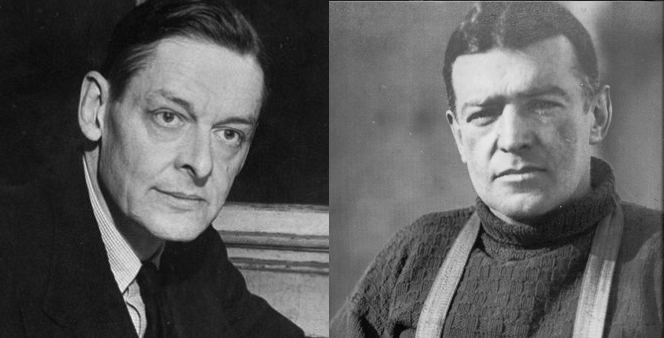
Eliot himself said that he took the idea of a mystery third person materializing from a contemporary account of a remarkable adventure story: the Antarctic survival saga of Ernest Shackleton’s explorers party whose ship was trapped and destroyed in ice.* While trekking across his waste land, Shackleton had written that he saw an extra man helping with their load. Enough others have had similar visions that the phenomenon has even been given the name “The Third Man factor.”
Eliot and Shackleton. Third man not shown. Should I have looked for a picture of Harry Lime or Jack White?
.
Please don’t take this as a take-it-to-the-bank or make-your-grade definitive exegesis of this piece of “The Waste Land,” but instead as a thought, a suggestion, that in times of trouble you may be visited by that element of your future that wishes to heal you, and that creature will be hard to recognize as you express this internally or externally — for in our troubles we may believe there is no future, no future you or us. Let this third walk beside you, even if you can’t quite know them, or know them yet.
My performance of this part of “What the Thunder Said” from T. S. Eliot’s “The Waste Land” can be heard either with a player gadget some of you will see below, or with this highlighted hyperlink which will open a new tab or window to play it.
.
*Eliot probably learned of this from Shackleton’s own accounts published around the time Eliot wrote “The Waste Land.” I learned about the Shackleton story 22 years ago from a crackling-good hour-long radio documentary made by a former co-worker of mine, John Rabe, which I’ll link here. Note that Rabe’s documentary sums up the lesson many draw from Shackleton’s story then and now, that we can endeavor to survive unimaginable trials, and that we can survive.
The river of history runs only in one direction.* And so on our river journey, the Modernist poetic landmark “The Waste Land” will arrive, and stopping and resting on the landing there will mark us as well past the headwaters, and our memories will diminish of the headwaters, even if the very water that carries our boats flows from there. T. S. Eliot wrote many letters and critical essays, he must have written somewhere about his American poetic forbearers — but if so, the spotty scholar writing this is so far unaware of what he said.
If one searches on that subject, one will see many mentions of Eliot’s Modernism supplanting the American 19th century New England worthies headed up by one Henry Wadsworth Longfellow. And then something else might turn up, like this deserves-to-be-better-known sonnet of Longfellow’s titled “Eliot’s Oak.”Here’s a link to the text if you’d like to follow along.
If we largely forget Longfellow these days, we tend to forget Longfellow the writer of short lyric poems to an even greater extent. If this sonnet had been attributed to Keats or Shelley, it would be no less antique in some of its usage, but I suspect it would be better remembered and rated for achievement. Besides the “speakest,” “days remote,” “eventide,” and “hath” language, its chief crust of old-fashionedness is its use of the pathetic fallacy, where a tree is addressed and converses in the poem. We’d forgive Keats and Shelly for this, where we likely won’t forgive Longfellow. If we allow that bald-faced metaphor to pass, we might notice that the imagery in the poem develops in an admirably subtle way. In the sound of the tree’s leaves the poem hears a variety of sounds whose meaning is just out of reach, and masterfully Longfellow transitions to say that different people will hear different nearly intelligible languages in this sound. Am I stretching this conceit’s move too much to say that this 1876 poem has just sought to impress upon us a key tenet of cultural Modernism?
As Longfellow’s sonnet reaches its turn for a final six lines, we are forced, as much as we might be in parts of “The Waste Land,” to seek out what is being referred to. With “The Waste Land,” it wouldn’t be extraordinary to believe that some of the readers of this blog would have some knowledge of Richard Wagner, Jacobean drama, Metaphysical poets, or Ovid; and it’s even more likely today that some here would have some understanding of Hindu religious thought and writings, which will get called out in the upcoming concluding sections. But, do any of you know of the “Apostle of the Indians, Eliot…” Longfellow speaks of, what this story means, and how dark it is? I didn’t.
The Eliot Oak still stood in Longfellow’s time, and long enough for a trolley line to run past it.
.
In the 17th century, the Puritans who founded the European colonization of Massachusetts included this stalwart preacher John Eliot who came to believe that he was called to preach to the indigenous Algonquin tribes there. The Puritans had a strong streak of religious zealotry, and given that and the commercial interests of colonization, many regarded the natives of their new colony has the devil’s savage minions. John Eliot believed them to be merely unconverted fellow humans.** As Longfellow’s poem indicates in his Biblical allusion in lines 10-11, Eliot views the indigenous as fellow members of the Abrahamic family, potential “people of the book.” At first, all this was only a philosophical/theological debate. Eliot was allowed to learn their language, preach Christianity to them, and form somewhat autonomous villages of “praying Indians.” In an act of superhuman intellectual and literary effort he managed to translate the entire Christian Bible into their native language. Just this massive translation alone would be remarkable, but these tribes had no written language, so he had to devise a way to use the western alphabet to depict it. Nor was it an easy job to then print the resulting Bible: the press had to be imported, and the work of setting the type and printing was not trivial either. Eliot headed this project, but it should also be noted that the first nations people who worked with him were indispensable.
The resulting book, in a first edition of 1000, Mamusse Wunneetupanatamwe Up-Biblum God, wasn’t just the first time anyone had created a new written language to publish a Bible, it was the first Bible to be printed in what would later become the United States.
Now of course the whole issue of evangelical Christianity and native cultures is a complex subject. Even those of you who do not know John Eliot’s particular story will include some who know some of the harmful incidents in such matters. Yes, this story gets dark, but there’s also a strange redeeming element in the end too.
In 1675 some of the Algonquins began a three-year uprising against the colonialists, leading to what was called King Phillips’ War. It makes no difference that Eliot’s converts are co-religionists of the colonialists or if they have any allegiance to the rebels. The very fact that many of them are now fluent in the native languages and English makes any of them prime suspects as spies and informants by both sides. Some of Eliot’s converts are killed, and the rest are shipped off to a concentration camp where many starve, despite Eliot’s efforts. Oh, and most copies of the Eliot bible are deliberately destroyed. Those theological debates have become warfare.
I promised there would be a ray of light in this. I’m not sure this had happened yet when Longfellow wrote his poem — and if so, he prophecies it in the poem’s last line — but in the ensuing colonial disaster inflicted on the native peoples, their language was wiped out. People still existed who were descendants of this Algonquin tribe, but they could not speak it’s Wampanoag language. Surviving copies of Eliot’s Bible become the Rosetta Stone that allows the language to be revived.
The same year Longfellow wrote his poem a memorial on a spot where Eliot preached to the Algonquin was built. I wondered through Google Streetview to find it still stands, though it looks ignored.
.
In summary, as you listen to today’s audio piece, it may just seem like a facile little ditty about a talking tree and this, whatever Eliot,*** who isn’t even T. S. Eliot. Understand what its images and references point to, and it’s a memento of one of the least-known and most-impressive American literary achievements and a link to the complex tragedy of some who hoped to turn in some way from genocide. Perhaps it’s the romantic in me, but consider some of the lost or just unheard stories of the land we live on during this #NationalPoetryMonth, the lips that spoke them, the hearts that heard them. The river of history may run in one direction — but go ahead, make a fool of yourself, and listen to the trees. Or listen first or second to my performance of Longfellow’s “Eliot’s Oak.” You can use the player gadget if you see it below, or this highlighted hyperlink will open a new tab or window to play it too.
***So, is John Eliot related to T. S. Eliot? I don’t have a family tree or other such documentation, but it’s highly likely. Eliot’s family was known to descend from early Puritan colonists.
It’s April, time to celebrate U. S. National Poetry Month! We’ve had a tradition here over the past five Aprils of performing “The Waste Land” in serial-installment fashion, and now this year we’ve come to the landmark Modernist poem’s final section: “What the Thunder Said.”
Since the Parlando Project officially launched in August 2016 it’s been a tremendous effort to lead this exploration of a variety of poetry and ways it can be performed with original music. Last year we crossed the 500th piece threshold — an incredible achievement in creative productivity that I’m often proud of. One could spend hours here just exploring the poets we’ve featured and the ways we’ve performed their work. Though I expect most listeners will enjoy only a portion of what the Parlando Project does, I’d say this month is a good opportunity to wander randomly through our archives or use the search function to see what we’ve explored.
Putting a little worn patina on The New, The Modern…
.
I am a little sad and a fair bit intimidated in reaching this section of “The Waste Land,” the ending. It has become harder for some uninteresting reasons to keep up this project’s pace, but as I come to this April, I know I’m going to miss my annual return to the sprawling collage that is Eliot’s great poem. Though I’m hugely grateful for the ability to come this far, sadness is all around me, friends and relatives in suffering situations that I’m unable to address or help, and a sad tribunal is taking place a few blocks from where I sit and write.
I’ve always found this section of the poem a confrontation with sadness, and as it largely removes the masks and personas that have peopled the rest of the poem, I think it’s the most difficult to perform, both for audience-effectiveness and because the performer should/must confront that element inside themselves.
I’ve always found this section of the poem a confrontation with sadness, and as it largely removes the masks and personas that have peopled the rest of the poem, I think it’s the most difficult to perform…
As dysfunctional and damaged as they may have been, today’s section of “The Waste Land” transitions us from the unreal city, its duplicitous characters, and the sweaty faces and the hubbub of “He do the police in different voices” sections, and begins to move us to the titular waste land that will be the stage on which that final confrontation with sadness will occur. Musically, I open this with an urgency as the battle is about to begin. And so, to hear my performance of the first part of “What the Thunder Said” from “The Waste Land” you may be able to use a player gadget below. If you don’t see the gadget, this highlighted hyperlink will alternatively play it.
Thank you for reading and listening. Over the rest of April, I plan on pressing on to the end of the poem, and to present as much other work here regarding the sister arts of poetry and music as I can. Click follow or come back, check out the other things here, and spread the word about this Project. Those of you who’ve done that are what keep this going.
Wait, before I reveal that, let me take a moment to describe what the Parlando Project does: we take words, most often other peoples’, most often poetry, and combine them with original music and present them to you as audio pieces.
I’ve chosen to use other peoples’ words almost entirely because I’m most comfortable writing about that transaction between a writer and myself as reader, composer, and performer in the midst of passing something on to you as another reader and listener.* The project doesn’t use poetry for every audio piece, but I like pieces with some mystery and ability to create an impact in less than 5 minutes, and poets are the ones that do that.
The music you hear is created for this project. I don’t use library music or borrowed music, and except for computer drums, I don’t use samples or canned loops. For better or worse, most everything you hear was played or scored by a real person.**
I don’t always make these combinations of music and words “songs” in the traditional sense — though our modern sense of song has changed so much in the last few decades that “song” has become a much looser expectation anyway. I try to make my musical settings as varied as I can, which means that I expect some will be more to any single listeners’ taste than others.
Now I’ve caught up any new visitors on the Parlando Project concept, we can complete our Winter ’20-’21 Top Ten Countdown with the most popular piece.
1 End of the Sky by Frank Hudson (after Thinking of Li Po at the End of the Sky by Du Fu). OK, this one used my words, though I based it off a classical Tang Dynasty Chinese poem. Since I wrote it last autumn, the meaning I extracted from Du Fu and attempted to convey in my modern English extension of his poem has only deepened in resonance for me personally. When it was written I was thinking about a small group of poets that I’ve met with every month for more than 40 years to discuss our work. I’m the youngest in that group by a short interval and we had all been writing for more than a decade when we first met.
More than a half-century of writing for each of us, yet I think of myself as less accomplished than the rest of the group — viewed objectively from amount of publication and such this is certainly true — but I wonder too if they ask their own version of the questions I ask myself about what’s valuable to say and what we may construct to justify a readers time and attention. Du Fu seemed to be dealing with some of those feelings in his poem addressed to fellow poet Li Po.
The poem’s statement, my attempt at faithful translation from Du Fu’s Chinese: “True literature doesn’t care if it is popular, and/It is only demons that care about a poet’s failures!” is one potential answer to those concerns. Poetry may be what we most care about, but the world cares less than that, and in that is a freedom. “How much difference does that make at this late date?” I ask in addition, a line only implied in Du Fu’s poem. And at the age of the poets in my group, “late date” is a general concern.
Since I wrote it, how has this poem changed for me? Those general concerns have been promoted in imminence. I’ll say in too-brief: two are dealing with existential illness. Loss can be at any hand for all of us. Will it, or any of us, be patient?
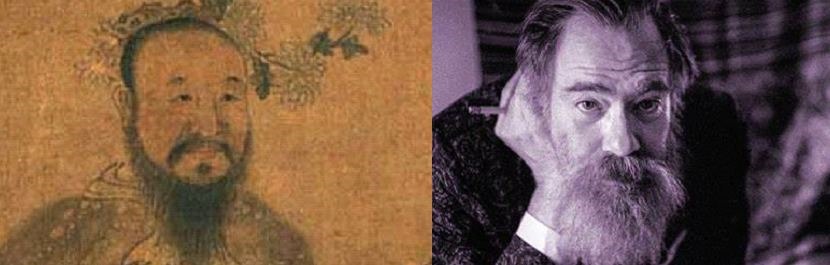
Du Fu’s poem concluded with an understated but devastating conclusion, something I often find in his work. He writes, our creations and our cares about our creation are like a customary gesture that would’ve been known to poets of his time and place: throwing poems as a gift into a river where a Qu Yuan, a Chinese poet from the past had leapt to his death.
They both ran out of patience. Do you see some resemblance? Qu Yuan and John Berryman, “…who was once handsome and tall as you.”
.
My modern English solution to my poem’s ending echoes Du Fu’s superficially, but differs in detail. This is what I meant to convey in my conclusion: Berryman’s mental illness and chemical dependency — fed by his doubts, feeding his doubts — weren’t his art or some driving force for it, for they understood none of that.
Say that, then, to your doubts: you don’t understand my art! Work instead to make your work more whole for yourself and for some potential audience, no matter how small. All doubt and self-abnegation can do is take away — and life and fate will do that for you anyway, it doesn’t need your help.
The player gadget to hear my performance of “End of the Sky” is below. If you don’t see the player, this highlighted hyperlink is an alternative way to play it.
.
*When I write or talk about myself, and later look at what I said or wrote, I almost always cringe. In only a short remove of time it seems disproportionate, self-involved, and vain. Every artist must have, at least episodically, some level of elevated self-regard, but for me that self-regard is always being chased by another that reminds me of my follies. I’ve lived a long life, and neither of those two have stopped running, an endless chase, which has allowed me to create — but as the pursuer and their prey, I’m often out of breath by the time it comes to talk about or promote it.
**Early Parlando Project pieces were often live band recordings, but with age, change, frailty, and finally the Covid pandemic, they’re increasingly all me multitracking myself. Computer drums are a compromise I’ve perhaps too easily fallen into.
Today’s report on the most listened to and liked pieces featured here over the past quarter will show three experiences of the mystery of winter. So, let’s return to our countdown:
4 Twilight Fallen White and Cold by Joseph Campbell. I seem to have become something of a promotor of this little-known in the United States Irish-born poet who I still know little about. He published a series of poetry collections before the end of WWI, and then his poetic output dropped off, for reasons I’m not yet clear on, though the politics of his country’s decolonization struggle may have contributed. This piece using his words that a lot of you liked and listened to may be the most mysterious of today’s trio.
Best as I can figure it, this winter nature landscape poem may be an expression of his nation’s detracted state and situation, particularly in the invocation of ancient earthworks (raths) and burial mounds — but I cannot plumb the entirety of the refraining line of “wounds of Eliom/weep on me” that I feature in my setting of Campbell’s poem. Eliom is a plural word for gods, sometimes used for polytheistic gods, sometimes used for the singular monotheistic diety, and as it may be here, used for angels. If that’s so, then the starry constellations, the winged vampires, the curlew birds, the floating mists, the carrying sound of the ocean are all the Eliom, the angels in this changed winter nighttime vision.
To hear my setting of Campbell’s poem, you can use this highlighted hyperlink which may open a new window with a player, or in many cases, you’ll see a player gadget below to directly play it.
.
It’s been too long since I’ve said this: thank you for coming to read or listen here. It’s become harder for me to respond to comments or properly promote this project, but I appreciate so much those who come here, listen, and let others know what the Parlando Project does.
..
3 The Snow is Deep on the Ground by Kenneth Patchen. Lawrence Ferlinghetti, whose words we met earlier in this countdown, would sometimes remind folks that he wasn’t really part of the Beat Generation, even if he was associated with others who might have been so thought. Patchen is a similar case, or perhaps more so, in that his poetry career started in the 1930s,
As with many of the best Patchen poems, even the political ones, this is a love poem, delicately poised between the enchantment of love and the world that allows the shattering of it. If one can fully absorb the illumination of this poem, as with some of the best of Patchen, you would cry tears of joy and sadness at the same time.
You can hear my performance of Patchen’s “The Snow is Deep on the Ground” with this highlighted hyperlink, or if you see it, with a player gadget below.
.
2 The Sky is low by Emily Dickinson. Some years back in this project I once compared Emily Dickinson to one of those unexploded, yet potential, bombs that are still unearthed in Britain or Europe from the World Wars. Originally she was found as the creator of curious little poems from an eccentric woman, then as a prescient 20th century Imagist, and now in our deconstructed age we can stare at one of her tiny poems, and like one trying to follow the decent of a single flake of snow in a flurry, fall as far as one can follow.
You can read, or listen to my performance, of “The Sky is low” and find a whimsical nursery rhyme, and find enough enjoyment in that — but let it stick in your memory or repeated ear and a little dialog about predestination, first causes and fate is discernible. To listen, use this hyperlink, or you may see a player gadget to directly play it below.
.
One more post in the Top Ten countdown to go, and then we can move on from the mysteries of winter to the mysteries of spring.
Let’s pickup the countdown of the pieces that drew the most listens and likes over this past winter. Each bold-faced listing is a link to the original post on the piece in case you’d like to read what I wrote back then, and those original posts will also contain links to the full text of the poems used.
7 Thursday by William Carlos Williams. Quite often when reading through early 20th century Modernist poetry, I repeat my surprise of how plainspoken and outwardly simple some of it seems. This poem by Williams is one of those. There’s not a single word in it that would be unfamiliar to a grade-schooler. One need know no complex allusions to anything other than ordinary life. Not all his contemporaries wrote like this. Wallace Stevens will pleasingly stump us with his love of obscure words, T. S. Eliot will ask us to consider how history rhymes its myths, and William Butler Yeats will make English sing with beautiful and metrical word-music. Against that sort of thing, this poem by Williams may seem ordinary. As ordinary as a Thursday.
There’s only one bit of word-trickery in it — and having no other in this short poem should invite us to ponder it: that unusual use of the common word “carelessly” in the context of “I remain now carelessly/with feet planted on the ground….” Carelessly? Huh? How many quick readers would slide over that and not notice anything out of place! In the opening of his poem Williams has told us his dream has come to nothing. Is this dream one of our ordinary nighttime hallucinations or a strong and potentially life-changing imagination for the course of things? He doesn’t say and may perhaps mean either. His stance on this? Back to observing the world standing simply and unmoved with both feet on the ground, “carelessly” in the sense of “without a care” regarding that; with the sense also that the overlords of guilt and ambition or the lure of more surreal and spectacular verse are saying he should care and he’s going to ignore them.
In place of that care, of that “tyranny of the shoulds,”* Williams offers us ordinary life, ordinary words, the meditation of breath. That resilience and carelessness, those two steady feet able to stand up to the sky, is this song. You can hear it with a player gadget that may appear below, or with this highlighted hyperlink that will also play it.
.
6 I wake and feel the fell of dark by Gerard Manley Hopkins. What a combination this makes with Williams’ poem that it happens to sit next to in our countdown! Hopkins’ poem has its speaker also awakening from a non-productive dream “Hours I mean years, mean life” — this dream is clearly both a nightly and a life’s dream. And he’s in the opposite of careless: roiled with distress and self-disgusted guilt over it.
What a combination this makes with Williams’ poem…
The language here is extra-ordinarily charged. Some of us have had such a self-castigating night, but few of us could express it in such a tight compressed form as a sonnet that moves musically and emotionally. Hopkins’ feet are not firmly on the ground at all — he’s rolling and tumbling as the great American floating Blues verse has it — and that’s the nature of Hopkins’ song.
This is the distress half of the engine of the Tao. We may more easily recognize it quickly as great poetry, and should, though without some balancing aspect it cannot long whirl.
My performance of this greatest of his “Terrible Sonnets” can be heard with this hyperlink, or in cases where it appears, the player gadget that may be below.
.
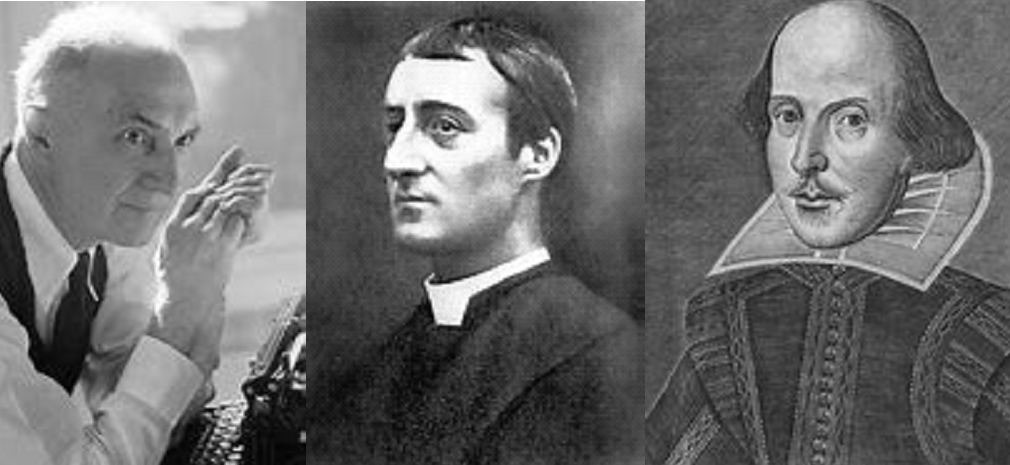
Collar styles of poetry, a retrospective. William Carlos Williams, Gerard Manley Hopkins, and William Shakespeare
Well, the jury’s still out on that one. It is always so with art, as art happens in the present when we look, read, listen, hear. That’s a large part of what this blog is about: encountering stuff written in various ways and times and seeing what we can make of it in the immediacy of a musical performance.
“Sonnet 97: How like a Winter hath my absence been” is neither the calm meditation after a dream’s failure nor the roiling disgust our first pair of poems had. Instead, this sonnet is all about the ambiguity. What kind of ambiguity? Shakespeare will pick several. One of the basest tests of mental state is “oriented to time and place.” This poem certainly isn’t — that’s its most pressing point. Is it winter, summer, fall, or spring? Can’t say for sure. The purportedly male authorial voice dons rhetorical drag and speaks of his sonnets as if they are birthed from a poetic womb as if the addressed “fair youth” is the only begetter in a very patriarchal metaphor for these sonnets. And what’s the true nature of the relationship between that authorial voice and the fair youth being addressed? Complicated. Author as vassal of the ruling class?** Lover? High-minded patronage? Some of all? Well, that’s Shakespeare’s song for us. This hyperlink will play my performance of it, or if you see it, you can use a player gadget that may appear below.
.
*The phrase is psychotherapist and author Karen Horney’s, whose mid-20th century work may still have something useful to say about us today.
**It was while dealing with this sonnet that this aspect of the “Fair Youth Sonnets” first occurred to me. I assume it’s occurred to others, but not being a Shakespeare scholar I can’t say who or where.
I’ve been tardy in many things for this project lately — but let me get on to recounting which pieces were most liked and listened to during the past quarter.
It may be a bit strange to revisit a winter we are glad to be emerging from, but poetry is about remembrance of all kinds of emotions and experiences. Which ones did the Parlando Project readers and listeners most connect with?
As we usually do, this is a countdown, so we start with the 10th most listened to and liked piece, and then over the next few posts we’ll move on to the most popular this winter. The bold-faced titles are links to the original post that introduced the piece in case you want to read what I wrote then.
.
10 Trifles – I Know What Stillness Is by Susan Glaspell. I wanted to do something special for this project’s 500th audio piece, and I decided to try to use some words from my distant relative who was herself a figure in the Modernist revolution of the early 20th Century that I mine for many of the pieces used here. Glaspell is not a poet like most writers I present, but this short scene is from what remains her most famous work: a still effective short play about two women who have accompanied their husbands who are charged with investigating a murder* in a remote 1900 Iowa farmhouse. At this point in the play, we know that a farmer has been strangled there and that his wife, Minnie, has been taken into custody as a suspect, even though there is some doubt that a small, quiet woman could have had the motivation and strength to commit such an act.
While the men continue their very official investigation, the two women discover a dead canary entombed in a fancy box and connect it with the lonely life of the farmwife. Should they tell their husbands what they found?
I solved a difficult problem by treating this scene as “poetic” enough to work with the music and then locating a dialog performance that let me avoid trying to do the voices of the two women myself. I’m also quite proud of the music I composed for this one. You can hear it one of two ways: this highlighted hyperlink, or for some of you, a player gadget below.
.
Susan Glaspell getting her work done. Per the radio-play practical audio-effects tradition: in the wintertime it’s nice to sit next to the crinkling cellophane and work on your manuscript.
.
9 The world is a beautiful place by Lawrence Ferlinghetti. I bent the rules to publish this older performance that Dave Moore and the LYL Band did with my off-the-cuff reading of a piece from Ferlinghetti’s A Coney Island of the Mind collection that so many treasured decades ago. These words are not in the public domain, and I had never received a reply when I sent in inquiry about presenting them here a few years back, but on the occasion of Ferlinghetti’s death I felt I had to share this with you, some of whom are among those that treasured those words.
But maybe some of you hadn’t “met” Ferlinghetti’s words before. Buy or read his book and meet more. Perhaps a few of you have an idea that the label “Beat Poetry” requires a dour and slack protest, a litany of muttered and solipsistic defeat. Maybe that’s not so.
.8 Escape by Georgia Douglas Johnson. I still know little about this “Harlem Renaissance” writer who wasn’t actually located in 1920s New York City. As time for this project gets harder to locate, I still hope to remedy that. Despite my deteriorating ability to complete new pieces, I made an extra effort this year to do work celebrating Black History Month this February, using work found in the landmark The New Negro anthology published in 1925. “Escape” was the one that found the most favor with this Project’s current audience.
Musically, I used the magic of MIDI “virtual instruments” to pay tribute to the Afro-American fiddler tradition, playing the featured violin part on my MIDI pickup guitar. At the end of the recorded performance, I tacked on a verse by the altogether unrelated Moondog, a musician who ironically was connected to New York City. Here’s the link to hear my performance, or if you see it, you can use the player gadget below.
.
*Glaspell was able to use her earlier reporting on an actual Iowa murder case as matter in her ground-breaking play.
Sunday is World Poetry Day and I should do a piece about poetry and poets to mark it. The specific idea of World Poetry Day is to celebrate every nations’ poetry, something I try to do here with fresh translations sometimes, but for today I’ve decided to use works by two American poets. The United States is still a young nation, still used to using the cruder tools of youth to impress itself upon the world, but our poets have had their innings, so today I’ll sing them to the rest of the world. First up: Wallace Stevens.
It’s not uncommon for poets to write poems about art or the art of poetry itself, but Stevens did this often. So it’s no surprise that “A High-Toned Old Christian Woman” starts off with an assertion about poetry, even though the rest of the poem seems to progress into an argument about religion and religious propriety. Here’s a link to the full text of Stevens’ poem in case you want to follow along.
Stevens’ poem slows down our understanding of what it means using two tactics. First, it gives us at best one-half of a conversation: a little like hearing a person talking on a phone in public where the other party is inaudible. It takes considerable effort in comprehension to settle on what issues and points are being addressed in the poem’s speaker’s argument. I’m not totally certain I grasp them myself despite several readings and going on to perform the piece. Our high-toned old Christian woman may be expressing outrage at some more pagan and unfettered artistic expression on Stevens’ part. Stevens’ response is to point out that art has its own religion of a sort, its own myths and beliefs. That unheard party, the HTOCW, seems to make an objection regarding Stevens’ or art’s outrageousness derived from its beliefs and theoretical constructions, and Stevens’ then parries with a short aria on the extremes of Christian asceticism bellowed over a tink-tank Vachel-Lindsay-ish Salvation Army band. In summary he’s claiming they are alike: that the HTOCW and her co-religious cohort and he the poet both have their own guiding constructions (supreme fictions), their own expectation of meaningful belief and actions that promise — well, what do they promise, or rather assuredly deliver?
He’s not sure. A poet’s masque (a play) performed on earth may aspire to cosmic importance, but we can be sure the planets will not be all that moved. And the most fervent displays of religious piety can’t move the heavenly spheres who would at most judge them as unserious “hullabaloo.”
The second way Stevens intentionally slows down our comprehension is with language, the stuff and lexicographic music of his poetry. Most any stanza of a Stevens’ poem is equal to a “Word-A-Day Calendar,” and this poem doesn’t disappoint: nave, citherns, peristyle, masque, epitaph, flagellants, muzzy, and hullabaloo are not common modern English language words, and I’ll wager that most readers, even the most educated among us, would be hard pressed on getting 100% on a definition test with that list.* I’ve always “read” Stevens as having fun with his use of these obscure words, and in many cases here he’s punning on their sound, so we think we understand something we hear in a performance from the sound, while on the silent page they remain stumpers. Making someone a nave/knave is to fool them. A peristyle projecting upwards sounds like a periscope from a WWI U-boat or trench. A masque might as well be a mask. Flagellants with muzzy bellies sounds like flatulence from fuzzy bellies.
And while not an obscure word, “palm” is repeated several times in the poem with different meanings pressed onto it by context. It first seems to be Christian praise, as in the arrival of Jesus into Jerusalem on Palm Sunday, a moment of triumph to be followed by Good Friday (and then, yes, for believers, Easter). In its second mention, the poet might earn laurels, palms of honor for their work, but like the praise of the crowd it may be fleeting, pace what I call Donald Hall’s Law. And lastly, the palm plants become hands I think, the two seemingly opposed, the two sides — the prim believer and the pagan poet that the poem has satirized — I believe, palm to palm, a pair making a prayer.**
Let’s look at the poem’s end at last: Stevens seems to be saying that salvation by faith in art or religion is unclear. Widows wince when doubt says they may not meet their husband in heavenly reward or when that doubt (or belief) is sung impiously by some poet who calls his art, his mythology, the “Supreme Fiction.” God and the muses are both winking at us, telling us that we only half have an understanding, flirting with us on that unknown stage of our best fictions.
Stevens was a famous late-starter, publishing his first poetry collection Harmonium where AHTOCW first appeared at age 44. Millay was already on to her second collection featuring First Fig at age 28.
.
What then to make of the poem I combine with it, a short poem with plain words that many feel they understand at first sight: Edna St. Vincent Millay’s “First Fig,” the one that begins, as so many have memorized, “My candle burns at both ends.”*** Is this not also a poem of faith in poetry? Yes, with the same limits and lack of assuredness. Is it also one half a debate with another point of view? Yes too, though it be a short epitaph “unpurged from bawdiness.”
In effect, “First Fig,” the opening poem in Millay’s A Few Figs from Thistles, is the title poem, the dedication of that short collection that set out the Millay outlook on youth, freedom, and autonomy sexual and otherwise. It made her famous for a while, and unlike Stevens’ knotty poems, hers (and herself) seemed understandable. Here’s its full text.
We understand this poem quickly to say: that one may, from our passions artistically — or otherwise in that mere and yet larger life — expend or risk so much that we allow it to be foreshortened, but that we believe that intensity is illuminating, possibly worth the sacrifice. Note, there’s no explicit conclusion. Millay’s poem doesn’t say outright it’ll be worth it, and other poems in A Few Figs from Thistles are not sure either. Its illumination is brief, a night in length it says. Yet a poem we think we understand, that we might memorize and carry in our muzzy brains may change as we project its light on different walls.****
Given Stevens’ satiric and philosophic wordiness, I came to think pairing it with Millay’s short heart-song would be a worthwhile contrast, each stronger with their lights against the ground of the other. You can listen to the performance and see if that’s valid — but before I go, is there one thing we don’t understand about Millay’s short poem?
Well, there’s the title. It’s such a short poem, yet we forget that there’s this added pair of words. I’d guess that many that know or have even memorized the poem forget the title. One thought was that it might be referencing an idiomatic English expression: “I don’t give a fig about…” which could easily be given an intensifying modifier “I don’t give a single (or the first) fig about…” I had assumed that fig, like the euphemistic interjections sugar or darn, was just a word used to replace a ruder word that started with the same letter-sound. I even wondered: was that idiom around when Millay wrote her poem in 1920? Well, just as I wouldn’t know muzzy or cithern fully when I read Stevens, it turns out I was off a bit. The idiom seems to date back to Shakespeare’s time or even more, which is odd in that the fig isn’t even a native fruit in England. It comes from Spanish and Italian; and it’s not only a word but it has a Mediterranean hand gesture to illustrate the thought, involving the thumb placed between two raised fingers. The intent in gesture or word in this idiom is to refer to low pink-toned lady parts, and in the patriarchal context then it’s an expression of contempt.
Did Millay know the derivation of the idiom? I don’t know — but she likely knew the non-etymological meaning of the phrase. In the context of the one-side of the debate that “First Fig” is presenting, that indicates that the speaker doesn’t give a single fig for the off-screen speaker who disapproves of the possible costs of passion.
Long post, but two poems for this World Poetry Day! The player gadget is below, or if it isn’t, this highlighted hyperlink will also play my performance of Wallace Stevens’ “A High-Toned Old Christian Woman” and Edna St. Vincent Millay’s “First Fig.”
.
*Ones I’d miss or get half-credit for? I knew citherns were an instrument from my interest in unusual instruments, but I wouldn’t be able to describe one definitively. I probably once knew peristyle from an early interest in classical theater, but had forgotten its meaning. Muzzy was dark to me and would have been a clear miss. A good dictionary then or the Internet now allows us to decode the original denotative meanings, but these still keep us from understanding Stevens too soon. And they can just be fun to come upon in a poem!
**This blog post and close reading, perhaps from more knowledge about Stevens’ biography, posits the HTOCW to be based on Stevens’ mother.
***If HTOCW may be Wallace Stevens’ mother, one of those that had memorized Millay’s “First Fig” was my father, who once or twice recited it to me. What caused him to memorize it, or to read Millay? I never knew. He never lived a bohemian life, and as far as I know he lived a modest, constant, and long life. I can guess however why he recited it to me, who did have my bohemian modes and times: to say that he knew something of that, or that I could have faith that something worthwhile could come from that.
****I’m increasingly seeing readings that see coded (intentionally or unconsciously) in this poem an expression of Millay’s bisexual/polyamorous autonomy.







 Frank Hudson