Yesterday was some kind of day to celebrate Wales, and I asked the teenager in the house what they did to celebrate since they have an interest in languages and had recently been studying Welsh language online.
“You mean for St. David’s Day?” They replied. I was surprised they knew — but then they’re often surprising. “What are you supposed to do?”
“I dunno. Maybe make a point to use W as a vowel?”
What did I do? I worked, using some increasingly rare time recently, on a new piece here that you may see later this month with words by Welsh poet Edward Thomas. But that’s not today. Today is my catching up with a piece that has been in the works for a couple of weeks at least, remaining unfinished as other concerns remand me to only hot takes and short contributions on Twitter.
Those I follow in the British Isles are sharing pictures of buds and first wildflowers. Not here.
.
Is Sara Teasdale’s “Winter Stars” late then? In my upper Midwest, absolutely not. Monday it snowed, my bicycle which I’ve ridden all winter, is behind a shed door whose jam is frozen completely shut by an icy enchantment after melt/refreeze — and 15 degrees F. this morning certainly won’t let it go. Yet, there’s one other time displacement to account for in this poem, for this is another of Teasdale’s poems about WWI. Particularly in Great Britain, when “War Poets” are mentioned, male citizen-soldiers are typically meant, and few now recall that American poet Teasdale wrote poems about the war. One of those poems is likely her best-known poem (or at least poem title, since Ray Bradbury borrowed it) “There Will Come Soft Rains.” So lovely and complete is that dystopian vision within itself that I suspect it never occurs to readers today that she was writing it in the context of WWI.
“Winter Stars” has the same strengths of not seeming to be stuck in time or current events. Indeed, folks have written about the poem and thought the blood flowing and wars mentioned within its lines are metaphoric tropes. Alas, as I considered this poem during this past February, the anniversary of the still ongoing invasion of Ukraine provided a corresponding all-too-actual simile. Here’s a link to the full text of Teasdale’s poem.
Teasdale’s night stars are then, like the sure-to-come soft rains of her other poem, a meditation on what endures when suffering, violence, and human vanity can change everything else. I was particularly taken with the next to last quatrain in Teasdale’s poem, remembering as I read it her guarded and constrained by illness childhood looking out a bedroom window at the immortal stars and the mighty Orion, the hunter, who could change and master things.
In the poem, it turns out that Orion doesn’t change things, rather that desire to change things is the constant. Teasdale would leave her sick-room childhood in St. Louis, find some brief success in New York. That older Teasdale is the writer of this lyric. Armies can march, hunting changeable borders to be drawn in blood. Teasdale seems to somehow fatalistically know that Orion and winter never leave, they only blink, they’re always there, the hunter and the prey.
The player gadget to hear my performance of Sara Teasdale’s “Winter Stars” is below for many of you. No player to be found? This highlighted link will open a new tab window with a player so you can hear it too.
I hope some of you enjoyed this Black History Month look at the premier 1926 issue of Fire!! Devoted to Younger Negro Artists. This landmark of the Harlem Renaissance announced a new generation of young Black writers, many just out their teens — artists who not only filled its pages, but organized and edited the publication. Today I’m going to tie up some loose ends and tuck in the laces on the Fire!! story and give you a few links in case you want to do your own exploring.
The quiz says I’m Gwendolyn Bennett. My wife’s results: Richard Bruce (Nugent). Richard Bruce too for longtime keyboard playing and alternate voice contributor to this Project Dave Moore. Dave’s artist partner joined me in the Gwendolyn Bennett result.
So, we looked at the first issue of Fire!! this month. What about the next issue, other issues? There wasn’t one. The magazine, founded by young artists, was not well funded, and selling and distributing didn’t go well. The gatekeepers were at least privately aghast at some of the content, so their advice and word of mouth was to disparage and discourage this effort. I’ve already mentioned when presenting two of the four poets I selected for musical performance that publication in Fire!! did not guarantee lasting readership or note for these young people. So, Fire!! folded, and in a lead-eared note of irony, the mostly unsold print run was destroyed in a storeroom fire. John Keats epitaph says his name was writ in water. Fire!! and some of its writer’s names were writ in fire, and it all died down.
I often suspect many folks who find these blog posts are looking for homework help or teaching resources. To what I (an old person) can understand, being a teacher or a student covers wider territories than in my days, but there are still skirmishes at the borders and difficult areas under the control of different warlords. Fire!! magazine sought to cross those borders then — and if one is to study it and its contributors in any depth, it still does. Not only did Fire!! bring forward new young writers — many committed to Modernist art and radical politics — it purposefully sought to express elements of life that the older generation of gatekeepers wanted to suppress or keep only within the tribe. One of those things was sexuality. So teachers and students, here we have a group of young creators in 1926 writing on race, injustice, and sexual expression that isn’t in committed relationships or straight. On what authority did these audacious writers take to break through those barriers? Not only were the instigators and contributors of Fire!! young, gifted and Black, they also were often somewhere on the spectrum we could label today as queer.*
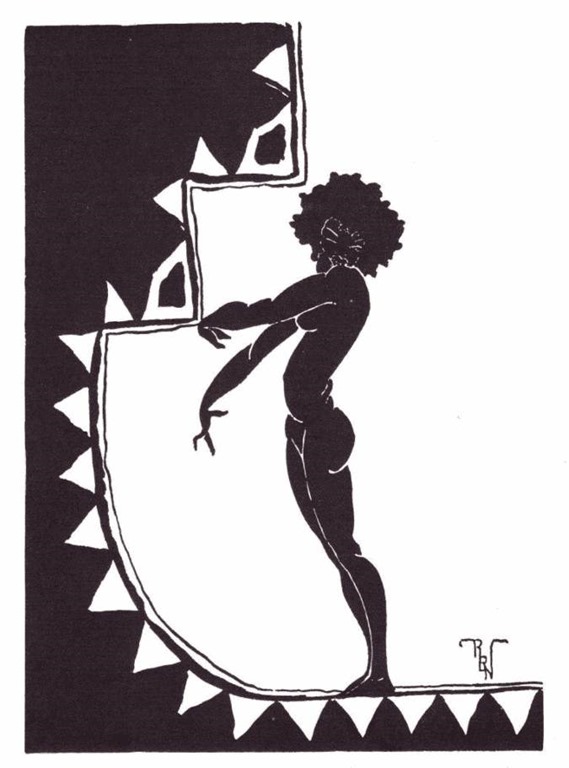
A drawing by Richard Bruce Nugent from Fire!!
.
So, to teach or discuss Fire!! and its creators beyond a surface is to go to places where teaching and learning is still constrained. I’d say to learners (a class that includes nearly all teachers) you may choose to go there even if traveling alone. Literature, music, the arts are the forged identity papers that let you cross borders. Though the writers of Fire!! are all dead, they won’t mind speaking with you.
In the spirit of gratitude to Afro-Americans and their vital contribution to American culture let me repost my Buzzfeed Fire!! contributor-like Gwendolyn Bennett’s summary in poetic “Song.” Graphical player below, or a backup player will open in a new tab link here.
.
*Here’s one web post by someone who taught school, doing a better job than I can today of discussing the queer aspects woven into the Harlem Renaissance. There is also this low-budget indie movie Brother to Brother made nearly a decade ago centering on Richard Bruce Nugent, Wallace Thurman, and the non-straight circle that organized Fire!! The film has some PG13 level sex scenes and self-violence. I found it available for rental from the usual online sources like Apple TV or Amazon Prime.
Last time here, as we examined the young “Harlem Renaissance” writers who created the 1926 issue of Fire!!, we met one of its lesser-known contributors, Waring Cuney. Today I present an example of something that Cuney did later in his career. But let’s start by going backwards. Cuney was contributing to Fire!! around the time he had won a poetry contest prize as a 19-year-old, but he was originally intending to become a musician. His Wikipedia entry says he changed his mind because he thought he had a poor singing voice.
Already you can see why I, with my inconstant voice and a project that uses the subtitle “The Place Where Music and Words Meet,” might take a liking to him. His family’s music and civil-rights connection may be deep and as strange as America could offer. While I can’t confirm this as I write today, he appears to have been the grandson or other descendant of Norris Wright Cuney (Waring’s father was named Norris Wright Cuney II) who was an important figure in Reconstruction era Texas politics and therefore also related to Norris’ daughter Maude Cuney Hare. Even a glance at the Wikipedia summaries for Norris Wright Cuney and Maude Cuney Hare might tell you how rich and fascinating American Black History can be.*
So, what strangeness made Cuney consider poetry? Here’s the story I found: one day Cuney was riding on a bus reading a newspaper when he saw in it a picture of another young black man his age who had just published a book of poetry. He looked up, and there was that same guy, riding on the same bus, Langston Hughes. The two became friends.
If Hughes’ poetry was early in concerning itself with Black musical expression, Cuney was alongside him with that same inclination. Later on, Hughes would occasionally read his poetry with jazz accompaniment. Cuney went Hughes one better, collaborating with Josh White on a remarkable dawn-of-WWII record of Blues songs about racial injustice called, like the lyric I perform today, “Southern Exposure.”
The 1941 record where Cuney’s lyric was first performed
.
This song lyric is nothing fancy, but it’s a compressed portrait of the forces that led large numbers of southern Afro-Americans to move North. What moved them? In short: industrial or domestic/pink color work seemed preferable to the feudal system of southern agriculture enforced with outright de jure racial segregation and restrictions. I could step back a bit and say that like Joseph Campbell’s highly compressed portrait of Irish rural poverty and emigration, “Southern Exposure’s” small cabinet of modest imagery is in the service of describing big things.
I didn’t use Josh White’s music or arrangement for my musical performance of Cuney’s “Southern Exposure,” preferring to rig up my own. I’m singing with acoustic guitar, the adopted Blues instrument White used, but about halfway in the rustic guitar is joined by a cello, a concert-hall instrument. You can hear my rendering of “Southern Exposure” with a graphic player if you see that, or with this backup highlighted link that will open a new tab with a music player.
.
*When I read the current controversies being utilized for political leverage regarding American Black History, may I introduce one point that I think gets missed as folks try to maximize white fears about this subject. Yes, horrible things occurred — and they weren’t accidents or fate, they were inflicted with intention. But strange and brave things occurred too. I’d argue that studying evils inflicted with intention is a vital subject for humanity — but also that the second, however bittersweet at times, is marvelous and intensely interesting.
I’m going to take a short break from our February celebration of 1926’s Fire!! Devoted to Younger Negro Artists* to celebrate old people — really old people. The audio piece today is also not as solemn as some of the issues we’ve dealt with in other posts: it’s about love, desire, lust — and those feelings are represented as Shakespeare or many of the Afro-American Blues artists of our last decade to be called “The Twenties” might present it, as “country matters.”
There’s a long poetic lyrical tradition of mixing rural metaphors with desire. We’ve done more than one piece here over the years in the bucolic poetic tradition of lusty shepherds and comely rural maids, but it has occurred to me in my present old age that they are almost always young and single. I, on the other hand, am an old, long-married man. Not to put a damper on the prurience factor, but when I say old, I mean old enough to think about not being around to promise love forever. I’ll repeat what I’ve said here before: that at my age when offered a lifetime guarantee on a product, I’ll ask now if there’s a better deal. Yet, oddly enough, that for me makes the desire to connect with my beloved no less ardent. Carpe Diem is no longer just a trope to be trotted out.
Does today’s rambunctious piece do a good job of communicating that? I’m not sure. I presented an earlier draft of this a decade ago to a writer’s group I was participating in — and they, in the springtime of their mid-60s, thought it was a persona poem about someone wooing a rural widow, while I thought the inescapable ribald joke in the piece was that the singer wanted to, ahem, get down with it, before they died making their wife a widow. That group was often right about such lack of clarity, but I sometimes wonder if they were too young — and now that half that group has died, that they might have a different understanding of this lusty Blues poem. And it occurs to me that’s an additional joke! The audience for poetry may be small, but am I expecting the audience for this one to be made up of dead people?
Here’s my Blues-poem lyric. We’ll be back with other peoples’ words soon.
.
I don’t know, but I wish all of the readers and listeners here, of whatever age, a happy Valentine’s Day. We may not understand love — after all, we barely understand lust — but let us fumble toward that understanding with chocolates and flowers in a cold February. You can hear me perform this Blues-poem with bottleneck-slide guitar using the graphical player gadget below, or with this alternative highlighted link.
*You might think, “1926, that’s old people!” but Fire!! was organized, edited, and written by members of the famed Harlem Renaissance when they were barely out of their teens.
As we continue our 2023 Black History Month encounter with the young Harlem New York based writers in the 1926 issue of Fire!! we reach a much less familiar name: Helene Johnson. Our lead-off poet Countee Cullen was a mere 3 years older than the 20-year-old Johnson when Fire!! was published, but Cullen had already published two books and had two more in the works. Johnson had published mostly though successful writing contest entries. In the upcoming year she’d publish a poem in Vanity Fair. And then? Well, not much.
None-the-less, her poem in Fire!! “A Southern Road” is as strong as any included. I’m going to try to be brief in discussing the poem’s craft — though the poem exhibits those skills — because discussions of meter and imagery against the poem’s subject seem disproportionate to my heart’s response. And let me be clear at the start of this discussion: “A Southern Road” is a lynching poem, and in the last decade called The Twenties most Black American poets assayed a poem on the terroristic acts against Afro-Americans that were then an occurrence as common as mass shootings or questionable police killings are today.* And like those things we experience today, lynchings and other acts of anti-Black violence were both a cause for political organizing and an ongoing hurt that the country seemed incapable of correcting. Let that sink in for cause of sorrow and information: around 100 years ago, in the lifetime of people in our lifetimes, it was considered an insolvable problem that American communities would torture, mutilate, and summarily execute fellow citizens as a public display of their power and the executed’s lack of it. Read that sentence again. Read it once more after that. This level of savagery was thought something that couldn’t be stopped, something inevitable.
Can I appropriately introduce an odd sort of hope into this horrendous history? Yes, the heart and head may be confused on that. Still, people, Black and white Americans, dealing with a nation that collectively thought this just had to continue, eventually made lynchings rare. There’s a long and likely necessary analysis on why this happened that would include how the same hatefulness mutates into new forms, I won’t get to that here. I’ll just say to our current, crucial, Greatest Generation (because, like the last given that name, they’ll have to be great) that pervasive “This can’t be changed. Any solution would be ineffective and worse than the disease” statements about present horrors can be reflexes not reflective of history.
As the poem appeared in Fire!! The Internet has some mistranscriptions likely due to OCR errors.
.
Did Johnson’s poem make this change come about? No, it’s not even well-known as a poem— not even well-known as an African-American Harlem Renaissance poem — but poetry works in each reader and listener, one-by-one. A little over a decade later Abel Meeropol’s song “Strange Fruit” was powerfully realized by Billie Holiday, but Johnson’s earlier work was similarly skillful in giving us a portrait of evil. Even more than “Strange Fruit,” “A Southern Road” is cast as a cold pastoral. “A Southern Road” opens with a somewhat specific yet mysterious image: a dry yellow tongue. A metaphoric rural clay road? A parched leaf? From the poem’s generalized title we don’t know. I think the following “little tune” image developed over the next few lines is birdsong, and our dry forest pastoral ends unexpectedly with a line “Pregnant with tears.”
Johnson’s next sentence spread over four lines is part of why I think the tune, a melody that is a “streaming line of beauty” is birdsong, as there’s a nest that’s been flung down by some indifferent god/fate, before the Sabbath. We are to worship that god? We are to puzzle at a beautiful song despite loss?
The poem’s final five lines have us reassessing the poem’s portion before them. Several antique words are used here, perhaps a conscious choice to make this horror that was contemporary to her time in a way more timeless and generalized. A tree is described as a “predella,” the platform of an alter. We can next tell that the metaphoric altarpiece in this case depicts a crucifixion of a kind, a lynched person. “Sacrificial dower to raff” is near-Chaucerian in language. “Dower” is the inheritance of a dead person, raff is Middle English for rubbish, akin to the slightly less out-dated term “riff-raff.” The sacrificed body does not seem like much of an inheritance, any more that Christ on the cross seems much like a godhead, but I think Johnson is using raff/riff-raff in this line also to refer to the lynchers and their hate’s inheritance.
The poem ends with the tortured body suspended in the air, which I believe the poem compares to a plausible reader’s opinion on this matter: suspended?
There, I said I would keep my account of how we might encounter and understand this poem’s craft brief. I’ve compared “A Southern Road” above to “Strange Fruit,” and so I took it as my job to give Helene Johnson’s poem some further equivalence, albeit with what I could create for music and with a less masterful singer. I needed to put the music together fairly quickly again, but despite having three guitars and an electric piano over the bass and drums it worked spontaneously, as it needed to. You can hear it with the player you may see below, or with this alternative highlighted link.
.
*There’s a figure easily found in web searches that more than a thousand lynchings occurred between 1900 and 1914. The later year 1919 (not included in that selection of years) was notorious for white riots and other forms of violence. US population at the time of today’s poem was roughly 1/3 of what it is today if you’d like to adjust figures. It’s plausible that numbers were not easily gathered for other years — after all, in our century there were no figures on the number of people killed in police encounters until recently. And anyway, technical arguments about collection and accuracy of numbers, like metrical scans of this poem’s lines don’t get at the overall effect of this: that people are going to terrorize and kill you and not enough are going to care about it.
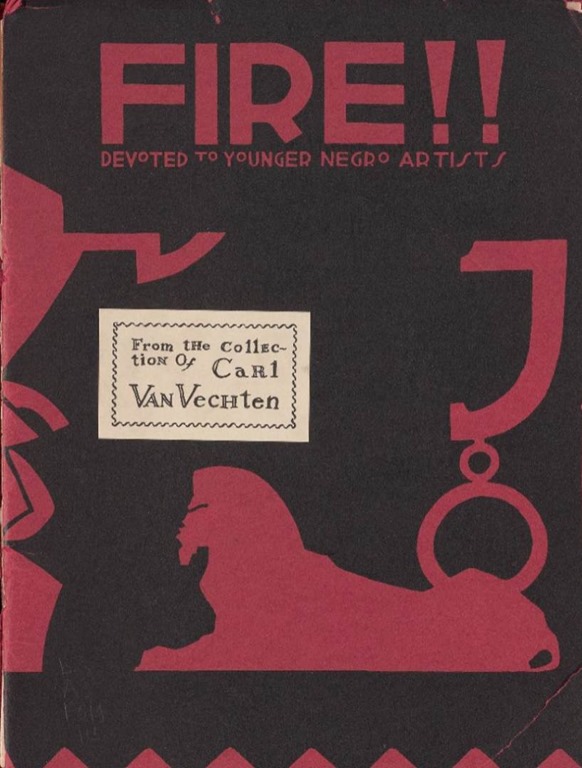
It’s February and in America it’s Black History Month.* In the past few years of this Project I’ve picked a publication that has entered into public domain status to examine.** This February I’m going to feature work from a singular 1926 publication, the first issue of what was to be a literary quarterly called Fire!! The cover advertised it would be “Devoted to younger Negro Artists.”
Want to read this issue of Fire!! in part or all? Here’s a link to a high-resolution scan of it.
.
It’s worth stopping and noticing that “younger” again. It’s easy to fall into a trap when considering a time so long ago to many who will be reading this in 2023 — but its contributors and instigators were in their younger 20s though some had been writing and publishing since they were teenagers. They may seem old to you by strange definition, but they were certainly young to themselves and their contemporaries.
I find that remarkable. While a range of Black American artists were coming to the fore in the last decade called “The Twenties,” I can’t think it was in any way a time friendly to them. Even artistic Modernism, which sought new sources of inspiration and often delighted in mocking old prejudices, was a mixed bag. Racism and ethnic stereotyping remained present in Modernism. Perhaps sociologists could tell us if it was greater or lesser in the world of art than in society at large then, but I’m certain it was no small factor. And yet here were these young writers who at this point thought it was time for them to unleash a record of their experiences.
It’s not so wild a theory to say that they were so audacious because they didn’t know any better. I’m not going to knock that — for this white elderly composer and amateur sorta-scholar to think I have anything to bring to their efforts is not how the smart money would bet either. And you? You’re reading a blog with poetry and a variety of non-commercial music. So clearly, we all don’t know any better.
In the previous year’s Black History Month series here we’ve noted that some forms of new expression that would be featured in Fire!! were not without opposition even from the existing Black Intelligentsia. Jazz and Blues musics were considered problematic. Literary examinations of the sequalae of poverty rather than stories of uplift were controversial. Even if the 1920s were the decade that free verse became more widespread, some of these young poets looked more to Shelley and Keats than Carl Sandburg or Langston Hughes.
Here’s Cullen’s sonnet as it appeared handsomely set in Fire!! It’s also the first poem in the poetry section of this issue, a section titled “Flame From the Dark Tower.”
.
Our lead-off poet is one such example. Countee Cullen was not a Modernist poet. Unlike other metrical/rhyming poets like Frost, and sometimes Yeats or Millay, he’s not even Modernist in outlook. While he’s 23 years old when this was published, he writes as if he was looking back to his last decade to be called the 20s, which would be the 1820s. None the less, “From the Dark Tower” is an impassioned account of the harms of white supremacy — and it is very well written within that style. If the premiere Afro-American poet Phyllis Wheatley was out to prove that she could write 18th century poetry as well as any white poet, Cullen demonstrates that he could do the same for the 19th century. Sure, there’s the matter that he was writing in the 20th century, and we are reading him in the 21st, but that’s likely a lesser sin now when there’s no fresh battle to be joined over free verse, Jazz rhythms, or Blues speech. It’s not unlikely that we read other older poems written in this poem’s style, and Cullen is in 2023 one of those old poets.
And then there’s this — this huge thing. I was trying to quickly get down an acceptable take of my simple acoustic guitar version of my song-setting of Cullen’s poem from Fire!! yesterday. Across my country, at the same time, in a city famed for its American music, so significantly Afro-American music, there was a funeral for yet another Black person killed by our official representatives in a manner that seems clearly to be an affront to civilization. Should we, musicians who’ve inherited that tradition, merely “beguile…with mellow flute?” To sing Cullen’s line, couched in careful rhyme and meter: “We were not made eternally to weep” — can I wish that situation would seem old-fashioned, out of date, a curiosity of the obsolete?
To hear that performance you can use a player gadget that should appear below. No player? This highlighted link is an alternative.
.
*Not to cast shade on this worthy endeavor, but Black History Month has been in my observation largely an Afro-American History month. There’s nothing inherently wrong with concentrating on that subject. I’ll just acknowledge that in the past century or so there’s been a counter-colonialist reassessment of African continental history — and while it has not risen to the level that this American has been aware of it (beyond some UK and other former English-speaking Commonwealth country reading) there may be worthwhile study and information coming forth on the wider African story.
**Because reusing, adapting, even performing, work not in the public domain is a legal gray area, this project shies away from using more modern work. Luckily as this nearing 7-year-long project has continued, more and more “Harlem Renaissance” work has entered PD status. Specific thanks is due to the Yale University Library for making Fire!! available digitally.
Let us return to the genius of Emily Dickinson, as we have regularly here at this Project. As I look to her work over the years, I find that Dickinson has several modes. In one mode, her approach is charming, a just-between-slightly-weird-friends sharing of concrete observations of people and the physical world. Even when that Emily speaks of death and eternity, it takes as its conveyance and destination a horse-drawn fate and a well-made bed/grave. Another mode, not as well represented in her “greatest hits,” can be puzzlingly condensed and abstract, as if shorthand notes taken from her own mind of states of thought or insight that come upon her.
One aspect of genius is that it can get away with things that us more craft-assigned poets cannot. To be abstract and nearly impenetrable at any length tires out readers even as her other poems draw us in. If one reads Dickinson as an entire collection, these modes are interspersed. We might think, “Oh, there’s our friend Emily in one of her private moments we cannot join — moments we accept with partial-at-best understanding because we’ve come to love the other parts of her poetry.”
Today’s short Emily Dickinson poem bridges those two modes. It opens as arrestingly as any poem could with the striking statement “I am afraid to own a body.” As I did with our last Dickinson performance here, I wonder at that line and immediately relate it to body dysphoria, something that portions of our current society experiences and is more free to express.
The poem then moves on to an allied and contrasting statement nearly as striking: “I am afraid to own a soul.” The soul is by definition incorporeal, but by linking it with the body in the first line we may palpate it none-the-less. As the quatrain finishes these two connected things, body and soul, are described as valuable, and despite our fears, inescapably present. The poem might be too short if it ended there, but I’d recognize it as a complete koan of enlightenment — but it doesn’t end.
1st stanza draws us in. 2nd one confounds. You & I may not be able to get away with such writing, but let us trust in the genius of Emily Dickinson.
.
In the second quatrain we are off in the abstract Emily. I often seek to remind readers here that Emily lived in a house devoted to law with a father, grandfather, and brother who practiced law.* I think there’s passion and emotion in this second and final stanza, but if we are to follow it we must think as if we’re reading a contract or one of those user agreements we so often click “accept” on without reading. This stanza as saying that both body and soul are willed to us, like a “conditions attached” bequest in a will — and then after the stanza’s second em-dash, what? Who’s the “Duke?” Since rural mid-19th century Massachusetts was not supplied with titled nobility, I suspect this is connected to something Dickinson read. I’m going to take a flying leap of wild assumption here, one that you shouldn’t “take to the bank” any more than my “what if?” wondering that the mouldering man who died for truth in this other Dickinson poem could be John Brown, and a link much less certain than the idea that the kept in quotes “hope” bird was a reference to Emily Brontë. Could this poem’s Duke be Robert Browning’s monologuing one who speaks of “My Last Duchess?” I know Dickinson read Elizabeth Barrett Browning, so it’s not an impossible leap to think she read EBB’s spouse too.
If our Duke is exhibiting his deathless painting of his now dead (likely on his own orders) “last Duchess,” Dickinson is perhaps (in a very obscure and condensed way) mentioning drawbacks to our existence as a body** and as a questing soul.*** What then to make of the final line? I’m not sure. Is God the bequeather of the soul and body in the bargain our speaker is afraid of? Is God as cruel and exacting as Browning’s Duke? What’s the closing “Frontier?” The course of our lifetimes not yet mapped out? A “light out for the territory” escape? I’m not sure.
I’ll be honest, I recorded my performance of this second stanza not having figured out even these potentially wrong readings of it. What did I rely on then? There is some worthwhile word-music — and poetry using that tactic can give pleasure and connection before understanding. I trusted the mystery of the words might convey some mystery to the listener even if I had not opened the packet containing their meaning. My hope: that I could be, however imperfect and limited, one who carries Emily Dickinson’s genius to you.
You can hear my performance of Emily Dickinson’s “I Am Afraid to Own a Body” with the player gadget below. If you don’t see the player, there’s this highlighted link that will play it too. Speaking of links, there are other hyperlinks in the post above to some other Parlando Project Dickinson pieces that you might want to read.
.
*Have other better-known and credentialed scholars made much of Emily Dickinson’s connection to the law? I think the last time I searched I didn’t find much of anything. There’s a thesis topic for some young reincarnation of Wallace Stevens.
**Not much of a leap to a feminist reading of a female body here.
***One of my observations on reading my first full-length biography of Dickinson many decades ago was how remarkably determined she was to resist the pull of declaring herself as “saved” during her time and place’s Christian religious revival. Schoolmates, family, and community all declared, and she steadfastly refused.
A person I know as a poet told me at a reading that he was playing with his Jazz combo on Sunday, assuming (rightly) that there would be some interest on my part. I told him I wasn’t sure if I could attend, since I live in a household with two distressed persons. They nodded as if they understood.
If you’ve noticed that this Project has been more intermittent, that’s much of the reason. The typical post here starts with looking for interesting texts, researching a bit about their context, composing, playing and recording the music, and then finally these blog entries about my encounters with the poems and the process of presenting them. The order of these events isn’t set in stone, occasionally there are gaps between steps, but it’s also common for each step to take an open-ended block of concentration. My desires to support those I love, their needs for quiet, and frankly, my unease held in common with theirs, has made that kind of focus rare for several months, wearing down what storehouse of steps I have for new pieces of work.
In place of that, I’ve taken up two things that more easily fill the odd-lots moments of time that come to me. I’ve increased Twitter promotion of the over 650 pieces in our Parlando Project archives found here.* I’m doing that enough that I’m probably seen by some as an ignorable nag by now, and the results so far in drawing traffic are only slightly better than my attempts on Twitter made during last National Poetry Month. Still this substitute effort to promote the various ways that music and words can combine makes me feel like I’m not abandoning this Project’s goals.
The other activity is reading, which of course has always been part of the Project, but I speak of reading that isn’t directly tied to finding a new piece or understanding its contexts. I’m mostly reading books about musicians, music, or poets for pleasure and as a reset from life stress.
But enough about me and troubles that aren’t yours. This post is getting tardy in getting to today’s work by William Butler Yeats. His “A Fairy Song” comes from a fairy story told in a verse play from early in Yeats career. Most recently we’ve presented a later Yeats poem “A Coat”in which Yeats is looking askance at this sort of earlier work and at those who chose to copy his early style. “A Fairy Song” is very pretty, and you could enjoy it just as fantasy word-music — decoration not declaration or anything much. I enjoyed the poem from first reading on that basis. In times of trouble, why not some dancing fantasy?
Easy chords & simple arrangement, and like many of my Parlando Project pieces, offered here in case other singers want to sing it.
.
However, after waking in the middle of the night last night I read the play The Land of Hearts Desire that this poem appears in twice, introduced inside the play by a fairy child. Let me quickly summarize the plot: a young bride is beguiled to take in a beautiful child who comes upon their rural poor Irish cottage at night. She gives the child food and warmth, and in return the child reminds her that her loving marriage means bondage to grinding tasks of life and family duties that will have no release until death — but if the young bride comes away with the beautiful child to the otherland of the faery, they will have nothing but carefree joy.
It’s a commonplace that fairy stories have psychological depth, and so to my mind in the middle of my night, I was ready to take this one in beyond idle fantasy. I hold for the loving marriage. I hold for duty. Ever the freedom and fate for breakage, ever the poverty or wealth of what we can give and bring — beside and knowing that — I’m for that above music and magic. And readers, I love music and poetry a great deal.
That poet who plays saxophone in his jazz combo? I waited until an hour before the show started, things were clear, I went off and saw them play. I was worried: jazz plus poetry is a formula that might each reduce the additive audience, but an appreciative 50 or so showed up scattered about the theater. A stranger a couple of seats over thought the keyboard player sang like Chet Baker — and yes he did. The playing was fine, and at my age I might have danced, but the fixed theater seat aisles would have kept a dancing ring from forming.
The next day I had what turned out to be a bit over an hour to find music from “The wind that blows out the gates of the day.”** I did so and quickly recorded this simple setting with acoustic guitar of Yeats’ “A Fairy Song.” You can hear it with the player gadget below. No gadget seen? This highlighted link will play it too.
.
*If you’re following the Elon-Musk-takes-Twitter farce of Internet doors opening and closing amid much bumbling, you may be curious about my take on this. No time today. There are some interesting people there, including a small poetry community — that size like all poetry communities. Twitter’s design, which long predates Musk, is conducive to folks like me with unknown blocks of time from a few minutes to sleepless doomscrolling hours. I personally find it impossible to keep up with WordPress on my phone, even though I treasure the blogs I follow when I can find time at a larger computer screen.
**If you’re interested in a deep dive into the Irish faery mythology that Yeats was using in his play and poem, this web page will give you quite a bit to go on.
Monday is Martin Luther King Day in the United States, which I take as an occasion to honor the man but also to honor the American promise that changes for the better can be achieved, albeit via earnest efforts and personal costs.
At my age King and the mid-century struggle for what was then called “Civil Rights” were not history — they were current events. I can tell you that despite the somewhat anodyne holiday we celebrate this year, these things were in King’s time as fractious and deadly as any issues today. Some of the immediate issues in the struggle were things we might now assume are self-evident, equivalent civic rights for Black Americans: the rights to vote, to travel, to sit in a restaurant, to speak for change. I assure you these things were controversial, and that it was easy to find short and long arguments as to why they were impossible or contraindicated by the inherent and/or empirical nature of Black or white America. Those things, or so it was widely said, were impossible, impractical, ill advised, a poor use of resources, against human nature.
Are any of my readers thinking that the consideration of history including so many instances of injustices is depressing? Or what of the fears that this will cause inordinate shame? Let me then point out on this holiday: societies can advance, costs borne in the struggle for those advances will be honored. On July 4th we celebrate the improbable founding of our country as “A republic if we can keep it.” On Memorial Day we celebrate great losses to preserve that country. On your choice of Labor’s Day we say our nation takes broad-based work. On Martin Luther King Day we can see all those things too. while being reminded that King was not a President or General, but a man who represented and gained his power from us, American citizens, asking adamant with the effectiveness of soul-force, for our country to stop doing what harms us, to start doing better. Isn’t that a fine thing to celebrate?
The 56-foot-tall Birmingham Vulcan exhibited before installation overlooking the city. How the iron man looked around the time MLK was in Birmingham. How it looks today atop it’s base and observation tower. African ancestor: Ptah. The MLK memorial statue.
.
The Song
Are any readers still reading who feel what I wrote above is jejune? If you’re still here, thank you for your patience, but I’m about to try your patience some more. “The Birmingham Vulcan (for MLK)” has never found an audience, and there are times when I can see why. I have an unreasonable love for unusual connections — things that in my mind connect but to most seem trivial. You’d think poetry might allow some license in such things, but that’s not so. When I showed this to my former group of poets when we were all alive together a few years ago, this piece was to them confusing and without a shred of emotional connection. My takeaway? I had portrayed nothing of the wide-ranging connections to them then. It’s gone through a couple of revisions since, likely improving things, but the core problem is that this piece requires a somewhat unique combination of knowledge to make sense.
So, let me take the usually foolish step of providing a brief decoder ring to the mythological story “The Birmingham Vulcan” tells. Poets and songwriters: you should know this is a bad idea. “The Waste Land” and “American Pie*” aside, few readers like the impression that the poem knows something they don’t.
My poet group first-readers stopped right off at the second word. “Who’s this Solon?” Short answer, he’s a big macher for classical Greek Athens and it’s system of government. “What’s he doing in Africa?” Plato told a story in one of his Symposiums that Solon went to Egypt, and the learned priests there told him that he had no idea about the history of his region. Now this is an interesting story choice in that the Greeks were famous for thinking they were exceptional, and here are these foreign Africans telling them they knew more about history than they did.
“OK, so who’s this iron man?” He’s Hephaestus to the Greeks, but to the Egyptians he was Ptah,** and to the Romans he was Vulcan. All three of these ancient gods were makers and metalworkers. Hephaestus has some additional particulars: he was segregated from the other Olympians, was described as deformed or ugly, and in a connection that will come up later, he was also the patron of weavers.
Did the statue’s maker make him clearly Afro-American? Nope, I don’t think the city fathers*** would have paid for any such depiction of Vulcan. But sometime between the World Wars they painted this iron statue brown, either to hide the corrosion or to make the connection to iron more plain.
Third stanza: segregation and regulation to lower paid jobs. One of the “Well, you don’t understand, it just works better that way” situations that King went to Birmingham to oppose.
Fourth stanza: King arrives. King’s “Letter from Birmingham Jail” is as wide-ranging as an Emerson essay in terms of references, but I loved this little noted connection: King was in a city of foundries and chose as an example of soul-force civil disobedience the men from the biblical book of Daniel thrown into a fiery furnace for disobeying the ruler.
Fifth stanza: “Letter from Birmingham Jail” is not written to dispute overt racists or the segregationists. Rather it was addressed to ostensible supporters who raised objections to getting on with stopping what was hurting the country and offending justice. The non-segregationist position was to object on a wide range of fronts to that civil rights movement — some with practical, strategic or logistical concerns, some seeking to assuage those whose “culture” and “traditions” might be offended. And of course, many too were silent on those issues out of fear, ignorance, or distaste for struggle. King spoke to those too in his letter.
The original version of this piece was called “The Cord of Life,” a phrase mysteriously used in King’s letter, and one I loved for its connection to Hephaestus, and so it remains in this stanza.
I trimmed some stanzas as the poem went through revision that directly referred to the infamous Birmingham Sunday terrorist bombing of a church during the civil rights struggle in Birmingham. A great many poems and songs have already sung of this and of the four schoolchildren killed going to Sunday School, so I hope it’s still remembered. That act was so offensive that the terrible sacrifice helped move public opinion. The sixth stanza is all that remains of that matter, and I still feel the song is a bit long, but I left this one in so that there’s some motivation for the Vulcan statue to magically speak in the concluding stanza.
The last stanza as the silent statue finally speaks has been worked over several times. I still hope it has some power on this day. You can hear my sung version of “The Birmingham Vulcan (for MLK)” with the player below, or for those who don’t see the player, with this highlighted link.
.
*I admire the former and am generally uninterested in the latter. So even for the exceptions this doesn’t always work.
**Ptah, venerated particularly in Memphis. As in the delightful Talking Heads lyric “Cities” got away with it: “Memphis, home of Elvis and the Ancient Greeks.” That song, like mine, is briefly referring to the “African origin” theory/myth that assuming that Western culture started with the Greeks ignores that African cultures may have informed the Greeks.
***The writer’s group, poets of good taste, disliked my play on words “foundering men.”
Here’s a well-worn trope you’ll see somewhere as the year 2022 ends. Someone will write or say:
“2022 — would it ever end? Glad to see that sorry year done.”
Troubling and bad things happened this past year. I know. I’m a grateful and privileged person, but still this year has had stressful and even frightening things in my family. And if we are to look fully at our nations and the world? Distress might seem a slighting word there.
Here’s another trope, one portrayed in many a cartoon around the New Years, one old enough to be old when I was a child: an aged man with a 2022 sash around his stooped body, and a young smiling toddler just able to stand and show the New Year 2023 banner arrayed across its torso. When I was a child, even a younger adult, I always looked fondly at that baby with the New Year’s sash. What wonders, what new things will the upcoming year bring? What burdens will be set down with the expiration of the old year? Even if I didn’t know how the balance of the forthcoming year would settle with the debts of the passing one, I was looking forward, closer in age to that toddler than to that geriatric December 31st.
Now that I’m an old man, that expiring year is closer to me than that tiny child — and it’s not just years that expire or stoop with age. Since last winter, long time alternative Parlando Project voice and LYL Band-mate Dave Moore and I did our part to say goodbye to some colleagues in poetry, and we both have had some family deaths. No wonder that there’s been a good number of elegies presented by this Project lately.
I’ve had the rough tracks of today’s elegy since last spring, the best of which was a vocal track that Dave laid down as part of a session we did in memory of poet Kevin FitzPatrick. It was only this December as the year was coming to a close that I found an idea of what to do with Dave’s song. His words in “Don’t Have To” are all about the routine troubles, tasks, and stresses of life mixed with the aspirations we poets dream to grasp. Kevin, who wrote about work and labor, and who labored and worked at his writing, had all of that.
This was Dave Moore’s own corrected manuscript I worked from to complete today’s piece.
.
It struck me that this is a great life-lot of things, a glorious jumble — Kevin’s poetry that I was privileged to experience, the care and responsibility that his family, friends, colleagues, and clients were sheltered by. If the First Noble Truth of the Buddha is that life is dukkha sacca,* then noticing a cessation of dukkha is apprehending the punching out of the timeclock of a lifetime too. Might it be worthwhile for us on New Year’s Eve to notice, or even thank, the aged 2022 of our families, friends, colleagues, and ourselves for their labors however strained and imperfect they were? When we, like the year 2022, are gone, others will take up that imperfect and sometimes thwarted work.
That thought arose as I took Dave’s vocals from last spring and using the modern tools of audio editing, I sped up their tempo to increase urgency. For music I started with a rollicking piano part which I triggered on my little plastic keyboard but made sound impossibly knuckle-busting by invoking an arpeggiator that kept the sixteenth notes flying. After establishing that tempo, I had to give my fingers a workout on the bass to lay down a bass track, and frankly I was running to catch up the whole length of the song. I added a little vibraphone and guitar to add some visiting outside timbres to the dominant piano and that completed the unusual elegy “Don’t Have To (Now You’re Done)” you can hear with the player below. Don’t see any player? This highlighted link is an alternative way to hear it.
.
*A complicated term to translate, though the simple translation of “life is suffering” is common. Properly, it includes the sense of stress, unease, and dissatisfaction as well.





 Frank Hudson