For National Poetry Month I’ve set out on a feature where I’m examining the poems in a pair of poetry anthologies directed at children which were published roughly a century ago: The Girls Book of Verse and The Boys Book of Verse. Each collected around a hundred poems in a variety of styles, sub-categorized in broad subject areas the anthologists thought reflected childhood moods and interests.
That child audience became our ancestors. The early readers of the first edition would have been the oft-praised Greatest Generation which grew up in the Great Depression and served in the titanic national struggles of WWII and the Cold War. It’s likely that childhood has changed since then, but did these books in any way equip the young minds for the panorama of their future?
One of the pair of anthologies used this well-known poem by Emily Dickinson as a lead-off poem placed even before the table of contents. How many libraries had, maybe still have, this poem on the wall of their children’s section? I can’t say, but I recall seeing it in more than one in my post-WWII childhood.
Some of the words, if laid plain on the page, might risk being obscure to a 1920 or 2020’s child. Dickinson and the anthologists seemingly had little fear of that. A frigate is a class of fast war ship. Do children still have youthful romance with sea-ships? Born in a landlocked Midwestern state, I did — reading of and knowing all the classifications of ships, famous naval battles, famous captains, that sort of thing. Modern youthful D&D fantasists of the earth-like realms seem kind of land-bound to me, perhaps because Tolkien seems to have left his sea-faring tales to the long unpublished Silmarillion. Current SciFi readers might still have all the trappings of sea-battles recast in airless space, but that is less the exact particulars of historic ships.
Coursers too is not a word in most modern children’s vocabularies, and I have my doubts for a 1920s child. It’s a term for a fast-pursuing horse, and by extension those that ride them. With frigates just preceding it, I always heard and misremembered the word here as corsairs, a term for pirates or privateers, and it’s possible Dickinson thought she was punning there.
Dickinson’s second stanza makes reference to funds, and by extension class, in its metaphor. Rather than the appeal to straightaway imagination in the more remembered first stanza, here she makes the case that it doesn’t take much money to read. Dickinson’s family seems to have been roughly middle class, despite some challenges in her family’s finances during her childhood. Extensive world travel might have been outside their means or attitudes, but books wouldn’t have been. Oddly though, she says the “poorest” can have this book-led adventure. Does she simply not know of that level of poverty, or is this just “poetic license?”
I’m grateful to my parents and librarians for extending limited means to afford books as a child. My mother, an avid reader, knew how to use library extension services to order nearly any book, and I can still recall my joy when she’d open a substantial cardboard box from a letter-placed order which would include several books picked by some far-off librarian to be about sailing and historic sea battles for me to read. My father would let me ride in the empty well of his bread truck to be let off at the county seat which had a beautiful and bountiful library for me to wander in.
Here’s a standing question for this month’s pieces from the two gendered anthologies: do you think it was the for boys or for girls book that lead off with this Dickinson poem? Answer below.
A note about how today’s musical setting of Dickinson’s poem came about. At around 10 PM, which ought to be bed-thinking time, I was still thinking about more recording opportunity to bank musical pieces for this Project. Like last-time’s Blake piper, today’s poem’s book-with-far-flung-words seems to invoke not only poetry, but this Project itself — so I thought I should do this one sooner rather than later. My wife, who’s sometimes bothered trying to sleep if I strum an unplugged electric guitar in the next room was out house-sitting for a friend. I need a tune! I grabbed an old plastic acoustic guitar with a large crack in its top that I bought in a second-hand shop decades ago and now keep out in the dry, wood-cracking-weather of my home office. The chord progression I settled on was simple. My melody, like many of mine, is doomed to be served by my voice, and so is utilitarian. After finding that music in the nighttime, I decided to record a short demo then and there. It was after midnight. I rigged up some way to record the cracked plastic guitar — a brittle and unappealing pickup as there’s no room for a mic on its body like I would use in my studio space — and set one down.
Simple guitar chord sheet in case you’d like to sing this song yourself.
.
The next morning I listened to the demo and thought it aspired to be presentable. To disguise the crinkly sound of the guitar I did my best to sweeten it with EQ and reverb — but more elaborately, I composed one of my simple string trio parts to further cover the guitar sound up. You can hear that night sound Tolless-Traverse with the audio player below. No player? This highlighted link is a backup way, as it opens a new tab with its own audio player. Was our poem, written by a woman hunting on fast, pursuing ships in her imagination, in the girls or the boys verse anthology? It was the boy’s book.
From my Parlando outlook, this is a fine choice to start off a look at our twin girls and boys 1920’s poetry anthologies for National Poetry Month. Today it’s a poem by William Blake, a poet still known and rated today, and a poem that includes a child and praise for music inside of it. It’ll make a natural beginning I figured.
After I made that decision, I started to notice a couple of things. The poem began to seem stranger than it somewhat straightforward first reading might suggest. The odd thing I noticed first was the amount of insistent repetition in it. Lyric poetry, and even more so poetry meant to be sung. will often refrain lines, repeat entire verses or sections — look at many a modern charting pop song and you’ll see hooks as repetitious as today’s poem — but it still struck me as odd. The child continues to ask for song. The piper plays it. Immediately, the child asks for the song again. Parents experienced with young children may relate here — insert your own bête noire kids-song ear worm and insatiable toddler — those requests can be cute and dulling at the same time. Blake’s child is laughing at the time of the first request, weeping at the second, Why? Best guess: because the song is over, and they must hear it again. But then the child asks for a third song — perhaps the same one, perhaps not — and they are asking for it without the piper playing the pipe. Since most pipes are wind instruments it’s likely the piper in the poem hasn’t been singing the first two times.*
Combining the child’s responses after the first two requests which the piper has immediately fulfilled (laughing, weeping) the child “wept with joy” after the third go-round.
The picture I get here is joy in repetition, and woe at ending. The child makes one more request: the piper should cease the singing and write this music down. The piper MacGyvers up a pen and ink and gets to scoring.
Simple guitar chords on the chord sheet this time.
.
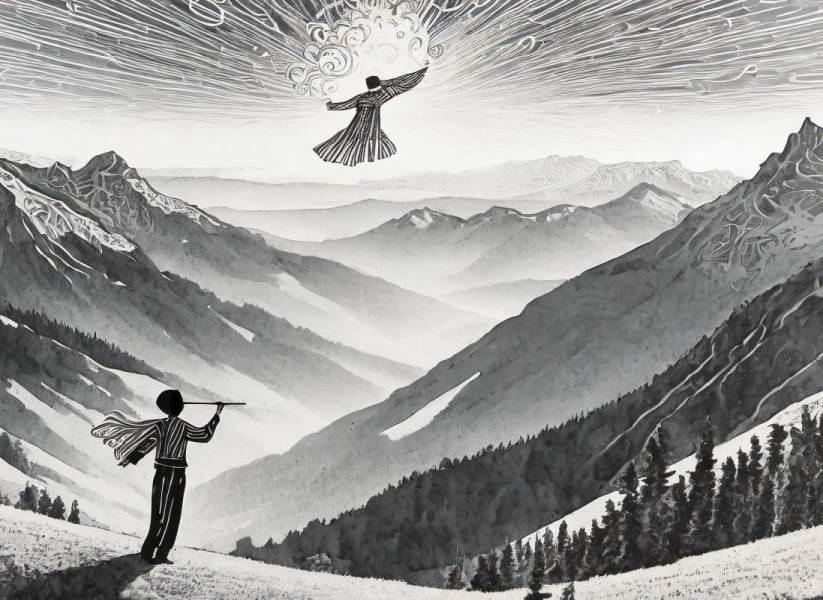
Then we’re told the child vanishes. This shouldn’t surprise us. If we were paying attention, this child appeared to the piper “on a cloud.” This child wasn’t a flesh and blood child — wasn’t one of the potential readers or listeners to the anthology’s contents — it’s a spiritual emanation of childhood.
OK, that’s a little weird, but Blake was a self-confessed visionary, and literary inspiration stories can be peculiar. Just another day at the poetic office for Blake. And as the piper makes his own pen and ink, I thought of one of the things that I found most inspirational in Blake’s life: that despite literary poverty he mastered the means of creating his own poetry, art, and engraved books.
Just after completing my musical version of this, another area of concern came to me. Just how strange did this seem to the children in the 1920s or to their parents who might read this to them if they were younger children?
I was a young child in post-WWII America, and in my time and place, I would have been puzzled. About the only piper I’d have any reference to was The Pied Piper, a page-bound storybook character. Yes, various kinds of musical pipes were extant then, as there would have been in the 1920s, but nothing I would expect in my time to see being played in wild valleys. Blake’s poem was over a century old when the 1920s anthology was made— maybe late 18th century England had itinerant rural pipers?
As they grew up, the child reader, then or now, would likely understand this is fantasy, even if exactly what Blake was getting at with his fable might be missed. Its value would remain as a set of word-music that speaks to the joy found in music and the arts.
Is anyone trying to guess if this was in the girls’ or boys’ anthology? Male author. The cloud/child is male, the piper is not gendered. Is joy in music a gender role thing? Not really.
Wilderness cumulous-carried spirit children are not a reliable compositional prompt.
.
It’s from the introductory section of the “for girls” book. My music is a simple folk music setting: acoustic guitar and bass, and eventually an Irish tin-whistle for piping. The tin-whistle is a played VI.** Two other instruments make a subtle entry in this recording. There’s a quiet electric piano in the piece, played and mixed so low it almost sounds like an overtone of the guitar, and another VI of a small obscure 1940s keyboard instrument, the Solovox that comes in for the next-to-last verse.
The Solovox was an FDR-era monophonic analog keyboard synthesizer, with glowing tubes and a wood-veneer case like a large table radio of the time. I used it for two reasons. If this song floats in fairy-tale time with children appearing and disappearing out of clouds, I thought the piper’s sound could change from the tin whistle to something more mid-20th century as a marker of how the children the anthologies were written for grew and changed. But also, I’ve seen, even briefly played, a particular real Solovox. The mother of alternative voice and keyboard player in this Project Dave Moore had one, and when he was young his mother would play piano and deftly slip one hand over to play melody lines on a Solovox. Dave now has his mother’s example of this old instrument, and has had it fixed so it plays, though with some glitches.
To hear “Piping Down the Valley’s Wild” you can use the graphical audio player you should see below. Player vanished? This highlighted link will open a new tab with an audio player. I plan more poems, adapted musical pieces, and observations from The Girls/The Boys Book of Verse coming up soon.
.
*There are methods to do that, where a singer alternates using their breath to sound the instrument and to sing lines of song. And there are bagpipes and the like where the wind comes from a bellows. But the child has asked the piper to drop their pipe and sing, so it stands to reason this is a request for the piper to sing a song with words after playing instrumentally for two renditions. The song then progresses from melody, to sung words, to finally written words — a plausible metaphor for the writing of a poem.
**I explained VI/Virtual Instrument technology last time, but in short it’s playable software that tries to contain all the sounds an actual instrument makes, often by capturing all conceivable notes and many articulations of those notes with a microphone it makers placed on the real instrument.
Perhaps we should remind ourselves in this pre-AI age that every poem, any poem, is written by another human being. I did the math with the years, and this is a poem published and likely written about a hundred years ago by a 40-something Midwestern American.
I’m decades past that age, as was Donald Hall when Hall gave us his law that states that most poets, even prize-winning ones, will be forgotten 40 years after they die. This may sound callous, but that process is likely necessary. How many poets can we hold as a culture, as a reader? Dozens? Certainly more. Hundreds? Whatever, there’s a limit. The poet who wrote today’s piece? Who would we give up in the pantheon to let him in?
I came upon the poet who wrote today’s poem, Edwin Ford Piper, by reading a striking poem he wrote of the closing American wilderness that I’ve already presented earlier this year. I know little about him as a person.* I almost worry to find out more, since human beings are full of all kinds of faults, deleterious opinions, vanities, and misapprehension. Did he write this poem in this time of the year, in the Spring? Who can say. Writers are full of memories, and imagination that can redress any cold or baren place, but it feels like he did. The poem’s trope of Spring’s reincarnation of driving/seeking life paired with the Christian holiday of Easter is far from unique — but the poem’s not, in feeling, much of a Sunday-dress observance — it’s luxuriously pantheistic. “Whispering Often” was written in a past era we still call Modernism, published in a journal that put forward many of the great English Language Modernist poets, Chicago’s Poetry Magazine, and it was included in Poetry’s founder’s anthology shortly afterward that had Modern American Poetry imprinted on its end-boards — but I can’t call it an example of Modernism.
If you can un-embarrass yourself, you could sing this Spring poem too.
.
It’s not end-rhymed. It does sing on the page, despite having a meter that I can’t easily chart out. There’s a familiar iambic rise to many of the phrases, but I don’t think I can call it blank verse, a form that Piper used elsewhere. Oh, but does this rite of Spring want to sing! The title says whispering, so maybe the poet is abashed at the voice that is called forth. Not a lot of today’s poetry sings like this. Instead, we’re more often interested in a poem showing us a particular apprehension the poet has uncovered, an apprehension we are to recognize and share. We are want to pause and recognize the matter of typical 21st century poems, like a friend speaking with us. A wise friend perhaps, a little better with language than we normally are — but still, we wouldn’t want them to break out into a song over shared teacups or beer glasses. How gauche that’d be!
And so, I think of this poem now, as Spring is rebeginning here in my Midwest, as the Abrahamic religions are celebrating holidays of freedom, rebirth, and revelation — but more so as the northern half of earth is celebrating something that Abraham could have seen in a place outside Ur. In this case, a man in his 40s, a Midwestern American like myself, stopped and wrote this down.
What an odd act! If he paused to think about it, he would know that by all odds this poem will be soon forgotten. Yes, Piper was a professor of literature, but he was an adult, someone who knows the comings and goings, the correct way to behave, the agreed worth of this and that. Yet the poem will appear as something as outrageous as an unbidden public song, one with a crush of erotic desire for life. Religion can shape and seek to make that solemn — and perhaps such a transformation teaches wisdom, brings thoughtful ethics to our roots and melting eddies — but that Spring is older than wisdom.
It’s enough to make a grown man break out into song after all.
So I did. Earlier this month I hurriedly sang a bunch of pieces I had written that I feared wouldn’t have time to shape and improve into full arrangements in an interrupted life. Long-time listeners will know my voice isn’t going to be polite, though maybe it should be. You can hear that quick, short, performance with the graphical audio player below. No player? You don’t have to rush past, you can use this alternative highlighted link that will open a new tab with its own audio player.
.
*It’s not certain, but there’s a fair chance that later this year I will make another trip to pay respects to one of my poetic heroes, Carl Sandburg, and on the way tarry awhile to see if I can learn more about Edwin Ford Piper.
Today is World Poetry Day, and if I want to represent the United States poetically to the world, one of my first thoughts for a representative poet would be Emily Dickinson. Dickinson has many “Greatest Hits,” poems remembered, poems anthologized, poems that literary critics have generated essays from.
Today’s poem isn’t one of those, for whatever reasons. I suspect it seems too playful, even child-like. The Dickinson I was taught in my youth, when she was considered a less important poet than she is today, was at least eccentric, often gothic. But here there’s no death in a carriage, no fly-funerals — there seems no novel slant of light or truth being told. It’s just the wind, an ordinary thing — or that’s the first impression.
The other immediate impression the poem might give is from its sound. This is Dickinson’s prosody at its most exuberant. No stern march of iambs here, and the use of unpredictable rhyme, end and internal, near, imperfect, and perfect. I love the loosening of rhyme personally, though I know there are others for whom imperfect rhyme grates. But this poem is so rich with the rhyme and pararhyme: today, hay, hat, very; bur, door, fir, where, declare, ever, there; odors, clovers, ours, mowers, hours; pebble, stubble, steeple; hay, day, say, stay.
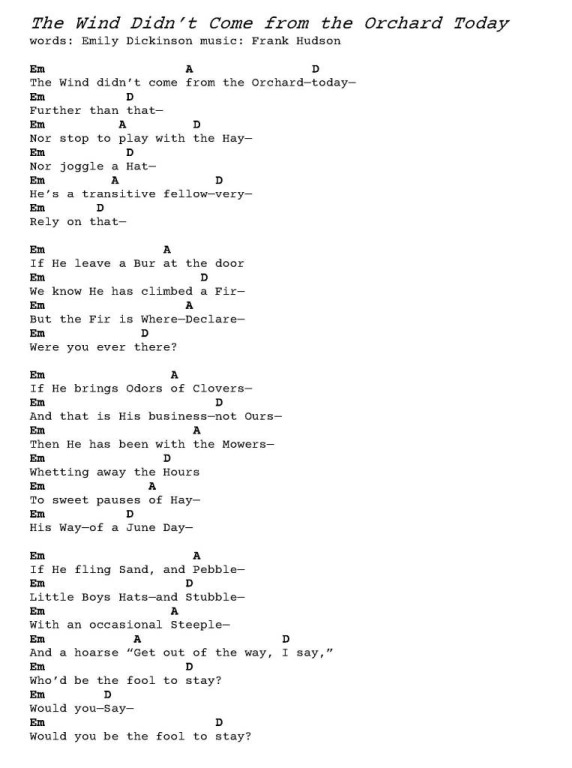
A chord sheet in case you want to celebrate World Poetry Day by singing it yourself. For performance I broke-apart Dickinson’s text, which is all one stanza — indeed, a single onrushing sentence!
.
America is a big country, a big culture. We certainly have our perfect formalists. But we have artists, like Dickinson, for whom form, and perfection in duplicating the form, is but an armature on which to improvise variations. While I’m one small ear compared to American Culture, I’ll take Dickinson’s side and place this poem in evidence.
Another thing to love in this one: the asides, set off with famous Dickinson dashes. “He’s a transitive fellow — very — rely on that” for example.
OK, so is this a musical slight-and-light poem about a playful wind we might meet in Spring?
Maybe.
Note that the poem starts off with a difference. The wind doesn’t come from the fruitful orchard.* It’s from somewhere distant. When I performed the poem, I began with the sense this must be an important fact to lead the poem off with it, but I didn’t know more. A playful breeze is mentioned, but again in the negative, this wind is too much in a hurry, that “transitive fellow — very,” and we can rely only on its capriciousness.
The sound of the “fir/where/declare” is so delightful, but what has happened here? Is the fir tree gone, uprooted, now out of place? Or is it just branches and seed-cones carried away from the location of the tree?
The sound of the mowers section is also delightful — and the work of hand mowing is so poetic one could create a whole suite of poems mentioning that kind of work — but it’s also the decapitation of anything above a height, and that’s always been part of the metaphor.
The final segment of the poem suggests a fiercer wind. An unremarkable wind might raise a little sand, but pebbles are being flung.** A playful March wind might dislodge a hat, but here it’s a steeple that has toppled off its head and the thing is like a run-away carriage.
In my Midwest, tornadoes are a common and feared storm with extraordinarily intense, though localized, winds. Dickinson’s New England has few of these. However, in the fall of 1861 during Dickinson’s most active years as a poet, two hurricanes, storms that can have high winds spread over a larger area, hit New England. Detailed contemporary meteorological measurements for that sort of thing don’t seem to exist, but sustained 60 mph winds are estimated. Ships were damaged, a ship was lost only a mile from the Boston harbor light, there were storm-driven high tides, and so forth. How far inland to Dickinson’s Amherst and at what force level it reached there I can’t say, but Dickinson could have been writing from regional news reports.***
In the many decades since Dickinson wrote her poem, we might not at first be able to hear the runaway roar of storm winds when we brush up against this poem — just the rush and song of Dickinson. So today, I will prod you to sense the mystery of the weather and the wind which we do not control.
For those of you who may have noticed a bit of a break in posts this month, it was not due to anything bad, more at a lot of effort toward new composing and recording. For the first time since last fall, The LYL Band reconvened last week, and you can hear their full folk-rock band performance of my song made from Dickinson’s poem with the audio player below. Has that audio player gadget seemingly blown away? Some ways of viewing this blog suppress showing it, so I provide this highlighted link as a backup.
.
*The Dickinson household was engaged in raising some of its own food, with Emily and her mother being known as experts in that field. The landscaping has changed at the Dickinson Homestead, but I understand that fruit trees were part of their domestic garden in Emily’s time.
**An incident from my own life. After a tornado at a branch radio network studio a few decades ago, I got a box containing the studio’s Macintosh tower audio computer to see what could be done for it. I took the computer out of its carton, and opened it to see what I could see, and the interior was packed with pea-sized landscaping gravel that had surrounded the building that housed our branch.
Even though the Parlando Project is about presenting other people’s words,* I sometimes remind myself that I still write poetry and lyrics. Every so often I’ll think of a song, sometimes one I wrote years ago, maybe one that never got a presentable recorded version, and I’ll wonder if I could record it like a regular Parlando Project piece.
“The Drunken Singer” is one of those songs. It’s well over a decade old, predating the Parlando Project altogether. A couple of coincidental things made it come to mind. At another place online that I participate in, there was a recent thread on another older song, one by the extraordinary singer-songwriter Richard Thompson called “God Loves a Drunk.” I love Richard Thompson’s work, but his fans sometimes feel called to warn potential listeners that he can be very dark. Like the British Isles folk music that influenced him, he can produce songs of death and misadventure — but he’ll also go another step further and produce songs of even greater bleakness. “God Loves a Drunk”is one of those.
Early in this Project I told the story of my misapprehension of a folk song of alcoholic abandon “Rye Whiskey.” I had wondered how my teetotaler great-grandfather could have been fond of it. In the process of working with this Project I discovered it was an oft-performed set-piece for the popular “Cowboy Singer” Tex Ritter, who played the song for laughter by imitating a drunken fool while he sang it. Thompson’s drunk song has no plausible laughter, though it does point out something ironic: that inside their degradation, the alcoholic touches on elemental things about the limits of the human condition.
Thompson’s song, and his performance of it, are skilled and intricate as are the many details he uses in it. None-the-less, it reminded me of this song of mine. “The Drunken Singer” uses only three sketchily presented incidents, a less-is-more approach that I often favor when writing lyrics or other poetry.**
A part of the inspiration for writing this song: despite my being in the cold-water army, my voice often produces sounds that too are not proper or correct.
.
The second reason “The Drunken Singer” came to mind was that I found myself working this month on a handful of possible songs I could set from poems that referenced singers, and you just heard one of them last post: “The Late Singer” by William Carlos Williams.
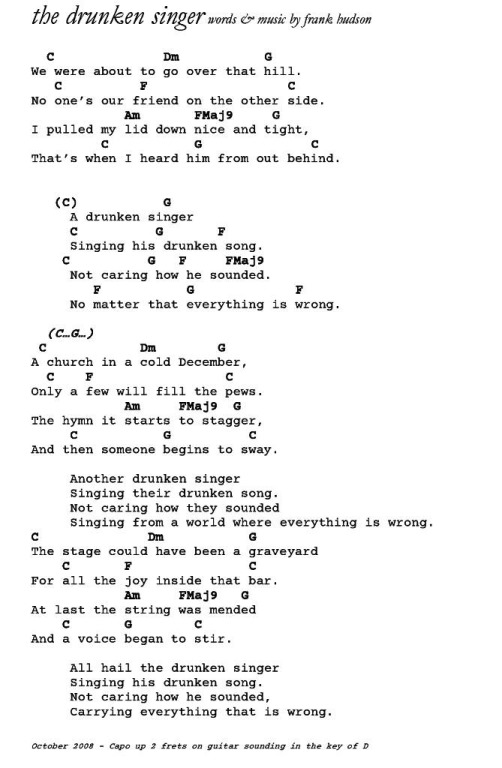
So, these are my reasons for inserting this, my own song, into the Project today. You can hear my new recording of “The Drunken Singer” with the player gadget you should see below. If there’s no gadget (some ways of viewing this blog suppress it) you can use this highlighted link that will open its own tab with an audio player.
.
*New here? The Parlando Project takes those words, usually literary poetry intended for the page, and combines them with music we compose and perform. Because I almost always use poetry in the public domain, I often use poems from the most recent period that has clearly moved into that status: the early 20th century, the era when Modernism emerged. But I don’t keep to the early Modernists only, as an examination of the more than 700 audio pieces available here since we started eight years ago will demonstrate.
**As to the “Are song lyrics poetry?” question, my summary answer is “They are a kind of poetry.” Do lyricists and literary poets focus on, or stress different things, or work with different expectations? Yes — but the range of what is canonically literary poetry shows those things vary widely within literary poetry too.
This Project knows there’s a tension there between page poetry and songs. I just think it’s fun to work within that tension, to push: to pull, to refer and to connect.
A short post and a short off-the-cuff audio piece today. I keep trying to fit this Project into my life, and this William Carlos Williams’ Spring poem reminds us that it’s never too late to sing.
I had to cancel a more pristine time in my recording space this week. I lost sleep the night before as I prepared fresh material to record, and then woke up early the following morning, anxious to see what I could do performing this new material. Then just as dawn and others woke up, I heard that a mild illness would cancel my plans. Disappointing, but, oh well. If life wasn’t bigger than this Project, what would there be to sing about?
Later that same afternoon I decided that I should do something, anything, with what had been put off. It occurred to me that by the time I’d have an occasion to reschedule I might forget the musical material I had only in my mind, since at this point the songs only existed on simple paper chord sheets, like this one.
Here’s one catch of my recording space: while ramshackle, and having a remarkable sound capturable in the room, is not acoustically isolated. Since outside sound leaks in, recording quieter acoustic instruments requires planning and scheduling. I decided, no matter if it wasn’t quiet there, I should record short, demo versions of the seven songs I was planning to work up. I figured I could do that in an hour or so, and I could afford that time.
I sat down in the space, background noise accepted, and used my Telecaster electric guitar* instead of an acoustic guitar, and ran through the seven songs one after the other. A couple of takes each, a third only if I had a major stumble. Time was so compressed that the first take was largely my own test of my “so far, only in my head” plans for the song.
During that hour I produced this quick & dirty version of William Carlos Williams’ “The Late Singer” that you can hear below with the audio player you should see. No player? This highlighted link then. It occurs to me that Spring itself has its way of being quick and dirty, and we find charm in that.
.
*Electric guitar masks much of the leaked noise compared to the sensitive microphones used for acoustic guitar. Some of the leakage into the vocal mic I found I could minimize with software that does a good job of “ducking” that noise. Solo electric guitar with a single singer is not a common musical format. Jazz has some examples, ones using more chops than I have. Some early Blues makes it powerful, but that format was soon superseded by full bands. Jeff Buckley’s outrageously good “Live at Sin-é” makes me want to put my voice inside a box in a closet and hide it. Billy Bragg, a man more of my utilitarian approach, busked and recorded with just his own electric guitar backing.
We’ve come to the end of our Black History Month series on early 20th Century Black Chicago poet Fenton Johnson. Let me try to wrap things up with a few summary points — which as I’ll warn again, are preliminary and include speculation on my part. Long post, so the headings may help you if parts of this are of more or less interest.
Was Fenton Johnson able to achieve his goals during his lifetime?
No. He seems to have had very high goals however. He wanted a general readership for his poetry across racial lines, he wanted to be part of the solution to “the racial problem” in America. For an Afro-American poet of his time being able to publish several book length collections, or to receive any notice for his poetry should mark him as achieving something. But those books were all self-published and likely had a small audience. It’s unlikely that he had anything like Paul Laurence Dunbar’s audience in the Black community, and his white cross-over audience was small. These are estimates: but it’s clear he didn’t “break-through” with either audience — and his political platform seems unremarkable and no more successful than early 20th Century America was in general when addressing racial discrimination and oft-times violent white supremacy.
Why did he fail in that?
Remember one of this Project’s mottos: “All Artists Fail?” Even the most successful will be misunderstood and will be downrated for cause by some, will have a limit to their reach even if popular or well-ranked. But even if we don’t rate him against a perfect score, he didn’t succeed to the level of Dunbar, and he was superseded by his successors in the Harlem Renaissance such as Langston Hughes in Black or white readership. My guess: he overrated the audience value of his verse and likely highly overrated the value of his prose/journalism. It’s easy to suppose that he was a bright young man seeing himself in the eyes of youth protected at least at first by the loving support his family was able to give him, but not necessarily with the eyes of a skilled careerist or marketer. His early poems have more value than his contemporaries judged, but some of that value was too deeply coded for some to appreciate in the pre-WWI era. Judging from the small portion of his journalist-writing I’ve read, his efforts there may have displaced his stronger talents. His later poems? James Weldon Johnson’s evaluation of Fenton Johnson in the 1931 version of The Book of American Negro Poetry points out that FJ was uniquely despairing for an Afro-American poet, and contrasts him with Claude McKay’s famous poem “If We Must Die” from the same era as “Tired,” discerning that McKay at least says we can, we should, fight back. One thing that is odd about Fenton Johnson, he’s unsparing about deprivations of rights and dignity for Black Americans in his poetry while maintaining this public face in his presentation of “we just need to listen to each other and work together.” Even onward into the era of Jim Crow and the Great Depression he might have been both too down-beat and too optimistic.
Further supposing on my part: Johnson seems to have been discouraged around 1920 by the evident failure of his audacious goals, and there’s a report that the self-funding from family sources had dried up. I don’t know how dire his life was after 1920, but his pre-WWI Black middle-class status might have changed in ways that refocused his life and added new obstacles. A lot of modern poets reach their heights in writing quality and audience in middle age, which was about the time Johnson’s poetry stops being published.
The Harlem Renaissance has been informally extended to include writers who weren’t NYC located in retrospect, but Frank Marshall Davis and Margaret Walker from between-the-wars Chicago indicated that patronage support and publishing contracts were not at New York levels in Chicago then. Yes, there was a Chicago Renaissance in Black writing, but that came after Johnson stopped publishing.
If Johnson’s early attitudes continued, he may have had a disconnect with some Black literary cultural outlooks that followed WWI. I’ve yet to find anything linking him directly to Temperance/Prohibition, but he writes often enough about alcohol as the marker of a fallen state. He seems to have retained a religious component until he stopped writing — and even the religious have been known to disdain those whose religion differs only slightly from their own, as much or more than non-believers. And lastly, Johnson is explicitly adamant that he’s against “the Bolsheviks,” and commented to friends that this was hurting him in literary circles.
If he’s just some poet who didn’t rise to an undeniable level of success, why read him?
I think there’s unqualified value in the best of Johnson’s poetry. Historically, reading even his lesser-known poems can tell us something about what a smart Black man in this “bridge era” was thinking and writing.
Johnson is precedent-setting in the use of Afro-American musical forms in poetry. This particularly endears him to me. This element alone is highly important culturally and should cause him to be more widely considered. He was active in an era when our resources for Afro-American speaking and musical expression are scarce, so there’s some musicological interest on top of literary value.
You were so down on his political essays. Would you rather he was some kind of radical who might have been tied to between wars dictators? Or hassled by the Red Squads?
No. They were just disappointing in their slack writing and surface allegiance to common political stances without any vivid insights. The man I see in his poems is much sharper than the essayist I’ve read so far. It’s possible that that writing was insincere, that he’s trying to market himself, probably to white audiences who might help fund him. Was he conscious of this split in himself? I can’t say. One may think of one of Dunbar’s best-known poems “We Wear the Mask.”
After he stopped publishing poetry, his friendships in Chicago included those who would be aligned with more leftist politics. As with his non-extant post-1920 poetry, his political analysis might have continued to evolve.
Even some relatively unsuccessful writers influence those who come later. Is Johnson one of those?
Incomplete, but there may be something there. Although his post-WWI poems are few, they were anthologized, and anthologies are still a place younger writers find ideas of the possibilities of their own poetic voice. This Project is an anthology of a kind, and I’ve tried to add that his “spirituals” are worthy of re-evaluation.
This month, I was able to read two accounts of the next generation of Black midwestern poets (Margaret Walker and Frank Marshall Davis) who lived in pre-WWII Chicago, knew Johnson, and mention Johnson’s connection with other writers in this period when Johnson was no longer publishing. Davis (who is himself a bridge between the pre-WWII Black poets and the post WWII Black Arts Movement) admired Johnson and found his work validating his own. Little that I know beyond that, but at least by association there’s a possibility that a later-in-life Fenton Johnson may have influenced these other writers first or second-hand, even after he ceased publishing himself.
AFAIK, this is the only known photo of Fenton Johnson, from when he was in his 20s. We have more photos of Emily Dickinson or Robert Johnson.
.
Summing Up, and A Musical Piece for Today
In closing, there’s still more for me to find out about Fenton Johnson, even if it’s likely that I (or any “we’s” reading this and sharing my curiosity) will never find out other details that would illuminate him. We have those final poems before he “went dark” as far as literature is concerned, and I’ll maintain that his earlier work has qualities worth re-assessing. Yes, he’s a case of someone who dreamed big, maybe spread himself too thin, maybe his self-regard was blind, maybe he underestimated the resources and skills needed — all that “reach exceeds his grasp” stuff. And he certainly had to deal with generalized and persisting cultural undervaluing of Afro-Americans — so this isn’t a simple case of hubris. His most famous poem, that despairing “Tired” remains on various printed pages silently waiting to be found — but there’s an unwritten poem that sums Fenton Johnson up for me: “Tried.”
His most famous poem, that despairing “Tired” remains on various printed pages silently waiting to be found — but there’s an unwritten poem that sums Fenton Johnson up for me: “Tried.”
For today’s musical piece I’ll give you something sung by Dave Moore. It’s called “When the Dream Outruns the Real.” Dave didn’t write it about Fenton Johnson, but it is about anyone who tries, dreams, and doesn’t make it. Here’s what I think is cool about what Dave wrote and sang: it’s not a rote put-down. Easy to laugh at the over-reachers, easy to mark it all down to vanity. The Qoheleth in Ecclesiastes preaches that “All is vanity.” Could that mean we laughers are vain too? You can hear The LYL Band perform this with the audio player below, or with this backup highlighted link.
.
Here’s my sketchy and incomplete timeline of what I know of Fenton Johnson’s career.
1888
Born in Chicago on May 7. An only child and his parents are middle-class. There seems to have been at least some modest wealth in other branches of his family. According to his later friend Arna Bontemps, he starts writing at age 9.
Circa 1905
At least one play was produced in Chicago while he’s a high school student. There are scattered other mentions of Johnson writing plays, but I’ve found nothing about what they were about or if there was much notice of them.
1906
His early model, Afro-American writer Paul Laurence Dunbar dies. Around the same time he graduates from Wendell Phillips High School in Chicago. Attends Northwestern University and the University of Chicago, does post-graduate work at Columbia University in NYC circa 1914.
1910
Briefly teaches at a HBCU, Simmons College in Kentucky, founded by the Baptist church.
1909
He submits a manuscript (handwritten on lined paper from the scanned copy I’ve seen) to Doubleday as a non-fiction diary, though it’s fiction. It survived, though unpublished. Titled a “A Wild Plaint,” the main character in the story commits suicide due to the stresses of his Afro-American life. I have not read this yet.
1913
Self-publishes his first book, a poetry collection A Little Dreaming which has a wide variety of poems in subject matter and styles reflecting mainstream 19th century poetry modes as well as dialect poetry. Dedicated to a relative who may have helped finance its printing.
1915
Returns to Chicago, presumably ending his education. Self-publishes his second book Visions of the Dusk. Dedicates it to Albert Shaw, a well-known white reviewer who had given a favorable review to his first book.
1916
Founds The Champion magazine in Chicago and is listed as its editor. It’s uncertain how many issues are published. One issue does exist as a scanned complete copy. I just found it online, though I haven’t read it yet. Also in 1916 comes a third volume of self-published poetry, Songs of the Soil, which concentrates on his dialect verse.
1918
Founds The Favorite Magazine. Again, it’s unsure how many issues there were, but it may have been as few as two. Published Three Negro Spirituals: “How Long, O Lord,” “Who is That A-Walking in the Corn,” and “The Lost Love” in the June issue of Chicago’s influential Poetry magazine.
1919
Publishes his best-known poem,“Tired,” in the January issue of The Others. The Others circulation is small, but it’s an influential landmark little magazine focusing on the new American avant-garde poetry
Publishes five poems in the February issue of The Others: “Aunt Hannah Jackson” “Aunt Jane Allen,” “The Gambler,” “The Barber,” “The Drunkard”
Publishes “The Artist” and “Dreams” in The Others April-May issue.
1920
Self-publishes two short books: For the Highest Good and Tales of Darkest America. The former is a reprint-collection of pieces from The Favorite Magazine and they are largely anodyne Republican party material. The latter is a short stories collection which sustains some interest while not demonstrating that Johnson is a great undiscovered short-fiction writer.
Around this year Johnson seems to have another ready manuscript of new poems, but is apparently unable to find a commercial publisher and family funds to self-publish another book are denied.
1921
Published Two Negro Spirituals: “A Dream” and “The Wonderful Morning” in the December issue of Poetry magazine.
1922
James Weldon Johnson publishes the first anthology of Afro-American poetry at the dawn of the Harlem Renaissance. He includes five of Fenton Johnson’s poems including “Tired,” marking down Fenton Johnson as someone to be remembered in future surveys of Black verse. JWJ says little about FJ in his preface, saying he “gives promise of greater work than he has yet done.” Fate laughs: FJ is no longer publishing poetry. Nearly a decade later JWL publishes a new edition of A Book of American Negro Poetry and has more to say about FJ then, notes his work is uniquely despairing.
1925
The Cabaret Girl, a play he wrote was staged at Chicago’s Shadow Theatre. I know nothing about the work, nor of any other public work by Fenton Johnson after this.
Works for the Federal Writers’ Project part of the WPA. Others recall he was also in the “South Side Writer’s Group” of Afro-American writers including Richard Wright, Arna Bontemps, Margaret Walker, Theodore Ward, and others. The young Gwendolyn Brooks may have been connected to this group’s later incarnations.
Margaret Walker says she worked with WPA/FWP in Chicago while a senior at Northwestern. She reports Nelson Algren, Jacob Scher, James Phelan, Sam Ross, Katherine Dunham, Willard Motley, Frank Yerby, Richard Wright, Arna Bontemps, Sterling A Brown, and Fenton Johnson were also in the Chicago WPA.
Personal note: my relative Susan Glaspell was also associated with the Chicago FWP during the Great Depression. I don’t know how officially or unofficially the FWP was racially segregated, so there’s no guarantee my relative and Johnson even knew of each other. I know of no work of interest ascribed to Fenton Johnson from the FWP, at least as yet.
1958
Fenton Johnson dies in Chicago on September 17. Some of his papers etc. reported destroyed in a basement flooding event. Arna Bontemps was his literary executor.
Given that there’s no full biography for Fenton Johnson, and that it would be difficult to produce one with reliable levels of detail at this late date, this post is going to resort to a measure of speculation. Reader beware: I’m not a fully engaged scholar, and my knowledge of American and Afro-American history for the early 20th century is only a little better than average. Still, I want to write this post during Black History Month to give a fuller picture of this interesting, if lesser-known, literary figure incorporating some additional information that has become available to me.
From my earliest encounters with Johnson’s work last decade, I’d read that he founded two magazines around 1920 that seemed to be concerned with political issues. What was he writing there? What were his political alliances, his political and social opinions? The possible range of positions here are wide — the early 20th century was a dynamic period, including one of the periodic “backlash” swings in American commitment to racial equality, while it was also an era where the “make it new” artistic movements included many in the arts who explicitly aligned themselves with radical political change. Just as to be a Modernist poet likely led them to make common cause with other Modernists in drama, painting, music, sculpture, etc, — the Modernists were often drawn to new, radical, political movements. A whole spectrum of such alignments were on offer: everything from revolutionary Communism spurred by the recent Soviet Russian Revolution, to Catholic Worker or Democratic Socialism, to anarchism, to various kinds of American Lost (Confederate) Cause racism, to the new violent reactionary nationalist cadres that came to be known as Fascism.
No matter what your personal political convictions are, looking into the alignments of Modernists in the first half of the 20th century is land-mine territory if you believe that the poets you read must have steadfastly maintained recognizably similar political beliefs to your own. Some of them even traced apostate paths making them bipolar pariahs!
For a moment let’s revisit Fenton Johnson’s most famous poem, “Tired.”
A little-appreciated aspect of Johnson’s most famous poem: it’s written in a persona. The speaker is clearly not Johnson himself.
.
Published in an avant-garde poetry magazine in 1919, it could have been written 50 years later, and it would have fit right in. Dashikis, big Afros, raised left fists, and conga drums would sit well in between this poem’s lines — and frankly, lines like “I’m tired of building up somebody else’s civilization” still sound a radical critique today. In Johnson’s biographic summary for the Chicago Literary Hall of Fame it’s said that Others editor/founder Kreymborg called Johnson “The first radical poet.” James Weldon Johnson* wrote slightly more specifically that Fenton Johnson was “One of the first Negro revolutionary poets” when he expanded his opinion of him in a revised 1931 edition of his landmark The Book of American Negro Poetry.
Oh, I thought, if I could only read Fenton Johnson in his short-lived The Favorite Magazine which was said to have included essays on his political and social opinions circa 1919 when he’s also publishing his revolutionary poetry in Others! I’m not sure how many issues there were of this magazine (it may have been a few as two), but as far as online materials there’s only a handful of lo-res scans showing clippings (not even entire pages) of The Favorite Magazine that I’ve found. What I did find was a good PDF scan of Johnson’s book For the Highest Good, from 1920 which seems to be his attempt to save and further distribute selections from that magazine.
Whatever my expectations might have been, the result was disappointing. The titular essay is the most informative. It’s a summary of his expressed credo that “Co-Operation Will Solve the Race Problem.” The rest of this very short book reads like hack-journalism in an obsequious mode. Politically it’s closely aligned with the Republican party.** Three essays in the short book are spent extolling the party, an obscure Republican politician/journalist, and the then current Republican mayor of Chicago, the famously corrupt William Hale Thompson.*** Johnson is adamant at declaiming his firm opposition to “Bolshevism.” His economic and labor platform seems to be (like his platform for racial and civil rights problems) mutual cooperation as well. Labor and Business need to work together he urges. One of the hard-to-read lo-res scanned clippings from the actual magazine praises Madame C. J. Walker for advancing the Afro-American cause through her business success.
If one was looking for an unsparing prose analysis that would seem to match the underlayment of his poetry, this isn’t that. If in his poetry he might aim to be, might be seen as, a Superman — as a Clark Kent he’s not only mild-mannered, he’s not even much of a reporter. I’m somewhat familiar with Republican party positions in this era, and this reads to me to be a restatement of their positions and political platform, with Johnson extending its labor/capital stance to the long-suffering crisis of Black second-class citizenship. The scanned copy that produced the PDF I read captures this piece of marginalia: an author’s dated, handwritten note to the new U. S. Vice President Calvin Coolidge dated Nov. 15, 1920. A stamp a couple of pages in, shows that if this was presented and was to be conveyed in some way to Coolidge, it was passed off to the Harvard University Library on November 27th, only a few days later. I was disappointed at the lack of substance in the book’s contents, but still a little sad to read that once again Johnson’s estimate of his salience was passed off.
Johnson’s handwritten note on the flyleaf of “For the Highest Good.”
.
My speculation, my judgement so far with gaps known and unknown: in his poetry Johnson remains the revolutionary he was made out to be. And I am not sure that his public political face represented his thoughts and emotions in totality. Was all this (to simply paraphrase) “I’m here to put my Black shoulder to the wheel to move forward mainstream (Republican) politics” persona just a way to get over, to cross-over, to get him a larger platform (or at least pay the rent?) Or where the more radical critiques portrayed in his poems “man on the street” personas — not representative of Johnson’s own sincere beliefs, but rather warnings of why a more moderate approach must actually produce change?
And there’s another possibility to speculate on: by the middle of the 1920s Johnson’s literary work seems to have gone dark. While there was another, 1920s, poetry collection planned by Johnson that likely extended the work that was printed in Others, it apparently found no publisher, and as of yet I know of no other writings that might show Johnson’s political analysis evolving or uncloaking. The 1930s produced another wave of political consciousness for writers. During that decade he apparently was employed with the New Deal WPA Writer’s project, but this could have been just a way to find a survival income during the Great Depression. Johnson lived past WWII and into the dawn of yet another wave of activism for Afro-American full citizenship. Some of the people who associated with him in the Chicago scene from the Thirties onward, and who were aware of his poetry, had less-accommodationist stances. I’ll plan to talk a little bit about them next time.
Instead of another selection from Fenton Johnson’s poetry, I’ll offer this work of another Afro-American 20th century poet today, one James Marshall Hendrix. Jimi Hendrix gets all his proper respect as a revolutionary of guitar, but way less than he deserves as a songwriter. In his “Up from the Skies” he gives us an Afro-Futurist (or is it Afro-Historicist) monolog about facing a world he’s both a foundational part of and estranged from.**** The LYL Band can’t hope to duplicate Hendrix’s performance, but with this variation we performed last fall on the anniversary of Hendrix’s passing-on, I tried to bring forward the SF story his lyric tells — a story that, as famous as Hendrix genius-electric-guitarist was, was maybe as under-read as Fenton Johnson.
.
*James Weldon Johnson was a polymath who among other things was a leading Black civil rights activist of his time, a literary figure himself, and an anthologist who helped make sure Fenton Johnson’s name was recorded as an Afro-American poet of note. Despite the shared last name, they are not related. As far as I know, neither JWJ nor Kreymborg ever met Fenton Johnson much less discussed politics or his poetic aesthetics with him.
I’ll mention here that there is a contemporary author also named Fenton Johnson. I reached out to him yesterday, and he’s aware of the coincidental name, and has even thought of writing a Fenton Johnson on Fenton Johnson piece.
**The early 20th century Republican party shares little but the name with the current political faction. On the matter of Afro-American civil rights it was, however faintly, still “The Party of Lincoln,” and many of the more ardent Black advocates were at least nominally Republicans. They were also the party more associated with business interests, government reform, moral probity and alcohol regulation. At least in his writing, Johnson seems earnestly on the side of moral probity.
One speculation, Johnson may have hoped for a political patronage job either in Chicago or in Washington. His early model, poet Paul Laurence Dunbar, had received such an appointment.
***Anyone who’s seen the play or movie The Front Page, the uproarious farce of Chicago newspapering in this era, may remember the inept and corrupt mayor who was worrying about the effect of his stances on the black vote. That’s Thompson in the eyes of Hecht and MacArthur.
****When the wry alien stranger monologist in Hendrix’s song says “I have been here before, in the days of ice,” I wonder if Hendrix, who was aware of his mother’s First Nation’s heritage, was accidently, subconsciously, or intentionally thinking of the ice-age nomads who crossed over into North America. It’s a common trope to wonder what Hendrix the guitar hero would have done if only he’d not suffered the accidental sleeping pill overdose in 1970. May I offer an alternative: what if he’d grown to more fully consider his Afro-American and Indigenous heritage as a writer and Science Fiction aficionado?
Over this February I’ve presented a variety of early poems by the lesser-known Black Chicago poet Fenton Johnson. Johnson self-published two book-length collections of his verse in the years before WWI, and he’s an interesting Afro-American poetic bridge between the turn of the century Paul Laurence Dunbar and the poets like Langston Hughes who emerged in the 1920s.
I try to remind myself that one of my goals in these posts is to make things accessible with fewer pre-requisites than a lot of other writing about poetry. Effective poetry can have a degree of timelessness, but I’ve come to believe Johnson was pioneering poetic expressions that we might forget haven’t always been available — so let me briefly explain today some more context that makes Johnson’s work especially interesting.
Dunbar and Johnson’s poems that use conventional late-19th century English language verse are a demonstration that Afro-American poets could utilize established prosody and forms while reflecting their own experiences; but then, as awkward as some of it seems to me,* Dunbar and Johnson’s dialect poems helped further something Mark Twain and other dialect writers were bringing to literature: a sense that the common vernacular had it’s own poetic diction that could have value. By the time we’ve moved onto Johnson’s dialect mode in a poem like “Mistah Witch” we’re getting something that is Afro-American in both sound and sense. My estimation of how valuable “Mistah Witch” was as an expression increased many-fold in my journey to performance of it this month. More than anything in dialect that I can recall from reading Dunbar, Johnson’s “Mistah Witch” reflected the Blues poetry that I treasure in Langston Hughes and song lyricists that will follow. Was there a direct flow-line of this innovation? Did Hughes know of Johnson’s work?**
Today’s piece is another example of Fenton Johnson’s prescience. Within his first two collections Johnson included poems reflecting Afro-American preaching modes to tell pointed versions of Biblical stories. He often called them “spirituals,” and in Visions of the Dusk where “The Prodigal Son” is printed, he introduces that section saying this:
These songs we offer, not as genuine Negro spirituals, but as imitations. We attempt to preserve the rhythm and the spirit of the slaves, and to give literary form and interpretation to their poetic endeavour. Here and there we have caught a phrase the unlettered minstrels used; here and there we have borrowed of that exquisite Oriental imagery the Africans brought with them.”
Note the careful and crafted way Johnson frames this section, thinking perhaps of the broad “crossover” audience he desired. To extrapolate: You might enjoy this even if you think of Black people as less smart, he pardons. It might seem strange, but strange might be exotic like other “foreign” things that interest you from farther lands, he offers.
Afro-American spirituals as a song-form emerged in the late 19th century as a popular concert music. White audiences found them moving — and to the best of my understanding, they often came to those feelings in a non-condescending way. For the Black intelligentsia, as late as the between-the-World-Wars “Jazz Age,” spirituals were used as an example of successful and laudatory Black musical expression, while Blues and Jazz might be held at arm’s length as too reflective of baser contexts.
Johnson’s spirituals don’t sound to me like the anonymously-authored choral concert music that has come down to us as spirituals. We have sheet music from before Afro-American artists were generally recorded in the 1920s, but those printed scores don’t show something substantially like the word-music I see portrayed in Johnson’s spirituals. What I do hear in Johnson’s Literary Spirituals — something recoverable once later recordings entered our historic record — is Afro-American preaching modes.*** This style of preaching is musical, and it will (like Johnson) make quick jump-cuts to other ways of seeing an element of the story being portrayed.
Though it appears in the table of contents as “The Prodigal Song,” here’s Johnson’s poem as it appeared in his 1915 collection Visions of the Dusk
.
As it turns out, this is a strong and versatile poetic form. It continues to be a significant part of the Afro-American strain in American literature. Although we “hear” it through Johnson’s silent printed pages, and also through his particular mind and ear, these poems are valuable in preserving some of this tradition.
Johnson, largely based out of Chicago, was well-placed to observe this. Not only because of Chicago’s diverse Black community including many “Great Migration” internal-immigrants from across the American south, but because Chicago seems to have been a key center in the development of the more overtly musical strain from this tradition, Afro-American Gospel music.****
My performance of Johnson’s “The Prodigal Son” is not exactly Black Gospel — I’m not sure it’s anything genre-wise really — but it’s more my independent attempt to perform the wide-ranging text of the poem with the musical resources I could bring to bear on it this month. “The Prodigal Son” is easier to see as a Modernist poem than the more formal, redolent of the 19th century verse I started with this February. It uses a free sense of phrasing in its meter. It uses near-rhyme subtly but has no fixed rhyme scheme. And look at how the poem’s narrative cuts cinematically: starting with a specifically northern speaker in a blustery Chicago winter, to a jump to the Biblical parable of the wastrel son who is seen returning home and the father calling for a welcoming feast, followed by what?***** Not a homecoming to a BCE Middle-Eastern farm settlement, but heaven, cast with Biblical notables — yet, the feast of welcoming does occur.
As the poem moves on, a litany of the particular sufferings of American chattel slavery are movingly condensed, in this section echoing the abolition/Underground Railroad folk song “No More Auction Block.” This welcome heaven/home will have no drivers’ whips, no bread and water diets, no more auction block separating families.
Johnson has one more final jump cut, one in time and place: we end at the River Jordan as the River Lethe (the river addressed in “Waters of Forgetfulness” earlier this month), and at the end we find that our poem’s singer hasn’t yet arrived to what the middle of the poem has described. This, the concluding metaphor for America: if we’re a nation of immigrants — including kidnapped ones, and ones driven here beyond their wills — we may find ourselves still awaiting arrival to the fulfilled landing of that promise.
My performance, as I said above, doesn’t really use Gospel music elements. Not only would that be a challenge to my singing constraints, I haven’t found the time to build a more grand musical ensemble that this poem could be said to deserve. I hope the sparse voice and acoustic guitar presentation you can hear below does it some justice. You can hear it with the audio player you should see below. No player? This highlighted link is a backup.
.
*I’m not alone in finding this part of their work troublesome. I can’t say how white audiences of their time might have viewed it, but the air of minstrel show stereotypes must have been hard to escape. When performing blues tunes in vernacular I’ve made the choice to not put on vocal black-face — in part because I’d be bad at it — but also because it can’t (for me) escape that burnt-cork shading, even though I’ll retain informal/colloquial syntax.
**Likely Hughes would have known at least Johnson’s later post WWI work as they published in the same journals and were included in early Afro-American poetry anthologies together. But independent observation of less-documented Black musical expression contemporary to them both (though this was not yet widely recorded for posterity) would have been easy for the two of them. There’s no reason I’m aware of to think that Hughes used Johnson as a model, but it’s fair speculation that reading Fenton Johnson, even incidentally, could have validated or confirmed to Langston Hughes that he was onto something worthwhile.
***In the between-wars era, besides “live” sermons in church or over the radio, we have commercial recordings issued by the same “race records” companies that would have pressed Blues songs — recorded sermons which likely reflect what Johnson could have heard prior to WWI from a slightly earlier generation of Afro-American preachers.
****Did Fenton Johnson influence Thomas Dorsey and contemporaries who helped formulate Black Gospel music in Chicago in the 1920s? I have no evidence, not even a likely. I’m reduced to those expressions from bad cryptozoology and UFO documentaries: “What if…” and “Could it be possible….” Weak stuff. Common inspirations is the real likely here — but with Johnson’s poetry we do have interesting examples of how this was emerging.
*****This is one of my favorite parables, because its narrative point is that the other sons are totally non-plussed by the father wanting to welcome the ne’er-do-well who’s been off carousing with outsiders, finding non-productive failure, and generally sinning. Other sons: “We had to stick around with you pops, doing all this righteous stuff day after law-following-day. Where’s our bar-b-que old man?” The point Jesus and Johnson then make from this: you celebrate the ending of suffering, and that goodness is its own reward.
Enjoy the Valentine’s candy if you have it, but this is a longer post, and we’re going to get into some uncomfortable stuff with this one. Yes racism, but then I’ll deal today with musicology and Modernist poetry too. The first is deadly in spirit and body, but then the latter two may often bring on the little death of boredom and indifference. This is why I respect you as an audience: poetry is a minority interest, mixing in the variety of musical styles I use here to the best of my subjective abilities will confound some of that audience, and then to discuss oppression — even the resistance to oppression which should be heartening — well, welcome rare, broad, and appreciated readers and listeners. Let us continue.
I said earlier in this year’s Black History Month series where I’m examining the early work of Chicago poet Fenton Johnson, that it may help us to orient ourselves into the time in which this young Black man in his twenties started writing and publishing. If we look at poetry and music, three big things are happening. They’re going to change how the 20th century, and even our own current century, approaches things.
The Fenton Johnson poetry I’ve presented so far this February has been in the 19th century tradition. It’s a style of poetry his school teachers would have taught him,* and like his chief model Paul Laurence Dunbar, he can speak for and about his fellow Afro-Americans using that mode of poetry. However, at this time something new is brewing in poetry. Over in England a small group of ex-pat Americans are joining forces with a couple of British poets/critics and a man from Belfast to create the first Modernist English poetry.** Few are noticing this yet, it takes a couple of years for it to get a foothold, but in 1909 the first poem in a style that would soon take to calling itself “Imagist” was published: “Autumn” by British writer T. E. Hulme.
What makes that poem and the Imagist poems that follow Modernist? First off, it’s concise, it gets to the point. The language may combine things in unexpected ways, but it uses much more ordinary and day-to-day language to do it. Indeed, it revels in that — part of its freshness is that it wants to render sublime moments in the same way of speaking that something utterly mundane might be expressed. Its commitment to this is so strong that those mundane moments, the “unpoetic” ones, can be charged with a power. It doesn’t care to have the people in its poetry seem high-flown, they don’t have to be different more “poetic” creatures. Yet these same poems often have an important core of distrust for common or worn-out appreciations of reality. Emotions may be stated, yes, but many of the most vivid poems portray the landscape and the palpable things surrounding an emotion rather than hang signposts or explanatory placards of their feelings. Rhyme and meter could be used, but they aren’t the main point if they lead the poet to ignore these new things to emphasize.
While this is going on, Black Americans are forging a couple of new musical forms that are going to overthrow their nation’s music — and from there, impact the world’s. Because this happened before the full emergence of commercial music recording, some of this is literally un-recorded. Buddy Bolden and his like are playing instrumental music largely sounded on brass-band instruments along with pianos, where access to those instruments is available. Eventually that will be called Jazz. Many mark the first Jazz record as being issued in 1917, though Jazz existed before the recording.
At roughly the same time various strains of music with lyrics made by Afro-Americans are being extracted and refined from the ore of American folk music. I would maintain that the lyrical part of this sung music can be viewed as Afro-American Modernism. The songs love to get to the point of things, stripping away hypocrisy and pretense. They deal with disappointment and sadness, yes, but they most often deal with it in resiliency and wry resistance. Taking from the preexisting tactics of folk musics, they will borrow and reference each other’s individual songs — and like Modernism will soon take to doing, they will collage together unlike things and verses to jump from incident to incident. That sung music will eventually be called Blues, and because it’s a sung music, any instrument can be used for accompaniment, including cheap and portable ones. No Blues? No rock’n’roll, no country music as we came to know it, no rap.*** The first Blues recordings were done in the 1920s, but the first sheet music which might be classed as Blues dates to 1912, though again we know it existed unrecorded and off the books before this.
So, three things — all big, culture shaping stuff. In 1900 there’s no general cultural knowledge that these three things exist: English-language Literary Modernism, Jazz, and Blues. By the 1920s they all become part of the mainstream culture, however misinterpreted and misrepresented they may be. Modernist poetry might be thought of as self-consciously crude esoteric nonsense sticking its thumb into the eye of real poetic verse, while Jazz was thought of as hopped-up fast-tempo music to deaden the mind as rapidly as cheap liquor might, and Blues? That’s merely sad and sentimental music of resignation to fate.
This is Fenton Johnson’s world as a young man. The Harlem Renaissance writers that would come a decade or so later would still be dealing with this world. As we’ve seen in previous Black History Month series here, the Black cultural leaders of the first part of the 20th century were not yet fully on-board with Jazz or Blues, which they often felt reflected badly on their race. They did briefly note Fenton Johnson as a Black Modernist free-verse poet, but this happened in the Twenties as Johnson was withdrawing from writing new verse.
I was thinking of this as I read Johnson’s first collection of poems, no doubt written in the years before the book’s publication in 1913, and I come upon this short poem, “Mistah Witch” printed in the phonetic dialect meant to represent unlettered Afro-American speech.
Here’s how it appeared published in Fenton Johnson’s “A Little Dreaming” in 1913
.
What matter of word music is this? I used my musicological knowledge along with literary thoughts as I examined it. It could be a folk-origin nursery rhyme or play song.*** It could just be a short supernatural poem, for we’ve seen last time that fantasy poems were a genre Johnson touched on in his more conventional verse. It may just be me, but I couldn’t help but read it as Blues Poetry — and a very early example of it too.
No, as printed it doesn’t use the Blues’ 12-bar structure or the three-line (two refrained or near refrained lines, and a response in the third line) stanza. Blues has never been purist about that, and early Blues often didn’t fit into regular musical forms. But I got a Blues sensibility from it. Mistah Witch may be mythologically, potentially, or actually, frightening, but the poem’s speaker seems to know Mistah Witch’s game, how he operates. I thought the poem’s sharpest line was (translated from the phonetic dialect) “Ain’t you tired of scaring me?” That implies Mistah Witch’s “magic” terror is weakening out of boredom and the rote nature of it for the speaker!
If Blues, like other Modernist poetry, likes to get to the point of things, it can also enjoy encoding its statements. The tactic is often: I’m going to speak something publicly, and part of the audience (the ones I want to let know we share an outlook) will get what I’m saying — while at the same time those that might not approve of my statement will be in the dark about what I’m talking about. The latter will just be puzzled or indifferent to what they don’t understand.
What could be encoded in “Mistah Witch?”
In plain talk: from the days of Fenton Johnson’s youth, through the years he began publishing his poetry, and continuing after his poetic work faded away, there was beside the slow incremental wear-and-tear of stereotypes and “civilized” discrimination an active and brutal threat of terroristic violence against Black Americans. Threats, attacks, lynching and (white) race riots are a part of American history that wasn’t talked about broadly out of a mixture of shame and “politeness.” ***** Blues doesn’t play that game, but a Blues singer (or a poet looking to find a broader audience) might encode a protest against that terror metaphorically. I did note that the poem concludes with telling us that Mistah Witch (“Mistah” signifying the frightener is someone the singer feels they must make a show of social respect to) has eyes like the sea — the bluest eye perhaps.
I’m not certain if that’s what Fenton Johnson is doing in “Mistah Witch,” perhaps even unconsciously. I am planning to try to include some information that I have recently learned about Johnson’s political views later in this series. Musically I took Johnson’s original poem, and for this performance turned it more toward an irregular folk-Blues structure to reflect the Blues sensibility I saw in the poem.
And for those who want a little time-machine technical magic to travel back to those early Blues recordings often pressed cheaply for the “race records” market and worn with dust and the needles of heavy-armed Victrolas, I’ve included a Bonus Track today: a simulation of how the recording would sound in that context.
Here’s my rough’n’ready musical performance of Fenton Johnson’s “Mistah Witch” recorded with inexpensive modern equipment.
.
Here’s the simulated worn 78 RPM shellac record version.
.
*Johnson, unlike most Americans and even more so, most non-white Americans, had a first-rate college education, attending Northwestern and the University of Chicago.
**This group coalescing before the start of WWI included T. E. Hulme, from the less fashionable north of England who’d been expelled from Cambridge, F. S. Flint a self-made man of letters who risen from Victorian poverty, the Americans T. S. Eliot, Ezra Pound, and Pound’s former college sweetheart Hilda Doolittle, as well as Robert Frost, and the somewhat forgotten man from Belfast was Joseph Campbell. I count Frost as a Modernist, as I see his poetry aligning in its outlook with Hulme’s theories, differences in prosody aside. Remaining in America, William Carlos Williams, Carl Sandburg, and Edgar Lee Masters would also be early Modernists.
***Jazz musicians will often maintain that the Blues is essential to Jazz as well. In that sense, my reading is that they aren’t just talking about Blues musical structures and vocal inflections portrayed by instruments, but the Blues sensibility.
****Blues could and did use lines shared with those folk music forms.
*****In 1919 Johnson’s Chicago suffered a mass racially motivated riot. In 1909 downstate Illinois had a similar incident in Springfield. Smaller acts of terrorism against Afro-Americans were continuous in Johnson’s time. Black History Month isn’t just about that, history shouldn’t be a flat picture. That stuff is ugly — it was meant to be so — and that ugliness is part of the reason it was suppressed and untaught. But. But. But — you can’t fully comprehend the beauty of resistance to that without knowing the ugliness it opposed.
“Mistah Witch” in my reading is racism, or white-supremacist terror in general, and it could be specifically referencing the original Klan terrorists who fancied themselves in their costumes as representing murderous ghosts and spirits.





 Frank Hudson