The Witnesses

A couple of posts ago as I presented a piece using words by American poet Henry Wadsworth Longfellow, I mentioned that his prestige has fallen greatly.

How far? His Wikipedia article shares some snark:

Longfellow was minor and derivative in every way throughout his career…nothing more than a hack imitator of the English Romantics.”

“Who, except wretched schoolchildren, now reads Longfellow.”

And Lewis Mumford sums up his significance with a dagger by declaring that Longfellow could be completely removed from the history of literature without much effect.

Furthermore, while there’s no modern bon mot to extract from the Wiki, Longfellow’s didacticism, a huge defect if detected in modern poets, is noted. Even during his lifetime, that rankled the Transcendentalists, always looking for the more inexplicable sublime.

Akin to one our Parlando Project principles, Longfellow took the idea of “other people’s stories” to what are now considered ridiculous lengths. Instead of writing of intense internal experiences as Emily Dickinson did, or expanding the fleshy personal into a democratic universal as Whitman did, Longfellow wrote about many cultures and translated poetry from many languages. The term “cultural appropriation” didn’t exist as such then, but Longfellow could easily be charged with it. His best-known epic poem, Hiawatha,  which has left its imprint all over my own region’s place names, is an earnest and non-hateful mishmash of the mid-19th century’s limited knowledge of indigenous Americans mixed with some contemporary to the time German romanticism. Longfellow would be a cultural criminal if he hadn’t already been reduced to a laughingstock.

OK, so what. All of these charges are true, but here’s what they leave out. To say Longfellow was “an American poet” is like saying Elvis Presley was a rock’n’roll singer. He proved that could be a thing, that an “American poet,” could connect successfully with a wide audience. He imitated Europeans and English romantics. Yes. Who the hell else was there to imitate? He wasn’t as original as Dickinson or Whitman. Yes, and neither is most any other poet you could name, now or then. And Mumford’s dagger? Alas, that can be said of most writers, because literature is a vast swarm of similar literary genetic ideas, but if there wasn’t a Longfellow, someone else would have to establish the idea of a popular American poet. That alternate-history someone else might have been good or bad, but it likely would have lead to some difference, even if the difference would be some other writer to rebel against.

I too wish Longfellow had tempered his didacticism, even if that is a large part of what made it possible for him to succeed. Most Victorian poets suffered from this as well, and it’s part of what the Modernists sought to break free from. To the degree that we are now Post-Modern, we can reassess this. Can poetry stand for something and still be art? If that is difficult to do, should it still be attempted?

Today’s piece is an example of Longfellow seeking to instruct, and the charge of cultural appropriation could be leveled at it too. In 1842, as opposition to slavery started to gather force in the United States, Longfellow wrote a short collection of poems on the “issue”—yes, human slavery, for and against, it was a debate. Longfellow explicitly released this collection for publication and distribution in support of the anti-slavery cause.

The Zong Atrocity

The obscenity of human jetsam. I learned about the Zong case only this year while traveling in Britain.


“The Witnesses”  is from that collection. In it I think Longfellow transcends propaganda for this noble cause and demonstrates his effectiveness as a poet. He audaciously takes the notorious Middle Passage of over-sea slave shipment as his subject here. Though those travails were not his personal experience, the obscene losses at sea in the shipment of chained-up human beings is portrayed. I chose to further highlight Longfellow’s concluding phrase to all this. “We are the witnesses!” he writes, as the still shackled skeletons speak in his poem—but of course, un-romantically, their remains cannot speak. The poet, the reader, the performer, the listener, are the real witnesses here.

A short note. Wouldn’t you know it, after spending a good part of this year exploring the early 20th Century Modernists, I now have been using 18th and 19th Century sources more this summer. One of my favorite blogs, My Year in 1918 recently noted how I was tackling those WWI-era writers with my musical pieces for her readers who might want to sample that.

Well, I’ll return to those literary Modernists soon. After all, a principle here is to try to mix things up, to not be predictable or to always rely on my established favorites. But even today, I think I’ve been tipping my hat to another key early 20th Century American Modernist. As I was writing and performing the music for “The Witnesses,”  with its variations on folk-style melodies that twisted between strains and finished with a louder cadence that didn’t resolve the multiplicity, I asked myself “Where’d that come from?” Early this morning it occurred to me: the composer Charles Ives, who was working at almost the same time as those literary figures. If he had access to an electric guitar he could have been Frank Zappa.

Once more I’ll break with my usual practice and apologize that I don’t feel I’ve fully realized this audio piece, mostly because it really should be performed with a number of featured voices and a chorus. While my computer and inexpensive collection of “virtual instruments” lets me reasonably realize a large number of instruments, it cannot represent vocal works very well. Go ahead and listen anyway, and if you can listen on speakers instead of earphones, crank the volume a bit.


America, A Prophecy

July 4th is celebrated in the U. S. as Independence Day, the day that our congress signed a declaration of independence from the British Empire. I know this project has an international audience. So, why celebrate a provincial event here?

Because the American Revolution was not simply a patriotic event. Ralph Waldo Emerson said that its initial battle was “the shot heard round the world.” What was so singular about it? It was not merely an anti-colonialist act—after all empires have had rebellious provinces forever, and empires always fall—but it was also an act that founded the modern democratic republic. Overthrowing a colonial government, as the American patriots did, is not in itself a remarkable event. I don’t mean to denigrate the sacrifices, the risks, they took. I don’t mean to overlook the evils inherent in armed struggle. I won’t today seek to re-litigate the proximate issues of the Revolutionary War, with its details of commercial interests (including, yes, commercial interests in human properties) and debate the best tactics for redress of grievances. No, those are all important, but they are not what makes the American Revolution worth our unique attention today.

signing the declaration

Silent thoughts in the room: What a fine statement of the Rights of Man we sign today! I hope they wrap this up before traffic on the turnpike gets crazy. None of my slaves have learned to read, right? Why am I the only one wearing a hat? I can’t get tickets to Hamilton? I am Hamilton!  All middle-age white guys, when does the prog-rock concert start?


Americans did not replace a king with a president for life. They didn’t exchange one dictator for another. They were not, in the end, interested in only replacing a bad man with what seemed to be a good man, and job-done. They instead instituted an imperfect, constantly challenged and constantly changing structure based on human rights and rule by reason and popular consent. The struggles, the risks of the Revolutionary generation were indeed great, but they pale in contrast to the struggles and risks born by the successor generations who sought to maintain and improve those structures. So, this is not a holiday honoring a person, a generation, or a concluding event, but instead, it is one marking a beginning.

Today’s piece was not written by an American, but by an Englishman who followed those revolutionary 18th Century events, but dealt with them on a spiritual plane: William Blake. The words come from his self-created 1793 book America, A Prophecy,  which he wrote, lettered, illustrated, and printed himself. It’s not an account of the actual battles, and its characters are largely his own imaginary beings, but he never lets his visionary eye fall away from what he sees as the core struggle in the events. It’s spiritual—not in sense of its fantastic stage—but in the sense of its divining the essence of the battle: human beings being held back from their potential and dignity by corrupt structures.

America_a_Prophecy_copy_a_plate_08

A plate from William Blake presenting part of today’s song


In our worldly plane, the men who signed that declaration were all men, all white men, mostly men of property, and yes, we should remember that some of those men of property’s properties were indeed other men, women, and children. Blake explicitly understood that. In his prophecy, the essence that they are declaring for, the angelic forces that cry for freedom and dignity are for all nations, for all genders. If the American structure had to struggle for generations to refuse slavery and give full citizenship to women, Blake says that, in essence, and in the philosophy of their republican structures and statements, they have already declared those evils as tyranny, even if they don’t perceive that yet.

It’s almost a reverse Faustian bargain, isn’t it? Instead of the devil tricking them to eternal slavery, freedom’s angels have them agreeing to dissolve their allegiance to a bad king—but the codicils they have signed declare for more than that! They’ve put their lives on the line to declare that humans have inalienable rights and that governments must work with the consent of the governed. How entirely can they understand what that entails? July 4th 1776 is a Thursday. Some are no doubt thinking of Friday; the men of foresight, to the possible course of the rest of the war; the wisest, perhaps, are thinking, of what, a generation ahead?

The sections I use from William Blake’s America, A Prophecy  are spoken by an angelic character he calls Orc, who personifies the overturning of the old tyrannies. With the limits of our short-piece format I’ve tried to give some flavor of what Blake understood was being overturned by the American Revolution. Musically, it’s a simple structure, though not the most common of chord progressions.  I tried to chant Blake’s words with as much passion as I could in this one-take performance by the LYL Band. If you are in the U. S., enjoy your cylindrical explosives and tubular sausages, but do not mix the two things up. Their shapes are similar, but keep your mind on their essences. The performance of an excerpt from William Blake’s America, A Prophecy  can be played with the gadget below.


For the American Hendrix

Today’s piece uses my own words to present some images regarding American musician and songwriter Jimi Hendrix. Just like William Carlos Williams meditation on a small plant last time, I pretty much follow the famous Imagist rules: direct treatment of the thing, no unnecessary words, and musical phrasing instead of mechanical metrical feet.

Each one of the images opens up what I hope is a rich question. It’s my hope that the resulting poem and audio piece assists you in remembering these questions that I see as posed in Hendrix’s life. Here is the poem I wrote and used with today’s music:


For the American Hendrix


And then he laid the guitar down, and set it afire

Which seems silly or sacred, depending on the art

He had only to keep himself alive, which would kill him.


He took every stop on the three 21 fret train tracks,

Slid between the rails, rode them underwater,

Understood the train-whistle called his ancestors


Living in the amplifiers, that he could not shake out,

That he could not know, that were here,

Before European words, that were here,


Brought in shackles, that were here,

Building in electricity, that were here

Now, for children who did not know they were children.


Voluntary orphans, immigrants discovering new worlds,

Walking on squatters’ land, not forgetting to bring their chains.


Jimi Hendrix

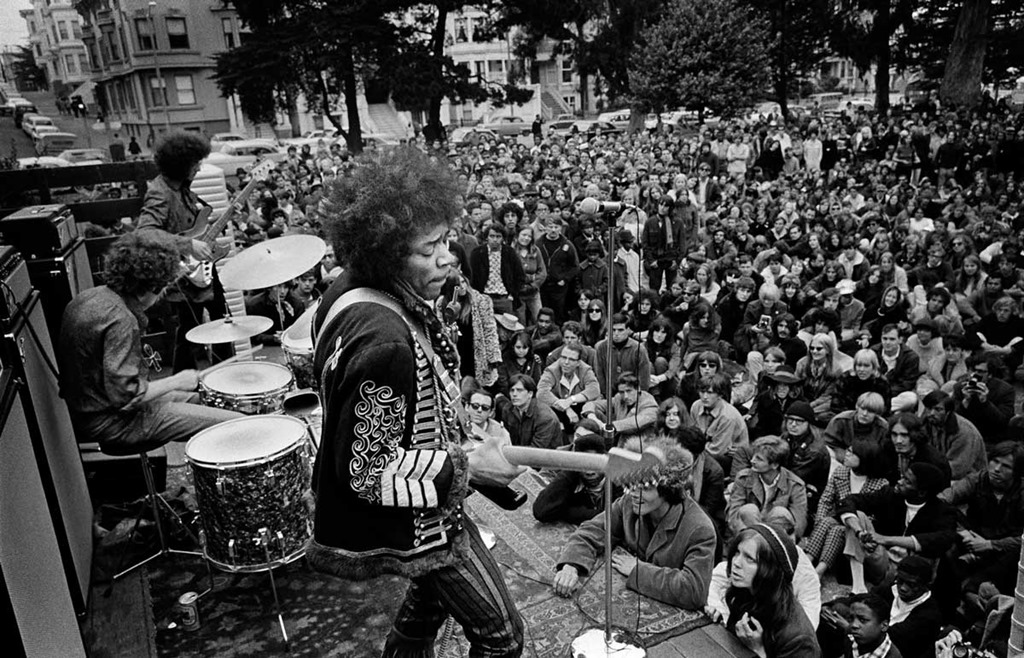
Jimi Hendrix plays for hippies in 1967. Do you envy them or feel superior to them?

In the first stanza, I remind us that Jimi Hendrix was a consummate showman, and that he used showmanship to wrest attention for his art, specifically when he appeared at his first significant concert as a bandleader at the famous Monterey Pop Festival and burned a guitar at the conclusion of a flamboyant act. I present this performance as being consistent to Hendrix’s commitment to his art, as a rock’n’roll musician, an itinerant life with associated dangers, which in his case lead to short life and career. Worth it? Necessary for success?


Hendrix ends his first American show as a bandleader with a sacrifice to his art.

The next stanza acclaims Hendrix for expanding the vocabulary of the electric guitar, using an image of the six-string guitar fretboard, which he transcended with notes beyond the temperament of the frets and though the use of feedback where the notes from the amplifier speaker reflect back to the guitar in the musician’s hands producing sustaining overtones that can be difficult to control but produce extraordinary effects. The question here: these sounds can be harsh, discordant, even painful, but do they too have a necessity?

Next stanza: this feedback is presented as Hendrix’s ancestry: part indigenous, native-American; part Afro-American, a descendent of slaves. This makes Hendrix the point where two arcs of American heritage cross: those that were brought to American against their will, like as to livestock; and those that that were already here and were supplanted by brutal or conniving invaders. The questions here should ask themselves, don’t you think?

The final lines move from Hendrix, to his audience while he was alive and performing: largely white, largely young, many taking a hippie bohemian voyage I liken to America’s famous immigrants, choosing to leave the world of their homes for some promised new world that cannot, and will not, be exactly as promised.

Whatever generation you reside in, you cannot get on a boat or plane to visit another generation’s time; but when you look at a picture or video of a crowd watching Hendrix play, consider those faces. They may be distracted by the day, transfixed or stunned, ignorant and seeking, intoxicated but intent, pleased and puzzled—they may not look like Hendrix, many will seem by their faces to not share his heritage, and none can know the depth of that heritage—and yet, they are dealing with the experience of his art. I ask you not to feel superior or inferior to them from the position of your age or the accident of your generation, but to instead to look to your own heart and ask if there you find some blindness or power, and then to ask, as the concluding words of “For the American Hendrix”  does: when coming to your new land, did you carry with you chains?

47 years ago today, Jimi Hendrix died, perhaps alone, perhaps ignored by his companion of itinerant convenience, trying to continue his art, ignorant of the strength of European sleeping pills.  To hear my performance of “For the American Hendrix,”  use the player below.

Eliza Winston

It’s now a commonplace to note how divided the United States is politically. The way the story is told, there are now two tribes, each sure the other side is largely wrong. We are said to know this, even if we are less than sure about everything “our side” may say, even if we are skeptical, even critical, of some in our faction. You may not believe that this is true about you, but this is what is widely said, and you may say something like this about others, even if you do not believe it about yourself.

I’m about to simplify a story, condensing its humanity so that you will only see moments in several people’s lives. That means you are going to need to pay attention, because the things it may lead you think about are only going to be there for moment.

On a summer day, 177 years ago, a sheriff bearing a writ from a judge knocked on the door of a house on the banks of Lake Harriet, which was then on the outskirts of Minneapolis Minnesota. If you live in Minneapolis, perhaps you know this lake. It just so happens that I’ve spent many mornings this summer reading poetry beside it, as panting joggers and conversing walkers surround it like clockwork.

The judge’s writ commanded the appearance in court of a piece of evidence. As he knocked, that piece of evidence was being told by the people inside to run out the back door and hide. The evidence did not obey. The evidence’s name was Eliza Winston, a 30-year-old woman held as property by the family inside. By her home state of Mississippi’s laws, her mother would have been property too, and her children, if she would have any, would be property as well, the same as livestock on a farm.

How did she happen to be in Minnesota? The man that owned her had traveled up the Mississippi river with his family to escape the heat of the South’s summer, taking a steamboat as far north as the great river was navigable. For his and his family’s comfort, he had taken one of his slaves, Eliza Winston, with him. The laws of the state he traveled to explicitly forbade slavery, but three years earlier the national Supreme Court had ruled that a slave named Dred Scott remained property when he had been brought to Minnesota.

Living in Minnesota then were people allied with a faction that sought to end the practice of slavery. They were looking for people claimed as property to contest those claims. How did they view the slave owners? Of course, as evil you may think. Wouldn’t anybody? Somehow, Eliza Winston had made contact with these slavery opponents. One of them, William Babbitt, would swear out a complaint that her slavery on Minnesota soil violated Minnesota law.

Imagine if you could own something as useful as another human being as property, to have complete control over them. Wouldn’t that be useful; and as a business venture, potentially profitable? The faction that owned other people certainly felt that way. How did they view that other faction, the ones who sought to end that practice?  They viewed them as wrong certainly, but they also saw them as annoying self-righteous busybodies that needed to be taught a lesson, a view that was sometimes shared even by those that weren’t sure that slavery was a good and necessary thing.

Since Eliza did not hide, she was taken to directly to a courtroom. Despite the rapidity of the actions, the courtroom was packed with those from both factions. Eliza’s owner was there with his lawyer, who pointed out Dred Scott. The lawyer for Babbitt had testimony from Eliza Winston that she was indeed a slave, that she’d been passed around like property between several owners, and the lawyer stipulated that Minnesota’s constitution clearly forbade slavery in the state.

The judge ruled, that based on Minnesota law, Eliza Winston was now free. As soon as he pronounced, a clergyman in the crowd jumped up and condemned the decision as “unrighteous,” pointing out that, regardless of the state or federal law, Christianity and its scriptures approved of slavery. I don’t know more of what he said, but he could have claimed that Babbitt and his faction were worse than thieves and rustlers, in that they not only stole, they were self-satisfied in their actions. The crowd stirred at this, and then there was moment of calm in the summer courtroom. Eliza Winston’s owner walked over to the woman that he had owned like a horse or a cow, and he calmly asked her if she wanted to come back with him and return to Mississippi. And Eliza, no longer property, answered that she wished to be free and remain in Minnesota. As Eliza Winston left the courtroom, the Minnesota clergyman was still orating on the wrong that had been done to the slave-owner.

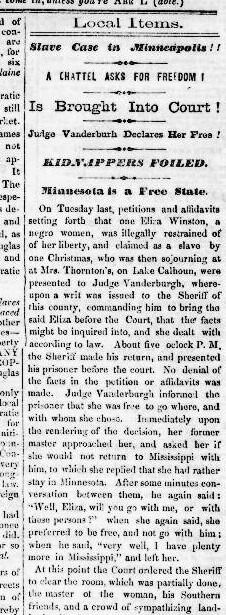
Eliza Winston newspaper story

“A chattel asks for freedom”

That night, those angry at the decision went out around the town looking for Eliza Winston. What would they have done if they had found her? One can only guess. They surrounded Babbitt’s house and battered down the door seeking Winston or Babbitt, and crying for blood. They similarly broke into another house seeking Winston. Winston, however had been moved somewhere else, and may have fled as far as Canada. A year later the Civil War broke out, and Winston, no longer property, became as if a ghost. There are no pictures of her, no tales of great or even small things that she may have done. Some even say she went back to the south after the war. In Minneapolis there is an inconspicuous historical marker about her case, placed along the Mississippi river that brought her here, and not much else.

Eliza Winston Marker
An inconspicuous historical plaque about Winston in Minneapolis
William Green has the most complete telling of the story I’ve seen. For a PDF click here.

Then last year Dave Moore was told a version of Eliza Winston’s story by a friend. The friend, or perhaps Dave, got a couple of the details wrong, and I have left a lot of details out of the story as well—that may not matter. Dave was struck, mixing Eliza’s story and the tale of his friend choosing to tell him this story together, and then forming this lovely, vulnerable song.

Here’s what I ask you, now that you’ve heard my telling of Eliza Winston’s story. If you ever find yourself in a world of factions, and you find yourself in one of those factions, perhaps not sure of what you think, but sure that the other side is clearly more wrong. Ask yourself what Eliza’s story, and the story of slavery tells you.

To hear Dave sing his Eliza Winston song with the LYL Band, use the player below:

Love and Money

Poetry turn-offs? There are lot of them. There’s the fatiguing stretching of language that can wear one out. There can be an air of paradoxical “Let me tell you what I think/you wouldn’t understand” attitude. While modernism has greatly reduced this, there remains an expectation of grand subjects treated solemnly—but then the modernism that gives us a wider choice of diction and subjects, also may hand us a confounding abstraction of words that refuse to work the way we’re accustomed to having words work.

Every one of these things has kept me from enjoying poems, and yet I’ve committed every one of these annoyances myself with my own writing. But what if we could relax, what if we could be told right at the outset that you won’t be tested on the meaning of the poem?

As it turns out, our culture has done that. We call this experience of poetry, without any need to immediately stand and deliver meaning, song lyrics.

With the Parlando Project we often test this theory by applying music to some well-known poetry meant for the page. This pulls the poetry off its silent ink and puts a human voice in it, letting you hear the sound and tenor of the words—but the music adds something else we’ve been culturally trained to do by decades of modern songwriting: it lets us experience the meaning of phrases within the song lyric in a subconscious, non-linear way. As listeners to songs, we sometimes grab the chorus or “the hook” first, and only later begin to appreciate how the verses are shading the experience of the refrain, and in-between times, the music lets us unselfconsciously tap our foot or shake a tail-feather.

Slave freedom paper2

Find the cost of freedom. In this case, a bit less than $172.

I hear alternative Parlando voice, Dave Moore’s “Love and Money”  less as a page poem and more as a song. Over various listens, I think I have drawn some tentative meaning from it. When I first heard the opening lines, I thought I was hearing part of an Afro-American slavery story, where freed slaves sometimes found themselves obligated to buy the rest of their family, because in that outrageous framework, property rights were the only rights that might be honored. As the song progresses, it’s jumps elsewhere, including a verse clearly set in this century. I hear the concluding verse as back in times of slavery, or some equivalent evil time, but the journey from beginning to end exists with a refrain that “our only chance comes down to love and money” and a wicked interlocking riff between Dave Moore’s electric clavinet part and my own Telecaster guitar.

So go ahead and listen to Dave Moore’s “Love and Money”  by using the player below. You won’t be asked to write an essay on it or anything.

I Was Reading About Jesse James

When I was growing up and learning songs from Jerry Silverman’s folk songbooks, there was song called “Jesse James”  included in many collections and sung by a wide variety of singers—and any song that has been sung by the Kingston Trio and Nick Cave, by Van Morrison and the Pogues, by yes, by both Peter Seeger and Bob Seger, has to be the very definition of a “folk song.”

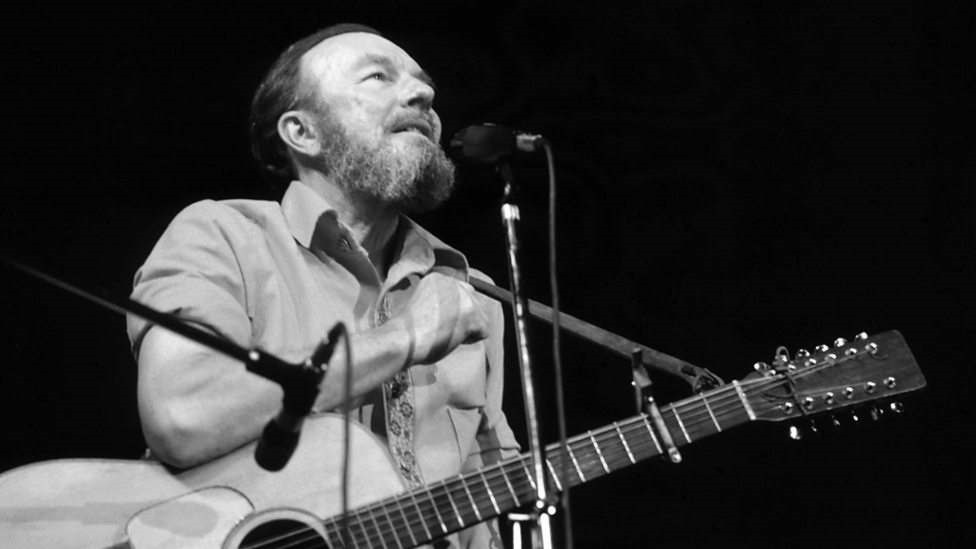
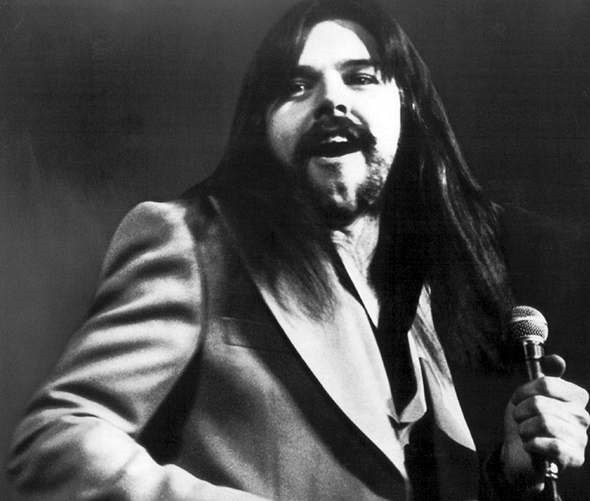
Pete SeegerBob Seger

Both these guys have sung thoughtful songs, but sometimes you need to think beyond the song yourself


Though “Jesse James”  takes some of its spirit from older English ballads celebrating legendary medieval populist outlaw Robin Hood, this American song is more about betrayal (James was killed by a gang associate in his own living room) and about telling us what an all-around bad-ass James was. We’re told he “killed many a man” (never why or how, though bravery is claimed) and that he robbed banks and railroads (but he “gave to the poor” and would “never rob a mother or a child”).

You can see how this sort of thing has a wide appeal. A tale of revenge on the rich and the powerful appeals to many, and banks and railroads were particular targets of late 19th and early 20th century rural populism, but the emotional core of the folk song “Jesse James”  is the betrayal and assassination.  No matter what the variation in the lyrics, there’s lots of mention of James’ cowardly assassin Robert Ford betraying the man who trusted him, shooting him in the back.

Woody Guthrie took “Jesse James’”  structure and melody and produced an incisive, though less popular, version of his own called “Jesus Christ”  which cast Jesus as a rebellious populist betrayed by a disciple—though it had to do without the “killed many a man” factor. So popular is the original “Jesse James”  ballad, that Guthrie likely knew that Jesse James’ action-hero rep would rub-off on his populist Jesus.

So, it was with interest that I followed up on the reality of Jesse James. One can assume that most heroes have feet of clay, portions of their behavior that show faults or inconsistency, but it turns out Jesse James doesn’t have feet of clay—the whole man is made of half-baked clay mixed with ample fresh dung as filler.
 
He’s a nasty piece of work. True, his character shows audacity, but that’s not the same thing as bravery. There’s no evidence I’m aware of that he ever killed an armed man who was opposing him, but lots of connections to killings of prisoners and bystanders. It was somewhat true that seeking cash through his robberies was a side-point to him, but his main motivation was to extend, defend, or to restore human slavery, or to take broad revenge on those who sought to end his career seeking those aims.

If there’s a defense for his actions, it would be some listing of the bad things done by his opponents, but then monsters often breed monstrous actions against them. It’s an argument against monsters, not a defense of the actions themselves.

Today’s piece “I Was Reading About Jesse James”  starts by asking you to think about this. I thought about trimming the piece’s instrumental coda shorter, but I have left it in. Consider the last half to be time for you to begin to ask those questions yourself. To hear the LYL Band ask those questions to music, use the player below.


Hymn to Evening

I’m going to tell you a very sad and very wondrous story. A little over 250 years ago, when America was still a colony of England, a young girl about 7 years old was abducted in West Africa by men who took and sold human beings for profit. This enterprise then shipped her across the ocean along with other abductees. This business, a very profitable and respectable business of the time, was slavery.

The way this business worked then, those who were deemed useful for labor would be shipped to the West Indies. There some were put to work as slaves, and others were—to use the term sometimes applied to the harnessing of wild horses—“broken,” so that they could be more useful as laboring slaves. In this case, with this ship, it took those that were not figured to be the good laborers— the odd lots and freight salvage of their cargo—and carried them on to Boston in the American colonies.

Our 7 year old girl was one of those less valuable pieces of cargo. And when she arrived in Boston, she was also sick, and so she was sold to a family for a very low price, because the ships master figured that if he didn’t sell her quickly she would die and there would be no profit in her.

The family that bought this girl treated her unusually. They named her Phillis, as that was the name of the ship that carried her away to America, and as was the custom, used the family’s last name Wheatley for her as well. They taught Phillis Wheatley to read and write English, and then as she showed extra facility with language, they allowed her to extend her learning. By the time she was teenager she was reading not just the Bible, but Greek and Latin classics and the works of the leading English classical writers of the time. And something even more remarkable happened: she started writing like these men.

Nothing like this had ever been seen. An American, in the far-off colonies, writing like an educated Englishman. No, an American woman—wait, not just a woman, an African-American woman, a slave, someone’s property, writing like an educated Englishman!

Did the business of enslavement of Africans, the thing that brought this girl to America, arise because of a belief in the inferiority of black Africans? Or did the widespread belief that black Africans were mentally and spiritually inferior become widespread because it allowed otherwise moral human beings to take part in this repulsive practice? Whichever, Phillis Wheatley, this young girl, had become a wondrous rebuke to those ideas of racial superiority.

phillis-wheatley-book-plate

First book of poems written by an African-American


In 1773, only 20 years old, Phillis Wheatley once more crossed the ocean and traveled to England, met Lords, Ladies, Counts and Countesses. A book of her poems was published there, the first book of poems by an African-American ever published. She was even going to meet King George, but she had to return to Boston before a date could be arranged. Back in America, as the foment leading to the American Revolution began, she wrote a poem to King George, reminding him that she was his loyal subject, but it might be wise to reconsider things like the Stamp Act that were riling up the colonies.

Yesterday, February 22nd was George Washington’s birthday, and three days ago I celebrated the holiday that replaced Washington’s Birthday with a piece based on a poem written by the teenaged Washington. After the Revolutionary War broke out, and Washington became the commander of the American forces, Phillis Wheatley wrote a poem and sent it to General Washington. Washington wrote back that he was impressed by her “great poetical talents” and suggested that if it could be worked out, he would “be happy to see a person so favoured by the Muses.” Alas, as with the King George, this meeting with the General (and slaveholder) never happened.

So here is Phillis Wheatley, a person who was abducted, torn from her family and home, sold for a pittance as damaged property, shipped across an ocean to a new land that speaks another language. She owns nothing, she herself is owned. And what then does she obtain? Poetry. The ability to speak fluently in the voice and art of this land of exile, and for a time, a measure of fame for this accomplishment. Is that enough?

I look at her words now, over 250 years later, and the style she wrote in is so mannered, often encrusted with the gilded and blushed Georgian portraits of Roman myths. I told you at the start: this story is sad and wondrous. We know, it is our obligation to know, the sadness of slavery, committed by humans on other humans. The wonder of what Phillis Wheatley was able to accomplish fades somewhat with time. As a small gesture to that wonder, today’s piece “Hymn to Evening”  uses a lyrical pastoral Phillis Wheatley wrote, wrapped in some music I composed and performed.


A few words about the music in this piece. The first line of Wheatley’s poem “Soon as the sun forsook the eastern main” somehow reminded me of an excellent if little-known Joni Mitchell song “Eastern Rain,” perhaps best known in an elaborate arrangement performed by Fairport Convention. I find that having an inexact memory is a benefit to composition, as my musical result has nothing in common with Mitchell’s, and the only thing I took from Fairport Convention’s version was a vaguely East Indian musical feel.  To hear my music and Phillis Wheatley’s “Hymn to Evening,” use the player below.


2ebruary

I decided on my own that Yeats’ piece in the last post was about February, but I have some other pieces that say, right out, in their own words, that they are about our current month. Here is one, “2ebruary.”

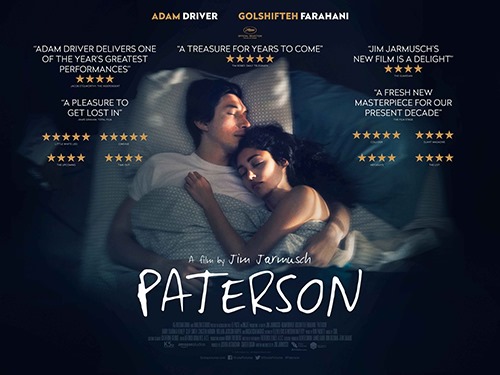
Earlier this month I saw Jim Jarmusch’s film, Paterson.”  This movie succeeds, in its modest and appropriate way, to do something impossible: to film poetry, or more exactly, the composition of literary work. It does this two ways: by having a writer, its central character, portrayed as a regimented, routinized person, grounded in a particularized working-class city and job; and then by having him compose “aloud in his head” his work against this background.

Paterson Poster

this movie has no light-sabers

This is a wonderful choice. The city, the routine clock of the days, the job, become the metrical, musical background for the flowerment of the writer’s consciousness that becomes the poems.

Though the movie is set in the New Jersey city of it’s title, the filmmaker refers often to the “New York School” of poetry, using the poems of Ron Padgett to stand-in for the work of the film’s main character.

The New York School uses a lot mid-20th Century Modern ideas, combining them into various combinations, depending on the individual writer associated with the movement. Some of it can be obscure and abstract, taking off from the same ideas that launched abstract expressionism in painting around the same time. But some also find a tenderness and wonder in the abstract patterns of urban existence, a Pop Art with a depth beneath its surface able to hold a beating heart.  At a point in the film, the main character opens his noon lunchbox to eat, and to write down the intermediate state of his morning’s writing aloud in his head, and there like a Thermos, nestled above an orange and a sandwich, is Frank O’Hara’s “Lunch Poems.” It has to be there.

Lunch Poems Cover

Don’t loose your Lunch Poems

O’Hara wrote in a great many styles, but this slim chapbook features several poems that someone once called his “I do this, I do that” poems. where O’Hara walks about, seemingly composing aloud in his head amidst daily tasks. These are my favorites, because, like “Paterson,” these poems seem to be about their own grounded creation in a city of routines, reflected inside the moist, encased, flowing mind of their writer.

Today’s piece “2ebruary” takes off from that Frank O’Hara mode, as I often like to do, though I’m an old man, writing in another century, in the Midwest, not New York City, and my old joints creak best on a bicycle.

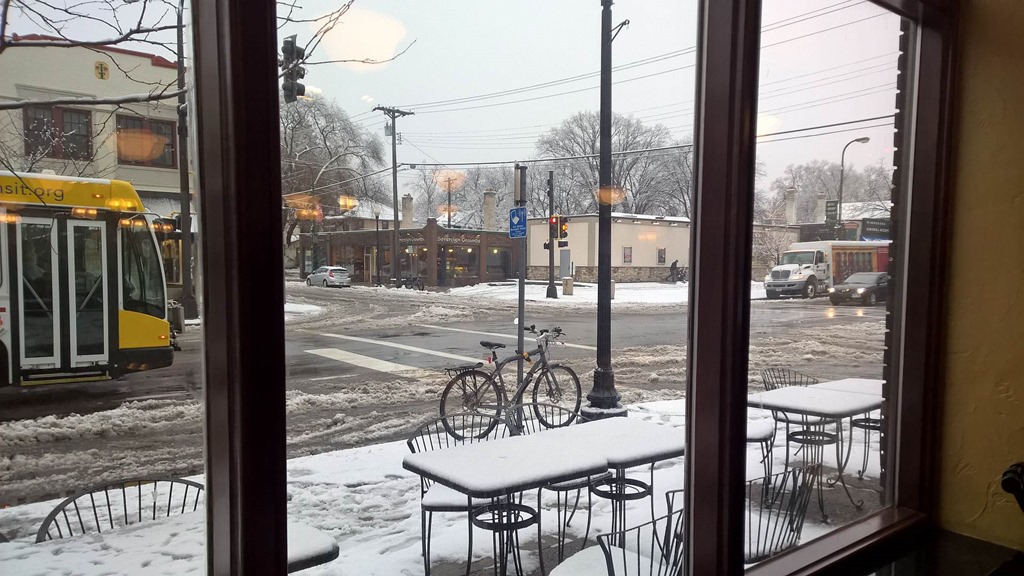
Schwinn IG5 outside Turtle Bread in Winter slush smaller

a scene from today’s piece, breakfast not included


“2ebruary” is a short bicycle journey thinking of history, and past the events that are turning into history that we can still change. I take a pause, as every American should, to note that American culture is made from those who came here carrying something from elsewhere. And Midwestern culture? For many, those packing trunks are hardly great-grandparent’s-age-old, at the eldest.

At one point in the journey, I note those that had no trunks when they came to America, they had only their chattel bodies and souls—and even of those two things, the former had been appropriated by others for handy profit. What could they unpack? Well for one thing: the largest and grandest part of our American music. Our history is short compared to many nations, but it contains mighty things like this. We who are joining that history, already in progress, can turn it one way or another. Which way do you choose to turn?

To hear the LYL Band perform “2ebruary” use the gadget below.