Paying the Piper chapter 4: “I heard my mother sing this ca. 1876”

Today is Juneteenth, a holiday coming into greater recognition as a celebration of the ending of America’s race-based chattel slavery. Why this date? I repeatedly warned you that I can’t tell a story simply and briefly, but for this holiday I have an excuse.

Slavery began in the American British colonies somewhat haphazardly, but by the time we became an independent country we had lots of laws, customs, and beliefs to entrench it. As it often is with the mechanics of oppression, the structures to hold it up took work to maintain, and by the 1850s there was great worry between slaveholders that it would collapse. In the 1860 election, Lincoln won, and even though he’d stated a politician’s compromise middle ground on the slavery issue, his party included enough abolitionists that most powerful slave-holders were ready to press their states to rebel and set up their own government. Civil war ensued.

Which didn’t free the slaves — at least not yet.

Of course the enslaved had been freeing themselves, when they could, all along. Armed rebellions hadn’t worked for more than moments, but the brave, lucky, and skilled might successfully flee at least from the slave-holding states if not to Canada where US law couldn’t touch them.*  But it wasn’t easy traveling all that far.

Once the war started in 1861, some enslaved people recognized they could try a shorter route: just make it to the Union troop’s camps, and a good many did just that, which created an awkward situation. You see: nothing had ended slavery’s legal framework, Lincoln still maintained he wasn’t doing that (if only because a few slave-holding states and slaveholders remained on the Union side). He just wanted to put down the rebellion.**  Law still said the slaves were property.

Someone on the Union side came up with a peculiar idea. If the enslaved were legally property, they could be confiscated during wartime like a cannon, horse, ship or other enemy property could be. Dehumanizing language? Sure, but escaping past the Union lines meant an increasing chance that they wouldn’t be taken back.

Eventually, Lincoln supersized that freedom, by declaring that all the enslaved in the states in rebellion were free. This, the Emancipation Proclamation was issued at the beginning of 1863. American slaves elsewhere? Nope, not in the Proclamation. Slave owners in places under Confederate rebel control? Not gonna listen to Lincoln’s order. In April of 1865 Robert E. Lee surrendered the bulk of Confederate troops, but that still didn’t mean all enslaved were free, and the legal matter wasn’t consolidated until December of that year with the adaptation of the 13th Amendment.

A couple chapters back I talked about how slow by modern standards communication could be in the mid-19th and early 20th century. Well, it was slower yet when not everyone was on-board with the news. Juneteenth, with an absurdity that is so often a part of America’s racial history, celebrates when Union troops got over to Texas in June of 1865 to announce that the war had been over for over a month and the enslaved in Confederate Texas were no longer legally slaves.

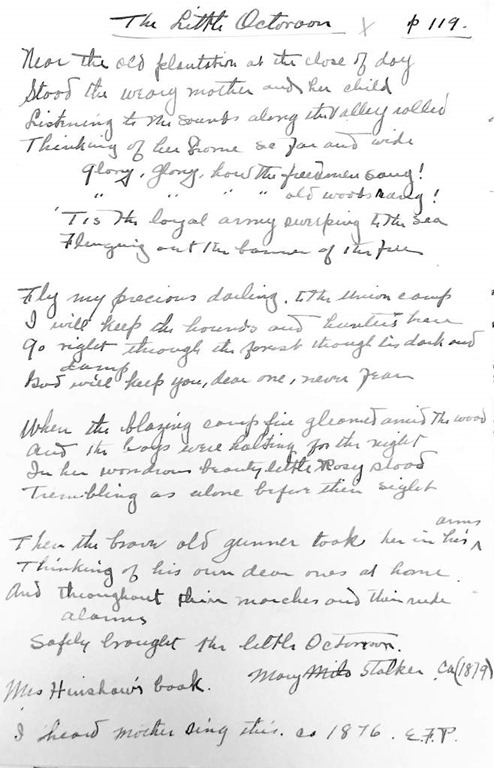
When I left off I was (more or less) talking about folk songs and the songs collected in the American Midwest before WWI by poet Edwin Ford Piper. I’ve also already mentioned that folk songs aren’t unchanging, and aren’t pure. While going through the yellowing paper in Piper’s archives, I came upon this song, handwritten in his own handwriting. He has the title as “The Little Octoroon.”   Things aren’t going to get simple here readers. I can’t be simple.
The Little Octoroon 1024

The song as Edwin Ford Piper heard it from his mother

.

Octoroon is a largely obsolete word, derived from a lot of rigmarole regarding how Black someone was. It means 1/8th (octo=8) Afro-American. In general, the mumbo-jumbo legal biochemistry in American history regularly said it didn’t make much difference. Half, quarter, sixteenth — hell, for those who had trouble with fractions it was sometimes written down as: 1% Black, you’re legally Black.

An octoroon may not look  Black. I can still recall when I was 14 or so, and having grown up in a tiny rural Iowa town. An Afro-American man who was a civil-rights activist was to visit my church camp. He arrives. Wait — that man’s Black? I remember in my naivete looking at his summer hands and forearms. The man had freckles people!

So why does this song, which is clearly a song from the Union and Abolitionist side make some point about the child being an octoroon? This will get weird: it was possible to be an abolitionist and  a white supremacist thinking Afro-American’s inferior. Yes, you could be smart and ignorant at the same time! If you’re trying to end chattel slavery, and you’re counting votes or troops, you might not care to make a sticking point about this, ugly as it is. Those with pseudo-scientific beliefs such as an octoroon is “nearly a white person” might have stirrings of respect. (Ugh!) And then at the unconscious, illogical level, there’s the factor of that person looking much like me, so maybe they  should have rights like me. Even if it’s a song (something with no visual element) those factors may have entered into its composition.***

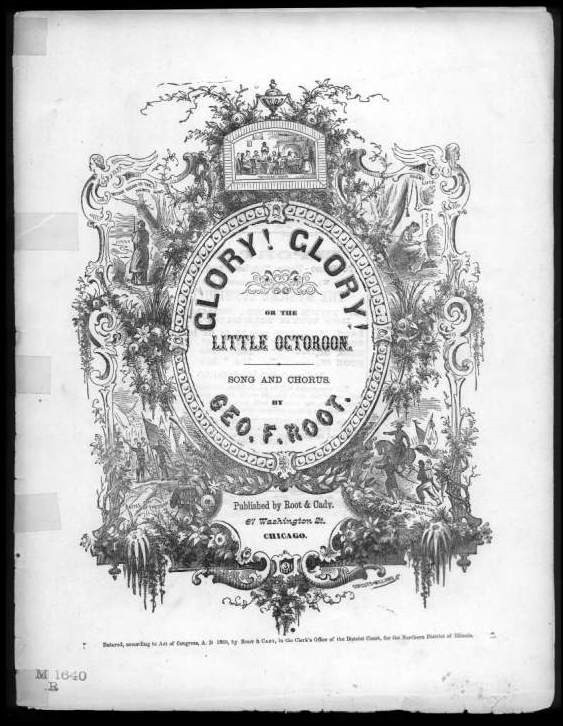
While there are no notes I saw in the archive that Piper knew this, this song does have a composer: George F. Root.  Root didn’t quite reach Stephen Foster or Dan Emmett level of 19th century American songwriter fame, but he had his “hits” such as they were in the pre-recording era. During the Civil War period and based out of Chicago, he specialized in songs for the Union side.
The Little Octoroon song sheet cover 800

The sheet music from George F. Root’s music publishing firm. When Piper remembers his mother singing this tune, it would have been only 10-years-old.

.

Did Piper’s mother learn this from someone else? Was there sheet music in a piano bench for this, unknown to the 5-year-old Piper? In the quiet library archive, I visualized two white people, a mother and child, in rural frontier Nebraska sharing this song. The differences in the printed song from the one Piper wrote down from his mother’s singing say this isn’t likely a handwritten copy from sheet music.****

Here’s my conclusion, which I hope I’ve demonstrated even though I’ve trimmed parts of this piece back: Juneteenth is the most complicated American legal holiday.  The only simple thing about the holiday is that it stands for freedom and the lifting of oppression. Taken at its whole, though messy and with calculated delay, that makes it a favorite of a person like me, who still cries and wonders at how simple truths and rights take so long to be established. The song I’m performing today, its path and turning into a folk song, isn’t that complicated — but yes, the path of American freedom is.

You can hear my performance of Root’s “The Little Octoroon”  with the audio player below. No player? This highlighted link is an alternate.

.

*In 1850 a Fugitive Slave Act was passed that required northern state governments, not just the federal government to return enslaved people who reached northern states. Some cities and states wouldn’t comply (there’s this Minnesota case for one example).

Piper’s mother was in Canada near the US border in this era. It’s possible that fugitive slaves might have crossed over into her region. I also note that Piper says she was singing it in 1876, perhaps because that’s the border of Edwin Ford Piper’s memory, but I read the date and think about it being the year Reconstruction largely ended and new de-jure laws and customs greatly restricted Afro-American citizenship.

**No, Nicki Haley, slavery was the cause of the Civil War, even though many liked to parse Lincoln’s compromise and coalition statements of this time to make it sound like it wasn’t. The flaw in that framing? Lincoln didn’t start the war, the South did, and they were explicit in proclaiming why they did it.

***There’s another song using this terminology that this Project has already presented: Longfellow’s scathing pre-Civil War poem “The Quadroon Girl.”   In Longfellow’s poem the situation leading to that poem’s mixed-race child is laid out: feudal concubinage and/or rape by slaveholders. For making a speech implying the same, Longfellow’s friend, US Senator Charles Sumner was beaten to within an inch of his life on the floor of congress.

****The biggest difference: the printed song’s title calls out the chorus — it’s officially “Glory, Glory, The Little Octoroon.”   I only sang the martial chorus twice in my performance because I was more drawn to the bravery and sacrifice told in the verses. We have two holidays that say soldiers made us free, but it’s not only soldiers.

I followed Piper’s transcription for the words, not the printed lyrics, honoring the chain of transmission to me rather than accuracy. I also modified Root’s tune and chords to suit my tastes and tendencies. I could not help but think of these things as I sang this: first, the mother, her family heritage caught in that sexual exploitation making the choice to stay and face the slave hunters and their dogs to assure her child’s escape. We never find out if she and the daughter will be reunited, or even if she survives. Then next I think of those pursuers who to the degree they are portrayed in the song would be gaslight villains — but in history they would be real people doing great evil, who could be thinking they were serving justice. And then lastly, the final-verse gunner who cares for the child, though he’s more the Horatio of the story, with the mother being the tragic hero. I ask you not to skip over the villain characters. It’s fine if you empathize with the gunner, but some great dangers in one’s life (and often to other lives) are those middle souls, like the slavecatcher pursuers, who have a system that tells them they are arduously, justly, doing right.

The Minstrel Boy

The Parlando Project’s thing: taking a literary poem and combining it with a piece of music isn’t a new thing. If poetry exists in every language, poetry combined with music exists in every language too, and such casual melding typically pre-dates the culture’s written poetry. We have just kept on doing it as a practical and immediate art.

This is National Poetry Month here in the U. S., but I don’t think I’m overly nationalist in the words I use here. Still, just as poetry and music go together, national and ethnic pride often takes poetry and song onto itself. W. H. Auden notably stated that “poetry makes nothing happen” but if we examine it the other way around, it’s unlikely that any great movement for change or nationhood ever has had no poetry and song associated with it.

As a poem “The Minstrel Boy”  was first published in 1813 as part of the author’s collection titled Irish Melodies, and its central image is a harp carried by a “warrior bard.” It’s therefore apt that Moore combined it with music forthwith, using what he named as a traditional Irish tune.*  Harps and lyres etc. are an extraordinarily large family of instruments, but Moore seems clearly to be writing of Ireland, where the Celtic harp has become a national symbol. At the time of its writing, Ireland was still under the long-standing, often cruel and exploitative, rule of England. Classmates of Moore had recently died in one of the periodic Irish rebellions.

Minstrel Boy

I asked alternate voice and keyboard player connected to this Project Dave Moore if his family has any connection to the liked named poet. None known, he tells me. Dave’s father preached for decades, and he wrote at least one literary short story that I read after he — one of the generation this month’s poetry anthologies were marketed for — had returned from WWII.  I told Dave’s dad his story reminded me of Hemingway. He replied “I don’t think I knew anything about Hemingway then, he was kind of avant-garde stuff at the time.”

.

The song also became popular in America, though I’m not certain how rapidly it took root here — but in the year of its publication America was at war with Britain for the second time after its revolution. And by later in the 19th century, the song had currency among Irish-American immigrants.

Ironically, Moore received a British diplomatic post to Bermuda, and in 1803 he not only visited the United States but met President Thomas Jefferson. The tale I read online says the two did not hit it off, and that Moore was not impressed with American chattel slavery. **

Since those times the song (or sometimes just the tune associated with it) has been closely associated with the armed forces, police, and firefighters — folks whose sense of professional duty includes risk of death. I find that ironic too, for the song’s minstrel boy is the definition of an untrained irregular, possibly underage, untrained (he has to borrow a weapon), and more of a singer-songwriter than a SEAL Team professional. *** This is one of those cases where tradition overwhelms close reading.

I’m performing this song as part of my NPM series looking at poems from a pair of 1920’s anthologies of verse for children: The Girls Book of Verse  andThe Boys Book of Verse, and “The Minstrel Boy”  appears in one of this gendered pair of books. In each instance this month I’ve asked you to guess which one: Boys or Girls.  Today’s poem is a free square in that game, as one would easily guess this military service theme would be in the boy’s book — as it is. Indeed, The Boys Book of Verse  has an entire section, Songs of Peace and War dealing with poems about battles and military service. The editors, both women, would have had recent experience of WWI, and whatever their feeling about warfare, they must have felt that subject was something their readers or purchasers would want included for the boys.

I stop to think here — as I do as I consider the entirety of this pair of “the last Twenties” books — that the first audience for these books would go on to experience a much greater and deadlier world war.

I’m likely not one of the best singers to have sung this well-loved song, but I performed it with a full rough’n’ready rock-band arrangement as best as I could peel off in this month’s accelerated schedule. My inspiration for singing this song? A similarly not-ready-for-the-most skilled-singer-contest one, Joe Strummer, who also recorded this song. You can hear me tear through those chords asunder with the audio player you should see below. If no audio player sullies your screen, it’s because some ways of reading this blog won’t show it. This highlighted link is your alternative — it will open a new tab with an audio player.

.

*The tune Moore selected, named as “The Moreen,”  was said to be a traditional tune. Wikipedia says that no one has independently found a source of this tune from before its pairing with “The Minstrel Boy’’ —  so it could be that it would have disappeared forever if Moore hadn’t tapped it for his poem about a doomed harper. That adds an air of mystery to the song, doesn’t it.

**The stirring final line stating the harpers fight was against slavery does and doesn’t require an explanation. Servitude in general, even government duties and tributes required from monarchs or tyrants, was often rhetorically called out as slavery, while American chattel slavery was totalitarian: humans — and with added cruelty, any families of those enslaved — owned in perpetuity like animals without rights of any kind. I read that this song was sung by both sides of the American Civil War — the “slavery” on one side rhetorical, the slavery on the other total and abject. When I started this post talking about the widespread tradition of nationalist poetry and song, take note: a corollary from Auden’s dictum may be that poetry and song prove nothing.

***This might be a fair poetic description of the Irish rebels that the teenage Moore knew, those who died in an ineffective rebellion. The long fight for Irish independence seems to have had an outsized portion of “warrior bards,” folks with less military experience and tactical acumen than literary and musical bona fides.

Almost Independence Day

Like many days recently with this Project, I have been thrashing about looking for time to find an inspiration for a new audio piece, and some inspiration to spend that time. This weekend I found one sliver of inspiration in musical memory, and then yesterday, I found an Independence Day piece so monumental that I had to figure out how to grasp it inside music.

The sliver? I recalled a song, or rather just a line, a refrain from a song, from my younger years. That refrain was also the song’s title, and the title of today’s piece, but by itself it was insufficient. “Almost Independence Day”  is a song that closes an early 1970s album by Van Morrison. It’s a peculiar song,* a lengthy (10-minute) two-chord jam with largely mundane lyrics that earns it’s interest — if it does — by the singer’s investment in presenting the ordinary, and by the unusual combination of instruments it uses to accompany itself. Morrison’s Almost Independence Day”  has drums, bass, two guitars, and keyboards. But the bass is an upright Jazz-sounding bass, allowed a high place in the mix at times, and one of the guitars is a 12-string guitar prominent in the song’s texture. And the keyboards? The keyboardist on the cut is Mark Naftalin, the son of a former mayor of my city. Naftalin was the keyboard player in the classic Butterfield Blues Band lineup, a tough sounding, gritty integrated band that played post WWII Chicago Blues — but on this song, the most prominent keyboard part is a low electronic synthesizer, reportedly played on one of those made by American synth pioneer Robert Moog. Wikipedia thinks it’s one of the earliest uses of that instrument on a “rock” record.

I had only remembered that song’s refrain — but even on re-listening to it, I found little besides the refrain and the song’s odd musical texture that I thought I could use.

Then early yesterday morning I thought of another, more substantial, set of words for Independence Day: a speech given in 1852 by Frederick Douglass, What to the Slave Is the Fourth of July?”   I’ve read it silently before, and I read it silently again. It’s a 19th century oration, the kind of lengthy and precisely enunciated rhetoric that would seem archaic to modern ears and attention spans.** Yet, it’s worth reading because it’s a unstinting analysis of American Ideals (worthy), acknowledging of American scientific and civic achievements (evidence of the possibility of unimaginable change), and yet clear and precise on great failures in extending its best to all Americans. As the title given to the speech makes clear, Douglass spoke at a time when chattel slavery was a large part of our country, when he himself had been enslaved, when a reticent and resistant national government had (through the Fugitive Slave Act) made clear that the whole nation was to support and maintain this evil.

Young Frederick Douglass

Does it seem odd that I’m linking Douglass with a Celtic song? Here’s an article about Douglass’ link to Ireland.

.

I assume we are all in agreement on that evil, on that horrendous disconnect.***  But continue: Douglass’ speech still speaks to us today if we can translate a bit from its old-style oratory. Doing so, it’s a forceful reminder on this holiday that American ideals, such as the things stated in our historic Declaration on the first Independence Day, aren’t an award citation — they are a to-do list. The work of our founding, the work of emancipation, the work of fulfillment of our ideals, is on-going. So, if we are clear in retrospect about the acceptance and legal enforcement of slavery, that’s only a beginning lesson. We need to be as unstinting in asking where we are today out of step from our best principles and practices.

American ideals, such as the things stated in our historic Declaration on the first Independence Day, aren’t an award citation — they are a to-do list.

In devising a way to use Douglass’ speech in our short musical format, I decided to take a short part of it, a litany of assertions made in 1852, and make them an enduring set of questions to ask ourselves (or for any nation to ask itself) about that disconnect now and in the future. Douglass’ recast litany starts at about 1:20 in the audio piece, and the other words are mine, though I’m seeking in them to convey Douglass’ insights.

So yesterday, in an hour or two that I had available after finding my inspiration, I worked to perform Douglass’ litany of questions, and still was able to finish with a couple of lines from an Irishman’s song. Why was Van Morrison singing about almost  Independence Day? Perhaps, it was only July 3rd, and he was noticing, as an immigrant, the expectations of this American holiday. But maybe too, this white man who sang “they can’t stop us on the road to freedom” was thinking that we are always, should be always, like those men in granite who declared our Independence two days before July 4th, looking forward to Independence Day, not remembering it.

You can hear my musical performance of this recast portion of Frederick Douglass’ speech with the audio player below. No player? This highlighted link will open a new tab with an audio player.

.

*Peculiar and a Van Morrison record is a tautology.

**Consider this: for all its elaborate speech, it’s shorter than the usual modern podcast length, and spends less of its time with repetitive familiarities and co-host back-slapping. Have our attention spans really gotten shorter, or is it the density of 19th century speeches like Douglass’ that wears out our attention?

***Well, there are still some neo-Confederates out there who will tell us it was a benign sort of thing, unremarkable really, and so long ago that we need not think about it — and coincidently, we should not think or teach about this example, and so setting out laws or best practices against that.

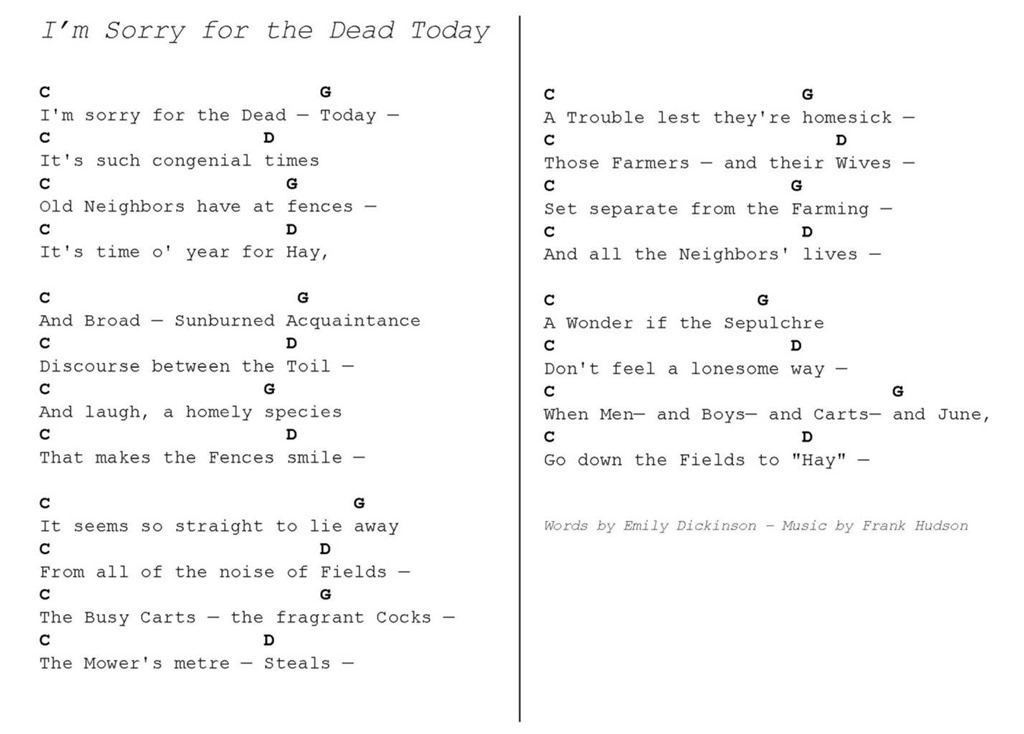
I’m Sorry for the Dead Today

Last episode here we had Jean Toomer’s poem of alienation from labor. In Toomer’s “Beehive”  the poem’s voice is portrayed as just another drone bee, only able to fantasize of escaping work or receiving any benefit from it. Today’s piece is by Emily Dickinson, and while there can often be a touch of irony in Dickinson, I think we can take the voice in her poem “I’m Sorry for the Dead Today”  as earnestly engaged in their farm work.

One doesn’t have to go too far into differences in biography to account for the contrast between the two poems. As I mentioned last time, Toomer was the child of an enslaved person, and the book in which his poem appeared was his literary account of an early 20th century southern American feudal society associated with a racial caste system. Dickinson was an upper middle-class daughter of a successful lawyer and politician — and well, let’s just say it — even if the rights and social assessments of women in mid-19th century America were constrained, she’s got that White Privilege and a different economic vantage point.

Dickinson’s poem, the one we perform today, looks to a specific farm labor event: the harvesting and storage of hay, likely for the animals including the horses used for transportation by her family. One thing I learned when I visited the Dickinson Homestead a few years ago was that the area right across the highway that still runs in front of her family’s house, was a field used to raise grain; and that at least in her youth, Dickinson had as one of her chores, taking food and water to the workers in that field. I don’t know the details of the ownership of that field. Was it shared between more than one family? A village green sort of resource for the town? The harvest depicted here seems to involve more than one family. That doesn’t make certain that it’s a shared field. For haying time, particularly when one has a smaller family lacking muscle power headcount, there may be an exchange of services between farmers, either for hire or in a cooperative barter agreement.

It’s a temptation, one that some American thinkers of Dickinson’s time easily fell into, to romanticize that kind of work, so different from the arrangement of slave labor plantations or share-cropping vassals. Indeed, some of the Northern and border state opposition to American chattel slavery was based less on belief in the full humanity of the enslaved and the crime of denying that, than on the idea that “free soil” labor was ennobling in and of itself and a benefit to a republican citizenship.

So, when Emily Dickinson, northern state’s daughter of a Whig representative, speaks of how engaged and happy the hearty labor of the hay harvesters is, she may be participating in a political sentiment of her time. Now how much the ironic Emily wants to undercut this I can’t tell for sure. The poem’s general argument is that this bustle of life and colleagueship for those with human rights, who are not scrounging for subsistence, is such that the sleep of death is not welcome. Is she making a subtle point in some undercurrent, that death will find this work only vanity? Is there a winking case for the repose of the grave verses labor’s toil? Intended or not, you might find a bit of that there, but it doesn’t seem so to me.

I'm Sorry for the Dead Today

Dead simple chords today. When I present these songs-sheets I’m hoping for better singers and players than I to take up these pieces.

.

Did you find this discussion of what surrounds this poem tiresome or detracting from the pleasure of Dickinson’s verse as a piece of art? If so, you may not even get to this paragraph. I read a remark by writer Caitlin Moran this week that a woman spends less than 1% of her lifetime making love — yet sex and desire, and woman’s role in that, seems to take up a much greater portion of what is written about them. Poetry too has that disproportionateness — and I’m not here to knock love poems, particularly honest ones — but I feel the world of work is too unrepresented in poetry. Maybe I’ll find a poem of acute love, or a transfixed descent into the book of nature next time? We’ll see.

You can hear my musical performance of Emily Dickinson’s “I’m Sorry for the Dead Today”  with a player gadget, if you see that. No gadget? I supply this backup highlighted link.  Thanks for reading, listening, and putting up with my varieties here!

.

Sail on, Oh Ship of State!

Claude McKay led an outsiders’ life, Allen Ginsberg became a near celebrity bohemian whose outsider status changed over his life. The author of today’s poem in our Independence Day series was more well-known than Ginsberg in his day, and he was as far from being an outsider as any American poet could be. At one time, as many knew and read his poems as Edgar Guest’s, and he was a much better versifier.

So, do you know today’s poem from the above title, or from the name of the longer work from which it’s excerpted, “The Building of the Ship?”   It’s highly unlikely that you would. The American writer Henry Wadsworth Longfellow went from being the stuffy square’s square, the kind of writer that Modernists didn’t want to be, to a forgotten man, the writer that no one remembers even to reject. He was a civic poet, a poet’s role that no longer exists in white America. Along with a handful of other men, most of whom he knew, he sought to create an American poetry in the first half of the 19th century when the American experiment was still new. After all, when he was born in 1817, many who celebrated July 4th were around for the July 4th!   And for much of his life Longfellow lived in a house that George Washington had lived in while commanding the American Revolutionary War troops.

Longfellow_National_Historic_Site,_Cambridge,_Massachusetts

George Washington lived here, and later so did Henry Wadsworth Longfellow. And a child named Darby Vassall. Haven’t heard of that last one? Read on.


In 1855, an elderly man visited that house where he had been born in 1769, meeting with Longfellow there. The man’s name was Darby Vassall, and this was the nature of his birth: he was born to enslaved Afro-Americans owned by the owners of that big house, which made him a slave by law from birth. When the Revolution came, his masters sided with the British, and so after the Battle of Bunker Hill, the owners skedaddled off to safer British-controlled territory. This left the house available for the new Revolutionary Army’s commander, General Washington, as spoils of war. Washington left his short-term smaller quarters and went to the big house to move in.

And here’s the story Darby Vassall liked to tell about meeting The Father of Our Country. There he was, six years old, and the revolution had by accident empirically freed him. He was swinging on the gate of the very house Longfellow now lived in, a time-honored childhood pastime then and now (see also sutures and Colles’ fracture.) General Washington, impressively tall for his time, and like the house’s absent owners, a rich slaveholder who traveled with an enslaved manservant, asked the boy if he would like to work for the new occupant, this man who’d become so honored and famous that people even now buy his portrait for something between 25 cents and a dollar.

Darby kept swinging, sizing up the tall white man, and then asked “How much are you paying?” Darby says Washington kind of lost interest in the conversation at that point—because, you know, slavery. He looked like a gentleman Darby later recounted, but “He was no gentleman.” Now that’s an Independence Day story!

We don’t know all Vassall told Longfellow about the house Longfellow now lived in, but the stories must have been interesting. The best-selling author blew off a meeting with his publisher to hear them all.

Have I forgotten to talk about Longfellow’s poem? No, this is another poem for our July 4th series. It comes at the end of a much longer poem Longfellow published in 1850, one that less than nobody reads today. The entire “The Building of the Ship”  is an allegorical story of a venerable ship builder* who with the help of a crew including a younger apprentice builds a ship for a merchant, more magnificent than any the builder has ever built. While building the ship, the apprentice and the master ship builder’s daughter fall in love, and the old master promises that on the day the ship launches his daughter and the apprentice will be wed. After many supple verse lines detailing the construction of this ship,** it’s complete and it launches with a epithalamium in which the new and lovely ship is embraced as a bride by the timeless, older, gray sea.

If the poem ended there it’d remain a curio of interest to scholars today, a romance in a European style adapted with distinctive American details and accomplished in English verse with a difficult rhyming scheme that never grates or seems fake, the sort of thing that is easier to do in French or Italian.***  But Longfellow had an envoi of sorts. The ship, as all man-made things do, would eventually wear out and come to a wrecked end. A downbeat, look-at-oneself-through-the-grave warning that would also not be out of place in romanticism.

This whole poem, along with that ending was sent to the publishers.

Then Longfellow called it back. He had a revision, with an entirely new ending. You can read the old ending and the story of the last-minute revision here. Not only is the new ending upbeat, it seemed to retroactively change the poem that proceeded it. That boat-like-a-bride thing was still there, but the ship was named “The Union,” and in those manifests of the things that made the ship, the entire young country seems to be the source. The Union becomes not just a marital union, it becomes the United States.

Here’s where that civic poet role comes into play. In the dozen years leading up to the Civil War, the delicate balance of slavery’s evil in a democratic country was becoming harder and harder to keep from spilling, the compromises seeking to keep the country in existence more and more difficult to negotiate. Longfellow’s new envoi, the one that I perform today, may seem anodyne if considered as an abstract statement of patriotism, but in 1850 it was a considered second-draft meant to say that ideals of the American experiment should continue, needed to continue, because those ideals, those plans, however imperfectly applied are contagious (in a good non-Covid-19 way). Enough for a small 6-year-old to stand up to Washington for example.

Now if we are to consider inspirational Afro-American patriotism, the best story that is likely not true is that Winston Churchill once quoted in a public speech Claude McKay’s “If We Must Die,”  a Black man’s valiant ode to self-defense written after the deadly “Red Summer” of 1919, but then applied during the darkest days of Great Britain standing against Nazi-occupied Europe. No one has such a transcript or recording. But there is  a recording of Churchill reading a section of the abolitionist**** Longfellow’s envoi during that time in a speech of endurance in 1940.


Maybe the strangest thing about this ship and it’s sailing on, even as the maker of the poem has slipped away from public consciousness, was “Sail on, O Ship of State”  being quoted in Leonard Cohen’s “Democracy,”  his excellent ode to the need to continue the American experiment, however flawed, because it’s flawed.

The player gadget to hear my performance of Longfellow’s “Sail On, Oh Ship of State”  is below. I’ll note that my performance has some flaws that I’m accepting for now in order to get this out in a timely manner, but the spirit is there. Happy 4th of July though it be just one date. May freedom and independence come to all of us. The revolution is plural.


*Though Longfellow lived and wrote much of his work in Cambridge Massachusetts, he was born and educated in Maine, and even at this late hour he probably vies with Stephen King and Edna St. Vincent Millay for the title of most well-known writer from Maine. Maine was a shipbuilding center in the 19th century and so the poems extended allegory of shipmaking was local color to Longfellow.

**I’m no expert here, but those who know about early 19th century American shipbuilding seem to feel that Longfellow got the details of ship design choices and construction right.

***Many prosody theorists think that rhyming English poetry is a mistake, as we have many fewer rhyming word-endings than other European languages. Longfellow’s poetry may not be to modern tastes, but one thing he did have was a non-forced and impressive “flow” in the hip-hop/rap sense.

****Among the favorable reviews from abolitionists: Thomas Wentworth Higginson said of “The Building of the Ship”  “The most complete and artistic which he ever wrote.” Lincoln was said to have quoted the envoi lines in private to his secretary as the Civil War broke out—and broke down in tears before he could finish them.

The Greatest Generation, or Thomas W. Higginson lands on Omaha Beach

I appreciate the attention readers here give to what I present, and so I’m going to warn you: this is a longer piece covering some historical topics that have not been as popular here as others. I plan to be back soon with a shorter post and  I promise a love poem set to music. Thanks for your attention and spreading the word about the Parlando Project. I value that!

Today is the anniversary of the WWII allies’ D-Day invasion of Northern Europe, and as each anniversary gets later the tributes to the sacrifices and courage of those who waded onto the beach amid the gun and cannon fire grow more glowing.

As one of America’s diverted poets once said, it is “altogether fitting and proper that we should do this.” And I say this knowing that this will likely be one of the least-read posts here. The audience for a blog about encounters with poetry and music is not a martial audience by and large. Even a poem like Slessor’s “Beach Burial”  recently presented here—a poem that is about war, though not really about battle or courage or warrior feats—will end up being one of the least noticed, read, liked, and listened to.

I speculatively assign that response—and the lessor response other stark war poems have received—to a number of things: that old battles are yesterday’s newspapers—or as we might say these days, just newspapers; that one of the things we might look for in the arts is a respite from, or at least a beautiful decoration for violent and horrific events. I’m casting no shade on you who have paid with your attention to what we do here for that—or your other judgements on the work we present. After all, I make those judgments myself all the time for my own reasons.

So now, having sincerely bowed to both those who were in the water on June 6th 1944 and you, dear reader and listener, I will diverge.

There is no Greatest Generation,* never was. Too much is assigned to generations, and if widely shared experiences and common events current to lifetimes has some glue to hold an aggregate together, extending “generations” to inner character and intrinsic resources of their membership, virtues and vices conferred merely from birth years is simplistic nonsense that should never be relied on.

I suspect wiser users of the term would correct me and say they do not mean that when they use the term, they mean the great things the WWII generation endured and did. Yes, I join them, there is value in noting that.

But one thing that literature teaches us, by doing its basic trick of letting us experience someone else’s life, is that the good and bad in human character and the challenges brought to bear on us are not unique to time and place. Are the challenges of WWII greater than the challenges of those of the trench soldiers of WWI that this project has featured? Are the privations of the Great Depression, followed by another World War and the following challenges of nuclear peace after great destruction worse than the challenges of 19th century American slavery followed by a Civil War followed by the continuing existence of a continent-wide republic after such trauma?

An Internet discussion mentioning these things often leads to claims and counter-claims of greatest evil: slavery, colonialism (which should include our “internal” American colonialism inflicted on our indigenous population), The Holocaust, Stalinism’s mismanagement, gulags and secret police, Pol Pot, and other evils whose incidental lack of notoriety should give them no cover. I’m sure there are appreciable differences in them, things philosophers could construct evaluative frameworks on. Don’t bother to comment or look for a poll feature to vote on the Greatest Evil or any generation associated with it. This will not be my point.

My point is: you, particularly the younger of those that read this, are the only generation that matters. If I need a silly name for you, a souvenir hat to show that you belong to this, then I’ll swallow my pendant’s pride and call you “The Greatest Generation.”

Do I want my own son, or you, to advance into shore batteries over an open beach or to try to hold Little Round Top without ammunition left? Do I wish it to be necessary to risk mobs, the bullies of privilege, or jail to secure basic freedoms? No, of course not. Nor can I be sure you will figure out what level of forgiveness and generosity vs. justice and retribution will succeed in the peace that all wars fail into. I would rather you figure out how to secure the things warriors were putting their lives in bond for without the war.

So why do I include these poems about war here? Here’s one reason, a personal one: I too often hear that arts and poetry in particular are a trivial activity, the first thing to be dispensed with when “reality” comes to call. And the arts in general, it’s said, aren’t they about vanity? Well, some of those warriors wrote, made and listened to songs. There were readers in foxholes. Call it pleasure, hope or need, some will hold onto poetry and music in any extremis.

And even the arts skeptics give us this: they pull those things out, music and poetry, for the funerals and anniversaries. Can we also realize that some of us hold to these things in life as well?

And here’s the more general reason: reading and listening to literature may remind you that those who pushed forward and those who opposed every good and bad thing are not historical figures, they have no powers or weaknesses because of the year they were born, no more than you do. They lived and died in their Imagist instant, just as you do, weighing duty, possibility, weakness, strength, love, hate, pretense, modesty, anger, resolve, justice and mercy. Seeing, doing, maybe not knowing. Literature shows us that all these things existed in each generation, gives us the evidence of what they feel like, how they exist, side-by-side.

That’s sort of like a poem may be. Those soldiers heading for the beach, like the words alone in a poem could not know fully what they meant. I do not mean by this a romantic claim that art or poetry equals their indominable authorial intent. There’s no measure of their last full measure, something we use art to teach ourselves. And anyway, as a working method our diverted poet settled that issue in his Gettysburg Address too, but chose to do it in his orated poem.

That said, now let me justify the post’s title. I’ve continued to read Thomas Wentworth Higginson’s writing this week, particularly his 1899 memoir, Cheerful Yesterdays.  Higginson is mostly known today as a footnote—kind of like the record company guy who passed on signing the Beatles—as the man in publishing who Emily Dickinson reached out to with a handful of poems and who then corresponded with her over a period of years when she was writing her groundbreaking poetry. Why didn’t he know right away what was on offer literature-wise with Dickinson?

I’ll confess I started his memoir in the middle, and I will now go back and read the start. From its “cheerful” title you may not have a good handle on its matter. It’s both breezy and polite and gripping and harrowing, a strange mix. I knew Higginson was (among other things) a slavery Abolitionist, and because of what he calls “The Sisterhood of Reforms” that he was involved in other social movements, including Feminism/Women’s rights. It’s in the middle, where I came in, that I learned about just what kind of Abolitionist he was.

Abolition included Fabian elements that sought to corral this basic evil legally and eventually end it, non-violent radicals and self-described “agitators” who put their lives on the line but would not morally take another’s life, and the “by any means necessary” crowd. The later was were Higginson lived, at least after 1850 and the Fugitive Slave Act. He was part of (seems to have been a principle in, though he characteristically refrains from claiming leadership) the Boston Vigilance Committee that sought to prevent captured slaves from being returned to their masters as that law required, and he grippingly relates his first hand participation in trying to prevent the last government-assisted attempt in Boston to do that, which includes his plan for a lightning strike by a cadre including himself on the city jail, where the enslaved man was held. The plan counted on an agitated mob in the streets as cover—a crowd who would be motivated to cause a ruckus by his own rable-rousing speech at Faneuil Hall, from where he would dash to the jail to lead the break-in!

Following chapters detail his organizing and gun-running during the “bloody Kansas” guerilla war fought around a plebiscite to decide if the new state would allow slavery, and his joining the John Brown/Harper’s Ferry conspiracy that he says was portrayed to him at first as an armed extension of the Underground Railroad, where a coordinated “jailbreak” of slaves would be accomplished, but which due to lack of funds and organizational ability became what was to be the opening battle in a general slave rebellion which disastrously failed. Particularly in the Brown story, Higginson’s quick-moving/hit the highlights narrative style seems an odd fit with the material. He’s sometimes ambiguous about Brown, and from his vantage point decades after the Civil War and Brown’s execution, he remarks that Brown’s outlook and mental state may have been compromised by Brown’s years in the struggle—but the events say that at the time he was putting himself at risk of felony imprisonment or even a charge of treason with only the surety of his faith in Brown and the necessity of his cause. During much of these activities, Higginson mentions that he was armed, and though he never mentions firing at anyone, presumably he wasn’t carrying pistols for sport.

If your vision when you have read the tale of Higginson in the Dickinson saga is of a rarefied literary critic whose wars were “laid away in books” you’ve understood him too quickly.

When the Civil War breaks out in 1861, the 38-year-old Higginson is raring to serve. He begins working to recruit soldiers almost immediately.* Within a year, he’s tasked with leading the first Afro-American regiment in the U.S. Army, which he takes up gladly.

This explains the oddest part of his rambling, Polonius-like  1862 “Letter to a Young Contributor”  magazine article that is often thought to have inspired Emily Dickinson to write Higginson. Near the end Higginson launches into a discussion of war as a subject for writing and a vocation for writers.

No doubt, war brings out grand and unexpected qualities, and there is a perennial fascination in the Elizabethan Raleighs and Sidneys, alike heroes of pen and sword. But the fact is patent, that there is scarcely any art whose rudiments are so easy to acquire as the military; the manuals of tactics have no difficulties comparable to those of the ordinary professional text-books; and any one who can drill a boat’s crew or a ball-club can learn in a very few weeks to drill a company or even a regiment.”

This seems like a combination of distain for the difficulties of military command (from a man who had already risked his own life and engaged in concerted acts which led to the death of others) and a bit of a backhanded and Americanized version of “The battle of Waterloo was won on the fields of Eton” line. But at the time this article was published, that was what Higginson was preparing to do. He was heading to South Carolina to take over that regiment of freed slaves.** Read in that knowledge it seems a bit like he’s trying to psych himself up for the task, or that someone has told him those things to convince him to go forward with the commission.

So, the first thing my wife asks when I tell her I’m reading Higginson’s memoir, is one you may be asking too. “Does he mention Emily Dickinson?” In this 1899 memoir, he does not. Due in some part to Higginson himself, the posthumous 1890 original edition of a large chunk of Dickinson poetry was an unexpected, multi-printing success, but this didn’t make Dickinson what she is today: one of the giants of American poetry. The “unexploded bomb” of Emily Dickinson took almost a century to explode slowly. She’s just one author he worked with, and since he knew many of the literary figures of the day, Dickinson wouldn’t be the only notable to mention. He knew Longfellow and Emerson, spent a day with the reclusive Tennyson, all persons of unfathomable fame then.

Suppose a 20th century music figure who knew Bob Dylan, had met all the Beatles, and worked with Stevie Wonder, while also having run with the Weathermen, the Panthers, fought with Che Guevara and was a co-founder of Ms. Magazine, was to write a memoir in 1999. How assuredly must there be a paragraph in that imaginary book that started. “Oh, by the way, one time, Joni Mitchell*** wrote me some letters. I wrote back asking if all those open-tunings were really necessary?”

But even without hypothetical metaphors, it does say something about the attention Higginson spent on an unknown woman poet’s poems in 1862. We might say, with hindsight: too little. But with the above context, we may be surprised at the attention he did  pay.

Back to metaphor: instead of taking the usual story of the boneheaded critic and the revolutionary artist, we might ask if someone was training to parachute into occupied France in 1944 to work with partisans,**** why would he care about poetry? Higginson apparently did.

If you’re a buff about 19th Century American history and culture, particularly the Abolitionist circle around Boston, Cheerful Days  is a brisk read and is available in the books section of archive.org. As I mentioned in introducing it, its tone is somewhat incongruous considering the deadly American crisis at its center, but no matter how much Higginson may be trying to shape his story modestly and discretely, it still gives insight to the times. I say that even though if you don’t have a basic understanding of the events leading up to the Civil War if may be confusing to you in places, as Higginson assumes some common knowledge of things his cohort lived through.


*Military recruitment at the start of the American Civil War was a much more localized and “free-enterprisey” kind of thing, and his connections with armed slavery resistance and the Kansas war meant he already knew who was ready to take up arms.

**Not yet citizens, not yet even really “freed” as the compromise taken at this point in the war before the Emancipation Proclamation was to treat slaves who crossed the lines as “contraband of war,” a term, however dehumanizing, that prevented them from being returned to their masters.

***I use Joni Michell pointedly here. Like Dickinson, she was considered a niche artist held in limited esteem in the 1990s. and only decades later is she more fully recognized for the level of originality and effectiveness in her work.

****Once more, I’m making a considered point here. Officers of Afro-American troops were not to be treated as prisoners of war, but to be summarily executed by decree of the Confederate government. In his memoir Higginson says he didn’t think they’d really do that.

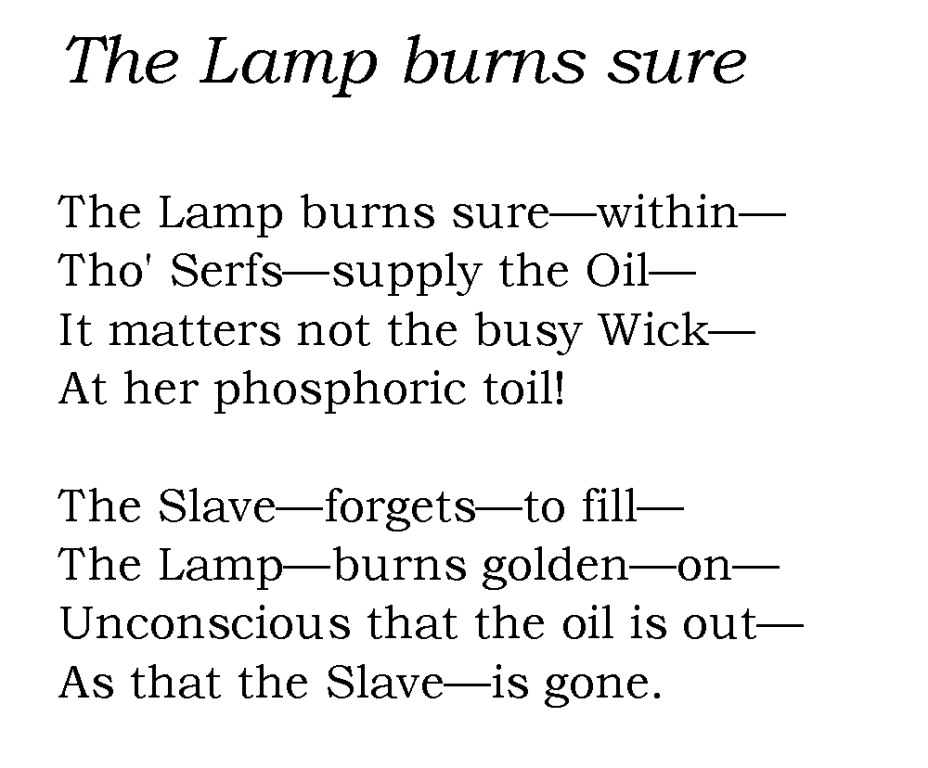
The Lamp burns sure

What did Emily Dickinson think about the American Civil War, that great national trauma that occurred during her most productive time as a poet? And what did she think about the great national sin that was the cause of that war, slavery?

Emily Dickinson often writes puzzling poems, compressed like a set of speaker’s reminder notes on an index card. Despite occasional antique words and references to obsolete technology, Dickinson’s poems don’t really seem to dwell in a particular time or have any anchors in a time’s signature events. Instead we are left with the multiple capitalized idealized concepts that in the hands of most poets would doom a poem to vapid incorporeality—but the speed and brio of a Dickinson poem seems like the rush of thoughts, and that and they carry us along. All of this lets us see a remarkable mind thinking, but it doesn’t necessarily tell us the conclusions, only the methods by which it tries to reach them.

With many other American poets of her day we can tell what they thought of the Civil War and where they stood on the issues of slavery. Of course, we no longer read most of them, and we continue to read Dickinson. Even though my curiosity about these matters is personal, and in the end it doesn’t significantly change the originality and attraction of Dickinson’s work, I’ve still looked to see what I could find.

Dickinson’s father, Edward, was a politician, a member of the short-lived Whig party, and so there are political stands associated with him. The American Whig party, particularly for northern Whigs, was a “free soil” party. This meant that they did not stand for the abolition of existing slavery but wished to limit any expansion of the practice. Southern slaveholder interests were not content with that as a compromise. In an era when new territories and states were being added to the Union, they feared that they would eventually be too small a minority in a growing United States. In the 19th century before the Civil War, time and again these interests would come into conflict, and it was generally the Whigs who worked out some compromise that put off the Civil War. Edward Dickinson seems to have been an orthodox Whig, he supported those compromises, including voting for one of the last and most fateful of them, the Compromise of 1850 that gave the slave holders a Federal Fugitive Slave Act, giving license for bounty hunters of dubious ethics to haul escaped slaves back to the South (and financial rewards if they over-reached and just grabbed a free black person “by mistake”) and requiring local state authorities to assist in their efforts.

The injustices of the Fugitive Slave Act enraged Afro-Americans and energized abolitionist sentiments. And in the slave states who would secede at the start of the Civil War one of their chief complaints was that the Federal Government wasn’t doing enough to enforce this Fugitive Slave law against individual states that were hampering rather than aiding these “slave catcher” bounty hunters.

The Whig parties balancing act fell off the high wire shortly after that. It essentially split into two parties, the new Republican Party which was more adamant about free soil with no compromises, and eventually became the “party of Lincoln” and slavery’s abolition. The other part was the Constitutional Unionist Party which wanted to continue the Whig-style balancing act. Edward Dickinson seems to have aligned with the Constitutional Unionist faction, which completed the rapidly increasing progression to irrelevance for the Whigs.

On the other hand, both Edward and Emily Dickinson were on friendly terms with those who went the Republican route and even the more radical abolitionist bent. If yesterday’s story of Angeline Palmer might lead you to see a 19th century Massachusetts casting of To Kill a Mockingbird  with Edward as Atticus Finch and the young Emily as Scout, the reality of the Dickinsons is much more ambiguous.

I’ve found various critics and commentators who have sought to answer my questions about what Emily Dickinson thought on these things. Some point to Dickinson poems and have suggested readings of them, but these are most often unconvincing to me. She does have poems mentioning warrior courage, duty and loss, but none of them seem to say anything about the causes or necessity of the pressing war in her time. Even more rare are references to slavery or people of color in the poems.

The Lamp burns sure

Mysterious and burning. Dickinson’s mind by lamplight

The poem I use for today’s piece is one of those rare ones. “The Lamp burns sure”  is Dickinson at her most compressed and ambiguous. The poem’s plot is clear enough, an oil lamp whose oil is supplied by slaves or serfs (the poem says both at first, muddying the waters if it’s talking about slavery) runs out of oil because they have stopped filling the reservoir. The lamp’s wick is so busy burning that it doesn’t notice that it’s out of fuel and would in the normal course of events burn itself out shortly. The poem does not proceed to that end however. It leaves us only with the wick’s obliviousness, and then breaking the tie between the oil bringer’s role as being a serf or a slave, leaves us with the final statement that the busily burning wick is also unaware that the oil is out because “the Slave —  is gone.” We don’t get to find out if the lamp is some Hanukkah mystery that will go on burning longer miraculously.

So, what does it mean, if it indeed means one thing? Some read it as a parable of creativity, that we’ll work ourselves past our resources in our passion. A key word there would be “within” indicating some imaginary inner lamp and the slave is just our body and emotional resources.

Some read it as a comment on the base labors that support a civilization that in turn supports arts, science or spiritual pursuits, and in that reading it’s an acknowledgment of the necessity of those labors—take them away, no light! The confusion of serf and slaves is a necessary confusion as it’s talking generally about civilizations.

And then some think, since this is a poem written in 1861 as the Civil War has broken out, and all the slave labor that has supported a large portion of the agricultural economy of the nation is now in question along with that nation itself, that this is not a generalized metaphor. The slave who’s gone, is an American slave, the light is an American light that will burn golden on.

Emily Dickinson's desk

Emily Dickinson’s desk with a whale oil lamp, a little luxury that could extend her writing hours

That last one would make it the closest to an Emily Dickinson statement on slavery and the Civil War. As I burn my own midnight oil tonight and I think of Emily Dickinson who wrote at night by the light of an oil lamp, I lean to the first reading. But some other day I might see something else and read it another way. I’d like to be surprised and to find out that Emily Dickinson’s keen and questioning mind could see what only some in her time could see about people of color and slavery, but that might not be the case. But here’s what I do find when I go to the music of that mind: a mind unafraid to be original and like Frederick Douglass in Robert Hayden’s poem, to believe freedom thought to be as needful as a heartbeat. Even if she didn’t free anyone from slavery like Lewis Frazier and his fellow servants in our last post, or agitate and orate like Douglass, I find there’s liberation there that burns sure.

Here’s my performance of Emily Dickinson’s “The Lamp burns sure.”  You can use the player below to hear it if you can see one. No player? Then use this highlighted hyperlink.

Angeline Palmer

Here’s a story. You can decide for yourself if it’s a sad or happy one.

It was a spring day in 1840 in a town in rural Massachusetts named Belchertown. For children you might expect that would be a fine day for play, but that’s not what this story is about, though it is about a child, one with a beautiful name: Angeline Palmer.

Angeline was a poor orphan and ten years old. Playtime was not on her mind. About a year back, the town poorhouse in which she’d lived since she was two years old had bonded her out as a servant to a prominent family in Belchertown. The town’s council ran the poorhouse, and Angeline was their ward legally, but such arrangements reduced the cost of running the almshouse.

I can’t be sure what work a nine or ten-year-old servant performed in those days in that place, but of course there were no appliances, and in rural towns there were not even stores stocked with things we might buy to save a household from having to make them. Households then were very labor intensive, so there must have been work for Angeline.

A servant like Angeline might dream of a better life on a spring day. Some would learn trades in household service that would allow them to start their own businesses. Or they might marry and start households of their own, where even if their lot would be the same sort of household work, they’d be servants of their own.

But Angeline wasn’t dreaming of a better life that day. Instead the future looked ominous. The man who owned the house was now staying in Georgia, looking for new business ventures. He had sent his wife all the way to Massachusetts to check on things at his house in Belchertown, and while she was there, a letter arrived. The letter had instructions for raising some money for his new business: ship Angeline Palmer down to Georgia. The letter figured she’d be worth $600 cash sold as a slave there. That’s about $17,000 today.

You see, Angeline Palmer was Afro-American. She was an orphan, poor, a servant—all things that limited her life, but she was free.

Servants in the house heard this letter being discussed, and quickly sent news of it back to the town where Angeline had been born. She had a half-brother there, Lewis Frazier, barely more than a teenager himself, he arranged a delegation to the town’s council, the men who were by law Angeline’s effective parents. The council wouldn’t take action.

Angeline was allowed to return to Amherst to say goodbye before the trip to Georgia and slavery. Her Grandmother was a servant at the home of the town’s postmaster. She asked him what could be done. Alas, the postmaster was the brother-in-law of the wife who’d been sent the letter. Instead of stopping this, he warned the Belchertown people that someone might be trying to stop the shipment of Angeline.

The postmaster worried someone might try to interrupt Angeline’s trip back to Belchertown by the scheduled stagecoach. Figuring they’d try something on the open road, he hired a liveryman to take her back by special wagon over a different route.

The postmaster was right. Angeline’s half-brother and a friend did flag down that stage, and of course Angeline was not on it. Slowly the pair walked back to town, sure that they’d failed.

But the liveryman had a servant too, and he knew the slower roundabout route the liveryman was taking back to Belchertown with Angeline. The town’s butcher loaned the liveryman’s servant a wagon and the now trio of rescuers sped off to Belchertown.

Despite the liveryman’s slow route, Angeline was already there, back in the house where she’d been a servant and from where she’d soon be shipped off to slavery. There was no time to waste, no one left to appeal to. Leaving the other two in the wagon, Lewis Frazier rushed into the house and found Angeline. Those in the house quickly reacted, and locked Angeline and her would-be rescuer in a room.

The other two men who’d raced from Amherst then left the safety of the buggy, ran up the stairs, pushed aside those trying to stop them, opened the door and took Angeline and her half-brother back down the stairs to their borrowed buggy. A crowd was beginning to form. Angeline and the three men didn’t wait to see what they might do, whipping back out of town as fast as their team could pull.

Angeline was secreted out of Amherst to an underground railroad safe house. Lewis Frazier and his two accomplices were arrested and charged. Though they’d stopped the fraudulent theft of a human being who would have been turned into property, who would have been owned along with her offspring, and bought and sold like livestock, the trio was charged with assault and kidnapping. The evil scheme of the man in Georgia was beyond the local court’s jurisdiction, and besides the three men had prevented that crime.

I don’t know how Belchertown looked upon this matter, but some in Amherst seemed to support the rescuers. Amherst’s most prestigious lawyer defended the trio of Afro-American men at the trial. That lawyer’s name was Edward Dickinson. Dickinson had a red-headed daughter, only a year older than Angeline Palmer, and her name was Emily Dickinson, who later would become known as a poet. Despite Dickinson’s efforts, the trio were convicted. They were given a sentence of 3 months, but it would be stayed if they would reveal where Angeline was hiding.

The dutiful trio didn’t take that deal, but the jailer seemed to be another who sympathized with them. While they slept in the jail at night during their sentence, he granted them liberty each day, and it’s said that townsfolk brought them gifts of extra food. The three men gave up some of their liberty for a short time but prevented a life of slavery.

So, what happened to Angeline Palmer? After a decade had passed, she returned to Amherst and married a relative of one of the men who had rescued her. She died, likely in childbirth, a few years after that. That may sound sad, but that was also the ordinary risk of a free woman living a married life in that time. They’d tried to steal her away and make her a slave, but a network of servants and three African-American men who cared for her risked all to prevent it. So, is that a sad story or a happy one?

For today’s audio piece, here’s my reading of Robert Hayden’s poem “Frederick Douglass”  about a man who stole his own freedom. Thanks again to the publisher for permission to perform this. “Frederick Douglass”  is Copyright © 1966 by Robert Hayden. From COLLECTED POEMS OF ROBERT HAYDEN by Robert Hayden edited by Frederick Glaysher. Used by permission of Liveright Publishing Company.

My chief source for the story of Angeline Palmer is this blog post by Cliff McCarthy of Belchertown. The web site that includes that post has  other stories about Afro-Americans in Emily Dickinson’s time and region.

The player gadget for my reading of “Frederick Douglass”  is below. The text of Hayden’s sonnet for those who wish to read along, is here.


Kidnaped

I can’t let February and Black History month go by without another poem, so let’s return to the man who could be said to have established Afro-American poetry in the United States, Paul Laurence Dunbar.

Although he lived into the first few years of the 20th century, Dunbar as a poet is fixed in the previous century, and his poetic models are all of that time. He died young, only 33, and who can tell how he would have grappled with the Modernist wave that was starting on both sides of the Atlantic at the time of his death.

While other contemporaries were attending college, racial prejudice and lack of money meant that Dunbar would instead seek to make his way immediately as an author, and that aim shaped his work to meet the needs of the commercial market for poetry then.

He got some bootstrap help from the owner of a bicycle shop in his hometown of Dayton Ohio, a guy named Orville Wright. Orville would later do some preliminary work that eventually led to frequent-flyer miles, but mostly Dunbar had to be good, as the market defined good, and he had to get good fast.

There were no Afro-American models he could look to in this endeavor, but Dunbar could instead use Henry Wadsworth Longfellow and the American Fireside Poets associated with him. Longfellow was less than a decade dead when Dunbar started publishing poetry, and Longfellow was no small thing to aspire to—he was one of the best-known and best-selling American authors of his time, regardless of genre.

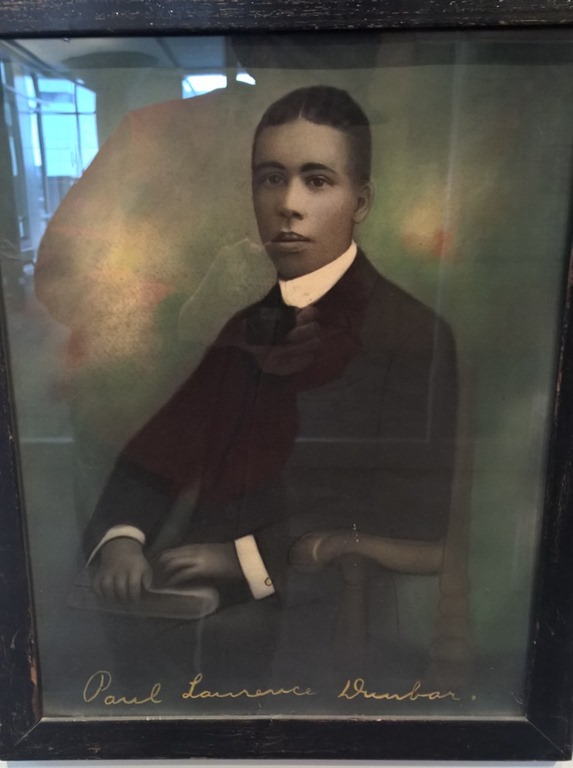
Dunbar book and pencil note insideDunbar portrait smaller

Pride in Dunbar’s poetry created additional markets. Collections of his poems, as the penciled note in this edition reflects, were sold door-to-door, and portrait photos were produced to demonstrate that American people of color could rise to literary fame.


Dunbar’s poem “Kidnapped”  could be the sort of thing the market might be buying, with just an extra touch of wit. It opens with the poet boasting of a carefree heart, but by the next stanza we (and the poet) come upon “Learned Dr. Cupid.” Cupid’s not the usual fat cherub with bow and arrow, but a capitol S “Scientist” with a net. What for? Why, to catch butterflies, which metaphorically and metamorphically the poet and/or his heart can be taken for. And cue tidy ending: this captured heart is “passing sweet.”

Simple.

Wait!

Dunbar could be aiming to produce a tidy innocent love poem that a publication would be glad to pay for and publish—something ready to snip out and share with your valentine—but stop and examine that metaphor. Authoritative Science did what? What’s the term Dunbar uses? “Kidnaped.” He says he’s to take it as “sweet” this happened.

Longfellow wrote impassioned anti-slavery poems, but he didn’t write this poem. Paul Laurence Dunbar, the son of two enslaved people did.

As to my music this time, every line resolves up or down to E♭ and I think of it as major key, but that constant return to the key center creates a mood, and the number of minor chords it moves from adds a rub between minor and major. This isn’t conventional western pop-music harmony but give a listen (or two) to it anyway. The player is below.


The Quadroon Girl

Remember back a few posts ago when the Parlando Project performed a question posed by poet Vijay Seshadri? He asked what poetry, or any art, can say about children in cages. There are many answers to that for poets. One obvious one: to say in your work that it is wrong and that you oppose it. One can argue that shouldn’t be avoided. Even if denunciation is simple and obvious, it could still be appropriate. Others will find simple denunciation worse than not sufficient, that it may only be signaling your self-removal from it.

Some will say, poetry or art is beside the point in such cases, to the barricades! or the voting booth! The former is easier to say than a poem, though harder to do successfully—so hard, that the consequences of power, due should the revolution succeed, can most always be avoided. The later seems so prosaic and lacking in artistic verve and purity that we shrug it off as too easy or uninspiring.

Seshadri ends up suggesting that poetry and art can express reality and some moral order vibrating in the universe in a compelling way, that this is the sharp edge of its weapon or scalpel. A good point. That’s what art does, it’s a way to transfer experience, including the experience of this. But his question about dealing with great and obvious evils in a poem is still difficult to answer successfully. It’s easier to write a successful poem, a small sound-machine made out of words, against menial human faults: ignorance, self-importance, narrow thinking, the ordinary follies.

Perhaps it’s those small faults, ones we all share, that accumulate, and lead to great evil.

Henry Wadsworth Longfellow, that once hugely popular and now deeply unfashionable poet, seems to have tried but once to use his poetry to address great evil: a pamphlet of poems addressing slavery. His effort was not long-remembered, and it has not saved him from his fate to be cast off as a poet of undistinguished, conventional and sentimental verse, the very sort of thing that the Modernist movement needed to supersede.

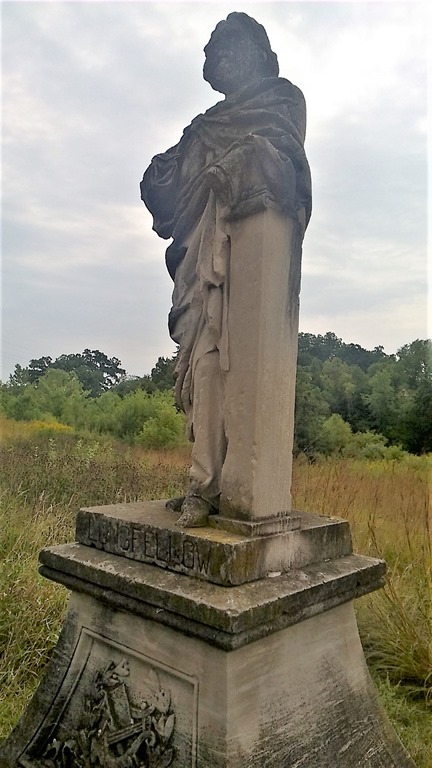
Mpls Longfellow Statue 6!!

This eroded statue of Longfellow stands, missing its hands, in a little visited corner of an otherwise busy Minneapolis park, somehow saying something about how Longfellow is viewed today.

I’ve already performed one of those Longfellow poems on slavery: “The Witnesses.”  I could have performed “The Quadroon Girl”  instead, but I didn’t think I could. This is a level of evil so deep, compounding even the evil of slavery, that it is, paradoxically, a sort of sacred space. I didn’t think I was ready or worthy to go there.

I’m not going to further explicate “The Quadroon Girl”  here. Despite the shakiness of my singing, it’s better to listen to it, to follow the story as it unfolds. I’ve performed it exactly twice, and I don’t know if I could perform it again. The player is below.