One need not be a chamber to be haunted. You could be a cassette tape.

However similar if amorphous shapes, everyone’s ghosts are private spirits, and I have a new musical piece with words by Emily Dickinson testifying to that — but let me slide over to a couple of personal things first, as if I was a regular blogger externalizing their internal story.

I’ve had a couple of weeks when I’ve needed to come back to the Parlando Project stuff from other things. I had a colonoscopy with unremarkable results. Huzzah. That’s some prime blogger internal dialog! But before that, I searched around my crowded little bedroom/office to find old cassette tapes. The oldest are from The Sixties when I had one of those small battery powered monaural cassette recorders with a slide-out chrome handle, a single speaker on the top, and a chorded plastic microphone with a start-stop slider button on its side. Others were from the 1970’s-2000 era when I recorded musical things, first on the stereo tape decks of the late 20th century home hi-fi era until I was able to afford one of the legendary Portastudio models designed for musicians, using the same humble cassette tapes, but able to record 4 distinct tracks. My task: to make digital copies that I can store in no appreciable physical space and are independent of an obsolete format.*  More than 30 years of this stuff, much of it of only private interest, though you may hear some of it eventually.
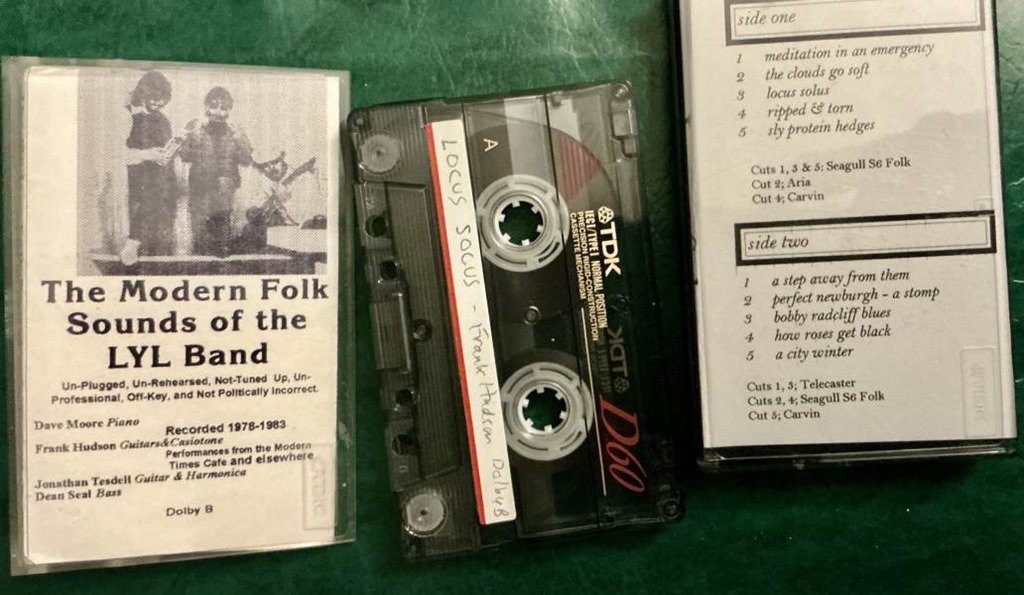
Cassettes 600

Some of the cassette tapes.

.

The ubiquitousness of inexpensive video is fairly recent, but assuming no catastrophic events, many born in the past 15-20 years will likely have color video with sound of their childhoods and young adulthood that could follow them the rest of their lives.**  Is that a good thing, something they welcome? I don’t know. Before this some folks had diaries and journals, or kept letters, so some level of self-documentation is not entirely novel. Still, for me, a person whose Project lives in music and sound, whose favored form of literature began in sound before writing was invented — retaining an element of the sound of the words, and their sequence, and echoes — my particular audio time-capsules have a special tang. And fears.

Most of the tapes are not just me, in a few I’m just the man holding the microphone, though I’m there as the shadow that chose to start the recorder. They hold our imperfections: things before we knew, before we learned — and then too the persistent faux pas that we still commit: there, and committed to a recording. Given that most can record now anytime with the tap of screen, how many will simply erase to save future embarrassment?

So back to Emily Dickinson and this poem about ourselves and what we think we fear — which may not be what we actually fear, or should fear. “One need not be a chamber — to be haunted”  is a poem about that self we either can’t lose or can’t consider. In five stanzas Dickinson lays out some conventional gothic scenery (some of which she herself will erect in other poems) haunted houses, undead ghosts, church graveyards, and finally an assassin laying in wait for us.***  Dickinson points out that the self may be making or amplifying those fears, and perhaps that self, making scary movies in our imaginations, may be doing it to displace us from seeing the real fear source, our mind’s-self. “Ourself — behind Ourself — Concealed — Should startle — most” Dickinson’s poem concludes. You can read the text of Dickinson’s poem at this link. And yes, you might note I sang “alley” by mistake instead of “abbey” messing up Dickinson’s graveyard implication.

So, is that our choice? To ignore ourselves, out of fear of what we’ll find, or to disappear into a copious kingdom of solitary solipsistic self, many of us with the digital equivalent of Krapp’s Last Tape  clanking and dangling from them like Marley’s ghost? Socrates decried the unexamined life. Memoir can be an honorable genre. Despite my taking the time this month with the old tapes, I think of this Scylla and Charybdis, and in the end there’s ultimately no keeping of this life and self, though sometimes there is sharing.

Today’s musical ensemble is a Rock-band of some kind: drums, bass, piano, 12-string acoustic guitar, and two electric guitars, one of which is run through enough effects to mask its guitaristic nature. No need to rewind, you can hear it with the audio player below. No player? No need to untangle that with a pencil in the reel-hole — this highlighted link will open a new tab with its own audio player.

.

*Many years ago, I was on a committee working on the technical design for a radio network’s archives (most of which were still on audio tape then) which involved long-term storage and public accessibility elements. The online “New Media” folks had their ideas about what formats to use for listeners to stream over the Internet, the audio engineers had concerns about what would give the longest life and best fidelity, and the computer IT folks had thoughts about what media would have the capacity to hold something that might climb into the then hard to imagine “terabytes” of digital storage. The three groups weren’t always in agreement, and a grizzled consultant from some outside large, already in existence, archive was brought in to meet with us. Should we use digital tape, hard drives, optical disks? What file-system format on which? What audio file format should be used on that media? Is some of this going to die from “bit rot” on the media in how many years? We had lots of questions and wanted the wizard to arbitrate our concerns. He listened for a while as we cross-talked.

Then he answered. “It doesn’t make much difference what you choose. You’re going to have to convert to other media, file-systems, and audio formats in the future, and every few years going forward. Plan for that.”

**Many of my mid-century generation have photos from their youth. I had a “baby book” that lasts into my grade-school years in black and white. A few families had movie cameras (though no one I knew did) but many of those shot silent film. The cost of film and developing that film constrained the amount of pictures and home movies made. Lots of birthday parties, weddings, holidays. Parts of life yes, but selected shorts.

***I was working on this in the wake of the news of a planned, lay-in-wait killing of an insurance company CEO, which will be followed in the American drama by the killing of a teacher and a teenage student in a school reported by a 2nd grader who called 911. The first was caught on ubiquitous digital video, and the emergency call of the second perhaps made on one of those smaller than a fat postal-letter things we call phones even when we aren’t making phone calls. More than social embarrassment may haunt our digital archives as we live going forward.

I also note that final stanza of this poem’s “revolver” is another example to go with “My life has stood — a loaded gun”  of Dickinson poetry citing a firearm being held as the high card in some kind of deadly personal dispute.

August Moonrise

I almost feel like I need to place a warning label on today’s piece: Rated RE Strong Romantic Emotional Content. Thanatopsic material. May not be suitable for those who have not sufficiently worked through issues with self-harm or the experience of self-dissolution.

Modernism had a strong tendency toward a critique and reaction to romanticism and its characteristic expression of emotional content. A man viewed as the founder of its English-language poetic wing, T. E. Hulme, wished to set it on a course of completely overturning Romanticism. But those bylaws didn’t always filter down to every chapter and member of the Modernist International. Readers here know I love some of the early Imagist works which are parsimonious with overt emotional words, even while seeking to charge their images with a fresh immediacy. These poems aren’t necessarily devoid of emotion if the reader has it to supply themselves—but then some Modernists, such as E. E. Cummings, were perfectly fine with frank emotional outpourings.

Sara Teasdale, in addition to being largely forgotten for the better part of the last 100 years, was never officially a Modernist, so there’s no movement membership to endanger and no expectations for her to fulfill anymore. She wrote intensely lyrical and musical verse in plainspoken and non-archaic language. That’s a surface shiny enough, devoid of hermetic imagery, and with sweet word-music that makes it too easy to miss what she’s saying.

Sara Teasdale2

Sara Teasdale is sick’n’tired of you mentioning how pretty her poems are

I knew this already, having presented Teasdale regularly here. Still, I had to go through a journey to inhabit and grasp this poem for this project. I collected it earlier this summer, seeking to stockpile a few seasonal poems ahead of time to have some on-the-shelf ideas for possible use.

Here’s the full text of the poem. If you skim through it, it looks like a fairly common poem subject: summer night. It might seem to hit the expected points too: hey, summer, it’s nice at night (maybe even better than the heat of afternoon). Plants, trees green and full, explicit birds. A Moon one can linger with long enough that you feel that if you stay the night you could watch it change its phase.

Teasdale can write a poem that seems like that. That’s a problem. It’s too easy to miss what she’s communicating if you leave it at “That’s pretty.” You could use her writing as a case-study in why some of the Modernist tactics that frustrate (or delay) understanding might not be counterproductive. Teasdale gets misunderstood quickly as one passes over the words, while someone like Mina Loy, Tristan Tzara, or Gertrude Stein causes those who won’t care to read carefully and empathetically to not stop in at all.

As I began to read, really read, “August Moonrise,”  to figure out how I might perform the words, the last section seemed dark—and not in the pretty moonlight way. Here are some of the words that hit the notes in her word-music after the poem’s midpoint: bitterness, sorrow, death, wavering, blind, fearful, fire, cold, vanish.

Seeing that, I reexamined the opening half for portents. The swallows are rushing, willfully, together and departing from each other. And is their willful act truly willful? Maybe not, it’s like the movement of dark tree leaves. If that was a spare Imagist poem, or a work of classical Chinese poetry, we’d be confronted with that image, asked on no uncertain terms to deal with it. Here you may think it’s so much minor scene-painting.

The scene-painting gets even more painterly next. Sunset, moonrise. The final palette: “a deeper blue than a flower could hold.” Is that merely a beautiful picture or a statement of more blue than can be sustained?

Teasdale’s singer in the poem is drawn in (note, she goes “down,” descends to it, even though the preceding birds, trees, sunset, moonrise are all things normally above the horizon) because it’s her, or because it will become her. The poem reaches—if only briefly—a quasi-orgasmic happiness. One line here: “I forgot the ways of men” is so rich in ambiguity. I could read it three or four ways easily.

This happiness, this intoxicated leaving of all but the senses (however brief) is portrayed as a consolation. Consolation for what?

And then we enter that section that is so full of darkness, loss, imperfection. Is this section spiritually sublime or just harrowing? I think you can play it either way, though I suspect it works best if the other choice is kept as an undertone. Compare this to Laurie Anderson’s childhood account of Buddhist Midwest night skies and the non-necessity of self, the archaic trials of the Lyke Wake Dirge, or to a searing inventory of imperfection, almost a suicide note.*

NY Times Teasdale Death Story

Teasdale: not waving, but drowning

Teasdale’s concluding couplet is so searing I think it must be performed understated. The crucial word in it, “theft,” says she doesn’t feel in control of this loss of control. Isn’t that frightening? Spending several hours with this text this week, fitting it to music, performing it, thinking about it was a journey, from “Oh, a summer night poem” to a consideration of the sameness and the difference of exceeding the self and end of the self.

So, am I out on a limb here, thinking this a major poem by a too overlooked poet? Has the seeming conventionality of its setting (subverted as it may be), the gender of its author, the musicality of its expression, the unabashed romanticism of its sensibility obscured our view? If this was Rilke translated from the German would we read it differently? If this was Yeats with swans instead of swallows would it matter? If a Cubist ran it through a copier a few times and then cut up all the lines and reassembled it, would we stop long enough to think about it? The issue of Teasdale’s membership or non-membership in Modernism might have seemed germane in the mid-20th century, but to a significant degree it’s immaterial now.

Well, I’ve done it again. Talked about the words so long that there’s no time to dance about the architecture of the music. Thinking about what I said above, I could have cut up and obscured Teasdale’s words rather than a straight recitation I recorded, but the choice I made has its strengths too. I did try to undersell the sensuousness of the lyric in hope it would cause the listener to consider it differently, but the opposite choice works too, for I’ve discovered this gorgeous and emotionally effecting choir setting of “August Moonrise”  by Blake Henson that had me in tears this morning. See my comments last post about how my limitations as a singer and no access to alternative skilled singers focuses my composition into other modes.

I intentionally avoid apologizing for my work. I think that’s a good practice. If you think you should do better, do better or do different, instead of talking about it. My approach to “August Moonlight”  with a skip-footed motorik beat and an ominous and fateful tone in the reading and music certainly contrasts with Henson. I could even imagine that hearing Henson’s work after considering Teasdale’s darker undercurrents intensifies it, as it did for me today. You can hear my version with the player below. Don’t see a player gadget? Then use this highlighted hyperlink to play it.

*There was a point in the production of this piece that I seriously considered abandoning my presentation of “August Moonlight”  because of this. Once I could see that element was present in the work (as it is in Teasdale’s life), I felt it shouldn’t be denied if I was to perform it. Many artists deal with feelings of self-harm and because “All artists fail” in the sense of imperfection and producing things farther, rather than “Something nearer your desire.” I hesitate to present work that might feed into that, particularly with a beautiful and romantic sheen to it all. In the end I decided that Teasdale is illuminating that, and if I presented it so that you can consider its danger, it could have value. Henson’s setting makes a choice to emphasize the perception of beauty, the singular hour of atonement, which also would have answered this concern.