Ollendorf’s Wife ‘Bout Changes and Things

Despite Orrick Johns’ lack of poetic fame, our curious audience seems to be responding to “Ollendorf’s Wife.”  Are you forgiving my unilateral revision of Johns’ 1917 words?

OK, here’s another rule breaker. The same day that I recorded the acoustic version of“Ollendorf’s Wife”  I also recorded this folk-rock performance with bass, drums, organ, and electric guitars. Is it better or worse than the acoustic version? I can’t say.

By subtitling this post/version “’Bout Changes & Things” I’m making an obscure reference to a quixotic mid-60s LP by Eric Anderson. Anderson was one of a handful of Greenwich Village folkies well positioned in the ‘60s to step into the new post-Bob Dylan breakthrough were the singers were expected to write their own songs with poetic sounding lyrics. ’Bout Changes & Things  had some of Anderson’s best early songs, songs that were already getting covered by some of the same acts that might also use a Dylan song.

However, about the time it came out another sea-change was occurring. Everyone’s folksinger records were starting to use electric instruments and drum-sets. Earnest acoustic guitar LPs with maybe Spike Lee’s dad on standup bass or Bruce Langhorne on “second guitar” were no longer what was expected. Dylan goes electric! The Byrds were having hits with folk songs and glorious electric 12-string guitars, John Sebastian and Zal Yanovsky had formed the Lovin’ Spoonful.

The trend was so strong that the production equivalent of revisionist history was resorted to. Tom Wilson overdubbed some session men on top of an already released but unnoticed Simon and Garfunkel song “The Sounds of Silence.”*  Alan Douglas took old tapes of Richie Havens and added new instruments to make “Electric Havens.”**  The former created a hit record and launched a career. The later couldn’t stop the undeniable soul force that was Havens.

Producers and Piano Players

Producers and piano players: Alan Douglass with Duke Ellington and Charles Mingus
Tom Wilson producing “Like a Rolling Stone” with Bob Dylan


Eric Anderson just went back into the studio and re-recorded his whole album with a band, and it was released as ’Bout Changes ‘n’ Things Take 2.  It did nothing for his career, and maybe even hurt it. It probably seemed not authentic, scene chasing, or some other sin.

Bout Changes and Things x2

Revisions: One set of songs, two albums.


So, there you go, one guy in Greenwich Village years ago who seemed at one point the equal of a lot of other up-and-comers but turned out to be a damp squib that didn’t ignite. And another guy. Same story.

To hear my folk-rock performance of “Ollendorf’s Wife,”  use the player below.


*Tom Wilson is another one of those “Why don’t more people know about him” characters. Besides midwifing Simon and Garfunkel’s first hit, even a brief look at who he worked with listed in his Wikipedia article should amaze anyone with any interest in mid-century American music. This labor of love web site can tell you more.

**Alan Douglas has an impressively varied producer’s resume similar to Wilson’s, but his ghost could probably stand to be less well-known. His overdubs of Havens work are largely forgotten, but he spent a couple of decades redoing tracks in the Jimi Hendrix archives (including replacing parts on the tapes with newly recorded session men) in an effort that was increasingly seen as fraudulent and cheesy. It’s not that I can’t see their critics’ point regarding Douglas’ Hendrix releases, and the resulting recordings are a mixed bag, but I indulge in the same sins of reusing and re-doing other artists work.
The Wood-Pile

Robert Frost is every bit the master of word music as Yeats and Millay. What makes Frost stand out is that he was every bit the thoroughgoing early 20th Century modernist as any of his free-verse contemporaries, while retaining an ease with accentual syllabic meter.

Here’s an example of Frost handling a subject just as a free-verse Imagist would. His aims, his presentation, hold to the Imagists’ principles. He deals with the thing directly (as we shall see, two things, but still…), and there are no tacked-on metaphors, no stock comparisons, no extraneous “poetic” language. Context is shown, but not explained. He loosens and varies his meter, so the poem sings and never seems to be a shackled march. At 40 lines, it’s a bit longer than Yeats’ poem considering “The Wild Swans at Coole,”  but Frost’s extra detail is even more specific and concrete than Yeats, though both begin their poem with the poet walking in a rural wetland. Yeats slough is a well-known place to him, conditioned with 19 previous visits. Frost is far enough into his swamp to not know exactly where he is, and so experiences what he sees with a first-time immediacy. Yeats’ slough then contains tradition, Frosts’ the more Modernist “Make it new!” place.

Though presented as one simple rural scene and story, “The Wood-Pile”  is more at two poems, though each part speaks to the other. As Frost’s tale starts, we are in the midst of one of his characteristic journeys, just as we are in other famous Frost poems. There’s a need for decision (“Turn back” or “go on farther”) and his choice, also made in other Frost poems, is to go on regardless of whatever doubts brought the question. If he’s lost in the dark by a wood on a snowy evening, keep going. If you come to a fork in the road, pick one and go on. If you’re walking in a swamp in winter and your foot is sometimes falling through the frozen crust, well, keep going “and we shall see.”

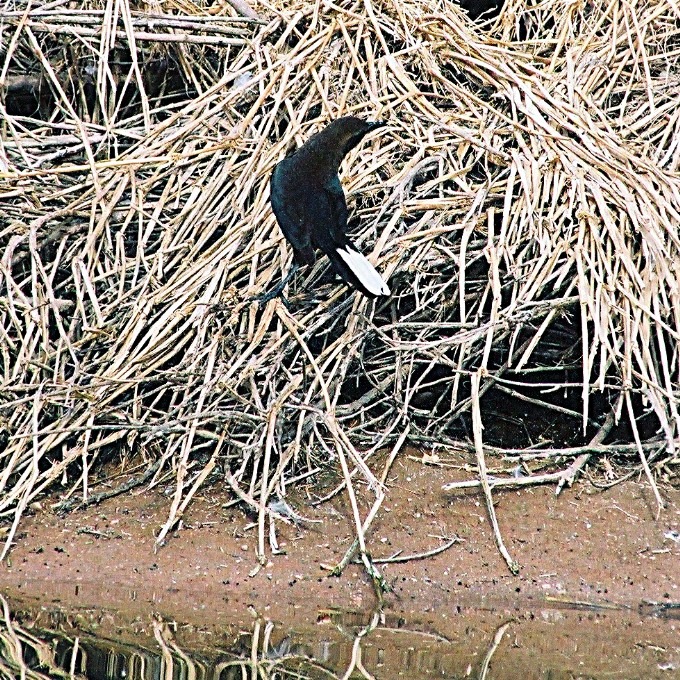
And so, here he sees his bird. No Keatsian nightingale, not Millay’s elusive flying swans with their awkward dangling legs and cries, nor Yeats’ majestic 59 swans, but a small bird. This bird becomes a mirror to the poet. Frost’s bird too must make choices in direction, and the poet, sensibly, thinks the bird’s guided by fear. “Keep something between little me and the big lummox trodding through the winter swamp,” he humansplains. And there’s a bit of humor at human’s expense as the poet muses that the bird, like humans with their self-importance, may think that the only reason for Frost to be out in the swamp is to go after the little bird.

Gackle with white tail feather

“He thought I was after him for a feather—the white one in his tail”


But, we don’t know why Frost is out in the frozen swamp explicitly. The only reason he’s given, or will give, is the Imagist poets’ reason: “and we shall see.”

The bird leads Frost to the second thing the poem wants to present: an abandoned fire-wood cache. Here Frost zooms in close. Every detail of the cut wood and the once neatly stacked and propped wood-pile is stated. Frost turns forensic, like some New England Sherlock Holmes: this pile has been abandoned for years. Mature vines have grown through it.

wood-pile

“The slow smokeless burning of decay”


Here is another context left unsaid. Why would someone abandon a purposeful wood-pile in a swamp? Frost leaves it for us to be detective and to solve the mystery. This isn’t some lot of fire-wood left temporarily to be gathered later in the day, care has been taken to stack and prop it.

The only thing I can think: someone once built a shack (now completely disappeared) on the swamp land. Frost muses, sardonically, that only someone so busy with “fresh tasks” could abandon such effort in cutting and stacking. Does he mean to say, “only a fool would be so industrious to cut and stack this wood and yet not notice he was building his shack on a swamp that would not support a homestead?”

Now, the small bird with his “little fears” and oh-so-human misapprehensions of reality—and now, the steadfast Frost of miles to keep going, even if you may be lost, are set in contrast to this choice. Your fears may lie to you—but so will your optimism.

I once heard an astringent biological statement that the length of our lives can be reduced to a slow-burning chemical reaction. Frost’s last line here is a sad and beautiful analog to that truth.

Turn back or go farther? Go on, and we shall hear my performance of Robert Frost’s “The Wood-Pile”  with my original music. Just use the player below.

My Feet

Today’s piece uses words from a more modern poem from a Minnesota poet: Renée Robbins. I met Renée after this piece was written, but I recall going with her to a very nice soirée celebrating the publication of this collection of poems by Minnesota poets, including her “My Feet”,  40 years ago.

A Coloring Book of Poetry for Adults

A good attempt at a broad-view of 70s Minnesota poets, including Renée.
Oddly, I can’t find the credit for the cover artist. Anyone know?


This was the 1970s, and from our age or our ages, an optimistic time to be a poet in Minnesota. Running down a list of names, I’ll slight anyone I leave off out of concerns of length and focus, but locally it was still the age of Robert Bly, John Berryman, and James Wright. Minnesota literature, at that time, seemed to have placed poetry at least equal to the novel or memoir.

I had come recently from New York and had reconnected with Dave Moore who had finished college. I was writing furiously, filled with a Twenty-Something desire to set on the page all the patterns I could see in our still forming lives. Renée had taken a shorter trip, going to college first in Duluth and then in Marshall Minnesota where she studied with Phil Dacey.

There is a longer story here, full, like most life stories, with twists that seem meaningful to us—even if not invested with the same importance by fatebut let’s return to poets, and the 1970s, and Minnesota.

Renee Robbins 1970s

Renée Robbins, later the 1970s


Note that truncated list I gave of the exciting characters, the names of poets that would be in someway connected to Minnesota in that time. No women. I find that odd. No similar list of the most notable contemporary poets in the United States made the middle ‘70s would be so gender singular. Is this an accident, a side-effect of the stubborn impact of Robert Bly locally, a reflection of a lingering patriarchy, or just a reflection of my own framing as I look backwards? It could be all of them I suppose. Established names or not, woman’s voices were coming forward.

Renée and I fell in love. Eventually we married. Eventually she got sick and died shortly after the turn of the century. As I said, these twists in the stories we hold as ours seem meaningful to us. Perhaps it’s a meaning like a deep poem, one with a deep image, one that doesn’t stand for anything other than itself, one that can bend light around it, leaving the densest shadow, as life still glitters around it, with a strange margin where they meet.

Robbins’ “My Feet”  may not be that kind of deep poem, but as I tried to argue here recently, poetry is richer and less constrained when we feel we can use it for more than the deepest things. And Robbins’ choices in “My Feet”  implicitly make that argument I think. Ozymandias may have two vast and trunkless legs of stone and those meaningful sands mocking them, but the rest of us have only our tired dogs, like to those Renée can apprehend with her characteristic artistic focus on close looking. Her time on the farming plains of Southwest Minnesota may have given her a new landscape to appreciate those feet.

To hear my music and performance of Renée Robbins’ “My Feet,”  use the player below.

Stopping by a Woods with Bad Cellphone Service

For some time, I’ve disliked the way the idea of “generations” has been treated by the culture at large. Not the nugget of thought that’s in it, that cohorts of people in a particular time and place will share certain experiences, some of which will shape their outlook—but the nutty, pseudo-scientific way it’s been used. The balderdash that’s been added to “generations” includes the nonsense that there are some sharp and agreed on borders to them and that everyone inside of these sharp lines in time not only shares the same experience, but reacts to these things in the same way.

The crap labels we use like “Generation X” (Billy Idol and Richard Hell may have a lot to answer for, but let’s not hang this on them) or “Millennials,” (who could just as well be perennial grinders of grain for all the meaning I assign to that word) have become like unto the Sixties’ penchant for astrological signs. “Oh, you’re so Millennial” or “Members of Gen X think this way” have become the Moonchildren and Fire Signs of our age.

And of course, the borders of these deterministic generation containers are natural and inviolate—no, don’t look at them, as they will seem arbitrary and varied if you look too close. Are generations 12, 20, 30 years long? Don’t ask, as we don’t agree. And is someone born in 1946 exposed to the same set of experiences as someone born in 1963? Don’t look too close.

I bring this up, because this week I wrote a parody. And as humorists have been known to do, I went and used some generational stereotypes. I was pressed for time, those sorts of things are ready-mades, one or two people found it funny, if I use it humorously I’m making fun of it—Oh, I’m giving up. I’m ashamed.

Look, one of the good things about considering the experiences conveyed by writers whose words I use here, is that most have been dead for generations, no matter how long we define that term. Seems like they are each their own people, not clichés like “Victorians” or “the Lost Generation.”

New start. I had a serious thought as I started this. Earlier this month I revisited the well-known yet too-little-reconsidered Robert Frost poem “Stopping by a Woods on a Snowy Evening.”  As I thought about the experience Robert Frost was describing (if an actual country winter buggy ride, some think it occurred in 1909), I considered how different the night and the rural roadscape would have been then, compared to how we have informally remembered Frost’s poem. I thought the opening stanza of that poem, starting with Frost’s line that’s fallen into too-famous-to-think-about status: “Whose woods these are, I think I know,” could be describing a person who was lost in a darkening, rural pre-electric light, night—instead of a poet some of us remember as irresponsibly stopping to look at a well-lit Christmas-card pretty sight of a woods in snowfall.

I was thinking then: “Now I’d have not just the possibility of bright headlights, but a cellphone in my pocket that should tell me just where I am, no matter what poetic truth I’d be trying to express.”

And then I thought again about that phone. There are still areas, even in North America, without cellphone service. GPS signals don’t penetrate everywhere. Those maps in our apps are not without errors.

Cell Coverage vs Drake in Coat

Drake’s from Canada, but Minnesota and New England need cell coverage and warm coats too.


So, today’s piece, which I call “Stopping by a Woods with Bad Cellphone Service”  is actually a serious piece of winter travel safety advice, not a scurrilous piece of generational stereotyping, which I would never stoop to doing here.

Stopping by a Woods with Bad Cellphone Service lyrics

Here are today’s words, but you want to listen to the music don’t you?


But when you think of scurrilous, I hope you think of the LYL Band. It’s been awhile since I’ve had a piece that wasn’t created by that scrupulous and well-behaved group of musicians that is myself—recording it instrument by instrument, a track at a time. The LYL Band is an organization in the same way that a hockey fight or litter of kittens is organized, which is to say, barely, though we attack things with abandon playfully or otherwise. To hear us, use the player below.


Stopping by the Woods on a Snowy Evening

Today I’m presenting a piece that is extraordinarily well-known, by an American poet whose work is still read and remembered outside of academic settings, Robert Frost.

In such cases it’s easy to think we know the poem, perhaps we’ve even memorized it in whole or in part, and we then say we know it in that special way. If we studied it in school, perhaps we learned or apprehended some deeper meanings for it. If this is so with you, I’ve had those experiences with “Stopping by the Woods on a Snowy Evening”  too.

Yet, sometimes, when we look at something with intended freshness, things step out from our remembered poem and introduce us to things we didn’t realize were always there. Let’s start with just how I (and perhaps you) have visualized the setting for this poem.

Currier and Ives Sledding in Central Park

In the rural winter of Frost’s time, things would be considerably more dark

.

Is Frost in a woods, a bright high-contrast Currier and Ives scene of crisp white snow and colored accents? Not as he wrote it. The title and a line in the second stanza tells us he’s on (presumably) a road, and that he is between the woods and a frozen lake. Is there a full moon and clear sky? No clear sky, it’s snowing, so overcast. He says “the darkest evening of the year,” so the moon isn’t adding significant light. In the rural New England of Frost’s time, it’s probably dark and getting darker, in a way that few of us know darkness today. There are no street lights, no farm yard lights, likely no headlights. One might see villages spotted with oil-lamp-lit windows from the crest of a hill, but he’s told us no village is in sight.

When he says he only thinks he knows “Whose woods these are,” he probably means, “I could tell you if it were noon, but not in this dark.” In the rural area of my youth, even forty years after this poem was written, directions were still given by knowing who owned (or once owned) a piece of land. Is he lost? Possibly. At the least, he wants us to know that he’s not exactly sure where he is.

At the end of the first stanza he says he stopping to watch the woods fill up with snow. If he accomplishes this, he doesn’t tell us. There are hundreds of good lines to describe snow falling on trees visually, and Frost has written many of them, but he doesn’t do it here. Is he leaving us to visualize it ourselves, from our own rich storehouse of memories? That’s possible. And if you and I remember the poem as having images of falling snow drifting through tree boughs in moonlight, that worked. My current guess is that Frost’s narrator could “see” this too, but like us, only in their mind.

It’s a testament to how thoroughly we prioritize visual imagery in poetry that we think those images are there, even if we’ve memorized the poem. Frost was especially proud of the poem’s third stanza, and justly so. It’s all sound images. The dark and solitary nature of being in the middle of un-occupied rural space at night allows sounds to take the place of what our eyes would lord over otherwise. It starts with the horse sounding his harness bells, bells not merely a decorative pretext to sing “Jingle Bells,”  but a useful method of letting other narrow-road users know someone’s coming around a curve or hill-crest, particularly in the dark. And the snow image that’s really there? It’s so quiet and he’s so focused in the darkness, that he can hear the sweep of the top layer of snow blowing across the surface of the rest.

The infinite depth and darkness of the woods in the final stanza is not just a metaphor. It’s dark out, and it will not get lighter until morning. Its loveliness, invisible in the dark, is conceptual art at this point for Frost.

In this view, the decision about staying or continuing the journey is not a temptation of a seductive external snowfall-on-the-woods scene, nor is it a thought of embracing death or a contemplation of suicide, though those elements may be there as subtext. The situation is “I’m not even sure where I am on this road in the falling dark. The momentary beauty I sought here is elusive and mostly in my head. Keep following the road, though I don’t have sure landmarks and don’t know for how many miles. Better the finite, even if not quantifiable, promises of the rotating wheel of my buggy than the depth of a forest I cannot see.”

And the sleep he ends the poem with? Frost always maintained it wasn’t death in metaphorical disguise, despite what professors in electrically lit rooms might think. The story is that he wrote “Stopping by the Woods”  at end of a long night of work on another, longer poem. Any writer would recognize that it’s actual sleep he now desires, rest that we only allow after exhausting our attempts to see what is lovely, dark and deep despite the night.

Musically, I sought to combine the familiar with a few twists for this one. There’s a reassuring folkie acoustic guitar part and even a cod banjo motif I played to my rusty ability. But then a cello and viola part carries throughout. Instead of bass guitar, I decided to play tambura, a traditional drone instrument of South Asian music, on my guitar using a MIDI interface.

I liked how it came out, maybe you will too. The player gadget below will let you hear it. Don’t see the player? This highlighted link will also play it.

Autumn Movement

I’ve been a bit long-winded in the past few posts, so a short-winded post about today’s piece. The words are another poem from Carl Sandburg, this time from his 1919 collection “Cornhuskers.”  There’s not very many words to it, a warning that there are not many leaves left here in the upper Midwest.

Cornhuskers cover

They were listening in London, and Sandburg’s “Cornhuskers” won him the Pulitzer prize.

I can compress talking about those words because I’ve already talked about Sandburg on the previous occasions when I’ve used his words here. In his poems of this era, he’s as perfect an imagist as any of the expatriates mixing up modernism in London and Paris around the same time.

Many of the Sandburg poems I’ve used previously have been from his landmark “Chicago Poems”  collection, but Sandburg, a child of middle, rural Illinois, spent time across the Midwest in his youth, from urban centers to the farms and small towns. The poem I use today, “Autumn Movement,”  is from that rural setting.

Images for autumn and fall foliage have been mined forever, which makes Sandburg’s key image here as unusual, even a century later, as T. E. Hulme’s red-faced farmer appearing as the harvest moon in his British autumn poem. Sandburg has the red and yellow of autumn leaves in a farm field vista as a yellow scarf with the copper color of a literally red-necked woman. So nearly has this skin color become an epithet, that few would think of using it today, as honest an image as it is.

Today’s audio piece is musically ars longa to the vita brevis of the words. I’ve been telling myself to allow space compositionally, and then going ahead anyway and filling things up like a compulsive cluttered room with only paths between piles of old newspapers. So, for this one, the drums (which are often quiet and spare) are the densest element. I added a simple bass line played on my fretless bass, a theme played on a Telecaster, and a digital synthesizer part that is a mix of four different patches played together rather than filling up the space with multiple synth parts. Give it a listen with the player  below. Or if you don’t see the player, you can use this highlighted hyperlink to play it.

The Self Unseeing

Today’s piece is our first proper piece by English poet Thomas Hardy. In America Hardy may be better known as a novelist, though he considered himself a poet first and last. When Hardy began writing poetry in the 19th Century, William Wordsworth was but a decade dead, and at the end of his career in 1928, T. S. Eliot’s “The Wasteland”  was several years old. So, Hardy’s career starts at the tail-end of the English Romantic revolution, and proceeds through the Modernist Explosion of the early 20th Century.

In some particularities of locales and events, Hardy’s poetry can seem of the 19th Century; but his language, direct, colloquial, and unfusty, seems as modern as the 20th Century modernists. Indeed, modernists from Robert Frost to Phillip Larkin found much to admire in Hardy. Setting many of his poems in the rural areas of western England diffuses the placement of some Hardy poems on a timeline, as the more rapid pace of cosmopolitan change does not mark them as sharply.

The Hardy Tree

“Strap yourself to a tree with roots”
Gravestones moved by Thomas Hardy when progress impinged on a country graveyard.


Today’s Thomas Hardy piece is “The Self-Unseeing,”  published in 1901, right in the turning of those centuries that Hardy spans. This is another poem brought to my attention by the Interesting Literature  blog, and I cannot improve on the excellent analysis of the poem there.

In “The Self-Unseeing”  there’s a visit, in a mix of memory and reality, to a long-ago childhood house, a mental voyage many of us can do, assuming we can ride out the emotional waves. Given the fires, floods, earthquakes and winds of the past couple of months across our continent, some will be being taking this visit now wholly in memory.

Thomas_Hardy's_heart

Bury my heart in Stinsford.


So, that’s it for analysis of the poem this time, but we’ll offer some music to go along with it: strummed acoustic guitars and bass, and a vocal that’s a bit more to the “sing” side of our usual talk-singing.  To hear it, use the player that should appear below. If you like the variety of what we’re doing here, combining various words with various music, please help us by sharing links to here, hitting the like button, or otherwise letting folks know. Thanks!


Autumn

100 years ago, a WWI German artillery shell ended the life of T. E. Hulme, the man who sparked off what we now know as modern English poetry. I was going to say “invented,” but that’s a dodgy word in art as much as in science. Hulme borrowed ideas from several places, and adapted poetic tactics the French and some Americans had already made use of. But we can still say he started things off because he collected the tinder and cordwood in the Poet’s Club in London in the first years of the 20th Century, and the spark was applied by suggesting that everything he thought poets were doing since, well, just about the Renaissance, was wrongheaded. Too flowery. Too ornamented. Too “romantic,” an error he believed made them think of mankind as exalted and godlike.

Hulme, interested in visual art as much as he was in literature, thought the new literary direction should be visual. Cold hard images, direct and vivid, not abstract, were to be the new order, but these images could even be homey and simple (as long as they retained that vividness), not the sort of thing that signaled high culture in the British poems of the past couple of centuries. He was very certain of this, and he either made a convincing case in person or provided the theoretical underpinnings through first or second-order influence to the soon to be mighty modernists: Pound, Eliot, Yeats, H.D., and Frost.

Bust of Hulme
Bust of T. E. Hulme by Jacob Epstein, another member of the early 20th Century artistic “American Invasion” to England

Hulme illustrated his ideas with short poems. I’m not altogether sure how seriously he took these writings, but I find they have three attractive attributes. First, for all the bluster and pugnaciousness that he propounded his theories, the poems are very unassuming. In subject, they often seem to follow one of the principles I try to follow in the Parlando Project: “Other people’s stories.” Second, they are short, and I am attracted to the variety of expression that can succeed in short poetry. And lastly, they are the first. They have that charm, the same charm I might apprehend looking at a Chuck Statler music video, an Apple I or MITS Altair personal computer, an early horseless carriage, or the pictograms on a cave wall. The other beginners looked at this, and said “why not?” Ezra Pound related to Hulme’s ideas in formulating “Imagism.” T. S. Eliot either saw or was reinforced in his ideas for a new classicism in poetry in Hulme’s work.

What would be striking about today’s piece, Hulme’s “Autumn,”  in 1908 when it was published?

It’s “free verse.” No rhyme, no regular metrical scheme. Besides some French poets, American Walt Whitman had done this, but this was still rare, and rarer still in England. The last part of Hulme’s “Autumn”  is still musical however, essentially iambic, and sound echoes, if not rhyme, are present in “wistful stars with white faces.”

Hulme’s two substantial images in “Autumn”  are extraordinarily unpretentious, particularly the first one: “the ruddy moon” at sunset leaning “over a hedge/Like a red-faced farmer.” Compare this to Shelley’s “To the Moon” where the moon is “of climbing heaven” and is addressed as “Thou chosen sister of the Spirit” or Wordsworth’s “With How Sad Steps, O Moon” which is “running among the clouds a Wood-nymph’s race”—and these are examples from good poems of the 19th Century, not the more forgettable lot.

Over at the Interesting Literature blog, where I discovered Hulme, it is pointed out that Hulme, who was from a rural district, also had a ruddy complexion. Perhaps Hulme is looking at himself when he sees the ruddy moon, or his hometown in the moon, but we don’t need to know this subtext to sense the nostalgic comfort in this scene. Except for “cold” near the beginning, which is a sensation as well as an emotion, the only other emotion that is “told” rather than “shown” in the poem is the adjective “wistful” applied to the stars.

Did Hulme toss this off, just to say “Look! You can write a poem like this.” I don’t know, but that’s beside the point. As a person myself who has emigrated from a small rural town, Hulme’s “Autumn”  works as well or better than a grander poem in a more florid manner.

What would Hulme have done if he hadn’t insisted in serving his country in WWI, or if that shell had landed on some other poor soul? That, no one can tell.

Ascenseur pour l'échafaud cover

Like Pound, Eliot,  H. D., Frost, and Epstein, Miles Davis was another American making new art abroad.


For today’s performance, I was struck by rehearing a portion of Miles Davis’ soundtrack to “Ascenseur pour l’échafaud”  earlier this week when a piece of it, “L’ Assassinat de Carala,”  appeared unexpectedly in Ken Burns and Lynn Novick’s “Vietnam”  documentary series.. Performed by Davis with a mostly French pickup band over a couple of days during a short stay in France, it’s something of a radically simple first of it’s own, as Davis essays a spare style with less harmonic movement, a style that he was soon to use with a company of more experienced and exceptional improvisers in his epochal “Kind of Blue” recording. Other than Davis’ own trumpet, the featured instrument on “Ascenseur pour l’échafaud”  is Pierre Michelot’s bass. In my music for “Autumn”  I made more use of the drums as well as the bass, as the only “trumpet” I could use was a synthesized approximation of the timbre of the real thing. There’s another first here: the first drum solo on a Parlando Project piece. To hear T. E. Hulme’s “Autumn”  as I performed it, use the gadget below.


The Lake Street Testament

The most popular TV show of my youth was a strange yet derivative series called “The Beverly Hillbillies.”  The basic device of this comedy was as old as Shakespeare’s rude mechanicals, and as common as 19th and 20th Century perennials like hillbilly plays, Ma and Pa Kettle films and even minstrel shows.

Beverly Hillbillies Confederates

Both of these statements are true:
A. The Beverly Hillbillies support your 2nd Amendment rights
B. They are portrayed as fools who constantly misunderstand the modern urban world


They all work the same way, and the joke never seems to grow old: rural folks are stupid, prone to exaggerating for comic effect all errors in human logic. They are above all inexperienced, leading to all kinds of misunderstandings; and they are peculiar in their language: misuse of words or odd pronunciations are rife. Abstractly, this is the ore of comedy gold, but culturally these traits are being applied to an “other,” a group that can safely be made fools of to demonstrate the audience’s superior understanding.

One trap of that kind of comedy: the dumber the writer thinks the audience is, the dumber the writer believes he must make the characters, until they lack all worth, delight and surprise. While one could worry about such authors violating political correctness, the worse danger to the authors’ career is for the audience to figure out that they are being played for rubes through a play about fools.

I was young when “The Beverly Hillbillies”  was going strong, and living in a very small town in a rural state, but I found this show funny. I never occurred to me that my own inexperience might be blinding me to the idea that I could be part of this bumpkin class, at least in some people’s eyes. My little town was progressive, proud of its school, and besides I didn’t think like those silly folks, I knew full well that richer folks’ houses could have a swimming pool in the back yard and that they were called just that, not See-Meant Ponds.

But my youth and my small town were  a course of inexperience. I was forever mispronouncing words and authors’ names because I had never heard them spoken—I had only seen them written on the page. I was, and yet wasn’t, those stock comic characters.
 
Is there any value in small towns? I believe there is. I’ll give you one example before I move on: in small towns there is no surplus of conscripts, everyone needs to do their part. Slacking doesn’t mean someone else does it, it means it doesn’t get done, and there’s no escaping that knowledge. I’m afraid that in my old age and life in a big city, I’ve become just such a slacker.

And there’s one other value to such a youth: going from a smaller, less varied place to a larger and more diverse one gives an eye a very sharp lens to look at things. I’m not sure movement the other way works as well. If one looks in the big end of the telescope, everything you point the small end at looks tiny and indistinct. It’s no accident that a very large group of writers follows that biographic path from town to city.
 
All this leads to today’s piece, “The Lake Street Testament,”  which is an urban story through and through.
 
The path of a long build up like this to a short ending is another comic staple: the Shaggy Dog Story. Earlier here you’ve seen me write about the essentially comic dimensions of the human condition, particularly when talking about Leonard Cohen, Mose Allison, and Phil Dacey. This piece takes that thought into this religious season and puts it on Lake Street, which is a main commercial east/west street through the center of Minneapolis, as urban a road as exists anywhere.

Lake Street

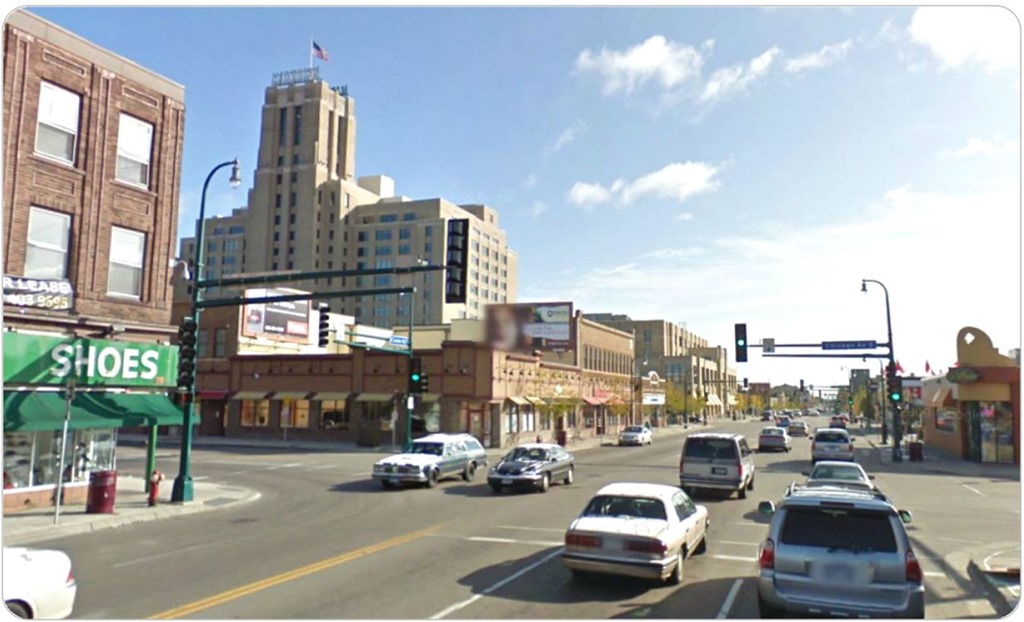
Lake Street in Minneapolis Minnesota. No palm trees, no movie stars.


The audio player below will let you hear the story of “The Lake Street Testament.”

An Old Man’s Winter Night

This is the most difficult set of words to read coherently that I’ve presented so far in the Parlando Project. Robert Frost’s “An Old Man’s Winter Night” looks on the page like any other chunk of blank verse (“blank verse:” unrhymed iambic pentameter). Shakespeare wrote whole sections of plays with this rhythm, and the walking one/two with a backbeat of an iamb has a forward propulsion that leads the reader to flow through the words.

The problem is, that even the most iron-lunged and fleet-tongued rapper has to pause for breath sometime. In general, it helps to pause for meaning, where the break for breath adds meaning. However, in the Parlando project I’m seeking to merge the words with music, and the musical cycles also suggest pauses.

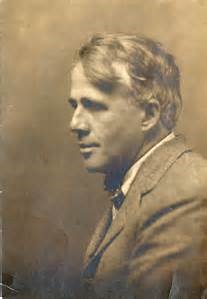
Robert Frost larger

I saida hip hop,
The hippie to the hippie
The hip hip a hop, and you don’t stop

“An Old Man’s Winter Night” was tough because I decided on a cycle of chords for the music, rather than basing the harmony around a drone, or simply “through composing” the music to follow the words without a repeating structure. I made that choice unconsciously, but I think I was responding to Frost. The poem seems to repeat itself, and my sense of the syntax was that the sentences seemed to start and begin again, like unto the central incident in the poem of an old person in a room not remembering why he had gone to that room. So the problem was: where to break the cycle of the circular speaking, keeping to cycling verses of chords, while helping the listener understand the meaning.

I got it almost right I think. I was further inspired as I worked by being in the midst of a Midwest below-zero cold snap while recording this.

I normally do not base my readings on others, though it might have helped me to listen to other solutions to my reading problem. Only after committing to the version you’ll now hear, did I listen to Robert Frost’s own reading of his poem and another good reading which does an excellent job of bringing out the meaning. Of those two, Frost aims to bring out the music in his rhythms, but it’s not a perfect reading. Authors have an advantage, in that they likely know the poem’s meaning—but they are also disadvantaged by that—since they know, they cannot always choose what the listener will need to have emphasized. By combining “An Old Man’s Winter Night” with music, I have another advantage over Frost’s own reading: I don’t have to follow the word’s rhythms closely to bring out the music.

“An Old Man’s Winter Night” embodies aged rural loneliness, something that even today’s modern communications can do little to ameliorate. For those of my generation who only remember Robert Frost as an old man, I’d like to point out that Frost first published this when he was 44. Frost beautifully describes being alone, separated, cut off; evoking all the surrounding emotions of that situation—yet he doesn’t once mention loneliness or any of those allied emotions by name. A great trick to pull off, don’t you think?

To hear my reading combined with music, use the gadget that appears below.