The Wood-Pile

Robert Frost is every bit the master of word music as Yeats and Millay. What makes Frost stand out is that he was every bit the thoroughgoing early 20th Century modernist as any of his free-verse contemporaries, while retaining an ease with accentual syllabic meter.

Here’s an example of Frost handling a subject just as a free-verse Imagist would. His aims, his presentation, hold to the Imagists’ principles. He deals with the thing directly (as we shall see, two things, but still…), and there are no tacked-on metaphors, no stock comparisons, no extraneous “poetic” language. Context is shown, but not explained. He loosens and varies his meter, so the poem sings and never seems to be a shackled march. At 40 lines, it’s a bit longer than Yeats’ poem considering “The Wild Swans at Coole,”  but Frost’s extra detail is even more specific and concrete than Yeats, though both begin their poem with the poet walking in a rural wetland. Yeats slough is a well-known place to him, conditioned with 19 previous visits. Frost is far enough into his swamp to not know exactly where he is, and so experiences what he sees with a first-time immediacy. Yeats’ slough then contains tradition, Frosts’ the more Modernist “Make it new!” place.

Though presented as one simple rural scene and story, “The Wood-Pile”  is more at two poems, though each part speaks to the other. As Frost’s tale starts, we are in the midst of one of his characteristic journeys, just as we are in other famous Frost poems. There’s a need for decision (“Turn back” or “go on farther”) and his choice, also made in other Frost poems, is to go on regardless of whatever doubts brought the question. If he’s lost in the dark by a wood on a snowy evening, keep going. If you come to a fork in the road, pick one and go on. If you’re walking in a swamp in winter and your foot is sometimes falling through the frozen crust, well, keep going “and we shall see.”

And so, here he sees his bird. No Keatsian nightingale, not Millay’s elusive flying swans with their awkward dangling legs and cries, nor Yeats’ majestic 59 swans, but a small bird. This bird becomes a mirror to the poet. Frost’s bird too must make choices in direction, and the poet, sensibly, thinks the bird’s guided by fear. “Keep something between little me and the big lummox trodding through the winter swamp,” he humansplains. And there’s a bit of humor at human’s expense as the poet muses that the bird, like humans with their self-importance, may think that the only reason for Frost to be out in the swamp is to go after the little bird.

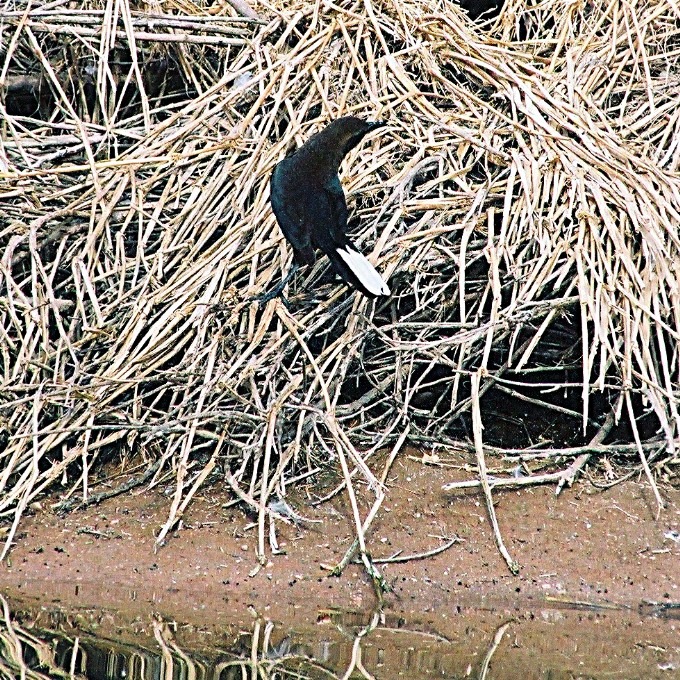
Gackle with white tail feather

“He thought I was after him for a feather—the white one in his tail”


But, we don’t know why Frost is out in the frozen swamp explicitly. The only reason he’s given, or will give, is the Imagist poets’ reason: “and we shall see.”

The bird leads Frost to the second thing the poem wants to present: an abandoned fire-wood cache. Here Frost zooms in close. Every detail of the cut wood and the once neatly stacked and propped wood-pile is stated. Frost turns forensic, like some New England Sherlock Holmes: this pile has been abandoned for years. Mature vines have grown through it.

wood-pile

“The slow smokeless burning of decay”


Here is another context left unsaid. Why would someone abandon a purposeful wood-pile in a swamp? Frost leaves it for us to be detective and to solve the mystery. This isn’t some lot of fire-wood left temporarily to be gathered later in the day, care has been taken to stack and prop it.

The only thing I can think: someone once built a shack (now completely disappeared) on the swamp land. Frost muses, sardonically, that only someone so busy with “fresh tasks” could abandon such effort in cutting and stacking. Does he mean to say, “only a fool would be so industrious to cut and stack this wood and yet not notice he was building his shack on a swamp that would not support a homestead?”

Now, the small bird with his “little fears” and oh-so-human misapprehensions of reality—and now, the steadfast Frost of miles to keep going, even if you may be lost, are set in contrast to this choice. Your fears may lie to you—but so will your optimism.

I once heard an astringent biological statement that the length of our lives can be reduced to a slow-burning chemical reaction. Frost’s last line here is a sad and beautiful analog to that truth.

Turn back or go farther? Go on, and we shall hear my performance of Robert Frost’s “The Wood-Pile”  with my original music. Just use the player below.

Stopping by a Woods with Bad Cellphone Service

For some time, I’ve disliked the way the idea of “generations” has been treated by the culture at large. Not the nugget of thought that’s in it, that cohorts of people in a particular time and place will share certain experiences, some of which will shape their outlook—but the nutty, pseudo-scientific way it’s been used. The balderdash that’s been added to “generations” includes the nonsense that there are some sharp and agreed on borders to them and that everyone inside of these sharp lines in time not only shares the same experience, but reacts to these things in the same way.

The crap labels we use like “Generation X” (Billy Idol and Richard Hell may have a lot to answer for, but let’s not hang this on them) or “Millennials,” (who could just as well be perennial grinders of grain for all the meaning I assign to that word) have become like unto the Sixties’ penchant for astrological signs. “Oh, you’re so Millennial” or “Members of Gen X think this way” have become the Moonchildren and Fire Signs of our age.

And of course, the borders of these deterministic generation containers are natural and inviolate—no, don’t look at them, as they will seem arbitrary and varied if you look too close. Are generations 12, 20, 30 years long? Don’t ask, as we don’t agree. And is someone born in 1946 exposed to the same set of experiences as someone born in 1963? Don’t look too close.

I bring this up, because this week I wrote a parody. And as humorists have been known to do, I went and used some generational stereotypes. I was pressed for time, those sorts of things are ready-mades, one or two people found it funny, if I use it humorously I’m making fun of it—Oh, I’m giving up. I’m ashamed.

Look, one of the good things about considering the experiences conveyed by writers whose words I use here, is that most have been dead for generations, no matter how long we define that term. Seems like they are each their own people, not clichés like “Victorians” or “the Lost Generation.”

New start. I had a serious thought as I started this. Earlier this month I revisited the well-known yet too-little-reconsidered Robert Frost poem “Stopping by a Woods on a Snowy Evening.”  As I thought about the experience Robert Frost was describing (if an actual country winter buggy ride, some think it occurred in 1909), I considered how different the night and the rural roadscape would have been then, compared to how we have informally remembered Frost’s poem. I thought the opening stanza of that poem, starting with Frost’s line that’s fallen into too-famous-to-think-about status: “Whose woods these are, I think I know,” could be describing a person who was lost in a darkening, rural pre-electric light, night—instead of a poet some of us remember as irresponsibly stopping to look at a well-lit Christmas-card pretty sight of a woods in snowfall.

I was thinking then: “Now I’d have not just the possibility of bright headlights, but a cellphone in my pocket that should tell me just where I am, no matter what poetic truth I’d be trying to express.”

And then I thought again about that phone. There are still areas, even in North America, without cellphone service. GPS signals don’t penetrate everywhere. Those maps in our apps are not without errors.

Cell Coverage vs Drake in Coat

Drake’s from Canada, but Minnesota and New England need cell coverage and warm coats too.


So, today’s piece, which I call “Stopping by a Woods with Bad Cellphone Service”  is actually a serious piece of winter travel safety advice, not a scurrilous piece of generational stereotyping, which I would never stoop to doing here.

Stopping by a Woods with Bad Cellphone Service lyrics

Here are today’s words, but you want to listen to the music don’t you?


But when you think of scurrilous, I hope you think of the LYL Band. It’s been awhile since I’ve had a piece that wasn’t created by that scrupulous and well-behaved group of musicians that is myself—recording it instrument by instrument, a track at a time. The LYL Band is an organization in the same way that a hockey fight or litter of kittens is organized, which is to say, barely, though we attack things with abandon playfully or otherwise. To hear us, use the player below.


A Dust of Snow

Here’s another winter poem by Robert Frost to put to our uses. Writing about my last piece here, Frost’s “Stopping by Woods on a Snowy Evening,”  I wondered about the actualities of the scene the poet was describing: a New England winter road in a dark snowy evening before the coming of rural electrification. Frost would know, of course, that it would be quite dark in those conditions. But did he use that knowledge when he wrote the poem? Did he, the author—like I did as a reader once (despite knowing too the darkness of rural night)—visualize a well-lit snowfall on trees, an alluring and beautiful sight that might tempt him to stay and watch for a while?

I can’t say for sure.

Frost’s “A Dust of Snow” is even shorter, and the accepted meaning of its images has been a settled thing for some time. Last time I wondered if “Stopping by Woods”  was more a poem about a man who was lost in the dark in both levels of meaning rather than a man who was tempted by bright beauty. I could have been wrong, but I think it’s worth considering. With “A Dust of Snow”  certain images have been determined by most academic readers to be, well, symbolic. What if we consider them as real, natural objects and not as handy metaphors?

Robert Frost with axe

Let’s cut down on our use of overdetermined symbols with Robert Frost

We start right off with a crow. “A symbol of death” it is said. Perhaps it doesn’t hurt the poem to think that. I think it’s a crow. A dark bird, darker yet against the snow, and no crow would let the poet that near without a racket of loud caws. The poet doesn’t let us hear the caws though. Instead, like the uncanny sound of sifting snow in “Stopping by Woods,”  Frost wants us to feel just a dusting of snow falling from the branch as the bird flaps off. He wants the main action in the poem to be almost microscopic. He could have written that the bird’s takeoff “dumped a pound of cold slush down my collar”—but that wouldn’t be the poem he wrote. Is the dust a symbol of death too? Or is it an image of a tiny action of little weight? I hold to the later.

Oh, and symbol alert! The tree the bird left is a hemlock tree. Or as the movieReal Genius  reminds us in “the immortal words of Socrates, who said: ‘I drank what?”

How aware was Frost that the American Hemlock is a pine tree and the European poison is a completely different, smaller plant? If this were written by the avid amateur botanist Emily Dickinson, we’d know the poet would know this. Even William Carlos Williams M. D. might have need to know about the derivations of poison. Like the crow being “death” or a bird, “hemlock” could be a reference to death or suicide—but the evergreen is also a symbol of life in winter too, if it must be a symbol. Frankly I think either taken in a one-to-one direct simile way may overdetermine the poem. In the book of nature, having a black bird against white snow causing the small, light amount of snow to fall from an evergreen tree is sufficient.

And this snow falls on the narrator of the poem, and the small sprinkling of snow lifts the rueful mood. I think that’s the essence of the poem: the smallest action of nature, a flighting crystalline snow sprinkle that may not have weighed an ounce, can lift a human out of their dense internal fixations. I think that’s a more graceful poem than the leaden march of death-crows, grave-dust snow and poison trees. I could be wrong, but I like that poem better.

Musically, a much simpler arrangement than last time, just a bass and 12-string guitar. I’m trying to carve out time to prepare for some more recording with the LYL Band tomorrow. Even if we are successful, you won’t hear those pieces for some time, so use the player below to hear “A Dust of Snow.”

Thanks again for the likes, comments, and the sharing of these pieces on your blogs or on social media.

Stopping by the Woods on a Snowy Evening

Today I’m presenting a piece that is extraordinarily well-known, by an American poet whose work is still read and remembered outside of academic settings, Robert Frost.

In such cases it’s easy to think we know the poem, perhaps we’ve even memorized it in whole or in part, and we then say we know it in that special way. If we studied it in school, perhaps we learned or apprehended some deeper meanings for it. If this is so with you, I’ve had those experiences with “Stopping by the Woods on a Snowy Evening”  too.

Yet, sometimes, when we look at something with intended freshness, things step out from our remembered poem and introduce us to things we didn’t realize were always there. Let’s start with just how I (and perhaps you) have visualized the setting for this poem.

Currier and Ives Sledding in Central Park

In the rural winter of Frost’s time, things would be considerably more dark

.

Is Frost in a woods, a bright high-contrast Currier and Ives scene of crisp white snow and colored accents? Not as he wrote it. The title and a line in the second stanza tells us he’s on (presumably) a road, and that he is between the woods and a frozen lake. Is there a full moon and clear sky? No clear sky, it’s snowing, so overcast. He says “the darkest evening of the year,” so the moon isn’t adding significant light. In the rural New England of Frost’s time, it’s probably dark and getting darker, in a way that few of us know darkness today. There are no street lights, no farm yard lights, likely no headlights. One might see villages spotted with oil-lamp-lit windows from the crest of a hill, but he’s told us no village is in sight.

When he says he only thinks he knows “Whose woods these are,” he probably means, “I could tell you if it were noon, but not in this dark.” In the rural area of my youth, even forty years after this poem was written, directions were still given by knowing who owned (or once owned) a piece of land. Is he lost? Possibly. At the least, he wants us to know that he’s not exactly sure where he is.

At the end of the first stanza he says he stopping to watch the woods fill up with snow. If he accomplishes this, he doesn’t tell us. There are hundreds of good lines to describe snow falling on trees visually, and Frost has written many of them, but he doesn’t do it here. Is he leaving us to visualize it ourselves, from our own rich storehouse of memories? That’s possible. And if you and I remember the poem as having images of falling snow drifting through tree boughs in moonlight, that worked. My current guess is that Frost’s narrator could “see” this too, but like us, only in their mind.

It’s a testament to how thoroughly we prioritize visual imagery in poetry that we think those images are there, even if we’ve memorized the poem. Frost was especially proud of the poem’s third stanza, and justly so. It’s all sound images. The dark and solitary nature of being in the middle of un-occupied rural space at night allows sounds to take the place of what our eyes would lord over otherwise. It starts with the horse sounding his harness bells, bells not merely a decorative pretext to sing “Jingle Bells,”  but a useful method of letting other narrow-road users know someone’s coming around a curve or hill-crest, particularly in the dark. And the snow image that’s really there? It’s so quiet and he’s so focused in the darkness, that he can hear the sweep of the top layer of snow blowing across the surface of the rest.

The infinite depth and darkness of the woods in the final stanza is not just a metaphor. It’s dark out, and it will not get lighter until morning. Its loveliness, invisible in the dark, is conceptual art at this point for Frost.

In this view, the decision about staying or continuing the journey is not a temptation of a seductive external snowfall-on-the-woods scene, nor is it a thought of embracing death or a contemplation of suicide, though those elements may be there as subtext. The situation is “I’m not even sure where I am on this road in the falling dark. The momentary beauty I sought here is elusive and mostly in my head. Keep following the road, though I don’t have sure landmarks and don’t know for how many miles. Better the finite, even if not quantifiable, promises of the rotating wheel of my buggy than the depth of a forest I cannot see.”

And the sleep he ends the poem with? Frost always maintained it wasn’t death in metaphorical disguise, despite what professors in electrically lit rooms might think. The story is that he wrote “Stopping by the Woods”  at end of a long night of work on another, longer poem. Any writer would recognize that it’s actual sleep he now desires, rest that we only allow after exhausting our attempts to see what is lovely, dark and deep despite the night.

Musically, I sought to combine the familiar with a few twists for this one. There’s a reassuring folkie acoustic guitar part and even a cod banjo motif I played to my rusty ability. But then a cello and viola part carries throughout. Instead of bass guitar, I decided to play tambura, a traditional drone instrument of South Asian music, on my guitar using a MIDI interface.

I liked how it came out, maybe you will too. The player gadget below will let you hear it. Don’t see the player? This highlighted link will also play it.

The Oven Bird

With today’s post, we’ve reached the 100th official episode of the Parlando Project, where we mix words from many sources (mainly poetry) with various kinds of music. For the 100th piece I’ve decided to feature an older recording of mine, almost 10 years old, of my performance of Robert Frost’s “The Oven Bird,”  because it marks some of the initial ideas that lead me to this ongoing Parlando Project.

Parlando Project 100th audio piece

the Parlando Project has posted 100 audio pieces combining music and words


Frost’s “The Oven Bird”  is a devastatingly accomplished lyric poem written early in the 20th Century. The rhythm of the lines both grooves and varies itself, like the best music, and the rhyme scheme is elaborate, yet it never falls into forced rhyme. Frost’s language here is so plainspoken, ironically saving the fanciest and longest word for the poem’s last line. Frost is as rigorous a modernist as any of his contemporaries in the Imagist school. He’s as willing as any of them to hack away all the overused and overgrown 19th century “poetic language” and to use no word more than needed, but he does it here while writing a sonnet in rhymed metrical verse that sounds as natural as any free verse.

Allow me to indulge for minute my musical interests for a moment. What Frost does here (and elsewhere) is like what John Coltrane did shortly before changing his focus to what was to be called “free jazz,” where melodic freedom was stressed by radically simplifying the underlying harmonic structure. Coltrane wrote and recorded the most devilish difficult set of rapid chord changes constantly shifting the harmonic center, an obstacle-course of a composition called “Giant Steps”,  and then proceeded to improvise over it as if it was no matter to him to make those changes. Like Coltrane, Frost could seem free, natural, and innovative, while writing inside a constraining form. This sort of kindred accomplishment speaks to what attracts me in the Parlando Project to equally privileging music and words.


“The Oven Bird”
  has a reputation as a downbeat poem, and while Frost will not sugar-coat the human condition, I did not, and still do not, find it so. In “The Oven Bird”  Frost draws our attention to a bird that sings on, past the promising days of spring, and whose song is none-the-less, loud and insistent, even though he’s singing in a season where he might well feel out of place and out of time for song. Then in the closing section we’re first told that the future holds the fall season—and by extension, both the fallen state of man and the death cycle of nature—and “the highway dust is over all.” Some have read that line as Frost noting the coming of the 20th Century roads that will close out even more forest and bring some measure of end to the natural world. I think instead the “highway dust” is more at a statement of the death of all living things (dust implies in my reading “to dust”) and that dust is the dust of a set, laid out, road.

Oven Bird

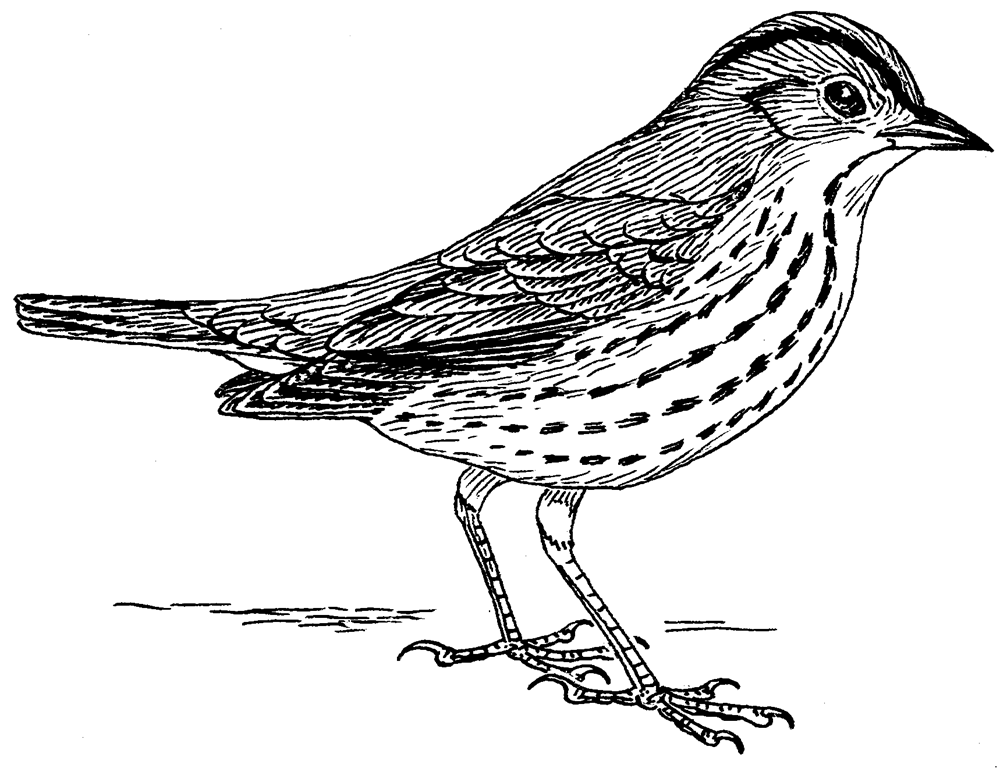
The oven bird: “He knows in singing not to sing”


Finally, Frost hits us, and me specifically near 10 years ago, with his conclusion—one that says much for this project that seeks to find “The place where music and words meet.” He says those of us, also mid-summer and mid-wood who listen knowing these things, sharing the bird’s predicament, should know that the bird has these teachings to pass on to us, “He knows in singing not to sing” (a zen koan of a line) and that the present question is “what to make of a diminished thing.” What a progression to this, from the plainest language with simple words never more than three syllables long, singing us the oldest cycle known to self-conscious humans—and then Frost gives us a line suitable for meditative thought and a question.

This is where I break from those who see this as a despairing poem about death, failure and decline. The poem asks what to make of that, offering the example to loudly sing.

To hear my performance of Robert Frost’s “The Oven Bird”, the 100th offical audio piece posted here as part of the Parlando Project, use the player below. “The Oven Bird”  performance is voice and acoustic guitar, but if you listened to others,  you know that the music and poetry we use varies. If you haven’t listened to other audio pieces in this project, check out the monthly archives for more. And if you like this, hit the like button or the follow button, and share this post or this blog address on your favorite social media channels. Those who’ve already done so help keep Dave and I encouraged to create new material, and you have helped grow the number of people listening to pieces from “Parlando – The Place Where Music and Words Meet.”


Adlestrop

Remember that “Reverse British Invasion” that happened 50 years before the Beatles landed in New York in 1964, when American modernist poets landed in London just before the outbreak of WWI?

One of those American poets was Robert Frost, and he soon struck up a friendship with an British writer Edward Thomas. Thomas was in his mid-30s by then, and he was writing this and that for whoever would pay, but he was not writing poetry. Frost and Thomas enjoyed walks about the Cotswolds together. Frost was encouraging Thomas to write poetry. On his part, on the walks Thomas would often puzzle at which country lane to take a crossroads, and Frost noted that.

Last summer I had the opportunity to take my own ramble about the Cotswolds with my wife. My itinerary was mixture of bicycling with some linkages between sections via train. During the biking part of the journey we often found ourselves lost. Just as with Thomas and Frost back in 1914, there seemed to be few straightforward crossroads and few road makers on the country lanes.  It was the hottest summer week in recent record in England that year, and at one train station stop the arrival of our train kept falling farther and farther back off-schedule as the trains were slowed and sometimes stopped by the fear that the heat would buckle the rails.

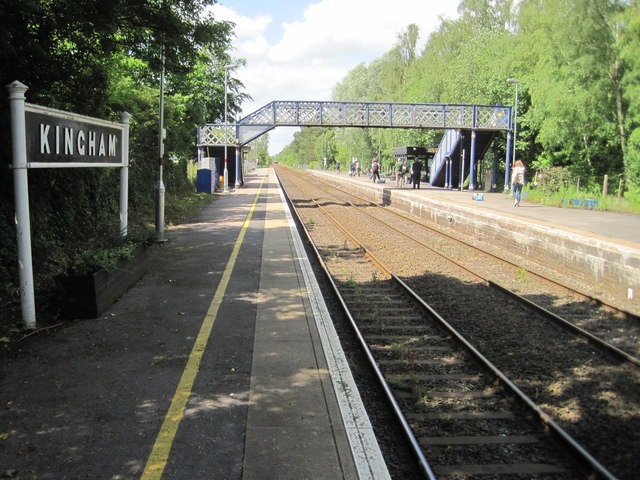
Well there was nothing we could do about it. We spent the next hours just sitting in the Kingham railway station in the heat we were somewhat accustomed to, watching the wind play with the trees and foliage, listening to the birds.

Kingham rail station

A few hours listening to the trees, breeze and birds at Kingham


This month in 1914, Edward Thomas had a train ride that stopped “unwontedly” in at the small Cotswold village of Adlestrop. Despite being a beginner at poetry, Thomas seemed to immediately grasp the modernist concepts, perhaps because he had no outmoded Georgian and Victorian habits to break.  His June experience lead him to write today’s piece, named after this village rail stop: “Adlestrop.”

adlestrop station sign

No rail stop in Adlestrop today, just this sign and bench remain. The present stop in Kingham is 3 miles away.


Thomas’ “Adelstrop”  has most of the markers of a modernist poem as Frost was writing them. It’s metrical, but not so strictly as to call to much attention to that. It’s rhymed, but again, the rhymes are not showy. There are no “hey look at me, I’m a clever simile or metaphor for something” tropes. In the place of that is the clean presentation of an exactly observed moment in time, peaceful, off the clock, yet clearly set in a time when the countryside’s nature and the train were in equilibrium. Thomas didn’t know it, but the moment in the poem gathered context after he wrote it, his village train-stop happened only a few weeks before WWI broke out, and England and Europe would be changed forever.

Robert Frost had returned to America, but he sent his friend a poem he had just written, one that was inspired by their Cotswold walks together, The Road Not Taken.”   Frost’s poem famously ends with the lines:

Two roads diverged in a wood, and I—

I took the one less traveled by,

And that has made all the difference.

It’s been Frost’s fate that his irony and dry wit, as well as his uncompromising assessment of human nature, has often been missed by his readers. I first read “The Road Not Taken”  and thought, as do many to this day, that this was a simple homily— a boast that taking one’s own, perhaps less popular path, is the road to success and happiness. But read again, more closely, Frost was gently making fun of his friend’s indecision, Thomas’ puzzling at if there are meaningful differences between the two choices in their rambles.

Thomas, though himself a discerning poet, missed Frost’s intent as well. He thought it was reminder of the necessity of making correct decisions, and he warned his friend that readers would misunderstand it. At the same time, Thomas was mulling his decision regarding enlistment in the British army, which was grinding up men at a prodigious rate against the weapons of modernist war. He enlisted, and within a few weeks of deployment in France, he was killed by a bullet through the chest.

Sometimes when I compose music for one of these pieces, I find at the end that I have written something that reminds me of another piece of music, one I can’t quite place. Often when I solve this internal puzzle there is a mysterious connection revealed. The music I played and recorded for Edward Thomas’ “Adlestrop” reminds me a bit of the Edgar Broughton Band song Evening Over Rooftops”—and the hidden connection for all that (different but shared) flanged and phased melody over an insistent strum,  is that like Thomas’ fine poem, they both are hymns to the eternal moment.

To hear my performance of “Adelstrop,”  use the player below. And another reminder that you can use the social media share buttons here to let other people know what the LYL Band and myself are doing here at the Parlando Project.


A Rustle of Feathers

As promised, here’s my “bird in the house” piece presented as a companion to Dave Moore’s episode from yesterday.

I wrote this about a decade ago. I was going through a bit of a rough spot in my life then, and just as the words place the narrator in the piece, I was alone in a house in the wintertime, acutely aware of the sounds in winter.  In that house, with no other human sounds but my own, I found myself thinking of my aged father, now widowed, living alone as well. In a somewhat morbid, gloomy mood I thought of unwitnessed death, of my father, or myself, dying alone.

Just as in the dream reported in Dave’s piece “The Bird Dream,” the trapped bird image came to me as I wrote the words for “A Rustle of Feathers.”

Odd that that trapped bird image occurred to both of us thinking of our aged parents. I don’t know if this is a common image or archetype, something that waits in our common human unconsciousness, waiting for a writer’s words to awaken. “A Rustle of Feathers,” with it’s aged narrator in an otherwise empty house acutely alert to sounds, shares a bit of the mise-en-scène of Robert Frost’s A Old Man’s Winters Night”  that was presented here earlier this month. Possibly I had read the Frost poem somewhere in my youth, but I don’t believe it was present in my unconscious as I wrote this; but shortly after I wrote “A Rustle of Feathers,” I did think that Edgar Allan Poe’s The Raven”a poem widely known to Americans of my generation—might have been a subliminal influence.

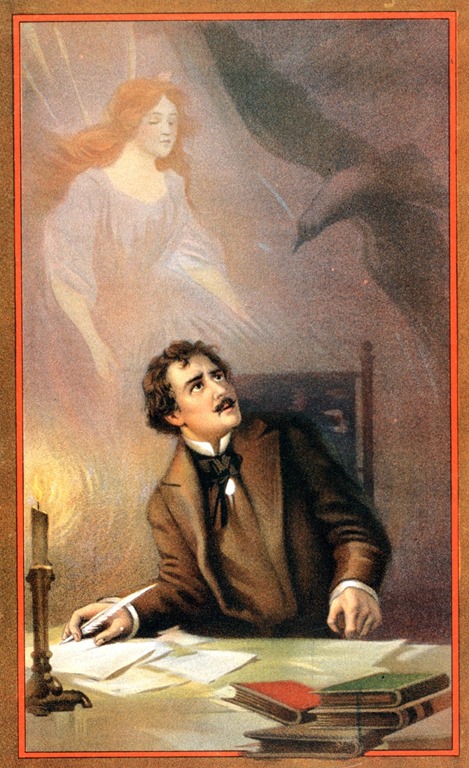
The Raven and Poe

Yes, I am using a plucked feather as a pen—but it’s a goose’s quill—so get out of my house!

Musically I was thinking a bit of a Johnny Cash feel as I composed the music, but I’m not sure that much of that came through in the final result. The guitar sound is a lovely example of a Fender Telecaster using both it’s pickups.

Well the muses keep dancing, and they are hard to keep in our narrow field of vision. The piece got written, and now it’s here for you to listen to. Just click on the gadget that appears below to hear it.

An Old Man’s Winter Night

This is the most difficult set of words to read coherently that I’ve presented so far in the Parlando Project. Robert Frost’s “An Old Man’s Winter Night” looks on the page like any other chunk of blank verse (“blank verse:” unrhymed iambic pentameter). Shakespeare wrote whole sections of plays with this rhythm, and the walking one/two with a backbeat of an iamb has a forward propulsion that leads the reader to flow through the words.

The problem is, that even the most iron-lunged and fleet-tongued rapper has to pause for breath sometime. In general, it helps to pause for meaning, where the break for breath adds meaning. However, in the Parlando project I’m seeking to merge the words with music, and the musical cycles also suggest pauses.

Robert Frost larger

I saida hip hop,
The hippie to the hippie
The hip hip a hop, and you don’t stop

“An Old Man’s Winter Night” was tough because I decided on a cycle of chords for the music, rather than basing the harmony around a drone, or simply “through composing” the music to follow the words without a repeating structure. I made that choice unconsciously, but I think I was responding to Frost. The poem seems to repeat itself, and my sense of the syntax was that the sentences seemed to start and begin again, like unto the central incident in the poem of an old person in a room not remembering why he had gone to that room. So the problem was: where to break the cycle of the circular speaking, keeping to cycling verses of chords, while helping the listener understand the meaning.

I got it almost right I think. I was further inspired as I worked by being in the midst of a Midwest below-zero cold snap while recording this.

I normally do not base my readings on others, though it might have helped me to listen to other solutions to my reading problem. Only after committing to the version you’ll now hear, did I listen to Robert Frost’s own reading of his poem and another good reading which does an excellent job of bringing out the meaning. Of those two, Frost aims to bring out the music in his rhythms, but it’s not a perfect reading. Authors have an advantage, in that they likely know the poem’s meaning—but they are also disadvantaged by that—since they know, they cannot always choose what the listener will need to have emphasized. By combining “An Old Man’s Winter Night” with music, I have another advantage over Frost’s own reading: I don’t have to follow the word’s rhythms closely to bring out the music.

“An Old Man’s Winter Night” embodies aged rural loneliness, something that even today’s modern communications can do little to ameliorate. For those of my generation who only remember Robert Frost as an old man, I’d like to point out that Frost first published this when he was 44. Frost beautifully describes being alone, separated, cut off; evoking all the surrounding emotions of that situation—yet he doesn’t once mention loneliness or any of those allied emotions by name. A great trick to pull off, don’t you think?

To hear my reading combined with music, use the gadget that appears below.

Frost’s October

Early on here I mentioned that I didn’t care for Robert Frost when I was young. When I first was introduced to him he was still alive, but the very image of an old man. I think of him on a cold, windy and monochrome day reading at John Kennedy’s inauguration ceremony, more than 80 years old, more than 70 years older that I was then.

Teachers introduced him as moralist:

“What does this poem tell us?” “What does he mean by the ‘road not taken?” The teachers would ask.

And as a formalist:

“Free verse is like playing tennis without a net.” That was his most famous quote not taken from a poem. All that wild bohemian, beatnik stuff–that’s like cheating!

Meaning in poetry can be problematic. It’s not that poets can’t express original observations or analysis of things, but poetry’s preference for brevity tends to make poems more like a hint than an instruction manual. I wonder how many students ended up hating poetry, thinking the poetry the teacher wanted them to interpret and “understand” was tricking them with irony and obscure metaphor. Frost, as he was taught when I was young, was “meaningful”—but worse than that, he seemed to be held up as someone whose poems were meant to teach good behavior and noble thoughts. As a teenager, I already felt I already had all I needed of that.

It was only a few years ago that I was looking for poems to set to music and sing, and to my surprise came upon the Frost of a hundred years before, the writer of short poems that just sang off the dry page. This sort of thing is very hard to do in English. I know, I’ve struggled to do it. What Frost could do wasn’t just tennis with the net strung up, this was playing grand slam tournament tennis while dancing classical ballet!

So here’s an example of Frost doing that: “October” written in 1913. Frost is a master here of singing vowels. This is less a poem than a singing mediation. Meaning? Well, yes this is one of many poems that look at October as the time of approaching Winter. That this is not a strikingly original thought is not really an issue, because the poem isn’t about the thought, it’s about the moment of that thought, common to many of us, and how to hold ourselves inside that thought. The real, valuable, “meaning” is in the sound and the way of saying it.

Musically I tried to serve that feeling of meditation, and once more I have a tambura drone grounding the melody lines. Dave Moore, who you may have heard reading other pieces here, is playing the keyboard part, which I call your attention to because I think it’s a fine performance on his part.

To hear that performance, click on the gadget below.