Each in His Own Tongue and the “middlebrow” problem

Social media likes controversy, so it’s no surprise that two things have recently mingled there in provocative assertion: poet Mary Oliver and the dread “middlebrow” epithet.*  It’s not a long bridge between the two: Oliver’s poems are put forward as all too middlebrow in this charge, and middlebrow is a sign of significant lack of ambition or achievement. I’m not a fan of the term “middlebrow,” for a hierarchy is implied and I don’t care for hierarchies much — but to speak of this I should define middlebrow poetry. A definition that works for me is: poems that remind us of something we already sorta-kinda know, but maybe couldn’t quite put into words. These poems are usually immediately understandable on first reading by a significantly literate reader.

Why’s this bad or lacking? If this is a singular mode it rules out poems that tell us multivalent things, or mysterious things that require more thought to comprehend, thought perhaps taken in stages. It rules out shocking, utterly surprising poems. And such poetry doesn’t feed our playful desire to puzzle-solve with clues we are proud to have acquired.**

My view? I think various modes of poetry (even differing modes of reading the same poem) have diverse values, and I’m more than OK with that. Poetry’s eye should be the insect’s compound eye, containing a hundred, a thousand, ommatidia. And so, if it was up to me, the best cultures wouldn’t be restricted to, or rewarding of, one poetic mode. This may be a visceral thing with me: I get bored with all one type of thing quickly. Building towers of hierarchies might be fun, and illustrative of what one can stably hold long enough to build such a tower, but in the end, the domain one will look out on will have a lot of scenery that isn’t in your tower. In the right mood, I can get pleasure out of looking at the commonplace apprehension poem and a “difficult” avant-garde one — and in the wrong mood on my part, or insufficient achievement in the poet, not a touch of pleasure in either mode. And beyond all this meaning and metaphor, there’s the oldest part of poetry, the part even young children understand, that poetry also has abstract pleasures like music has — poetry is the instrument on which the meaning plays.

A great many of the poems in our pair of 1920s children’s poetry anthologies are as middlebrow as any Mary Oliver poem brought up on charges in this controversy. This shouldn’t surprise us. A modern children’s anthologist looking to duplicate the task of those in the previous decade called The Twenties would, I think, do likewise. Some of those pressures would be commercial: what will sell to parents, libraries, teachers. Some would be practical: these children aren’t yet bored with the lessons of the world — those lessons are new and useful building-blocks for their youthful towers — and maybe a lesson of my old age (and a lesson of Mary Oliver) is that I shouldn’t have been bored with the lessons of the world either.

I think too of what happened as the first childhood readers of these poems in the 1920s progressed into the economic distress of the Great Depression, the rise of nationalist dictators, the Second World War, and the Damoclean Cold War. All through the middle of their lives how much time would they have for poetry that offered them the highbrow pleasure of gnostic meaning, of shocking new combinations and collisions?

The answer is: some would find the time, some went on and made their own verses in those modes — and many others would not. Some kept food on the table, kept bolts tightened on airplanes, tended the sick, kept fuel in NATO tanks facing east. Some had their yet young lives ended sans poetic envoi. Others desired, birthed, and raised my generation.

Highbrow, middlebrow, it is neither sophistication nor no-nonsense populism to forget either part of that cohort.

On to today’s poem, an example of a poem that earnestly intends to be a lesson: “Each in His Own Tongue”  by William Herbert Carruth. Look! Mary-Oliver-approved wild geese make their appearance in it, decades too early! I also offer this month’s puzzle challenge: the pair of 1920’s anthologies I’m drawing from were gendered: one for boys, one for girls. So as with each post this month, you’re asked to guess in which volume did the poem appear. Answer lower down.
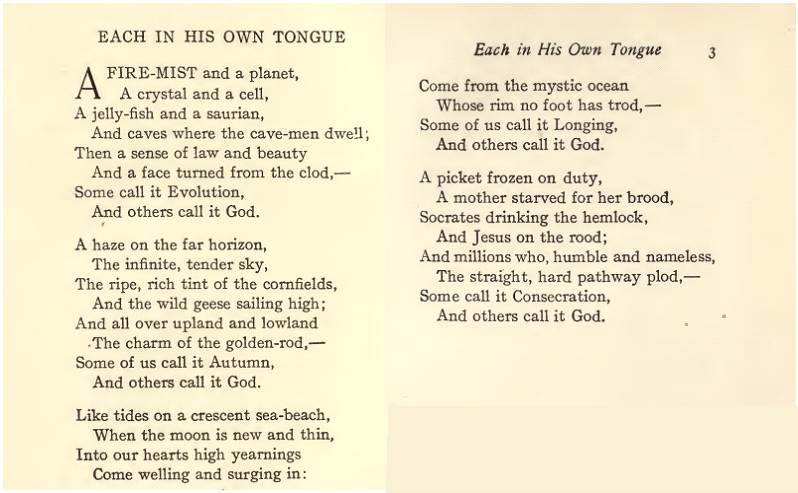
Each in His Own Tongue

dedication to Ina Coolbrith

Here’s today’s poem as it appeared as the title poem in a book-length poetry collection by Carruth.. Marginalia picked up in the scan of  a copy of that poetry collection. Wonder who Ina Coolbrith is? Here’s a link.

.

The brief Wikipedia stub for Carruth tells me he was “president of the Pacific Coast Conference of the Unitarian Church.” One of my preacher relatives once said of an Unitarian school he’d attended “The only time anyone would speak of ‘God’ is when someone stubbed their toe.” I read this morning a brief poetic knot of a summary of Oliver’s earnest lessons delivered by A. M. Juster who wrote that he’s “Not a big fan or a big detractor of Mary Oliver” but then sums up his impressions of her work by saying “I also think her spirit wanted to write religious poetry, but her mind wouldn’t let her.” Each in their own tongue I’d say, ungendering Carruth. Carruth wrote “His,” and his poem appeared in the Boys Book of Verse. You can hear my musical performance with the audio player gadget below. No gadget to be seen? This highlighted link is a backup which will open a new tab with an audio player.

.

*Here’s a link to a well-done post on the controversy, and a refresher on Oliver’s poetry if you are not familiar with it.

*This last factor is less-often laid out as I just did, perhaps because it doesn’t seem serious when complex poetry is discussed. But let’s admit it: great portions of humanity loves puzzles and challenges in which they feel rewarded if they can progress farther than some other human.

Whispering Often

Perhaps we should remind ourselves in this pre-AI age that every poem, any poem, is written by another human being. I did the math with the years, and this is a poem published and likely written about a hundred years ago by a 40-something Midwestern American.

I’m decades past that age, as was Donald Hall when Hall gave us his law that states that most poets, even prize-winning ones, will be forgotten 40 years after they die. This may sound callous, but that process is likely necessary. How many poets can we hold as a culture, as a reader? Dozens? Certainly more. Hundreds? Whatever, there’s a limit. The poet who wrote today’s piece? Who would we give up in the pantheon to let him in?

I came upon the poet who wrote today’s poem, Edwin Ford Piper, by reading a striking poem he wrote of the closing American wilderness that I’ve already presented earlier this year. I know little about him as a person.*  I almost worry to find out more, since human beings are full of all kinds of faults, deleterious opinions, vanities, and misapprehension. Did he write this poem in this time of the year, in the Spring? Who can say. Writers are full of memories, and imagination that can redress any cold or baren place, but it feels like he did. The poem’s trope of Spring’s reincarnation of driving/seeking life paired with the Christian holiday of Easter is far from unique — but the poem’s not, in feeling, much of a Sunday-dress observance — it’s luxuriously pantheistic. “Whispering Often”  was written in a past era we still call Modernism, published in a journal that put forward many of the great English Language Modernist poets, Chicago’s Poetry Magazine, and it was included in Poetry’s  founder’s anthology shortly afterward that had Modern American Poetry  imprinted on its end-boards — but I can’t call it an example of Modernism.

Whispering Often song

If you can un-embarrass yourself, you could sing this Spring poem too.

.

It’s not end-rhymed. It does sing on the page, despite having a meter that I can’t easily chart out. There’s a familiar iambic rise to many of the phrases, but I don’t think I can call it blank verse, a form that Piper used elsewhere. Oh, but does this rite of Spring want to sing! The title says whispering, so maybe the poet is abashed at the voice that is called forth. Not a lot of today’s poetry sings like this. Instead, we’re more often interested in a poem showing us a particular apprehension the poet has uncovered, an apprehension we are to recognize and share. We are want to pause and recognize the matter of typical 21st century poems, like a friend speaking with us. A wise friend perhaps, a little better with language than we normally are — but still, we wouldn’t want them to break out into a song over shared teacups or beer glasses. How gauche that’d be!

And so, I think of this poem now, as Spring is rebeginning here in my Midwest, as the Abrahamic religions are celebrating holidays of freedom, rebirth, and revelation — but more so as the northern half of earth is celebrating something that Abraham could have seen in a place outside Ur. In this case, a man in his 40s, a Midwestern American like myself, stopped and wrote this down.

What an odd act! If he paused to think about it, he would know that by all odds this poem will be soon forgotten. Yes, Piper was a professor of literature, but he was an adult, someone who knows the comings and goings, the correct way to behave, the agreed worth of this and that. Yet the poem will appear as something as outrageous as an unbidden public song, one with a crush of erotic desire for life. Religion can shape and seek to make that solemn — and perhaps such a transformation teaches wisdom, brings thoughtful ethics to our roots and melting eddies — but that Spring is older than wisdom.

It’s enough to make a grown man break out into song after all.

So I did. Earlier this month I hurriedly sang a bunch of pieces I had written that I feared wouldn’t have time to shape and improve into full arrangements in an interrupted life. Long-time listeners will know my voice isn’t going to be polite, though maybe it should be. You can hear that quick, short, performance with the graphical audio player below. No player? You don’t have to rush past, you can use this alternative highlighted link that will open a new tab with its own audio player.

.

*It’s not certain, but there’s a fair chance that later this year I will make another trip to pay respects to one of my poetic heroes, Carl Sandburg, and on the way tarry awhile to see if I can learn more about Edwin Ford Piper.

God Made Mud

Let’s complete our series honoring American writer Kurt Vonnegut on the 99th anniversary of his birth with another piece taken from his novel Cat’s Cradle.  In the world of this novel there’s an imaginary religion created called Bokononism whose elusive founder writes psalms and prayers that reference Caribbean musical styles. Even though Vonnegut never set music to them, he seemed happy that others did during his lifetime.*

Cat’s Cradle is still in print, so why not buy or read it? Also for the curious, here’s a nice “behind the making of the book” listicle

.

The LYL Band, the loose organization of herded cats that Dave Moore and I have played under for about 40 years, performed several pieces using Bokonon’s psalms and other short passages we’d read in Vonnegut’s novels three days after his death was announced back in 2007. I wrote the music for these in that interim and did the vocals when they were performed “live in the studio” within two one-hour sets. As I mentioned in other episodes of this series, the performances aren’t perfect. For one thing, Dave is creating his keyboard parts on the fly after maybe hearing a quick run down and with nothing more than a chord chart. Given that I’m not a very good chord/rhythm player that’s a testament to him and what decades of playing together will do for a band. Another problem was that I was suffering from cold/allergies that day and my vocals had issues with congestion and phlegm.

I recorded those two sets, though I thought it a shame that my phlegm issues reduced the quality of the performances. Over the years since 2007 I’ve listened to those performances, and I found that I either had become inured to their sound or that the emotional moment of us honoring Vonnegut overcomes that.

“God Made Mud”  was the next to last song we did that day.** It’s probably the best of our Vonnegut Memorial stuff in terms of my vocals. “God Made Mud”  appears in Vonnegut’s novel as the text of “The Last Rites of the Bokononist Faith.”   The Bokononism that Vonnegut invented is used in the novel in various ways to satirize human nature and our search for meaning. For some readers — oddly enough, atheists and secure believers both — those insights into belief are the emotional core of the book. For those in non-Abrahamic religions, there are echoes of Buddhist teachings, intentional or otherwise, mixed in there too.

But by the time Vonnegut gets to “God Made Mud”  the sincerity of the final human situation, the miracle and the limits of our lives, completely overcomes the satire, and removed from the novel’s plot it moves me. It moved me then as we were performing it in the week of its author’s death, moved me later in consideration of other deaths and thoughts of gratitude for lives, and moves me again this autumn as I consider death and the approach of death by folks in my circle.

Click this highlighted hyperlink to hear the LYL Band’s performance of “God Made Mud”  —  or some of you may see a horizontal player gadget below this paragraph to play it. One last thing before I go: if you appreciate what this Project does and you think you know someone or some audience who might also appreciate these varied combinations of words and original music, help it continue by sharing links to the audio pieces or posts on social media or elsewhere. I almost never have the time to do that, and I’m bad at it anyway, so a good deal of this effort’s audience comes to it this way. Thanks!

.

* Oddly, most of those settings that I’ve heard make no reference to Caribbean musical styles implied in Vonnegut’s imaginary Bokonon texts. One of those styles, calypso, has lost most of its currency in North America, but in today’s piece I used a reggae feel as a reasonable substitute.

**The last song back in 2007? Dave Moore’s own meditation on last things “The Final Minute,”  which we presented here this summer.

Medley: A High-Toned Old Christian Woman and First Fig

Sunday is World Poetry Day and I should do a piece about poetry and poets to mark it. The specific idea of World Poetry Day is to celebrate every nations’ poetry, something I try to do here with fresh translations sometimes, but for today I’ve decided to use works by two American poets. The United States is still a young nation, still used to using the cruder tools of youth to impress itself upon the world, but our poets have had their innings, so today I’ll sing them to the rest of the world. First up: Wallace Stevens.

It’s not uncommon for poets to write poems about art or the art of poetry itself, but Stevens did this often. So it’s no surprise that “A High-Toned Old Christian Woman”  starts off with an assertion about poetry, even though the rest of the poem seems to progress into an argument about religion and religious propriety. Here’s a link to the full text of Stevens’ poem in case you want to follow along.

Stevens’ poem slows down our understanding of what it means using two tactics. First, it gives us at best one-half of a conversation: a little like hearing a person talking on a phone in public where the other party is inaudible. It takes considerable effort in comprehension to settle on what issues and points are being addressed in the poem’s speaker’s argument. I’m not totally certain I grasp them myself despite several readings and going on to perform the piece. Our high-toned old Christian woman may be expressing outrage at some more pagan and unfettered artistic expression on Stevens’ part. Stevens’ response is to point out that art has its own religion of a sort, its own myths and beliefs. That unheard party, the HTOCW, seems to make an objection regarding Stevens’ or art’s outrageousness derived from its beliefs and theoretical constructions, and Stevens’ then parries with a short aria on the extremes of Christian asceticism bellowed over a tink-tank Vachel-Lindsay-ish Salvation Army band. In summary he’s claiming they are alike: that the HTOCW and her co-religious cohort and he the poet both have their own guiding constructions (supreme fictions), their own expectation of meaningful belief and actions that promise — well, what do they promise, or rather assuredly deliver?

He’s not sure. A poet’s masque (a play) performed on earth may aspire to cosmic importance, but we can be sure the planets will not be all that moved. And the most fervent displays of religious piety can’t move the heavenly spheres who would at most judge them as unserious “hullabaloo.”

The second way Stevens intentionally slows down our comprehension is with language, the stuff and lexicographic music of his poetry. Most any stanza of a Stevens’ poem is equal to a “Word-A-Day Calendar,” and this poem doesn’t disappoint: nave, citherns, peristyle, masque, epitaph, flagellants, muzzy, and hullabaloo are not common modern English language words, and I’ll wager that most readers, even the most educated among us, would be hard pressed on getting 100% on a definition test with that list.*  I’ve always “read” Stevens as having fun with his use of these obscure words, and in many cases here he’s punning on their sound, so we think we understand something we hear in a performance from the sound, while on the silent page they remain stumpers. Making someone a nave/knave is to fool them. A peristyle projecting upwards sounds like a periscope from a WWI U-boat or trench. A masque might as well be a mask. Flagellants with muzzy bellies sounds like flatulence from fuzzy bellies.

And while not an obscure word, “palm” is repeated several times in the poem with different meanings pressed onto it by context. It first seems to be Christian praise, as in the arrival of Jesus into Jerusalem on Palm Sunday, a moment of triumph to be followed by Good Friday (and then, yes, for believers, Easter). In its second mention, the poet might earn laurels, palms of honor for their work, but like the praise of the crowd it may be fleeting, pace what I call Donald Hall’s Law. And lastly, the palm plants become hands I think, the two seemingly opposed, the two sides — the prim believer and the pagan poet that the poem has satirized — I believe, palm to palm, a pair making a prayer.**

Let’s look at the poem’s end at last: Stevens seems to be saying that salvation by faith in art or religion is unclear. Widows wince when doubt says they may not meet their husband in heavenly reward or when that doubt (or belief) is sung impiously by some poet who calls his art, his mythology, the “Supreme Fiction.” God and the muses are both winking at us, telling us that we only half have an understanding, flirting with us on that unknown stage of our best fictions.

Stevens and Millay

Stevens was a famous late-starter, publishing his first poetry collection Harmonium where AHTOCW first appeared at age 44. Millay was already on to her second collection featuring First Fig at age 28.

.

What then to make of the poem I combine with it, a short poem with plain words that many feel they understand at first sight: Edna St. Vincent Millay’s “First Fig,”  the one that begins, as so many have memorized, “My candle burns at both ends.”***  Is this not also a poem of faith in poetry? Yes, with the same limits and lack of assuredness. Is it also one half a debate with another point of view? Yes too, though it be a short epitaph “unpurged from bawdiness.”

In effect, “First Fig,”  the opening poem in Millay’s A Few Figs from Thistles,  is the title poem, the dedication of that short collection that set out the Millay outlook on youth, freedom, and autonomy sexual and otherwise. It made her famous for a while, and unlike Stevens’ knotty poems, hers (and herself) seemed understandable. Here’s its full text.

We understand this poem quickly to say: that one may, from our passions artistically — or otherwise in that mere and yet larger life — expend or risk so much that we allow it to be foreshortened, but that we believe that intensity is illuminating, possibly worth the sacrifice. Note, there’s no explicit conclusion. Millay’s poem doesn’t say outright it’ll be worth it, and other poems in A Few Figs from Thistles  are not sure either. Its illumination is brief, a night in length it says. Yet a poem we think we understand, that we might memorize and carry in our muzzy brains may change as we project its light on different walls.****

Given Stevens’ satiric and philosophic wordiness, I came to think pairing it with Millay’s short heart-song would be a worthwhile contrast, each stronger with their lights against the ground of the other. You can listen to the performance and see if that’s valid — but before I go, is there one thing we don’t understand about Millay’s short poem?

Well, there’s the title. It’s such a short poem, yet we forget that there’s this added pair of words. I’d guess that many that know or have even memorized the poem forget the title. One thought was that it might be referencing an idiomatic English expression: “I don’t give a fig about…” which could easily be given an intensifying modifier “I don’t give a single (or the first) fig about…” I had assumed that fig, like the euphemistic interjections sugar or darn, was just a word used to replace a ruder word that started with the same letter-sound. I even wondered: was that idiom around when Millay wrote her poem in 1920? Well, just as I wouldn’t know muzzy or cithern fully when I read Stevens, it turns out I was off a bit. The idiom seems to date back to Shakespeare’s time or even more, which is odd in that the fig isn’t even a native fruit in England. It comes from Spanish and Italian; and it’s not only a word but it has a Mediterranean hand gesture to illustrate the thought, involving the thumb placed between two raised fingers. The intent in gesture or word in this idiom is to refer to low pink-toned lady parts, and in the patriarchal context then it’s an expression of contempt.

Did Millay know the derivation of the idiom? I don’t know — but she likely knew the non-etymological meaning of the phrase. In the context of the one-side of the debate that “First Fig”  is presenting, that indicates that the speaker doesn’t give a single fig for the off-screen speaker who disapproves of the possible costs of passion.

Long post, but two poems for this World Poetry Day! The player gadget is below, or if it isn’t, this highlighted hyperlink will also play my performance of Wallace Stevens’ “A High-Toned Old Christian Woman”  and Edna St. Vincent Millay’s “First Fig.”


.


*Ones I’d miss or get half-credit for? I knew citherns were an instrument from my interest in unusual instruments, but I wouldn’t be able to describe one definitively. I probably once knew peristyle from an early interest in classical theater, but had forgotten its meaning. Muzzy was dark to me and would have been a clear miss. A good dictionary then or the Internet now allows us to decode the original denotative meanings, but these still keep us from understanding Stevens too soon. And they can just be fun to come upon in a poem!

**This blog post and close reading, perhaps from more knowledge about Stevens’ biography, posits the HTOCW to be based on Stevens’ mother.

***If HTOCW may be Wallace Stevens’ mother, one of those that had memorized Millay’s “First Fig”  was my father, who once or twice recited it to me. What caused him to memorize it, or to read Millay? I never knew. He never lived a bohemian life, and as far as I know he lived a modest, constant, and long life. I can guess however why he recited it to me, who did have my bohemian modes and times: to say that he knew something of that, or that I could have faith that something worthwhile could come from that.

****I’m increasingly seeing readings that see coded (intentionally or unconsciously) in this poem an expression of Millay’s bisexual/polyamorous autonomy.

Helen Heaven

Let’s leave off those modernists of the era around WWI for a while, and move to a few songs about some midcentury mods. This is the time when popular culture mutated into something recognizable as ours, as it still is into this 21st Century.

Somewhere in this second decade of the 21st Century a new modernism is likely being born, but I do not know it yet. Back in the early 1950s people expected something new, perhaps as much or more than we expect change today in 2017. As it turns out, we may have not gotten all the change we thought we were due.

Today’s piece is the opening song in a song-cycle about one woman who had a moment in this moment of change in the early 1950s in Los Angeles/Hollywood. The woman was a second-generation Finnish-American, Malia Nurmi, who created a character that for a short time, just about a year, captivated TV audiences in Southern California with a strange take on sexuality and various horror tropes, blending in a beatnik/Dada critique of “normal” as a reaction to the unthinkable. The character was named “Vampira.”

Somewhere in the later 1960s it became a commonplace to view the 1950s as an era of calm, peace, satisfaction and complacency, and this characterization has only increased over time. But this was also the era just after a cataclysmic war ended with atom bombs, a horror that eventually moved from reality, to nightmares, to repressed acceptance, to forgetfulness and finally now again to present fears. This was the decade of a forgotten, brutal, war in Korea. This was an era when society tried to put back into the bottle the broadening social roles for women and Afro-Americans that WWII had allowed. This was the time that revealed the horrible efficiency of the extermination and slave labor camps, and the decade in which the utopian dream of Communism exposed its shames and shams. This was a deeply uneasy time when some feared everything “normal” was a dream and others saw clearly the waking hours outside the dream.

All of which makes this campy TV quipster host who created the makeup, costume and persona of Vampira seem inadequate to address this. Well, what is? As we move to celebrate Halloween, that strangest of holidays, where we make fun of our inability to escape fear, death, and too much candy, let’s reconsider her.

Helen Heaven - Aimee Semple and Maila Nurmi as Vampira

Media in black and white: Aimee Semple used religion, Maila Nurmi used Vampira

“Helen Heaven”  has words written by Dave Moore, the alternate voice and writer/musician here at the Parlando Project, along with music written and performed by myself. This piece is the first song in the Vampira song-cycle, contrasting the LA-based white-dressed pop-religious phenomenon Aimee Semple McPherson with Nurmi/Vampira’s dark negative.

To hear “Helen Heaven” use the player you should see just below this.

He Hit Me First

John Renbourn, the English guitarist, and the subject of our last episode, once introduced a song in concert by saying he was now going to play an English song, “It’s a nice little melody—alas, there are just not that many good English ones.” As we said last episode, John’s repertoire was vast, so he had many musical traditions to draw from and could pick and choose. I mention this only in passing today, because when it comes to music, musicians accept no borders.

In the US today we have an odd holiday, St. Patrick’s Day, where we broadly and vaguely celebrate—well, not missionary saints. Instead many engage in an approximate celebration of Irishness, where amongst the dyed green rivers and dyed green beers, the “Kiss me I’m Irish” T-shirts, and the saucy leprechauns on everything, there is some occasional notice given to Celtic culture.

Saint Patrick

Indiana Jones : “Snakes. Why’d it have to be snakes?”

Alas, I have nothing prepared to be dyed green. I expect we’ll revisit Irish writers’ words soon enough though.

Instead I have a piece by the LYL Band’s keyboard player and alternate reader Dave Moore titled “He Hit Me First.” I think his words speak well enough for themselves, so I’m not going to add much here to them. When I asked him if the words were written about a particular incident, he told me that it was inspired by working on a book

Lester Moore

Lester Moore: preacher, Dave’s father

collecting some of his father’s sermons. Looking over a pre-publication proof of that book, and the sermons Dave decided to include there, I don’t see where Dave used any exact words from his father, Lester Moore, in He Hit Me First;  but I do see how Lester Moore’s inclination and approach informed it. Here’s a few words from a sermon Lester Moore delivered in 1981:

Christianity conquered an empire that was more cruel than Hitler’s Auschwitz.  And it was done by Christians who were willing to live the love that God gave them in the model of Jesus.

I sometimes wonder why it is that we still fail to see this. Christians who offer love in today’s world are called ‘soft-headed.’ But what happens when we bluster and threaten in today’s world? Are we nearer peace today because we speak in militant tones?

Psychologists tell us that we get a REACTION equal to the ACTION in the emotional world just as we do in the physical world. When we shake our fist at someone, we get a fist right back. So, who is soft-headed?

Love does not turn its back on evil. It does not pretend that evil does not exist.  Love stands firm and insistent. It is disciplined and ready to sacrifice. It cares about what happens to people, whether it has to do with freedom or hunger or health or hope.”

This is a complex subject, and I’ve only given Lester Moore a few words for his position. Knowing the action/reaction pair he speaks of, I anticipate one response, something I could summarize as “That’s all very nice, but in the real world, you may want those fists, that military, those soldiers to protect your music, poetry, and preachers.”

I will note only that Lester Moore earned a Purple Heart, Bronze Star and Silver Star serving in WWII, before he took up the ministry and eventually gave this sermon.

To hear Dave Moore’s He Hit Me First, use the player gadget below.


On Being Asked for a War Poem

Today’s post returns to the issue we touched on last month with “Acting.” What is an artist’s proper role regarding politics and social issues? And why do artists who engage in politics draw especial condemnation for doing so?

This may be the wrong question. Does anyone ask, what’s the proper role of a lawyer, real estate tycoon, school teacher, doctor or fry cook in politics? None that I’ve heard of lately. My working answer to this possibly disingenuous question is going to be long, so if you can, bear with me.

Probably the only other profession that has its participation in politics questioned in any way would be clergy, and I think there are a pair of oddly similar issues with artists and clergy speaking on politics.

Artists, at least good ones, by their nature tend to be “progressives.” Please, if you can, skip by any associated political stances you attach to that label, it’s honestly the best word I could come up with. By “progressives,” I mean that artists naturally seek change, novelty, and the advancement of new ideas even if they are built on older ones. Scientists and technologists have a similar bent, but artists like to think of themselves as ahead of even the sciences in this regard. Religious leaders, teachers, preachers, tend to be “conservative.” Please apply the same caution to that word as I asked for “progressives.” By conservative, I mean that they see the values in cultural traditions as possibly being given by supernatural forces that are of a higher order than mere human thought, or at the very least, that traditions are time-tested in such a way that they need to be honored, and to extent that seems reasonable to them, for those traditions to remain unchanged.

Are there “conservative” artists. Yes, they are. It’s quite possible to be artistically progressive (important for good artistic work) and politically conservative. Shakespeare presents himself as conservative politically, but was a culture changing artist. And it’s easy for me to think of some 20th century artists who are not “conservative” but “reactionary,” Ezra Pound for one. Caution again, just a label, let me explain: I use reactionary as a label here to denote people who believe that some important elements have failed to have been conserved, and that change is necessary to return to that state or set of values that no longer effectively exist.
 
Are there religious “progressives.” Yes indeed. Remember that religious people overwhelmingly believe that certain values are given by superhuman forces, ones that exceed what humans themselves might honor. There has always been a large part of religious thought that says that mankind is “fallen” and so therefore is in constant need for change toward the good, a good that might never be properly illuminated by fallen human thought.
 
So for both our “conservative” label (clergy) and “progressive” label (artists) we’re talking associated tendencies, not absolute dictates. Humans are complicated after all; but I think that’s one thing that strangely joins concerns about artists and clergy in the political arena. Opponents to conservative clergy and progressive artists see these groups as respectively prejudiced, temperamentally oriented toward resistance to necessary change or moving toward too broad and untested change. In this outlook, their self-selected temperaments that lead to their professions blind them, and so they aren’t viewing things fairly or deeply enough because of who they are. One proof we can see in this is that it’s rare for conservatives to criticize conservative artists in politics, or for progressives to criticize religious leaders who champion progressive causes. The belief here would be that those who go against natural tendencies in their professions must be significantly immune to that issue of characteristic prejudice.

You might next think or ask: well doesn’t a fry cook or a real-estate tycoon have their own prejudices based on their livelihoods? What’s different about artists or clergy?

My answer to that moves to another thing those two professions have in common: they are both pretty much in the same business. When a religious leader gives a spell-binding sermon, or a writer moves us to tears, when a religious visionary tells us what the angels said to them, or the musician brings sounds together in a way that moves us, when the crowd rises as one, with one hosanna on their lips, does it matter here who is at the front of the house?
 
What is important to our question comes after these remarkably similar experiences. Are we in that crowd, and yet not moved to rise in praise like the others? Is there often a let-down, however vague and hard to explain afterward? A way in which we feel unworthy, a way in which we feel we thought we were changed and yet we are not changed? Do we ever feel tricked: fearing, or perhaps even knowing, that the artist or preacher has engineered this with the techniques of their craft, techniques that might work regardless of the content they convey?

Now what if the person at the front of the room is not an artist or a preacher, but a political figure? Don’t all the same things apply?

So all this is a prelude to a very short, yet puzzling piece, with words by William Butler Yeats: “On Being Asked for a War Poem.”

Why puzzling? Yeats is good example of an artist engaged both in spiritual concerns and politics. In the struggle for Irish independence, Yeats was a leader in the idea that Irish cultural independence as a pre-requisite for political independence. If skeptical of armed rebellion, Yeats consistently pushed for what eventually became the independent Republic of Ireland and he become a Senator after Irish independence. One of Yeats inspirations, Percy Bysshe Shelley had famously said “poets are the unacknowledged legislators of the world.” Yeats in effect revised Shelley’s passage by striking “Unacknowledged!”

 William Butler Yeats

Couldn’t make it in the NBA, but an artist engaged in politics

What would you expect from such a man in regards the use of his art for political purposes? You’d guess he’d be all in. Well, he was asked, just like the title says. Edith Wharton asked for a poem from Yeats for book meant to raise funds for Belgian war victims during WWI, and this was his response, which indeed was printed and therefore served its charitable purpose. Here is the entire poem:

“I think it better that in times like these
A poet’s mouth be silent, for in truth
We have no gift to set a statesman right;
He has had enough of meddling who can please
A young girl in the indolence of her youth,
Or an old man upon a winter’s night.”

So why is Yeats seeming to refuse to put his artist’s shoulder to the wheel and write a “war poem,” as so many others did? Well first, Ireland’s position in WWI was complicated, as it was not yet independent. Ireland’s colonial ruler, England, was engaged. The ancient principle of “the enemy of my enemy is my friend” might make an Irish nationalist (at the least) abstain from taking sides.
 
He goes beyond that however, on the face of it saying that a poet—“a poet,” unqualified, not “this poet,” or “given that I’m a colonial subject against my will, don’t ask me for poetry about your war.” Poets, he says, have “no gift to set the statesman right.”

I don’t know what was inside Yeats’ mind, nor am any kind of expert on his work, but in thinking about these things, about how the artist, the clergy, and at times that statesmen, are all in the same line of work; an alternative reading has come to me.

That pronoun “He” that starts the fifth line, why did Yeats not make the antecedent clear? Most readers believe that the “He,” the one who’s suited to pleasing an indolent young girl or an “old man upon a winter’s night”—that last, a character who could be that frightened and lonely farmer in Frost’s poem we recently featured here—is the poet, or a poet performing his rightful role. If so, it’s a surprisingly modest, even dismissive, statement of a poet’s worth. However, the last noun before that pronoun “He” isn’t the poet, it’s the “statesmen.” English syntax rules indicate that “statesmen” could likely be the “He.”  If I write “Frank went to a Minnesota Timberwolves basketball game, saw Karl Anthony Towns, and he scored 42 points.” We know that I couldn’t score 42 points, even in an empty gym, not because of my athletic ineptitude, but because we usually think the pronoun refers to the last applicable noun before it.

karl-anthony-towns

Not the author of this post, but he can play some ball

So did Yeats slyly mean to say that a statesman, like the poet, like the artist in general, is engaged in the same game, fooling the youth and the feeble old?
 
I have more to say about artists with political opinions in the upcoming week, but to hear the LYL Band and William Butler Yeats  “On Being Asked for a War Poem” use the player below.


Today’s post, as I’m reminded specifically today about the clergy and political action by his life, is dedicated to Lester Moore, the father of Dave Moore. You’ve heard Dave reading and playing keyboards here (including the various keyboards in today’s piece).