Four Performances-Part Four: We play an Alternative Prom

The experience of the fourth performance in this July series was unlike the previous three. Those reading along may recall that each of the first three I’ve written about this month left me with its own distinct feeling of disconnect, of ways that I had not been able to reach an audience. I could’ve taken the performer’s side in this failure to connect — there is a long and necessary tradition of confounding audience expectations after all — but emotionally I couldn’t live with that unreservedly. Given that the core of the LYL Band was a band of poets not reliable professional musicians, and those poets were reflexive non-conformists singing songs that held up to examination or ridicule civic and cultural matters, I should have expected that outcome.*   Intellectually, I understood this, but emotionally, it bothered me, particularly after the U of M concert I wrote of last time.

Society picks a few non-conformists, perhaps ones bound with redeeming qualities or compelling evolutionary necessities, and is fine dispensing with the rest.**  If it didn’t do this mostly, well, the non-conformists wouldn’t be non-conformists would they? The LYL Band in this metaphor is the platypus.

But as I said, today’s performance is different. Somewhere in the mid-1980s a couple of nurses at the hospital I worked at had an idea: they wanted to put on a Prom to remediate memories of less-than-accepting Proms from their high-school years. What a great idea! They set a date and went about decorating a house’s basement with festooned crepe paper and colored light bulbs, plastic flowers, and some cardboard gilding, just as small school gyms had been transformed in teenage midcentury America. One of the nurses knew I had a band, would we be the rockin’ dance combo for this event?***  Sure, we’d do it — if we could find a drummer.

If nothing else, the perceived (by me) failure of the U of M concert from last time cemented in my mind that playing electric instruments without a backbeat couldn’t sustain the illusion that we were a Rock band. Someone knew a drummer. He agreed. We rehearsed with him a single time, and Dave and I selected from our repertoire songs that might be fit for dancers.

When the night of the Alternative Prom arrived, we set up in the house’s basement. We had no PA as such for vocals at this time, so I used a small Radio Shack mixer connected to my home stereo for the vocals, with no provision for monitors. I even set up one mic for any members of the audience that wanted to sing backing vocals.

The Prom attendees arrived. Some had scrounged old formal wear from second-hand stores, and even accessorized with corsages, while others were in come-as-you-are casual dress. Some came with their we’ve-achieved-adulthood-now partners, others just themselves. Given the nurse-origin of the event, women were in the majority. How many in the audience? Again, memory can’t count, but the basement was soon quite full, just enough room to dance, maybe 30-35 people? I really can’t be sure. I think there was some food and drink, but I don’t recall the particulars as my mind was keyed up for the performance.

Our little trio began to play about 10 p.m., myself with my electric guitar, Dave with his Farfisa combo organ with grey bass-register left-hand keys, and our for-the-night-drummer at his kit.

Dancing broke out, and continued through our roughly 60 minute set which concluded with a cover of Wilson Pickett’s garage-rock classic “In the Midnight Hour.”   I don’t know what experiences any of my readers who play instruments have had, but let me say that if you ever get a chance to play for a dancing audience, I highly recommend it. I believe that music (and to a degree, its sibling art poetry too) are meant to move bodies. While I have never been a very good “rhythm guitarist,” here in a trio I had to fill that space however shambolically I could. It helped that the drummer was good, and fully-invested in “more cowbell,” and Dave’s left hand on the organ grey keys filled in well for no bass player.

I’d considered what should be our encore if the performance worked, and my idea was to lean on my still patent Patti-Smith-inspired vocal improvisation skills. The planned framework would be the ultimate chestnut of its era “Louie Louie,”  a three-chord song that I would connect with whatever songs came into my head by converting them to fit “Louie Louie’s”  three-chord-trick cadence.

Dave started the encore, his voice hoarse from singing without the benefit of vocal monitors that night. “Louie Louie” soon slid into Dave’s song “Sugar Rush.”   As the guitar breaks and audience sing-alongs carried us forward toward midnight, I merged in other songs: “Like a Rolling Stone.” “La Bomba.” “The Star-Spangled Banner.” “Fortunate Son,”  and finally, tiny snippets of the Velvet Underground’s “Pale Blue Eyes”  and “Sweet Jane.”

The performance was over. Art is hard to measure, harder yet when it’s rough-edged, imperfect, and improbable; but it may have been the single best LYL Band performance, despite (or because) of its unconcern for sophistication. The recording is crude too, and the vocals suffer from the lack of monitors and strained voices. The funk of the sweaty basement, the joy of the dancers remediating their teen-age years, the surrounds of dance steps and emotions: none-of-than can make it directly onto audio tape. But Rock’n’Roll isn’t a juried competition. On any one night, with any one audience, it’s a shared mood of ecstatic feelings, and no level of skill and fidelity sans those feelings can’t maintain it.

I can’t find any pictures from the Alternative Prom, but for visuals I put in a bunch of LYL ‘80s posters and pictures from other gigs, including the U of M concert I wrote about last time. One level of our non-conformity:  we tried and succeeded in not dressing for the part of a punk band.

.

*If only in a footnote, I feel a need to note the death of Tom Lehrer this week. He really made an impression on me, and Lehrer’s presentation was, like the early LYL band, centered on the idea of gleefully rubbishing many cultural standards and pieties. I even tried to work in a punked-up version of his “We’ll All Go Together When We Go,”  as our answer to “99 Luftballons.”.

If the Fugs, that other band of poets, were arguably the first punk rock group, I suspect any acerbic singer-songwriter from my generation had listened to Lehrer’s LPs. Here’s one odd thing I noted in the reaction to his death, and the inevitable short pieces on his career: I have yet to see a conservative weigh in with their view. No tut-tutting from the religious cultural nationalists on Lehrer’s satire tearing down the church and militaristic state. No remarks on his musical asides to sexual laissez faire oppressing or not-oppressing in the proper ways. No public-health consequences drawn from his 1953 ode to “The Old Dope Peddler”  recorded when Lou Reed hadn’t turned 12 years old. Somewhere there may have been some “he’d be cancelled today” edge-lord free-to-be-fascist Lehrer elegy, but the respectable conservatives are leaving the field to the crickets. My theory: there’s an audience result that isn’t “enemy list” notoriety, but is more at “never heard of him” where Lehrer resided for 75 years or so.

**Frank Zappa, who understood a scientist’s cool examination of such things, had this quote: “Without deviation from the norm, progress is not possible.”

***Let me do a capsule American Rock history lesson here. During the 1960s and into the early ‘70s the nation was full of small musical combos made up of young semi-professional musicians. They had different models: some wanted to be the Ventures, or Booker T and the MGs, others The Beatles, or Animals, The Young Rascals, The Rolling Stones, Paul Revere and the Raiders, Mitch Ryder and the Detroit Wheels, or the Yardbirds. By later in this era many of these combos took on psychedelic trappings and had converted to ballroom and movie-house stage ambitions, but for a few years before, these “garage rock” band’s gigs would be bars, under-21 not-bars or teen-clubs, and youthful social functions such as high-school dances and proms.

Four Performances-Part Two: “I love it when guns show up”

Today’s performance happened a decade later in 1981. This is a series about performances, so I’ll leave out a lot that happened in-between, but in summary, I left school, began working in a nursing home and subsequently spent almost twenty years working in nursing roles, the bulk of that in what were called, in those days, Emergency Rooms.*  I rather liked the work, as it was undeniably useful, and the broad ad-lib nature of the responsibilities fostered teamwork between staff. There was something else about it too: if one’s own life was not going smoothly or following some path of professional advancement, a great many of the people you took care of were having a worse day than whatever day you were having.

In the mid-Seventies I decided to try to teach myself how to play guitar, and a couple of years later I moved to Minneapolis Minnesota, where I reconnected with Dave Moore. In the middle of that decade a musical movement was forming which had no name for a year or so until it started being called “Punk.” Once something gets a label, folks will come along and take what the label describes as a goal or set of expectations that should be met — but the musical acts that were already there when that label was created didn’t have those restrictions. They were all over the place in musical intents and tactics.

But there was something that united those that were there to be called “punk” founders ex-post-facto. I’ll use this military metaphor: what happens when a regime has fallen, when the standing armies are no longer functioning, yet a struggle continues? Pressed into the battle are the irregulars, the untrained — and those punk-before-the-name bands prime movers were often: poets, artists, & writers, not musicians. Nor were these figures reactionaries who hated hippies, Rock’s traditions, or exploratory musical moves. For the large part they wanted to take up the fallen banners of what had been exciting about Sixties music and to carry them forward. Where they were in opposition, they were against those credentialed musical acts that weren’t doing that.

Well Dave Moore and I were writers, poets. I’d learned a little about how to play guitar. Dave could play keyboards. This new musical moment was allowing a new “underground” of original music bands to pop up in Minneapolis. What Sixties banner could we take up?

The list of artists we shared as touchstones would be long, and what we thought we could take from them would be a long list too. Let me select but one: The Fugs.

Andrew Hickey, the writer behind the excellent music-head project The History of Rock Music in 500 Songs has a maxim he deploys often in his work: “There’s no first of anything.” When a wise writer gets to questions like “What was the first Rock record” or “Who first played electric guitar” and stuff like that, it’s actually impossible to set objective criteria or establish exact dates, but being aware of that useful maxim, the Fugs can be claimed the first Punk band, and they didn’t start in the middle-Seventies, but in the middle-Sixties.

The Fugs and their implications and cultural inflections are too long a story to tell in this post. If my energy holds out, I’ll make my account of the Fugs a “bonus episode” here, but in short, starting at the beginning of 1965 in NYC’s Greenwich Village, two poets Ed Sanders and Tuli Kupferberg began caterwauling songs with various accomplices in what they advertised as “Total Assault on the Culture.” I suspect they saw themselves as an outgrowth of the “Jug Band Music” branch of the Fifties and early Sixties folk music revival,* but the Fugs material was a substantial expansion from the folk-revival jug bands. The Fugs performed single-entendre odes to sex acts, anarchist satire and political protest, translated excerpts from ancient Egyptian or Greek literature, settings of literary poetry, dispatches from drug takers, and the other daily concerns of Bohemia.

Kuperberg and Sanders did not have professional voices. Their first album is so out of tune that the vocal timbres can drive even those that might entertain their political and cultural points to “turn that damn ‘singing’ off!” You’ve heard me sing here — that sort of “we’ll give it a go anyway” audacity actually comforted me.

Dave and I started playing informally in our living rooms, and between the two of us we quickly developed a dozen or more original songs. Our fresh material addressed the social issues of the on-coming Eighties: the Reagan rightward tilt, the local “big boys who always run things” (as Dave put it in one of his songs), and working class experiences. Unlike the Fugs we largely eschewed the aggressively sex-positive topics and the recreational drug-use reports.***  This rundown makes our early songs sound more like doctrinaire agitprop that I think they were. As songwriters we both were fond of the character study, which is by its nature more complex than a protest sign or bumper sticker.

Dave (the more businesslike and socially competent of the two of us) soon set us out to perform publicly by making arrangements with Ed Felien, a long-time city activist who was at the time running a café called Modern Times in South Minneapolis. We started to use a stage at one end of the dining area there to perform publicly.

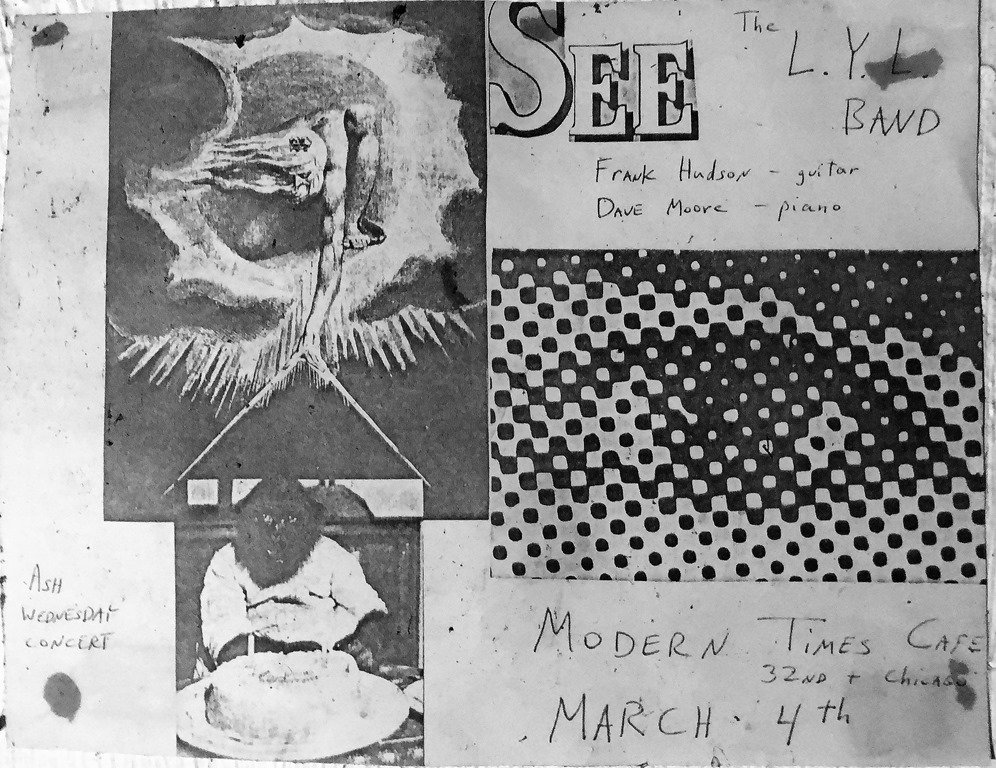
See the LYL Band Modern Times Cafe Ash Wednesday by Dave Moore 800

One of Dave Moore’s posters for the LYL Band appearing at the Modern Times Cafe in the early Eighties

.

Audiences were small, but it was fun to do. The stage had an upright piano for Dave to play and the place had two vocal microphones connected to a low-volume PA. I played an acoustic guitar which I had to pick with all my might to keep up with the volume of Dave’s two-handed piano chording. I was the weaker of the two of us as a performer, but because of our equality practice of alternating songs, I could feel that Dave’s steadier and more confidently presented songs could keep the audience satisfied, and I enjoyed the accompaniment role during his songs.

So one day, we’re playing on the Modern Times stage to a small crowd. Late in the first set we did a topical song of mine “The Ballad of J.W. Hinckley,”  a song set parodically to the form of Steely Dan’s “Do It Again.”  The song was voiced as being sung by the titular young man from a well-off family who had just shot President Reagan and his Press Secretary in the hopes of impressing Jody Foster. The point of the song was that due to Hinckley’s privilege and America’s laissez-faire gun regs, he was free to make his attempt even after he’d been caught trying to carry guns onto an airline flight. Yes, I suppose there was a wicked wink in my use of the chorus borrowed from Steely Dan’s song: “You go back, Jack, do it again” — but the subject of the Dan song is a chronic loser, and the Hinckley character in my song was non-heroic too.

We took a little break between sets and we were winding up the first song of our second stint when a thin older man entered the dining area carrying a long-gun. Dave was sitting at the piano, facing sideways, stage right. I was right down in front at the lip of the low stage. The man walked up next to the stage, raised his gun at me, and began his spiel.

So what! Let’s take up a song in honor of Mr. Reagan — in his honor….He’s a wonderful man. He may turn this country around. Let’s have both sides of the story. I think I am well educated (both sides) and I don’t have a pointy head anymore.”

Well, once again someone was missing the subtle point a song was trying to make — but I didn’t try to debate the armed man. In my ER job I’d dealt with many angry people, even agitated, insane folks in the midst of mania or paranoia. My default tactic in such ER cases was to listen to them calmly, perhaps waiting to gently redirect them if they calmed down or had a question. It was actually rare in my ER years to have to struggle to restrain them (those who had been violent outside were brought in already restrained).

I listened to the man talk, trying to present myself as interested in what he had to say. What he said seemed almost composed, as if he was (like myself) trying to perform. He was present for less than a minute, but in gun-time things slowed down. I remember trying to judge just how much height I had from the low stage: could I kick or throw myself down over the leveled barrel of the long gun, forcing it to ground, followed by my younger body pinning the older man? No, my acoustic guitar would impede me. I can’t recall if I thought to look at the position of the man’s trigger finger — perhaps I thought such a clear glance rather than paying attention to his speech might be a tell. I didn’t have time to recalculate much, as the man finished saying his piece, turned and walked out onto Chicago Avenue just as he had come in.

Dave, I suspect elevated in expressiveness from being in his outgoing performer mode, said into his vocal mic “We love it when guns show up!”

Did this incident cause me to have stage fright problems? You might think it odd, but it did not — I still wanted to perform, but my problem as a performer continued to be my lack of sufficient performer’s skills and my issues with being confident in what I was able to convey, leading to a progression within a performance of accumulating failure of “nerve,” and the ability to project confidence.

On top of one of the tables in the Modern Times dining area, I had placed a little tape recorder to record our performance. I’d hit record for the second set minutes before the man walked in with the gun. Later that year when we created our only official record, we melded in part of the incident as an intro to the studio version of “The Ballad of J.W. Hinckley,”  and you can hear that with the audio player below. One additional note on the ending part captured in this performance of the song: in my younger years I could improvise poetry over guitar. I think I was modeling that on early Patti Smith, whose first recorded pieces captured at poetry readings were done that way.

Audio player gadget below. What, no gadget to be seen? It’s not stage fright, it’s just that some ways of reading this blog will suppress showing the player.  This highlighted link will open a new tab with its own audio player.

.

*In most hospitals these days they’ve been expanded to departments or subsections, with varying services. All the systems that deal with the acutely ill, trauma victims, mental health crises, or those that have no other place to go for healthcare have been expanded — and I lived through a lot of that change in my lower-level position — but the first Emergency Room that I worked in was literally a room or two located by a ground level entrance where an ambulance could pull up likely staffed by folks with a higher degree of licensure to drive a commercial vehicle than medical training.

**This was in effect a largely white effort to revive a largely Afro-American genre of string band music with vocals that often would include double entendre songs performed at lively tempos. One advantage in the commercial folk-revival was that a jug band group could allow more specialization, grouping effective instrumental musicians with appealing singers. In the mid-Sixties US West Coast, the Grateful Dead and Country Joe and the Fish started as jug band revivalists. On the East Coast, Jim Kweskin’s Jug Band and the Loving Spoonful worked out of that style.

***Exceptions? We did cover two Fugs tunes “Slum Goddess of the Lower East Side”  and “I Couldn’t Get High;”  and though we never played them live, we did play the Velvet Underground’s “White Light/White Heat”  and an original song adapted from a local poet’s poem called “Pussy from the Black Lagoon”  that was renamed on our sole official recording to “Lucy from the Black Lagoon.”

The Fugs were typical male mid-century bohemians in that women’s equality and perspectives were issues rarely addressed. One of my early original songs from 1980 dealt with the then famous case of Mary Cunningham, a freshly promoted VP at the Bendix Corporation who was rumored to be having an affair with the CEO. Employees gossiped, and the Corporation’s board requested that Cunningham be fired. She resigned. The CEO? He remained. I didn’t know then, and I can’t find a quick answer in a web search today if they were actually having an affair, though the two did marry

Lilacs (version) — Amy Lowell as Patti Smith

Attention is an investment. Today’s piece combines two poets that had my attention this Spring. Regarding one poet, this expenditure was long-standing, for the other, the attention is more short-lived, conditional. My attention requests yours, so let me get on with this as I try to be brief while providing context.

Fifty years ago I had just bought a cheap nylon-string guitar from the unsold Christmas stock at a local J. C. Penny’s store. I was learning to play it because I, a poet, wanted to write songs. I can’t say much for how substantially I’ve mastered guitar playing, but I have learned how to make songs.

I had models in early 1975 for what I was trying to do. My internal list of influences was shorter than it would be now, but it wasn’t just one or two. Certainly one was a young woman roughly my age who I’d read was performing her poetry with an electric guitar player and who had written a few literary pieces I’d seen published.*  In the Fall of 1975 she released her first record album. I bought that LP the week it was released, likely at the sprawling Lloyds store on the edge of town.

The Seventies were a heyday for recording. The record business had recently become bigger economically and Rock music was huge culturally. Oddly, at the same time of this growth there was a falling off of the visionary and exploratory stuff that had attracted me as a teenager. Key artists of the previous decade had died or been diminished. Commercial filters along with endemic chemical narcissism and dependency reduced the force of many of those still recording. That debut record I eagerly bought — Horses,  by the Patti Smith Group — was nothing like those compromises, and it retains considerable uniqueness to this day. It’s a poetry record as much as it’s a Rock music record. Large portions are chanted rather than sung. Smith’s words, however delivered, demanded a listen from the heart and the pelvis before taking the long-way around to the brain. What Smith was doing wasn’t unprecedented for a woman (or a man for that matter), but it was rare then, and still is. But I don’t want to diminish the music on the record either, the band, the Patti Smith Group, were also doing things underrepresented in 1975, despite their irregular formation. Writer Lenny Kaye had been the electric guitarist backing Smith at those NYC poetry readings earlier in the decade, and now he had another guitarist, Czech refugee Ivan Kral, to expand the sound, along with a rhapsodic keyboardist Richard “DNV” Sohl, and a drummer, Jay Dee Daugherty, who had joined the group just before going into the studio. They were fellow explorers to Smith, willing to go places they didn’t have charts or established trading routes for.

Horses  gathered some attention. It was the spearhead of a musical revitalization movement that soon got a reductionist name: “Punk Rock.” Released on a major record label in this era meant that it had to be reviewed. While Horses  is now recognized as a landmark, a signpost to new paths, the reviews then were mixed, though usually respecting its ambition. It was not a commercial blockbuster, sales were modest, but that was OK then as first albums were allowed mere “worthy of attention” response. My own reaction wasn’t as a critic or chart watcher — I needed inspiration, and I overwhelmingly welcomed it.

To get to today’s Parlando piece we need to move on to the PSG’s meeting up with the problematic-second-album syndrome. That album, Radio Ethiopia,  sold even less than the first, and the Rock critics were even more mixed in opinions. It was a shot-by-both-sides response. These contradictory judgments were issued: it was even less commercial than Horses,  it was trying to be a mainstream Rock record and so wasn’t Punk; it indulged too much in Smith’s self-mythologizing (evidence: she, a woman without credentials, played naïve guitar on the LP’s longest jam), it was too much a band-record featuring the Group instead of Smith.

I liked Radio Ethiopia. More inspiration as far as I was (and still am) concerned. A song from that doomed follow up has remained in Smith’s repertoire for the rest of her career: the breakup song “Pissing in a River.”   In this linked 20 minute 21st century account of Radio Ethiopia  and that song, Smith herself movingly describes her state of mind while making that expression. She was so full of doubts that the wholly committed vocals that mesh with Ivan Kral’s compelling four-chord cycle in “Pissing in a River”  are credited by Smith to her brother, who came to the studio just to stand next to her, silently, at the mic. Last time here I spoke of how our relationships with others broaden what we see and report as artists. I teared up listening to Smith’s account this week, another testimony.

Lilacs

The version I used for performance is roughly half the length of the original poem.

.

This Spring, as I made tentative plans for National Poetry Month pieces here, I made a note next to a poem “Lilacs”  by pioneering early 20th century Modernist poet Amy Lowell: “Long. Maybe do it Patti Smith style?”

I have not played much attention to Lowell, though one musical performance of a poem of hers is a personal favorite of mine. In the landmark era when English-language Modernist poetry emerged, she was a controversial figure — those mixed reviews again. It’s undeniable that she helped popularize the new free-verse style as a poet, anthologist, critic, and promoter — but otherwise these were arrayed against her: she was a woman, not gender-conforming, overweight, and suspected of being a wealthy bougie poetic interloper on the bohemian Modernists. I’ll add my own personal count against Lowell: a lot of her poetry doesn’t consistently reward my interest. My current theory is that she’s something like Wordsworth, a poet whose best work may be diminished by a mass of undistinguished work, and great lines sit next to meh ones. But also like Wordsworth, her value in theorizing and promoting a new prosody must be acknowledged.**

“Lilacs,”  the poem that gathered some of my attention, is an example of the good and bad as I see things with Lowell. There’s immediacy in the poem that attracts me for performance (Lowell was an enthusiastic public reader). “Lilac’s”  theme, remembering her New England ancestry,*** would befit her cousinoid Robert Lowell later in the 20th century, and I loved lines that sounded like Allen Ginsberg (“Clerks….reading ‘Song of Solomon’ at night, so many verses before bed-time, because it was in the Bible”) and Frank O’Hara (“Parks where everyone walks and nobody is home.”) ****

So, I did one of my “use what fits me best” editing jobs on Lowell’s original text, excerpting what I thought of as the most vital images in the poem, reshaping some of the lines, and following through on my first-thought of performing it in the manner of the Patti Smith Group.

That incantatory “Pissing in a River”  chord cycle was a good match. I needed to rotate myself into each player’s role to create the ensemble, getting the rhythmic core down with a drum program, adding a bass line, and then performing each channel of the song’s double-tracked rhythm guitar bedrock. I used a sophisticated arpeggiator to create a right-hand piano part, but on evaluation I was so proud that I could get the just-little-different precision of the doubled guitar parts that I removed the piano.*****

Now it was time for the vocal recording pass. I made an unusual choice to try to improve what I fear is the least successful part of my recordings: as my expedient to Patti Smith’s brother undergirding her resolve, and only as preparation for the take using Amy Lowell’s words, I recorded an entire “scratch take” performance of “Pissing in a River,”

My four-chord riff cycle isn’t played exactly as the PSG recorded it, but the last part of my recording was an even larger departure from my inspiration. As a musician I’m a full-idiot/half-way savant. The part I’m most comfortable in is lead guitar playing, so my version isn’t a copy of theirs, I looked to another mode, their adventuresome NYC scene-mate guitarists: Tom Verlaine, Richard Lloyd, Ivan Julian, and Robert Quine. The performance in my recording of “Lilacs (version)”  includes what some (many?) would consider overplaying. As I (too?) often do, I continue to play during the vocal passages. I know this is incorrect — but more than correctness, I worry that it might detract from the song. Asking myself why I do this, my answer is that because my voice can’t provide the melodic elaboration I’d offer if I was a more skilled singer; and as a poet, I think the words can be (are?) powerful enough to compete with wailing electric guitar.

I leave that last thought with this restatement: as a writer, it’s OK to whisper — understatement has its power — but even if you read unaccompanied, or write for the silent but companiable page, consider if your chosen words are committed so they could go toe-to-toe with a cranked guitar. Sometimes you might want that.

You can hear my performance melding impressions of the 1970s Patti Smith Group with parts of the 1920s Amy Lowell poem “Lilacs”  using the audio player below. No player? It hasn’t been dropped by the record company man — it’s un-displayed by some ways of reading this blog.  This highlighted link is an alternative way to rock it, as it will open a new tab with its own audio player.

.

*The page poem I still specifically recall was “Dylan’s Dog”  (aka “Dog Dream”).

**As I mentioned recently, the issue of being too prolix and prolific with putting out work is something I worry about with the Project and myself.

***Like fellow New Englanders Cummings and Millay (and the British Housman) already performed this National Poetry Month here, Amy Lowell is presenting Spring as a memory of the quill-written past wafting through graveyards unkempt by their Modern age.

****As with a lot of early 20th century female Modernists, Amy Lowell dropped off the canonical map in mid-century as High Modernism and the New Critics came to the fore. Lowell’s popularizing efforts gained little credit as poetry sought a refuge in elite understandings and “serious subject” male-centric viewpoints. Our current century is re-evaluating that.

*****As a naïve keyboard player, arpeggiators are a crutch I often lean on. Give them a chord and their rule-based fingers will present a more sophisticated output. I border on shame when using them, though similar tactics are all over modern music. I’ve tried to bargain with my guilt by referring to my favorite arpeggiator as “DNV” — the nickname Lenny Kaye gave to Richard Sohl who was a vital elaborator of the earliest PSG records. “DNV” stood for “Death in Venice” because Kaye thought Sohl looked like an actor from the movie version of Thomas Mann’s story.

A Birthday, Vampires, and The Greatest Original Music Band Minneapolis Ever Forgot.

If Halloween is about shadows, ghosts, the dead and un-dead etc etc, it comes in the month I celebrate the birthday of my friend, the living Dave Moore, an occasional alternate voice here at the Parlando Project. Dave’s a poet, songwriter, cartoonist, and my longtime musical partner in the LYL Band. Back in the 1970s his lyrics were frequently used by “The Greatest Original Music Band Minneapolis Ever Forgot,” Fine Art.

I wrote about Dave and Fine Art a few years back. TL:DNR summary: Fine Art were a Rock band that emerged in 1978, issuing a self-produced, self-titled, vinyl LP, and then performing often in what few Twin Cities locations that were open to the handful of original music bands.* “Punk” was still the sticky label used for young bands that performed non-conformist new material then, but it was not a homogeneous scene of Ramones and Sex Pistols cadre three-chord-shouting-in-leather-jackets-and-frayed-cotton.**  Television, Patti Smith, Pere Ubu, Talking Heads — all these were formative bands in the Seventies, present at the beginning. Yet, oddly enough, labels like New Wave, and Post-Punk were generated to try to describe those that didn’t follow the stance of regimented simplicity for concentrated force and/or skill-set necessity. Fine Art were one of those from that non-traditional tradition.

As the famous Minneapolis First Ave club moved to presenting young original music bands, Fine Art played there regularly in the early Eighties, both in the small side-room the 7th Street Entry and in the big main room. When someone reprints a poster of that fabled club’s scheduled acts from that era to highlight Husker Du, The Replacements, Soul Asylum, or even Prince, you’ll often see the Fine Art band name playing the week before or after.

When this era is covered in overview, even by locals who want to concentrate on “the scene” not just the national acts that emerged, Fine Art barely makes the footnotes. That’s not exceptional, history-is-written-by-the-winners and all that. But here’s the thing: Fine Art’s material was all original (they never performed a cover), and it was very very good. The band two guitarists were excellent: Ken Carlson’s driving chordal center on rhythm guitar and Colin Mansfield the genius lead guitarist who could do song hooks or Free Jazz, sometimes in the same song. The two women lead singers format was unusual then as now, and the original pair Kay (Carol) Maxwell and Terry Paul, and later Kay and Jennifer Holt were effective. But it’s the songs, those constructions that were passing sounds on a club stage and remain only on the barely surviving and out-of-print records that shock me to revisit. They’re still  unconventional — and as such, they still sound fresh 40 years later. Dave’s lyrics are part of that, even if he wasn’t the only lyricist in the band.

Vampires. Coffins. Fear of being suffocated. A song with a Dave Moore lyric from Fine Art’s LP issued at the start of the band’s existence in 1978.

.

Fine Art didn’t survive past the Eighties, but the LYL Band still gets together. You still can hear songs Dave wrote and ones he contributes to here sometimes. I do my best trying to be musically adventurous to support Dave’s words.

In one’s youth you are told you should think of the future.

Generally, you don’t.

In one’s old age you are said to think too much of the past. I generally don’t. A smaller future is the treasure I consider, the treasure I want to spend. Playing with and knowing Dave is part of the treasure.

.

*I think this surprises some younger indie musicians or fans today. In the Twin Cities in the Seventies, if you wanted to play in public in a band you were expected to perform songs people knew, which meant cover songs. If you wanted to buck that trend, there were in 1978 maybe 2-3 places that would let you try it. When you hear of The Replacements doing one of their live piss-take cover song tangents, there’s likely just a bit of residual anger at that constraint behind it.

**In retrospect, many assume an amoeba, fish, surfacing amphibian, stooped monkey, biped man with club picture of how indie evolved from punk. But the earliest CBGBs bands were a very mixed lot. The Ramones stood out  because of their fast, faster, and fastest strumming rock minimalism in that scene. And Ur-source band The Velvet Underground mixed simple and complex, pop ambition and alienation noise with abandon. New Wave and Post-Punk existed from the beginning — or before the beginning. Fine Art may have produced fewer hard core adjacent songs as the band evolved, but they were always composing fresh, heterodox musical concepts.

Why am I presenting a song about Christopher Columbus?

I was long-winded last time, so let me try to minimize the gab today. I went to sleep last night wondering if I’ve ever done anything for an Indigenous Peoples’ Day. Though I’m going to keep my own comments brief, I can hear over the Internet a few groans. “Indigenous Peoples’ Day? Isn’t that one of those woke-ish things with a work-ish name meant to single out some small subsection of Americans?” Well, objects in my mirror are closer than they may appear to you.

The Twin Cities is home to a lot of what used to be called Urban Indians. “Indians” of course being part of Columbus’ “My dog ate my GPS” report back to the royals in Spain, where he imagined he had found a route to the frontiers of South Asia. My part of the Twin Cities has a lot of Mexican and Central American immigrants — immigrants that have DNA that says they were in the Americas before my ancestors were.  We’ve got folks around here from India too — makes things confusing.

But for any complaints about special holidays implying special pleading, this day is still widely known as “Columbus Day,” which with footnotes and explications, can be said to mark the start of European colonization of the Americas. But it’s widely known that the day became a holiday through the desires of Americans with Italian heritage wanting a day to celebrate that. I’m fine with that too, it’s just that where I live in our big and diverse country I’m more likely to be around folks who think of themselves as Native or Indigenous Americans.

So, here’s what I did today to hurry up and figuratively meet the Spanish boats with an Italian commander, and to celebrate Americans discovering them. Yes, what happened as a result is a complicated story, and I said I’ll be brief.

I recalled that the LYL Band had once covered a couple of songs on one past version of this holiday. One was Patti Smith’s “Amerigo”  from her under-rated Banga  record. I listened to it, and it’s kind of long and languid, and I’m not in that mood today. Then I listened to the other, a cover of a song from the Nazz.*  Now that was more like it, though my mix of the rough and ready performance from six years ago was not very good. So, I took some time to remix it today, not so that’s it’s sophisticated or genteel. No, it’s still LYL in its immediate punk mode. No acoustic guitar or my approaches to Jazz-my-way. This is turn it up and roar music. Also, some notes escaped being hit in the mayhem. Sorry about that, but in the right punk mode you may be able to deal with it.


You may want to turn it up loud.

.

*The Nazz were a group from the late Sixties that never got as much traction as their records deserved. Think of an American band that sounded like Laura Nyro or Loving Spoonful-era John Sebastian writing songs for The Who or The Yardbirds. Connoisseurs know The Nazz as the band Todd Rundgren emerged from. Todd’s talents as a producer and musician made sure their recordings sounded a lot more polished than our cover, but maybe he’d like our energy? After all, he did get the job producing the first New York Dolls LP (and the Patti Smith Group’s Wave  too). I think I even casually assumed “Christopher Columbus”  was a Rundgren song, but it seems that it was written by the band’s bass player Carson Van Osten. Van Osten went on to have a considerable career behind the scenes at, of all things, Disney.

What the Thunder Said Part 4 and completing our performance of “The Waste Land”

During this project’s first April #NationalPoetryMonth back in 2017 I started what has become a 5-year serialized performance of the entirety of T. S. Eliot’s “The Waste Land.”  And here we are today, finally completing that portion of our Parlando Project.

Why “The Waste Land?”  for this lengthy each-April presentation? Several reasons.

Like a number of literary cultural artifacts, the single thing widely known and carried forth from it is only a single line. A certain significant ratio of us knows “The best of times, the worst of times,” or “Do not go gentle into that good night,” or “To be or not to be” — and so you may know “The Waste Land”  from its opening line: “April is the cruelest month.” That small keepsake of a long poem is much brought forward for anything that occurs in any April, and as much or more than Chaucer’s April preface to his Canterbury Tales, it’s likely the reason April is National Poetry Month. As an opening line it’s not misleading. Much cruelty happens in Eliot’s poem. Is it cruel to be kind as Shakespeare and Nick Lowe might put it? Is it just cruelty for shock effect — or can it cure, however partially? Our long serialization explores that, covering all those parts that you may have forgotten even as you remember and repeat the first line only.

“The Waste Land”  is also a landmark, a milepost, a line in the sand for a certain kind of Modernist English language poetry. While this project is not entirely about the rise of Modernism, the current rules of public domain make work from the first quarter of the 20th century the latest I can surely use for my project’s purposes without complications. If time permits me, I may follow up today’s post with a later one about what I’ve learned about Modernist poetry before and after “The Waste Land”  while working on this project; but when I first encountered the unescapable “The Waste Land”  in a schoolbook and classroom as a teenager one thing that I understood about it (perhaps the only thing I understood about it) was that it’s quite musical in most all of it’s movements.

“The Waste Land”  is not, at least in America, a beloved poem from what I can tell. Even among college-education-exposed Americans it’s not commonly memorized, kept in a commonplace way, used for occasions, or re-read for pleasure or new insights. Consistent with that, for the most part, these every-April “Waste Land”  segments have not been among the most popular here.*  Even among poetry lovers there are some that actively dislike it, find it a pretentious mishmash overrated by those afraid to speak plainly. Eliot himself seemed to avoid speaking about it or reading sections of it at later public readings. He may have thought his later poetry more accomplished, but I also wonder if he didn’t care to revisit the more unbounded elements of his life reflected in The Waste Land.

Which brings me to the main reason you’re about to get a chance to hear this performance today: The Waste Land  is not just one thing by design or execution, but it is significantly about someone in the throes of depression. Indeed, much of this year’s final section, “What the Thunder Said,”  was first drafted while Eliot was hospitalized for this. This section is not “The Waste Land”  of scholarly footnotes, bank officer work, gender blurring and questioning, or the knowledge of a night-class schoolteacher for working class women, or the lament of a man who has a personal sense of the intimate losses of a great war. This is the howl of personal despair of a consciousness who can portray those things — and it’s the howl of someone seeking to explode and break out of that state.

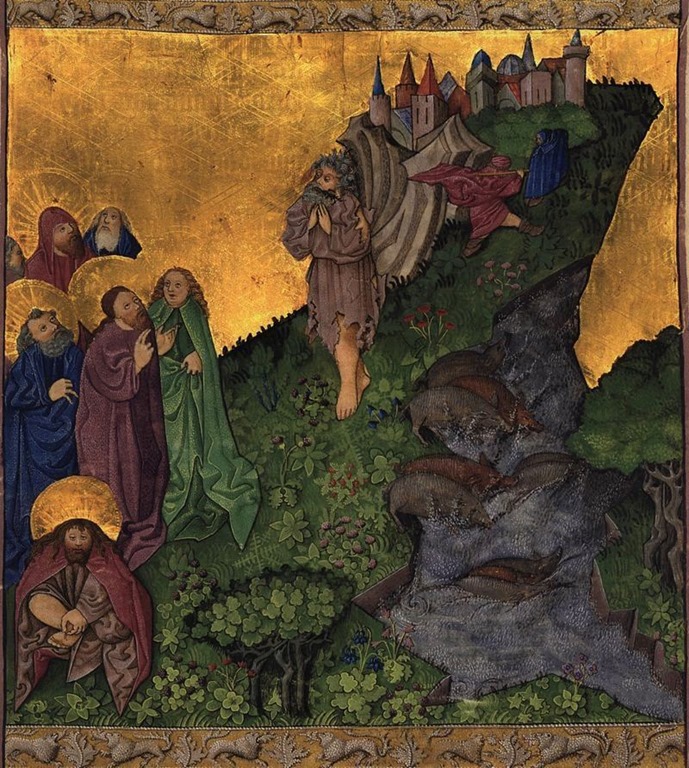
The LYL Band performance you’ll hear if you click on the player at the bottom of this post is a live performance from more than a decade ago, long predating the other sections I’ve presented here of “The Waste Land”  over the past 5 years. At the time of that performance I myself was emerging then from an episode of depression, one of two I believe I have gone through in my life. Depression has a variety of feelings and absence of feelings, and if one reads good writers describing their own depression experience you may well get a sense of the blind men’s elephant of fable, but my own feelings on the day and hour this was recorded were largely feeling sick and tired of those depression feelings. At some level I felt this section of Eliot’s poem was similar to what I was seeking, feeling, finding: an expression of an expiation of that, of demons transferred into mad pigs being cast into the sea. This coincidence of my life, a performance, and the poem would make it dear to me.

Ottheinrich Folio casting demons into swine

Jesus casting demons into swine. Guitar feedback not shown.

.

As I said, this is a recording of a live performance. Besides my voice and electric guitar playing, you’ll also hear Dave Moore’s voice spontaneously following along as I unfurled mine. I was cold-reading Eliot’s text here, I had not rehearsed or prepared for this performance, other than printing out the text. Embarrassingly, as I reached many of the foreign words in the text and fully in high transport of the moment, I mangled their pronunciation or dropped them from the reading. I used a handful of short samples you’ll hear mixed in the background to restore some of the dropped text.

In later, calmer reflection I continue to think this element of expiation is part of Eliot’s design here. A line I recall feeling strongly and intimately as I came upon it in my reading and performance that day is:

We think of the key, each in his prison
Thinking of the key, each confirms a prison.”

Whatever part of the elephant of despair or depression you might jiggle, touch, or be crushed by, we think of the key. Can we also think, hope to think, expect to think, of the prison as invalidated, destroyed, or obsolete?

What you’ll hear if you click on the player or hyperlink is rough, it has some mistakes, and being recorded live there is little I can do to fix them — and by intent it’s not a very genteel and formal presentation of Eliot’s poem. If that was my intent on that day over a decade ago, I today renew that intent by concluding our long, serialized The Waste Land  with this performance that predates all the other segments. In one of Eliot’s later poems (“The Little Gidding”) that he may have uprated over his 1922 landmark, he wrote:

We shall not cease from exploration
And the end of all our exploring
Will be to arrive where we started
And know the place for the first time.”

And so it is here too: every episode for this serialized presentation of “The Waste Land”  has been informed by that beginning, performed and recorded long before, that is now being used at it’s conclusion.

The player is below in most full-fledged web browsers, but this is an alternative hyperlink for those reading in apps or views that won’t show the player gadget. Yes, a longer audio piece than we customarily present —nearly 14 minutes — but it may still be worth your time and attention.

.

*For whatever reason, the Hyacinth Girl segment is one part that does get viewed over the years.

The Little Car

Poetry as an immediate witness to momentous history is not a common thing. Poems of events tend to autobiography, deaths, love, births, personal injuries and triumphs. Today’s piece has both elements—memorable on both counts.

Guillaume Apollinaire is a major figure in Modernism with an influence across the arts as a critic and theorist. He popularized the term Cubism, invented the term Surrealism, and using his own name “Orphism” helped explain and formulate abstract expressionism. In the era surrounding WWI his influence and omnipresence was stronger from his base in Paris with French-speakers than Ezra Pound’s was for English-speakers from London. As a poet Apollinaire bridges the 19th century Symbolists to the Dada and Surrealism to come, and though he wrote in French, many of the English-language Modernists looked to French models for their verse.*  While his work is experimental with form and language, it’s also very open-hearted and joyous in a way I associate with later 20th century American Frank O’Hara.

“The little car”  tells of a day of Apollinaire’s that would change his life. On that biographic matter alone it would be of interest to literary historians. But it also tells us about the early days of the most influential event in Modernism, the outbreak of WWI. Apollinaire’s poem is comparable to W. H. Auden’s better-known beginning of WWII poem September 1, 1939.”

So, let’s begin talking about the poetry as history today.

World War I started over a series of days earlier in the month of August 1914, kicked off by a ham-handed assassination in the Balkans at the end of June, followed by a slow enactment of various alliances and agreements plunging the whole world into warfare over the course of weeks (or in the case of the U.S., years).

Unlike the reputation of WWI as a brutal struggle of attrition between trenches, the opening August weeks were fast-moving. German troops cut through Belgium taking over that country in short order, putting them at the northern border of France as they met the French army. Large military movements and formations just slightly modernized from the Napoleonic era, that still included cavalry charges and fife and drum, met modern artillery and rapid firing weapons. Aerial bombings were introduced to warfare (though ground-based actions were more deadly to civilians). Soon amplified by propaganda, there are widespread accounts of bestial atrocities by the advancing army.**

Before the events of today’s poem, which self-dates itself to the end of August 1914 and into the following September day, during the Battle of the Frontiers, France’s army had suffered its largest single day of deaths and casualties in this or any war before or since, a staggering total of 27,000 killed in one day, with a figure of 300,000 casualties. The French army was reeling, withdrawing back toward Paris, which was the Germans’ objective in this first month of the war.

Apollinaire and his friend the artist André Rouveyre are in Deauville on the northern, English Channel coast of France. The poem doesn’t say, but I’m assuming they feel that the German advance is threatening their location, and so they do what threatened people unsure of the future often too, they head for home, Paris, not weighing that the French capital is the objective of that invading army.

The Little Car printed_Page_1The Little Car printed_Page_2

Here’s my new translation of Apollinaire’s “La petite auto” used for today’s performance


That they leave “a little before midnight” is not just an image of imminent dark change, it also may say something of a necessity not to wait, or perhaps a decision that traveling at night, as difficult as it might be with primitive headlights, may be safer under the cover of darkness.

The poem continues with a series of Symbolist images, assembled in whatever order, as a Cubist painting might be. These are not mere inventions. Although expressed symbolically, they are reportage. Indeed, some of the symbolic events which may seem mundane to us in our world, would be accounts of dreadful wonder in 1914: men fighting in the sky, submarine monsters of war—the masters/merchants of war with their opulent and extraordinary wares.

Another feature of this poem is that the text begins to wander on the page and eventually is laid out in a manner that Apollinaire called “Calligrammes” to form the shape of “The little car”  of the title.***  I’ve not included that concrete poetry text in my new translation for reasons of length and focus on the spoken potential of the piece.

The poem ends with Apollinaire and Rouveyre arriving in Paris on the afternoon of September 1st. I note the poem says they stopped for a bit in Fontainebleau, just south of Paris, which indicates that they took a round-about route that day since Fontainebleau is south-east of Paris though they were coming from the north-west of Paris.

The “mobilization posters” he speaks of that were being put up as they pulled into town tell of the irony of their route to escape the Germans. The German army is now threatening Paris itself, advancing to between 20-30 miles from the city, and legend has it that the French army was able to redeploy quickly by dragooning the entire taxi-fleet of Paris.****

What happened after the events recounted in this poem? Apollinaire fought in WWI for his adopted country France, and in 1916 was seriously wounded. Still weakened by the wounds, he’s felled by the infamous flu epidemic of 1918, two days before the end of the war that would reshape and extend Modernism, as Tristan Tzara would say in his moving elegy “He would have rather enjoyed the fact of victory.”

Many of Apollinaire’s WWI generation lived on as forces in my post-WWII lifetime, as still-living actors in the culture, but Apollinaire was not to be one of them. So influential as he was in the early-20th century’s cultural ferment, it could be said that his death during the war was the single most important cultural casualty, more important than the death of promising poets such as Edward Thomas or Wilfred Owen because Apollinaire, like another casualty, T. E. Hulme, was more than just a writer, he was a leader and promoter of ideas. You can make the case that his death is the same magnitude as some alternate-time-line where the world lost Picasso in 1918. Or you could make another judgement: he was so effective in the pre-1918 years, and the Modernist urge was so strong and then intensified by a world war that made the old artistic forms seem like a cavalry charge against machine guns, that his continued life was not crucial. That’s a cold debate. His friends sure missed him, and kept working.

Pop and Apollinaire

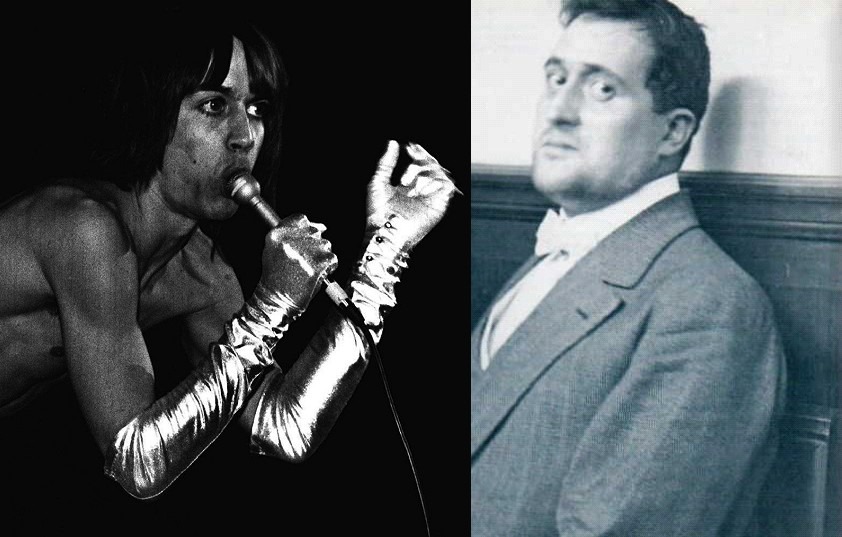
Dionysus and Apollinaire.


Musically I’ve had this thought lately that I’ve avoided use of some of my most basic musical genres. And Iggy and the Stooges are the definition of that. They started as an art project, making free-form noise on stage, with Iggy Pop, a converted blues-band drummer as their front man. Somehow they decided that the most elemental and elementary expression, however untutored and unvarnished was the way to go. Iggy Pop’s lyrics were the Blue Undershirts  of 60s rock, the rejoinder to “you call that poetry.” A song such as “1969”  from their debut LP is a bored and hedonistic critique of a year deep in another war, cultural and shooting. Robert Lowell it’s not. It’s really not. No, it’s really really not.

For this performance I’ve enlisted my son, the “in his first year of it” bass player and singer, who from his interest in punk and indie-rock can explore that aesthetic with a fresh set of fingers. Conceptually, this song is inspired by the Stooges “1969”  because here we have (with “The little car”)  two songs about war across a nation,***** but in my tribute I simplified the Stooges’ typical 3 chord trick into a 2 chord chug. Of course, to my son the Vietnam era is exactly  as old as WWI was to Iggy and the Stooges. All wars should be so old.

Here’s the text of “La petite auto” in French with the calligrammes section.

The player for our performance is below. Click on play and turn it up.


*And the French in turn sometimes looked to American Walt Whitman, who never found full favor with the English language avant garde, making the French vers libre writers  poetic money-launderers!

**Posters about the evil Hun that I happened across in visits to the Iowa Historical Society museum in my childhood impressed me with the arbitrariness of racism: roughly as subhuman as any Jim Crow or evil-Asian propaganda. When you ascribe evil to an other, skin pigment is just a convention that you can work around.

***E. E. Cummings was heavily inspired not only by Apollinaire’s dropping of punctuation, but his freeness with placement of text on the page.

****The taxis that saved Paris legend may not hold up. But my favorite part of this linked story? The account that the taxi owners kept the meters running and presented a bill to the government after the battle. Paging Joseph Heller or Milo Minderbinder to the white courtesy phone.

*****Or not—at least by intent. On the rattling plastic luggage record players of the time, I always heard Iggy Pop’s opening lines in 1969 to be “It’s 1969 OK/War across the USA.” Some cover versions say I’m not the only one who heard “war” as part of the folk process. The published lyrics and close listening with headphones say Iggy was singing “All across the USA.” Well, excuse me while I kiss this guy. The Iliad  was carried by an oral tradition long before it was written down. Regression analysis says Homer wrote it about some sunny Mediterranean partying and dancing. The homoerotic and warfare parts were just misheard by the folks in the back row.

The Story of Dave Moore and Love Songs

Don’t worry, we’re only taking a break from our regularly scheduled mix of various words (mostly poetry) with original music to tell the history of the Parlando Project’s alternate voice Dave Moore. So far in our story, he’s gone from poet to pioneering Twin Cities indie band lyricist to full-fledged songwriter to singer-songwriter-keyboardist for a two-person band of poets with instruments in about two years. If you’ve been following along, I’m the other poet.

How did this turn out?

Returning to 1980 after the release of the Lose Your Lunch Band’s Driving the Porcelain Bus  recording, the two-man-poet-band thing seemed to be a problem. Around this time a handful of Twin Cities indie rock bands had eked out a local circuit of venues that would book them. This was all very tentative, and only sufficient to give bands the initial toe-hold on a career, and it wasn’t really open to something as sparse and loose as we were. Could we possibly have tried to push that square peg, a “hardly rock band,” into that circuit?

Perhaps. We started looking to fill out the band, with the drummer being the biggest problem. I had started to dabble with electric bass, and Dave’s Farfisa combo organ had left-hand gray keys which could be dedicated to keyboard bass duties in the Ray Manzarek mode. The first third was Jonathan Tesdell, a guitarist who had a set of congas, and who was drafted out of a commune down the street. Jonathan practiced and played with us for a few gigs on electric guitar, but I can’t recall us ever even trying the congas as a replacement for a more rockist drum set live. But after a few months, Jonathan left town, traveling light. I once heard that his Gibson Firebird electric guitar that he sold before packing for travel was bought by The Replacements’ Bob Stinson.

Next up was a very talented guy who I believe was working then in the live comedy and theater scene,* Dean Seal. Dave somehow recruited him**, and Dean played drums and bass. Of course, not at the same time, a limitation we overlooked because he was willing to play with us. Dean could write great songs as idiosyncratic as Dave’s, and he had a good singing voice (later recordings with Mr. Elk and Mr. Seal demonstrate his cabaret-ready performance chops***). Dean later went on to a long and unique career, leading the Minnesota Fringe Festival for several years, and in this century becoming a UCC minister who combined his theater and comedy experience with religion.****

A fully operational LYL Band

Performing “Magnetized,” the rarely seen, full LYL Band live in the ‘80s. L to R: unknown drummer (see below) Dean Seal, Dave Moore, and Frank Hudson


Alas, Dave and I had sort of lost the fire to play out around the time Dean joined up. I’m not even sure if Dean could have been the singing drummer (harder than it looks) and songwriting voice that could have given Dave a rock-club ready band. With us, Dean played mostly electric bass, and he took a liking to a cheap Japanese copy of a Gibson EB0 bass that I had found in a second-hand store. We traded basses, mine for his similarly low-quality Made In Japan bad-translation-of-a-Fender bass. That instrument sits next to me as I type this, and I still play it often on pieces you hear here. Somewhere in the later ‘80s the LYL Band went, as press-releases still say these days, “on hiatus.”

Why? When I asked Dave today he said he hadn’t thought of that, but as we chewed it over I think it was the matter of both of us, in committed relationships and needing to pay the rent and bills at the lower edges of the economy, gradually converting the concept of the public band to a private joy.

But as that was, almost imperceptibly to us, happening, Dave’s songwriting took one more turn. The goth and gothic Fine Art lyrics and the agitprop and Dada characters of the early LYL songs were joined by unconventional and sincere love songs.

It’s more than 30 years ago, but I can still remember the first time I heard Dave sing this song, as I have heard Dave sing many songs before or since, stone cold fresh. We didn’t often discuss songs before playing them. Unless specifically working out a live set, we didn’t work out arrangements, run through the changes or discuss accompaniment. We just let it happen for fun or failure.

So, there we are in the 1980s. Dave’s standing at the Montgomery Wards electric piano, I’m no doubt sitting with my Cortez 12-string acoustic guitar with a DeArmond soundhole pickup. I’ve programmed a simple three-drum beat on a Mattel Synsonics electronic drums toy. I hit record on the cassette recorder. Dave hammers out some chords and I figure out the key and some kind of pattern as quick as I can. He begins to sing—and I suddenly realize this is, surprisingly, a love song, a damn fine love song, though still uniquely Dave. What do I think next? Well, that I had better not screw this up. Playing lead/melody lines on a 12-string has a catch: the two highest string courses are tuned in unison, but move to the G string and lower, and they jump up to courses tuned an octave apart. Listening to this now, I can still feel how I kept that in mind as I played. If music be the food of love, don’t lose your lunch.

I have some later, better-recorded versions of “(I Think I’ve Lost My) Total Recall.”  The lyrics Dave wrote as a younger 30-something were good then, but when I perform or listen to this song now, thoughts of memory loss mixing with love are real as well as art representing the impact of love. As songs occasionally do, it’s gone from heartfelt to heartbreaking—but this is the moment I first heard it, and so, excuse the archival audio quality and listen.


As a bonus, although also low-fi, here’s what a putative ‘80s LYL Band as a fully realized rock band would sound like. We’d planned this gig at a Native American center with Dean Seal playing drums or bass on alternate numbers. We’d setup and sound-checked ourselves, and then left our instruments sitting on stands at the end of the building’s gym. As we left for the rest of the event before we played, four guys, unknown to us, went over to our instruments, and began to play them. They were pretty good as I recall, sort of blues-rock. We figured there was no reason to stop the better, volunteer musicians. They played a short set, maybe two or three songs or so. Later that night, the drummer asked if he could sit in for our set on Dean’s drums. Trusting in chance, that’s what happened. The song “Magnetized”  is a Dave Moore lyric, another love song, but I think I wrote the music and sang it here. Once more it’s a cassette recording, taken from the vocal PA that night. You can hear me slightly off-mic trying to let the band know when I’m going to the bridge and walking over to let the rhythm section know that it’s time to end the tune.


*Someone should write a book on that circa ‘80s Twin Cities comedy scene, and yet oddly enough no one has. Louie Anderson, Liz Winstead, Joel Hodgson, Kevin Kling, Jeff Cesario—and I could go on—were all starting out in the Twin Cities in this era.

**Dave remembers he was working as a record store clerk for a time at the Wax Museum on Lake Street, and his manager there, knew Dean, and probably introduced them. Dave doesn’t recall knowing anything about Dean’s theater and comedy work then, only that he played bass.

***One story is that when Mr. Elk and Mr. Seal recorded an album at Prince’s Paisley Park they did it so quickly that it was the least expensive recording ever made there. Here’s some of their work.

****Here’s an article that touches on Dean’s 21st century take on Christianity.

The Story of Dave Moore and Politically Pointed Songs

Today we’re going to have our first Parlando Project double-header, two pieces whose words and music were written by Dave Moore back in the 1979-1982 era and both of which appeared on the Lose Your Lunch Band’s only official release, the cassette-only Driving the Porcelain Bus  in 1982 1980*.

The LYL Band and Porcelain Bus  were not entirely political, but the elements of political protest and social commentary were a big part of it. Some of this was based around the election of Ronald Reagan as US President in late 1980 which at the time seemed to be the culmination of a long conservative struggle dating back to the early ‘50s.**  You could say it was like today’s post-Trump election era, and one could point to similarities, although the pendant in me could list considerable differences too. I’ll just let that rough likeness stand to simplify the history for our younger readers. It’s close enough for rock’n’roll.

Dave also points out that his spouse and her relatives at the time were politically interested, and discussions in their circle often included political analysis and issues. I’d add, knowing Dave from a decade before that, that the same could be said about him. Let’s just say that around 1980 it wouldn’t be strange for political dialectics to be part of a casual conversation in South Minneapolis, again, just as today.

But here’s something interesting I noted as I rethought those years, the local music scene really didn’t reflect that directly. I recall folk-singer Larry Long, a man who has sought to continue the legacy of Pete Seeger, as being around the cities during this era, but at least as far as recordings he comes later. John Trudell an activist and singer was based out of the region later in his career, but in the early 80s his musical expression was just beginning, and he was living in California then.

Of course, artists portraying the world and how people relate to it cannot help but reflect political and social connotations in their work, and to that degree that any of the biggest bands to eventually emerge out of the Twin Cities indie scene were political, it was largely that.***  Those bands had something to say about life: what they opposed, what they preferred. An argument can be made on both artistic and commercially-distributed subversion levels for that. But the songs Dave was writing then were sometimes upfront about their political stance. In those songs, subtext, which was also there, was what was beneath the politics, not the other way around.

See the LYL Band Modern Times Cafe Ash Wednesday by Dave Moore

Traveling to a telephone pole of the past, we see a Dave Moore Dada poster for an early ‘80s show


So, let’s step out of the history and into the songs.

Here’s “Scrap”  a companion song to “The Night Inspector”   which you’ve already heard here, inspired by Dave’s work in a machine shop in this era. There was a good live version sung by Dave on Porcelain Bus,  but I don’t have access to a digital copy of it right now, so in its place here’s a later solo acoustic guitar version where I sing it.


And here is an actual cut from the Porcelain Bus,  engineered by Colin Mansfield, just after he was helping Husker Du get underway, a song asking the rhetorical question “What’s Wrong with That?”


If you’re asking yourself, where’s the poetry and various musical settings that you’ve seen here before, know that I plan only about one more history-of-a-band post before returning to our regularly scheduled programing. If, on the other hand, you wonder how this all turned out, the next post will be about that.


And, of course, footnotes, but we reject the hierarchy of superscript numbers for asterixis!

*I’ve just located a few digital scans I made years back of the even then moldering materials form this era, and they show the the Twin City Reader reviewed Porcelain Bus (see footnote below) in their issue that covered the upcoming week interval of January 7th to the 13th 1981. This would mean we recorded it in late 1980 and probably released it before the turn of the year.

**for a detailed history of this conservative effort, I recommend Before the Storm  by Rick Perlstein. For me a lot of what he covers was current events, but for most present-day Americans, it’s history. His two follow-up books are good too, but why not start at the beginning?

***Two exceptions I can note, even if neither are the best-known songs in their respective catalogs: Paul Westerberg’s “Androgynous”  from the 1984 Replacements LP Let It Be,  a heart-felt yet casual sounding and appropriately ambiguous song about busting gender roles, and then Prince’s arch “Ronnie Talk to Russia”  from 1981’s Controversy,  where Prince sounds like the LYL Band would sound if they had Prince’s skills, work-ethic and recording studio (or at least a drummer and bass player). Perhaps Mr. Nelson was paying tribute to The LYL Band and our sound, but Prince’s song was released a little less than a year before “Driving the Porcelain Bus.”  OK, the new date for Porcelain Bus  means that theoretically Prince could  have heard Dave’s Farisa drenched sound before he used a similar punky combo organ sound on “Ronnie Talk to Russia.” File this under “improbable.”

OK, that last part is irony for you English majors, but Porcelain Bus  was reviewed and got a cover blurb on the local alternative weekly in 1982 January 1981, along with Prince protégé’s The Time’s LP. The blurb said “The Time Ain’t No Lose Your Lunch Band,” a statement that I think we can all agree on. The review said we might become a cult band. If you’ve read this far, you’re our last chance as cult adherents. You don’t have to shave your head, sell tracts, move to a compound in the country, or worship Dave as a semi-divine incarnation—unless you think it’ll really help. I believe Dave would rather be worshiped as an Andy Devine incarnation anyway.

Fog

I’m going to take a break from my Dave Moore series today, if only because I rather like this piece I’ve been working on and want to present it to you.

“Fog”  is likely the most well-known poem by Carl Sandburg without Chicago in its title, and it appears in many school textbooks where it serves as an introduction to metaphor. The Carl Sandburg who wrote it didn’t intend it to be a lesson. I think he wanted to write a Modernist, Imagist poem, the way a small group of others were writing them in the era roughly 100 years ago.

One thing I’ve learned searching out pieces for this project was that Modernism in its High Modernism guise has overtaken the work done by those preceding Imagist pioneers. As those who’ve visited here during cruel April Poetry Month will know, I enjoy somewhat those knotty, learned, collaged and college-ruled works that T. S. Eliot’s The Wasteland laid out. And World War I, we should not forget, was a terrible disaster with near untellable loss of life and loss of hope for its generation. WWI probably had to change things. The Carl Sandburg who wrote his early Imagist poems went about his pre-WWI world with an open heart and open eyes. In his poetry and in his political writing there’s a panorama of evil and survival, loneliness and stubborn love.

So, to reduce “Fog”  to a lesson on metaphor is to amputate that context, and to forget the Imagist quest to renovate entirely metaphor as it had been received by Sandburg’s generation. Imagist poems often wanted to break through the fourth wall of metaphor, to make it more than an a decorative, this stands for that, analogy. “Fog”  is fog, and the cat is a cat. Yes, they have meaning beyond that, all reality does.

You could start by asking yourself, if this is a real cat then, what kind of cat is it?

A house pet, one used to demanding the pricey wet food and best place on the dry, warm bed? No, it’s on the docks. It could be a ship’s cat, a fellow laborer, or a feral cat making do with what it can find there. It can’t call attention to itself for its prey and its own risk, and so it’s silent—and like its life and labor, obscured by the fog, by the cat’s own actions and the actions of the world. Sandburg sees his worth to see that.

Carl Sandburg at the machine of his labor

Carl Sandburg at the machine of his labor.

That’s an Imagist poem, a direct presentation of reality, with no false rhymes of conventional or show-off imagery. There’s love and respect in it too, for the working common of us, singing the insubstantial and all-covering fog of our lives and labor, that save for the notice of the poet or artist, is silent and then moves on.

That, dear readers and listeners, is why you should pay attention to Carl Sandburg, who’s nearly fallen out of the cannon of important Modernists and consideration as an important poet, who is, I tell you, as you are, more than an example of metaphor.

Remember back to the formation of the LYL Band were we self-labeled ourselves as “Punk Folk?” Given that folk music by definition doesn’t ask for certifications or approval to be performed, that was something of a tautology. It occurs to me that what I’m doing here with pieces like this, using a string quartet I play part by part along with two pianos (one electric) and a drum set could be Punk Orchestral. My string parts are extraordinarily simple, like unto a lot of downstroke strums of power chords in some Punk.

Decades back, the Pixies helped popularize the Punk soft/loud arrangement, but of course orchestral music did it OG before them, and I exploit that in this one. Some other incidental ideas that helped steer me in this piece came from reading some recent posts at the Brettworks blog, where a more trained and accomplished composer talks about some of his processes and inspirations. Specifically Brett was talking about creating a piano part that had enough space where the various notes could have enough time to express their decay trails. Musically, this piece started by exploring that idea, but then the string quartet decided to kick out their jam.

I peform Sandburg’s words like a stalking cat hunts, sliding forward and stopping, then slipping forward again before pouncing.  To hear this, use the player gadget below.