Searoads: a contemporary poem by Henry Gould

Today’s piece is rare for the Parlando Project: a presentation of a contemporary poem by American poet Henry Gould.

Contemporary? How contemporary? “Searoads” was written only a few days ago. I read it on Halloween when the poet shared it on Blue Sky shortly after it had been written.  Since I follow Gould on Blue Sky, I had read several of his poems before. He’s posted poems and poem drafts written serially as he works on a book-length opus dedicated to a topic. In recent Gould poem-series, historical time seems to take place simultaneously, and wide references to history and literary works weave through stanzas (or even within lines) of individual poems, this weave sometimes worked with the warp of wordplay.

That makes for a challenging density. Since my youth I’ve taken self-pride in being a history buff, and working on this Project has extended the poetry I’ve had contact with to a level that tests the working set of my old-guy memory. When I’ve got the energy to exercise those parts of my personality, digging into one of Gould’s poems can match up with those receptors. Gould’s work is ambitious and deals with earnest subjects, but I suspect it’s also playful. When you can catch, and hopscotch through the pattern of one of his sideways leaps to connection, there’s a pleasure in discovery – and this is so even though honest history and literature contains a great deal of conflict and pain.

I have a term I use for an effect I find in poetry – the polyphony layers of perceptions invoked with images, the melody of tracking from one thing to another like unto it, the intervals of sames separated by time – The Music of Thought. I assume this isn’t a new idea, but while study of the prosody of sound is commonplace, a prosody of the patterns when the images and what they present, composed in that order and layering, seems rarer to me. That I take any pride in writing about this is likely secondary to my ignorance of how thoroughly others have already written about this. I’m the kind of solitary, stubborn cuss that has to discover it myself to be able to integrate it into my enjoyment of poetry.

There can be a problem with the Music of Thought. While tastes in the word-sound-music may vary among readers and listeners to poetry, the effect requires nothing special in terms of shared knowledge. Children can enjoy Dr. Suess before they have much of a corpus of knowledge at all.*   Poems of Yeats, Eliot, Frost, or Emily Dickinson can charm us by their sound even when – if we were tested by some exacting taskmaster to do so – we couldn’t write an internally consistent and plausible essay on what they were on about exactly. Fear of that looming taskmaster kills poetry readership, but the lure of the pleasures of sound draws us back in. The Music of Thought may still be sensuous, but it’s more abstract, it requires more knowledge and attention from a reader.
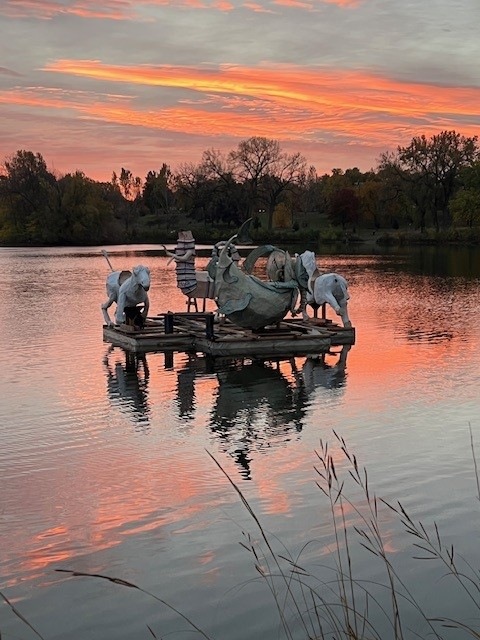
Assembledge in Powderhorn Lake Halloween 2025 by Heidi Randen

My wife shot this mysterious assemblage in Powderhorn Park at the dawn of All Souls Day 2025

.

When I came upon Gould’s “Searoads”  it was late in the day. I was in the context of the short-attention-span-theater that is a modern social media feed. Tough court for the poem?

The sound caught me first and last, and I also easily fell into this poem’s Music of Thought. In both musics, “Searoads”  drives forward attractively, and I was gathering meaning even on the first time through.**

How does it work? I’m bad at scansion (when creating music I’m habitually playing with offbeats and syncopations, sporting with measures, which probably demonstrates that I don’t understand the basic pattern well enough). Could “Searoads”  be intended pentameter with predominant iambic stresses? I read the stresses as having variation (which good verse should have) but I scanned the lines as having a goodly amount of iambs, while I hear them as predominantly four-feet lines.***

The use of rhyme here is excellent. I heard rhymes the first time through, but not the scheme – so I didn’t know when they were coming. My own ear or taste loves off/near rhyme, and that too helps the sound work without some regular clock-coocoo chime effect. If I take apart the mechanism, it’s ABABCABCA. And there’s a lovely moment in the poem when an extra C rhyme comes strongly in the middle of the last line of the first stanza with “infants.”

The poem has a few unusual words. I knew “sarabande” was a dance form that survives in European classical music, and I even knew that there is some dispute about its origin, including a theory that it includes American musical ideas adapted by Spanish colonialists in the 16th century from native central American music. I didn’t know the word “Argive” (of the Greek city-state of Argos) – but two things referenced in the poem were part of my attraction. On Halloween I was intending to work on a piece for All Saint’s Day (November 1st) or All Souls Day (November 2nd), but despite some effort earlier in the week I hadn’t found a suitable text. As I read Gould’s poem, he may be invoking circular reincarnated or pre-existing souls in the second stanza – so in celebrating all who have died and the unity of that human experience, we may celebrate all unborn as well. What a lovely autumnal thought! And the same stanza even needle-drops a line from one of the All Souls’ texts that I wasn’t progressing on making music for: the “full-fathom five (my father lies)” speech from Shakespeare’s The Tempest.

But one word (well, hyphenated, but…) is most responsible for the piece you can hear today: “Ark-Dove.”**** I suspected the dove sent out from Noah’s Ark to confirm the time afloat in the great flood was ebbing. When I asked Gould, he confirmed to me he was thinking of that too, at least in part, as he wrote his poem. In our troubled times, a great flood of destructions, on a boat stinking of animal effluents, I think we are waiting for the dove to return with a green twig – but I had another specific thing going off in my mind too.

There’s a folk song, collected in 1906 in Texas at a temporary work camp along the Brazos river. A woman there, washing clothes on that riverbank sang this song about being abandoned; but imagining Noah’s dove anyway, singing “If I had wings, like Noah’s dove, I’d fly down the river to the one I love.” Beside the song, the folk-song collector only got the name “Dink” for the singer. He wrote that he tried to find out more later, but when he returned to ask about her, she was gone from the camp and no one knew where. We cannot know if she found wings to carry her above the river or if the river carried her, submerged, down its current.

So, as I returned to the top to read Henry Gould’s poem for a second time on Halloween, I was already humming that folk song, known as “Dink’s Song,”  to myself as I read the words. The next morning, I had no Dink to ask for, but on All Saints Day I decided to work out some music to sing Gould’s poem. I did this with no expectation that anyone besides myself (and probably Gould, who I figured I’d just send it to, unbidden) would hear it.

I’ve been composing a lot in October on acoustic guitar, this meant I had some musical ideas to try with the words. I loosely based my music on the chord cadence from the verse of “Dink’s Song,”  (D G5 D / Bm G5 D) with an even looser variation from the song’s chorus on the last line of each stanza (D G5 D Asus2 D). I’m not a very melodic singer, and unless one knows “Dinks Song”  and reads this, one won’t hear the connection. I recorded this using my usual cross-picking technique on acoustic guitar while singing, and picked the best out of about five passes I quickly recorded that afternoon. I added a low-pitched piano part that emulates the way a tanpura is used in South Asian music and a bass part as I thought the piece needed a little more low-end activity.

Henry Gould received the recording and has graciously allowed me to share this musical performance of his fine poem “Searoads”  here. You can hear it with the audio player below. Has the audio player flown down river? No, it’s just that some ways of reading this blog suppress showing an audio player gadget. This highlighted link will open a new tab with its own audio player so you can hear it.

.

*Adults could enjoy challenging Modernist poetry more if they allowed themselves to initially listen to it (even silently) as a toddler listens to board books. For that matter, I assume Dr. Suess/Theo Geisel had Lewis Carroll and Ogden Nash in his ear when he wrote, but his poetry makes me think he was reading Gertrude Stein or Marianne Moore too.

**I don’t rate myself highly in understanding poems, but a short poem that draws me in usually gets a repeated reading where often my understanding changes. One of the pleasures of doing this Project is that that the poem I start with can change to a poem I understand differently by the time I’m done with the recording.

***Today’s short discussion of prosody demonstrates why I do that sort of thing rarely here. I suspect a combination of being bad at it (not getting the correct answers in my scansion) and distrusting the classic accentual/syllabic theory that may need to be followed more loosely to produce a sophisticated effect.

****”Searoads’”  unusual “Ark-Dove” with hyphen and capitalization made me think Gould must have had something else specific in mind, beyond my folk song and the Bible story. I did a quick search and found that two ships, the Arc and the Dove brought the first English settlers to Maryland – the Arc and the Dove are sort of the Catholic U.S. version of the Pilgrims and the Mayflower. What a rich reference! I asked Gould. Nope, he wasn’t thinking of that. Ah, but the muses Henry – they must have whispered in your ear.

And the poem’s title gave me thoughts too. Isn’t “Searoads” the way medieval English poetry might refer to a ships’ path?
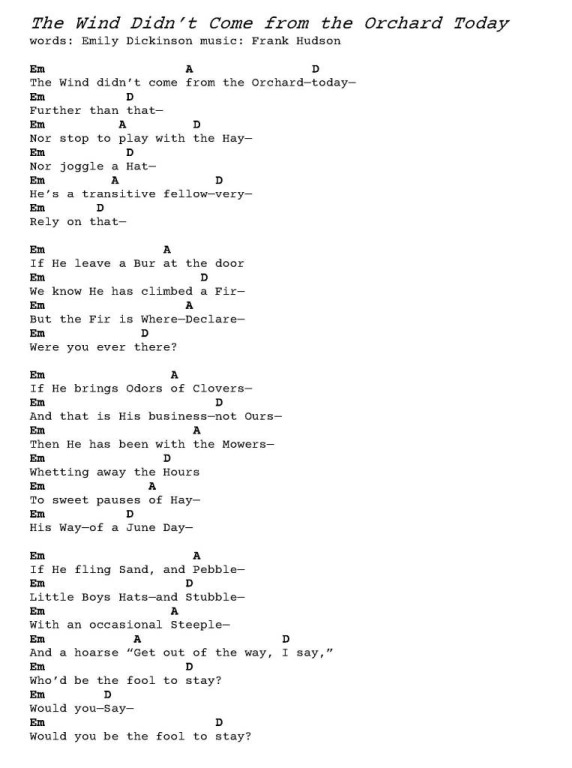
The Wind Didn’t Come from the Orchard Today

Today is World Poetry Day, and if I want to represent the United States poetically to the world, one of my first thoughts for a representative poet would be Emily Dickinson. Dickinson has many “Greatest Hits,” poems remembered, poems anthologized, poems that literary critics have generated essays from.

Today’s poem isn’t one of those, for whatever reasons. I suspect it seems too playful, even child-like. The Dickinson I was taught in my youth, when she was considered a less important poet than she is today, was at least eccentric, often gothic. But here there’s no death in a carriage, no fly-funerals — there seems no novel slant of light or truth being told. It’s just the wind, an ordinary thing — or that’s the first impression.

The other immediate impression the poem might give is from its sound. This is Dickinson’s prosody at its most exuberant. No stern march of iambs here, and the use of unpredictable rhyme, end and internal, near, imperfect, and perfect. I love the loosening of rhyme personally, though I know there are others for whom imperfect rhyme grates. But this poem is so rich with the rhyme and pararhyme:  today, hay, hat, very; bur, door, fir, where, declare, ever, there; odors, clovers, ours, mowers, hours; pebble, stubble, steeple; hay, day, say, stay.

The Wind Didn't Come

A chord sheet in case you want to celebrate World Poetry Day by singing it yourself. For performance I broke-apart Dickinson’s text, which is all one stanza —  indeed, a single onrushing sentence!

.

America is a big country, a big culture. We certainly have our perfect formalists. But we have artists, like Dickinson, for whom form, and perfection in duplicating the form, is but an armature on which to improvise variations. While I’m one small ear compared to American Culture, I’ll take Dickinson’s side and place this poem in evidence.

Another thing to love in this one: the asides, set off with famous Dickinson dashes. “He’s a transitive fellow — very — rely on that” for example.

OK, so is this a musical slight-and-light poem about a playful wind we might meet in Spring?

Maybe.

Note that the poem starts off with a difference. The wind doesn’t come from the fruitful orchard.*  It’s from somewhere distant. When I performed the poem, I began with the sense this must be an important fact to lead the poem off with it, but I didn’t know more. A playful breeze is mentioned, but again in the negative,  this wind is too much in a hurry, that “transitive fellow — very,” and we can rely only on its capriciousness.

The sound of the “fir/where/declare” is so delightful, but what has happened here? Is the fir tree gone, uprooted, now out of place? Or is it just branches and seed-cones carried away from the location of the tree?

The sound of the mowers section is also delightful — and the work of hand mowing is so poetic one could create a whole suite of poems mentioning that kind of work — but it’s also the decapitation of anything above a height, and that’s always been part of the metaphor.

The final segment of the poem suggests a fiercer wind. An unremarkable wind might raise a little sand, but pebbles are being flung.**  A playful March wind might dislodge a hat, but here it’s a steeple that has toppled off its head and the thing is like a run-away carriage.

In my Midwest, tornadoes are a common and feared storm with extraordinarily intense, though localized, winds. Dickinson’s New England has few of these. However, in the fall of 1861 during Dickinson’s most active years as a poet, two hurricanes, storms that can have high winds spread over a larger area, hit New England. Detailed contemporary meteorological measurements for that sort of thing don’t seem to exist, but sustained 60 mph winds are estimated. Ships were damaged, a ship was lost only a mile from the Boston harbor light, there were storm-driven high tides, and so forth. How far inland to Dickinson’s Amherst and at what force level it reached there I can’t say, but Dickinson could have been writing from regional news reports.***

In the many decades since Dickinson wrote her poem, we might not at first be able to hear the runaway roar of storm winds when we brush up against this poem — just the rush and song of Dickinson. So today, I will prod you to sense the mystery of the weather and the wind which we do not control.

For those of you who may have noticed a bit of a break in posts this month, it was not due to anything bad, more at a lot of effort toward new composing and recording. For the first time since last fall, The LYL Band reconvened last week, and you can hear their full folk-rock band performance of my song made from Dickinson’s poem with the audio player below. Has that audio player gadget seemingly blown away? Some ways of viewing this blog suppress showing it, so I provide this highlighted link as a backup.

.

*The Dickinson household was engaged in raising some of its own food, with Emily and her mother being known as experts in that field. The landscaping has changed at the Dickinson Homestead, but I understand that fruit trees were part of their domestic garden in Emily’s time.

**An incident from my own life. After a tornado at a branch radio network studio a few decades ago, I got a box containing the studio’s Macintosh tower audio computer to see what could be done for it. I took the computer out of its carton, and opened it to see what I could see, and the interior was packed with pea-sized landscaping gravel that had surrounded the building that housed our branch.

***I first read about the hurricane here.  More about the pair of two Fall 1861 storms and how they impacted Civil War operations at this New York Times story.

Instructions for Angels

What I’ll write about today’s piece might be needlessly complex. I’ll try not to take too much of your time so you can get to the simple performance of the poem below and you can decide.

The usual job of a critical essay on a poem or other work of art is to explain how something works and doesn’t work, usually making use of, or in the context of, criteria for artistic value. Within these efforts, the spread of essays praising or condemning a poet, poem, or poems is maintained. There’s no contradiction here. How can there be good art if we don’t have bad art? Judgments, pointing out good and bad, are equally creative, just as when we are writing and revising ourselves.

Is this a critical essay? I’m not sure it is. Instead, I think of these pieces of prose as short notes about my experiences with the texts, nearly always literary poems, as I combine them with music and perform them. And in the case of today’s audio piece using Kenneth Patchen’s “Instructions for Angels”  my experience so contradicts what criteria I believe I have that it calls into question that I have them or really believe in them.

What do I think are the things I look for in a successful poem? First, I think poetry is musical speech. “Instructions for Angels”  is free verse, something formalists take as problematic. I doubt I’m a formalist. I admit the effects of rhyme and meter, but my musical sense admits also that the amount of symmetry and regularity can and should vary. There’s some underlying da DUM da DUM iambic back-beat feel here in Patchen’s poem, that King James version 17th century English thing that can itself now feel overused or overfamiliar. But familiarity is not always bad, no more than regularity in structure. “Instructions for Angels”  does clearly use one musical feature: the refrain. Perhaps this is what drew me to it when skimming through a book-length selected poems looking for what would be good to set with music. I’m not alone in choosing this poem. I’ve found several other musical settings online.

instructions for angels

Today’s piece is easy enough to play on guitar, so guitarists have at it.

.

I do think we too often confuse imagery with poetry’s essence, praising coded word-play rather than word-music. But imagery is a more abstract version of word music isn’t it? That this-is-like-that, or things arrayed in an as-above-so-below manner is an intellectual harmony. The intervals and combinations are pleasing as audible music is. “Instructions for Angels”  is plainsong in this regard. Yes, I suppose angels and God have a certain majesty, but as a recent coronation reminds us, tired pomp can bore quickly. The rest of the poem is full of threadbare, generalized counters isn’t it? “pretty girl,” “red mouth,” “baby,” “beautiful,” “rain,” “snow,” “flowers,” “trees,” “winds,” and “fields.” If one looks for fresh and arresting imagery this poem doesn’t seem to have it. If I was revising this poem or it was being workshopped, it would be easy to imagine changing a few of those general terms to more specific ones. I can see someone asking “But Ken, what flower exactly do you like? Give us the name so we can see it.”

How about a poem’s message? Shouldn’t that count for something? Yes, I think it should, yet over the ages critics can worry that worthy messages are too common, too cheap — or that art for art’s sake has judged any meaning as secondary. Writing in the 1930s Patchen was often reacting to a Modernism that was too inhuman, too concerned with form, and too unconcerned with the fates of its readers. I sense the present pendulum has once more swung and we are now again asking poems to tell us worthy things, and for the poets to be worthy people. I should be happy, yet I’m not always happy with poems on the right side of the issues. I wouldn’t like it if that was all the poetry I read and sing. Am I just cursed with contrariness? Should I note here that Patchen’s pacifism continued throughout WWII? That was a contrary position and not helpful to his poetic career at the time.

If a poem’s message is important, shouldn’t it be as clear as prose about saying it? How obscure can or should poetry be? Again, poems and critics differ on this, but there’s a consensus that a poem shouldn’t be harder to understand than it has to be.

That “has to be” is a broad thing however. Proponents of exciting and fresh images and language will say beauty and skill allows indirection, ambiguity is true to life, a little, even a lot, of mystery can compel, and that irony combats blandness and tiresome cliché. The greatest benefit of workshopping poems, or at least second readers, is for a poet to find out they are sometimes unintentionally obscure.

One could say that “Instructions for Angels”  is clear. But on first and later readings, even into my performance, there was one small thing that was less than clear and more at odd. We don’t have to wait long for it: the first sentence says “Take the usual events/For your tall.” “The usual events” is clear, it’s a statement of purpose for the everyday and common that Patchen will praise as the poem continues. But “tall?” It looks like a typo.* I could make more immediate sense if it was “tale,” “tail,” “toll” or “tell.” Is Patchen saying “Angels pass this info up (way up,  like to heaven) the chain?” A phrase soon to come, “Blue weather,” is fine, and there is some nice ambiguity there: blues or blue skies? Patchen returns and expands that image with “The weather in the highest soul” indicating he intends that ambiguity.

So where does that leave me, all this applying of what I think and have been taught to understand might constitute a “good poem?” In my present, poems have two states: ones that interest me, often because I can see performing them; and then, the ones I skip over. It may not be the fault of the poet or their poem that I skip them — that poem just doesn’t exist with me in my moment. I’m not totally without criteria, some things I can predict, but this poem is an example of a poem that met me emotionally in my moment, the place where some poems live while others are undressed tombstones. Is Patchen’s poem technically perfect? Unlikely, but there’s a ruined recording take were I just started crying a bit as I tried to sing.

I don’t believe every poem needs to do that. Pleasure in the words, images, and music of some other poems will make them live for me. Amazement at virtuosities can compel at times. If every poem in the world was like “Instructions for Angels,”  I’d be a rebel angel, and crawl into a John Ashbery volume and never come out. As it is, I’d instruct the angels to not poop on my head and to pass it up the line that I’m grateful for Kenneth Patchen.

You can hear my performance of “Instructions for Angels”  with the graphical player below. No player? This highlighted link will open a new tab with one.

.

*I have a scanned pdf of the published collection presumably OK’d by Patchen, but the typo theory remains possible. Patchen was recorded reading some of his poems, sometimes with music. That would answer this doubt, but as far as search goes I haven’t found him reading this  poem.

But These Things Too (Are Spring’s)

British poet Edward Thomas, who deserves to be better-known in the U. S., is one of the best nature poets I’m aware of. And today’s ode to the beginnings of spring shows one reason why. Like many a good nature poet, Thomas’ landscape, animals, and plants are infused not only with his region’s specifics, but with his own understanding of the order and significance of life. What takes his poetic observation to a next level? In this poem, it’s, well — bird poop.

Here’s a link to the text of “But These Things Also.”   This is a grey poem about and often grey time, despite all the odes to the greenness and new-found warmth cataloged in other spring poems. In the reduced contrast of this poem’s palette, white splashes against grey make up its color field. Thomas (who didn’t make it past middle age,* but who could have been myopic) sees plausible flowers emerging. It’s not. It’s bird droppings. Here, nature instructs, changes his poem from an otherwise competent one to a better one. The later appearance of starlings, the British bird of indifferent song and nuisance potential, are foreshadowed (foreshite?) — and we might know (as Thomas certainly would have) that the starlings flocks are startling in their amazing patterned flights.  Life and spring may well get on with amazement after first meagre overtures.

The White Things A Man Mistakes

“In splashes of the purest white” vs. “Continuous as the stars that shine and twinkle on the milky way” Thomas vs. Wordsworth in a springtime faeces & flowers battle

.

You can hear my rock-band setting of Edward Thomas’ “But These Things Also”  below, but before I leave off writing about his poem, let me speak a bit about what I note about the poem’s use of rhyme. Like another great nature poet, Emily Dickinson, Thomas here is not over-determined by his need to make perfect rhymes, and the ABCB scheme starts right off with a sight rhyme of “grass” with “was.” Let’s not mark him down a grade, because the poem has a great deal of near rhyme, an effect that I find often more effective than ding-dong perfect rhymes. The pair of adjacent words “earliest” and “violets” are as strong to me as violet’s eventual end-rhyme with “debts.” And “debts” still hears the echo of the preceding “dung” and following “mist.” You may hear other consonance, assonance, and pararhymes in Thomas’ word choices.

It’s these sorts of things that make me resistant to some poetic formalists. While perfect regularity can reinforce a sense of fate (or to be honest about my own response, boredom) — irregular rhyme appearances, and variations to and from perfect rhyme, can evoke surprise and discovery.

OK, enough dancing about architecture. Let’s get onto the audio piece, the performance. Graphical player below for some of you, and if not, this highlighted link that’ll open an audio player. This is one of those pieces where I wish there was a better singer than myself handy, but it was still fun to move from chair to chair to create this one-man-band recording. I recorded this close enough together with our last piece, Anna Akhmatova’s “Like a White Stone,”  that I’m thinking if this was a polished prog-rock album that I’d fade the two pieces into a 7-minute medley.

.

*I decided to insert into Thomas’ ode my own aged vision issues, by making “man” in his text, “old man” in my performance.

Parlando Summer 2020 Top Ten, numbers 7-5

Maybe it’d be a good time to remind new readers what the Parlando Project does. We take various words, mostly poetry, and combine them with original music. Because seeking allowance for performance of words still under copyright is difficult,* we tend to use words in the public domain.

One common response to this capsule description is, “You mean songs?” And yes, sometimes there is singing of words. When I say I compose music for this, particularly when I use orchestral instruments, there’s an expectation of the general field of art song. And when I say a particular performance is me speaking the words in front of a, sometimes live, band, there are generational expectations from the beatnik to the hip hop.

The Parlando Project is not solely any of those things, and in the midst of the various combinations it comes up with, I’d say I’m still seeking, even now after hundreds of pieces and more than four years, for new ways to combine music and words. Song, art song, and the wide range of spoken word with music all seek this too. I just try to do it allowing for exploration of all three.

So, let’s get on to the continued countdown from 10 to 1 for the most liked and listened to Parlando Project pieces last summer.

7. Inversnaid by Gerard Manley Hopkins. Just like with music-music, word-music is a subjective thing. One person’s sublime poetry for sound and flow may not please another at all, and one person’s favorite recording or performance might be torture or boredom to the next listener.

I can sometimes be both persons above, one day liking the complex, the next the simple, in one mood seeking sweet consonance and another day a rich bitterness, or bursts of enormous energy sometimes and then expository slowness other times. It is a good thing that I have access to a range of musics.

But even if for sound alone, the poetry of Gerard Manley Hopkins tends to please me. It may help that it’s not an overexposed sound. Most modern poetry has an easy conversational feel with underlying iambs, while Hopkins feel for stresses with varying valleys and rills between loosens the lockstep yet retains a home footfall.

A great many of you listened to and liked my performance of Hopkins’ “Inversnaid”  this past summer. As I mentioned in the original post, this is not a poem that is easy to understand through and through for meaning, but the sound of it can carry one over the spillway of it’s wilderness waters.

.

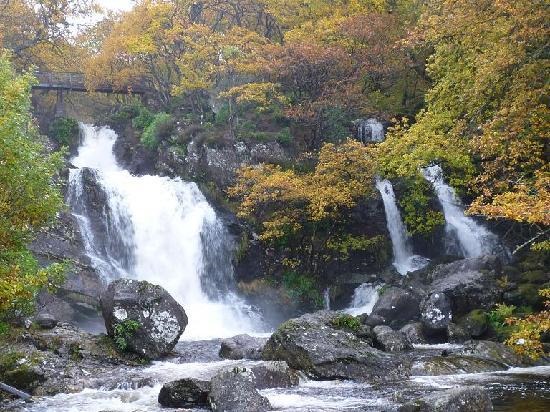
Falls at Inversnaid

A falls at Inversnaid. There’s a hotel right next door to these. Hopkins’ nature was to well, use nature to represent things. Sandburg often chose to use human-made things to explain humans.

.

6. Good Night by Carl Sandburg.  I remain immensely comforted by the range of Sandburg’s poetry. His concern for the commonality of people echoes one of this project’s goals: “Other people’s stories.” His eye for injustice is clear. Modernism has a reputation for solitary individuality, but in his best short poems he harnesses the continued freshness of Imagism with these concerns.

In times like these I can find in Sandburg the things I need, the necessary skepticism, the necessary hope, the indispensable love that allows endurance and asks for change.

One thing I’ve encouraged during this project’s presentation of Sandburg is to assume that he, no less than other Imagists, deserves deep reading. Obviously, many current aesthetic theories say this is true of anything, but I think for whatever it’s worth that it’s likely part of Sandburg’s intent in his best early work too. If he wrote in a garret in Paris. If Sandburg never achieved any of the general renown he accumulated (renown the times and mores eventually spent down during the 20th century) scattered scholars might look for that.

Is there something below the surface of his “Goodnight?”  I think he, the artist, chose  the trains and steamboats as the leaving things of sleep and its longer analog rather than conventional poetic things from a palette of sur-human nature. Now technological progress has added a nostalgic note to his specifically steam-powered leaving. That may be an accident the author didn’t intend, giving this poem an extended feeling, extending out down the track, down the river, over the horizon.

.

5. The Workman’s Dream by Edgar Guest. Does deep reading of poetry tire you? It does me sometimes. Does the chance that you’re missing the “real” meaning of some piece embarrass you once, and once is enough? Are you brave enough to laugh at Dorothy Parker’s smart-set summation** of the coolness-factor of “The Workman’s Dream’s”  author and still listen to him today?

Like Sandburg, Guest was a working journalist. Unlike the entire Sandburg, Guest’s poetry retains a certain work for hire desire to please over the coffee. Can we allow poetry to do that (sometimes) and not harm it? Well for Father’s Day I performed this one. The bold-face heading to each top ten listing will open in an new browser tab the original post I wrote, where in this case you can get the chords I used if you’d like to sing this one yourself.

.

*My estimation: mostly because the poetry rights holders don’t care to seek this—and even when asked. This indifference is also mixed with some concern that it could reduce their control over how the material is presented and any (improbable) revenue.

**”I rather flunk my Wasserman test then read a poem by Edgar Guest” said Parker.

Pied Beauty

It’s said about significant musicians that a careful listener can tell who’s playing just from their sound. The word-music of poets could be a similar tell, but in the case of poetry we have other kinds of data: subjects, characteristic outlooks, and the kind of imagery they choose to use—and those things often overwhelm the distinctions in the sound of a poet’s poem.

But even 130 years after his death, British poet Gerard Manley Hopkins sounds like no other. The piece I’m going to present today is one of his best known poems: “Pied Beauty,”  and he intended it as a rhymed metrical poem, but Hopkins’ conception of meter and phrasing is so unlike other English poets that it might sound like a piece of free verse.

If Hopkins doesn’t sound like other poetry in English, he does have some similarities to Old English and ancient Welsh poetry, two languages he had some familiarity with. In place of the traditional musical phrases that his Victorian contemporaries might use, flowing lines in regularly stressed feet, Hopkins substitutes shorter, broken and paused phrases and a great deal of word sound echoing beyond just conventional end-rhyme.

Reading Hopkins in the pre-Modernist era at the end of WWI must have been like hearing Thelonious Monk play piano just after WWII. It doesn’t sound “right,” it breaks, or more correctly ignores, rules of how things are supposed to sound. Yes, the phrasing is instantly felt as rhythmic, but that’s no anchor, because the rhythm is part of what’s “wrong.” But also like Monk, to more than a few listeners, it can be arresting, even on first listen. You don’t have to understand the structure, or know how it works differently—that’s not a simple task by the way—to hear something that grabs your attention. You may dig it; but even though we humans are natural imitating machines, you may still not be able to do it.

And so, like Monk, Hopkins doesn’t have as many imitators as he has admirers of his achievement, even today.

Monk Hopkins Genius of Modern Music

His music still sounds more modern than most—both of ‘em.


An additional barrier to Hopkins is that his subject matter, though explicitly Christian religious, is also often harrowing. British poets have long explored unrelieved melancholy, but Hopkins doesn’t want to read Job, or understand Job theologically, he wants (or can’t escape) to be Job.*

Which makes “Pied Beauty”  a good introduction to Hopkins word-music, because while it’s making a subtle theological point, this is not a particularly sad, tragic, or even solemn poem. Did Hopkins interject “Who knows how?” mostly to make his rhyme on the 8th line? I don’t know, but I can’t read that phrase and this poem without a little of the feeling of “Ain’t that funny? Unchanging, pure monotheist deity, and yet maker of a world of mixed and changing things.”

Musically, I’m not Thelonious Monk, nor was meant to be—am an attendant lord, one that will do. Still I musically sought to put a certain angle on my usual chords and cadences. Old-time Chicago jazz guy Eddie Condon said the modernist jazz composers flatted their fifths, while his crew just drank them. If so, I caucus with the modernists. Harmony has laws and customs, but the anarchists have melodies.**  The full text of Hopkins’s poem is here. My musical presentation of it is available with the player gadget below.


*Just because he’s so distinctive in his sound and phrasing, we don’t need to overlook the imagery in Hopkins’ poem. Skies like cows? That’s proto-Surrealist, “old bossy in the skies with diamonds” stuff. I have to confess that my eyes once read “brinded cow” as a more conventional if workmanlike “bridled cow.” Brinded means patched patterns as on cows’ hides, it’s an archaic Middle English word, in keeping with Hopkins’ love for the sound of the poetry of the ancestors of modern English. See also firecoal colored tree nuts and painted fish.

**Well this is true at least for me. When I’m not working in drone or heavily home-chord centered structures, I will construct chords and chord progressions based on others’ ideas, or the mathematical commonplaces, testing the results for interest. But for melody, I usually don’t choose to follow rules or commonplaces, and when I find myself approaching those things, I may start to subvert them immediately. Yes, there are pleasures in knowing exactly what note comes next—must come next—but there’s too little music out there that mines disputing that expectation.

I awoke this morning to read that Ginger Baker died, a prime musical iconoclast if there ever was one. I’d read the earlier notes that he was gravely ill and I think I may have tried to imitate some of his playing (those tom rolls…) with the drum track on this.

The Wood-Pile

Robert Frost is every bit the master of word music as Yeats and Millay. What makes Frost stand out is that he was every bit the thoroughgoing early 20th Century modernist as any of his free-verse contemporaries, while retaining an ease with accentual syllabic meter.

Here’s an example of Frost handling a subject just as a free-verse Imagist would. His aims, his presentation, hold to the Imagists’ principles. He deals with the thing directly (as we shall see, two things, but still…), and there are no tacked-on metaphors, no stock comparisons, no extraneous “poetic” language. Context is shown, but not explained. He loosens and varies his meter, so the poem sings and never seems to be a shackled march. At 40 lines, it’s a bit longer than Yeats’ poem considering “The Wild Swans at Coole,”  but Frost’s extra detail is even more specific and concrete than Yeats, though both begin their poem with the poet walking in a rural wetland. Yeats slough is a well-known place to him, conditioned with 19 previous visits. Frost is far enough into his swamp to not know exactly where he is, and so experiences what he sees with a first-time immediacy. Yeats’ slough then contains tradition, Frosts’ the more Modernist “Make it new!” place.

Though presented as one simple rural scene and story, “The Wood-Pile”  is more at two poems, though each part speaks to the other. As Frost’s tale starts, we are in the midst of one of his characteristic journeys, just as we are in other famous Frost poems. There’s a need for decision (“Turn back” or “go on farther”) and his choice, also made in other Frost poems, is to go on regardless of whatever doubts brought the question. If he’s lost in the dark by a wood on a snowy evening, keep going. If you come to a fork in the road, pick one and go on. If you’re walking in a swamp in winter and your foot is sometimes falling through the frozen crust, well, keep going “and we shall see.”

And so, here he sees his bird. No Keatsian nightingale, not Millay’s elusive flying swans with their awkward dangling legs and cries, nor Yeats’ majestic 59 swans, but a small bird. This bird becomes a mirror to the poet. Frost’s bird too must make choices in direction, and the poet, sensibly, thinks the bird’s guided by fear. “Keep something between little me and the big lummox trodding through the winter swamp,” he humansplains. And there’s a bit of humor at human’s expense as the poet muses that the bird, like humans with their self-importance, may think that the only reason for Frost to be out in the swamp is to go after the little bird.

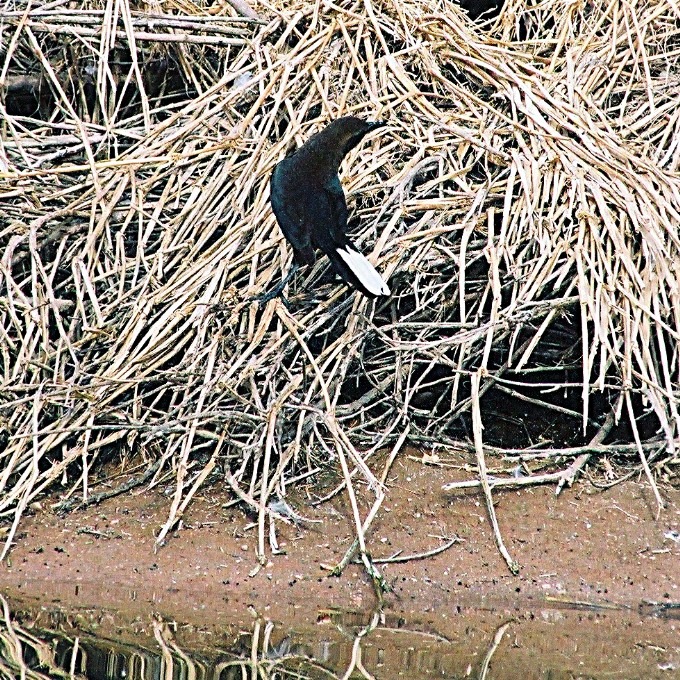
Gackle with white tail feather

“He thought I was after him for a feather—the white one in his tail”


But, we don’t know why Frost is out in the frozen swamp explicitly. The only reason he’s given, or will give, is the Imagist poets’ reason: “and we shall see.”

The bird leads Frost to the second thing the poem wants to present: an abandoned fire-wood cache. Here Frost zooms in close. Every detail of the cut wood and the once neatly stacked and propped wood-pile is stated. Frost turns forensic, like some New England Sherlock Holmes: this pile has been abandoned for years. Mature vines have grown through it.

wood-pile

“The slow smokeless burning of decay”


Here is another context left unsaid. Why would someone abandon a purposeful wood-pile in a swamp? Frost leaves it for us to be detective and to solve the mystery. This isn’t some lot of fire-wood left temporarily to be gathered later in the day, care has been taken to stack and prop it.

The only thing I can think: someone once built a shack (now completely disappeared) on the swamp land. Frost muses, sardonically, that only someone so busy with “fresh tasks” could abandon such effort in cutting and stacking. Does he mean to say, “only a fool would be so industrious to cut and stack this wood and yet not notice he was building his shack on a swamp that would not support a homestead?”

Now, the small bird with his “little fears” and oh-so-human misapprehensions of reality—and now, the steadfast Frost of miles to keep going, even if you may be lost, are set in contrast to this choice. Your fears may lie to you—but so will your optimism.

I once heard an astringent biological statement that the length of our lives can be reduced to a slow-burning chemical reaction. Frost’s last line here is a sad and beautiful analog to that truth.

Turn back or go farther? Go on, and we shall hear my performance of Robert Frost’s “The Wood-Pile”  with my original music. Just use the player below.