Barn, Burning

Here is a piece based on a poem by a second Irish-American poet, Ethna McKiernan, who before her death in 2021 would host a reading every St. Patrick’s Day. I can’t say I knew her very well as a person, though as mentioned last time she was a long-time participant in the Lake Street Writer’s Group with myself, Parlando contributor Dave Moore, and the poet featured last time, Kevin FitzPatrick. I’ll next be going off on a short tangent, as is my nature, but it any of this writing displeases or tires you, just skip to the bottom. I quite like the piece that is the occasion for writing this today, and you are excused to go there and just listen to it.

I don’t think Ethna liked me much as a person, and I can imagine any number of reasons why that might be so. Let me leave most of those guesses behind for today’s purposes. In my old age I’ve come to the realization that I am often a careless and inappropriate person. I suspect that’s for neurological reasons, but who can say, it may be a defect in my soul as would have been said in the old ways.

One peculiarity that I had in writing groups is that I was prone to writing long responses to drafts shared by other members. I’d often get quite detailed with noticing what works, and at least as much so with what I thought didn’t or had alternatives to be considered. The audience of this Project know that I have a broad appreciation for styles and approaches. I don’t hold to a narrow poetic style and down-rank anything that doesn’t follow it, but just as I do with editing audio or trying out compositional ideas in music, I tend to look closely, and over the years of doing this, I’d notice how zoomed in and nit-picky some of my responses were — and I wasn’t at all sure my suggestions for alternative approaches were actually improvements. It’s been a few years since I’ve done that, but I still cringe at some of the things I wrote, particularly in response to Ethna’s poems. After all, here was a poet with several published collections, a grant-winner with a distinct cultural connection to a great poetic culture, and who had taken advanced academic creative writing study. Me? I’m a high-school graduate from nowhere, who has no distinct poetic style to trumpet, who last was published in the 20th century. And need I add one more kicker — I would be in Etna’s case a man writing to a woman poet. Women poets reading this know how that often goes.

So in summary: matters of technique and poetic tactics vs. being emotionally myopic. A lot of the first only emphasizes the second.

My reactions to Ethna’s poems continue to trouble me because, at her best I considered her to be an excellent writer, but one that left me tantalized by another poet within her — a far stranger one, one that only materialized from time to time, and seemed to be constrained by her internal editor and self-anthologist.* Yes, it’s a writer’s prerogative to choose what to present or emphasize, but I wonder if other writer’s group respondents, creative-writing seminars, or outside editorial preferences/fashions kept that element down in McKiernan’s writing. Those things have standing, and it may be me who’s out of step, whose taste is questionable or unlikely. But that’s how I felt when reading the poem “Barn Burning” used to make today’s musical piece. I was compelled to do something that may be regrettable. I strongly thought that a developed image just past the midpoint of the poem was not quite as vivid as possible, and that the poem’s ending was short of how sharply spoken it could be.**

Light Rolling Slowly Backwards front cover

Want the author’s final selected poems collection without my blather? Ethna McKiernan’s “Light Rolling Slowly Backwards”  is available here.

.

Ethna is some years dead now. Poets have trouble finding audiences when alive, and once they cross the Lethe, our forgetting often matches the dead’s. Improper, inappropriate, imperious, presumptuous — convict me of the lot. I’m taking the risk that I’m damaging the poem, though that’s not my intent. It’s done out of love for the poem and in hopes of bringing forth this element of the poet who might be condemning me from the other side.

If the worst is the case, take the performance below as damaged, counterfeit goods. If the best of the case is so, enjoy this poem’s mystical experience with my best efforts at adding music to it. I’m not Irish, I just hung out with some Irish-American poets, and it seems consistent to make this offense out of admiration.

You can hear the resulting “Barn, Burning”  with the audio player below. What, has the player been incinerated and not even ash remains? Well then, your listening can be reborn with this highlighted link that will open a new tab with its own audio player.

.

*I remain puzzled why her poem “Letting Go the Wolves”  was not included in her own final new and selected collection Light Rolling Slowly Backwards.  While it’s a fine collection, well worth reading, to my tastes that’s a pluperfect anthology piece, one I’d say any poet could be proud of having be the one poem others know of their work. Of the poems included there, poems as strange as “Stones”  and “Barn Burning”  display moods not widely indulged in, even though her other poems have their virtues too.

**Should be? Let me say again, I don’t know. I’m just one reader, but one who chose to perform it, and who wants to maximize its impact. Here are the last six lines of “Barn Burning”  as McKiernan had them in her final collection: “The outline of the lit barn/and its lean bones;/the world changed suddenly/as baptism, my life changed/forever with the knowledge/of fire.” Here is what I performed: “The outline of the barn,/the eager edges of its light/surrounding reluctant bones./The world, now sudden as baptism./My life forever with fire knowledge.” And as evidence of how zoomed in my suggestions sometimes were: I think the poem’s title is stronger with a comma in the middle.

Kevin FitzPatrick’s Farewell

Nearly 50 years ago when I moved to the Twin Cities I fell in with a group of Irish-American writers — only they didn’t call themselves that, they called themselves the Lake Street Writer’s Group, and when my friend Dave Moore wanted to roughly categorize them back in those days he’d say many of them worked as bartenders. And so, at first, their monthly meetings would be at a bar table, I think the first one I attended was at the Artist’s Quarter, a bar and music venue.

Time and writing changes one, and so it changes groups of writers. Over the years some wandered off to other pursuits, or to other cities, and one or two died. In its last decade of existence, the group winnowed down to four people. Dave Moore and myself, and two other poets: Ethna McKiernan and Kevin FitzPatrick.*  None of us remainers were bartenders. Dave worked for a co-op grocery after working in bookstores. I worked for a public radio network. Ethna ran an Irish-Arts store until it needed to close, and then worked as a social worker. Kevin had a job with the state labor department, but he spent every non-workday at his life-partner Tina’s farm across the border in rural Wisconsin.

The poet I perform today and his last book.

.

Kevin was a healthy seeming guy, able to handle the manual small-farm work in contrast to his desk job. During that decade our little quartet of poets would hear Kevin recount his latest news from the farm, and then we’d hear what he’d transformed out of that when he showed us drafts of poems about the odd turn his post middle-aged life had taken. In this series of poems an office-worker who grew up in the Cities was encountering country labors, mores, and situations, being befuddled or making sense of them.

Kevin’s poems were narrative, and he had a real knack for that form, particularly in his talent for drawing characters in a few words and letting you get a sense of them in a stanza or two.**  One of the charming characters we met as the series of poems spun out was the farm dog: an incongruous poodle named Katie — not a Collie or German Shepard, not any other breed you’d naturally think of protecting the flock and farm. The poet didn’t invent that detail of the farmstead’s dog, but the poet knew a symbol when he came upon one.

Farm dogs are pets with job descriptions, but I don’t think Katie was a herding dog in a professional sense, any more than Kevin was a professional farmer. Still, there were in the poems a sense of Katie being an intermediary between the livestock and the bipeds, and she was portrayed as a useful watchdog and companion when Kevin needed to return to his workweek office job.

In Kevin’s poems we learned that Katie had gotten sick; and though it strained budgets, she had gone through some veterinary treatment. Then, at one month’s meeting, we learned that the poodle farm-dog had succumbed to her illness.

The Kevin FitzPatrick poem I perform today came shortly thereafter. For me, this poem works well, even though intellectually it could seem maudlin or sentimental if summarized. We should be wary of such reduction — poems are much more than AI summaries. Kevin undercut the merely weepy here with his dry sense of humor and understated anger — and then too there’s the poem’s sensual detail: a man at work with the remains and memories of a working dog, the corpse as light as a cardboard cutout, the unthawed March cold.

The poem’s ending has extra poignance for me: it was not that long after the poem was written, and the collection that contained it, Still Living in Town,***  was published, that Kevin unexpectedly took sick and died. I think I remember talking with Kevin — before that knowledge on either of our parts — about liking the final part of the poem, how it implies that when the fear and final of death might come to the poem’s speaker, that the dog’s spirit, preceding over the hill, that hearth and home animal in-between livestock and us humans, would be there faithfully there to assuage the fear of what may be nothing in an empty darkness. I call the piece today “Kevin FitzPatrick’s Farewell”   because to me its writer ended up making that statement while writing a poem about a farm dog.

Kevin heard a couple of my performances of his poems, and his feedback was that I overstated them — and my performances were certainly different from his. He had that drier Robert Frost reading tone down whenever I saw him do public readings, mixed with the kind of Irish wit that evidences just a slightest eye twinkle and unvocalized “a-ha!” while it spears some folly with an off-hand brickbat or dagger. So, to honor that contrast between us I had to fire up the electric guitar and make the speaker in his poem a little shoutier than Kevin. You can hear that performance of mine with the audio player below. No audio player to be seen? Listen: Katie is barking that you can use this highlighted link that will open a new tab with its own audio player.

.

*Kevin and Ethna took to hosting a poetry reading every St. Patrick’s Day. The last ones not at some Lake Street dive bar, but at a more tony academic site: The University Club near St. Paul’s Summit Avenue. I’m not Irish, but personally I don’t favor the mandatory cute intoxication elements endemic to that celebration, so I preferred a spotlight on that culture’s poetic side. As the holiday approaches this year, I’m planning to get to Ethna’s poetry too in time for St. Patrick’s Day.

**I admire conciseness. I’ve sometimes compared Kevin’s poems to the narrative poems of Robert Frost. While Frost’s longer blank-verse narrative poems have their power and richness, it’s not the mode that I read for pleasure. Kevin’s rural life poems take more after Frost’s shorter narrations like the “Mending Wall.”  And Kevin’s poems make more use of humor than Frost’s do.

***That book, and others, are available via this web site link.

I Sit and Sew

Today is International Women’s Day, and I was fortunate to be able to complete this recording of a new musical piece setting a poem by Alice Dunbar-Nelson before the day ended.

“I Sit and Sew”  is likely Dunbar-Nelson’s best-known poem — it’s certainly the first one I knew of. I’d encountered it as a poem written amid WWI during the years this Project was noting that conflict’s centenary. “I Sit and Sew”  still comes up fairly often in regards to war and destruction, or because it mentions domestic, woman-associated work in the context of the greater world.

I noticed one other element in re-reading it this week: it seemed to me to relate to another line of woman-associated work: medical nursing. Having spent a couple of decades doing nursing work myself, the poem’s focusing-in on the trauma and injuries of warfare really made me think Dunbar-Nelson wasn’t just thinking generally, writing something that could be paraphrased as “War is terrible, and yet here I am peacefully making or mending something with needle and thread, as women have for millennia.” There’s nothing wrong with experiencing the poem that way, as a companion-piece perhaps to Hardy’s “In the Time of the Breaking of Nations”but I’m a person who often asks questions while reading.

While the poem can stand on its own, I wondered if Dunbar-Nelson herself wanted to serve as a nurse.*   Short answer: this issue has additional complications. Currently in the United States we’re suffering from numerous outlandish statements and acts snuffing out complexities of diversity, but historically women’s wartime work, including nursing, is tightly connected with increasing respect and civic equality for women.

Alice Dunbar-Nelson was an Afro-American woman. The U.S. armed forces were segregated during WWI, and the roles available to the non-White military were limited along with that, based proximally on rules about race-mixing no-doubt supported by a pervasive background of racial superiority. A few years back, while learning about another poem, I came upon the case of Col. Charles Young, a Black West Point educated officer with experience in two foreign deployments who couldn’t get himself utilized as America mobilized for WWI. The situation for Black Americans who wanted to work overseas as nurses was also exclusionary. I’ve found out Dunbar-Nelson was working as a national organizer, a member of something called the Women’s Committee of the Council of Defense, and her focus was on Afro-American support of the war effort. She published today’s poem in 1918, and after the war she wrote up a summary of Black women’s WWI efforts.

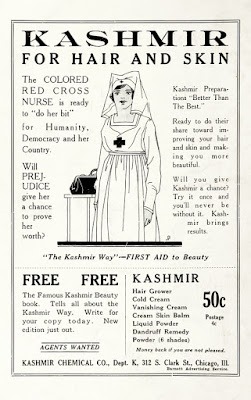
Kashmire for colored red cross nurse Crisis Vol 16 No 4 Aug 1918

We Wear the Mask Dept. I found this ad here in another post mentioning this poem. In her article linked above, Dunbar-Nelson mentions, in passing, (pun intended) that some lighter-complexion Afro-Americans snuck through the overseas nursing service ban.

.

No long post today, that’s a start for anyone who wants to dig deeper.

The song I made out of her poem came together more efficiently than many, partly because it began before I knew I was making a song. This week I remodeled a nearly 30-year-old Squier Telecaster that I had put a Bigsby vibrato bridge on a decade or so ago. This guitar and that bridge just never worked out. I couldn’t get the neck angle and string height right, the saddles rattled, and the strings slipped sideways when I bent strings. After some looking, I unearthed the guitar’s original non-vibrato bridge and put it back on.**  The guitar was transformed. Back when I put on the Bigsby I’d also installed a set of upgraded replacement pickups, and with the string-path mechanics sorted out, the guitar played and sounded great! While I was resetting the action/intonation etc., I quickly made a short musical piece on my recording computer that would let me play strummed chords, arpeggiated chords, and single-note lead lines over three separate sections — just so I could have fun while seeing if I’d eliminated all issues.

Funny how fast you can compose, if you’re not composing. I saved the drum pattern, the bass track, and the keyboard noodling after testing the guitar, thinking “Hey, I like that groove, might be useful.” This morning, I had about an hour when I could open a mic and record. I loaded the saved rhythm tracks, worked them into a longer song-form, recorded the guitar parts using the transformed guitar, and found that I could sing Dunbar-Nelson’s poem to this.

You can hear it with the audio player below. No player? It’s not hiding under a box, it’s just some ways of reading this blog suppress the player gadget.  This highlighted link will open a tab with its own audio player.

.

*”Nursing” is a very broad word covering a wide range of caring work and levels of technical knowledge. Dunbar-Nelson’s write-up seems to indicate the women’s war work she was promoting covered a range of things, not just licensed medical nursing as we know it this century.

**One difficulty was that the original — like the Vibramate-brand vibrato bridge I took off — was a non-standard bridge. When I finally found the original bridge, it was sitting underneath  a storage box in my studio space. Luckily, like most Telecaster parts, it’s not a fragile thing. By the way, I’m not knocking Vibramate’s hardware. I’ve used Vibramate products to add Bigsby vibrato bridges to other guitars with good results, and their “Spoiler” accessory for Bigsby bridges makes restringing or replacing a broken string a much calmer experience.

Credo (The Will To Love)

A friend of the blog noticed today I used a particular phrase when I wrote about late-night work on the musical piece you can hear below. I’ll try not to take too much of your time, but I thought I’d expand on my explanation to him, and at the bottom you’ll be able to hear a 2-minute song made from a poem by Alfred Kreymborg.

The early years of the Parlando Project benefited from several things that are not in as great a supply now: I had multiple days in each week when I could work on finding and making these musical pieces. I worked regular workday hours on this, beginning after my morning bicycle ride for breakfast. I was eight years younger then, and those days were filled with rewarding creative work as I learned more about musical composition and recording technology. Shortly after the public launch of the Parlando Project, we had a consequential election in America,*  but that (if anything) increased the energy I found most weeks.

Those who happen upon early posts here might notice a tone that isn’t as common in recent years. Without announcement, I was writing back then with my child in mind as an audience. They were going to be entering the 6th grade, and I vividly recall from my own youth how a great vista of complex, connective, and evaluative thought opens up around that age. I wasn’t going to make it a point to them to read this — adolescents aren’t looking for that sort of thing from parents — but rather more, I thought others in their peer group might come upon this Project and find some interest in my promotion of discovery and enjoyment. Working from that aim, as my child grew, I gradually changed the age group I was aiming the blog writing here at — though I don’t know if I ever achieved an adolescent audience.

Then a few years ago my family went through a series of crises, and it was only after a period of distress that the wise and resourceful members of my little family met those issues and managed them. I tried to be supportive — I probably was, to my imperfect degree — but that work was largely their doing. I’ll say that in that year or so of the greatest distress, my time spent here was a tonic for me from the stress and worry. How much of that was (in the modern terminology) “self-care,” and how much was temporary flight from responsibility? I can’t say, my perspective is too close-in.

But now in the past year or so, the time I can devote to this Parlando Project is constrained by external and internal factors. By choices outside my control, days go by when I’m restricted from recording, and even the blocks of assured time to compose or research are harder to come by. At the same time my energy endurance is lower as I age. As grateful as I remain to have the opportunity to do this Project, I guilt and grumble as an old codger when an opportunity comes — time when I can play or record — and at that moment my body is saying: take a nap instead. If I could schedule creative time, if I was to ask for concessions to schedule it, I’d probably face complex outcomes and reactions when my old body can’t be assured the energy levels and ready fingers like my 70-something self could.

Let me be complexly-clear about that though: that frustration doesn’t outweigh the gratitude. To have the opportunity and resources to do this Project remains a blessing! I just have to work with this, that’s all.

Here’s one “how” of that: after everyone in the house has gone to sleep early, or is at work on an evening shift outside our home — I can do my work, as long as it’s in silence. Knowing this, I often get a “second-wind” after 8 or 9 PM or so. I might spend this time researching or writing early or final drafts of these posts. There’s even limited music-making that can be done without making noise. I can go over the things I have been able to record, evaluate if they are worth using, perhaps adding additional parts silently using my little plastic keyboard, and mix the results into something suitable for releasing to the public. So: the hours between 9 PM and 1 AM have increasingly become working hours for the Parlando Project.

I’ve come to call that time “burning the midnight lamp.” As I told my online friend this morning, that phrase is taken from two particular sources — ones you might not guess could be combined.

“Burning the Midnight Lamp”  is a song, a lesser-known “deep cut,” by Jimi Hendrix. The song had a long gestation, Hendrix struggled to complete it. It was written early in his Jimi Hendrix Experience career, while living in London. Hendrix was a young man who previously had been in the care of a succession of childhood relatives, foster homes, and then a short Army barracks stint followed by couch-surfing until this point. For the first time he had his own place, shared with a woman in what sounds like an equality of love.**  That Hendrix London flat has been restored to appear as it did then, and when I visited it some years back I thought of what a special place it must have seemed to him. I imagine his thoughts: my own place, paid for with my own money, living on my own recognition, work done under my own name. In anyone’s life (not just a “rock star”) the time when one has achieved that — that’s something.

Here’s an odd connection: when you visit the site it’s a joint institution. Hendrix’s apartment is upstairs, but the main floor is laid out to reflect another emigrant musician of another era: this address was also George Frideric Handel’s London home.

When Hendrix was searching for the extra sound needed to complete his “Burning the Midnight Lamp,”   he found the recording studio he was in had an odd instrument present: a harpsichord. Comparing Hendrix’s guitarist skills to my own would be laughable, but things even out in naivete when at the musical keyboard. Today’s song uses piano, but I had to play separate right and left hand tracks to realize the simple part. Likewise, Hendrix hacked out a little harpsichord part for his song. Was Hendrix tipping his hat to his downstairs ghost with that harpsichord?

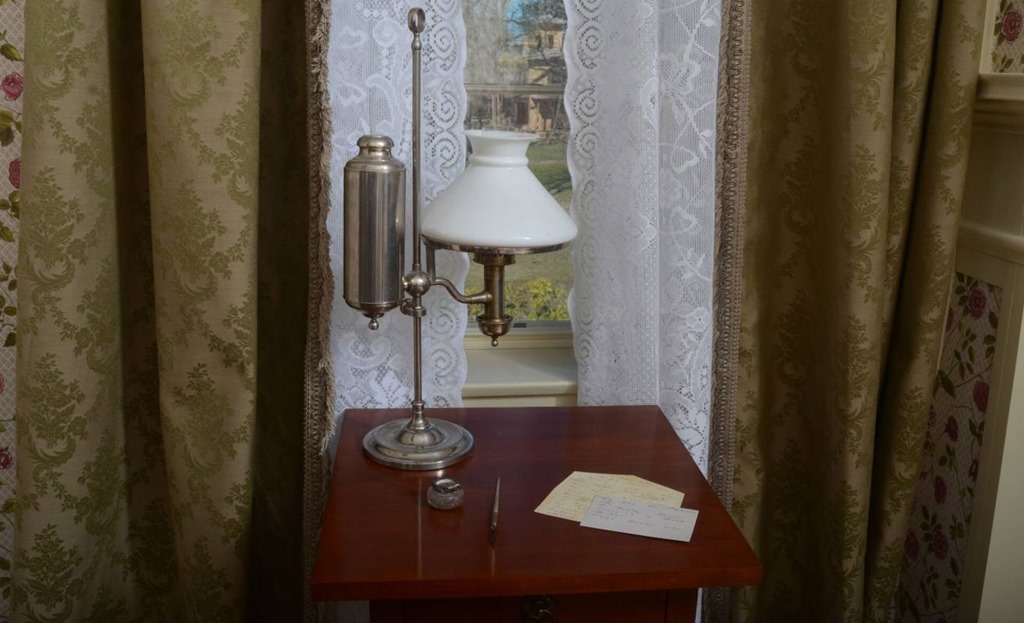
Why did Hendrix write his tune about working late within the endemic uncertainty of creatives using the image of a lamp? No guess. But another lamp, elsewhere, in another visit: something I recall when visiting Emily Dickinson’s bedroom was the little table that was her writing desk. On the small top of the table was a whale oil lamp. Dickinson, living with her family in a household, with household tasks and human needs that would take the daylight hours, had this little mid-19th Century, middle-class luxury of a warm effective light to work by after the busier-with-others’ hours.

dickinson's desk and lamp

“Ready for the same old explosion/Going through my mind…” A small writing table and lamp in Emily Dickinson’s bedroom (photo from the Emily Dickinson museum)

.

Looking at Dickinson’s lamp, I thought of the whole system that represented: the swimming mammals of the dark, cold sea, the diverse Moby Dick industry which captured, killed and deconstructed those massive bodies — and so, extra hours glowing with North Atlantic juice opened for a woman to scribble and sew little booklets. If I’d try to tell these thoughts and feelings when looking at the lamp to the average person, they’d sense a disproportion. Someone might even harrumph to me “It’s just a lamp — an unexceptional, domestic thing.” Readers here? You’re not that sort of person — and on her part, Dickinson too, she had further thoughts.

And so I continue, to burn the midnight lamp. Alone.

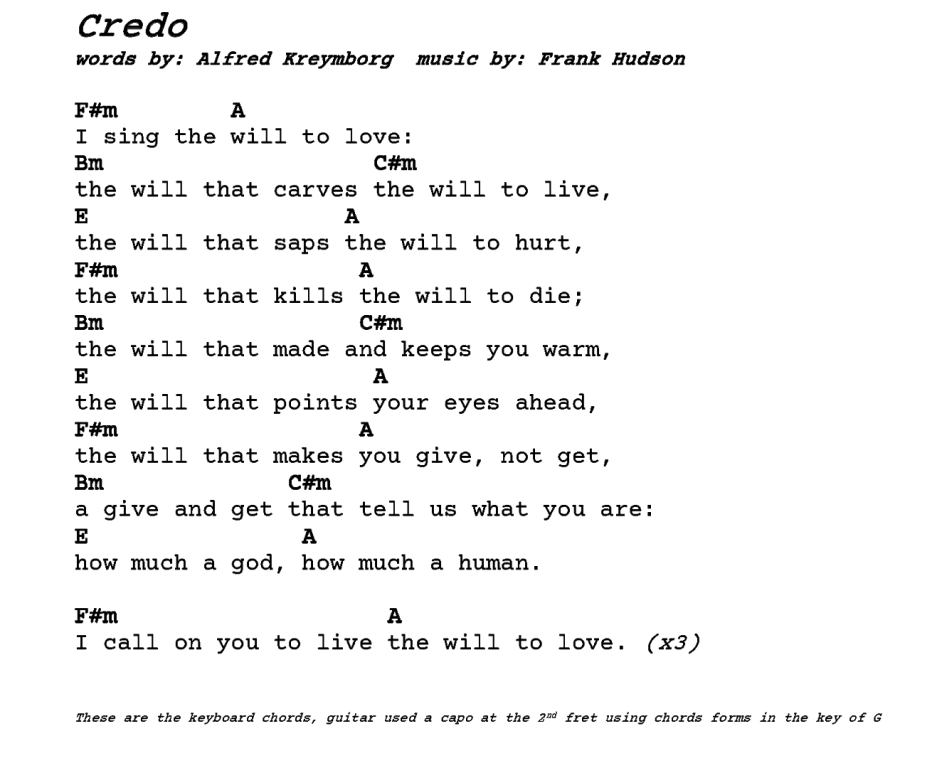
Today’s results came after a week of disappointing myself as I looked for some words to express what I was feeling, words that would ask me to sing them out even with my inexact and unprofessional voice. I was seeking words that would add something hopeful in a time of extraordinarily slipshod callousness carried out with motives of punishment as a virtue. It was this short poem by early American Modernist poet, editor, and publisher Alfred Kreymborg that captured me.

Credo keyboard chords

As I often say here under these chord sheets: someone out there can likely sing this song better than I can.

.

Last post here was a series of inspirational maxims carried by a Jazz musician. Maybe Kreymborg’s “Credo” seems a little too hopeful, too earnest for some of you. It’s probably not the sort of poem you’d first think of as an early text of American Modernist poetry from a colleague of William Carlos Williams, Man Ray, and Mina Loy. Little matter, I felt I needed to sing it. That’s enough for now.

You can hear my performance of “Credo”  with the graphical audio player gadget below. No gadget? It’s not that you didn’t keep your lamplight trimmed and burning, it’s just that some ways of reading this suppress showing the player gadget.  This highlighted link will open a new tab with its own audio player.

.

*Decades before, longtime Parlando contributor Dave Moore and I started the LYL Band just before Ronald Reagan’s election. Then too something that wasn’t very good for the country paradoxically encouraged creativity as contrast.

**This short video shows the flat decorated to look just as it was in the mid-Sixties, and features Hendrix’s then-partner, Kathy Etchingham, speaking briefly about their time together. Hendrix, like other struggling musicians, lived before largely at the behest of his hosts. From accounts, the two lovers seemed to be in a somewhat equitable partnership (within the expectations of the time). Etchingham worked as a DJ in London clubs and had a resident’s knowledge and straight-white-British appearance to bring to the arrangement. Hendrix’s fame was still somewhat localized, and his uprising career had offered him a semblance of a regular income.

When Black History Month was just what you were living, Part Nine

My feature this February has been centered around an Afro-American scrapbook entrusted to me after it was found in a crawlspace at a former South Minneapolis rooming house in the middle 1970s. This series has taken me away from the usual Parlando focus, which is combining literary poetry with original music in differing styles. If you’ve been missing that, look to the bottom of today’s post — I’ll have something new for you today.

This exploration has taken a tremendous amount of time and effort, and I sometimes doubt how many readers will share my level of interest in looking back at what’s in and surrounding that scrapbook. It seems worthy of notice to me, and that supports my mind and heart work in this month’s effort. I did warn at the start of this series that what I’m writing here is coming fresh from an examination of the scrapbook, and some of my findings will be preliminary or subject to better evaluation — even little things in this larger than usual collection of writing. I just finished fixing a handful of typos on the previous episode that escaped my eye last night before I went to sleep, and now it’s time for the next one.

As a document the scrapbook spends a lot of time in the World War Two years. The book’s leading man, guitarist and singer Hank Hazlett, got his big show-business break then with the Jazz quartet The Cats and the Fiddle,* and the scrapbook evidences notice of the war in the things its maker chooses to include.

Here’s a Roy Wilkins column collected by the scrapbook maker rejecting racial prejudice in the US armed forces published during the war.

Roy Wilkins on WWII Racial Stereotypes

.

And here are a few more war related clippings in the scrapbook.

There's a war on montage

.

Another war-related story included in the scrapbook is a newspaper clipping that tells us of the Hank Hazlett era Cats opening for and then backing Lena Horne in a musical appearance in front of a hospital’s wounded soldiers. The Cat’s opening set was “Stomp, Stomp,” I Miss You So,” “Straighten Up and Fly Right,” with “Another Day” as their encore. With Horne at the mic, the combo supported her singing “Sometimes,” Stormy Weather,” and “Honeysuckle Rose.”

Lena Horne and the Cats

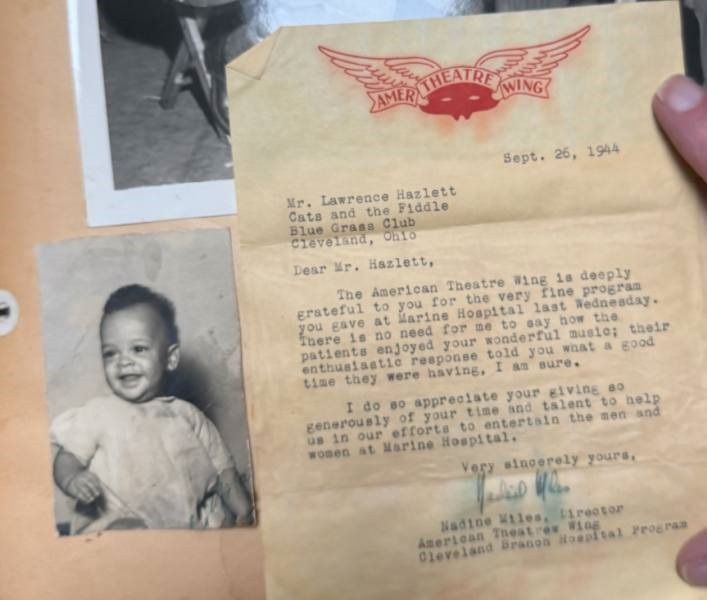
Thank You for entertaining wounded troops

.

Having this dated letter from 1944 pasted next to the baby picture opens a theory regarding a possible child of Hank and Edith that I wrote about yesterday. A 1940s child could be part of Hank’s deferment, could be the right age to write Felicia’s letter to Daddy a few years later quoted in yesterday’s post, and later yet could also be a young, teenage woman, the subject of another picture in the scrapbook. That the thank you letter is addressed to Hank indicates to me that he might have been the de facto bandleader for the Cats and the Fiddle during his time with them. He was likely 6 or 7 years older than the other Cats in addition to taking the place of their regular lead singer — so, that role might have fallen to him.

A strong theme throughout the scrapbook is Afro-American pride and their struggle for equity in the arts. Many clippings demonstrate that the maker of the scrapbook was concerned with the stereotyping and constraints on Black entertainers and some clippings celebrate their achievements in overcoming that. Here are a few of those items from the scrapbook:

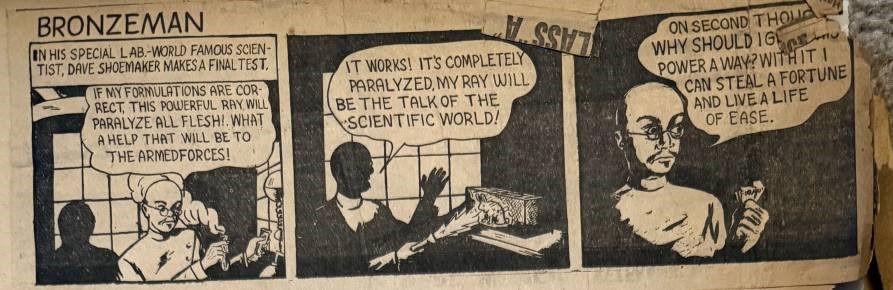
Bronzeman

Did a bronze man create this? Yes. A.C. Hollingsworth created Bronze Man in Blue Beetle #42. As in Paul Laurence Dunbar’s famous poem, he was to “wear a mask.” Publishers changed things though. See this link.

.

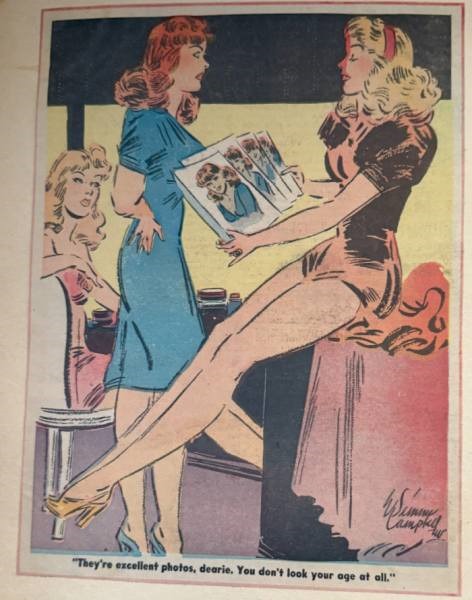
E Simms Campbell cartoon 600

I wondered about a series of cartoons in the scrapbook. All white characters, nothing about music. What was the reason the scrapbook took note of them? The cartoonist E. Simms Campbell. was the first Afro-American cartoonist published in the big time U.S. “slick” magazines. His Wikipedia page says his work appeared in nearly every issue of Esquire magazine from 1933 to 1958, and in many other publications.

.

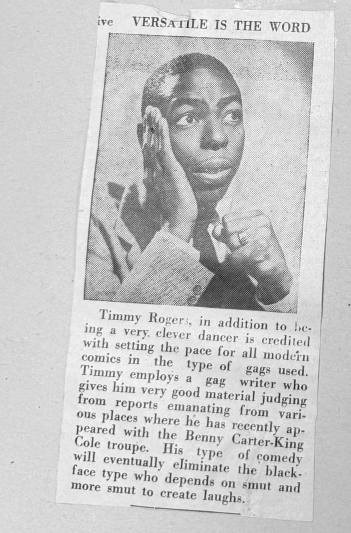
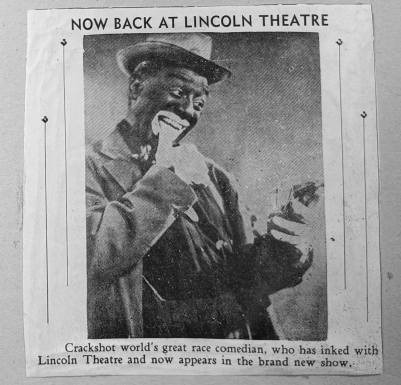
.Timmy Rogers wants to change Black comedyCrackshot in Blackface

Dialectic, but make it funny: the clipping tells us Timmy Rogers was a Black comic who wanted to move beyond the blackface fool stereotypes. More info on Rogers.  I can find nothing on Crackshot, though he’s given his clipping in the scrapbook too.

.

Othello staring Paul Robeson program

The entire multipage program for this landmark stage production starring the multi-talented Paul Robeson was pasted into the scrapbook.

.

Horne and McQueen with a GI sitting in with the Cats

Lena Horne, Dorothy Dandridge, and Butterfly McQueen. Three black women in entertainment who needed to struggle for non-stereotyped parts in the ‘40s. And keeping with our WWII subject, here are the Cats jamming with a white G.I. on bass. The armed forces may have been segregated, but music has established a beachhead. I note too, the scrapbook maker is paying considerable attention to women in the arts.
 
Pearl PrimusI knew about Lena Horne and Paul Robeson.
I knew about Robeson, Horne, Dandridge et al. I’d never heard of Pearl Primus before this month’s examination of the the scrapbook. Her Wikipedia entry tells what she did. This, Robeson’s Shakespeare, and the comics artists above are examples of how the scrapbook’s maker wasn’t just interested in music, but had a broad interest in the arts.

.

Our summary today: not all warriors carry a gun. We’ve had war today, and prejudice, and stereotypes — and me writing a bunch more words (with maybe  fewer typos). So, let’s have a little music, and poetry — and love not war. Here’s a poem by Afro-American poet Alice Dunbar Nelson written in the last decade to be called The Twenties. This may be Black History Month, but all I read next to my breakfast each morning this month is telling me that the nonsensical denigration of Black American military and cultural contributions along with a side-helping of gay panic isn’t history, just as it wasn’t history to the maker or makers of the scrapbook. To hear Dunbar-Nelson’s poem “You! Inez!”  as I sang it to music composed today in-between typing this, you can use the audio player gadget below. No player? Elon hasn’t fired it, it’s just that some ways of viewing this blog suppress it.  This highlighted link will open a new tab with its own audio player.

.

*A founding member and most often featured singer of the Cats and the Fiddle was drafted. The scrapbook doesn’t deal with this, but I did wonder why Hank or other members of that quartet weren’t drafted. Hank Hazlett was born in 1911, and in 1940 he’d have been 29. The WWII draft was different than the Vietnam draft I’m most familiar with — in my day, most called up were younger than 27. In WWII draft men up to age 35 were commonly drafted. I only know the age of one of the original Cats quartet, but the bass player would have been 22 in 1940, and since the original quartet all knew each other from high school, I’m assuming they were near the same age — yet, as far as I know only Austin Powell was drafted. This is a complicated subject and we know so little about the men in the Cats. There were classes of deferments for various reasons, and even stories that some draft boards didn’t want to draft Afro-Americans for Jim Crowish reasons — this even though the Armed Forces were segregated throughout the war. There were also stipulations for physical condition that histories tell us bedeviled the system during WWII. One oft cited report had it that in the draft first year, 1940, “nearly half the men drafted were sent home” for not being fit enough for service.

Or course a great many Afro-Americans did work in war-industry, or were drafted or volunteered for the military, despite the Armed Forces still hewing to the Jim Crow segregation/white superiority regime of mid-century America.

Langston’s Blues (Dreams)

Some of you made it through my summarization of the musical career of the Cats and the Fiddle Jazz combo this week, but even though I was writing about music, we didn’t add much poetry there. One little thing I found out since I wrote that summary: that eBay matchbook collector item should have tipped me off about the site of one of those young Chicago kids’ gigs — a way stop on a trip to Hollywood to try breaking into the movies. It wasn’t at the “Airplane Café Club” as Marv Goldberg had it from his research, but the “Aeroplane  Café. I’ve found a postcard. Looks pretty swanky. I wonder how the Cats act went down there in 1936 — did the Denver white swing kids dig their act? Four or five years later I’d give our band of audacious teenagers better odds on that.

Well, however they were received, they were young, they had dreams of a career ahead of them.

Aeroplane Cafe

Looking at what musical acts were playing Denver at this club and elsewhere during the ‘30s, it was mostly white bands for dancing. Black bands started appearing on the bills in the ‘40s. My research said the Aeroplane Cafe lasted until the ‘80s, hosting in its last years rockabilly bands.

.

So, let’s combine some literary poetry with music, Parlando style today. The words are by Langston Hughes, one of the first poets to recognize that Blues and Jazz were poetic, suitable for praise in poems, suitable to combine with Jazz words he’d contribute. When the young Hughes wrote today’s words for publication, he called the short poem “Dreams.”   I heard it as a kind of Blues, a Blues with a sorrowful side, but with an admonishment to endure. If some reading this are having a February of backlash and disappointment tempting despair, this is after all Black History Month. Afro-American poet Hughes knew that dreams may well be knocked down, ignored, belittled. Yes, I know the word “woke” is a word in present contention. I find it odd it is used by those who smirk and dismiss the word as they speak it, aiming it toward those who know very well the reasons that dreams are extinguished.

Hold fast to dreams
For if dreams die
Life is a broken-winged bird
That cannot fly.

Hold fast to dreams
For when dreams go
Life is a barren field
Frozen with snow.

I’m looking at a bare and snowy landscape out my window this evening. I rode to breakfast in 10 degrees with a cold wind this morning. I read the newspaper when I got to the cafe, because I’m a man who still spills eggs and hot sauce on the news in the morning. None of the news was good.

I spent my last couple of days making the musical piece work as well as I could make it, tickling an old guitar that I played when I was young, playing piano the way I can: a finger or two on the keys, tracking the left and right hand parts separately to disguise my ham-handedness — because music may find a way. I sang Langston Hughes’ words quietly, mouth up near the microphone. I had to, it was near midnight when I sang them, and my family was asleep and I want them to keep their dreams.

I want you too to keep the sweeter of your dreams. Waking right now can script all the nightmares and anxiety dreams that need no help. When the best mysteries come under the eyelids, ones almost too good to remember, I want you to keep them, even just the sense of them.

The audio player to hear my adaptation of Hughes’ poem I call “Langston’s Blues”  can be heard with the audio player gadget below. No gadget? It’s off dreaming, but you can also use this highlighted link which will open a new tab with its own audio player.

I’m planning to return in a few days with more on why I wanted to work at figuring out all I could about that young Jazz combo of the 1930s and ‘40s.

All Along the Watchtower — the Tarot Card Version

For more than 50 years, I’ve often thought of this Bob Dylan song.

Today I was learning how to use a feature in my recording software, and I needed a vocal take to use as an example. I’ve been much concerned this winter with events that seem (as Thomas Hardy once wrote) to be “in the breaking of nations.” I guess I thought that busying myself with learning might let me take a break from that dread, and when I opened up a mic to sing, this was the song that came out of my mouth. I think it asked to be here today.

Songs and poems can do that. They aren’t necessarily mystic fortune-telling omens — they’re more at waves in the air or memory that come in to rattle your bones and vibrate your vocal cords or synapses.

The story in “All Along the Watchtower’s”  lyric is a repeating loop, the last verse’s approaching riders are the two foreground characters arriving to speak and open the song.  So, “All Along the Watchtower’s”  story doesn’t unfold — it refolds — and I chose to point that out in my version today. To illustrate this song for the video I dealt out some tarot cards. I don’t believe those cards are omniscient omens either, but the pictures can flip and spread for a receiving eye and mind. Perhaps all symbols, songs, fables, poems, pictures — all foolishness and wisdom — rotate around themselves like that.

Is this short post a break from Black History Month, so soon in this February? Well, maybe, but the song “All Along the Watchtower” is  best known from a monumental version performed by Jimi Hendrix.

Here’s the video of my version:

.

Black History Month 2025: There is a house…

In the past few years I’ve enjoyed focusing here on Afro-American poets during the month of February. Last year, I dug in and did a bit more research on an understudied but fascinating Chicago poet Fenton Johnson, whose published work sits between the emergence and premature death of Paul Lawrence Dunbar and the Harlem Renaissance. Johnson became easily identifiable as a Modernist before his access to extant publications dried up in the 1920s, and I suggested last year that his poetry allows us to see —albeit silently on a page until I did some musical settings — into the formative years of Afro-American Gospel and Blues music before it made it onto recordings.

Here’s something I formulated for myself early in this Project as I found myself often looking at the rise of Modernism in the 20th century: a part of why Americans became highly significant innovators in Modernism has to do with Afro-Americans. Literary-only scholars might not focus on this inside their silo, but at the same time Pound, Eliot, Frost, Moore, Stevens, Millay, Williams, H.D., Sandburg, et al were reforming poetry, Afro-Americans were spearheading a revamped approach to music. Black poets like Johnson and Langston Hughes were hip to how those two things should be viewed together from the start, and after all, Modernism took root during the last decade called The Twenties under the banner of “The Jazz Age.”

That 2024 series on Fenton Johnson let me further express the musical part of the Parlando Project: “Where Music and Words Meet” — and it should also be obvious by now to regular readers that history is one of my interests. So, this February, like the Fenton Johnson series of last year, I’m going to get into the deep weeds a bit this on some lesser-known stuff.

I’m unable to schedule the Parlando Project work in a fully professional manner, so it’s likely you, if you follow along this month, will be going on a journey with me as I look into elements in real time. I may be revising myself before the finish, and if that gets awkward, let me say at the start that this isn’t some plotted-out documentary, I don’t know what all I’ll find. It’s likely going to be very first-drafty, so put on your reading sweater.

If this was an audio presentation, at this point there’d be one of those audio fades with reverb to suggest a passage of time now. From out of the echo my voice will be saying: “It all started in 1976 when I moved to Minnesota from New York…”

I was looking for a new start. It wasn’t entirely clear if I was going to continue intermittent attendance at college, which was both logistically and financially limited to me at the time. One advantage I had: doing nursing work in an Emergency Department was an easily transferable skill, I could go most anywhere that had a hospital, and maybe it would be good if where I moved also had a college. I settled on Minneapolis because I knew a couple living there from my Iowa college experience in The Sixties. One of that couple, Dave Moore has remained a friend (and contributor to the Parlando Project). Dave and his then wife had plotted out a plan for themselves. They were going to run a small mail-order used book business and needed a place to collect stock, store it, and run that business. They purchased (for an attractive low price) a large old house on Park Avenue in Minneapolis. Park Avenue was, in the last Gilded Age, a place where newly rich Minneapolitans built their mansions along a wide tree-lined street leading into the business center downtown. Now in 1976, this couple I knew were going in big on the sweat equity thing, rehabbing that house. The place, 3132 Park Avenue South, was built as a sort of a Junior-Grade Mansion. The 3rd floor, where the original owners had servant’s quarters would hold their stock of books which Dave was obtaining from aging bookstores that were beginning to close down or dump old stock. The other two floors would be their living space and nursery for the child they were planning to have. I could help a bit with the enterprise and rehab, and stay with them for a while.

It was a grand adventure. I had no builders skills, but mainly helped with the stripping of paint off the old woodwork and general lifting and toting. Work was already more than half done when I arrived. Dave told me that around mid-century the house had been turned into a set of small rentable spaces part-way between a rooming house and a set of apartments. Most of those changes had been removed already, and the book business part of things was more at my interests. For that, I’d go with Dave on trips to the basements of sole-proprietor bookstores, some closed, closing, or soon to close, to clean out old stock in their basements or back rooms. There was so much stuff from the 50s and the early 60s — before, you know, The Sixties.  From ruined books I collected a small batch of lurid pulpy covers on these expeditions. The packrat in me wished I’d grabbed more.

Pulp Joyce cover

It’s James Joyce’s birthday today. This cover from those ‘70s bookstore hauls was stuck up in my studio space for years. There’s no music directly for this essay today, but here a Joyce poem conveyed in the early years of this Project.

.

This house on Park Avenue is just a location for the drama, a set for one of the acts I want to present haphazardly this month. The whole play is not extant. It exists only in fragments, a bad quattro. How do we raise the curtain?

Dave knew I had an interest in old Blues music, and somewhere in an interval after I was staying at 3132 Park Avenue and maybe as late as when I moved into the rented part of a duplex next door a few years later, he gave me a tattered scrapbook found when they were cleaning out those rooming house remnants. I’ve learned a lot since that scrapbook came into my possession. Let’s take a look inside as this series continues.

Sandburg’s Couples

Time for me to get back on my Carl Sandburg soapbox. I’ll be brief — as today’s poem, now song, is as well. My point (again) is I think there’s more there in his poetry than is currently remembered or considered. Your impressions may be from two stalwarts of American poetry anthologies: the Whitmanesque “Chicago”  with those big shoulders and the quite contrasting short metaphoric poem “Fog”  with its cat’s feet. Not a lot for a poet who wrote so much, so early in the Modernist era, but it does point out a range of expression.

I’ve performed segments of Sandburg’s prolix mode here. I like Whitman well enough. Within limits, I like Sandburg doing Whitman’s mode too. He’s not quite the opera singer that Whitman aspires to be, he’s more of the folk-ballad, song-suite, kind of poet. America’s a big country, so I guess we need big, shouting, poems — and even if that’s not my favorite mode, either poet can move me as they traverse long distances with galloping catalogs and litanies. My point today is that this Sandburg, being bigger, overshadows another Sandburg, one that I particularly treasure, the one that reminds me more of Du Fu than Whitman: the forgotten, pioneering, ground-level reporting, American Imagist, Sandburg. Sandburg’s poems in the compressed style are not accidents, seeds of long poems that didn’t germinate, or little palate cleansers between his important work. His earliest collections are packed with sub-sonnet-length pieces.

On awaking this morning, I was thinking of a set of poems by a couple of the earliest American Modernists, Ezra Pound and Sandburg, where they each showed gratitude for their American forbearers. I paired their poems as one musical piece early in this Project, and here’s a link to that.  Pound, within his characteristic grumpy mode in “A Pact,”  makes peace with Whitman — and while casting a little shade on Walt for being the son of a house-carpenter, he claims his own finely crafted woodcarving is descended from the cross-cut and rip saw of Whitman.

Who does Sandburg say are his native 19th century inspirations? Whitman? Nope. Maybe Longfellow, with his civic-minded striving for uplift and justice? No. Who’s left? Poe? Hmm. Interesting thought, even if Poe is awfully rhymey for a free-verse poet. The other Fireside poets? Well, yes, Sandburg wanted a wide audience, but as the child of an immigrant couple and attendee of a non-descript Midwest school, he lacked their pedigree.

Sandburg in his “Letters to Dead Imagists”  is declaring his allegiance to that spear-point of English-language Modernism, but here he claims a couple of Americans as his predecessors: Emily Dickinson and Stephen Crane.

The poet he names first, Dickinson, will likely seem a more conventional choice to those reading this today than it was when Sandburg wrote his poem in the early 20th century. Dickinson’s eventual rise to genius status would still be early in its slope — she was more known then as an eccentric than as a model for poetic expression. The second, Stephen Crane, is more associated with prose, but he wrote a singular collection of gnomic, short free verse poems, The Black Riders,  in 1895. An inspiration for Crane’s unusual work: the new, first publication of the poetry of Emily Dickinson in 1890.

Sandburg was among the first to try to form a 20th century style combining the “mother and father” of American poetry: Dickinson and Whitman. And I happen to like it when he takes after dear old mom.

Today’s piece, Sandburg’s “Couples”  sounds a little like Crane, a little like Dickinson, and it has a characteristic early Imagist trope of close-focus specifics and vivid color by name. Here’s a link to the text of it.  If one thinks of Sandburg as being a clear-speaking poet, this poem should disabuse you that he’s always about some obvious point. Part of the delay in publishing my version of his poem is that I’m still not sure what he’s describing. There’s parallelism set up between six “women” dressed in green and six “men.” They’re described as dancing, likely haphazardly as the infamously strong liquor absinthe* is mentioned, they make a hissing laughter sound. They are somehow cheating or gaming each other. There’s a worn path of hard packed dirt said to be from the dancing feet. The poem closes with dewy weeds said to be as high as six little crosses, one for each couple.

I’m stumped. A graveyard? Then maybe the dancers are ghosts. But if so, why the specific detail of the dirt floor packed down if it’s a weedy, less-than-well-tended graveyard? A barn-dance? The weeds are described as “mourning veils.” Or are the six live couples dancing around six graves? Why, who are they to the buried, if it’s that? Perhaps instead, the dancers are green plants of some kind, their dance uncoordinated as random winds, and the wind through them is the hissing laughter, and they’re maybe even the weeds the poem closes with. Did Sandburg just choose their number to be six out of desire to be specific? But again, he spends two lines of a short poem on the packed down dirt floor under the “dancers,” and plants dancing in the wind wouldn’t compress the earth.

In summary: as obscure as any of Crane’s Black Riders  poems — but specific, like a closely-observed Emily Dickinson riddle poem. If Sandburg intended mystery, he achieved a stubborn dose of it in this poem of his, and the incantatory power of its spikey, inexplicable details may still carry us through. While it’s unlikely Sandburg’s model, if one was to translate this into French and say it was from Rimbaud’s “Drunken Boat”  how would we experience it?

Carl Sandburg with guitar at mic

Glad to be at the open mic. I’m going to do “Wagon Wheel” and this Oasis song “Wonderwall” now.

.

If forced to a final guess: they are  graves, and the dancers are the living as continuing life-force, not dancing on the graves as revenge, but out of the joy of continuance, and the packed dirt is the mark of our ongoing life-work and dance. The cheating? The unfaithfulness and trifling of love and desire, or they are cheating death by living and loving. The couples of the title then are not only the paired male and female dancers engendering a new generation, but the connection between the living and the dead. Why six? I don’t know.**

I performed this with just acoustic guitar, Carl Sandburg’s own instrument of choice. When assessing his guitaristic skills, Carl would sometime say he was at least one prison sentence from getting any good. You can hear my misdemeanor playing with the audio player gadget you should see below. No gadget? It was pardoned, or impounded, or deported, or took a buyout, or something. No one seems to know, because some vain fool runs things, and there’s not enough conscientious people left to make knowledge from foolishness. But I do give you this highlighted link that’ll open a new tab with its own audio player.

.

*Absinthe is colored green, doubling down on the use of that color in the poem.

**Rejected guesses why six couples and six crosses: six is sometimes used as the number of cardinal directions, sometimes shown as a six-armed cross, but Sandburg seems to be clearly saying six separate crosses. The Oklahoma state flag shows a First Nations (Ossage) shield with six separate crosses on it (the cross is a common indigenous American symbol) — but that flag was adopted a decade after the poem, and I can’t find any source of previous use of that distinct six crosses symbolism that the flag drew on.

Timothée Chalamet, A Complete Unknown, and a mid-winter song: Three Angels

I’m trying to decide between work on finishing a new Parlando piece combining literary poetry and original music, and seeing what I can do for a February Black History Month observance here. The first is mostly done, the latter is but ideas at this late date.

What to do? In my typical direct approach, I did something else today. This weekend I watched Timothée Chalamet appear on Saturday Night Live as the musical act on the long-lived sketch comedy television show. Chalamet is fresh off an acclaimed performance as the young Bob Dylan in the film A Complete Unknown.

I mostly liked that movie. Biopics are always dodgy things to do, as most people’s biographies when told straightforwardly do not have enough dramatic concision to make a compelling two-hour film. Which means they all have fibs in them, and they will perforce leave things and people out. It’s become an apparently unavoidable cliché to remark on this element by quoting a line from another film, The Man Who Shot Liberty Valance: ” When the legend becomes fact, print the legend.”*  This misses the point of John Ford’s great film. When that line is uttered near the very end of that movie, Ford has shown us a compelling tale of a man, played by Jimmy Stewart, who had many great things about him, a man who at the end of the film had risen to become an honored Senator, a plausible Vice President even — but Ford also told us of another man, played by John Wayne, who may have been less interesting as a biography, but whose acts are critical to the movie, and who gave up more than legendary fame when making his choices. Ford isn’t praising that “print the legend” eventuality. Ford’s film prints “the fact.” He thinks that’s more interesting.

A Complete Unknown  tries within conventional running time to tell a complex story: of a young man who’s forming himself — not so much finding himself — as he wants to be unfindable. Instead of doing a “great man” tale, it wants us to see the other folks around him, lovers attracted to and understandably frustrated by Dylan; and a pair of men: one a businessman, the other a saint of citizenship (Albert Grossman and Pete Seeger). In between these, Johnny Cash plays an imp of the perverse. That complex tale is told at a brisk pace. I was able to forgive that. Yes, there are characters undervalued, incidents re-arranged in the timeline — but in the movie’s defense I’d say it couldn’t be otherwise, there were just so many  talented and interesting people in that time and place.

And then we got to the final incident, the film’s climax. Here time is suddenly allowed to expand and we are given more detail about something that lasted maybe 48 hours in real time. Some of that detail is accurate, much of it is not. Most of the inaccuracies are aimed not to expand the complexities of the relationships and times, but to simplify them and underline a simplistic point. Finally, the movie has introduced all these characters, and this is the place where the earlier parts of the film are exposition, and you can get them to fully spark and rub with their differing viewpoints. Instead, that doesn’t happen, you get instead a rock’n’roll pantomime, with caricatures shouting and everything but a pie-in-the face fight.**

This is not the fault of the performers though. The cast does a fine job, and before his actual work could be seen, Chalamet’s ability to pull off his performance as Dylan was generally doubted in online forums of musicians and music fans. He did fine, and as the movie publicity has informed us, he “did his own stunts” by learning to play guitar and harmonica and to sing live, and this led to this past weekend’s choice for him to appear as a musical act.***

Again, Chalamet exceeded expectations. His opening Dylan song, “Outlaw Blues,”  (done as a rap-chant with Jack White/Black Keys-like elements in the ensemble) was fresh and effective, including that Minnesota call-out to being “9 below zero at 3 o’clock in the afternoon.”  Even more surprising was Chalamet immediately going down-tempo with a real rarity that would have stumped all but the deepest of the deep-cut Dylan fans: “Three Angels.”   It’s a brief song from a now little regarded Dylan album New Morning.  It seemed a throw-away even in that less-celebrated collection, an off-hand narration of an urban winter scene post-Christmas. From my Parlando focus, it attracts me though. It’s got some elements of one of poet Frank O’Hara’s “walking around poems,” that paying attention to what we are not usually paying attention to mixed with a casual surrealism. Everyone in the song seems a non-sequitur somehow, and why does the truck have no wheels, why is the cop skipping? Three fellas are “crawling back to work” under the same number of angels playing silent fanfares in snow, and we may not know if those three are wise men or not, as nobody stops to ask why they are going to work. Here a link to his set of performances.

So, I admire Chalamet’s taste in Dylan songs there. Perhaps if he lives to my age he’ll also be good enough looking to play me in my biopic. But watching his performance my ego remembered that decades ago I did a cover of “Three Angels”  myself, one done early in my ability to overdub parts creating a one-man-band on a recording. Today I found the recording and made this short video to present it.

I think I did this recording on a “portastudio” cassette, or on my first computer-based recording system.

.

*Here’s a good run-down of that “print the legend” trope, which takes care to get the details right.

**If you really want to know the complexities, I recommend the book which the movie bought the rights to: Elijah Wald’s Dylan Goes Electric.   I thought I knew all the details of the film’s famous climactic Newport Folk Festival scene, but I learned stuff from Wald’s reporting and extensive context on the “folk scare” American folk revival. Sure, 99.5% of the folks who watched the movie will not benefit from getting this book, but the .5% who would, need to read it.

***In the post WWII era, there were a lot of poets who in their dreams wanted to also be musical performers. Easy to see why too: poetry was a small cultural sideline, but for much of this era it was possible to become highly popular and well-paid as a “rock star.” It’s less acknowledged, but the same could be said of some actors — despite the fame, adoration, and income levels achievable in commercially successful acting being roughly equal to popular musicians. In 2025, I believe this is less often true — more and more professional musicians these days have meager incomes. But there may still be some desire to play Orpheus in real life among a sub-set of actors.

What do I think? I think poetry and music are kin, and if my thought-dreams could be seen they’d probably put my head in a guillotine. And despite the fame level of Bob Dylan, Chalamet is helping Dylan’s art by illuminating it. Good on him.