Let’s celebrate our arrived spring with this LYL Band performance of another Kevin FitzPatrick poem. Here’s a link to the full text of Kevin’s poem that we used — a link which also serves as a reminder that Garrison Keillor’s old Writer’s Almanac program used this poem once too.
Not a satellite image of Antarctica, but a representation of how ice is fading and green emerging in Minnesota.
.
Like most all of Kevin’s poems this one yields a straightforward meaning to many readers or listeners without need of study or re-reading. As I mentioned last time, that was one of Kevin’s aims. You may also notice the care he takes with the word-music in this piece. In our little poet’s group, Kevin’s suggestions would often be metrical improvements, and isn’t the sound of this poem’s opening line: “Windy, sunny, and Sunday” a fine springboard into this spring poem!
If one expects, requires, or prefers a more allusive and elusive poetry, you could shrug at this poem on the page. The poem’s overall metaphor — that learning to ride a bicycle in childhood is representative of a parent and child’s task of independence and departure — is likely apparent before you complete the poem. Myself? I found the poem charming. I can come to like a poem that doesn’t charm me at first — but how many poems survive to be understood when we initially stand coldly next to them? Oh, some poems taunt you with mystery. Some ask you to be impressed with verbal richness. Some present unknown worlds you may choose to explore. “Bicycle Spring” seems simple. So, is it less good, or good only for lesser pleasures and less respect?
I’ve been writing, reading, and performing poetry for decades. I suppose I should have a valuable opinion on that matter. Sorry to disappoint, but I do not. Readers often tell me that my own poems and lyrics are too obscure and mannered. I personally prize originality in outlook and images highly, even at the risk of asking my readers/listeners to drop expectations and habitual/familiar ways of understanding a piece. Is that the best way, or do I even execute that way very well?
Way back in the 20th century I was taking a seminar class with poet Michael Dennis Browne, and in talking to the group he suggested that most of us students were writing poems that were more obscure than the ones he was writing. He asked, or at least strongly implied, that we should ask if that obscurity was necessary. I now ask you — as I continue to ask myself — to ask that. One thing should be key to your analysis: obscurity may be a way to cover up bad writing, insufficient intention, and fear — yes fear — of being understood.
Kevin FitzPatrick’s poetry was one poet’s answer to those questions. He truly wanted to speak to a broad audience, and yet at his death had achieved only a small (if appreciative) one. Dave and I are trying to enlarge that audience a little bit with this series,* as well as to memorialize our feelings after the death of our colleague.
Before I leave you with Dave Moore’s performance of Kevin FitzPatrick’s poem “Bicycle Spring,” let me point out that there are often little figures on the horizon or in the background that can add depth to the first hearing or reading of one of Kevin’s poems. In our first example this month “Blackberries,” I should have given you a link to the Seamus Heaney poem “Blackberry Picking” that serves as the distant core of FitzPatrick’s poem. FitzPatrick’s “Blackberries” is homey, humorous, even practical. Heaney’s “Blackberry Picking” is fatalistic, mildly tragic, haunted by waste. Kevin admired one poem, wrote another, and says so in “Blackberries.” To know the tragic and to choose the comic is a complex choice isn’t it? And in “Bicycle Spring” the background is there too, those concluding “blocks where he/has forbidden you to walk.” The father’s job is in part to help himself disappear.
The graphical player to hear the LYL Band’s performance of FitzPatrick’s “Bicycle Spring” is below for many. If you don’t see that, here’s a highlighted hyperlink to hear it too.
.
*Kevin’s poetry collections were published by Midwest Villages & Voices, and are not available through easily linked online booksellers or AFAIK, even directly from the publisher. “Bicycle Spring” is in his 1987 collection Down on the Corner which is ISBN 978-0935697025 and this information may help you get a copy via your library or local bookseller.
Here’s a performance of a poem in time for St. Patrick’s Day to start Dave and my celebration of the poetry of Kevin FitzPatrick. Longtime readers here may remember me speaking of Kevin late last year when he became seriously ill and then died. I even published a post then that discussed some things that FitzPatrick’s poetry did that my own poetry, or much other contemporary poetry, didn’t make enough use off. Despite that earlier post, I’m going to say a few more words about the value of his poetry you may not hear at first — even though most of his poems are clear, plain spoken, and easy enough to understand for most readers.
Right there is a first potential problem. Some readers have an “Is that all there is?” response to many of Kevin’s poems. To the degree that I knew Kevin’s internal processes I don’t think he was troubled with that “problem.” He wanted his poetry to communicate to audiences not inured to modern poetry which might communicate in a non-linear way or with great reliance on esoteric imagery. But just because FitzPatrick doesn’t “come in hot” with arresting first lines, occult mysteries, and outlandish similes or settings, doesn’t mean it can’t have some other values. In the series this post initiates, I hope to show some of those strengths.
This is the picture that seems most “Like Kevin” to me.
.
Today’s piece uses the poem that led off FitzPatrick’s final collection, Still Living In Town. And for St. Patrick’s Day? Besides Kevin’s own Irish heritage, this one is about taking a fresh look at Ireland’s Nobel Prize winning poet Seamus Heaney. Like Heaney, FitzPatrick liked to take a sly look at his subjects.
There’s a player below to hear The LYL Band’s performance of this poem by our friend and fellow poet. In our celebration of Kevin earlier this month we performed all the pieces live, one after the other, without rehearsals or preliminary run-throughs. This leaves some rough spots, sure, but perhaps we can take them as evidence of life for us left to sing against the taking from us?
There’s a fairly long intro before the words begin today, which documents how our recording session began: with Dave coming from the stairs into the studio as I am already commencing my musical part. He then needs to start almost without thought.
Oh, what if you don’t see the graphical player below? This highlighted hyperlink is another way to hear that same performance.
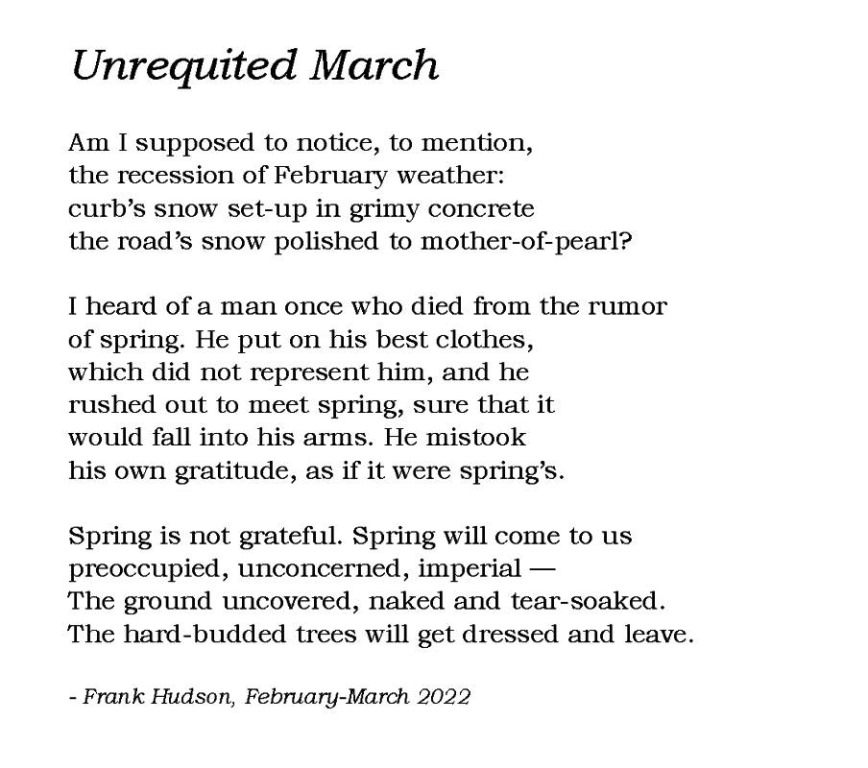
I started this inconstant month calling it “Unrequited March” — and I had this desire: to pay a more complete tribute to a recently departed poet I knew: Kevin FitzPatrick. In that task I wanted to see if I could rejoin with another voice and poet you’ve heard here: my friend Dave Moore.
Dave’s had some reduction in his ability to play keyboards, and he wasn’t sure how well his voice would hold up, but he was able to join me late last week as we took our usual “live in the studio” approach to doing some new pieces together, including a number of ones using FitzPatrick’s words. This requitement was doubly appropriate because Dave knew Kevin even longer than I did. Dave and I managed fine, and had a good time.
In the normal course of things those pieces would get worked on in the following week, but life has interrupted our singing back at death.
We are all racing forward and melting.
.
How? Even if one of this Project’s mottos is “Other People’s Stories,” I have qualms about telling other living persons’ events, so I don’t feel right discussing more details here today, but there have been hospitals involved, and some pretty long hours in the last two days in those places.
The outlook, best as I can predict it now, is that beyond my concerns with these other matters, my ability to work on audio pieces will be restricted for a while. If time allows, you might still hear some of the Kevin FitzPatrick related stuff yet this week.
Does it seem odd to work on art and our experience of it, even when other things must take precedence? That occurred to me too. Well, when I visited our newly hospitalized patient, they had two needs: music and Jacques Derrida. Go figure.
I’m posting a bit late in the day, but it’s International Women’s Day, and so today’s audio piece uses as a text a poem by a very international woman, Lola Ridge. Ridge’s poetry is perhaps best known for a fierce commitment to social justice and the situation of the poor in early 20th century America; but she was born in Ireland, left with her parents for New Zealand as a child, emigrated from there to Australia to attend college, and then to America, eventually New York City, where she mixed with most of the political and artistic radicals of the early Modernist era, including on the arts side: Marianne Moore, Edna St. Vincent Millay, Hart Crane, and William Carlos Williams and the rest of the circle around the NYC Modernist magazine The Others. Over at the Midwestern anchor of Modernist American poetry, it’s editor/founder Harriet Monroe was said to have called Ridge a genius, and she won awards and some favorable reviews in the years between the two World Wars.
Late in the 1930’s she apparently fell from the scene politically and artistically, and when she died in 1941 she was as poor as the people she wrote about, and then seemingly the subject of a rapid and rather complete forgetting for the rest of the 20th century.
Luckily our 21st century has become interested in reassessing the women who were on the scene a century ago along with the male Modernists, and there’s now a revival in considering her work.
Unlike some of Ridge’s poetry, today’s piece is not formally Modernist. It’s not only a sonnet, it attempts to present a passionate if conventional poetic argument regarding the abstract ideal of artistic beauty. Taken by itself it’s more Percy Bysshe Shelley than William Carlos Williams, but if we look just a little beyond its surface we can be reminded that Shelley was a thoroughgoing political and social radical as well as a Romantic era poet. Here’s a link to the text of Ridge’s “Sonnet to Beauty,” from a blog that does a great job of presenting sonnets and similar shorter poems, FourteenLines.blog.
Ridge’s poem starts by worshiping beauty almost as an awed acolyte unable to face the godhead. But in the midst of the poem, something strange starts to manifest itself: a buzzard (an ugly, carrion-eating bird) appears gussied up by “The wizardry of light” to appear “All but lovely as the swan.” I read this as Ridge saying that artists and society can fail, can deceive, can fake beauty.
A musical metaphor follows this that says despite the diversity of artistic endeavor — including false beauties or injustice like unto our buzzard — that beyond the dissonance and the harmonic stress of this dialectic, that the chords can resolve. The poem ends avowing that true beauty can still chime through ugliness, falsehood, and strife.
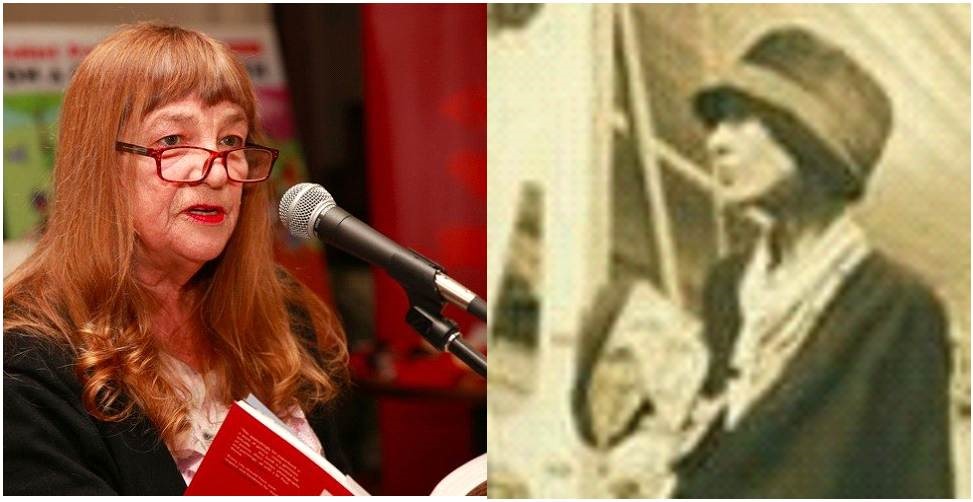
Beyond sonnets, I will now make a turn in this post before giving you a chance to hear my performance of Ridge’s poem. Let me quickly summarize the event I attended this past Sunday remembering Irish-American poet Ethna McKiernan. There may be more than coincidence that Lola Ridge started this off.
Ethna McKiernan reading, with lipstick, and Lola Ridge, I’m not sure.
.
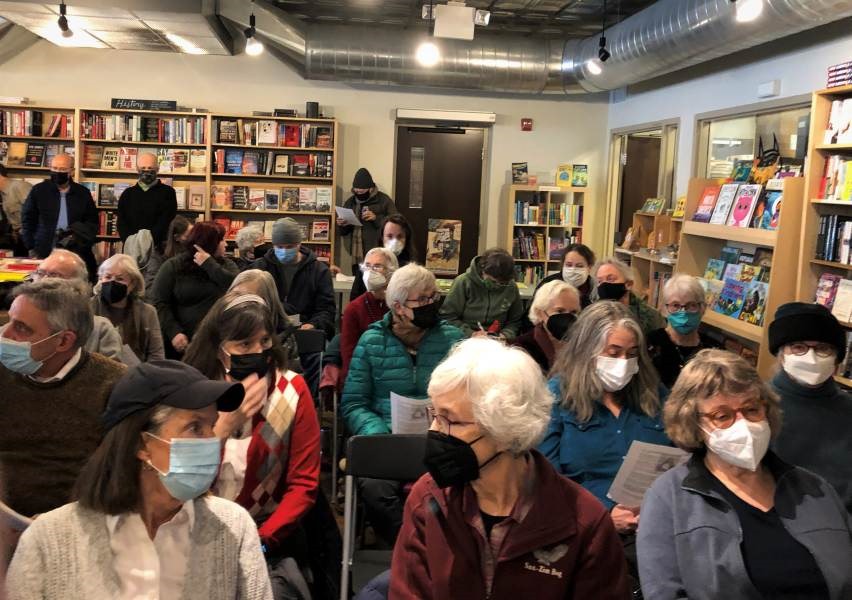
Minnesota weather and continued Covid-19 concerns might have conspired to reduce attendance, as the side streets were still full of sloppy snow from Saturday’s snowfall.* I arrived early and helped the bookstore staff setup chairs. They seemed to be expecting maybe a couple of dozen, which may be par for a Twin Cities local-writer poetry reading, but both the event organizer and myself the bystander suspected we’d need to maximize the amount of chairs the space could hold. I think we were able to get nearly 40 folding chairs into the designated space, but as the crowd started to assemble, extra chairs needed to be rounded up and put in the various aisles between the bookstore shelves to handle those that kept coming in, and we had a few standees who fit in where they could.
More than typical bookstore poetry readings, I suspect most of the crowd knew Ethna for a long time. And that may have given a boost to the eight poets who read poems of Ethna’s, a smattering of their own, and gave short thoughts about her as a writer and a person. So less a usual public reading where some poets might be nervously trying to consider how they would come off presenting their work to an audience which might not know it, and more like an experienced and informal poetry group of long-time colleagues.
Several of the readers were members of other periodically-meeting writer’s groups that included Ethna, like unto the Lake Street Writer’s group that Dave Moore, Kevin FitzPatrick, Ethna, and I were decades-long members of. I’m sure that if Kevin had lived, he would have been a valued part of this event, as Ethna often credited Kevin as an influence on her writing — but he died a few weeks ahead of Ethna. I tried to make myself useful by playing stagehand and raising and lowering the mic stand for the variety of readers.
Many of the readers spoke of Ethna’s work with homeless outreach, and read some of her poems that dealt with that work, something that echoes today’s poet Ridge. Though the audience was entirely masked, a few noted that Ethna was a stickler for always putting on lipstick when out in public. For all anyone knew, what with our Covid era masks, we all were wearing lipstick! Who could see — but I believe all of us were remembering Ethna.
Covid-era ambiguity: “Lipstick? We were supposed to wear lipstick?” A portion of the crowd at the “Remembering Ethna” event last Sunday.
.
So, as I speak of a woman who promoted culture, wrote beautiful poetry, and was committed to helping the economically desperate, I will now leave you with a piece using the words of another woman who a century before us did the same. You can hear Lola Ridge’s “Sonnet to Beauty” with a graphical player below if you see that, or if you don’t, with this highlighted link.
.
*My friend and participant here in the Parlando Project Dave Moore was unable to attend due to concerns with the street conditions. I’ve attended two other book-launch poetry readings given by Ethna herself, and this Sunday’s was the smallest crowd of the three. Consider though that most of those who knew Ethna are “senior citizens,” and some are frail as well.
I know this Project has an international reach, with listeners and readers in many countries. This is natural, because interest in poetry and music is borderless — but this month many areas of our world are also following the invasion of Ukraine by Russian troops. There’s no shortage of news, opinions, and analysis of that matter available anywhere where such things are allowed to be freely discussed, and I’ll not be adding personally to that here today. Some of you may be saying “Well, you must speak out! The situation is clear!” I agree that the situation seems clear to me too. I don’t believe I need to be an expert on the matter to have my villain and my set-upon victims, and my mere words in this Project’s small but valued audience won’t add that much.
But one of the Parlando Project’s mottos is “Other People’s Stories.” This lets me call in others’ words to bear on this. Neither of the poems I’ll use excerpts from today were writing about the current invasion, but they weren’t writing about things unconnected to it either. I won’t explicate their words here in any length, I’ll let those words speak for themselves today.
In place of that, let me give you a short description of how I came to create this piece which I call by the names of the two poems I used parts of: “Babi Yar – Testament.”
In the news this month I read that some ordinance in the invasion has landed on the site of Babi Yar, which is the hallowed memorial site of the execution of 33,000 people, mostly Jews, during the German invasion of Ukraine in WWII. The primary reason I know of that horrific event was from a poem I first heard as a teenager, named as the place was: “Babi Yar.” “Babi Yar” was written by a young Russian poet Yevgeny Yevtushenko, and the event of this poem was extraordinarily noteworthy in 1961 when it was published. First it was a poem read internationally by a Russian citizen that included criticism of the Soviet government and some elements of Russian history. Those of my age may know how unique that seemed at that time. After all, even the term dissident hadn’t really escaped from the Soviet regime back then.
And the poet? He was young, good looking, and a powerful reader of his poetry. Yevtushenko was seven years younger than Allen Ginsberg, and roughly as famous for a time after this young Russian was put on the cover of mass-market American magazines.
The whole thing was strange enough that some folks even thought there was a double-game being played, usually around the idea that Yevtushenko was the Soviet equivalent of the Black employee who is given the desk by the door to demonstrate that the firm they worked for didn’t discriminate on color. “See we’ve got our bright rebellious youth too, and there’s really no suppression of speech much less imprisonment for literature in the USSR.” One Yevtushenko, it was supposed, allowed the suppression of a multitude of others.
Let’s leave it at that, because the important thing I want to mention, is that the main reason I knew of the site of Babi Yar was from the man’s poem, the utter empathy it expressed for the victims who died there, and the statement that his native country hadn’t properly memorialized that spot. I often go into the background of poems here, but the poem had a power outside of that.
It’s been around 60 years since I heard or read that poem (I’m not sure which came first) and I wanted to revisit it. I was so bad at remembering the correct spelling of Yevtushenko’s last name that my first web search for some Scrabble rack of a bad guess with “poet” added in the search window brought up another poet instead: Taras Shevchenko.
I don’t know why I read that link to Shevchenko’s Wikipedia page, but that 19th century man has been called the bard of Ukraine. I knew nothing of him, though his wiki entry is long and detailed. An accidental cross-link had now occurred: I read of an attack during the current Russian Ukraine invasion, yet thought of a Russian poem and poet — and in searching for that, came upon a much-honored Ukrainian poet!
Today’s audio piece uses part of Shevchenko’s poem “Zapovit” translated* as “Testament” read by myself, mixed with several sections of “Babi Yar” read by Yevgeny Yevtushenko himself.**
This is the video showing the full performance of “Babi Yar” that I excerpted for my mashup.
.
The piece you can listen to below may seem like the sort of thing I used to do when I recorded with other musicians, but it has elements of remarkable accident too. The drums and bass parts were generated by a little box that I normally use only to practice with.*** I played a chord progression in rhythm into this box and it then generates a drum pattern in time with that and a bass line to follow the chords I played. Next recording pass, I played my reverse Stratocaster to add a guitar part to that bass/drums rhythm section, mostly using that very characteristic Strat “quack” two-pickup setting. Thinking that I might want a different option sonically, I played another take using an Epiphone semi-hollow-body guitar. This left me with two takes of guitar over the same beat. I figured I’d listen to one, then the other, and decide which sounded better later. Not an unusual tactic in these days of digital multi-track recording that.
When I first pulled up the tracks later that same day, I forgot to mute one of the two different electric guitar parts, and instead I heard the two tracks simultaneously. They seemed to weave with each other, even engaging in what sounded like responses — as if two guitarists were standing toe-to-toe and playing at each other. Without planning to, I’d played each part differently against the beat in a way that coincidentally complimented the other part. I decided that was the perfect accident for my Russian/Ukrainian poetry mashup.
I next moved to weave in the parts of “Babi Yar” as read by Yevtushenko and my own reading from Shevchenko’s “Testament.” The final addition was to play some layered synth. The completed piece has Yevtushenko, his poem, and the Stratocaster in the left channel and my reading of an English translation of Shevchenko’s “Testament” in the right. My aim was for it to sound something like a live jam, but I’ve tipped my hand today as to the artifice creating that impression.
Even with those parts separated in the stereo field, and two writers from two now combatant countries, it’s not really a dialectic. By a widely scattered coincidence both poets seem to reference the socialist anthem “The Internationale.” In the translation I used, “Testament” speaks of “Arise, sundering your chains,” while “Babi Yar” wishes for “The Internationale” to “thunder when the last antisemite on earth is buried for ever.” Each poem speaks of graves and outrage. Yevtushenko’s poem and expressive reading focus on the suffering of Jews, long persecuted in Europe even outside of the enormous atrocity of The Holocaust, and he audaciously claims to take on that suffering as a non-Jew.**** Comparing atrocities and suffering — oh, I cannot bear to do that tonight — but each suffering victim is their own suffering, each death their own death. Amid the current bombs and guns I won’t put that on a scale.
*Wikipedia credits Vera Rich for the translation I used. The use of the translation on the Wikipedia page may well indicate it’s free for reuse.
**In this case, I haven’t obtained express rights to use these parts of Yevtushenko’s performance. I normally would not do this here, but it’s such a powerful statement that speaks to feelings that I and some others have with the current crisis, so I went ahead and used it for this non-revenue Project today. If any rights holder objects, I’ll promptly remove it.
***The box is the Digitech Trio. I think I’ve used it once or twice here before in this Project’s over 600 audio pieces. I thought I might play my own bass line, but I couldn’t “untangle” the drum parts from the bass, and leakage into the guitar mics of the backing parts would have been another problem— and then generally, some of the issues I’m dealing with are a reduction in my time to record, or to record with others, or even my own body at my age being up for playing.
****I don’t recall anyone objecting to Yevtushenko’s poem’s statements back in the early ‘60s that “I seem to be Anne Frank,” “I am each old man here shot dead,” or his concluding statement that he has “no Jewish blood” yet he must he hated “now as a Jew.” Yes, I hear earnest empathy there, even risk in his time and place as well — but I could see some saying now, or even then, “You’re a fine, famous poet Yevgeny, so good words, but what do you really know of living that?”
As I navigate the Parlando Project and one of its goals, “Other People’s Stories,” I try to recognize similar things. My current working theory is that I’d rather get it half-right than not try at all, and I don’t feel any level of prominence that lets me stand in front of and obscure others who want to tell their stories particular to their lives.
Here’s a sonnet of my own about the oncoming spring. I live in Minnesota, and here that season’s arrival is something of a lottery ticket. Oh, it’s likely that by sometime in February a Minnesotan is tired of winter, and we know that somewhere around May Day we’ll not have snow or cold to deal with for a few months, but when today’s high got to 40 F, we know no more than that. When I moved here, I was told that on days like today we might see folks wearing T-shirts outside — and yes that’s so. We are so in a hurry for spring that what would be a 5-degree Celsius winter day in more temperate regions seems time to ditch the jacket. Yet we are still likely to have more cold, and even more likely to get substantial snowfall, particularly in March.
So it is, from late February to late April is a two-month season of “what d’ya got” in our state. That’s what my poem performed today deals with.
Things are still snow-covered around here, but it’s not fluffy, Christmas-card snow— more at rugged crusts. I still ride a bicycle nearly every day year-round, and so winter means that I pay special attention to the surface conditions of the side-streets that I most often ride. You know the old factoid that Inuit peoples have a multitude of words for snow in their vocabulary? A day or two after a snow what’s often found is compressed and polished snow with some patches of white glaze where tires’ friction has buffed a gloss.* A few days later there will be areas where that surface further abrades and patches of dull-brown porridge-like snow aggregates are scattered on the roadway. I call the later “brown-sugar,” and the earlier hard white surface looks to me like the smooth inside of a shell.
Spring-time bike rides in Minnesota aren’t necessarily what you think.
.
Low-pressure studded bike tires work pretty well on the hard shiny stuff, and large knobby treads are the thing for the loose brown sugar. My deep-winter bike’s tires are a pair of Venn diagram hoops circling both.
That’s a poet’s bike ride for you: metaphors per hour.
The meter’s a bit loose, yet not loose enough to cry “Kings X — Free Verse!” either.
.
Does any of this help “translate” my poem for those without my climate? That’s my hope anyway. Though the title of my poem is “Unrequited March,” my wish for you, curious or stalwart reader/listener, is that spring will love you back this year. The player gadget to hear about the uncertainty of that is below for many readers, and for those whose way of reading this blog won’t show that graphical player, this highlighted hyperlink will open a new tab to play the performance just as well.
.
*The large, knobby, low-pressure tires are also capable of riding on fresh snow before cars get to it. Un-rutted light and granular cold-weather snow is kind of fun to ride in. The wetter and clumpy snow that will likely come in any heavy storms for the rest of the season is much less joyful. That stuff is like riding in deep mud. The tires’ knobs will get traction — it’s not the tires, it’s an old out-of-shape guy like myself who’ll get tired quick riding through that.
This winter readers of this blog got to follow my own celebration of the work of Irish-American poet Ethna McKiernan. That was my memorial to her fine work, by which some of you now can know her. I realize that the Parlando Project has a world-wide readership, but for those of you that are in the Minneapolis-St. Paul area there’ll be a live event to celebrate her and her work featuring a number of her Twin Cities area poetic peers.
This will be a bittersweet occasion for me and some others, as Ethna and Kevin FitzPatrick used to do a poetry reading around every St. Patrick’s Day in March, and now of course both of them have died., turning them into memories and their words.
I assume McKiernan’s selected poems collection Light Rolling Slowly Backwards will be available at the event. If you’re not local, here’s the publisher’s listing.
.
Here’s one of those pieces I did this winter with Ethna’s words and my music. Player gadget below for some ways you may be reading this, or this alternative highlighted hyperlink if you don’t see that graphical player.
The sense I get from today’s example is that by using the generic if exalted name of “Poem” as the title, when what follows is so spare and simply stated, is meant to draw attention to the provocation that this is worth consideration as a complete lyric.
It may be me and my current situation, but when I read “Poem” I immediately thought it was a memorial poem, a five-line-with-one-refrained-line statement of the essence of loss intended to put itself up against something like the book-length “In Memoriam A.H.H.” by Alfred Tennyson. I still find nothing in the text that forbids that reading.
But death isn’t the only loss in life. Some, particularly those looking for obscured clues to Langston Hughes’ erotic orientation see this a coded statement of a romantic or erotic breakup with a “He.” Like Shakespeare’s sonnet sequence and Tennyson’s long poem, the poem has a dedication to a set of initials: “F. S.” in “Poem’s” case. Some articles one can find in a web search identify this dedicatee as Ferdinand Smith, who was in the merchant marine — as was young Hughes before he published The Weary Blues. Hughes did know Smith, but I haven’t seen a full explanation of how this putative identification was made. Oddly, if this poem of complete separation was written about Smith, Hughes and Smith kept in touch until Smith’s death in 1961. In Real Life there was no utter break between the two — but that’s biographical information, nothing in the text forbids the abandoned love reading either.
Frederick Smith, who’s been identified by some as the mysterious F.S.
.
And then too the poet Hughes of The Weary Blues and elsewhere is very broad in his use of the pronoun I. Not only does Hughes not identify F. S. and what exactly was the nature of the love relationship, Hughes is fully capable of using “I” as a collective or representational singular. Think of Hughes most famous early poem “The Negro Speaks of Rivers”— its litany of I’s is not a Quantum Leap confession that this certain 20th century poet worked on the Pyramids or rafted the Mississippi with Abe Lincoln.
But “Poem” does feel like a personal expression, even if Hughes may frustrate us if we prefer poems as memoir filled with explicit self-expression. Yet maybe this is of little importance to the essence the poem wants to express. Grief from loss of a lover who leaves and lives, or loss of a friend who has died — does the heart assay any difference?
Musically today I demonstrated fidelity of a different kind, playing a cheap 40-year-old 12-string guitar that I bought shortly after coming to Minnesota, and a bass that once belonged to Dean Seal, who played in the LYL Band in the early 80s. I have newer better* instruments, but it seemed like a good way to reset and get back to making some new Parlando Project musical pieces after February presented other matters that needed to be done.
You can hear my performance of Langston Hughes’ “Poem” with the player gadget below — or if you don’t see that, with this highlighted link.
.
*My newer guitars are better in that they don’t have parts that won’t exactly work anymore or intonation issues I need to work around, but besides old-times-sake I think there’s some character remaining in these funky instruments sound.
I was talking to Glen at the café I rode to for breakfast this morning. “It’s President’s Day. Did you get him anything?”
Glen has a pretty quick mind, but he thought for a moment and countered “Well, it’s one of those vestigial holidays. We’ve got a tailbone, but how many million years since we’ve needed it? It’s on the calendar and that’s about it.”
I think he’s right. It used to be more at Washington’s Birthday, and in some states Lincoln’s Birthday was also celebrated this month. And then one of the reasons February is Black History Month is that this short month also includes the date celebrated as Fredrick Douglass’ Birthday.
No sub-text here: 19th century celebrating heavenly Presidential bromance
.
My celebration, my observance was taken up with the ubiquitous modern American civic act this weekend, watching things on a screen alone — which is kind of sad, but the others in my family have more proximate concerns nearer to them than my fiddly interest in musty histories and art.
I started by watching Lincoln’s Dilemma, a four-part, four-hour documentary mini-series produced by a number of Afro-Americans that is available on Apple TV+ now. It covers the time from Lincoln’s entry into state politics until his burial, focusing on his evolving and politically and war charged relationship with American chattel slavery and the Afro-American’s subjected to that. I was a teenager during the centennial of the American Civil War who read avidly about it, and between that and my interest in American Black history there was a lot that was only refrain and time-line refreshment for me, but like any well-done extensive overview there’s a power in putting things together and linking this and that.
Two things discussed fairly early in the documentary were stories I hadn’t known. One deals with the Christiana Incident, something I’d heard nothing about. It’s easily as gripping as my own city’s Eliza Winston story, or the Emily Dickinson adjacent stories of Angeline Palmer or Dickinson’s “Preceptor” Thomas Higginson’s armed assault on a Boston jail. The other was its accounts from the under-covered period between Lincoln’s election, his subsequent spring-time inauguration, and the firing on Fort Sumter that started the Civil War. I would eagerly see entire documentaries or “based on a true story” depictions of either. For example, did you know (I didn’t) that during this period, as a last-ditch effort to placate southern states that were issuing their declarations of succession based on the Federal Government and its soon to be leader’s insufficient devotion to slavery, that a proposed 13th amendment that would constitutionally prohibit the ending of slavery was put forward? It passed the House and Senate with the required 2/3 majorities. Although the Civil War would soon be raging, five! states ratified it.
If this sort of thing sounds interesting to you, and you have access to it, I easily recommend Lincoln’s Dilemma.
I took a break halfway in on Lincoln’s Dilemma to watch John Ford’s 1939 Young Lincoln staring a startlingly well-made-up Henry Fonda as Lincoln. For good and ill this well-made film hits all the John Ford tropes* and is very inconstant in a “print the myth” way regarding historical accuracy. I suspect Young Lincoln’s emotional content no longer communicates, and more the same, it’s earnest civic lessons would be lost to most audiences today too. But it’s Ford, so we’re left with mise en scene and striking tableau frames that contemporary film makers might still copy. For humor’s sake I could try to hype its contemporary value as “The story of the trial of a pair of accused cop killers who are surprisingly defended by a lawyer reverently devoted to the law.”
Before I leave you, let me touch on George Washington, the man who posthumously gave up his birthday for President’s Day. The story of the Civil War and the end of slavery is but one example of a dictum often taken as absolute by revolutionaries: “Power concedes nothing without a demand. It never did and it never will.” And of course, as the leader of an armed revolution, Washington would seem to be an example** of demand backed by guns. But the singular greatest fact about Washington, a thing we should be grateful for beyond other things, is that after the American state got independence and he became its leader, he willingly, and without demand or struggle, gave up power. That’s rare.
Love of the thing one is struggling for, not for personal power, or opportunity, or mere revenge and expiation, is a hard thing to find — perhaps even more so in those who win some part of their struggles. So, let me leave off this Presidents Day not with a piece about a President, but about the man who stated that revolutionary’s dictum above, Frederick Douglass. Written by poet Robert Hayden,*** with my music and performance, you’ll can hear it with a graphical player below if you see that — or if you don’t, with this highlighted link. If you want to read Hayden’s sonnet about Douglass as you listen, you can find the text here. Back with new pieces soon.
.
*Although I’m reasonably familiar with why Ford is viewed as an important foundational cinema artist, I actually haven’t seen all his best-regarded films. Only last year I saw his The Searchers for the first time. As to that film: I found it highly compelling, significantly because it’s a film about racism made largely by men that could be fairly judged as patriarchal racists, and yet it’s not Triumph of the Will, some sharply focused mirror of evil, either. Somehow, Ford and fate made it multivalent.
As I mentioned as January ended, this February has been challenging for me to keep up with this Project and it’s associated tasks. I still hope to have new pieces soon. In place of a new encounter and performance with a poem or other text, let me do one of those posts where I pretend this is a normal blog
I know nothing other than what I read in the news about the situation in Ukraine — and that news with Ukraine now is, in short, mostly about what is feared to be an imminent invasion. I’m sure this Internet is full of folks with takes and information and policy positions if you feel the need for that, but instead I’m going to tell you a little story from my youth.
Back in the 1970s I was working the overnight shift in an urban hospital’s Emergency Department. Overnight, those 11 PM to 7 AM shifts, are probably not good for one’s health or social life, but I rather liked them. Staffing is much lower, and there was in my day almost no administrative or support presence. No crowd of attending MDs looking for proper deference to their priorities, no administrators to set or enforce policy in between meetings. Therefore, hierarchies were radically flattened at night, and I got to see and participate in a lot of different medical things.
My ED then was staffed with myself, a registered nurse (RN), a clerk who typed in information to print up a chart and the handy labels that would be pasted on lab requests/samples, and a family practice resident* Just down the hall from our suite of four treatment rooms was a door with a buzzer where anyone from the ambulance patients we’d expect after incoming radio calls, to those who’d called their doctor and clinic and were told to drive to the hospital for further evaluation that couldn’t wait until morning would appear. And then too, the walk in.**
I worked nearly 20 years in hospitals, most often in Emergency Rooms. This stock photo looks about the right vintage.
.
On the night I remember, the buzzer rang and there was an older man at the door. He had apparently walked up alone, and I usually was the one who went to the door to see what was the matter. And that was the issue from the start: he was speaking some foreign language, and he seemed to have only a scattered understanding of English and almost no English words to reply with. He looked to be in his seventies, had no obvious injuries, no severe distress. He moved slowly, but was walking.
Our door had a big lit-up Emergency Room sign, we could only assume he’d come in for treatment, but for what? You might assume that any 1970s urban hospital would have multiple language interpreters on hand, but that was not the case in ours then. And frankly, we wouldn’t even know what interpreter to call because we couldn’t figure out what language the man was speaking. Some words sounded a bit like German to me, so we called up a nurse working that night who spoke some German to come down. The RN and I hooked our mystery man up to the cardiac monitor, and the resident MD did a quick exam to see if we could figure out why this man had come to us. I think I may have even done an EKG on him, with no obvious issues found.
We looked for an ID in his clothes once we’d put him in a hospital gown and on a stretcher. There was none.
The nurse who spoke some German arrived. She got to her first preliminary question, which might have been “What is your name?” “Or why are you here?” and the mystery man exploded. At least some of the reply was in German. And our volunteer nurse interpreter said his angry words were that Germans had killed his family. How much German did he know? Made no difference, he wasn’t going to answer questions when asked in German.
I next got a bright idea. One of that class of residents was a young doctor who had a great facility in European languages, speaking at least a half-a-dozen of them. He wasn’t on call, and it was 4 AM, but I thought we should call him in. Given the infamous hours that residents worked in those days (maybe still do) that was asking a substantial favor, but he agreed to come in early. I was busy with something when our multilingual resident MD arrived. At one point he thought maybe Russian, and tried that. Later, I heard that once again the mystery patient became angry. Our resident didn’t know the man’s native language, but he got back something that was similar to our German speaking nurse — Russian was not a welcome language to our mystery patient.
Our multilingual resident was a smart guy though. One of the old-guard attending doctors on the hospital’s staff was Ukrainian American and had written a book dealing with Ukrainian culture in Ukrainian, a copy of which was on the shelf in the hospital’s medical library. Our resident showed that book to our mystery patient he later told us, and there was a quick realization that that was his language. After the regular day got underway, the older Ukrainian American doctor found that the man was one of his patients who was somewhat confused and had wandered to the hospital thinking that his doctor might just be there in the middle of the night.
So, as I said at the start, I know nothing about Ukraine — but I do think of that man who appeared in the night at the door of my Emergency Department and demonstrated how little I knew of him and what his country had been through.
Long guns, a poetic example.
.
What to bring forward for a musical piece today? How about this one about war and violence that combines a line or two of language expression from Afro-American singer Howlin’ Wolf with second generation Swedish immigrant Carl Sandburg’s poem about countries that pack those long guns. Player gadget below for some of you to play it, or you can use this highlighted link otherwise.
.
*Family Practice was the improved modern evolution of the old school “General Practitioner,” and the program that our hospital had treated that generalism like any other specialist residency to give the doctors who went through it a great deal of practical experience in things they would encounter. Almost every one of the residents I worked with there and then were fine people, who would come in some degree of unsure in the Emergency Room and leave after three years as the kind of doctor that I would want for myself or my family. Doctors and regular medical educators ran that program, but experienced nurses were so important in that too. Each June brought in new residents who really needed the steady hand of nurses at night to guide them in practical medical logistics and solutions.
**There was an indoor hockey rink across the street that had a fairly full set of bookings that ran until midnight. Yes, we needed to keep a lot of suture kits in stock.






 Frank Hudson