Some of you made it through my summarization of the musical career of the Cats and the Fiddle Jazz combo this week, but even though I was writing about music, we didn’t add much poetry there. One little thing I found out since I wrote that summary: that eBay matchbook collector item should have tipped me off about the site of one of those young Chicago kids’ gigs — a way stop on a trip to Hollywood to try breaking into the movies. It wasn’t at the “Airplane Café Club” as Marv Goldberg had it from his research, but the “Aeroplane Café. I’ve found a postcard. Looks pretty swanky. I wonder how the Cats act went down there in 1936 — did the Denver white swing kids dig their act? Four or five years later I’d give our band of audacious teenagers better odds on that.
Well, however they were received, they were young, they had dreams of a career ahead of them.
Looking at what musical acts were playing Denver at this club and elsewhere during the ‘30s, it was mostly white bands for dancing. Black bands started appearing on the bills in the ‘40s. My research said the Aeroplane Cafe lasted until the ‘80s, hosting in its last years rockabilly bands.
.
So, let’s combine some literary poetry with music, Parlando style today. The words are by Langston Hughes, one of the first poets to recognize that Blues and Jazz were poetic, suitable for praise in poems, suitable to combine with Jazz words he’d contribute. When the young Hughes wrote today’s words for publication, he called the short poem “Dreams.” I heard it as a kind of Blues, a Blues with a sorrowful side, but with an admonishment to endure. If some reading this are having a February of backlash and disappointment tempting despair, this is after all Black History Month. Afro-American poet Hughes knew that dreams may well be knocked down, ignored, belittled. Yes, I know the word “woke” is a word in present contention. I find it odd it is used by those who smirk and dismiss the word as they speak it, aiming it toward those who know very well the reasons that dreams are extinguished.
Hold fast to dreams
For if dreams die
Life is a broken-winged bird
That cannot fly.
Hold fast to dreams
For when dreams go
Life is a barren field
Frozen with snow.
I’m looking at a bare and snowy landscape out my window this evening. I rode to breakfast in 10 degrees with a cold wind this morning. I read the newspaper when I got to the cafe, because I’m a man who still spills eggs and hot sauce on the news in the morning. None of the news was good.
I spent my last couple of days making the musical piece work as well as I could make it, tickling an old guitar that I played when I was young, playing piano the way I can: a finger or two on the keys, tracking the left and right hand parts separately to disguise my ham-handedness — because music may find a way. I sang Langston Hughes’ words quietly, mouth up near the microphone. I had to, it was near midnight when I sang them, and my family was asleep and I want them to keep their dreams.
I want you too to keep the sweeter of your dreams. Waking right now can script all the nightmares and anxiety dreams that need no help. When the best mysteries come under the eyelids, ones almost too good to remember, I want you to keep them, even just the sense of them.
The audio player to hear my adaptation of Hughes’ poem I call “Langston’s Blues” can be heard with the audio player gadget below. No gadget? It’s off dreaming, but you can also use this highlighted link which will open a new tab with its own audio player.
I’m planning to return in a few days with more on why I wanted to work at figuring out all I could about that young Jazz combo of the 1930s and ‘40s.
We left off last time in my Black History Month series this year, with a crumbling scrapbook filled with mid-20th century things someone had gathered. The scrapbook compiler was concerned with entertainment, particularly Afro-American’s in that role, and the largest number of items they’d pasted in focused on a somewhat obscure musical act: The Cats and the Fiddle. Was the compiler a fan or a musician themselves? Woah, we get ahead of ourselves. Let’s stay with the musical evidence we have for a little while longer.
Once I get out of bed in the morning, I grab a newspaper from somewhere in the vicinity of my front door and read it. This is antiquated behavior. I often linger in bed before or after sleeping reading near-instant news on a large tablet connected to the Internet before I later get to the morning paper’s headlines that were written yesterday, yet still I take comfort or distress from reading them printed on paper. This is memory/habit working. I’ve read a newspaper in the morning since shortly after I learned to read. I even delivered them door to door as a youth in my little Iowa town, a place where and when the newspaper might be the only way you’d find out about some things in any detail.
Though I compose music and operate various musical instruments constantly as part of this Project, I’m somewhat removed from the general life of a musician today though I read accounts, I observe. But all of us listen to music, experience it some way. I know of no culture anywhere that for any appreciable span of time has been without music.
In the 1940s and ‘50s world the scrapbook photos, magazine clippings, and ephemera collected would have overlapped my childhood, would have been my parent’s adulthood. I experienced music some from records, some from television or movies, and largely from radio.* Music face to face? Church music once a week, and the school’s student marching brass band a few times a year. I enjoyed rock’n’roll cover bands just twice, at the Junior and Senior proms in my high school. Concerts? I once got to travel to the large auditorium at the state capitol to hear Handel’s Messiah oratorio. But that’s a rural, small-town story within a family that had no special connection to music, played no instruments.
For other white folks in cities, and in other areas, music could have been more central, more direct. Step back a generation to my grandparents’ youth? Recordings, perhaps some, radio not yet broadcasting, movies silent. Non-commercially, there was the parlor and folk music of those whose neighbors or families played. Music at events meant musicians playing, making the entirety of the noise right there and then. Let me repeat: that era’s connection to music was almost entirely performer in the room or performance space — and so where you lived or traveled to impacted your music heavily, and overwhelmingly your connection to your music was as fully dimensional, occupying the same space at the same time with you.
Some who read this may be two full generations younger than me. Your connection to music will likely be more removed: streaming playlists, the soundtrack to video games, concerts that could be large TV screens over a distant stage of dancers and miming singers with microphones in their hands. Or it could be a sweaty basement or a club with a small stage at one side, or something you try to record on the ubiquitous computers surrounding us, to hopefully exist elsewhere momentarily on phones, like a brief, wrong-number phone call that each connected party, embarrassed, occupies briefly, and leaves. You may think: I decide how I experience music, or how I make music! Yes, you do have choice, even if you may, out the other side of your mouth, decry that most all others are dictated by culture and capital. The in-between truth is that you, musician or listener, and the musical audience and musicians in general, are still living inside a present culture that changes things. The older ones living now still remember past cultural contexts, a diversity of time.
Because Afro-American representation lagged in mainstream American culture, representation of their music in mass media was filtered out, shown behind a screen for much of America. A Black American circa 1930-1960 is going to make and experience music because of their contemporary cultural particulars, their landscape in time. How long this post would be for me to try to even outline or list those things I think I have a smidgen of understanding of: the divide of parochial cultural ignorance from non-Black folks can fill volumes, Black History Month a pitcher of a lakeful. Demeaning white superiority, colonial European cultural hierarchies, and minstrel show comic-fool stereotypes are the proscenium for Afro-American performers. Sometimes violence lurks at the meeting edges. A well-meaning paragraph in a blog post staggers to carry that weight.
So then, if a Black American was going to use music to relax, or as a balm against the absurdities of your life and times, how much easier is it going to be to find that in Black entertainers, in Black saturated places among fellow Black audience members. But also consider: your experience of music is going to be that fully-dimensional one most often. In the room. In the same time. You can smell the music, which you can’t on Spotify.
Think back to that short movie clip from the previous post in this series,“The Harlem Yodel.” The Cats and the Fiddle and the Dandridge Sisters are dressed up for the Alps in the roomful of mirrors that we’re to know to be an indoor ski meet. It’s 1938. I notice as the Cats enter our frame at one minute into the video clip, they drop a short series of sour, single string plucks. Is that a musical Dada expression saying: we know this is ridiculous, but we’re getting to be in the MGM movies, even if it’s a B minus, undercard short-subject? One of the producers of the short, Jack Chertok, would work on more than 30 shorts in 1938. By the early 60s he’d be the producer of My Favorite Martian, a half-hour TV sitcom about an undocumented extraterrestrial alien living incognito on a grey-scale Earth — not exactly Ralph Ellison, but some of the strangeness is intentional. In the movie, the audience is white.
White folks on the right: “What, we can’t even have segregation at an indoor ski jump competition?”
.
In the second music clip, “Killin’ Jive,” the audience is black in the film and in the producer’s movie-house intent. It’s from one of a series of Westerns made for Black audiences, and the picture’s star (unseen in the clip) is the “Sensational Singing Cowboy” who was variously billed as Herb or Herbert Jeffries or Jeffrey. Wikipedia decided on Herb Jeffries, but I don’t know if the last name varied for carelessness or branding tweaks. His Wikipedia article goes on to write about the unsettled ethnic background of the man born Umberto Valentino, but he was clearly marketed at the time as an Afro-American. The band’s performance there is intense and uninhibited — can’t-top-this showmanship. This clip, and publicity photos, would mean that the Cats would need to do this live on club stages at some point in their sets. This song (like many in the Cat’s recorded repertoire) is by a member of the band, and “Killin’ Jive” is, full of insider Jazz/Black slang. Here’s a link to the lyrics.
Clearly, it’s a song about marijuana intoxication, and it’s performed in a let’s-get-high-and-party manner. The lyrics, which as I said are written by one of the group’s founders, Austin Powell, can be read as adding an undercurrent to that performance. A line is refrained in the song “He’s a sad man, not a bad man,” and I expect “bad man” in Thirties Jazz argot could carry the same “formidable and unrestrained” (in this case, when high) Afro-American slang meaning as well as the mainstream cultural meaning of he’s not evil, he’s just depressed. There are lines too about “darkest days” and “got no rent” (not transcribed correctly in the link) If this were a Brecht and Wiell song from say The Rise and Fall of the City of Mahagonny, we’d read these lines and expect Modernist irony. What do I expect? That Powell had a brain and a viewpoint and meant what he wrote.
CORRECTION: The “Killin Jive” song was actually performed in another Black-audience-targeting picture called The Duke is Tops. They did appear in Two Gun Man from Harlem too, I just trusted my memory more than double-checking my notes,
“All Star Negro Cast” in the film from which “Killin’ Jive” appears
.
In real life and not in front of Hollywood backlot cameras? I can’t say for sure what kind of places the Cats and the Fiddle played in, but as working musicians the places they performed in would surely be physical contexts in a segregated society. Los Angeles had its own Black musical scene and audience around the Central Avenue neighborhood, and they could have played there. In a following post in the series we’ll get into what I can figure out regarding their musical career and travels from supposition, elements in the scrapbook, and some new information I was able to gather this month. More to come here soon in this series.
For a musical note, here’s a Langston Hughes poem remembering time on the other side of the tracks. There should be an audio player gadget below, but if it’s been red-lined out for you, this highlighted link will open a new tab with its own audio player.
.
*Radio was more-or-less the streaming of my era, but it had the extra dimensions that you knew that others were listening to the same music you were listening to at the same time. When “your record,” the one you made, or simply the one you cared about as a listener, was played on the radio, you may have been alone in your room or your car, but you knew also you were one of some many in a simultaneous nexus. Music on television or in the movie house was most often a generation behind. I’m nowhere near a Jazz musician in skills, but I owe it to TV and movies of my youth that when I hear a Jazz take on a “Standard” I usually know the tune.
For more than 50 years, I’ve often thought of this Bob Dylan song.
Today I was learning how to use a feature in my recording software, and I needed a vocal take to use as an example. I’ve been much concerned this winter with events that seem (as Thomas Hardy once wrote) to be “in the breaking of nations.” I guess I thought that busying myself with learning might let me take a break from that dread, and when I opened up a mic to sing, this was the song that came out of my mouth. I think it asked to be here today.
Songs and poems can do that. They aren’t necessarily mystic fortune-telling omens — they’re more at waves in the air or memory that come in to rattle your bones and vibrate your vocal cords or synapses.
The story in “All Along the Watchtower’s” lyric is a repeating loop, the last verse’s approaching riders are the two foreground characters arriving to speak and open the song. So, “All Along the Watchtower’s” story doesn’t unfold — it refolds — and I chose to point that out in my version today. To illustrate this song for the video I dealt out some tarot cards. I don’t believe those cards are omniscient omens either, but the pictures can flip and spread for a receiving eye and mind. Perhaps all symbols, songs, fables, poems, pictures — all foolishness and wisdom — rotate around themselves like that.
Is this short post a break from Black History Month, so soon in this February? Well, maybe, but the song “All Along the Watchtower”is best known from a monumental version performed by Jimi Hendrix.
Time for me to get back on my Carl Sandburg soapbox. I’ll be brief — as today’s poem, now song, is as well. My point (again) is I think there’s more there in his poetry than is currently remembered or considered. Your impressions may be from two stalwarts of American poetry anthologies: the Whitmanesque “Chicago” with those big shoulders and the quite contrasting short metaphoric poem “Fog” with its cat’s feet. Not a lot for a poet who wrote so much, so early in the Modernist era, but it does point out a range of expression.
I’ve performed segments of Sandburg’s prolix mode here. I like Whitman well enough. Within limits, I like Sandburg doing Whitman’s mode too. He’s not quite the opera singer that Whitman aspires to be, he’s more of the folk-ballad, song-suite, kind of poet. America’s a big country, so I guess we need big, shouting, poems — and even if that’s not my favorite mode, either poet can move me as they traverse long distances with galloping catalogs and litanies. My point today is that this Sandburg, being bigger, overshadows another Sandburg, one that I particularly treasure, the one that reminds me more of Du Fu than Whitman: the forgotten, pioneering, ground-level reporting, American Imagist, Sandburg. Sandburg’s poems in the compressed style are not accidents, seeds of long poems that didn’t germinate, or little palate cleansers between his important work. His earliest collections are packed with sub-sonnet-length pieces.
On awaking this morning, I was thinking of a set of poems by a couple of the earliest American Modernists, Ezra Pound and Sandburg, where they each showed gratitude for their American forbearers. I paired their poems as one musical piece early in this Project, and here’s a link to that.Pound, within his characteristic grumpy mode in “A Pact,” makes peace with Whitman — and while casting a little shade on Walt for being the son of a house-carpenter, he claims his own finely crafted woodcarving is descended from the cross-cut and rip saw of Whitman.
Who does Sandburg say are his native 19th century inspirations? Whitman? Nope. Maybe Longfellow, with his civic-minded striving for uplift and justice? No. Who’s left? Poe? Hmm. Interesting thought, even if Poe is awfully rhymey for a free-verse poet. The other Fireside poets? Well, yes, Sandburg wanted a wide audience, but as the child of an immigrant couple and attendee of a non-descript Midwest school, he lacked their pedigree.
Sandburg in his “Letters to Dead Imagists”is declaring his allegiance to that spear-point of English-language Modernism, but here he claims a couple of Americans as his predecessors: Emily Dickinson and Stephen Crane.
The poet he names first, Dickinson, will likely seem a more conventional choice to those reading this today than it was when Sandburg wrote his poem in the early 20th century. Dickinson’s eventual rise to genius status would still be early in its slope — she was more known then as an eccentric than as a model for poetic expression. The second, Stephen Crane, is more associated with prose, but he wrote a singular collection of gnomic, short free verse poems, The Black Riders, in 1895. An inspiration for Crane’s unusual work: the new, first publication of the poetry of Emily Dickinson in 1890.
Sandburg was among the first to try to form a 20th century style combining the “mother and father” of American poetry: Dickinson and Whitman. And I happen to like it when he takes after dear old mom.
Today’s piece, Sandburg’s “Couples” sounds a little like Crane, a little like Dickinson, and it has a characteristic early Imagist trope of close-focus specifics and vivid color by name. Here’s a link to the text of it. If one thinks of Sandburg as being a clear-speaking poet, this poem should disabuse you that he’s always about some obvious point. Part of the delay in publishing my version of his poem is that I’m still not sure what he’s describing. There’s parallelism set up between six “women” dressed in green and six “men.” They’re described as dancing, likely haphazardly as the infamously strong liquor absinthe* is mentioned, they make a hissing laughter sound. They are somehow cheating or gaming each other. There’s a worn path of hard packed dirt said to be from the dancing feet. The poem closes with dewy weeds said to be as high as six little crosses, one for each couple.
I’m stumped. A graveyard? Then maybe the dancers are ghosts. But if so, why the specific detail of the dirt floor packed down if it’s a weedy, less-than-well-tended graveyard? A barn-dance? The weeds are described as “mourning veils.” Or are the six live couples dancing around six graves? Why, who are they to the buried, if it’s that? Perhaps instead, the dancers are green plants of some kind, their dance uncoordinated as random winds, and the wind through them is the hissing laughter, and they’re maybe even the weeds the poem closes with. Did Sandburg just choose their number to be six out of desire to be specific? But again, he spends two lines of a short poem on the packed down dirt floor under the “dancers,” and plants dancing in the wind wouldn’t compress the earth.
In summary: as obscure as any of Crane’s Black Riders poems — but specific, like a closely-observed Emily Dickinson riddle poem. If Sandburg intended mystery, he achieved a stubborn dose of it in this poem of his, and the incantatory power of its spikey, inexplicable details may still carry us through. While it’s unlikely Sandburg’s model, if one was to translate this into French and say it was from Rimbaud’s “Drunken Boat” how would we experience it?
Glad to be at the open mic. I’m going to do “Wagon Wheel” and this Oasis song “Wonderwall” now.
.
If forced to a final guess: they are graves, and the dancers are the living as continuing life-force, not dancing on the graves as revenge, but out of the joy of continuance, and the packed dirt is the mark of our ongoing life-work and dance. The cheating? The unfaithfulness and trifling of love and desire, or they are cheating death by living and loving. The couples of the title then are not only the paired male and female dancers engendering a new generation, but the connection between the living and the dead. Why six? I don’t know.**
I performed this with just acoustic guitar, Carl Sandburg’s own instrument of choice. When assessing his guitaristic skills, Carl would sometime say he was at least one prison sentence from getting any good. You can hear my misdemeanor playing with the audio player gadget you should see below. No gadget? It was pardoned, or impounded, or deported, or took a buyout, or something. No one seems to know, because some vain fool runs things, and there’s not enough conscientious people left to make knowledge from foolishness. But I do give you this highlighted link that’ll open a new tab with its own audio player.
.
*Absinthe is colored green, doubling down on the use of that color in the poem.
**Rejected guesses why six couples and six crosses: six is sometimes used as the number of cardinal directions, sometimes shown as a six-armed cross, but Sandburg seems to be clearly saying six separate crosses. The Oklahoma state flag shows a First Nations (Ossage) shield with six separate crosses on it (the cross is a common indigenous American symbol) — but that flag was adopted a decade after the poem, and I can’t find any source of previous use of that distinct six crosses symbolism that the flag drew on.
I’m trying to decide between work on finishing a new Parlando piece combining literary poetry and original music, and seeing what I can do for a February Black History Month observance here. The first is mostly done, the latter is but ideas at this late date.
What to do? In my typical direct approach, I did something else today. This weekend I watched Timothée Chalamet appear on Saturday Night Live as the musical act on the long-lived sketch comedy television show. Chalamet is fresh off an acclaimed performance as the young Bob Dylan in the film A Complete Unknown.
I mostly liked that movie. Biopics are always dodgy things to do, as most people’s biographies when told straightforwardly do not have enough dramatic concision to make a compelling two-hour film. Which means they all have fibs in them, and they will perforce leave things and people out. It’s become an apparently unavoidable cliché to remark on this element by quoting a line from another film, The Man Who Shot Liberty Valance: ” When the legend becomes fact, print the legend.”* This misses the point of John Ford’s great film. When that line is uttered near the very end of that movie, Ford has shown us a compelling tale of a man, played by Jimmy Stewart, who had many great things about him, a man who at the end of the film had risen to become an honored Senator, a plausible Vice President even — but Ford also told us of another man, played by John Wayne, who may have been less interesting as a biography, but whose acts are critical to the movie, and who gave up more than legendary fame when making his choices. Ford isn’t praising that “print the legend” eventuality. Ford’s film prints “the fact.” He thinks that’s more interesting.
A Complete Unknown tries within conventional running time to tell a complex story: of a young man who’s forming himself — not so much finding himself — as he wants to be unfindable. Instead of doing a “great man” tale, it wants us to see the other folks around him, lovers attracted to and understandably frustrated by Dylan; and a pair of men: one a businessman, the other a saint of citizenship (Albert Grossman and Pete Seeger). In between these, Johnny Cash plays an imp of the perverse. That complex tale is told at a brisk pace. I was able to forgive that. Yes, there are characters undervalued, incidents re-arranged in the timeline — but in the movie’s defense I’d say it couldn’t be otherwise, there were just so many talented and interesting people in that time and place.
And then we got to the final incident, the film’s climax. Here time is suddenly allowed to expand and we are given more detail about something that lasted maybe 48 hours in real time. Some of that detail is accurate, much of it is not. Most of the inaccuracies are aimed not to expand the complexities of the relationships and times, but to simplify them and underline a simplistic point. Finally, the movie has introduced all these characters, and this is the place where the earlier parts of the film are exposition, and you can get them to fully spark and rub with their differing viewpoints. Instead, that doesn’t happen, you get instead a rock’n’roll pantomime, with caricatures shouting and everything but a pie-in-the face fight.**
This is not the fault of the performers though. The cast does a fine job, and before his actual work could be seen, Chalamet’s ability to pull off his performance as Dylan was generally doubted in online forums of musicians and music fans. He did fine, and as the movie publicity has informed us, he “did his own stunts” by learning to play guitar and harmonica and to sing live, and this led to this past weekend’s choice for him to appear as a musical act.***
Again, Chalamet exceeded expectations. His opening Dylan song, “Outlaw Blues,” (done as a rap-chant with Jack White/Black Keys-like elements in the ensemble) was fresh and effective, including that Minnesota call-out to being “9 below zero at 3 o’clock in the afternoon.” Even more surprising was Chalamet immediately going down-tempo with a real rarity that would have stumped all but the deepest of the deep-cut Dylan fans: “Three Angels.” It’s a brief song from a now little regarded Dylan album New Morning. It seemed a throw-away even in that less-celebrated collection, an off-hand narration of an urban winter scene post-Christmas. From my Parlando focus, it attracts me though. It’s got some elements of one of poet Frank O’Hara’s “walking around poems,” that paying attention to what we are not usually paying attention to mixed with a casual surrealism. Everyone in the song seems a non-sequitur somehow, and why does the truck have no wheels, why is the cop skipping? Three fellas are “crawling back to work” under the same number of angels playing silent fanfares in snow, and we may not know if those three are wise men or not, as nobody stops to ask why they are going to work. Here a link to his set of performances.
So, I admire Chalamet’s taste in Dylan songs there. Perhaps if he lives to my age he’ll also be good enough looking to play me in my biopic. But watching his performance my ego remembered that decades ago I did a cover of “Three Angels” myself, one done early in my ability to overdub parts creating a one-man-band on a recording. Today I found the recording and made this short video to present it.
I think I did this recording on a “portastudio” cassette, or on my first computer-based recording system.
**If you really want to know the complexities, I recommend the book which the movie bought the rights to: Elijah Wald’s Dylan Goes Electric. I thought I knew all the details of the film’s famous climactic Newport Folk Festival scene, but I learned stuff from Wald’s reporting and extensive context on the “folk scare” American folk revival. Sure, 99.5% of the folks who watched the movie will not benefit from getting this book, but the .5% who would, need to read it.
***In the post WWII era, there were a lot of poets who in their dreams wanted to also be musical performers. Easy to see why too: poetry was a small cultural sideline, but for much of this era it was possible to become highly popular and well-paid as a “rock star.” It’s less acknowledged, but the same could be said of some actors — despite the fame, adoration, and income levels achievable in commercially successful acting being roughly equal to popular musicians. In 2025, I believe this is less often true — more and more professional musicians these days have meager incomes. But there may still be some desire to play Orpheus in real life among a sub-set of actors.
What do I think? I think poetry and music are kin, and if my thought-dreams could be seen they’d probably put my head in a guillotine. And despite the fame level of Bob Dylan, Chalamet is helping Dylan’s art by illuminating it. Good on him.
Today is Robert Burns’ birthday, which I hear is much celebrated in Scotland. While this Project has done over 800 audio pieces over the years, none of them (before today) have used Burns words. Why not? It’s a personal limitation of mine: his poetry uses a lot of Scottish words and dialect, and I have a hard time doing that.*
But, at last, I’ve finally snuck in a bit of Burns. And while it’s not as novel, I’m also using a set of words I wrote for the bulk of today’s performance, though the Parlando Project remains overwhelmingly about experiencing other people’s words. The second part of “Arcadian Ewes” is a draft version from a work in progress: The Memory Care Sonnets. Drafts of other poems in the series have appeared here before, but for those new to this, they tell the story of a daughter visiting and caring for a mother with increasing dementia.
While hearing the original account of a daughter and the daughter’s friend going for a weekly singing session at the memory care facility last fall, I was somehow struck at the time with the story’s Arcadian sensibility. That’s a place I know from this Project. Poetry and folk-song is rich in Arcadia: there are shepherds, flocks, meadows, love, peril, loneliness, peace, gifts, songs, a sense of time ever-present without fences, taking place over the hills and away from our actual daily lives. Here, in the sonnet, the shepherdesses go to the place, gather their flock of singers. What songs will they sing?
Even as I was writing the poem the refrain of Burns’ song that now begins the recorded performance was in my mind. I can’t quite account for why, other than the song for some reason often brings me to tears — and I can’t fully explain that either.
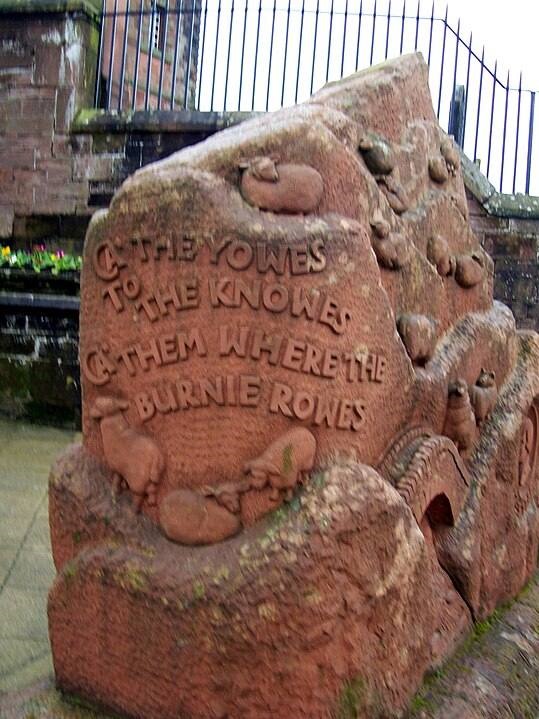
Today’s musical piece begins with part of a Robert Burns’ song displayed on this monument in Dumfries Scotland (photo by: summonedbyfells via Wikipedia)
.
“Ca’ the Yowes to the Knowes” was collected and reshaped by Robert Burns in the late 18th century. He published at least two versions, and the folk process has given us other variations, including differences in how much of the Scottish accent and wordage is retained. As a text though, it generally isn’t a sad song. The song’s shepherdess, taking her ewes among the hills seems happy enough in her labor, but happier yet to find a swain in her Arcadia who promises her unending devotion and care. That story isn’t sad now, is it — unless one dotes on how love’s promises aren’t always faithful, that human lives are not unending. But as I said above, poetic Arcadian time doesn’t end, and maybe that contrast with human time is the essential sadness. Perhaps it is those elemental parts of Burns’ story, of the care for the carer, is what linked it to my resulting poem of the daughter taking care of the mother.
However inexplicably, I believe it’s the music that makes me cry when I hear that song’s tune. Music, that same powerful class of thing that is the balm that restores a connection to the mother on one of her “bad days” of deeper withdrawal in the sonnet. The music for the performance you can hear below doesn’t hew exactly to the old song’s tune, for I don’t know if I could have stayed with the reading if it did. You can hear my performance with the audio player gadget below. Has your audio player strayed away over the hills? No, just some ways of reading this blog suppress displaying it, so I also offer this highlighted link which will open a new tab with its own audio player.
.
*That lack of the ability to hear and then repeat back sounds bedevils me several ways: it’s often relied on in musical endeavors, and it’s long frustrated me in my desire to speak other languages, or even pronounce some names correctly. I suspect it’s a neurological quirk of my brain.
I suspect a majority of my readers are looking for something related to poetry when they visit here. Stats show continued high visit counts for older posts on some poems this winter, proof of Pound’s dictum that “Poetry is news that stays news.” I remain a little puzzled by the trailing interest in the audio pieces that accompany nearly all the blog posts. The analyst in me assigns that to the fleeting visits of many internet users who sometimes can’t politely play audio, or who don’t care to expend the 2 to 5 minutes most of my musical pieces would take. Maybe some think the audio player gadget will launch an all-to-typical one-hour-plus podcast with an inefficient, in-joking set of hosts rattling each-other’s funny bones? Or it could be musical tastes that diverge, including expectations of better or different musicianship and a more attractive and commercial voice than mine? If so, fair enough.
I doubt any but a few are here for politics. And this week, more so.
I had a political life, I retain an interest in politics in old age, yet even I am on a political news diet this winter.* If it looks like I’ve been writing thinly veiled political posts lately, I’ll claim my intent is more to expiate my own emotions — and to, with whatever value, to succor those that William Carlos Williams portrayed last time as “huddled together brooding our fate.”
One of my early poetic heroes, Carl Sandburg, had both a political and literary life. I recall a story that as his early Modernist poetry was breaking out into publication, he was challenged on controversial political elements in his poems. He claimed (earnestly, or with care for his emergent career, I don’t know) that any such was incidental — that he, the author couldn’t fully compartmentalize himself. I have no career. My primary interests here are to promote other people’s poetry and to learn and enjoy myself while doing that, and so I’ll make a similar claim.
Which brings me back, as this Project often does, to Emily Dickinson. There are some things exceedingly modern about this mid-19th century American poet: the compression of her language, her freedom from lockstep prosody or conventional syntax, the explicit use of the mind’s interior as a landscape, her abrupt linkage of the prosaic ordinary and the most high-flown concepts. With all that stuff that still seems modern, folks looking to more deeply comprehend her work may need to be reminded that she is, for all her genius, a citizen of a particular place and era.
I remember a short session I had while at the Dickinson Homestead Museum some years back, when a tour docent made a comment that Dickinson wrote a good deal about the Civil War.
“Huh?” I said to myself. I could recall no such poems. In my ignorance then I assumed Dickinson was largely insulated from that, being in small-town New England, privileged, white, and female. I’ve learned a lot since then, and that’s been one of the joys of this Project.
Today’s musical piece is her poem “Inconceivably Solemn.” In its abrupt/oblique language, landscaped with the blank horizons of those em-dashes, I can’t catch a definitive picture of what she’s observing. Metaphoric or actual, it seems to be a parade or celebration. What’s the occasion? An Independence Day? A group of newly mustered troops for that Civil War? An election? I lean to the latter two, and remind those who aren’t steeped in mid-19th century American history that those two things were linked as chattel slavery was a huge and sundering political issue for decades before breaking into war. I first thought the poem was troops going off to war from her town, and it still may be. The 1861-65 war overlapped Dickinson’s most productive years as a poet, and her Amherst sent troops which quite likely enlisted and marched out from the town.
If you’re tired of politics, poet Emily Dickinson seems skeptical of the celebration here.
.
On the other hand, the poem also seems at times to place the celebration/parade as being far away. Is she imagining the soldiers marching into battles at the battlefields that weren’t near her town? Or reacting to battlefield reports in publications perhaps with “mute” engravings of the troops? The poem starts and ends with clear oxymorons, with that first line’s “inconceivably solemn” that is used as the title stand-in. That “solemn” is soon “gay.” And the penultimate line has “wincing with delight.” So then: portraying great causes, assumed honor and bravery, but also suffering and death.
Allow me one moment of my pedantry, and some very uncertain speculation on my part, regarding something that only occurred to me today after working with the poem earlier this winter to prepare the music you can hear below. You see, there’s this odd line “Pierce — by the vary Press.” Dickinson is no stranger to choosing an unusual word, and that may be all “Pierce” is meant to do here.
But one of my youthful enthusiasms was history, and just today I thought, “Is she punning on Franklin Pierce?” OK, I know I’m defeating audience expectations here to ask you to be interested in poetry and vaguely-indie-folk-rock in one Project — and now there’s a history pop quiz? You see, Franklin Pierce was one of America’s worst and least-successful Presidents. He was a Democrat, though in an era where political alignments under that party differed greatly from today. He was elected President in 1852. Dickinson would have been just in her majority, though as a woman, unable to vote — but her father, Edward, was politically involved.** In the 1830s and 40s Edward served six years in various offices as a state legislator and elsewhere with the state Governor. In 1852, the same year that Pierce was elected, Edward Dickinson was elected to the national House of Representatives. Edward Dickinson was a staunch Whig party man. Once more I’ll skip the complex details of the political alignments of this time —but during the 1850s and the run up to the Civil War the Whig party disintegrated. And Pierce? By the midterm elections of 1854 Pierce’s Democratic party was reeling as well. In 1856 Pierce became the first American President to seek and be denied the nomination for a second term — but as ineffective as he was a President, his victory in 1852 coincided with the steep decline of the Whig party of Dickinson’s father.
So from that plausible wordplay connection,*** and the absence of any armaments or uniforms in this poem — only flags, drums, and pageantry — I’m open to the thought that it’s one of those raucous political parades that were a big part of 19th century American politicking that’s being depicted. Improbable gay solemnity could describe such a civic event, and the poem’s side-eye to all the noise and celebration would be all the more appropriate if the Dickinson family’s party might have been on the loosing end of the campaign hurly-burly. If written with hindsight after the Civil War has broken out following the failures of Pierce and his successor, the similarly one term and terrible President Buchanan — then the final “Drums” is reminding us in conclusion that the martial drums of a Civil War were “too near.”
OK, here’s that short musical piece. Perhaps thinking of Colin Mansfield reminding me of the early Woody Allen gag about the cellist in the marching band, I didn’t do a brass band for this, but acoustic guitar, organ, violin, and yes, cello in this song of a parade. There’s a graphical audio player below, but if you don’t see it’s mute pomp and pleading pageantry, I supply this highlighted link that will open its own tab with an audio player.
.
*And Parlando contributor Dave Moore has, at least as of the time being, dropped his monthly comic published elsewhere, which often commented on political issues. He and his partner should be allowed to tell their own story, but he told me recently that he couldn’t bear to do the same comics over again as the country enters its Restoration era.
**I’ve written often here about a theory I have, that Emily picked up information, terminology, and concepts from the family business, lawyering, practiced by her grandfather, father, brother, and maybe even her later-life flame Judge Lord. I’m sure there has been, or should be, some scholar who’ll do a graduate thesis on the use of the Law in her verse. And why not the same regarding the closely allied field of politics?
***Wikipedia says that the Democrats needled the Whigs by campaigning in Pierce’s 1852 race with the slogan “We Polked (successful Presidential campaigner James Polk) in forty-four. We’ll Pierce in fifty-two.”
We’re going to have some William Carlos Williams poetry turned into a song below. If you’ve missed that sort of thing from me, I’ve returned with time to focus on what we do here.*
I think I’ve already mentioned that I’m disappointed in my country and its follies this past year after the national election. I could take your time and patience with some personal punditry on where to apportion blame for this. The electorate? The winning vassal party and it’s red duchies? The oligarchs and emperors ever-richer and more protective of prerogatives? And then too, the losing party, who gets apportioned blame for everything else on the list as well as bearing the sting of defeat?
I’m not going to do that. A complete list opens up the vulnerability of adding one’s own self to the blame. While many personalities have strong defenses against that self-indictment, I’m not sure if that’s a good or bad thing. By now, if you wanted any variety of that, you’ve already had your fill. Rather, if you’re on the side that lost, you might feel left alone. As we approach the new regency in a matter of hours, let me repeat something I said after the election: we can, we should, forgive ourselves for hope. It is a right-sure prediction that we’re going to need more not less hope in the next few years.
As we approach the new regency in a matter of hours, let me also repeat something I said after the election: we can, we should, forgive ourselves for hope. It is a right-sure prediction that we’re going to need more not less hope in the next few years.
Further in that feeling alone — except for the exchange of blame and shame — I’m not thinking this group are presently at risk of being visited by reporters seeking to understand their sorrow, fear, disappointment, despair. They’ve had over 60 days to file those “I must understand them” stories, but there’s a general silence on that front. Perhaps there will be some stories of the manifestations to come of what some of us fear — though if the worst fears come, those could be harder to find, and stories after injury may be less efficacious than the now-impossible to file stories that could have come beforehand.
I urge folks to sing these Parlando songs themselves, so here’s a chord sheet for today’s piece. Some will likely do a better job than I do, and additional voices strengthen a song.
.
So, I was happy to find, write music for, and sing this short William Carlos Williams poem this winter, even though it was written back in the last decade called The Twenties. I too feel forced into the mud, and so much now depends on the stink of the ash-cart rolling toward us. You can hear it with the graphical audio player gadget that should appear below. No player? No editor looking over his shoulder at their owner-baron has spiked it. No algorithm has ruled against it in court. The audio gadget has always been impartially suppressed by some ways to view this blog — but you can use this highlighted link to open a new tab with its own audio player.
.
*This isn’t the first holiday season that has caused a drop in new pieces or posts, but I’ve spent a good deal of time in this cold bilaterally looking January shopping for a replacement for my 20-year-old car. I had previously figured I’d wait until that car had reached its full majority this upcoming fall to shop for a replacement, but like some others I played the odds that new tariff taxes and repercussions would raise prices.
Are blogging and social media as much about complaints as they are about praise? I can’t say for sure on that. One reason there: my personal appetite for a good rant or jeremiad has limits. But sometimes — even when the subject is something you’re fond of— within a negative review, you might see something new you never appreciated.
The Christmas season ended yesterday with Epiphany, the Christian church calendar date on which the Three Wise Men, kings or soothsayers from the East, legendarily visit the newborn infant god-head.
It’s a favored event for painters of Christian religious scenes, since it has the rich aroma of an Incarnation appearing in a rude stable, and yet at the same time it allows the depiction of exotic, wealthy, well-attired prince/priests bringing gifts to the child. The Renaissance artists often loved depth of detail, and this gives them so much to depict.
For the holiday season at the end of 1921, T. S. Eliot wrote a poem for this last day of the 12-days of Christmas. In his “Journey of the Magi” he exercises one of his youthful talents: flavorful disjointed poetic dialog expressive of different human aspects infused with sound and high and low cultural references. His poem is a poetic monolog by one of the Wise Men — but it omits the moment in the paintings: the worshipful giving of gifts to the baby Jesus. You can read the full text of the poem at this link if you’d like to follow along.
Instead, the poem opens with a bad review of the travel to Bethlehem. To paraphrase, the first stanza: look, we had it good in our temperate-zone palaces, servants bringing us cool sherbet treats, and now we’re out here where it’s either too hot or too cold, in a place no one knows how important we are.
In the poem’s second stanza we do get in words some of the matter of those Renaissance paintings — you could see the brush-hand of a Bruegel in it. We smell the landscape, there’s a little stream, a water-mill, a singular white horse, a tavern with the (later post-mortem) pieces of silver being gambled for, drinker’s feet tripping over wine-skins, There should be a saint, and angel, or the Holy Family in this painting too, resplendent in the foreground — but our speaker leaves any of that out. I love the Yelp review that ends this stanza: not the max-stars that everyone is urged to leave: “(you may say) satisfactory.”
In the last stanza Eliot’s monologist gets to hint at the piety that would later take over that poet’s outlook. After all, the Three Priests or Kings or Sages that have traveled so far are not believers in the story, only esoteric knowers. Their testimony is that they know the Christian incarnation is important, but they don’t know or believe why. Our speaker says, recalling the trip on the sore camel’s back across the desert, moor, and mountains, just that he has some sense that his former comforts, his kingdom, his belief, his place in things, his magic, has been changed some way. What comes next after the death of his homeplace belief? He doesn’t know, but somehow he senses it’ll be better.
That’s often a good story isn’t it — that kings are just a convention, a shared or temporarily-enforced belief?
Speaking of Bruegel, here’s a painting of the Adoration of the Magi by him. Looking at the king in crimson on the left: from the expression on that face, I think we can imagine he’s the speaker in Eliot’s poem.
.
Even though today’s poem is written of events remembered in the past, I’m late with this piece. I performed it yesterday, on the suitable date, but it was nearing the stroke of midnight when I laid down the last track. This morning after breakfast and grocery shopping I mixed the version you can hear below. I thought about putting in caroling bells or angelic voices in the arrangement, but as I worked with Eliot’s words I figured it might be better to decorate it with some Silk Road instruments, ones that might have been heard in the better stops on the Three Kings’ journey: the oud an the santoor. But there’s also a drum set, a piano, and an electric bass — and I can’t figure out how a camel could carry those! You can hear my performance of “The Journey of the Magi” with the audio player below. No player seen? You’re not too late, it’s just the way some ways of viewing this blog suppress showing that, so I offer this shining star, or rather highlighted link which will open a new tab with its own audio player.
I’ve long been fond of the poetry of Kenneth Patchen — but even though an old edition of his Collected Poems has followed me about over the years, it was only today that I appreciated this poem of his. He wrote it sometime in the 1930s, but reading it this morning I felt he was speaking my thoughts as I look back from the ending of our year 2024.
Patchen’s poetic sensibility was essentially an exercise in Keats’ Negative Capability. Patchen admired human love and wrote reverently about nature and joy, but he was also disappointed and in opposition to a world manipulated by selfish and thoughtless power. He wrote some poems so sweet you might select them for a child’s bedroom wall, and others bitter in the taste of his analysis — but his life wasn’t a trajectory between those poles. Some of Patchen’s most politically radical and downbeat poems were written in his youth and some of the most hopeful pieces of bonhomie came from late in his life. And this was so despite never achieving crowning literary success, and after suffering chronic and painful health setbacks. He seems to have liked today’s poem, as it stuck with him. Looking briefly at its history tonight I see he had sent it out to be set for a choral musical performance in the 1940s,* and he printed a broadside of a slightly revised version in 1967, shortly before his death. So whatever specifics he was thinking of when he first set it down, the man himself thought it more universal. Here’s a link to the version of “At the New Year” I found on my bookshelf.
Kenneth Patchen. He wrote of his times and is timeless.
.
Today I read it as if it was expressing my own thoughts this year, about this year — not some year in the 30s, 40s, or 60s. Most any decade has wars, but the cruelty of current wars and new refugees cuts freshly. And then, my country’s last national election was heartbreaking for me. I have long held faith with Lincoln’s democratic analysis of how long how many can be fooled, but at my old age I don’t know if I will be there awaiting the arc of the universe when it bends toward justice. As Patchen moves into the second half of his poem he writes of the brave talk and the mean talk, he takes in this world as full of the good and the lovely, but also a measure of the sham and hatred. When he says as the New Year’s bells are to be rung that there are other bells that he, that I, that you and I too perhaps, would ring — well I got a little misty singing those words this afternoon.**
I had to proceed rapidly to create a realized singable version of Patchen’s poem before New Year’s Eve, and so I quickly set up a broadly repeating musical cycle for the accompaniment: VI, V, i changes in musician’s shorthand, but the VI and V sometimes go minor in the quick and dirty rush to make the cycle. Since the passage of years is cyclical and won’t wait, perhaps this accidentally makes for a fitting setting. I was lucky to get accommodation this afternoon so I could open a microphone, and I ripped through the vocal you can hear below while that musical cycle did its thing.
The audio player is below for my performance of Kenneth Patchen’s “At the New Year.” What, has the ball dropped, the bells have rung, and there’s no player gadget on your screen? No need to stop time, just use this highlighted link. That’ll open a new tab with its own audio player.
.
*I make a quick search to see if I could find this once-planned 1940s choral setting, but came up empty,
**The bells motif at the end of Patchen’s poem recalls Henry Wadsworth Longfellow’s holiday poem “I Heard the Bells on Christmas Day”that I wrote about and performed a few years back. Long after Longfellow, and some years after the death of Patchen, Leonard Cohen did his own New Year’s “Anthem” with bells that contains one of that poet’s more remembered passages: “Ring the bells that still can ring,/forget your perfect offering,/there is a crack in everything/that’s how the light gets in.” Cohen’s poem echoes Patchen’s sentiments, and Cohen’s poem and song may have been in conversation with those earlier poets’ work.




 Frank Hudson