Zalka Peetruza (Who Was Christened Lucy Jane) for National Poetry Month

Here’s a sharp short poem about an alienated performer written by a little-known Afro-American poet who slots in between Paul Laurence Dunbar and Langston Hughes, Raymond G. Dandridge.*   Given that most 20th century Afro-American poets get placed in the “Harlem Renaissance” shelf-section, it’s notable that all three of these Black poets have connections with Ohio. Dandridge lived his life in Cincinnati, Dunbar was from Dayton, and Hughes went to high school and started writing poetry in Cleveland.

Unlike Dunbar and Hughes, Dandridge never left Cincinnati, but “Zalka Peetruza  (Who Was Christened Lucy Jane)”   made it into some anthologies, and that’s where I came upon it in the early years of the Parlando Project. It’s a momentary portrait of a woman who has taken on a foreign sounding name to further her persona as an exotic dancer. Dandridge says she “danced, near nude,” but the poem doesn’t more fully explain the context. Moderns may wonder if this is a tawdry stripper kind of gig, but my ignorance of what Dandridge would have known and possibly seen as a young man in early 20th century Ohio, doesn’t give me enough of a clue.

The 19th and Early 20th century in America did have scandalous but putatively artistic dancing by scantily clad women, often playing exotic roles from myths, legends, or even the Bible. So, I just don’t know. What Dandridge does make plain is that our Zalka Peetruza is doubly alienated. She’s not presenting herself as Lucy Jane, a domestic Afro-American, and there’s no sign that she has agency or enjoyment in the eroticism of her act.**  There are levels upon levels of alienation here: she’s pretending to not be an Afro-American, she’s performing without joy in the performance, without any understanding of her by the audience, and all this is in the situation of America’s racial caste system and overt early 20th century racism.

To illustrate the strange alienation of black dancers  before white audiences, I was able to find some pictures of the Afro-American performers at Harlem’s famous Cotton Club whose audience was “whites only.”

.

Dunbar’s poem “We Wear the Mask”  has become a famous general statement of Afro-American alienation. Dandridge’s poem is more specific and focused, but it gains its own power from that.

But wait, there’s one more level of alienation to deal with here. Raymond Dandridge was paralyzed from polio as a young man. He wrote this poem about a dancer when he himself was bedridden, able only to write after learning to use his left hand. From this stance, this situation, he wrote a poem about all the ways that dancer was alienated from being an authentic artist in America, and the moment of “shame” in that failure.

Raymond Dandridge writing

A newspaper illustration of how Dandridge wrote. Oddly, the illustrator shows him using his right hand.

.

There are three ways to hear my performance of “Zalka Peetruza  (Who Was Christened Lucy Jane)” that  I’ve re-released as part of our observance of National Poetry Month this April. Above is a new lyric video, and then below (for some) is a graphic audio player. If you just want to hear the audio of my performance and musical setting for Dandridge’s poem, and don’t see the player, there’s also this highlighted link.

.

*Silly things I wonder about sometimes. There are two other notable Black Dandridges. One that even comes up in web searches for Raymond G. is Ray E. Dandridge who was a slick fielding and hot hitting Negro Leagues 3rd baseman who was just a bit too old to benefit from the post Jackie Robinson integration of baseball. He did spend time in the high minors past his prime playing years with the Minneapolis Millers, who played a few blocks from where I write this. And then there’s Dorothy Dandridge, who was a mid-20th century Afro-American singer, dancer, and actor. I idly wonder if our poet was related to either. Ray E. was from Virginia, but Dorothy was from Cleveland.

**Nor does the poem’s speaker, who is perhaps Dandridge himself, admit to any positives to Zalka’s dance. The implications may be that he does not have, or that he’s not willing to talk about any erotic charge received from it — but I also suspect that there are elements here of the sexual exploitations of enslavement making the dance situation shame-prone. However, Dandridge is not shaming the dancer, only noting that she feels shame. The poem doesn’t tell us what took Zalka/Lucy Jane to this career, or even who the audience or employer is. I can only speculate.

Yeats’ “He Wishes for the Cloths of Heaven” for National Poetry Month

Continuing our National Poetry Month celebration, here’s another poet’s love poem, loved by other poets, William Butler Yeats’ “He Wishes for the Cloths of Heaven.”   If Millay’s “Rosemary”  portrays a relationship turned cold, “He Wishes for the Cloths of Heaven”  is more at the wooing stage.

The speaker in Yeats poem begins by saying that they’d offer their beloved heaven or the heavens — well, to be exact, a luxurious simulation as some kind of cloth — and then not care that the beloved might just use it like a rug and walk all over it. And then they say they don’t have those cloths of heaven, only a dream. Still, the beloved can walk on that, the poet’s dreams; but the poem finishes with a plea that they should walk softly on that treasure, the wooer’s dreams.

In this short eight-line poem, Yeats does some fine things. First — no surprise if it’s Yeats — it sounds beautifully, and he does this almost entirely with meter, supplely alternating two and three foot beats in my scansion of it, though you can force an iambic feel.*  Unlike many poets and poems that pour on the consonance seeking musical sounds, he avoids this here other than “dim and dark.” Nor is end rhyme a factor, though there are 2.9 internal rhymes in the entire poem (“night” – “light,” “spread” – “tread,” and “cloths” – “enwrought.) Instead, Yeats leans on repetition of words, even though one can read or hear this poem without noticing just how heavily repetition is used. These words are repeated at least once: “cloths,” “light,” “feet,” “I,” “dreams,” “spread,” “under,” “my,” and “your” along with generally-repeatable articles like “and” and “the,” and with only 61 words in the entire poem, almost half the poem has another half echoing it.

It’s also subtle in it’s meaning. Yes, it has been used in “real life” as a wooing poem by others, but being subtle in a valentine is a risky business. Yeats himself originally published this as a persona poem in the voice of a character as “Adah Wishes for the Cloths of Heaven,”  even though many identify this as an expression of his in-real-life love for Maude Gonne. But notice this: the poem’s speaker would be extravagant with something he doesn’t own (and maybe no one could own fabric as rich as heaven) — but he’s asking for some mercy with the actuality of his immaterial dreams.

So, there’s a lot here for other poets to admire, but there’s more: this poem restates the situation of most poets when they are writing too. We plan to create the closest we can with words and their weave to the heavens — and those plans, those wishes, are our dreams. And then — like Maude Gonne, the plausible love interest this poem may have been directed to — people walk, not on them, but around them.   Don’t be dismayed, such is life. All Artists Fail.  We are the wooers, and then when we read or perform poetry such as this one by Yeats, we become the lovers, the beloved.

Watch here for views of a statue depicting this poem created by Jackie McKenna that I much admire. One thing I just noticed when doing this video: the crouching figure of the wooer looks quietly satisfied viewed straight on, and then in the final profile shot, a little sad or resigned. Intended or trick of the light?

.

Three ways to hear my music and performance of Yeats’ “He Wishes for the Cloths of Heaven:”   there’s a player gadget for some, this highlighted link for others to use, and, at least for now, I’m continuing to create new lyric videos for this National Poetry Month series, and that is available above.

.

*That sort of repetition with variations, trod gently, gives a better musical effect in most cases.

Millay’s “Rosemary” for National Poetry Month

It’s my hope that some of you are newer people reading this as a result of my increased posting frequency and other activity during April’s National Poetry Month. If you’ve just found this: welcome! What we do here is combine words (usually poetry) with original music in varied styles, and then write about our encounters with those words and what we discover from performing them.

Since we’ve been doing this for 6 years and over 600 pieces, what we’ve been doing this Poetry Month has been to highlight some of my favorites from the first half of our Project. Since the composition, performing, and recording tasks are already done for these pieces, this has made the daily posts possible, but it has still been a lot of work at a time when life has made other calls on my time and concern. I’ll skip that story, but I want to take a moment to tell those other blog authors that I follow that I’ve been unable to read your posts for the past couple of weeks. I miss that, and I still intend to catch up.

Today’s piece is from a poem of love and respect lost by Edna St. Vincent Millay which is titled “Rosemary.”  As a lyric poem it’s somewhat mysterious in terms of time, place, and exact events. The opening verse’s rushes and bergamot have something of a house-cleaning feel to them. Rush stalks were used in place of rugs or other floor covering historically in homes as varied as Native American structures to European castles, and dried bergamot is fragrant and would be a nice way to make a place smell better, as is the herb rosemary, which may be the name of the speaker in the poem, and/or another way to freshen the smell of the house. Housekeeping is continued as a theme in the second verse. The final verse links back to the opening two lines, and I read it as a revelation that those tasks are being done out of duty and with a false-face of faithful servitude. After the final verse, those early fragrant herbs and fresh-straw-on-the-floor mentions now say something has gone off, is spoiled or rotten.

Millay on Chaise Lounge 3

I felt a contemporary link for dismay when I saw this picture of Millay “On a chaise lounge, on a chaise lounge, on a chaise lounge…”

.

Is the poem’s speaker a wife or partner in a cold relationship? Or possibly a servant? The poem’s “gentle sirs” in its next-to-last line indicates more than one master is being acknowledged, but I can’t eliminate the idea that it could be a spurned lover chiding a partner as if she’s now a servant.

I called this poem “mysterious” rather than “vague” largely because I find Millay’s word-music enticing. Another poem with the same matter, but without that extra factor, might merit that second term. In my performance I created a jaunty tune for this enigmatic but essentially sad story. That’s a common tactic in British Isles folk music, where you can have brisk tunes telling stories of unjust and sorrowful fates. The performance ensemble is a small acoustic band: drum set, bass, two acoustic guitars — but I’m a one-man band performing that in overdubs. Listening back on this several years later I admire that I was able to make it sound like a live take by an actual band. My musicianship has remained inconsistent throughout my life, but this one works, and is able to serve the composer (me), though I wish I was a better vocalist here and elsewhere.

The lyric video

.

Three ways to hear it: a player gadget below for some of you, and this backup highlighted link if you don’t see the player. And as I’ve done so far with all these re-releases of early Parlando Project performances, I’ve created a new lyric video that shows the full text of the poem above.

.

Soul Selector Blues for National Poetry Month

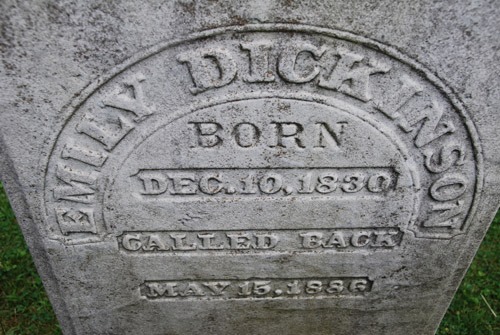
Just suppose that back in the 1920s someone wanted to record a Blues song based on Emily Dickinson’s “A Soul selects her own Society,”  and so they waxed a 78 rpm platter at Paramount records “New York Recording Laboratories,” located back then in, well, Wisconsin.*

If they did, it might sound a little like this.

We offer this sort of nonsense as part of our celebration of National Poetry Month. Then again, maybe it’s not nonsense. Dickinson’s poem does fit into “Old Weird America” and its music shockingly well. Why’s that?

As best as can be determined, Dickinson wrote “A Soul selects her own Society”  during her highly-productive mid-19th century, but for a variety of reasons, this poem, like almost all the other poems that she wrote, wasn’t published until near the end of that century. Somewhat “regularized,” Dickinson’s poetry was bound then into book-length collections that sold well for poetry by an otherwise unknown author, partly due to the myth of her eccentric later-life used as hype for the verse, and because some of her poetry was disarmingly informal and approachable — at least on the surface.

Literary poetry gradually began to take notice of her. I presented Sandburg’s audacious mention of her in 1914 as an “Imagist” earlier this month, and over the course of the 20th century her work has eventually been judged as important as Whitman’s in presaging 20th century Modernism. Now, I daresay that if one was to survey living poets in 21st century America for what 19th century American poet they read, admire, and use as an influence, Dickinson would beat out Whitman — and those two would leave the rest of the field far arrears.

What else happened around the beginning of the 20th century, but took serious critics and culture a while to notice? Afro-American secular music — Blues and Jazz — which would come to significantly define American music internationally and become the dominant strain of our country’s music ever since. Americans were highly important in English language poetic Modernism.** Afro-Americans had their Modernist revolution to offer too, and a great deal was musical in this era.***

So, in another way, this unlikely pairing of Dickinson and Blues isn’t as odd as it seems.

Paramount’s “race records” ads scattered in this video, like other white-owned firms marketing to Black listeners, ran often in Black publications like the Chicago Defender. Outside of these ads, the Defender of the ‘20s largely ignored Blues as problematic. From examples I’ve seen the Paramount ads were less stereotyped than other “race records” companies’. Paramount did hire a Black consultant, Mayo Williams, who may be partly responsible for that.

.

Three ways to hear this performance of speculative fiction: a graphical player is below for a portion of you, but if your way of reading this blog doesn’t show that, this highlighted link will also do the job.  And the new lyric videos we’re doing this month is the third way to hear “Soul Selector Blues.”   Oh — it’s not your speakers or computer — it’s supposed to sound like a Paramount 78 RPM record!

.

*Port Washington Wisconsin to be exact. I’m not entirely sure why Paramount Records wanted to make it sound like it was in New York, perhaps for prestige, and despite the name they had no connection with the motion picture company Paramount either. What was a record company doing in Wisconsin anyway? Well, they made furniture (the upper Midwest was a timber source) and that led them to make cabinets for the new entertainment device, the phonograph. And if they made phonographs, why not seek another income stream from the “software,” the disks to be played on them?

If you choose to view today’s lyric video you’ll see a sampling of how they marketed to Black Americans variously (I can hear the meeting: “Who really knows what they like and will buy…”). High culture to gut-bucket, spirituals to sexual rebels (Ma Rainey’s “Prove It On Me” is about exactly what the illustration on its Paramount ad might lead you to think it was about). They had a pitch for your money and ears.

**Curiously, almost exactly 50 years before the “English Invasion” brought British rock’n’roll bands to the U.S., a small but influential group of Americans were over in England evangelizing poetic Modernism. Were The Beatles payback for Ezra Pound and T. S. Eliot?

***Even literary minded Afro-American writers, critics, and poets weren’t necessarily ahead of the curve in seeing Jazz music and Blues lyrics as an authentic Modernist revitalization of tired-out existing tropes at first. Langston Hughes and Carl Sandburg were exceptions a century ago in seeing this.

We Grow Accustomed to the Dark for National Poetry Month

How has it been this far into National Poetry Month before featuring Emily Dickinson here? Well, no matter, time to get onto that today, as a number of our most popular pieces over the years have been related to Dickinson. Today’s piece is one of my personal favorites, our orchestral setting for her “We Grow Accustomed to the Dark.”

When I did this setting and then its subsequent performance back in 2017 I went intuitively with a contrary reading of this poem. Generally, Dickinson’s poem is read as saying that when we reach a point of uncertainty bordering on no knowledge whatsoever, we may still press ahead, and if we don’t exactly find our way, we may find a  way.*

But that message is delivered in a vivid little parable whose details can undercut that “persevere” moral — and those images’ undercurrent, along with some American cultural dread from that time, led me to make it more dismaying. The sense I was communicating in my music and performance was more at that we may become accustomed to the dark, but that’s not a good thing.

The lyric video

.

If we view this as a poem of voyaging mysticism or stoic perseverance — or if we view it as us no longer noticing that we’ve left the comity of friends and turned our back on knowledge — the poems finest choice in imagery is both odd and comic. Emily Dickinson seems to be something of a Transcendentalist, the insurgent “New Thought” movement of her era, and one that held that the universe’s highest knowledge and truth were to be found in the book of nature. Dickinson’s poem does meet nature partway in: a tree. Such reverence for nature eventually birthed an epithet: “Tree Hugger.” Dickinson doesn’t go with that exactly. How then? You can find out three ways. There’s a graphical player below for some, but for those who don’t see it, this highlighted link will open a backup player in a new tab. And as we’ve been doing during this National Poetry Month, we have a lyric video with a thumbnail picture link to view the video above.

.

* It occurs to me that Dickinson’s “We Grow Accustomed to the Dark”  is in some ways a pair with Robert Frost’s “Stopping by the Woods on a Snowy Evening”  as both are poems about being disoriented in darkness. My parody of “Stopping by the Woods”  was re-released here last week, but if you’d like to see what I did with Frost’s original, here’s a link to that.

Kicking off our celebration of National Poetry Month: Stars Songs Faces

Aha! I have a plan for National Poetry Month.

You might think we’d need do nothing but what we usually do — after all, we’re always celebrating poetry here. We have over 600 pieces you can find in our archives, performances that combine words (mostly poetry) with original music we compose and record ourselves. But here was my problem as April arrived: time to compose new pieces is inconsistently available.

So, I’m going to lean on that collection of pieces we’ve done and make this also a celebration of what the Parlando Project has done over this past 6 years. My plan is to regularly repost pieces from the first half of our history this April. For many of you who joined this Project already in progress these may well be pieces you haven’t heard, but an additional goal is to introduce new listeners to these audio performances.

Why do that? Readership of this blog, originally intended as brief “show notes” for the audio pieces, has grown tremendously over the past year, but the audience for the musical presentations has increased only by a small amount over the same time. I’m hoping to capture more ears for those performances and the poets whose work we interpret, sometimes in surprising ways.

To gather more ears I’m going to be making new low-budget YouTube videos for these classic pieces, mostly just “lyric videos” that display the poet’s words we are presenting. Most new people find us via search engines, and my wild guess is that putting things in front of YouTube searchers may bring more listeners and readers.

To begin this series? Why not use the first piece from this project’s official public launch in 2016: Carl Sandburg’s “Stars Songs Faces.”   Speaking of strange, The LYL Band performed this on January 11th 2016, the day after David Bowie died. Carl Sandburg didn’t have the opportunity to prepare a eulogy for Bowie, since that American poet died in 1967, but back in 1920 he wrote this short evocative poem that we used for the words in this performance. Spookily, Sandburg’s poem presented this way makes it seem like he did write a eulogy for Bowie. And to eerily evoke that short time when both Sandburg and Bowie were extant, the music makes use of one of The Sixties most distinctive sounds: the wobbly Mellotron that could sound like a string section whose batteries were running down.

Sandburg-Bowie

“What will I be believing, and who will connect me with love?” The young Swedish-American and the star with songs and faces.

.

Here’s a link to that simple YouTube lyric video. And here’s a link to just the audio performance if you’d like to rest your eyes. And finally, some of you will see our traditional audio player gadget below, another way to just play the audio.

.

Letting Go the Wolves: I praise Ethna’s wolves

I’ve promised one more piece using texts taken from Irish-American poet Ethna McKiernan, and here it is. There are a couple of reasons why I left this one to the end of this series memorializing her work. The first reason: the poem’s persona seems to speak of her approaching death. The second reason: I don’t know if McKiernan actually liked or rated it as highly as I do. Let me make this plain at the start: I think this is a great poem, and I’ll go into why in just a bit.

I believe I encountered “Wolves”  at the same writer’s group where I heard other work Ethna was working on in draft form.*  These things make my performance today particularly fraught with issues. I only take this step of releasing this performance today because of my admiration for the poem, and my feeling that some out there in the rare and appreciated audience for this Project will welcome it. “Wolves”  has what poetry often hopes for: it is beautiful and yet harrowing, and its experience is vivid while not guarded inside defined borders.

I hear the snow crust crack
into spider-fine antenna lines
with every thudded footbeat. It is so still
that their light scratch of nails on ice
rasps the air like flakes of metal filings.

Let’s grab this text as it grabbed me, even on first hearing, with the opening statement: “I hear the snow crust crack / into spider-fine antenna lines…” The meter has a lope of accents that appeals, the internal rhyme of “fine” and “lines” separated by the chime of the assonant “antenna.” The three strong accents together in “snow crust crack” which allow “crust” to not get the full stress it would normally get appeals and announces. “…with every thudded footbeat. It is so still / that their light scratch of nails on ice / rasps the air like flakes of metal filings.” follows — and if you’re not captured yet by this poem’s story, I can’t think of what language can do to do that.

This opening almost registers as synesthesia, as the sense invoking words rush in. “Snow-crust crack” is visual and auditory together — and for a winter clime resident, you feel that texture in your own feet too. Besides the word-music the visual of “spider-fine antenna lines” has the sense of the spreading broadcast of the wolves’ approach. The ordinary snow-surface footfall of a “thudded footbeat” made by the furry pads of the wolf would be only present in an unnatural silence — and then the quiet but more plausibly audible sound of talons on ice. The shivers of it, nails on blackboard-like, invokes the winter.

ice pond

Listen carefully for those claws on the ice.

.

I could go on, but I think any listener who is pulled in by this opening will sense equally strong lines and images as McKiernan’s poem proceeds. The creative writers in my audience may benefit from analyzing for themselves why they work their attraction on us. There’s an overall effect of intimacy with nature in the midst of this poem: not a passive, uncomplicated, and easily beautiful nature, but one close enough to be (prematurely) incorporated with the poem’s speaker.

The cave mentioned in the poem means that this is almost certainly a persona poem. The voice we hear telling this story is not the literal biography of a modern Irish-American woman who normally lived in cities, yet the astonishingly vivid images lets us doubt this just enough to not judge that outright. Even the most personal and revealing poetry can benefit from real and fantastical lies.

I’ll not explicate the ending outright, for I want you to experience it in the course of the poem’s story. I’ll only say that it could possibly be why McKiernan did not select this poem for wider distribution while she lived. “Twist endings” can cloy or leave a reader/listener feeling tricked, but my judgement says this one only enriches what’s sensed as the description of the poem’s scene has unfolded. Like many a good ending of a great short poem, it may make us want to read/listen to it again immediately.

Before I direct you to my performance of Ethna McKIernan’s masterful “Wolves,”  I’ll leave you with one thought the context of this poem leaves with me beyond the poem’s own effects: what might your art do that you don’t necessarily realize that it can do? For it’s a mystery to me why this wasn’t in a final selected poems. The poem seems to me to be fearless and exact, but the self-editor may have been frightened or dissatisfied.**

A player gadget to play this performance appears below in some ways this blog is read. Others will need to use this highlighted hyperlink to hear it.

.

*Just before I published this post I thought to do a final string-search for the opening lines of this poem — and found that it had indeed been published in The Poetry Ireland Review  of January 1984! This published version uses exactly the text used for this performance, and you can find that text via this online link. That publication date is much earlier than I would have expected it to be. Did I somehow run across it — not as a draft as I recalled inside the Lake Street Writer’s Group — but in a publication that might have been shared with the group?

On publication it was titled “Letting Go the Wolves.”   I had recorded the performance you can hear above  a decade ago thinking the title was only “Wolves.”

Did McKiernan feel it was too immature a work when making final judgements for her final “New &Selected” collection Light Rolling Slowly Backwards  compiled a few months before her death? I don’t judge it so.

**Another, if unlikely, possibility: Ethna may not have secured rights to secondary publication, though the grant of such is traditional within small-press poetry. As much as the wolves in the poem, I may be clambering on top of thin ice in presenting this poem, even though I only want to point out its value. If I haven’t made it clear recently: The Parlando Project is not even a non-profit organization — it’s a no-profit organization.

Oh, Maria

Here’s my performance of another poem from Irish-American poet Ethna McKiernan’s final collection Light Rolling Slowly Backwards.  In McKiernan’s later years of life she did social work with people who were homeless, and she dedicated Light Rolling Slowly Backwards  to “the hundreds of homeless clients I’ve worked with through the years — to their resilience, courage and care for each other.” Given that Ethna was somewhat frail even before her final illness, I marveled at her strength in taking that work on.

I recommend this collection, a fine summation of McKiernan’s poetry and its range. Here’s that link again to the Irish publisher of this book.

Why this one to start reading McKiernan? She herself created this “New & Selected Poems” book before she died late last year.

.

When I first encountered “Oh, Maria”  in draft form as a member of the Lake Street Writers’ Group I couldn’t help but flashback to my time working in Emergency Departments as a young man. As one side-point Ethna’s poem tries to convey the feeling of being next to someone experiencing a sudden, and unexpected death. I’d summarize those memories of mine as being full of intense experience, intent action, and if stabilization isn’t achieved, a solemn ceasing. Ethna’s account adds poignancy because it’s missing that middle part. I ached with her both as she feels guilt for not immediately recognizing the mortal nature of Maria’s incident — and then comes the line as she considers if she should have performed CPR: “If I remembered, God help me, how.”

I probably did my usual awkwardness in responding to that first hearing, perhaps mentioning how it reminded me of my experiences — something which was likely no help in her revision process. I think I did express that her missing the initial diagnosis of what was happening was not only forgivable, but par for the course. Could that have been worthwhile?

Indeed, my experience was that most people, even people who are otherwise medically trained, are likely to get this wrong in some way. Although my experience is now decades ago, I’ve seen CPR being performed on breathing people with a pulse — which is not a good thing. And effective CPR requires a degree of skill and frankly cold intent that is hard to practice outside of repeated actual events. Given that I last worked in an Emergency Department more than 30 years ago, and last went through the practice-with-dummies certification around a dozen years ago, I myself would likely not be the best person to be next to you if you were to experience a cardiac arrest.

If you ever take, or have taken CPR training, pay attention to that first step of assessment.   It’s important.*

So, besides the imperfectly empathic personal reaction I had, this poem’s core matter is Ethna’s continued sharing of the experience of those without homes, which exceeds even my old ER experience with our un or underhoused “regulars.” Notice the subtle point Ethna weaves into this poem: she expects that Maria is severely intoxicated when she collapses, and then she concludes her memories of this person dealing with complex problems imperfectly in the telling line “I laughed at your antics weekly.” What were the antics? Maria might have had a sense of humor, that could be part of it. It’s also possible, even probable, that Maria’s human attempts to deal with the difficult state of homelessness and its context were at times comically imperfect or ineffective.**   Ethna knows this from her intimacy with Maria, just as you know it with those you have in your lives. Intimacy isn’t just the experience of joyous connection, it’s the experience of our misapprehensions too.

Same with poetry. We write it imperfectly, read it imperfectly. That is part of our human experience of it.

To hear my performance of Ethna McKiernan’s “Oh, Maria”  you can use a player gadget if you see it below, or this highlighted hyperlink which will work if you don’t see the player.

.

*Several decades ago a book called The House of God  by Samuel Shem was written that was like unto a modern Machiavelli’s The Prince,  only about practical hospital medical training instead of statecraft. In Shem’s book there is a list of “laws,” one of which is “At a cardiac arrest, the first procedure is to take your own pulse.”

**Dealing with homelessness either as one who has reached that state or, as McKiernan did, as someone trying to mitigate it, is much more difficult than dealing with cardiac arrest. In my couple of decades in Emergency Rooms, I’ll admit that in the course of a shift or two dealing with intractable problems and complexly impossible situations, the “break” of dealing with a crash-cart severe trauma case or a cardiac arrest with their steps of immediate choose/act instants was, strange as it might seem, a relief.

Stones

I’m going to write here a bit, but if you’re in a hurry, I urge you to do two things. The first is to simply listen to today’s audio piece. I think that will reward you. You’ll find a way to play that near the bottom of this post along with my second suggestion.

To a large extent this project adapts other people’s poetry in the process of combining it with music I write and record. Occasionally when I mention this, or when the more general topic of a difference between poetry and song lyrics comes up, there will be objections or distinctions brought forward: those two things (poetry found on the page and words designed to be combined with music) aren’t the same, they’re different.

I’ve written about this here in the past. My conclusions in summary: the thing we call poetry includes a great deal of unlike expressions,*  and many are comfortable with that. Why chop off “song lyrics” as an appendix of non-poetry or not-quite-good-enough poetry? Well, if we do that are we forgetting that poetry across multiple cultures began as an oral presentation almost certainly combined with music? Why would that precedent not mean that literary poetry, however prized and skilled, has failed to sing or express its music explicitly?

So, if I move past those differences between poetry meant for the page and poetry meant for performance with music, and seek to test literary poetry in that context, what do I find? Well, a number of things that seem like problems with musical performance of Modernist page poetry are often less difficult than they seem. Poem doesn’t rhyme? That doesn’t help one memorize for unaided performance, but it’s not really a big deal. Uneven meter or line lengths? Modern musical expression has long slipped the bonds of straight beats or fixed length of melodic lines. One can even up shorter lines with musical elements too.

What is challenging? There are auditory challenges. Texts designed for performance often take into account pronunciation obstacles and allow space for breath. At least for myself there is a general difference in attention between words heard and words read in terms of attention. If a word or image requires one to pause for consideration on the silent page, there is an automatic “pause button” in our consciousness, and this is not so in the ear. The richest literary poetry may overwhelm us when listened to, though performance itself may also illuminate things we would never hear on the page, even after multiple readings.

In the context of today’s piece, let me speak of another issue. Work for performance, such a song lyrics, thrives on repetition, or refrains. Rhyme itself is one of those matters of repetition, even if it’s not required. Refrain draws our attention as it combines with the rest of the performed text, allows us to more fully absorb one part of what is expressed, and combines naturally with musical motifs that also repeat.

When I look through a poetry collection looking for Parlando candidates, the poems that use repetition will often be the ones that seem most suitable for performance — but that said, many pieces I’ve performed here have no refrain, no repeating chorus. Particularly with shorter texts this can still work, but piece after piece of poetry performed without repeating elements seems too much of avoiding that useful thing.

More than 50 years ago, a pioneering rock critic Richard Goldstein, published a book, The Poetry of Rock,  examining the possibility that rock lyrics of that era could be considered as poetry. Despite the title, the book did not wholesale advocate for the conclusion that they were simply poetry. Instead Goldstein noted, as I’ll admit, that these two ways of encountering words lend themselves to different experiences.** One tactic Goldstein decided on when dealing with song refrains in his printed examples to be experienced as literary poetry was to not completely transcribe the refrains in his versions of the lyrics. Instead he might just put them once at the end of the set of words. Making them the final statement on the page gave them emphasis, as repetition in a chorus would, without overwhelming the expression of the verses.

Working the other way, as I will do today, one can reverse this tactic. One can simply repeat a stanza, perhaps the first one, as a chorus, or at the end. Or one can take a line and make it a refrain, as I did with Sheng-Yu’s “Lament”  this fall.

Celtic Ouroboros

The Poetry of Rock? A Celtic representation of the ouroboros. This is a mystical symbol beloved by Jung and alchemists that is often used in graveyards. What does it mean? Thoughts differ, so may I offer one: Death can go kiss its own ass.

.

Did you skip to here? That’s fine.

OK, let’s get to the good stuff: this poem “Stones”  appears in the new poems section of Ethna McKiernan’s Light Rolling Slowly Backwards.  It’s a fine poem on the page, and I highly encourage you to experience more of McKiernan’s work there by buying her book or seeking it out via a library. Here’s the publisher’s link.  That’s the other “ask” I have for you today. But “Stones”  is also a poem of lyric experiences, it calls out to be performed with the context of its implied emotions shared in your ear.

And this I did. Besides presuming unilaterally to do that, I made one other adaptation in the piece for performance’s sake: I took a line in the final stanza and made it a refrain. Because that line is repeated now six extra times, I’m bringing it forward for you to make sure you notice it and its possible meanings.***  I could throw in some more paragraphs about what I considered those possible meanings to be as I performed this beautiful poem, but I’ll not do that today. May your ear link to your heart, and listen with the player gadget below —if your way of viewing this blog shows that — or this highlighted hyperlink otherwise.

.

*”Paradise Lost,” “Tyger,” “We grow accustomed to the dark,”  and “The Red Wheelbarrow”  are all worthy poems we might agree. Are they less different from each other than some random literary poem is from some song lyric?

**I may be repeating myself to say this here in a footnote — but that’s part of why I do the Parlando Project: because I expect you’ll experience the texts differently when you hear them performed with music.

***Did Ethna intend that line, now a refrain, to reflect itself in those meanings? I can’t say, but perhaps not. I, who performed it, intend for those extra meanings to come forward. I completely subverted William Butler Yeats intended meaning in one of his poems this fall. Judge me as you will.

The Men in the Basement

Late last year I promised you’d get to hear some pieces based on the poetry of Ethna McKiernan. I thought about which one to start off with, and decided I’d perform this one for you first. Why? Because it may make you smile.

Regular readers here recently will have caught up with my connection with Ethna: how I heard her read work in progress in a small group of other writers who cycled through each other’s homes each month to do that. You’ll also know that the rest of the group was usually men in its later years.

When we met in Ethna’s our meeting would always start in her little kitchen. We’d stand near her sink and stove and brew up some tea and talk a bit about what happened since we last met, until our remaining writer’s group members accumulated. On one side of that room was the clipping and photo-decorated refrigerator door, a generalized cultural artifact, and on the other side a small table and chair. Her house was a modest South Minneapolis bungalow probably built in the last Twenties, a couple of blocks off of East Lake Street. Comfortable and reasonably roomy with the usual shelves of books in its main-floor rooms and a couple of wandering cats as one might find in a poet’s house. I never saw more than the main floor, but there was a second story up a wooden staircase, and as we shall shortly hear, a basement below. That all said, it seems Ethna wrote and revised mostly in that small kitchen.

Kitchens are a physical metaphor, the site of drudgery and giving, sustenance and routine. If I may gender a floorplan: the most female part of most houses.

South Minneapolis is Tough on Barbies by Heidi Randen

Approximately how some of us feel on winter days. If only there was some help…

.

I remember hearing “The Men in the Basement”  at one of those meetings. Everyone enjoyed it, got it, right off the bat, which was far from a universal reaction to the work we shared. I heard her read it at least once at a public reading, and since it was included in her New and Selected  collection* published just before her death late last year, we can be sure that Ethna herself liked this poem and expected audiences to do so too.

Do women understand this poem more than men do? How the hell should I know, though I suppose some raise themselves to opinions on such matters. I myself found it easy enough for my anima to perform it, though maybe some listeners will find that strange. Again, how the hell should I know? Anyway, given that we all bruise, want, wonder, live together and alone — and sorry, buzzkill for this entertainingly arch poem, we all sicken and die — I don’t find it worthwhile to predict or expect right now.

Musically I made this one an assortment of sounds, and I even worried that I may have over-egged it with the variety, but I’ll limit my predictions to that you’ll enjoy meeting Ethna’s text today. There’s a player gadget below for many of you, but you can also use this highlighted hyperlink where the player isn’t shown to hear it.

.

*That book, Light Rolling Slowly Backwards: New and Selected Poems  is a great summary of McKiernan’s poetry. Here’s a link to the publisher’s listing.