Burying the Poet’s Typewriter

Elegies are a funny business. Your job is to say something about the missing person — the missing and the person — in some combination. I’m personally committed to the short lyric poem, which asks furthermore that one finds short, immediate, and melodious things to stand for a life and loss. Proportions like that risk absurdity. I decided with this piece to run into that risk.

Absurd proportions in elegies can work. I think of Frank O’Hara’s pair of marvelously effective elegies A Step Away from Them”  and The Day Lady Died,”  which spend nearly their entire compressed length talking about the persona and the living activities of the mourner.

Do we expect Bunny Lang or Billie Holiday to rise up and slap O’Hara’s face or utter a sharp remark? “Who cares about your malted or gift shopping, your cracks about Puerto Ricans or African poets. I just died!”

Buy and large, we don’t object. Mundane specifics and little noticings go on after loss for the living. One wonders if the dead (if they have consciousness) miss them as much as the most luminous moments of their lives. And in the end, don’t those little tarrying things mock death most thoroughly?

The performance you can hear below is from last March, live in my studio space with the Dave Moore that’s also in the poem. I continue to tinker with the poem, a few lines or phrases may not be done yet. Go ahead and listen now at the bottom of the post if you’d like to experience the poem and the performance without further discussion from me. The rest of this post is unnecessary to that.

Burying the Poet's Typewriter Cover smaller

Other performances from this session were featured back in March 2022, and are available via our archives

.

The optional part begins here…

This poem is an American Sonnet, which means we hold the truths self-evident that we can change elements of the sonnet form. I wanted to set the opening, as many of Kevin’s poems did, firmly in working-class lives with old cars that work if you know what to do.

Burying the Poet's Typewriter

There are small differences in the above version that post-dates the live performance you can hear below.

.

Stanza two introduces elements of the typewriter in the title obscurely. Even though the title will prepare the most alert readers to what the object is, my expectation is that most readers are not oriented to the world of the poem yet. The typewriter serves as a generalized symbol here, though with a specific in-joke. In Real Life Kevin used a typewriter to present his poems well into this century. We’d gather to discuss work and exchange drafts each month and Kevin would hand us not some variety of computer printed high-resolution pages, but copies made with carbon-paper on his typewriter. I’d sometimes joke: “Kevin, mine’s from down in the stack. Could I have a darker one closer to the top?” All that’s missing from the poem today — except to Kevin’s family and friends who might hear or read it. Kevin’s place was always quite neat, nothing left out and un-put-away, so I don’t think I ever saw his typewriter, but I think it was a later generation electric typewriter. Yet, the one I present in the poem is more OG, one with an open keyboard with exposed metacarpal levers beneath the lettered key tips. Back when I took a typing class we called them “manual typewriters” (as opposed to the electric models that we had just one seat-row of in the classroom) and they metaphorically are our skeletal writing hands within the poem’s second stanza.

Kevin wrote an elegy, included in his final collection “Still Living in Town  for Katie, the incongruous farm-dog poodle that appeared in several poems in that collection. In it, Kevin struggles to bury the dog in frozen farm ground. Kevin’s poem is an Old Yeller-sized tear-jerker in reader effect, but he undercuts it with humor and anger that intensifies that effect. Here too the proportions are absurd, and that poem of Kevin’s has mechanics that are strange if one stops to look at them. I start the third stanza tipping my hat to that poem of his. I do worry that that connection is lost on the casual reader of this single poem of mine, but it may be enough in the self-contained world of the poem that it indicates that if we are burying Kevin’s typewriter we would choose a meaningful place. I’m trying to adjust the balance here between the missing person and the persons doing the missing.

My feeling/judgement/plan is that last line in that stanza works by strange underlayment of associations with several typewriter brands. Even now in the 21st century I fear this may already be footnote material as typewriters recede into history. These brand-names reeled off say this is a “royal” burial, “underwood,” of the mythical messenger Hermes, and finally the Mount of Olives significant to the Abrahamic religions.

Maybe this is a poem for folks my age — or the very diminished audience of those even older. Perhaps they are the only ones who have the shared experience to “Do not ask for whom the return bell tolls…”

Now why did I go through these other few paragraphs here? The planning and intent and selection I talk about is immaterial to the poem as an object. The reader or listener either gets what I put there and left out, or they don’t. I did this partly out of my nearsighted pride in my craft. More than one reader of this has commented “It seems like a dream.” Well, yes, there was imagination involved. Work at writing or any art long enough and your imagination may become trained, and your appreciation of imagination’s useful moments sharpened. But in the end the poem succeeds as an object based on craft. I’m unsure of my level of craft, but I continue to try to use it.

You can hear the LYL Band’s performance of “Burying the Writer’s Typewriter”  with a player below. Don’t see a player?  This highlighted hyperlink will also play it.

.

*Just so that there be no mistake, I admire Frank O’Hara and these two poems. And if you’ve got a moment, follow the hyperlink for “A Step Away from Them”  as it leads to a nice short appreciation of that poem by Rod Padgett.

To Whom It May Concern (Carry Them Away)

I’ve mentioned previously that our poetic colleague Kevin FitzPatrick, who died last autumn, often wrote poems about work. Here’s one of them from his book Rush Hour.  Kevin titled his poem “To Whom It May Concern,”  and in performance I took a line from the poem and recast it as a refrain, which you’ll see as the subtitle today.

Dave Moore and I attended the memorial service held for Kevin at the end of last month. It was organized by Kevin’s large and talented family, many of whom I only knew as their player-shadows in Kevin’s poems, and many of his family read favorite poems of their relative at the memorial. It seems that Kevin, who was decidedly analog and offline well into this century, would often send them copies of his work in letters mailed across town. Some of them read their pieces after unfolding them from inside their original envelopes.

I’ve been online since online meant wire phone lines. I ran a BBS, I used Gopher, FTP, Usenet, but I found this charming as I listened to their stories in 2022. Typed poems sent in paper envelopes, still bearing cancelled stamps. Poems read by “civilians” recognizably about parts of their own lives. A man whose poetry was generous with “other people’s stories.”

I know many of you are in various parts of the US, or in other countries around the globe. Kevin didn’t “tour” his poetry, and though he often read publicly in the Twin Cities area, his poetry collections were not available other than by being specially ordered through a local bookstore.* You can still do that, but I’m happy to also mention that his family have recently made the books available online via their own website: kevinfitzpatrickpoetry.com. This makes it easy for you to get a copy of Still Living In Town  or one of the earlier collections.

A good picture of Kevin from that web site where one can order his books.

.

Now, back to that memorial. Dave gave a fine summary of Kevin’s work on the Lake Street Review magazine at the event. I had asked the organizers to read one of Kevin’s poems. They asked me which one, and I said “Timepiece.”

“That one’s already taken…” which didn’t surprise me. It’s a touching poem, and in writing about his father’s death, Kevin wrote well about the shared underground of grief connecting all losses. No problem.** I suggested instead the short poem you’re going to get to hear a performance of today “To Whom It May Concern.”

I warned her: I sing that poem. “Warning, why?” you may ask. I was largely warning and committing myself at the same time. To say the least, I’m an inconsistent vocalist, and if one was to listen to a great many of the pieces here you’ll see how often I eschew actual singing — and some examples where perhaps I should have more consistently done that. Still, “To Whom It May Concern”  is a story that askes to be sung. And in the folk music tradition that means you’re obligated to sing it regardless of your American Idol candidacy. For logical and cultural reasons*** I decided to increase my own fear factor: I would sing it unaccompanied.

I practiced singing it while riding my bicycle for a few days before the event. Then, just to see if I could at least keep to a level of performance that wouldn’t take away from the event’s focus on Kevin, I recorded two takes**** of me singing it unaccompanied in my studio space.

The day of the event, I got on stage, I softly tried to find a note by singing the phrase with the highest note under my breath and launched into Kevin’s poem. How’d I do? Folks were kind. I myself had no sense whatsoever. That’s one of my problems with live singing: I can’t really “hear myself” well while singing even with monitors or headphones. Even more oddly I had no memory at all of singing the majority of the 2nd stanza. I’d guess I did, but by that point I was thinking of the poem’s speaker and the bard that wrote down their story, and that was all I could remember.

Today’s version of “To Whom It May Concern (Carry Them Away)”  starts out with that first proof-of-concept take in my studio space and then segues into a recorded live performance with Dave and some guitar accompaniment. There’s a player below to hear that, and if you don’t see the player, this highlighted link is another way to playback this audio piece.

.

*The web site’s listing of Kevin’s books include the titles and ISBN numbers of the collections that may help at a bookstore or when requesting at a library.

**Dave and I had performed “Timepiece”  long ago, shortly after it was written, so you can easily hear our take on that poem via this link.

***Irish and British Isles singing in general has a strong tradition of unaccompanied singing of songs. The modern scheme of accompanying singing of folk songs with guitar accompaniment was actually resisted as untraditional, at least at first. Logistically it just seemed like carrying a guitar around would get in the way of the event’s focus.

****I’d actually planned to record only one take, which I thought better as the public performance would be just that: getting up and singing. Recordists get the luxury of working into the performance with several takes, and live performers don’t. The second take was no better than the first. Oddly enough, that was comforting.

Enjoying Flowers Walking Alone

I mentioned earlier this spring, that master classical Chinese poet Du Fu wrote in a troubled era that also troubled his life. Both he and his contemporary poet Li Po were exiled or forced to flee at times, and while I know no details of this poem, I get an exile sense from it somehow.

Have I mistaken this poem? It’s possible. To say I’m no expert on Chinese history, culture, and literature, is to greatly understate the concern one should have. On one level it seems to be a nature poem, set in spring with tree blossoms and flowers. The poem’s speaker walks out among them one morning and notes how extravagant their splendor is.

American nature poetry, such as Emily Dickinson’s, is often suffused with Transcendentalism and a sense that the book of nature presents truths to a close observer. It’s in that sense that I read this poem. The speaker (I’ll just call him Du Fu for the rest of this) is letting the wind (nature, fate) carry him on a path. He notes that the peach trees are blossoming, though no one owns them. No boss, no lord, no slave master, has sent the requirements for this work. Du Fu observing them wonders if he should prefer one shade of blossoms to another, and decides choice is beside the point.

Nor is there any need for an accounting and report of the number of petals that cover his path. They are not losses to be put on a balance sheet, for the trees simply have “more blossoms than they can hold.”

The concluding two lines have my greatest leap of faith or invention from the literal English gloss that I worked with. If, as I sense, this may be the poem of someone fleeing trouble or in exile, this beautiful morning presents a bittersweet scene. Should he simply stay and revel like the butterflies? I sense the final line’s “free and unrestrained” oriole bird is a contrast to that. That bird has choice. It, like Du Fu, can leave. That freedom, to flee beauty, is not a simple thing.

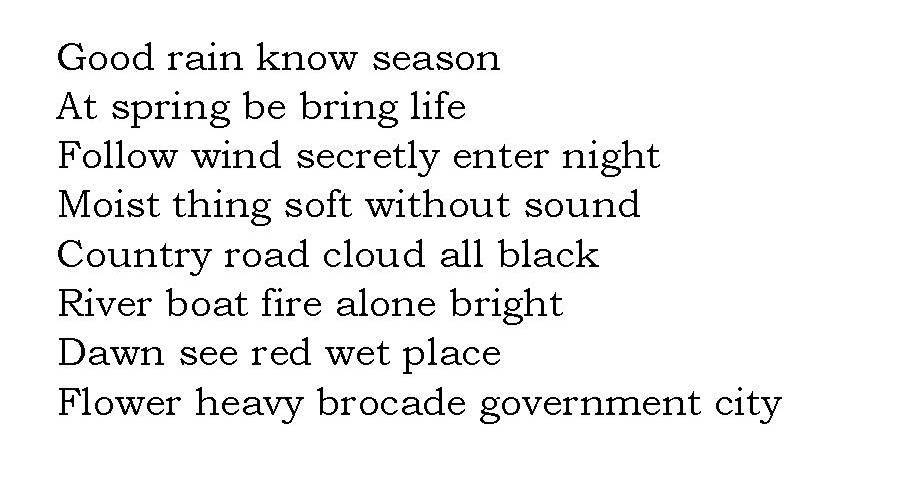
Here’s the text for today’s performance that I adapted from Du Fu’s Chinese poem using a literal gloss in English. All I had were two portions (#5 and #6) of what is apparently a longer poem or series:

Enjoying Flowers Walking Alone

.

Here’s what that gloss had:

Huang abbot pagoda before river water east
Spring bright lazy sleepy rely on light wind
Peach blossom one clump open without owner
Lovely deep red love light red

Huangsi girl house flowers fill path
Thousand blossom ten thousand blossom press branch low
Reluctant to leave play butterfly constantly dance
Free and unrestrained lovely oriole cry

The music today features an acoustic guitar that doesn’t harmonically move much with a root note of D. While an actual D minor chord is sounded at times, much of the music stays on suspended chords without a major or minor defining 3rd. At one point I’m fretting an F and F# at the same time which somehow works to my ear in this song’s mood. You can hear the performance with a player that appears below for many of you. Don’t see a player?  This highlighted link is an alternative way to hear it.


Dickinson’s “Bloom”

If I didn’t read the news, it would still be spring.

I’ve mentioned it’s been hard to produce new pieces here recently. While there’s a variety of reasons for this, here’s one: I’d planned a little series on May flowers. I was inspired by my wife’s love for our native northland wildflowers and some gorgeous photographs of cactus blossoms by Kenne Turner that I recently viewed on his blog. I had this witty little poem by Emily Dickinson with a not so obscure moral underneath about being an artist — Emerson with a dose of playfulness. I’d completed composing the tune for it. And I planned to pair that Dickinson with a couple of poems by the master of Chinese classical poetry Du Fu.

But I was only halfway there in how captured I was by transient beauty. Earlier this spring on my morning bike ride I started to mull over this line that hasn’t found its poem yet: “This spring is filled with bird-songs and the death of young black men.” So, the horrible and the hortatory were already mixing in my thoughts, while I have nothing but good will and empathy to claim there.

Everyday I try to will myself to make useful or pleasurable work toward this project, and this, among other things, makes me pause. Am I missing the point? Do I even know what the point is, or the series of points that lead to it? I feel bad for the limits of what I can offer, and then I feel bad for not offering that little. Still, I’m stubborn with this. I keep butting against it, trying to push it over or trick my way around it.

And Tuesday I did. Starting early, I recorded an acceptable performance of the Dickinson poem with my music, worked on music for the Du Fu flower poems, and practiced my understanding of how to perform a poem of Kevin FitzPatrick’s that I will present at a memorial event this weekend. A good day it seemed, even if I missed the day’s near-perfect spring weather outside — never mind, the internal weather of being able to create, to illuminate for myself and perhaps for others the work of Dickinson, Du Fu, and Kevin was pleasant and enough.

Never mind, as I got ready to go to bed after this fruitful day, and I caught the news of another rain of bullets. Grade-school kids!

Should I have something appropriate to say, something useful about that? The horrible and the hortatory. Something that isn’t so entirely obvious to some and beside the point to others? Long time readers here will know one motto I have here: “All artists fail.” I’m certainly failing here for some today.

So, you’re going to hear me perform this little poem about flowers, about the work that goes into making mere transient beauty. Here’s a link to the text I used today if you’d like to read along. Dickinson judges right off that she’s sure this isn’t some “minor circumstance.” And Dickinson would know. She knew her flowers, wild and cultivated, intimately.* She was a serious gardener of food and flowers, and despite her growing reputation for being some secular nun always in cloister, she purposely chose that outdoor work with plants over other household chores. She knew their use for food, she knew their use for transient beauty. Flour and flowers.

Her little poem goes on, and the little bud fights several ways for survival. I love the litigious line she uses in passing that she may have borrowed from her male family’s life as lawyers “Obtain its right of dew.”

Prowling Bee by Heidi Randen

A prowling bee “Assisting in the Bright Affair so intricately done…”

.

My dear wife left me on the rise to her job with a hug this morning, wishing me success in being creative today. Was she being a “prowling bee?” If so, as another bard had it, “Sail on my little honey bee, sail on.”

To fail in art, as with Dickinson’s final judgement on our flower that blooms past bud, is a “Profound Responsibility.” If you’re working on art this spring, I’m not asking you to fail, or to be happy with failure — at least I never am. This spring is full of bird song and dead people, the lightness of flower petals laid on us are a suffocating “heavy brocade” as Du Fu had it in a poem of his, one I was able to complete a performance of. All I know and can tell you is how that feels.

To hear my musical performance of Dickinson’s  “Bloom” (Bloom — is Result — to meet a Flower)  you can use the audio player you may see just below, or if you don’t see the player, through this alternative highlighted link.

.

*As I mulled over this poem’s presentation, I was reminded of how seriously Dickinson took her connection with gardens and flowers by Twila Newey musing on Twitter that Dickinson’s mature aversion to publishing could have been the result of her individual conviction that transient and intimate beauty, as in her garden, was sufficient, or even superior to a wider advertisement fixed in type.

Rain on a Spring Night (after Du Fu)

Early this week, Poet Jose Hernandez Diaz on Twitter put out a call for people to respond with their go-to poets in our troubled times. I’m always uneasy when being put on the spot for short-lists, because I’m by nature a person of various moods and needs. The poet I need today is not always the one I need tomorrow. And then, it’s the same or even more so with music for me. Perhaps some of that comes through here in this project’s variety?

Two names surprised me* as I tapped in the poet names that came to my mind that day this month: Edward Thomas and Du Fu. We’ve dealt with Thomas here more recently, so today I’ll speak of Du Fu.**

Two things seem to connect me to this master of classical Chinese poetry: Du Fu wrote his best work as an old man (such as I am) — and that productive period coincided with a great governmental rebellion and crisis in China. When Du Fu writes a lovely nature passage, I always read it as the work of someone who is also seeing great destruction and violence in the human part of nature.

Du Fu, not an Asian-American, but his poetry sometimes speaks to my country none-the-less.

.

In this troubled week I went looking for a poem I could get close to and perform, and I found this one of Du Fu’s. For practical reasons, I need to make my own translations of Du Fu from English language glosses (such as the ones found at Chinese-poems.com) and the difficulties of making a graceful poem in English out of an 8th century Chinese poem would seem daunting, but they attract me all the more. Obviously, there are great risks that I will misunderstand what Du Fu is trying to say — but not only do I accept those risks, I’ve been tempted more than once to transform key images from Du Fu’s time and place to contemporary America. For these reasons most of my Du Fu pieces should be understood as adaptations, the kind of thing that I’ve decided are best labeled as “After a poem by….”***

Here’s the English gloss of the Chinese I worked from, and for comparison here’s a link to another person’s English language translation.

gloss rain

This is the gloss I worked from for today’s piece.

.

And here’s my “Rain on a Spring Night (after Du Fu)”  version used for today’s performance:

Rain on a Spring Night by Frank Hudson

I usually would work longer on one of these, but it’s been too long since I presented new work here.

I think of my opening section as a good faith attempt at an accurate translation into a working English poem. I used English syntax and conventions, added the poetic device of parallelism to substitute for the word-music losses inherent to translation, and tried, as I always do, to present vivid images.

The last section of Du Fu’s poem is where I likely diverge. I do sense a turn in the poem at this point, I think it’s possible Du Fu’s trying to contrast the peaceful rain following nature’s order in his opening. The (cooking? signal? lantern?) fire on the boat is the only human sign in the poem. Is that only coincidental decoration? The gloss’ final line is most difficult. A single image there comes through to me: that flowers, perhaps even fallen blossoms, are like the patterns on a brocade fabric. “Government city” puzzles. Like brocade on rich courtiers? Or is this spring morning near a capitol city?

So, my choice was to allude, somewhat obliquely as Du Fu seems to have done, and the final scene is designed to depict not peaceful spring and beneficent rain, but the aftermath of violence as we all to well know it now and here: the yellow crime scene tape, the flower memorials left. A rain of bullets is not a good rain.

My music and performance is very sparse for this, but I decided that’s starkness was effective. You can hear the performance with a player some will see below, or with this highlighted link.

.

*I wouldn’t even have known their names, much less their poetry or something of their lives before starting this Project six years ago.

**I have to note his name was often spelled in the western alphabet as Tu Fu. Du Fu is supposed to be the better approximation, even though there are as many or more references to him as Tu Fu online or in books.

***I was aware of that sort of classification, but it was poet Robert Okaji (who has also produced graceful work in English from classical Chinese poems) who cinched down that tactic for me. Another thing that informed my practice here is my love for “the folk process” transformations that folk music lyrics go through. In that latter example, a tale of an unfortunate British Isles rake easily becomes the tale of a dying cowboy on the streets of Laredo Texas, or a run-of-the-mill elusive bad-boy-robber ballad gets pared down by a colonial subject whose nation has been dehumanized into the tale of a shape-shifting were-fox.

William Blake’s “The Tyger”

It seemed a long time since I last had a new performance to share. I checked, and found it’d only been a week, but since then the moon has had a red eclipse, and in my country there’s been a couple of mass shootings motivated by ignorant ethnic hatreds. Willful ignorance combined with violence is particularly ugly, and presently a state-leader with missiles and bigger guns wants to kill to impress too.

I’ve completed no new pieces. I tried to start two, but so far nothing is developing. So today I thought I’d present this new-to-you performance of William Blake’s “The Tyger,”  mostly because it’s pretty good and I don’t have anything else ready. I made that decision this morning, and then I suddenly realized that “The Tyger,”  a poem first published in 1794 by a mystical Englishman, has turned just about right for this ominous spring and our current year.

Over 40 years ago, I was in bed and my partner asked me how I could account for the presence in the world of evil.*   Strange place and time for that question — for in that moment I was more impressed with beauty and joy. I stumbled for my answer: good was always present in the universe, and always powerful enough to overcome evil — but not always both at the same point. Alas, “not always” is more painful than it sounds to nakedly say.

Visionary poet William Blake asked that question too. Blake was born into a family of religious dissenters and progressed to rebel even further from Christian dogma. He intuited a moral universe where evil was caused by over-justified powers of the creator. Interesting thought that. In “The Tyger”  poet Blake asks a manifestation of terrible predatory power a series of rhetorical questions, meaning to direct our thoughts in the direction of his conclusion.

Now, to get to my performance of Blake’s poem, we need to make a jump cut. Ready?

Year of the Tyger

Year of the Tyger, three times.

.

In what’s usually called the Chinese zodiac, years go through a 12 year cycle. I wrote this musical setting for a video of an event in 2010 tied to the Chinese Year of the Tiger. In order to extend the length of performance to the length needed for the video, I refrained Blake’s “Tyger Tyger burning bright” stanza after every verse, a tactic which makes it longer than I’d like it to be today. As it turned out, the video ran longer than planned, and I needed to cross-fade even my lengthened “Tyger”  with another piece then for the final cut of the video. Given how long ago the recording was done, I only have that completed mix from the video’s soundtrack, so “The Tyger”  I present today ends on the start of that cross-fade.

The “Chinese Zodiac” progresses, and as it goes we’ve once again come to the Year of the Tiger in 2022. I think this performance from the previous Year of the Tiger retains its power and so I present it to you now.** There’s an audio player gadget below that will play it for many of you, and where that’s absent, here’s a highlighted link that’s an alternative way to play it.

.

*This all seems way too Leonard Cohen doesn’t it? No, it actually happened like that.

**I often find I have one more question as I think I’ve finished a post. This time, I asked myself, what year in the Zodiac cycle was Blake’s 1794? Why, another Year of the Tiger of course.

It’s been hard to complete new work recently, so “Anglers” for Minnesota’s Sport Fishing Opener day.

The world of this poem is scribed with the understanding that when you’re on a lake’s surface you are at the boundary level of two worlds. Like unto angels in Medieval drawings, those fishing are pulling the fish from the aqueous world into the sky world, and I often felt I could sense the hooked fish’s wonder and distress. “Who are these scale-less giants unconcerned by gaseous air?” This poem is called “Anglers.”

Meanwhile, back in Chicago, the Yip Abides blog and rmichaelroman caught this wall painting in 2009. Whimsey aside, the very fish the anglers are seeking to catch in Minnesota today are spending their day trying to catch other fish.

.

It’s unsaid in the poem, but I was in the boat described. I didn’t put myself there because I wanted to focus the reader’s attention on the two brothers and yes, on the fish. There are other undercurrents that I think I kept out of the poem, and someday should make at least one other fishing boat poem. If any in this blogs’ diverse readership reads this before or after getting in a boat and wetting a line, net, or spear, the poem asks you to consider this if you like to think on the water and not just chum with talk: you are frighteningly miraculous.*  Don’t let it give you a big head or anything. There are angler forces without skin on another level above our surface.

My grandfather’s actual Johnson Seahorse outboard motor mentioned in the poem

.

I recall that the more published and noticed members of my little writer’s group Kevin FitzPatrick and Ethna McKiernan were not particularly satisfied as readers/listeners of this poem in an earlier version, and I may have made a couple of changes based on that in the version you can hear today. I think they may have been puzzled or unimpressed** by the pun at the heart of the title: that on the flat surface of the lake, the “anglers” are the highest upward length of a right-angle to the water surface, the sharpest break vertical the fish would ever experience. And then there’s the even more obscure eye-rhyme-ish pun of anglers and angels. Neither of them cared much for puns, while Dave Moore and I indulged generously, enough to wrinkle the other half of the group’s noses.

Now Kevin and Ethna have been, like the fish, also pulled through the surface, and today there’s a church-based memorial service for Ethna which I don’t think I will be attending, though I’m glad to have attended a poetry-centered one for her earlier this year, and I’m planning to attend the poet-focused one for Kevin later this May.  In lieu of today’s service attendance, and out of guilt from my absence, I’ll say that if their skin-less existence is in wonder and distress, that my thoughts go with them, and in my dim watery existence here I ask us on all our levels to turn our circle-eyes toward wonder.

And I know too there are practical voices in the fishing opener today. “That’s what I get for getting into a fishing boat with a poet. Such high-flown thoughts! Damnit. I’m trying to get a worm on this rig’s hook. We feed worms to fish, and then well, we feed worms.”

If you’d like to hear my performance of my own poem “Anglers”  there’s an audio player gadget below this for many of you, and for those who can’t see that, this highlighted link  will open an audio player  for it in a new tab. My music for this uses what I often call my “punk rock orchestration.” I use very simple orchestral instrument colors both because I lack the knowledge/skill to do more complex ones and because I think there’s a direct charm remaining and being featured by stripping that sound down.

.

*Ah, footnotes, the sinker-weighed lures bobbling along near the bottom! No, I’m not out fishing today, or most any days in this part of my life, though I think about my hours of fishing as a young person. I always considered the fish though, a little to a lot. One thing’s simple though: every poet wants to be miraculous.

**When a poem or poet doesn’t “hook” us, these two feelings can be cause and effect in either order.

Edward Thomas’ “Cock-Crow” cleaves the wood of thoughts that grows by night

A lot of these performances begin somewhat randomly. Oh, Edward Thomas isn’t random, I’ve enjoyed exploring this British writer with you since I first ran into his connection with Robert Frost in the years just before WWI. Was I looking for a poem considering a particular subject or event? One could see today’s piece, “Cock-Crow”  as a spring poem. Well, spring is  random, the current one where I live more so than most. but I wasn’t looking for a spring poem so much as I wanted to find someone else to present from the early 20th century.

I picked up a poetry anthology from 1929. It’s titled 20th Century Poetry,  which would be audacious for a book published a little more than a quarter of the way in, but the editors were aware of that and they rightly note that their century milepost had marked a noticeable change in poetic expression.*

It starts with selections from 50 British Isles poets. Names you might expect are there: Yeats, Hardy, Houseman, De La Mare, Masefield, and so on. A couple of distinctive British women poets you may recall from posts here too: Charlotte Mew, Frances Cornford.

It’s to be expected, given that 1929-to-now allows plenty of shelf-life for poet’s readership and notice to expire, and because Britain and the United States do not share a completely unified poetic canon, that there are a good number of “Who?” names there too: Edmund Gosse, William Watson, Henry Newbolt, Clifford Bax, and Edward Shanks.

It may have been my mood, but though I would have loved to find a little-known poem I thought would be interesting to perform there, much of it was quite dreary as I skimmed through it. The copy I was reading was a library scan, and these books sometimes have interesting marginalia. In my boredom, I examined the library stamp:

Fort Huachuca stamp

.

I wondered where Fort Huachuca was, and what would be going on there between the World Wars? Turns out it’s near the Mexican border in Arizona. It was a military facility since Western Frontier times, and it was the base for a “Buffalo Soldiers” Afro-American Calvary Regiment. Just before America’s entry into WWI, the base commander was Charles Young, the Black officer that was the subject of this poetic tribute by Countee Cullen that I presented here last year. So, as I wandered off from the poems themselves, an interesting place for this poetry anthology to reside — even more so when I glanced at the Wikipedia list of the notable people who had been there over the years. That list includes Jayne Cortez a Black Arts Movement poet and (out)spoken-word performer who was born while her father was stationed there. She’d have been too young when she left Fort Huachuca to have read this anthology, but the momentary thought that perhaps her parents had read this volume I was scanning was more intriguing than many of the British poems — or at least it seemed to me reading through it in the middle of a 21st century night.

The editor** is faint-praise in his introductory note to Edward Thomas in his anthology, calling him accurately (but misleadingly) a “commencing poet” and saying that Thomas’ poetry “comes from a very shy and personal mood that sometimes seems to lack variety if we bear it company for long at a time.” He oddly concludes Thomas’ “Invention made no parade of vigour, but he borrowed hints from no one.” Gee, Johnny Editor, it’s the middle of my American night and a lot of the early 20th century British poets you’re presenting are boring me to the point I can’t get to sleep with their all-too-unoriginal “vigour” — an odd effect which I attribute to my hopefulness of discovery — but I’ll take Thomas’ originality thank you.

“Cock-Crow”  is a little 8-line poem describing awakening from disturbing or unresolved dream-sleep, or lack of it, to a set of chickens — not hanging out round a New Jersey wheelbarrow, but amusing Thomas with the bird-pair’s face-to-face rural dramatization of a veddy British heraldic motif. Is Thomas simply smiling at that coat-of-arms likeness, or is there a resonance toward Britain’s more overt class structure?

Heralds of Spendor

“Heralds of splendour’ he says of us! That’s about right. Lions’ll  go and eat you, and unicorns don’t even bother existing.”

.

The charm of this poem is that Thomas acknowledges the unsettling “wood of thoughts that grows by night”*** yet allows them to be chopped down by bird-song — and transcendental bird song is ever-present in Thomas’ poetry. And what revelation does that song bring? Farm workers putting their boots on and getting to work. So. Much. Depends. Upon. Putting your boots on and getting to work. Want to read the text while listening? Here’s a link.

Musically I started with a simple folk-guitar accompaniment, though I tried to be settled and unsettled with the harmonic cadence in this one. I ended it with a minute-long coda where I used a vocal chorus to spread out across the English countryside like all the birds of spring. Why do I do these audio pieces? Because I want to hear them —  and you can to. You can use the player that appears below, or this highlighted link in the player’s absence.

.

*We’re approaching a similar milepost in the 21st century. Can we say that English-language poetry has significantly changed since 2001? You might say “We’ll know later what we can’t see now in the midst of things.” But the editors of this book were in the midst, and yet thought they could see something distinct in their new quarter-century.

**John Drinkwater for the anthology’s British half.

***Whose woods these are, I think he knows. Thomas led a troubled life. Every peaceful British rural scene in a Thomas poem is set next to that dark woods of thought that grows by night.

Willie Mays, and my April poetry adventure

This is going to be a sort of catch-all post following up on a variety of things. And speaking of catch-all, it’s Willie Mays’ birthday today,* and at the end there’s a recording of an early LYL Band performance of a Dave Moore song celebrating the great center-fielder.

I want to start off by saying that I plan to write something regarding the welcome and thoughtful response about translation Teresa Pelka left here a couple of weeks ago. Hope to have that here soon.

Next, I want to thank those of you who stuck with the experiment/new thing during April Poetry Month where I did daily posts which included some of my favorite pieces from the early years of the Parlando Project with short new accounts of how I view them in 2022. Many of my regular readers/listeners hadn’t heard some of those early pieces. On the other hand, I worried too that that much posting, that many audio pieces, could overwhelm some people.

I’m up to around April 25th in catching up with the blogs I usually follow. I’m too often a week or two behind, but I missed all of your own posts in my being “away” for National Poetry Month on my adventure.

Besides the “classic pieces from the early years” posts I did two other different things this April. The most easily noticed one was the lyric videos. I had noted that my teenager does a fair amount of searching for topics inside of YouTube itself, and sometimes follows algorithm suggestions for other videos, and since a large part of the readership of blog posts here comes from general search engines, I wanted to see if the YouTube audience might bring some new eyes and ears to this.

Did that work? Hard to say. YouTube analytics say that I didn’t get to a thousand views in the month, but I doubt they count the views of the embedded videos in the blog posts.** The most popular video as far as YouTube counts was Yeats’ “He Wishes for the Cloths of Heaven”  at just 33 views, but the effort may have a long tail, as some older videos of mine have slowly picked up views over the years. Having 30 videos of various kinds of poetry and music on YouTube at least gives something of a representation of what the Parlando Project does for those who happen upon it.

I thought I could knock off the lyric videos quickly. “It’s just a lyric video” I’d tell myself, but I kept getting interested in the limited toolset of the software I was using*** and wondering how this or that could be used. And I started wanting to include more and more relevant pictures behind the lyrics after the first couple of them, which led to rapid but extensive searches for pictures. One thing I feel bad about: I don’t have my wife’s photos (the better digital photographer in the family), or even my own, handy for quick search and retrieval, so I ended up under time pressure sometimes using other people’s work without giving the photographer their due credit. Photographers in my audience: my apologies to your art, and if I ever do successive lyric videos expect to see credits.

The less noticeable thing I tried — and that less-noticeable result was particularly disappointing — was that I became Twitter-active during April. I tweeted multiple times many days, and tried promoting the pieces with tweets embedding the blog post link and/or the video. Neither link drove any traffic to speak of. With YouTube the views on Twitter may have been invisible, but the WordPress blog post analytics tell me if someone read a post via a tweet link, and I don’t think I got into double digits for the whole month. The tweets themselves didn’t take as much time as the videos of course, but that wasn’t all. During the month I also monitored #NationalPoetryMonth hashtag tweets — reading many, liking those that gave me something I appreciated, replying to some that I thought I had something to say about, and at least skim-glancing the rest. That this was humanly possible to do says something about how skimpy the Twitter National Poetry Month traffic was by Internet standards. Yes, hundreds of #NationalPoetryMonth tweets a day, but I also monitored three “Day” events during April: Arbor Day, Anzac Day, and International Jazz Day. If Arbor Day swamps the number of tweets over National Poetry Month traffic that tells you something (Anzac Day was even heavier, I couldn’t even skim there were so many).

I think Twitter works if you already have a large circle of acquaintances and want to keep them at least minimally engaged, but I can’t say that it works well to grow that circle. I wasn’t the only one sincerely trying to promote poetry on Twitter in April, and it’s possible I wasn’t the best at it, but from watching not just myself but the others using the #NationalPoetryMonth hashtag, I’d say Twitter was non-rewarding in promoting poetry via #NationalPoetryMonth.

I probably worked full time every day of April on these things, part for the adventure (which I received) and part to grow the audience for poetry and this Project (results mixed, some may be yet to come).

Well, I promised Willie Mays, and you shall get him in the person of Dave Moore’s exuberant piece from the middle 1980s recorded with Radio Shack microphones and battery powered mixer, a cassette tape recorder, and drums via me pounding on a four-pad Mattel Synsonics Drums electronic drum toy from the era. How did I play the drums and the guitar on this? I would pound out the beat and record it onto a second tape recorder first, and then press play while the rest of the band joined in with their parts. Dave’s on keys, and the bass player is Dean Seal.


Something this very short clip doesn’t show you. There were 2 men on base. You see Mays throwing the ball after the catch from that deep a center field and it was fast and on target to the 2nd baseman. The opposition batter who hit that didn’t even get a sac fly RBI out of it!

.

I “remastered” this this morning from a stereo digital file I took from the cassette 20 years ago, but there’s only so much help I can give it. I like the way Dave tells the story though, and maybe you will too. Player gadget below where it can be seen, and this backup highlighted link for others.

.

*Experience has taught me that baseball-related posts here get a very low interest. I understand somewhat — my interest in the game has dropped since my youth too. Still, Willie Mays was a baseball hero of my youth, and he was a very good centerfielder who could hit, run, and go and catch the ball in the strangely elongated center field of the New York Giant’s Polo Grounds stadium. Shaped like a very deep U, the deepest part of center field was nearly 500 feet from home plate, and the gaps a “mere” 450 feet or so.  “Two-thirds of the earth is covered with water. The rest is covered by Willie Mays in center field.” Oh, and a super-tangential link to the name-alike baseball player to poet Ray Dandridge we featured last month: Ray Dandridge the baseball player played for the NY Giants high minor league team in Minneapolis for several years. One of the young Afro-American players he took under his wing: Willie Mays.

**It doesn’t appear the count includes views of the embedded videos you saw inside the blog posts here, and if you’re like me that’s how you view the videos in web posts, because viewing them on YouTube itself means you have to sit through at least the start of an ad or two in many cases.

***I started using Windows Movie Maker, which is slow, a bit buggy, and has been unsupported for several years now. I moved over to Apple’s iMovie on the Mac, the latest version of supported software from a huge company that is supposed to be very aligned with art and artist’s needs. I found it indistinguishable from iMovie versions of several years back, incredibly simplistic and simpleminded in how it treats text and typography, and yet because it was running on a nearly decade newer computer than my Windows desktop, faster and more responsive — and I found I needed that doing a video a day along with everything else. One other thing it became fast at during April: complete and utter lock ups of the Mac that would be followed seconds to a couple of minutes later by an unbidden computer reboot. This would happen when editing/creating pieces, particularly when I was trying to work rapidly, and other times when rendering the video. This was very frustrating, and I can’t understand how a company with Apple’s resources would produce application software running on its own operating system on its own hardware that could produce a crash of the entire system and an unbidden reboot  like I was some 1990’s computer. Bizarre. If you ever find yourself in this kind of iMovie situation, the old “dumping prefs” thing seemed to help, and I went to a planned reboot before every render by the last half of the month.

“Oh Me! Oh Life!” Walt Whitman’s de profundis poem performed

I saw this Whitman poem from the 1867 version of Leaves of Grass  during National Poetry Month but was unable to find the time to compose the music and arrange a performance during that busy month. Still, I was so stunned by its expression that I made a note to myself to get to it after April.

This week I did just that.

The de profundis poem is a fairly common poetic trope, up there with the aubade and the elegy in examples. It takes its name from the opening words of the Latin version of the Hebrew psalm 130, but it’s not a mode we often associate with Whitman. Whitman, with all his talk of containing multitudes and nonchalantly harboring his contradictions has a personal poetic voice associated with an unashamed and near-boasting manner, a self-portrayal as an example of an unafraid and unbounded life-force.

Why would he write such a poem then? Well, he did want to portray everything human, which would include doubt and failure, it could just be that. But let’s consider something else about Whitman. When this poem was written he’d been working for more than a decade on creating a poetry that was unprecedented: not just free in its subject matter, but “free verse” without fixed meter and rhyme. There were next-to-no models for that form then. Yet, if one was to go this week to a good bookstore, move to its poetry section, and then open any volume of contemporary poetry to a random page, the odds are you’ll find an unrhymed poem, rhythmic perhaps, but not likely in strict meter with unvarying beat-count line-lengths. That poem may not sound like Whitman, but the path to make its own sound can be traced to him.

Back in the middle of the 19th century, in an America which was just getting its poetic feet planted, and still in the process of proving it could write as well as the Europeans in the way the European’s wrote, there wasn’t any call for this. Isn’t it remarkable then, that this carpenter’s son and peripatetic journalist in a place so far off the cultural centers of the western world went and did this!

When Whitman wrote this poem America had just emerged from a great civil war. I’ve said here that WWI, a similar trauma for Britain and Europe, made from its breaking of nations a plausible opening for Modernist poetry. But in post-Civil War America, Whitman’s break didn’t quite take, even though Whitman would include free-verse poems about that war in this edition of Leaves of Grass.

Ah, but there was one Civil War poem in Whitman’s 1867 edition that, for the first time caught the public’s fancy: “My Captain, Oh My Captain,”  an elegy for the assassinated President Lincoln all strictly rhymed up and in regular meter. Oh me! Oh life!

No matter, eventually Whitman got his due. We no longer even need to particularly like his poetry (though I suspect many here do), so significant is his prime-mover role.


I’d forgotten that an abridged version of this poem appeared in the movie “Dead Poets Society.” A photo of Whitman is in front of the classroom, but most recall the “My Captain, Oh My Captain” scene over the one above.


.

The things that stand out for me in “Oh Me! Oh Life!”  are Whitman’s acknowledgement that the failures of those around him, which drive him to despair, are a way in which he is like and “intertwined” to those “cities fill’d with the foolish” and “sordid crowds,” and then the answer he says he receives from out of the depths: the answer that we live to experience that connection, however sorrowful as well as comforting — and that each of us, in our own wisdom, paths, failure, and imperfections contains a self-consciousness, an individual identity, the lifely miracle that we experience life through our own minds creating themselves.

In working on how to perform “Oh Me! Oh Life!”  I considered spoken word (a choice I often make here) — but I soon decided that I needed to sing it in an open and emotive style. Whitman was a fan of opera (a more popular form in his time), and his poem here is something of an aria. This decision seemed right, but it presented a problem: I’m not that good a singer. I pressed ahead anyway, as I think imperfection in the service of required expression was the better choice. My version of “Oh Me! Oh Life!”  isn’t opera — I kept the accompaniment spare for my setting perhaps in the hope that the simplicity of the music will match the limited nature of my voice. I think that did work somewhat. The irregular nature of Whitman’s line-lengths also presented some challenges, and I “solved” them in my performance by elaborating and repeating some of his phrases.

You can hear my Whitman performance two ways. There’s a player gadget below for many, but some can’t see that, and so I also provide this highlighted link to play it.

.