The Dark Interval Version 1

How faithful should a translation be? I can hear your first answer even over the silence of the Internet: “As faithful as it can be, of course.”

And there are many times when I wish it could be so. One has to accept the translation loses when the devices of one language can’t make it over to the new one. Then, often there is the decay of time and the distances of cultures, and this can make meaning murky and less vibrant—but even between two people, of the same time and culture, native speakers of the same language, misunderstanding and misinterpretations of poetry occurs, as you can see with some pieces here where I perform words written by alternative reader and LYL Band keyboardist Dave Moore, which I didn’t fully grasp.

In the next two episodes of the Parlando Project, I’m going to demonstrate two different paths I’ve taken with the same poem, Rainer Maria Rilke’s “The Dark Interval.”  Today’s version is an attempt at a faithful translation.

rainer-maria-rilke

Looks like kind of the intense sort: Rainer Maria Rilke


Rilke, like Tristan Tzara or Apollinaire is another one of those WWI area European artists who exact nationality is hard to pin down. Is he Czech, Bohemian, Austrian, German, Swiss? It’s doesn’t help that the maps of Europe were being redrawn during his lifetime by the outcome of the WWI.

Nor does it help our translation task that he wrote “The Dark Interval”  in German, the language that one set of my grandparents spoke in their youth, and that even my mother was somewhat fluent in as a child, because I know even less German than French.

And Rilke is philosophically dense. His poems are full of compressed thoughts about the inexplicable, and he has a strong spiritualist bent. The former makes it hard for anyone to marshal his thoughts into another language while impressing on you the need to do so; the later makes it harder for me in particular, as I have come to believe that a philosophical spirituality is (at least for me) an impediment to approaching the mysteries.

It may help that I first encountered Rilke’s “The Dark Interval”  in a way deeply integrated into life. I, along with my friend John, was watching a band, The New Standards, perform in 2006, and during an interval in their show a man (who name I should remember, but can’t) read this poem. He did a good job of it, transmitting something of Rilke and himself in his reading. The translation he read was somewhat like the one I made later, and perform for today’s piece.

Just to give you a flavor of that concert, here’s the first piece they played. They did not pre-announce the song they were covering, leaving us in the audience to recognize it as their very different version unfolded:


I heard the Rilke poem immediately then as a meditation on the hurried mid-lives that John, I, and perhaps many of the audience were living at that time. Perhaps he—or the band performers, largely composed of veterans of locally famous indie rock bands of the 1980s and ‘90s—selected it for just that reason.

That’s not the version I perform here today. I did not change the words of this first translation, which sought to be faithful as I could understand it to be to the original German words, but circumstances changed how I hear it. John died, unexpectedly, way too young, a short time after we attended that concert. I learned later that Rilke composed it as he began to suffer from his final fatal illness. I can now see this not as a work about the busyness of middle age, but a work about the busyness of living nearer to dying. Different poem.

Here’s my performance of Rilke’s “The Dark Interval.” Just use the player that appears below to hear it. Tomorrow, my second translation of the same poem, with a different performance.
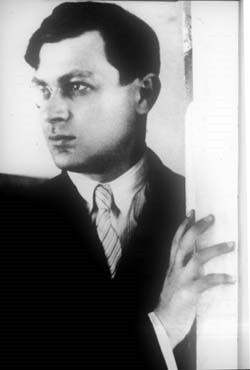
 

The Death of Apollinaire

This is an elegy, not a love poem, but then an elegy is a love poem that replaces the focus masking the complexity of love with the common mystery of death. Even the images and incidents can have an eerie similarity, as an absence may be at the center of either.

The author of today’s piece, Tristian Tzara, is as much as anyone the founder of Dada—if that absurdist movement can structurally support a founder. Like much of the early 20th Century modernist movement, the horrors and changes of WWI accelerated Dada’s development. Proudly anarchistic and rejecting the whole lot of social norms and artistic traditions, Dada was at turns playful and bitter about a European world order that that was itself disordering everything on the continent though modern warfare.

Tristan Tzaratzara_by_picabia

When I look inside the back of my guitar amp,  do I find? Picabia’s portrait of Leo Fender, or a tube socket schematic?

As we’ve learned in earlier posts here, a whole generation was mobilized as part of The Great War. The teenage Tzara, residing in neutral Switzerland, escaped this, but he apparently tried to gain funds from both sides’ propaganda arms to fund Dada activities—which would be just the kind of audacious prank that Dada loved.

The subject of today’s piece, Guillaume Apollinaire, was a slightly older member of that WWI generation who should have gone on to even greater things after the war. As I mentioned last time, he had invented the name for Surrealism, the modernist movement that was a post-war outgrowth of Dada. Before that, he had also invented the term Cubism. In France during this time, Apollinaire seemed to know, and was admired by, everyone: composers, writers, painters, theater artists, the whole lot of this vibrant cultural scene.

Swept up into the military by the war, Apollinaire was seriously wounded at the front and weakened by his wounds, he died during the great flu outbreak of 1918.

Apollinaire with WWI head wound

Apollinaire, his war-wound bandages “pendaient avec leur couronne”

His death then leads to Tzara’s elegy, today’s piece. Given Tzara and Dada’s reputation, I was worried as I started to translate this. Translation, particularly for someone like me who is not a fluent speaker of other languages, is already fraught with issues, but doubly so with writers who can use arbitrary absurdist phrases intentionally. When is something unclear, and when is it meant to be so? That’s a question you ask a lot with these writers. I have a prejudice for vibrancy, and if I feel there’s a good image or English phrase hidden in an unfamiliar language’s idiom, I will generally seek to bring it out, but I also realize that I’m fully capable of misunderstanding the writer’s intent.

With Tzara’s “The Death of Apollinaire”  I grew to believe that this was a sincere elegy for this much-loved artist among artists, and so, translated and performed it as such. Yes, it has its absurd images, but I chose to translate them with clarity in mind. Apollinaire died in November, and so I took the mourning images as a series of late autumn images, and presented them as such. I had the most puzzlement with the line “et les arbres pendaient avec leur couronne” which can be simply left as an unusual combination: a (presumably, shiny metal) crown hanging in a tree-top.  As I looked at “couronne” it appears that it’s used also for a laurel wreath crown, and for a funeral wreath too, and for a while thought “wreath” or “funeral wreath” would be the best translation. And then I considered the botanical meaning of “crown” applied to trees, and the follow-up line “unique pleur” made me think of the last leaves in autumn, a rather conventional image—but a great deal of what makes that conventional in English is the popular song “Autumn Leaves”  written originally in French by Surrealist Jacques Prévert!  My translation: “And the trees, those still with hanging leaves” takes liberties with Tzara’s words, in hopes that I might have divined his image. I’m more confident in how I translated the last line, “un beau long voyage et la vacance illimitée de la chair des structures des os” which I proudly think is superior to other English translations.

Musically, today’s performance is a mix of 12-string guitar in Steve Tibbett’s tuning, with electric guitar and bass. As always, there’s a handy player below so that you can hear it. If you like a piece you hear here, go ahead and hit the like button, but it’s even more important in bringing this work to others attention to share it on your favored social media platform. Thanks for reading and listening, and double thanks for sharing!

How to Make Speeches

I’m going to ask you to not read these notes yet. Listen to today’s audio piece first at least once. It’s short, two minutes long, it won’t take long. The audio player is at the bottom of this post.

OK, now you’re back and you’ve listened to the piece at least once. Do you think the words were written recently? Do think it’s a satire, some kind of sly Machiavellian comment on a particular modern politician?  Do you think it’s Donald Trump’s first draft of his recent speech to the Boy Scouts? Or perhaps is a secret litany of personal affirmations? It does at times seem like a twisted take on self-help.

So what is it?

It’s my quick and dirty attempt at a version of a section of the “Surrealist Manifesto”  written by André Breton in the early 1920s. The Manifesto  is sort of a grab bag, part a sincere plea for a deeper and broader application of imagination in art, part a catalog of examples of how unleashed imagination has already been applied, and part is indeed a parody of a certain genre of self-help, the kind published by occult gurus of the time.

Surrealist Manifesto cover

Not the Boy Scout manual

 
My piece is taken from that parody segment, and I’ve departed from conventional translations in two ways. First, to disguise it, I removed one phrase specifically mentioning Surrealism, and secondly, I’ve chosen my own idiosyncratic translation of the phrase “Peau de l’ours” in it. This is a condensed version an old and French saying, “Don’t sell the bear skin before you have it.” (a French version of “Don’t count your chickens before they hatch.”) Breton may have been using that cliché to contrast with the religious campaign-promise of heaven, but he also could have been refereeing to a hedge fund of his time which used that exact Peau de l’ours” name. And critically, what the investor group bought (and later sold for tremendous profit) was modern French art. “Hedge fund” gave me both ideas in a way that would be meaningful to a 21st Century English speaker.

andre bretonDonald Trump

André Breton and perhaps the Surrealist Party’s first President, Donald Trump.

 
So Breton, as he often does in his pronouncements, is mixing the absurd, with recognizable satire, with sincere advice. But briefly, before I go, I ask you to think about a bigger question. What does it say that some modern artistic principles sound like they could be descriptions of Donald Trump’s (or other similar politicians) philosophy? Is it that Trump doesn’t have a philosophy, only that he finds excuses or rationalizations? For past politicians, we would say they lack a sense of irony, but Trump speaks ironically so often that one wonders if there’s a word for unconscious irony. Could it mean that the sincere iconoclastic individualism and commitment to their own personal freedom that 20th Century artists thought they needed as a corrective to disasters like WWI and a restrictive society and its expectations, is now leaching upward to more powerful men in conventional professions?

L’Amoureuse

I promise you, we will end up today very close to the love song of the last episode, though we will travel a ways before we get there.

I’ve not featured any French writers yet with the Parlando Project, but as this summer has used the words of many 20th Century English poets, we may be overdue for that, as the start of that century found some of them looking to the French for some new ways to write.

French poets started to go “modern” before the British poets, around the same time that Emily Dickinson and Walt Whitman were making their own breaks with past practice in America, so they had a head start, and their avant-garde was way past the supply lines of conventional narrative and sentiment by the time the 20th Century really got rolling.  The absurd casualties of WWI, largely fought in France and its neighboring countries, and so deadly to some of the generation of men doomed to fight in it, only accelerated the modernist direction away from the kind of meaning you might find in a political speech or battle plans.

This summer, 50 years ago, the Polish-French writer Guillaume Apollinaire coined a new word to describe a new way to approach the world in words: “Surrealism.” A few years later, his term was taken up by a group of artists who went about trying to practice a new idea, presented in 1924 as if it was a political manifesto, to write and create from:

“…The actual functioning of thought. Dictated by thought, in the absence of any control exercised by reason, exempt from any aesthetic or moral concern.”

  The Surrealists went on from there, going in various directions, becoming less an idea and more of a brand—but stop and think for a moment, that original idea, isn’t it powerful? The idea that there is a reality that we agree not to apprehend, not to speak of, that we constantly reframe our thoughts to, isn’t that idea political as well as aesthetic?
 
You take the idea of Surrealism, add music to it, and later that century you get Bob Dylan. You take the idea of Surrealism, apply it to the current reality, and you are woke, not from the dream, but to the dream that should not be denied.

Today’s piece uses the words of one of the French Surrealists, Paul Éluard. Éluard, like many of the British poets of this era, was another veteran of WWI. One story of his war service was that, since he was a writer, his military superiors assigned him to the office tasked with writing the official letters to the relatives of the casualties, and such was the efficiency of modern war that he sometimes needed to write 150 of them a day. After a year of this, he asked to be sent to the frontline trenches.

Alphaville Capital of Pain book

Jean-Luc Godard’s film “Alphaville.”  “I love you” could be the ending.

 
I have exposed you several times this month to pieces about the horrors of war and slavery, but I also told you we must travel a ways to get to today’s piece. After the war, as a founding Surrealist, Éluard produced verse with strange images and seemingly arbitrary combinations—Surrealist tactics to break the conventions—but his great subject, against the night, pain, and suffering, was love. Perhaps after those 150-letters-a-day forced march, he too wanted to look to war’s opposite.

Paul Eluard and Gala 2

Paul Éluard and the beloved, Gala. Eyelids not visible in this picture.

“L’Amoureuse”  (The  Beloved) is one of Éluard’s most famous early works, and uses my English translation of his words. The LYL Band performance of it was recorded live several years ago. To hear it, use the player below.

She is Sleeping on the Boundaries of the Night

I said I would change things up last time, and by stepping back a few years, today’s piece does that.

How much different is “She is Sleeping on the Boundaries of the Night”  from the last few posts? First off, we’ve left off from war. This is a love poem. Death appears in it only briefly passing—so fast it passes, as it can in a poem, you might not even notice it. And rather than being a piece by another poet, the words here are mine. We live here at the Parlando Project with the idea of presenting “other people’s stories,” but I also want variety, so I’ll make the exception this time, and present part of my story.
 
One of the modernist/Imagist ideas that Ernest Hemmingway liked to use in his early stories was to leave an essential detail out of story, and then to strive to write it so well that the power of that detail would become present subliminally.

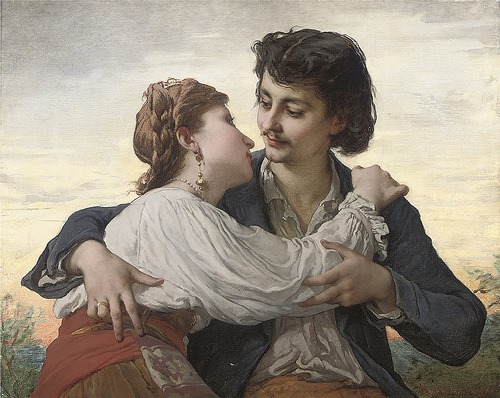
Lovers Tryst

In a classical aubade lovers are always awaking in a field and forgetting to check for contact dermatitis

“She is Sleeping on the Boundaries of the Night”  is an aubade, a traditional form of love poetry. An aubade features lovers awaking at dawn, and the poet lamenting that their night is over, so they must now part for their un-enchanted days. What do I think is different in my aubade?

Sixteen years ago, my wife died after a short and painful illness, not yet 44 years old. I cannot tell you all that means, but one thing I experienced in my grieving process was the question of where one goes from that stopped thing. After all, you are definitively stopped, you have no momentum in any direction, unlike in the normal flow of life. You can stay stopped, or move off in any direction.

I moved, and was moved, in the direction of falling in love again. There are some difficulties in that direction, knowing of love’s inescapable impermanence. Like the lover in an aubade, I knew now, deep in my soul and body, that love means that parting is intensified.

In the end, “She is Sleeping on the Boundaries of the Night”  is a love poem that hardly mentions death. I was trying to do that modernist/Imagist thing. Is death still there?

Alas, the other thing that I left out, is that other person, lying beside the speaker, stuffed with dreams no doubt with all the richness, sadness and choices of their life. My love poem fails, as some do, in that respect. Can it remain unsaid my partner chose to move, and move me, as well?

Today’s piece is musically a bit different as well—there’s an antique 20th Century beat box rhythm used for one thing. To hear the LYL Band perform “She is Sleeping on the Boundaries of the Night”  use the player gadget that should appear below.

Eliza Winston

It’s now a commonplace to note how divided the United States is politically. The way the story is told, there are now two tribes, each sure the other side is largely wrong. We are said to know this, even if we are less than sure about everything “our side” may say, even if we are skeptical, even critical, of some in our faction. You may not believe that this is true about you, but this is what is widely said, and you may say something like this about others, even if you do not believe it about yourself.

I’m about to simplify a story, condensing its humanity so that you will only see moments in several people’s lives. That means you are going to need to pay attention, because the things it may lead you think about are only going to be there for moment.

On a summer day, 177 years ago, a sheriff bearing a writ from a judge knocked on the door of a house on the banks of Lake Harriet, which was then on the outskirts of Minneapolis Minnesota. If you live in Minneapolis, perhaps you know this lake. It just so happens that I’ve spent many mornings this summer reading poetry beside it, as panting joggers and conversing walkers surround it like clockwork.

The judge’s writ commanded the appearance in court of a piece of evidence. As he knocked, that piece of evidence was being told by the people inside to run out the back door and hide. The evidence did not obey. The evidence’s name was Eliza Winston, a 30-year-old woman held as property by the family inside. By her home state of Mississippi’s laws, her mother would have been property too, and her children, if she would have any, would be property as well, the same as livestock on a farm.

How did she happen to be in Minnesota? The man that owned her had traveled up the Mississippi river with his family to escape the heat of the South’s summer, taking a steamboat as far north as the great river was navigable. For his and his family’s comfort, he had taken one of his slaves, Eliza Winston, with him. The laws of the state he traveled to explicitly forbade slavery, but three years earlier the national Supreme Court had ruled that a slave named Dred Scott remained property when he had been brought to Minnesota.

Living in Minnesota then were people allied with a faction that sought to end the practice of slavery. They were looking for people claimed as property to contest those claims. How did they view the slave owners? Of course, as evil you may think. Wouldn’t anybody? Somehow, Eliza Winston had made contact with these slavery opponents. One of them, William Babbitt, would swear out a complaint that her slavery on Minnesota soil violated Minnesota law.

Imagine if you could own something as useful as another human being as property, to have complete control over them. Wouldn’t that be useful; and as a business venture, potentially profitable? The faction that owned other people certainly felt that way. How did they view that other faction, the ones who sought to end that practice?  They viewed them as wrong certainly, but they also saw them as annoying self-righteous busybodies that needed to be taught a lesson, a view that was sometimes shared even by those that weren’t sure that slavery was a good and necessary thing.

Since Eliza did not hide, she was taken to directly to a courtroom. Despite the rapidity of the actions, the courtroom was packed with those from both factions. Eliza’s owner was there with his lawyer, who pointed out Dred Scott. The lawyer for Babbitt had testimony from Eliza Winston that she was indeed a slave, that she’d been passed around like property between several owners, and the lawyer stipulated that Minnesota’s constitution clearly forbade slavery in the state.

The judge ruled, that based on Minnesota law, Eliza Winston was now free. As soon as he pronounced, a clergyman in the crowd jumped up and condemned the decision as “unrighteous,” pointing out that, regardless of the state or federal law, Christianity and its scriptures approved of slavery. I don’t know more of what he said, but he could have claimed that Babbitt and his faction were worse than thieves and rustlers, in that they not only stole, they were self-satisfied in their actions. The crowd stirred at this, and then there was moment of calm in the summer courtroom. Eliza Winston’s owner walked over to the woman that he had owned like a horse or a cow, and he calmly asked her if she wanted to come back with him and return to Mississippi. And Eliza, no longer property, answered that she wished to be free and remain in Minnesota. As Eliza Winston left the courtroom, the Minnesota clergyman was still orating on the wrong that had been done to the slave-owner.

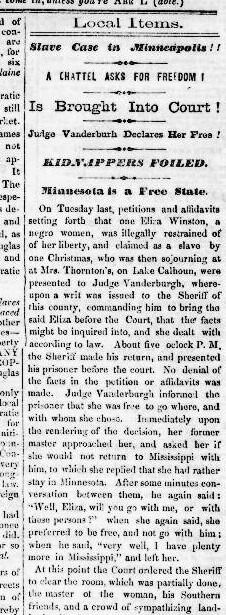
Eliza Winston newspaper story

“A chattel asks for freedom”

That night, those angry at the decision went out around the town looking for Eliza Winston. What would they have done if they had found her? One can only guess. They surrounded Babbitt’s house and battered down the door seeking Winston or Babbitt, and crying for blood. They similarly broke into another house seeking Winston. Winston, however had been moved somewhere else, and may have fled as far as Canada. A year later the Civil War broke out, and Winston, no longer property, became as if a ghost. There are no pictures of her, no tales of great or even small things that she may have done. Some even say she went back to the south after the war. In Minneapolis there is an inconspicuous historical marker about her case, placed along the Mississippi river that brought her here, and not much else.

Eliza Winston Marker
An inconspicuous historical plaque about Winston in Minneapolis
William Green has the most complete telling of the story I’ve seen. For a PDF click here.

Then last year Dave Moore was told a version of Eliza Winston’s story by a friend. The friend, or perhaps Dave, got a couple of the details wrong, and I have left a lot of details out of the story as well—that may not matter. Dave was struck, mixing Eliza’s story and the tale of his friend choosing to tell him this story together, and then forming this lovely, vulnerable song.

Here’s what I ask you, now that you’ve heard my telling of Eliza Winston’s story. If you ever find yourself in a world of factions, and you find yourself in one of those factions, perhaps not sure of what you think, but sure that the other side is clearly more wrong. Ask yourself what Eliza’s story, and the story of slavery tells you.

To hear Dave sing his Eliza Winston song with the LYL Band, use the player below:

On the Troop Ship to Gallipoli

In the past few posts I’ve mentioned how Ezra Pound was more than an exemplary writer, theorist, and promoter for the early 20th Century modernist poetic movement that he called Imagism. He was also an excellent editor.

His most famous blue pencil job remains T. S. Eliot’s “The Wasteland,”  but he also worked with H.D. and Ernest Hemingway, teaching with his editing how to pare away extra words, overused similes, and extraneous authorial sentiment. And once shown, those writers we able to use Pound’s insights to do the create their own pared down, modern styles.

In the last episode, I noted that Pound had been critical of some WWI poems written by Rupert Brooke. Here for example is the first part of Brooke’s most famous war poem “The Soldier:”

If I should die, think only this of me:

That there’s some corner of a foreign field

That is forever England.  There shall be

In that rich earth a richer dust concealed;

A dust whom England bore, shaped, made aware,

Gave, once, her flowers to love, her ways to roam,

A body of England’s, breathing English air,

Washed by the rivers, blest by suns of home.

Written as England entered into WWI, and as Brooke himself rushed to enlist, this poem was embraced by a patriotic public almost immediately. If one shares it’s sentiments, the actual technique of the poetry probably admits no impediments to a reader, even today—but ask yourself, does it have a sense of actual immediacy? As you read, do you share with a fellow human, feeling, seeing, smelling, this experience? What I get as I read it is a thought, where a soldier thinks that if he dies in battle and his body rots overseas, that his body will homeopathically retain its English birth and experience, and that experience, it is inferred, is worth dying for. Why? Well because the poet says so, and he says it with rather polite poetical words. “Die” and “dust” are perfectly good, simple words, but as a description of death and decomposition, they are surrounded by forevers, flowers, air, rivers, and sun—all presumably sweet and genteel.

Rupert Brooke died at age 27 of an illness he contracted while on his way to the Gallipoli campaign in his war, but what if he, like Yeats, had continued to live and react to the developments of his young century? And what if Ezra Pound had gotten a hold of him and showed him how to punch up his verse?

NPG P101(a); Rupert Brooke

Rupert Brooke, charter member of “The 27 Club


Today’s piece shows what could have happened. One of the last things Brooke wrote was this fragment written on the troop ship in the month he died. Here’s the original:

I strayed about the deck, an hour, to-night

Under a cloudy moonless sky; and peeped

In at the windows, watched my friends at table,

Or playing cards, or standing in the doorway,

Or coming out into the darkness. Still

No one could see me.
I would have thought of them

–Heedless, within a week of battle–in pity,

Pride in their strength and in the weight and firmness

And link’d beauty of bodies, and pity that

This gay machine of splendour ‘ld soon be broken,

Thought little of, pashed, scattered. . . .
Only, always,

I could but see them—against the lamplight–pass

Like coloured shadows, thinner than filmy glass,

Slight bubbles, fainter than the wave’s faint light,

That broke to phosphorous out in the night,

Perishing things and strange ghosts–soon to die

To other ghosts–this one, or that, or I.

What can I, acting as Pound might have, do with this? Well first I can locate the charged images in it, hidden as they are inside Brooke’s extraneous comment. What are they? The soldier pacing at night on his troop ship. He’s staring back inside the ship, looking at his fellow recruits on the way to their first battle. If we have any empathy as readers, we don’t need to be told anything about what he’s feeling if it can be conveyed by what he’s seeing. What are our charged images? The troops are playing cards, games of soldier’s chances. They can’t see the poet, and he can see them only imperfectly, backlit by uneven lighting, “coloured shadows,” which is a great image obscured by all the muck about it. And he sees the faint light of a wave’s phosphorescence as bioluminescent plankton are sweep aside by the wake of the ship. The soldiers, and the poet himself, are already in the course of war, like ghosts, fleetingly seen, or only partially and incorporeally seen.

Have you tried the exercise where you make a poem by taking a marker and blacking out most of page of text, revealing a poem could be in what remains? That’s like what I did with Brooke’s fragment:

On the Troop Ship to Gallipoli

I strayed about the deck, an hour,

Under a cloudy moonless sky.

Peeped in at the windows,

Watched my friends

At table, playing cards,

Standing in the doorway,

Out into the darkness.

No one could see me.

I could but see them

Against the lamplight,

Coloured shadows,

Thinner than glass.

A wave’s faint light,

Broken to phosphorous.

Perishing things and strange ghosts

Steaming to other ghosts,

Only, always.

I removed over a hundred words that didn’t need to be there, which covered up what did need to be there. I don’t need to say that these things relate to each other, putting them in a short poem together makes that clear. I added only one word, choosing to add “steaming” instead of just “to other ghosts” because it’s an action word, and because “steam,” though active and industrious, is another thing that dissipates and disappears.

I have two unfair advantages over Rupert Brooke as I transformed his words. First, he died in service to his country shortly after writing this, so he didn’t have the chance to revise his fragment. Secondly, the place he was going, Gallipoli, and the outcome for so many British and Commonwealth soldiers who were deployed there is now infamous for poor tactics and horrendous casualties. I can simply use “Gallipoli” in the title and magnify the dread of soldiers on their way to battle.

Today’s episode is dedicated to Julie Shapiro, who introduced me to Eric Bogle’s “The Band Played Waltzing Matilda.”  This is a song about Australian troops at Gallipoli, and though I can link to one of my favorite singers, June Tabor’s, version of it, there is nothing but my memory to testify to the devastating version Julie used to perform.

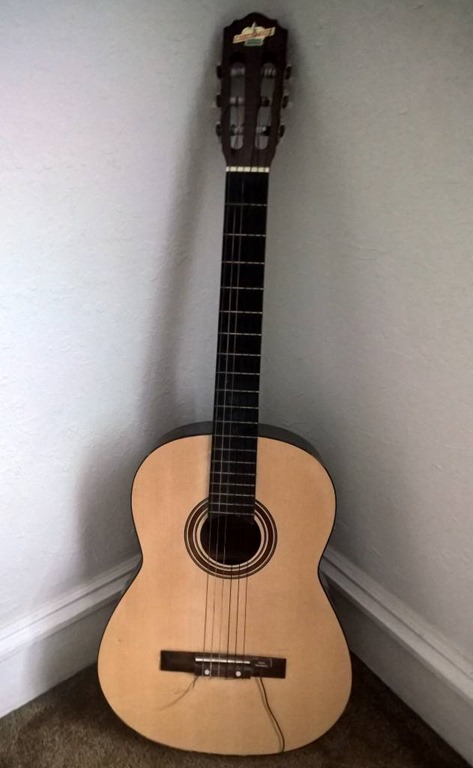
My First Guitar

My first guitar, purchased for $40 in 1974, and played on today’s audio piece


Long post again, no time to talk much about the music for this performance. Perhaps I don’t need to tell, you just need to hear it. Use the player below then for my performance of a revised fragment by Rupert Brooke.


South Folk in Cold Country

Here’s one more piece from Ezra Pound’s 1915 breakthrough collection “Cathay,”  a war story he called “South Folk in Cold Country.”

At the time Pound was working from Ernest Fenollosa’s, and Fenollosa’s Japanese teachers,’ notes to translate classic Chinese poetry, World War I had broken out, and England, where Pound was living, had mobilized to fight this war. Like William Butler Yeats (with whom Pound was staying for part of this time) Pound did not want to take a side in the war. Not only skeptical of the war’s patriotic rationales, Pound also wanted to continue to focus on his modernist artistic revolution.

Earlier in the Parlando Project, we’ve seen how Yeats responded at the beginning of the war. His On Being Asked For a War Poem”  cloaked his disdain for statesmen’s’ rhetoric while seeming to take a aesthete’s stance of artistic superiority and inferiority.

Pounds Directions to Yeats House

Robert Frost needed to get to W. B. Yeats house,
so a helpful  Ezra Pound drew him this map.


Pound felt similarly. He may not have been sure, at first, of the what he would eventually call lies by the politicians by the end of the war, but his poetic BS meter was immediately sure that the patriotic verse being produced to ennoble the war was false ethically and artistically. But Pound also recognized that any poetry he would write in such a charged environment would be inescapably seen in the context of the war.

Still, he was wary of writing about war as a civilian who had never fought in battle. At one point, he reported he had tried to enlist, but was turned down due to his (then neutral) American citizenship. At another point, he wrote a review critical of Rupert Brooke’s war poetry, only to have Brooke, who was serving in the British armed forces, die while in service, leading Pound to qualify that he was only criticizing the poetry, not the citizenship.

So as Pound created and promoted Imagism, his vision of new modernist poetry by recreating classical Chinese poetry in English, he came upon a solution. He would use the Chinese poets, both as the model for his new kind of verse and as a way to comment on the war.

Today’s audio piece is an example of how Pound went about those two things, once again translating and transforming the work of 9th Century Chinese poet Li Bai.

“South Folk in Cold Country”  is an account by Li Bai of a military campaign in the north of China that had occurred almost a thousand years before he wrote. Pound, taking this for his modernism, has the soldiers who speak of their war experience say nothing of what they are feeling. There is not a word of them saying they are tired, confused, frustrated, or suffering, but their world is described by them as the image of all these things. While Li Bai/Pound’s “River Merchant’s Wife”  reads musically off the page, despite being “free verse” in English, “South Folk in a Cold Country”  has a more abrupt and doubtful music. Pound was trusting Li Bai and his own artistic sensibilities so that he might get some of the war experience right.

When I first read “South Folk in Cold Country”  this year I thought: this sounds like a bag of fortune cookies mixed in with Ernest Hemingway. Either or both of those comparisons may sound dismissive to you, but I suspect the best fortune cookie aphorisms have some relationship, however strained, to the concision of classic Chinese poetry, and Hemingway, however familiar he may seem to us now, was using Pound’s ideas as part of what was to be Hemingway’s revolution in prose. Thanks to Hemingway, and in turn, to Pound who directly influenced and taught him, we now are not surprised by representations of war, violence, and death that assume concise description and charged observation can be truer than superfluous remarks by the author.

Hemingway in uniform

Hemingway, who did serve in WWI, sought out Ezra Pound to shape his writing about it

I did wonder about the General Rishogu mentioned at the end the piece. His Chinese name (remember, Pound was working from notes of Japanese scholars, not Chinese ones) was Li Guang, and his story is here. I like this as an ending. I’m not sure if Li Bai’s soldiers who speak in this piece are using Rishogu/Guang as an example of the hard fate of soldiers; or if they are saying, after what we’ve been through, making all those rapid marches to make Rishogu/Guang’s name, who among them will care about the general’s death. On the odds, I’ll take the later.

Musically I used some relentless vibes over electric piano and bass to stand for the rapid marches that the “swift moving” general kept ordering, and then some neighing winds from a synthesizer patch. To hear me perform “South Folk in Cold Country”  with that music, use the player gadget below.


The River Merchants Wife

The River Merchant’s Wife: A Letter”  has a very complicated history. I can’t even say “Ezra Pound’s ‘The River Merchant’s Wife”— though he’s often listed as the author.

Let’s begin, as a river or a journey might, at the beginning. Back in the 9th Century in China there were two great poets. One of them we’ve already met there: Du Fu. He was known for his wisdom and level-headedness. The other was Li Bai (his name is also written in western letters as Li Po and Li Bo, and in Japan as Rihaku) who was known for his more excessive existence. In China both have been continually revered, but in early 20th Century Europe or America, they were nearly unknown. Only scholars interested in off-beat subjects knew of these men’s work.

One such scholar was an American, Ernest Fenollosa, who had traveled to Japan and become deeply immersed in Japanese culture, and as a sidelight to that, he also was exposed to Chinese culture. Early in the 20th Century, Fenollosa was one of a group of Americans living in England. We’ve met others here who were part of this “reverse British Invasion” of Americans: Ezra Pound, Robert Frost, T.S. Eliot—and you’ll soon get to meet another, H.D.  Fenollosa then died in 1908, still in London.

Here’s were something fateful happened. Fenollosa’s widow, for some reason, gave Ezra Pound a bunch of her late husband’s papers. Pound was a young man who was trying his damnedest to start some kind of artistic movement in London. In the papers were scholarly prose translations of Li Bai’s poems done by Fenollosa and two of his Japanese associates, Mori and Ariga.

Ernest FenollosaLi Bai

Ernest Fenollosa, deeply attracted to fur; and Li Bai, more into silk

Pound fell upon these scholar’s notes. He’d already sought out other old poetry for inspiration for his revolution (much as the Pre-Raphaelites had looked backwards for something fresh), but in this old Chinese poetry he found what he was looking for. It was concise. It was free of centuries of cruft that English poetry had accumulated. And Pound naïvely felt that the poems themselves grew out of the ideograms for their words, Chinese characters which had evolved from drawings of objects. He had found his poetic revolution. Poems should be constructed of little more than images. Not images in the sense of elaborate similes or strained allegories, images in the sense of a presentation of the direct observation of the poet, unadorned. Pound published what he created out of those scholars’ notes as a ground-breaking poetry collection “Cathay,”  and he quickly began to compose his own modernist poems using his epiphany.

If Fenollosa hadn’t died in London, and if his widow hadn’t given this tranche of papers to an artistic provocateur such as Pound, it’s possible that Li Bai would be no better known in English today than he was in 1908, and it’s even more likely that poetry in English from that point on would have evolved differently.

If Fenollosa hadn’t died in London, and if his widow hadn’t given this tranche of papers to an artistic provocateur such as Pound, it’s possible that Li Bai would be no better known in English today than he was in 1908, and it’s even more likely that poetry in English from that point on would have evolved differently.

Seems like a miracle when such things line up, doesn’t it? Well, here’s something as miraculous: though “The River Merchant’s Wife’s”  source was written over 1200 years ago in a culture so far removed from America that the childhood legend was that one would need to dig a hole through the center of the Earth to get there, even though it comes to us filtered through non-Chinese scholars, and even though the particular words I’ll use today to express it were written by an avant-garde poet whose work remains little-read and understood today, many people have an immediate deep emotional response to this poem the first time they hear it.

Isn’t that odd? All that strangeness in customs, place-names, time, provenance—and yet more: it’s a poem of female desire written in the voice of young woman by a man, and translated and transformed by men. And yet, woman and men, young and old, hear it, and they feel the pangs of desire and separation just as much as any 8th Century resident of China—even though the poem, following the tenants of what Pound would call “Imagism,” barely mentions the speaker’s emotions (“bashful,” “desired,” and the only present-tense one, “hurt.”)

I know I felt those things when I first heard it, aged perhaps 21 on a sad journey with a young woman. I hear it now as an old man too, and think once again of my friend John, and of China. The place, Cho-fu-Sa, that the river merchant’s wife says she will go out to meet her husband is, I’m told, hundreds of miles from her village in the poem. What is such distance to the heart?

To hear my performance of “The River Merchant’s Wife: A Letter”  use the player gadget at the bottom here. Since this post is already long, I’m not going to talk much about the music today. The higher-pitched string instrument you’ll hear is my approximation of the pipa, a traditional Chinese lute. There are many moving recitations of this poem available online, but to see an entirely light-hearted modern translation of “The River Merchant’s Wife” after listening to mine, view this one.

The Summer 2017 Parlando Project Top 10

The subtitle of the Parlando Project is “The Place Where Music and Words Meet”. As I mentioned last night, this project, which combines words sourced from a variety of sources with a variety of music, has now reached 100 available audio pieces since it’s official launch 11 months ago. Note that stress on variety. In terms of writers, I have my favorites, and the short format of our audio pieces strongly favors poetry, but the Parlando Project has featured words taken from other sources as well, and some of the poets featured were unknown to me until I ran across them looking for material, and I’m trying to vary the music as much as I can. Sometimes our pieces are as simple as acoustic guitar and voice, as in our most recent post The Oven Bird.  Some pieces have full arrangements with multiple instruments, and some feature spontaneous performances by the LYL Band, a folk-rock band that’s been playing a rough and ready mix of electric instruments and literate lyrics since the early days of Minneapolis punk rock.

We’ve gotten thousands of downloads and streams so far, and though I don’t have the time to thank everyone personally for the likes and the shares, it’s been your passing on the existence of our audio pieces that has grown our audience from a few hundred downloads to thousands. I don’t have time for a social media presence myself. Researching, writing the majority of the music, as well as arranging, producing and recording these 100 pieces has taken an untold number of fascinating hours, but it leaves me little time to promote this work myself. So I’m very grateful for you, the readers/listeners who have done so.

Since we last did did a Top 10 in the spring, that growth in listenership has meant that there is only one returning piece since that list a few months ago. Which piece has the staying power?  Lets start off the countdown in the traditional order, with #10.

10. Adlestrop – a late surge brought this piece with words by fateful British poet Edward Thomas into the top 10, just beating out Zalka Peetruza  and Spring Grass  as the final slot shifted back and forth this week. Adlestop’s   download rate is noteworthy too in that its the newest post to make this list.  Listening to this hazy slide guitar piece I still recall my own muggy summer unscheduled lay-over in Kingham a year ago, but that’s a private moment, though I feel somehow I’ve shared it with Thomas thanks to his words. In a more public way, this poem gains resonance from it’s connection to Robert Frost’s The Road Not Taken and to the Centenary of WWI.


9. Grass – speaking of WWI,  here’s the first of two placings of a Carl Sandburg piece on this Summer’s Top 10. My private memory is performing this with the LYL Band, spontaneously as usual, with no rehearsal or warning as I read Sandburg’s words, and having us stop on a dime for line that starts “What place is this…” as Grass  approaches Sandburg’s ending. For other listeners, particularly those with friends, families, and even ancestors lost to war, Sandburg’s piece asks a powerful  question of forgetfulness.


8. Intro to The Waste Land – One could say this continues our WWI Centenary theme, as T.S. Eliot deals with his personal depression in the context of the aftermath of The Great War in this poem, but it was instead intended as part of our April “National Poetry Month” celebration, which I will always link to the poem’s famous opening line “April is the cruelest month.”  This is one of my composed pieces musically, were I get to write and perform all the parts myself, which means I get to fully realize my personal “vision” of the music (something the listener needs to care not a bit about) and to therefore be responsible for all my own mistakes.  My personal memories of The Waste Land  are two-fold, one a memory of reading it for the first time in college, and though mystified, feeling an intense musical thrust in what Eliot wrote, and then to a time more than a decade ago when I felt just past my lowest ebb emotionally and then performed the last sections of The Waste Land  spontaneously with the LYL Band, and found it as musical as I expected it would be, but also was surprised at how it expiational performing it was. Publically, the downloads of this have been steady, and have continued long past #NPM in April, so it’s either due to your sharing of it, or the poem’s continued fame.


7. To A Friend Whose Work Has Come To Nothing – Irish poet William Butler Yeats is another writer whose work we’ve mined for more than one piece here. One thing I learned while looking at material for this blog was that Yeats too believed that poetry performed with music was a necessary combination. Another investigation, brought on specifically by this piece, was to find out just who the friend was whose work had been thwarted, and what that work was. This has been another piece with a steady listening rate since posted. My guess is that the experience Yeats was telling us about is common to many, and whenever it is encountered it is not easily forgotten. Weeks after this was posted, I watched the former FBI director James Comey testify before Congress, and thought if Yeats was his friend, he would have said the same things in verse to him.


6. Clark Street Bridge – Carl Sandburg gets his second appearance on this Top 10 with this wistful story of day and night on this busy downtown Chicago river bridge. As a personal experience I got to see the Clark Street Bridge this spring on a visit to Chicago, and though the current bridge is almost 100 years old, it’s not the one Sandburg watched and wrote of. Another thing I learned during my trip: his night scene with silver singing stars equal in number to all the broken hearts in Chicago contained a larger number than I would have estimated from modern urban nights, as the poem was written before the widespread adoption of all-night electric lights. What are, or could,  the listeners be attracted to? Well, broken hearts remain as numerous as the stars in a dark sky for sure, and Chicago has taken Sandburg to it’s heart; despite, or because, he says that that heart is broken.


5. The Death of Col. Bruce Hampton – I’ve written a number of direct tributes to musicians that I’ve featured here, but this is the most popular.  Particularly now as the main lot of musicians fall back into the lower levels of the “gig economy” they gave their name to without additional payment, I see them as retaining the heroism of artists in general, who do what they do to general indifference, but now with a much lower chance of professional earnings. This is the only piece in this Top 10 where I wrote the words and the music, but that’s about the right amount, as the Parlando Project is about appreciating “Other People’s Stories” after all. The defensive shells and double-ended poison stingers that artists grow don’t always lead to happy lives, but those who knew Bruce Hampton have grateful things to say about him as a person and collaborator. And by chance, he got to come to the end his life with some of those folks thanking him, while he encouraged the creation of even more spontaneous art. I assume that’s the reason for so many people listening to this piece.


4. These Fought – Here’s one I’m a little surprised about. Ezra Pound may have done more than any other person to create modern poetry, but he’s less read today than many he influenced and championed. And though other modernists dabbled in between-the-wars nationalism and racial theories, Pound became America’s most notorious fascist apologist. And this piece, posted around Memorial Day is an uncompromising denial of the honor in the sacrifices of WWI. If you like your poetry feel-good and inspirational, if you like your poets cuddly and full of civic pride, this piece is not your choice. The LYL Band tries to equal Pound’s fierceness in this performance.


3. Love and Money – Unlike many other poetry and spoken word blogs, we feature other people’s words almost all the time in the Parlando Project. Of course, there’s nothing wrong with self-expression, but in following the Project’s dictum “Other People’s Stories,” we don’t do that often. Perhaps in consolidating that stated aim with the catalog of thought-provoking words that Dave has written over the years, many of the Dave Moore pieces I’ve posted so far have been performances where I perform Dave’s words–a mixed blessing that–because, to steal an old Columbia Records ad from the 1960s “No one sings Dave Moore like Dave Moore.” I was sold on this one the moment I heard Dave sing the first line of this piece as we spontaneously performed it, and there’s no way I could do it justice.  The popularity of “Love and Money”  probably has the same private and public reasons, it’s just a good song. Oh, and Dave’s pounding electric clavichord performance might have something to do with it too.


2. Up-Hill – Here’s an example of a poet I knew close to nothing about before looking for material in the public domain to adopt for Parlando performance. Having a long time love of the Pre-Raphaelite painters and knowing that poetry and poets were part of their artistic circle, I went looking for Pre-Raphaelite poems that I could relate to musically. I kept striking out. I really wanted to find something by Algernon Charles Swinburne, because, well, “Algernon Charles Swinburne”. Is there any name that says more clearly that you don’t give a damn about sounding cleanly modern and approachable? Only Ezra Pound’s invented persona “Hugh Selwyn Mauberley” comes close. Alas, I could find nothing I felt I could inhabit–and then I came upon some of Christina Rossetti’s shorter poems. Read this on the page just once, and you know it’s crying out to be sung. Perhaps Up-Hill  draws listeners because it’s a Christian religious poem, but Rossetti’s writing personally connects with me because it’s imagery and expression is so non-abstract and modest.


1. Frances – Here’s the only repeat from last Spring, and it’s still on top, with almost double the total listens since released of the any of the others on this list. I released Frances  on a lark to mark US President’s Day last February. I suspect it got picked up and linked somewhere more popular than other pieces that have been linked from here, but I haven’t been able to find out where. Here’s an example of how relatively popular it’s remained, long after it’s author’s, the first US President George Washington’s, birthday this winter: it was the 8th most listened to piece from the Parlando Project in May, still 19th in June, and currently it’s the 13th most listened to song in July, with a hundred alternatives competing with it. What accounts for this? Well it’s a love song for one thing. Maybe it’s the pared back Pixies soft/loud arrangement? It’s a mystery.


So that completes the Summer 2017 Top 10. I plan to do another one next Fall.  If you’ve got a favorite you’ve found here, do what someone must have done with Frances, and go ahead a link to it to see if it can get more listeners.