Nature Can Do No More Blues: Combining mysteries with bottleneck slide guitar

I thought I was done with my Emily Dickinson series. I had started to think of what poets would be next, and….

Emily came back.  Not the mystical psychedelic Dickinson. Not the weird indie-folk Dickinson. Oh, still mysterious, still a trickster — but she asked not for unusual harmonies or strange timbres this time. She wanted to Rock!

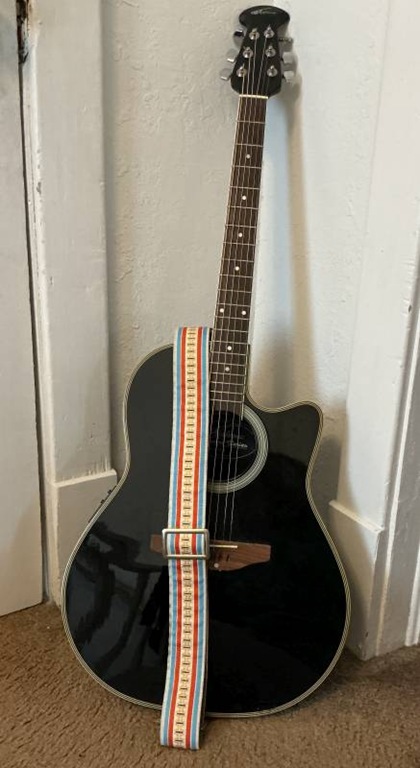
Well, if you’ve been in a mode lately of working with acoustic guitar, and you want to transition to Rock, then there’s no better way to start than Blues. I grabbed my bottleneck slide and my resonator guitar* and it was time to get down with some rough ‘n’ ready Delta Blues — at least the way I play them.

I didn’t learn how to play slide from some Papa Legba at the crossroads, nor by grizzled tutelage from an in-the-tradition player. I was an Iowa teenager when a white college kid from Minnesota pulled out a severed wine bottle top from his jean-jacket pocket and proceeded to show the results of the guitar lessons he’d had in Minneapolis.**   I recall his technique was not pristine, but the sound including the incidental noises of the slide grinding into the strings and occasionally slapping onto the fretboard entranced me.***  Five years later I finally decided to try to figure out how to play guitar, by myself, living in a little rented travel trailer, and unable to afford any lessons.

We know Emily Dickinson played piano. Did she have lessons her family could have afforded her? Did a family member teach her? I don’t know if we know what kind of music she played, but it may have been hymns and popular parlor pieces that were sold as sheet music. Did the Celtic immigrants in Amherst leak any of their music to her? Was Black American music in her ken, and if so what variety? All mysteries, but it’s unlikely she had any idea of Blues music, because as best as can be determined, it didn’t exist yet. Sometime around the time her poetic writing was tailing off, it seems that Black Americans began mixing the musics they heard around them in North America with the music that survived the slave ships, and lullabies, and work-a-day chants of work-gangs or field laborers. Most were newly freed from enslavement. Commercial entertainment was a newly opened field for them as musicians and as audiences. In this new situation they had a new story to tell.

Extracted as musicological theory, Blues can be expressed in a lot of ways, but my appreciation says it’s an attitude as much or more than a scale, timbre, or harmonic framework. What attitude? The Blues isn’t “the Blues” as Western European derived Americans knew it. It’s not melancholia or simply depression. It’s not elevated Romantic despair. Sad, bad, and difficult things happen in a Blues song, but that’s not the main point: the main points are that the singer is still here, can tell you about it, and has maybe figured out something about what has led to this situation that they’ll share with you.

So, here’s what Emily Dickinson did that was Blues-like. Like the Blues, Dickinson is going to use humor and incongruity to describe her experience. If death is a fact of human existence, she’s going to write its Yelp review telling you about it. She’s going to tell her tales using coded language at times, so as to not rile up those who think she shouldn’t have the thoughts she has — and besides, coded language gives one the paradoxical freedom to choose the strongest, sharpest words.

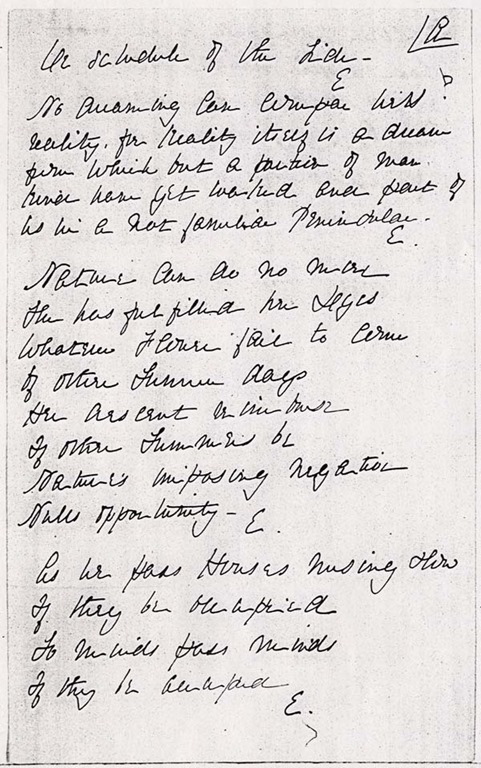
Now the poem I took today is from late in Dickinson’s life, and it’s more puzzling than many of her often puzzling poems. “Nature can do no more” strikes me as an Autumn poem. Here’s all it is, as she wrote it down:

Nature can do no more
She has fulfilled her Dyes
Whatever Flower fail to come
Of other Summer days
Her crescent reimburse
If other Summers be
Nature’s imposing negative
Nulls opportunity —

Nature can do no more in Manuscript

Dickinson’s “Nature can do no more” in manuscript. Above the poem she wrote: No dreaming can compare with reality, for reality itself is a dream from which but a portion of mankind have yet worked and part of us in a not familiar Peninsula.“

This poem expresses itself strangely. “Fulfilled her Dyes?” Floral blooming colors? Autumn leaves? Punning “dies?” The transcribers think she scribed “crescent” but it might be “descent” — but what’s accounts receivable here? “Negative Nulls opportunity?” As the Pythagorean math-lyricist Billy Preston put it “Nothing from nothing leaves nothing.” Or it just clearing the field for new growth? I saw a short presentation on Dickinson poetry this week where the presenter compared Dickinson to Joyce’s tangled Modernist word-play mode. This poem would be an exhibit for that.

But this struck me as Blues-like too. You see, following up on my mid-century, Upper Mississippi white-blues-kid introduction to this old acoustic Blues style, I wanted to hear more of this music performed by its originators, and you did that listening to LPs re-recorded off of worn, made-cheap, second-hand-store shellac 78s, cut fast in any handy room with a single approximated microphone. It’s a powerful sound, but it’s not a pristine and clear sound. And the singers, even if I was in the room — maybe because I was in the room, a white guy like almost all the recordists — aren’t always going to speak out. They’re asking to be heard by other Afro-American listeners perhaps, so their patois and accents aren’t lightened or toned down.

To this day, after years of listening, after much more study of Afro-American history and language, after generations of audio restoration advancements, there aren’t 100% agreed upon transcriptions of lyrics sung and said on all those early 20th century records (and their meaningful context) — “crescent” or “descent” isn’t the half of it.

So mysterious Emily Dickinson, meet Geeshie Wiley.****  What’s “Eagles on the half dollar” have to do with commerce and sex, was it “bolted meal” and flour or flowers?  I was ready to combine the mysteries here — and yes Emily Dickinson, rock a little.

I might have performed Dickinson’s exact words for this piece, but I wanted them to fit into a common Blues music form, and so I was already prepared to modify them. I decided to make words that were more my extrapolation of what I feel she might be saying as she views the null of winter coming on with the knowledge of the cyclical phase of the seasons meaning another summer follows. I tried to mumble the words a bit as I sang them to give it the air of those old slide-guitar Blues records. Here’s what I sang:

Nature can do no more, she has fulfilled her Dyes
Flowers that failed to bloom left for other summer days

The crescent moon decrees, other Summers yet to be
Colors’ slow cremation — nulls for opportunity

Yes, there’s a spoken aside in the middle of the song. I’m not printing that, because the spirit of the old 78s says you have to try to figure it out. You can hear my performance of this “after a poem by Emily Dickinson” song with the audio player you should see below. No player seen? You don’t have to jump the Katy looking for it, you can use this highlighted link that will open a new tab with its own audio player.

.

*The, neck and the body’s outline shape is like a regular acoustic guitar, but the top and interior are replaced with a 10-inch metal speaker cone. This cone is driven to vibrate by the bridge holding the guitar’s strings producing a louder piercing tone that has a directness and can’t-ignore-it volume that Blues players liked.

**The kid’s name was Don Williams, an all-to-common name. If he’s still alive he’d be in his 70s. I’d love to meet him again if only to tell him that for all his pretentions and mine he imprinted my approach to the guitar.

***This is not how everyone plays slide guitar, even Blues slide. Precise touch and technique can produce music with tight intonation that avoids all these artifacts. I just like hearing those artifacts. I love recording piano with key or pedal noise or even a bit of a squeaking bench too.

****I often fear I’m too long-winded when a feeling starts me up. But I’m nothing like what recordings like Geeshie Wiley’s can do to folks whom the muse has touched. Here’s two of them (warning: long form writing)  Daphne A. Brooks. John Jeremiah Sullivan.

Rejoicing Veins

Summer has event dates for me. Wedding anniversary for my living wife, death anniversary for my dead wife. In between, my birthday. A birthday has the same date on the calendar, but they change over the years in their nature. I can still recall the birthdays for singular digit ages, those massive markers toward becoming, achieving oneself. And then there are the rights-granting ages, 18 and 21; or certain decade mileposts, 30 and 50.

Now aged, the age number becomes hazy, defining less. A fair number of people who’d be my age aren’t, due to death. Most of my cohort have some collection of Marley’s Ghost chronic conditions, mild to significant. This is, after all, the portion of life that takes away things, slowly or all-at-once.

But it’s important to add to this calculation, life adds each day too. I’m celebrating my birthday today with my wife and a couple of friends. We’ll meet at an art museum’s restaurant. Everyone and I have not stopped breathing.

I celebrated my actual birthday by getting an ultrasound study of my aorta. My doctor suggested it since I had smoked in my twenties, and there’s some increased risk that this major artery can later swell and be at risk for a rupture, something that is in that all-at-once class of ageing events. Weird going through a test like the one when I first saw the shadow of my child, to know if I have a shadow of death inside me.*

To a degree not equaling my enjoyment of life right now with my little family and this Project, with still being able to hop on a bicycle and ride, with the ability to meet an instrument and come to an agreement on some music, I do have a sense of shadows. Multiple family members, all younger than me, have had some mild to more significant cognitive issues diagnosed this past year. Slowly or all-at-once — that’s birthdays, that’s aging. I’m enjoying the days slowly.

“Upon our couch we lay as lie the dead,/Sleeping away the unreturning time.” Go ahead Vincent, it’s OK to take a nap. It what you get done when you wake up that counts.

.

Today’s musical piece is my setting of a sonnet by Edna St. Vincent Millay. You can read the text of her poem here if you’d like at this link, and listen to my performance with the audio player below. I had a half-a-dozen beginnings/basic tracks of Parlando musical pieces sitting on my hard drive, and I selected this one mostly out of how near to being finished it seemed. Then as I set down to write today’s post — asking myself what I was thinking — I realized the poem expressed elements of my life this summer.

I remember when I presented my first Millay sonnet for this Project, years ago. I knocked her then for using too much archaic language and sentence order, an affliction her contemporary Modernists were seeking a cure for. “Rejoicing Veins”  is from later in Millay’s career, and by then the language in this one shows little of that fault. This is another poem that seems to me to speak accurately about old age, yet this was written by a 40-year-old poet. Vinny, that doesn’t seem so old to me, but you got it right!

There’s that graphical audio player now, or if you don’t see it, this highlighted link that will open a new tab with its own audio player.

.

*Test results? Everything looked fine. Rejoicing arteries?

The Wind

Today’s piece from the two volumes of The Girls  and The Boys Book of Verse  pair is by a poet I’ve begun to revisit during the past year, Robert Louis Stevenson. Taken just as verse, Stevenson will impress the ears of adults and children alike as charming, but as I revisit his children’s poetry I’m finding additional resonances. So, let’s look very briefly at his “The Wind”  today.

The Wind

A chord sheet so you can sing this one yourself if you’d like. As you look at Stevenson’s poem here you can also participate by guessing if it was placed in the boys or the girls volume of the pair of 1920’s poetry anthologies I’ve been looking at all month. Answer below.

.

The two things the poem wants to establish about its title subject is the wind’s presence and its mysteriousness. It’s felt as a body pushing force, heard as gentle sound of fabric on grass. But its first-mover, its purpose, the meaning we are to derive from it, is expressed as unknown. The wind here is a symbol of motion. Those easily teleological or mythological might reduce this to a matter of God or gods. That might be Stevenson’s intent, and is likely some reader’s experience.

I prefer to find the poem restricted to what I see on the page, and there I find it as a poem of the growth and going  of childhood. Stevenson chimes on that elsewhere in his children’s verse.

Do children feel that, that wind of their growth, or is it so merely there  as to be unthought of? I, an old man on a bicycle this Spring, certainly think of it, wind in its expression of gusts. I huff and puff in it, mine a much weaker blowing back!

I’ve said this before but let me reiterate in this month when I’m examining a sample of the literature my parents might have experienced in childhood: a lot of good children’s literature speaks to the adult and the child with the same words, the same images — words heard, images seen, from two sides. I think that’s what Stevenson is doing here. The child will find the familiar feeling reflected on the page sensuously. The adult gets the mystery, the passingness.

In the final five days of this National Poetry Month, I’m going to try to move to completion a number of audio pieces I’ve got in various stages. The posts may come — will have to come if I do this — in rapid succession. I’m grateful for your attention, and I apologize if I will press or exceed it. The music for today’s piece is back to electric folk-rock combo mode: Telecaster guitar, drums and electric bass. You can hear my performance of Robert Louis Stevenson’s “The Wind”  with the graphical audio player gadget below. Has that gadget blown away? No, you’re just reading this blog in one of the ways that suppresses showing that. This highlighted link will open a new tab with its own audio player so that you can hear my performance. And your answer to which of the two gendered poetry anthologies this poem appeared in: girls.

.

The House of Hospitalities

It’s Christmas morning, and besides spending time with my little family, I spent Christmas Eve wrapping a little present to myself and to you, reader and listener. It’s a poem by British poet Thomas Hardy, who has supplied several texts for pieces by this Project. “The House of Hospitalities”  is wistful, even melancholy, but I think its heart is in memories — which after all, each Christmas gives and becomes. That’s what we seek out, make, and gift wrap: memories of each other, of each other’s gifts and presents.

Hardy writes using some older words and phrases, a few seeking the rhyme here, and the nostalgic sentiment in his poem might remind us that he lived, and lived past, the Victorian age in Great Britain when some of the Christmas traditions that are still part of observances of this day emerged. There’s hearth, food, company, and music in this Christmas memory, but like a good 20th Century Modernist Hardy tells this story in things, not labels. Note the absence of words naming emotions in this old man’s poem. Oh, “tired” appears in Hardy’s second stanza — but I can testify as a fellow old man that tired is not a verb or adjective, it becomes a very noun in later life. His word-music is graceful, but careful readers of Hardy’s text* that I sing here will notice that I modified it a bit to fit the song music I made and sang this with.

New Year's Gifts

Music as a gift: later today I’ll be going out to hear the Midwestern Jazz combo The Bad Plus, a present from my wife.

.

While other members of my little household baked cookies, I worked on composing that music for “The House of Hospitalities.”   It’s a simple tune, but Hardy’s words and my sensibilities didn’t ask for more than that. I played it on an electric guitar as I sang — electric oddly, so that I could keep the sound lower and separate from the household’s other holiday tasks, for Hardy’s poem is solitary save for memories. Then late on Christmas Eve I worked on adding the bowed strings Hardy mentions in the viol that is now home to wood-worms, some treated electric piano, and the tiny lead instrument of the piece you can hear: glockenspiel. I finished after midnight’s noon, Christmas having entered in the dark.

This morning I give it to you to unwrap. You can play it with the graphical player below that most will see. Don’t see that? No problem, here’s an alternative highlighted link that will play my performance.

.

*I need to thank the Fourteen Lines blog who introduced me to this poem of Hardy’s this month. Lots of variety in the poems they share there. Here’s a link to their presentation of it with Hardy’s original text.

Summer 2021 Parlando Project Top Ten, numbers 4-2

Continuing our countdown of the most listened to and liked pieces here this past summer we move today to the numbers 4 through 2 on our list. I’ve mentioned that blog traffic and listens have dropped off a bit this summer, which from looking at past years stats follows a yearly trend. Things are picking up this month, which is encouraging — and even before autumn has begun, we’ve already rolled up our most page views and visitors for a year ever. Most of the blog visits come from those using search engines stumbling onto a particular page, and there are some perennially popular Parlando blog posts that draw visitors month after month and year after year. Maybe sometime this fall I’ll talk about those, but when it comes to listens to the audio pieces this summer, the list is all recent work, so let’s move on to them.

4. I, Too by Langston Hughes  I did a double post for American Independence Day, using texts from Walt Whitman (“I Hear America Singing”)  and this answer piece by Langston Hughes. Hughes’ piece easily outdrew the Whitman in listens, perhaps because it’s fresher to some listeners (Whitman’s piece has already had at least one widely-sung setting). Then too, the music I wrote for “I, Too”  was a catchy little cycle of chords that I played in full strums on acoustic guitar. To my ears, and apparently many of yours, it was simply effective.

Hughes wrote his poem as an individual Afro-American’s story, one paralleling his own biography, but it’s easy to see he intends it as a fully-earned addition to Whitman’s catalog of Unum’s in the E Pluribus. I decided to add onto Mr. Hughes’ lyric one short phrase at the ending, “If not us, who else,” in part to double-down the Independence Day point being made. Questions of cultural appropriation may prick us, their needling will establish these concerns have small if sharp and painful points, but the overall issue of who tells, who sings is long past decision. Story tellers will tell. Singers will sing. Poets can do both at the same time.

If you haven’t heard this one, or want to hear it again, there may be a player gadget below, and if not, this highlighted hyperlink can also play the piece.

.

3. Sappho’s Old Age by Sappho  Speaking of cultural appropriation, yesterday in this Top Ten countdown we had a piece written by pioneering Canadian poet Bliss Carman presenting himself as if a reincarnated Sappho. Is that ridiculous? I guess it can’t help but be, but I honestly enjoyed his poem and performing it. However, this piece in today’s part of the countdown was somewhat more popular this summer and was actually largely written by Sappho.

Now it’s my turn to respectfully appropriate her work and twist it my way. Ancient Greek being — oh what’s a saying for this? Oh yes: “It’s Greek to me.” — I worked from literal glosses of the text and tried to turn it into singable modern English idiom. Then I got to the poem’s conclusion, and enchanted by the parallels with a poem by 19th century French poet Arthur Rimbaud that I presented here this spring, I decided to replace Sappho’s metaphor with one drawn from Rimbaud and his life.

Bliss, I guess you and I are in the same boat, probably on one of the lakes between my state and yours.

To hear the performance in my old age of Sappho’s song of her old age a lot of ages ago, you can use the gadget below or this highlighted hyperlink which will open a new tab window and play it.

.

Bee Busy Hearts

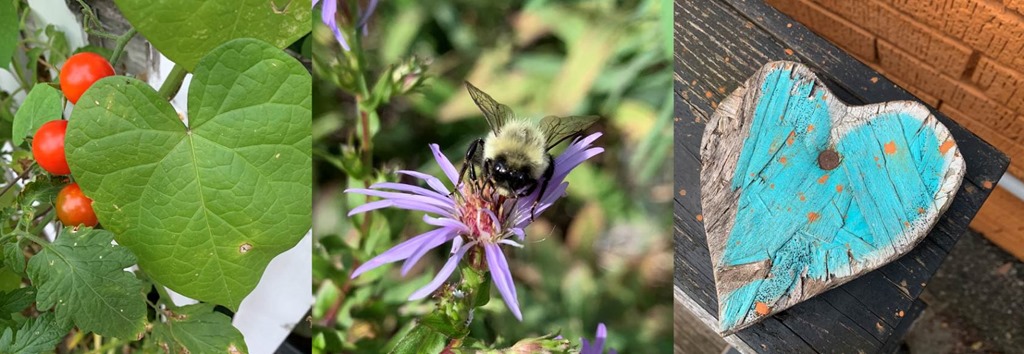
Bee busy! Hearts! Summer photos by Heidi Randen.

.

2. The Poem ‘The Wild Iris’ by Heidi Randen   Heidi wrote the text I used here at the end of a post at her blog this summer, though I added the music and additional repetitions and pauses of my device to the piece you’ll hear. In turn Heidi was resonating with something she had read in a poem by Louise Glück. So, in the end, I appropriated her work appropriating Glück’s. This process by which I appropriated the text as well as the musical repetition give it a rondeau effect if not that exact form.

Oddly, all this repetition was to present a thought about transitions, which Heidi and I are both going through this summer. Things cycle, things repeat, and then they don’t. Every day for months a parent picks up an infant and carries it somewhere. Then the toddler asks, and the parent lifts their toddling body to hip or shoulder and carries them bidden. One day they no longer ask, the parent no longer lifts, and never lifts again. And then sometimes, with time and age, the parent, will be carried by the child.

That and more. We can be so nearsighted with doorways, they sometime appear only when we are on the threshold.

You may see a player gadget below to play this highly popular piece from this summer, but some ways of reading the blog won’t show that. This highlighted hyperlink is another way to hear it.

Sappho’s Old Age (Rimbaud version)

The ancient Greek poet Sappho is one of the oldest poetic voices we have record of. Like the Greek epic poet Homer, her work likely predates written literature and was originally intended to be sung. How much more do we know about her?

Almost nothing for sure — or even by likelihood. As with Homer there are traditions and later stories about her, none of which are plainly based on first-hand accounts, all written centuries later. If one prefers to base their literary analysis on the text alone, that would be just about the only choice in Sappho’s case. Yet for many people not generally interested in ancient Greek poetry, Sappho is best known for being a lesbian writer — indeed the very term for that erotic affinity is derived from the Aegean Island where Sappho lived, Lesbos.

I’d need to be more knowledgeable than I am to discuss how Sappho’s lesbian identification came to be accepted as general knowledge, but some arguments are made using evidence from the text of her poetry. Which brings me to the next thing I was reminded of as I looked at using some of Sappho’s poetry over the past couple of weeks: there’s really very little of it. Very little of it.

Imagine you are a couple of centuries after some event which has erased a great deal of our formerly recorded literature. Suppose you were, in such a time, to try to assess the works of T. S. Eliot, Bob Dylan, or Emily Dickinson based only on other writers’ surviving references to them, references you can only hope will be buttressed with a short quote or two. Everything else would be lost. Sure, those commentaries in surviving texts would be tantalizing, testimony to the author’s greatness — but because they were written before some general loss of literature, they are painful too in their assumption that they needed then to be only pointers to something every cultured person would know.

In such a world of imaginary loss T. S. Eliot would be the “April is the cruelest month” and “bang not a whimper” guy without necessarily the rest of the poems that contained those lines in context surviving. And what could we make about a lost work about, what — cats? Dylan’s music*  might well be lost, but a few pithy phrases would survive because so many others liked to quote him to make a point about their times. Some accounts would say he was a great performer, yet others would make fun of his voice. Dickinson? Perhaps a legend would survive of a lifelong, lovelorn hermit, since that makes for a good story,**  but beside that we could have only a stanza or so of her short poems, her actual art retaining only the “greatest hits” lines that got quoted, “Hope is a thing with feathers,” “Because I could not stop for death,” and so on.

Sadly, this is what’s left of Sappho’s art.*** So perhaps it’s consolation during Pride month that we have presently imagined her as someone like those we know today: a breathing, living individual of desires and feelings.

Until this century there are only a couple of Sappho poems that were complete enough to consider as an entire work. Then in 2004 another mostly complete poem was added to the canon. The text was found incorporated into the structure of a paper-mache like mummy case that had languished in a European museum. The ancient makers of the mummy case had just recycled what was then garbage dump material, but this dump just happened to contain a manuscript from the 3rd century BCE of a poem by Sappho.

If you’d like to see the text in archaic Greek, a gloss in English, and several English translations other than mine, you can find it at this page. Alas, I can’t link to this section on the long web page that this poem’s entry is part of, but if you search for (Control F on your keyboard) Lobel-Page 58 you’ll jump to it.

Once more in my translation I was tempted and gave in to changing a concluding cultural reference made by the original author. Sappho used a mythological story of Tithonus, but having just this spring translated a poem (“Dawn”)  by 19th century French poet Arthur Rimbaud that imagined a strikingly similar story of a tryst between a young man and the personified dawn, the vividness of that similarity set against the biographical course of Rimbaud’s life was too powerful to resist.****  Up until that last part of the poem I tried to render my best estimate of what Sappho intended in modern English.

Sapphos Old Age

My translation, which substitutes Rimbaud for Tithonus

.

You can hear my musical performance of what I’ve titled “Sappho’s Old Age (Rimbaud version)”  with either the player gadget that some will see below, or with this highlighted hyperlink that will open a new tab to play it.

.

*Sappho was a composer and lyre player. Some accounts have her as the leader of a school that taught music, which led me to translate the opening of today’s poem as a musical admonition.

**That summary of Dickinson’s life isn’t all that different rounded-off from the one I received in my youth anyway, even though our modern scholarship has established a roughly normal life for Dickinson, whose noticeable agoraphobia came after her literary work decreased.

***There doesn’t seem to be a single cause for so little of Sappho’s work surviving intact. The random acts of time alone would account for much of that loss. The famed lost libraries of Alexandria no doubt carried some of her work.

****Rimbaud, who wrote his entire influential corpus of revolutionary poetry before he turned 20, spent the last years of his short life as a merchant-trader in an Ethiopian branch office dealing in coffee.

The most popular piece here this last winter was…

Wait, before I reveal that, let me take a moment to describe what the Parlando Project does: we take words, most often other peoples’, most often poetry, and combine them with original music and present them to you as audio pieces.

I’ve chosen to use other peoples’ words almost entirely because I’m most comfortable writing about that transaction between a writer and myself as reader, composer, and performer in the midst of passing something on to you as another reader and listener.*  The project doesn’t use poetry for every audio piece, but I like pieces with some mystery and ability to create an impact in less than 5 minutes, and poets are the ones that do that.

The music you hear is created for this project. I don’t use library music or borrowed music, and except for computer drums, I don’t use samples or canned loops. For better or worse, most everything you hear was played or scored by a real person.**

I don’t always make these combinations of music and words “songs” in the traditional sense — though our modern sense of song has changed so much in the last few decades that “song” has become a much looser expectation anyway. I try to make my musical settings as varied as I can, which means that I expect some will be more to any single listeners’ taste than others.

Now I’ve caught up any new visitors on the Parlando Project concept, we can complete our Winter ’20-’21 Top Ten Countdown with the most popular piece.

1 End of the Sky  by Frank Hudson (after Thinking of Li Po at the End of the Sky  by Du Fu). OK, this one used my words, though I based it off a classical Tang Dynasty Chinese poem. Since I wrote it last autumn, the meaning I extracted from Du Fu and attempted to convey in my modern English extension of his poem has only deepened in resonance for me personally. When it was written I was thinking about a small group of poets that I’ve met with every month for more than 40 years to discuss our work. I’m the youngest in that group by a short interval and we had all been writing for more than a decade when we first met.

More than a half-century of writing for each of us, yet I think of myself as less accomplished than the rest of the group — viewed objectively from amount of publication and such this is certainly true — but I wonder too if they ask their own version of the questions I ask myself about what’s valuable to say and what we may construct to justify a readers time and attention. Du Fu seemed to be dealing with some of those feelings in his poem addressed to fellow poet Li Po.

The poem’s statement, my attempt at faithful translation from Du Fu’s Chinese: “True literature doesn’t care if it is popular, and/It is only demons that care about a poet’s failures!” is one potential answer to those concerns. Poetry may be what we most care about, but the world cares less than that, and in that is a freedom. “How much difference does that make at this late date?” I ask in addition, a line only implied in Du Fu’s poem. And at the age of the poets in my group, “late date” is a general concern.

Since I wrote it, how has this poem changed for me? Those general concerns have been promoted in imminence. I’ll say in too-brief: two are dealing with existential illness. Loss can be at any hand for all of us. Will it, or any of us, be patient?

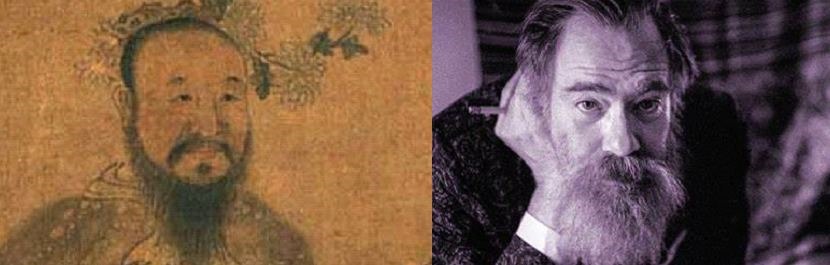
Du Fu’s poem concluded with an understated but devastating conclusion, something I often find in his work. He writes, our creations and our cares about our creation are like a customary gesture that would’ve been known to poets of his time and place: throwing poems as a gift into a river where a Qu Yuan, a Chinese poet from the past had leapt to his death.

Qu Yuan and Berryman

They both ran out of patience. Do you see some resemblance? Qu Yuan and John Berryman, “…who was once handsome and tall as you.”

.

My modern English solution to my poem’s ending echoes Du Fu’s superficially, but differs in detail. This is what I meant to convey in my conclusion: Berryman’s mental illness and chemical dependency — fed by his doubts, feeding his doubts — weren’t his art or some driving force for it, for they understood none of that.

Say that, then, to your doubts: you don’t understand my art!  Work instead to make your work more whole for yourself and for some potential audience, no matter how small. All doubt and self-abnegation can do is take away — and life and fate will do that for you anyway, it doesn’t need your help.

The player gadget to hear my performance of “End of the Sky”  is below. If you don’t see the player, this highlighted hyperlink is an alternative way to play it.

.

*When I write or talk about myself, and later look at what I said or wrote, I almost always cringe. In only a short remove of time it seems disproportionate, self-involved, and vain. Every artist must have, at least episodically, some level of elevated self-regard, but for me that self-regard is always being chased by another that reminds me of my follies. I’ve lived a long life, and neither of those two have stopped running, an endless chase, which has allowed me to create — but as the pursuer and their prey, I’m often out of breath by the time it comes to talk about or promote it.

**Early Parlando Project pieces were often live band recordings, but with age, change, frailty, and finally the Covid pandemic, they’re increasingly all me multitracking myself. Computer drums are a compromise I’ve perhaps too easily fallen into.

When You Are Old

A few months back I presented a series of poems about old age that turned out to be written by young poets. Here’s another one written by the great Irish poet William Butler Yeats when he was in his 20s.

“When You Are Old”  is generally considered to be written about Yeats’ love for Maud Gonne, who like Yeats was active in Irish cultural nationalism and their country’s struggle for political independence. Yeats’ largely unrequited love for Gonne has a long and complicated story, the kind I’d often delve into here—but not today. This widely assumed context for “When You Are Old”  makes plain the poem’s historical, denotative meaning. One could paraphrase it like this: “You think I’m just another lovelorn suitor asking for your hand, and possibly other leading bodily parts, now—but someday you’re going to be old, and you’ll realize that the others around you were just after you ‘cause you’re a major hottie who seems to have it going on cultural-politically. I’m not like that. I’m your soul mate, who respects that you’re busy with this, and loves you even though you’re out searching for other things. That’s OK. Just know that someday, like when you’re old, you’re going to miss me. You’ll probably want to google William Butler Yeats some night and see if I’m still alive and what I’m up to….”

Yeats-Gonne

Yeats and Gonne. Yeats may be taking the bow-tie thing a bit too far. Rather than the musical style (or that paraphrase) I used today, I might have gone with this bare-faced expression of the same angst. You’re gonna miss me baby!


Did I just loose a bunch of readers* with this base summary of a beautiful poem that is sincerely loved by so many people? Don’t understand me too quickly, I’ll get back to what I think when I encounter this poem before I finish.

Indeed, this poem is especially well loved by older people and by a great many women.** If there’s a greatest hits of love poems in English, this poem is there. And I don’t think they’re wrong or missing some unavoidable explication of the poem’s context. I can’t say Yeats’ intent when he wrote it as a young man, or when he published it still being both of those things; but I doubt it was simply to dis an ex that wasn’t exactly an ex. And those that love the poem Yeats made are experiencing it in other contexts close to their own hearts and lives.

I’m close to Yeats’ age when he died, though still younger than Gonne who lived to be 86. The future mood predicted in this poem written by a twenty-something doesn’t ring false to me. I don’t dwell in the past, but it comes to visit me from time to time, and I’ll think of old lovers and not-to-be lovers absent and missing in time and place. For older people, some of those people remembered are dead, and so their present times and places are further obscured by the crowded stars. We often expect our poets today to write of their experience, but it turns out that we aren’t necessarily going to trade Yeats’ skill with a beautiful line for an authentic memoir-poem by an age-group peer.

One could trash this poem on gender role/sexual politics counts. Fine if you do—art is argument to a large part—but I doubt the women who love this poem do so all because they have self-worth issues. And after all, the poem doesn’t predict crushing regret at not bedding W. B. Yeats, or a reader’s personal equivalent. It only asks for a quantity of “a little sadly,” which doesn’t hurt anybody. Patriarchy aside, I suspect every letter in every acronym can accumulate such thoughts over a life-time. And throw out love, sex, and success, and we still cherish memories of any connection where someone saw and bowed to the pilgrim soul inside us. The youth in us seeks it, the old in us remembers it. Even 20-somethings.

So where does this pilgrim soul stand on “When You Are Old?”   That want for connection it speaks of and the word music it’s sung in captures me entirely. It’s good not to trust poetry and poets entirely, but to give oneself over to this song is worthwhile.

I’m sure this poem has been set to music often, but that didn’t stop me. I used an interesting acoustic guitar tuning that someone said had been used by Mary Chapin Carpenter: C G D G B C for this, and then added another of my simple-is-all-I-can-do piano parts. That’s one of the joys of music: sometimes it doesn’t have to be complicated to please us. The player gadget is below to hear my performance. Here’s the text of Yeats’ poem if you’d like to read along. We’ll be back soon with more of our April celebration of National Poetry Month. Spread the word if you can.


*I’m hopeful I didn’t, if only because listener/readers here should already know that I’m going to mix things up. If you think today’s music is what I’ll do next time, you should hear the #NPM2020 piece I’ve been working on—and you probably will be able to in the next few days.

**Here’s a 10 minute video where someone old and someone woman both declare their love for this poem.

Winter Sleep

What age are we when we write poetry? What age should we be?

Poet Donald Hall while writing memoir in essay form after age 80 said that part of why he turned to prose was that after a certain age he no longer felt he had the urge to, or could, write poetry. I’m not that old yet, but after so many decades of writing poems I’m more likely to ask myself why this poem needs to exist.

This never occurred to me as a younger writer. It was enough that the urge was there, that the work of shaping it was rewarding, that the existence of some new set of words in some novel order representing a moment of experience had occurred. There are times when we may suppose this always is—at least approximately. We’re all our own first reader. For some of us, some of the time, our only readers. Even if we believe we’re writing a poem for someone else, that first audience is still inevitably connected with the poem’s creator.

I don’t know that there’s any pattern in that first audience disliking its own poem at times. Does one get better at crafting poems or observing experience with time? Does one get better at staying out of the way of the poem when that’s necessary? Does one get more preceptive at the ways the poem fails to meet, or cannot meet, some more perfect state? Does one just realize that some days you eat the bear, and other days the bear eats you?

A couple of years back I had some fun looking at a compiled list of the 20 most anthologized American poems of the modern era. Now of course such a list reflects any number of factors, some of which are extra-literary, such as prejudices, impact, and probably even some ivy-tower log-rolling. But still, these poems can safely be considered as successful with an experienced audience early in our century.

One thing surprised me. About half of these poems, the ones that are presumed to reflect the author’s masterpieces, were written in the author’s 40s. Six more were written in the author’s 30s. Just one was written by a writer past 50 (Elizabeth Bishop’s “One Art” published when the writer was 65). Only two were written by writer’s in their 20s (the list’s youngster was T. S. Eliot’s “Prufrock”,  completed when the author was 27.)

But how old were these poets in their souls of experience, the place from where they wrote these poems? It’s not unusual for younger poets to take on the air of more experienced people in their poems. This past fall we presented a couple of well-known and liked poems considered to be about old age: Rilke’s “Autumn Day”  and Shakespeare’s Sonnet 73 “Bare Ruined Choirs.”  Rilke wrote his autumn of one’s years poem in his 20s, Shakespeare’s was penned in his 30s.

Yet neither sounds false to this older reader.

Similarly, there are times when I’m writing that I feel younger than my years. It’s a commonplace that there’s a sense of play in the arts, something that past a certain age is increasingly rare to find in off-hand physical activity.

So perhaps you, like I, may feel unstuck in time when writing. Our writing may not be objectively timeless, but our mental flight seems so.

While thinking about these things this winter, I came upon this poem* that seemed to me to be a fine expression of the experience of old age experiencing the unsettledness of sense of age.

Edith M Thomas engraving

Edith Matilda Thomas. One thing I’ve found out: Emily Dickinson classmate Helen Hunt Jackson helped launch Thomas’ writing career.


There’s not much here today about the author, American Edith M. Thomas, who published “Winter Sleep”  in 1896, when she was just in her 40s. I don’t know that much about her yet. It’s strictly metrical and all rhymed up, but once or twice it seems to strain natural speech to make its rhyme and meter.

What’s impressive about it is that it strikingly presents not just old age, but the approach of death as an unstable state, the dream of life. This isn’t an “autumn of my years” poem—it’s a “winter of my years poem.” I immediately sought to set it to music for performance. To hear what I came up with, use the player gadget below.


*”Winter Sleep”  is another poem and poet I was introduced to by Poem-A-Day from the Academy of American Poets. Here’s a link to the text of the poem and you can sign up for Poem-A-Day there too.

Sonnet 73 “Bare Ruined Choirs”

Here’s one of the best-known of Shakespeare’s sonnets, which means it’s clearly one of “Poetry’s Greatest Hits.”

Since I’m not a real scholar or expert in such things, let’s take a look at it as if it was another of our presentations of lesser-known poems by little-known poets. You may want to follow along with the text, which can be found here. What might we see if we encounter it this way, without preconceptions?

The first thing one might notice is the antique language. In this case it’s not so much a case of “need to look that one up” words so much as it’s the olden-days tenses, pronouns and word forms: “mayst, ”thou,” “see’st,” “fadeth,” “doth,” “perceiv’st,” and “ere.” Given that the sonnet is a compressed form (this one uses 121 words) that might put one off. The syntax too, is not modern-day natural speech, but then when undertaking a sonnet even modern-day poets will sacrifice some of that for sound and compression of expression reasons.

If one is able to overlook those two things, or simply accept them as artifacts of the form and the time it was written, the next thing I notice is how much is stuffed into those 121 words. Tonight I’ll go to a meeting with three other poets, two of which are more accomplished than I am, with several published collections under their names. If I was to present to this group a poem with as many ideas and loosely linked tropes as Sonnet 73 (albeit with whatever level of skill I otherwise possess) they would likely be puzzled and displeased with it. Modern poetry is full of a great many styles, but many of them don’t try to push so much into so short a poem.

Let’s briefly look at those thoughts and the images by which we are to experience them. The first two lines open with a common autumn poem touchstone: the turning, falling, and fallen leaves. There are approximately 127 billion English language poems using autumn leaves by now, though there might have been only a few dozen in Shakespeare’s time. I think his image here is dual though, the left-leaves are compared to a balding head.

Chandos Portrait of Shakespeare

He’s not balding, he just has a large forehead. This disputed portrait has not been used to argue that Shakespeare was actually written by Larry Fine or translated from Klingon.

This image is further developed or morphed in the next two lines, including the image by which I always remember this poem: the now bare or near-bare branches bereft of the migratory and mate seeking/singing birds of earlier in the year liked to a ruined choir loft. Since choir lofts are elevated, and we’ve started with leaves equaling the now spare hair on a head, they are also the mind and voice which engenders such poetry and song.

Starting in the 20th Century some Shakespeare scholarship relates that ruined choirs image to the destruction and abandonment of Catholic abbeys and churches during his century. If so, Shakespeare has brought an undercurrent of the dangerous social change of his century into his short poem.*

Shakespeare doesn’t linger on that image, though it is so sharp it may have made his point. He next moves on to another image we now find common, the ending of a day related to the later parts of one’s life. His take is the variation (also used in some autumn poems) that there is extra beauty in the endingness, by implication it’s preciousness of limits, and from the luminous colors of sunset. He develops this a bit with an image that would have once seemed common, but has since fallen into disuse: that sleep is a model of death.

The final quatrain before the concluding couplet develops yet another image, one steeped in fire as one of the classical four elements. It’s antique physics, but observationally still rich for anyone that has ever dealt with burning wood: the speaker is the hot coals, hotter than the kindling fire of youth, or the early lapping flames. Since this is ostensibly a love poem, one can take this as another commonplace: fire equaling desire. My reading is that the love poem aspect is yet another layer of image, present, but not the only element, as it’s also about the artistic spirit that could create such a sonnet. The final line in the final quatrain is nearly the equal of the “bare ruined choirs” one. “Consumed by that which it was nourished by” is both a statement about the scientific nature of combustion; about desire, love, and it’s ending; and about the artistic impulse: that we must burn, fill and empty ourselves as if by weightless flame; that we will consume our time, our life-time.

The final couplet, as with many an English “Shakespearean” sonnet, jumps on to something else. In its guise as a love poem, it says that the lover must be extra passionate and devoted, because the poem’s speaker has limited time left and yet they still love them. What should we make of that? As a devotional interpersonal love-note, the thing the poem presents itself to be, it has emotional heft.** As a statement about the artistic drive, likewise. Every time one sets out to make something, we truly don’t know if it’s the last work we will do. As we age (I’m old, this is eminently personal with me) this becomes less and less a moot philosophical point. Treat the work as a lover, treat your lover as a work of art.

So, there’s a lot of territory in this poem. Even doing my best to present it with my performance there’s too much here to absorb in one listening, one reading, in one moment in one’s life. This is a reason why other kinds of poems may be better received. Many modern short poems seek to make one point, or tell a story with a plot rather than a complex instant that has no plot yet, or several plots happening at once. Those poems can work too, and work quickly.

Shakespeare seeks to lure us with his word-music, even now centuries later, even though he’s going to try to put a gallon of thought into a pint-sized poem, and even if he’s going to use a form of English we strain to hear as natural. “Bare ruined choirs where late the sweet birds sang” isn’t just an image, and an allusion to a piece of history that may be unfamiliar to us, it’s a lovely piece of sound. I could go on with other lines that have their compelling worth as sound: “When yellow leaves, or none, or few, do hang” or “Death’s second self, that seals up all in rest.” Can that word-music let us live with the 121 words long enough to get over the things which make us either hear this as “Shakespeare” the brand name or as an example of obsolescence?

I tried in my performance to illuminate the text and its sound as best I could. You can hear it with the player below. See no player? This alternate highlighted link will play it too.

*I’ve always loved the way Michael Wood presented the beginning of his series of TV programs on Shakespeare by saying he was born into what was a police state due to the whipsawing religious and geopolitical changes/wars/disputes England went through in the 16th century.

**By pointing out that this poem in my mind is expressing something about the experience of making art, I’m not prudishly seeking to eliminate the erotic reading. Many of the best images are bilateral. They aren’t just some thrown-off thing meant to decorate the poem with some cleverness or allusion. The thing used to represent the thing is real, maybe even more real than the thing it signifies. The thing signified enriches the image just as vice versa.

For an example of the erotic use of some similar imagery in a complex emotional landscape see this Edna St. Vincent Millay sonnet, a favorite of listeners here.

One piece of evidence that Shakespeare intends this as a complex set of images is that it was likely written when Shakespeare was in his 30s. Sure it reads “true” for this old man, but it’s not memoir as poetry. Memoir as poetry can work too, but I often feel that we’ve over-emphasized that mode.