Anne Spencer’s “Dunbar” for National Poetry Month

In 1922, amazing Afro-American polymath James Weldon Johnson* published an audacious anthology titled The Book of American Negro Poetry.   Not only did it claim that there was a tradition worth an anthology at that early date; in his preface Johnson made the observation that Afro-American music was disproportionately important in American musical culture, and furthermore that he saw no reason that Afro-American’s literary impact shouldn’t also arise to that level.

A century later Johnson the prophet could be charged with underestimating Black American’s musical impact, but we are entering an era when his predictions about Afro-American poets are no longer considered exceptional cases, and not even a “why not” situation — but instead an “of course” predilection.

One has to give Johnson credit for declaring this back then, with what poets had managed to be published or otherwise eked out a career at a time when the ex-enslaved were still living. A few of the poets he put in his anthology would soon be known as the vanguard of the “Harlem Renaissance” and yet others would remain little-known afterward. Only one, Paul Laurence Dunbar, really had made writing a career at that point, and a large part of that career’s viability was on the back of a 19th century fashion for dialect writing, with rough printed approximation of regional and ethnic speech being put forward as evidence of America’s diversity or oddness. Reading Dunbar’s dialect poems today is rough going, a lot of context and translation cultural and phonetic is required.** But Dunbar also wrote fluent poetry in the rhymed metrical styles of the day, and those are the poems he’s remembered for now.

And what about those “deep cuts” in Johnson’s anthology, those poets and poems that aren’t required in a modern summary anthology of American poetry? One of those is Anne Spencer.  It’s an imperfect analogy, but you could roughly think of Spencer as a sepia Emily Dickinson. The two poets even shared a passion for gardening. Except there wasn’t a preserved and handed-down pack of good copies of poems in Spencer’s case. Imagine what we’d know of Emily Dickinson if the tiny number of poems that were published in Dickinson’s lifetime were all we had?

It’s plausible the proximate reason that Spencer’s poem praising Dunbar was included in Johnson’s anthology was that Spencer’s home was a waystation and salon frequented by Black artists and civil rights activists in the Jim Crow era, which would have included Johnson. But let’s just be grateful, it’s a lovely short lyric making in a handful of words, the case that Dunbar, and by extension Afro-American poets yet to come, can stand with and extend the tradition of British poets then considered “canon.” And by linking Dunbar with the struggling working-class poets Chatterton and Keats, and the exiled radical Shelley, Spencer may have been making a subtle point about where poetry could, or should, come from. And like Johnson, she predicted with her poem’s linkage that by our present time we’d remember Dunbar as a supple lyrical poet unlinked from the fashion of dialect poetry.

The lyric video includes a poster for a Dunbar performance and some photos of Spencer. Spencer wrote poetry throughout her life, but didn’t focus on publishing.

.

Three ways to hear my setting and performance of Spencer’s “Dunbar”  today. You can use a players that will be shown below in some ways this blog is read, or this highlighted link if you don’t see the player. And, as we’re doing this April, there’s the lyric video above.

.

*Polymath? Well, let’s see: key early civil rights leader, helped found NAACP, poetry, novels, wrote the lyrics to “Lift Every Voice and Sing”  (aka “the Negro National Anthem”), diplomat, teacher.

**Dunbar made a go of it touring and reading his poetry, the sort of thing that was the YouTuber or podcaster route for extra-literary revenue and publicity then. His dialect poems were often touted on the billings, and so may have been the crowd draw. I don’t know how integrated his audiences were, or indeed how the dialect stuff was presented. I’m unaware that any recordings of Dunbar exist, and I don’t know that we even have secondary recordings such as exist of folks who knew Twain, imitating him on early records from direct memory of performances.

Zeppelins for National Poetry Month

Here’s another piece from the early days of the Parlando Project that we’re re-releasing for this year’s National Poetry Month. This is the place where I’d often encourage you to listen to the musical performance made from this poem, but I also could see why you might want to skip it and wait for tomorrow’s.

The poem “Zeppelins”  is by F. S. Flint, a too-little-known man who rose from poverty to help launch English language Modernism early in the 20th century as one of the original Imagists who shucked off the expectations of overused poetic tactics and filigree for what he called “unrhymed cadences.”  As a piece of poetry, I think it still sounds modern, still hits this listener with an impact you can feel.

And there’s the rub regarding this poem. It intends to be disturbing, to communicate an intimate dread and revulsion. Not everyone respects Williams’ “Red Wheelbarrow”  celebration of utilitarian beauty for its insistence on simplicity. There are probably even some who won’t “get” Frost’s exuberant ode to the shaping of nature’s gusts to singing words. But neither of those poems will disturb you, and our lives may have enough disturbance that I can see one not wanting to seek out a poem that gives us more of that. Flint’s poem is the story of one of the first aerial bombing raids on a city, an attack in May of 1915 on London that caused around 100 casualties, including children.*

Furthermore, this poem from 1915 is disturbing for another reason: it’s still topical. It was so when I first posted it in 2017 — cities and towns were being bombed and civilians killed then. So it is today. As another bombing witness was wont to say: “So it goes.”

Imagism in action. Note how Flint intimately invokes confusion, dread, and fear directly in this rapidly accelerating narrative poem

.

So skip today’s poem if you don’t want to be subjected to that, if your life is already strafed. I’ll understand. Poetry like “Zeppelins”  can serve as a powerful witness, we should respect that, but I can see why we may ask poetry for something else too.

The performance is available three ways. You’ve seen the picture of the lyrics video above, you may see a graphical player below to play the audio of the performance, and then there’s this highlighted link to also play it.

.

*I felt obligated to put an advisory on the video, not because I desire a world of poetry that cannot frighten or offend, but because such a piece may be too much for children who may be introduced to poetry during National Poetry Month.

The Aim Was Song for National Poetry Month

It’s National Poetry Month, and we’re celebrating here by re-releasing some of my favorite pieces from early in this project’s six-year history. Today’s poem’s poet is American Robert Frost speaking about spring, spring winds, and the poets’ transcendental task of continuing and shaping nature.

I’ve often reminded readers here that I didn’t care for Robert Frost when I was a young person. He was still a living poet while I was a teenager, and I associated him (wrongly) with dreary homilies and his placement in the school anthologies as the most recent poet included. More than once I complained to teachers and any fellow students who seemed at all interested in poetry that there had to be something, someone, newer and more relevant than Frost that could be studied.

What I didn’t know then was that Frost could be a nimble lyric poet delivering subtle messages, and that he was, in the generational nomenclature that would come 20 years later than my youthful 1960’s complaints, “a slacker.”

Frost spent the first 40 years of his life basically failing and flailing as a poet and human being. American interest in his poetry was nil. Only after wandering to England did he find a publisher for his first collection and a key promoter in fellow American in pre-WWI England, Ezra Pound. Pound was nearly a dozen years younger than Frost.

Frost didn’t write poetry as memoir, as many modern poets do, but all that experience made it into his poetry. Frost wrote often of failure and limitations* — but today’s poem “The Aim Was Song”  isn’t one of those poems. First published 101 years ago, this is Frost exulting in the triumphs of poets and poetry after he had finally broken through into acclaim in his home country. And it’s a good one for the Parlando Project to perform during National Poetry Month because Frost’s imagery here celebrates the oral, vocal, and musical heart of poetry. Also it’s an excuse for the composer to tell the guitar player: “Why don’t you turn up and play some.”**

Laptops were larger and more wooden in Robert Frost’s day. 

.

As with our other re-releases this April, you can hear my performance of this poem with the player gadget below (where seen), or this highlighted link, as well as with today’s low-budget lyric video that is trying to catch the attention of additional listeners to the Parlando Project.

.

*By the time his poem “Nothing Gold Can Stay”  was made into a motif in The Outsiders  movie in the 1980s, “slackers” could sense that kinship that I missed.

**OK, it’s the same guy, so the guitar player has considerable influence over the composer.

The Red Wheelbarrow for National Poetry Month

Besides being the first day of National Poetry Month, it’s April Fools day, so maybe it’s a good day to present a poem that caused many readers to wonder if it’s a joke: William Carlos Williams “The Red Wheelbarrow.”

I’m not against a poem causing wonderment, are you? It’s fine to look at it and respond “You can’t be serious — is that really a poem?” but I urge you to follow that question with other ones, such as “What use is it?” “Is this just an artsy provocation?” or “What should poetry be then?”

I think Williams’ poem is a late but effective representation of the movement that launched Modernist poetry in English: Imagism. Fairly quickly, a great deal of English language Modernism soon moved on to more complex poetry, a poetry that was often hard to grasp due to intense but hermetic personal material or elaborate references to other works of art, but “The Red Wheelbarrow”  is none of that. Instead it expresses, like a sub-two-minute punk song from the mid-1970s, a rejection and clarification of overly elaborate poetry.

2022 NATIONAL POETRY MONTH POSTER 1024

and this place has chickens. Also a short 12 tone-row composition.

.

I think Williams genuinely thinks the rain-water makes the wheelbarrow beautiful, and he doesn’t even think he needs to say that word “beauty” or make some elaborate metaphor to seal the deal. To say that, and just that,* is a provocation against poetry that asks more, and to readers that expect the poet to give them more. But it’s not just the momentary rain-water glaze that makes it poetic: it’s useful, something to depend on. Now that’s a goal for poetry (or any art) to meet at least some of the time, don’t you think? Self-impressive poetry, trickster poetry, poetry that gathers and unites widespread allusions — all have their place as well, but sometimes it’s good to see what there is seen naked in the rain. When the cave dwellers put their hand or the hand of their child up against the wall of the cave and blew red ochre dust around it, that’s art — not of the artists showing us skills, but the art of our shared and transient experiences made fixed.

Musically here I decided to use another contemporary early Modernist tactic: the tone-row. If one knocks “The Red Wheelbarrow”  for not having poetry’s elaborate or fanciful imagery, or some tight connection with the artist’s personal biography, perhaps this performance will show something traditional it retains: a lovely, largely iambic, word music. Yes, it’s music in miniature, but still that poetic element was there for me to express.

To hear my audio performance of William Carlos Williams’ “The Red Wheelbarrow”  set to my own music, you can use this highlighted link, or (if visible) a player gadget below. And as I’ve been doing with our National Poetry Month re-releases, there’s a simple, low-budget, lyric video at this link.

.

*Well, he also admires the contrasting chickens.

Kicking off our celebration of National Poetry Month: Stars Songs Faces

Aha! I have a plan for National Poetry Month.

You might think we’d need do nothing but what we usually do — after all, we’re always celebrating poetry here. We have over 600 pieces you can find in our archives, performances that combine words (mostly poetry) with original music we compose and record ourselves. But here was my problem as April arrived: time to compose new pieces is inconsistently available.

So, I’m going to lean on that collection of pieces we’ve done and make this also a celebration of what the Parlando Project has done over this past 6 years. My plan is to regularly repost pieces from the first half of our history this April. For many of you who joined this Project already in progress these may well be pieces you haven’t heard, but an additional goal is to introduce new listeners to these audio performances.

Why do that? Readership of this blog, originally intended as brief “show notes” for the audio pieces, has grown tremendously over the past year, but the audience for the musical presentations has increased only by a small amount over the same time. I’m hoping to capture more ears for those performances and the poets whose work we interpret, sometimes in surprising ways.

To gather more ears I’m going to be making new low-budget YouTube videos for these classic pieces, mostly just “lyric videos” that display the poet’s words we are presenting. Most new people find us via search engines, and my wild guess is that putting things in front of YouTube searchers may bring more listeners and readers.

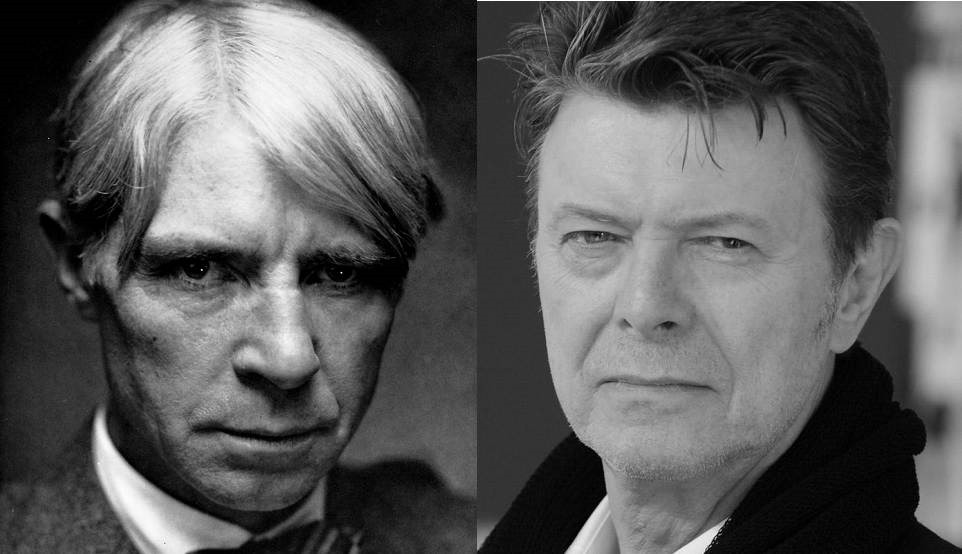
To begin this series? Why not use the first piece from this project’s official public launch in 2016: Carl Sandburg’s “Stars Songs Faces.”   Speaking of strange, The LYL Band performed this on January 11th 2016, the day after David Bowie died. Carl Sandburg didn’t have the opportunity to prepare a eulogy for Bowie, since that American poet died in 1967, but back in 1920 he wrote this short evocative poem that we used for the words in this performance. Spookily, Sandburg’s poem presented this way makes it seem like he did write a eulogy for Bowie. And to eerily evoke that short time when both Sandburg and Bowie were extant, the music makes use of one of The Sixties most distinctive sounds: the wobbly Mellotron that could sound like a string section whose batteries were running down.

Sandburg-Bowie

“What will I be believing, and who will connect me with love?” The young Swedish-American and the star with songs and faces.

.

Here’s a link to that simple YouTube lyric video. And here’s a link to just the audio performance if you’d like to rest your eyes. And finally, some of you will see our traditional audio player gadget below, another way to just play the audio.

.

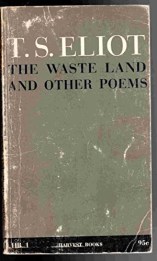
T. S. Eliot’s The Waste Land, an eclectic musical performance

I sort of meant to do this last month as I wrapped up my five year serial presentation of Eliot’s Modernist landmark. This will not be a wrap-up of all the discoveries and feeling that living with this poem each April brought forward for me, but instead a single post that allows one to find the whole thing as I presented it over the years. The kinds of music I wrote and performed for this project varies considerably: blues, folk-rock, punk, orchestral instruments, synths, and solo acoustic guitar. I think this fits with Eliot’s design for his poem, which varies its voice and voices throughout too. Listening to all the parts below in one sitting will require a longer period of attention than this project usually asks for, over a hour. Not for you? Feel free to look at other posts and audio pieces here which are usually under 5 minutes in length.

Taking T. S. Eliot off the page and onto the wings of music for five Aprils.

.

First, here’s The Burial of the Dead,  the opening section.  If you don’t see a player gadget, this highlighted hyperlink will open a new tab that will have a way to play my performance of this section. April and spring and remembrance falls off into a rather gothic take on the “unreal city.” In-between we get the most popular single sub-section in the entire series, the “Hyacinth Girl.”

.

Next, we move on to A Game of Chess,  which opens rather sleepily*  and finishes with the appearance of the project’s guest voice Heidi Randen. A player will appear for some, and otherwise, here’s the hyperlink for those that don’t get one in their reader.

.

The poem’s third section, The Fire Sermon,  has some of my favorite performances of the entire series, the ones that I think work the best, and from first to last it’s the one I’m most proud of. Gadget below for some, or this highlighted hyperlink for others.

.

The Death by Water  section is by far the shortest, and here it is. By now you know the drill, gadget if your blog reader allows it, or this highlighted hyperlink.

.

I have not rolled up the final section, What the Thunder Said  yet because it would be extraordinarily long. In place of the entire performance of the poem’s longest section, here it is in four subparts as first presented this past April. Highlighted hyperlinks of each part precede the player gadget that some will see and some won’t.

Part 1

.

Part 2

.

Part 3

.

Part 4

.

That final, 4th segment, just above differs from every other one in that it’s an earlier LYL Band live performance which is rough, and ready to take on the complex conclusion of The Waste Land  from a hotly-felt cold-reading of the text (complete with some mispronunciations on my part) .

As I occasionally warned readers here, The Waste Land  is not for everyone, though I think it can be enjoyed simply as a wash of contrasting moods and mysterious words without need for “Will this be on the test?” understanding and extractable meaning. None of these pieces have been particularly popular here, but still the effort to complete this has increased my appreciation for Eliot’s achievement. I’d like to thank in particular Dr. Oliver Tearle over at the Interesting Literature blog whose posts helped illuminate various things regarding this poem and the WWI era while I was creating these performances.

.

*Conceptually, my idea for the opening of this section, to conflate the mood of Eliot’s poem here with Blonde on Blonde  era Bob Dylan was fine, but my execution of that kind of languor wasn’t as effective as it should be. If I ever was to do a new, improved version of something in this entire performance, that would be the sub-section I’d think most needs it.

.

In England Now (Home Thoughts, from Abroad)

One of the odd things that can happen to a poem is for a single line to become remembered while the poem itself may fade out of fashion. Today’s poem, which is likely to be our final poem for this April’s American National Poetry Month was published in the middle of the 19th century by an Englishman who was away from his home country in Italy. So yes, this one goes out to my faithful British listeners — but, at least in my country, about all that remains of it is the poem’s opening two lines: “Oh to be in England/Now that April’s there.*”

I didn’t know what poem it came from before this month. I didn’t even know it was from a poem, or that Robert Browning wrote it. A poem like his wife’s Sonnet 43 “How Do I Love Thee? Let me count the ways.”  may be similarly antique in age and language, but I recall, however hazily, something of the whole of that poem, it’s sense, and meaning.

robert-browning

Robert Browning, making the chin-beard somehow work for him.

.

Since it’s likely that many of you don’t know this poem more than I did, here’s a link to the full text as Browning wrote it.

So, what is this poem saying, what is it on about? It’s a poem very much of longing for one’s home. A romantic catalog of nature details from the English countryside is mentioned: birds, trees, flowers. I’m ignorant enough about such things that I can’t tell you the song or plumage of any of the birds (I even mispronounced the name of one of them in my performance), I know little of the exact trees, and only a bit more of the blossoms and flowers listed, but I think the poem survives this ignorance. The catalog is enough to demonstrate that there’s a specific spring, specific to place (and by now, perhaps to time), that Browning is missing.

There are three telling lines in the midst of this nature catalog. Early in the poem Browning says that if someone simply wakes in an English April morning, they are unaware. This is of course not universally true, some will awake to marvel at a Spring morning wherever their bed is, but Browning’s point is that some will not, and by implication that he himself often didn’t. Another telling line: in remembering the birdsong of the thrush** he says that the bird sings each song twice, seemingly to prove that the bird had fully absorbed and internalized the rapture of Spring, so that it can recall it at will. That opens the question of if Browning feels in his poem if he has been able to do the same, to recall what he is now separated from. Perhaps it’s more so than remembrance. It’s often said that nostalgia and memory increase the sense that what is gone was better and more intense than it was.

Which brings us to the third telling line, which is almost a throwaway in Browning’s version of his poem, but the one I’ve chosen to make a refrain that I think changes and reframes the poem: “In England now.”

Browning’s use of the line may have been largely a rhyming choice in the series of “bough,” “now,” “follows,” and “swallows” — but rhyme, like chance effects beloved by some Modernists, may cause the mind to go elsewhere or to bring out things it would not consciously choose. By making “In England now” a refrain, it sits beside and comments on nearly every part of Browning’s original poem. My intent is that this refrain will bring out different responses to different listeners, perhaps even different responses to a single listener as it reappears. To test that out, you can hear my performance with a player gadget if you see it below, or with this highlighted hyperlink that will open a new tab and play it.

.

*Given its English subject matter it may be somewhat more remembered by our British readers. Back in 1995 it placed in the middle of the pack of the best loved poems in a British survey. And in an even more Parlando moment, the poem’s title and its enduring worth were both sung in 1973 by an English singer-songwriter Clifford T. Ward, who had a minor hit in the British Isles with it.

**In other April poetry, we’ve just finished our serialized performance of T. S. Eliot’s “The Waste Land”  which features a thrush singing in its concluding section performed and presented here earlier this month. Eliot’s thrush singing in the pine trees he wrote in his notes to “The Waste Land,” was from his personal memories of camping in Canada as a youth.

April Rain Song

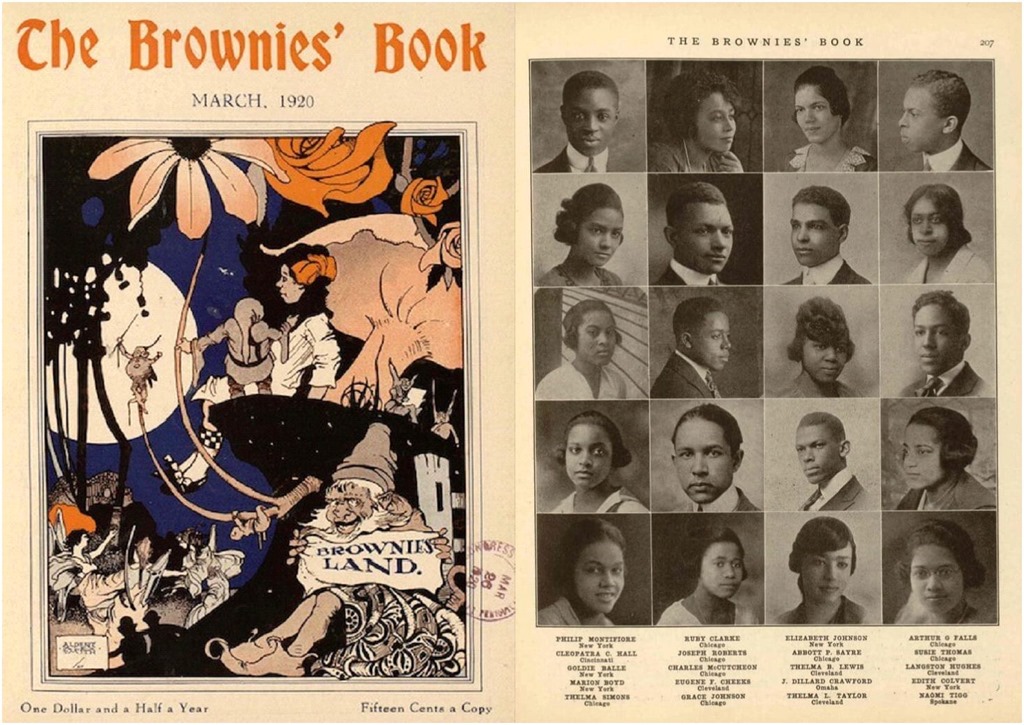
As we continue our celebration of National Poetry Month, I remind us all that not everything in poetry needs to be heavy business. For example, here’s a poem by American writer Langston Hughes, a man known largely for his poetry that deals frankly with the Afro-American experience, and this poem of his was published in a magazine founded by W. E. B. Du Bois during the famed Harlem Renaissance.

But wait, not only is this a poem about springtime, it’s a children’s poem written for Du Bois’ children’s magazine The Brownies’ Book.  I first learned about this pioneering publication for Afro-American children at the My Life 100 Years Ago  blog, which among other things often covers what was happening with magazines of that era.

Hughes himself wrote today’s poem when he was a teenager, and The Brownies’ Book  was the first publication to publish his poetry. “April Rain Song”  is a charming poem, and in rhythm and poetic tactics it reminds me of Carl Sandburg, a fellow Midwesterner whose writing influenced the young Hughes. Here’s a link to the text of Hughes’ poem if you want to follow along.

The Brownies Book

Check out the high school graduate in far right middle row. Yup, that’s Langston Hughes.

.

It’s been April rainy the past two days in my city, so working on making “April Rain Song”  a Parlando Project piece had overcast and setting. Hughes here shows me a mode I sometimes aim for: it’s a nature poem, but specifically set in a city, not in some rural nature. The rain meets sidewalks and street-gutters, not some Eden.

Rain, specifically spring rain, has a strong memory element for me. Perhaps you share this? Outside in rain I’ll often recall other wet spring days, watching from the current distance my child-self walking beside miniature gutter rivers, observing for no particular reason their sweep around last years’ leaves and last winter’s final dusky ice clumps. Or perhaps you recall a particular roof on which fell our general rain? Was Langston Hughes too young yet to have that experience of memory when he wrote this poem? I cannot say, but I have that now, and so I add a bit of wistfulness to his words today.

The player gadget to hear my performance of Hughes’ “April Rain Song”  is below for many of you, but if you don’t have it, this highlighted hyperlink will also play the song I made of it.

.

Oscars, then Oscar, during National Poetry Month

I hope to still have at least one more piece ready here this month, but I’ll admit that I waylaid some time yesterday watching the Academy Award “Oscars” while restringing and doing some deferred maintenance on a couple of guitars.

Awards shows — which are of course promotional events regardless of their area of the arts and the event’s prestige or pedigree — seem to be going through a rough patch of late. The Nobel literature prize even got removed for a year, so I’d judge that less prestigious awards stand in greater peril. The question of their value, or even if they have become counterproductive, has become commonplace. The use of these events for airing political and social issue positions is one sore point for some.

Let me not waste too much of your time, but to summarize my belief on that last issue: the whole purpose of art is to share human experiences in a way that nothing else does. How things are run, how we experience that, it just can’t be separated from art, and once that is allowed, the questions about what should change and what should be maintained can’t be fenced off as off-limits. This risks of course that wrong and half-wrong and outright misrepresentation is going to be propagated in shiny works of art. An even more subtle risk is that what will be presented must be simplified in some way, even within arts’ ability to present strange non-binary states. Resulting work can be painful or dreary even for points of view we already agree with — and outright hurtful or disgusting for things we find false. The criticisms are true, but this can’t be avoided if we are to have figurative/narrative art at all.

Film is extravagantly more expensive to produce than poetry, and by reputation successful people in the movies most visible roles are well-paid for their contribution to that capital-intensive industry. Garden-variety actors, directors, and writers outside of commercial film, who may not share this wealth, rarely get to speak about their beliefs on international live TV shows. Does this make it bad when the wealthier artists speak, or should we have no actors, writers, directors speak at all?

As a change, I enjoyed the trimmed back show, with many fewer in the main room and with little attempt to make it a spectacular variety show. Different compared to the traditional Oscars, but also not revolutionary. It made the show very like most smaller awards shows, the kind us regular poets or writers might attend. I felt there was a substantial emphasis placed on current social discussions, particularly diversity, representation, racism, violence. I’m no expert, but I suspect that may well be, to use the old Hollywood term, “box office poison.” So, if the ratings turn out to be bad, I will not be shocked. Given that I agree with many of the viewpoints expressed or embodied, should I consider that then brave?

Here at my keyboard today, I started to write a further reflection on those elements. Then I decided to drop it. Then I decided to include it again. Then dropped it. I doubt there is any demand for my extended thoughts on these matters.

But it is still #NationalPoetryMonth. Two of the award recipients made poetry a substantial portion of their acceptance speeches. Did anyone else note that?

Chloe Zhao began her speech for Best Director by saying that her father would banter with her when she was a child by reciting parts of the Three Character Classic*  back and forth to each other from memory. She then recited that poetic work’s opening two lines in Chinese and then in English translation. Let me print those two lines here, and also the two that follow, which add additional illumination I think:

“People at birth
Are entirely good
Their natures are similar
But their habits make the difference”

.

The White Hen or was Dick and Jane ghostwritten by W C Williams

William Carlos Williams concision and white chickens meet Confucian respect for elders. Maybe I need to reassess Dick and Jane?

.

The second bit of poetry was both even more subtle and yet striking too in its poetic compression. Although Best Actress winner Frances McDormand opened with a tiny, informal comic aside, I think she intended her entire acceptance speech to be this:

“I have no words, my voice is in my sword!’

The sword is our work.

And I like work.”

I was stunned. First of all, the concision overwhelmed me, but I believe I caught some intense meaning in these 19 syllables making 19 words. The opening line is MacDuff’s from Shakespeare’s Macbeth. That character utters it as he seeks to revenge the killing of his family. In McDormand’s context, I think the Blakean sword here is not a harvester of souls, but the un-resting illumination of our best work.

Your sword is your work. There is joy in that.

No new audio piece today, but since another Oscar appears in it, and it tells of the plague of humanity being seen as nails, and guns the only tool, I’ll give you former movie critic** Carl Sandburg’s “Long Guns”  with a guest appearance by the spirit of Howlin’ Wolf as MacDuff. Player gadget below for some of you, and this highlighted hyperlink will play it if you don’t see that.

.

*Despite developing an attraction for classical Chinese poetry, I didn’t know that work. Zhao’s experience wasn’t unique. I read that it’s long been used as an introductory text for young children. I can only flash back to the Fun with Dick and Jane  readers of my grade school years, which I’m not sure bring as much instructional density.

**No fib. For 8 years he was the film critic for the Chicago Daily News. He wrote hundreds of reviews, interviewed Hollywood figures, and seemed to have a pretty good grasp of a developing art. Someone has collected his film reviews, and here’s Roger Ebert’s review, and another account, and a short discussion on Sandburg and his view of films.

What the Thunder Said Part 4 and completing our performance of “The Waste Land”

During this project’s first April #NationalPoetryMonth back in 2017 I started what has become a 5-year serialized performance of the entirety of T. S. Eliot’s “The Waste Land.”  And here we are today, finally completing that portion of our Parlando Project.

Why “The Waste Land?”  for this lengthy each-April presentation? Several reasons.

Like a number of literary cultural artifacts, the single thing widely known and carried forth from it is only a single line. A certain significant ratio of us knows “The best of times, the worst of times,” or “Do not go gentle into that good night,” or “To be or not to be” — and so you may know “The Waste Land”  from its opening line: “April is the cruelest month.” That small keepsake of a long poem is much brought forward for anything that occurs in any April, and as much or more than Chaucer’s April preface to his Canterbury Tales, it’s likely the reason April is National Poetry Month. As an opening line it’s not misleading. Much cruelty happens in Eliot’s poem. Is it cruel to be kind as Shakespeare and Nick Lowe might put it? Is it just cruelty for shock effect — or can it cure, however partially? Our long serialization explores that, covering all those parts that you may have forgotten even as you remember and repeat the first line only.

“The Waste Land”  is also a landmark, a milepost, a line in the sand for a certain kind of Modernist English language poetry. While this project is not entirely about the rise of Modernism, the current rules of public domain make work from the first quarter of the 20th century the latest I can surely use for my project’s purposes without complications. If time permits me, I may follow up today’s post with a later one about what I’ve learned about Modernist poetry before and after “The Waste Land”  while working on this project; but when I first encountered the unescapable “The Waste Land”  in a schoolbook and classroom as a teenager one thing that I understood about it (perhaps the only thing I understood about it) was that it’s quite musical in most all of it’s movements.

“The Waste Land”  is not, at least in America, a beloved poem from what I can tell. Even among college-education-exposed Americans it’s not commonly memorized, kept in a commonplace way, used for occasions, or re-read for pleasure or new insights. Consistent with that, for the most part, these every-April “Waste Land”  segments have not been among the most popular here.*  Even among poetry lovers there are some that actively dislike it, find it a pretentious mishmash overrated by those afraid to speak plainly. Eliot himself seemed to avoid speaking about it or reading sections of it at later public readings. He may have thought his later poetry more accomplished, but I also wonder if he didn’t care to revisit the more unbounded elements of his life reflected in The Waste Land.

Which brings me to the main reason you’re about to get a chance to hear this performance today: The Waste Land  is not just one thing by design or execution, but it is significantly about someone in the throes of depression. Indeed, much of this year’s final section, “What the Thunder Said,”  was first drafted while Eliot was hospitalized for this. This section is not “The Waste Land”  of scholarly footnotes, bank officer work, gender blurring and questioning, or the knowledge of a night-class schoolteacher for working class women, or the lament of a man who has a personal sense of the intimate losses of a great war. This is the howl of personal despair of a consciousness who can portray those things — and it’s the howl of someone seeking to explode and break out of that state.

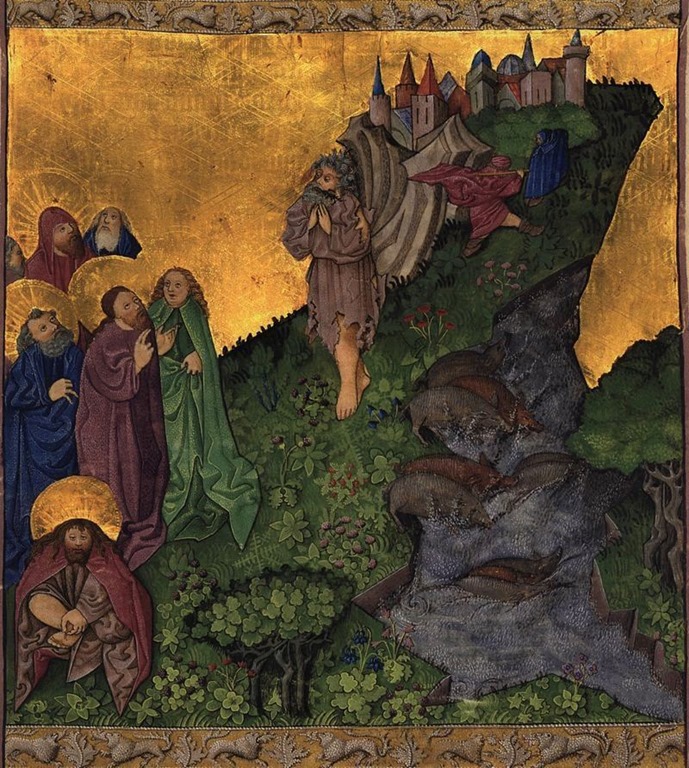
The LYL Band performance you’ll hear if you click on the player at the bottom of this post is a live performance from more than a decade ago, long predating the other sections I’ve presented here of “The Waste Land”  over the past 5 years. At the time of that performance I myself was emerging then from an episode of depression, one of two I believe I have gone through in my life. Depression has a variety of feelings and absence of feelings, and if one reads good writers describing their own depression experience you may well get a sense of the blind men’s elephant of fable, but my own feelings on the day and hour this was recorded were largely feeling sick and tired of those depression feelings. At some level I felt this section of Eliot’s poem was similar to what I was seeking, feeling, finding: an expression of an expiation of that, of demons transferred into mad pigs being cast into the sea. This coincidence of my life, a performance, and the poem would make it dear to me.

Ottheinrich Folio casting demons into swine

Jesus casting demons into swine. Guitar feedback not shown.

.

As I said, this is a recording of a live performance. Besides my voice and electric guitar playing, you’ll also hear Dave Moore’s voice spontaneously following along as I unfurled mine. I was cold-reading Eliot’s text here, I had not rehearsed or prepared for this performance, other than printing out the text. Embarrassingly, as I reached many of the foreign words in the text and fully in high transport of the moment, I mangled their pronunciation or dropped them from the reading. I used a handful of short samples you’ll hear mixed in the background to restore some of the dropped text.

In later, calmer reflection I continue to think this element of expiation is part of Eliot’s design here. A line I recall feeling strongly and intimately as I came upon it in my reading and performance that day is:

We think of the key, each in his prison
Thinking of the key, each confirms a prison.”

Whatever part of the elephant of despair or depression you might jiggle, touch, or be crushed by, we think of the key. Can we also think, hope to think, expect to think, of the prison as invalidated, destroyed, or obsolete?

What you’ll hear if you click on the player or hyperlink is rough, it has some mistakes, and being recorded live there is little I can do to fix them — and by intent it’s not a very genteel and formal presentation of Eliot’s poem. If that was my intent on that day over a decade ago, I today renew that intent by concluding our long, serialized The Waste Land  with this performance that predates all the other segments. In one of Eliot’s later poems (“The Little Gidding”) that he may have uprated over his 1922 landmark, he wrote:

We shall not cease from exploration
And the end of all our exploring
Will be to arrive where we started
And know the place for the first time.”

And so it is here too: every episode for this serialized presentation of “The Waste Land”  has been informed by that beginning, performed and recorded long before, that is now being used at it’s conclusion.

The player is below in most full-fledged web browsers, but this is an alternative hyperlink for those reading in apps or views that won’t show the player gadget. Yes, a longer audio piece than we customarily present —nearly 14 minutes — but it may still be worth your time and attention.

.

*For whatever reason, the Hyacinth Girl segment is one part that does get viewed over the years.