This blog isn’t really a news source, even if poet Ezra Pound famously said literature (and this can be extended to art generally) is “news that stays news.” And given my age, I could make this elegies all the time, and I don’t want that.
But I cannot let this horseman pass by, even though I never saw Franklin perform, even if I (like many record buyers) haven’t gone to the record store to purchase a disk with her face on the cover for decades. You could do that now I suppose, or you could open that glowing palm thing and press to search. What are you searching for? If you’re searching, you must need something.
Maybe you know. Maybe you don’t. But what you will find, if commerce allows, is that voice, and on some of her best records, perhaps her own gospely piano chords and her sisters singing along. Maybe there’s some small-town white guys, working, like her, on their shared art. What will you receive is, what? Energy, sublime expression, healing force—oh, you might as well just call it “soul.”
Today’s episode is something of a companion to our last one, what with moths appearing in each. Emily Dickinson’s sister-in-law Susan Gilbert Dickinson let the Book of Job fly in with her moth, and today Thomas Hardy’s open summer window lets in four bugs.
Our scene: a summer night, window open, a 19th Century lamp letting Hardy literally and literarily burn the midnight oil. The breeze and light brings on the bugs, and beside the moth we get a daddy-longlegs spider, a fly, and a dumbledore. Besides it making his rhyme, I think Hardy must have liked that charming name for his fourth bug, which is either a bumble bee or a beetle, though either will disappoint Harry Potter fans brought here by a search term.
A dumbledore beetle and a DOD Carcosa fuzz pedal. They could be filed under “things you step on.”
What was Hardy writing when the bugs arrived? He doesn’t say, though of course to be meta, it should be this poem now shouldn’t it—but even if it was some other piece, the bugs interrupt it, marching over his just-penned wet ink and drawing his attention away to their antics. Susan Gilbert Dickinson called her moth “silly” and Hardy has his insects more or less performing a Three Stooges skit bumping into the glass of his artificial light.
Susan Gilbert Dickinson wanted to remind us of that harrowing Old Testament lesson that God can crush a human as easily as a bug. She wrote “Irony” and underlined it over the top of her poem’s manuscript. Hardy writes a slightly different conclusion. After watching his fab four beetles make a farce out of replacing the poet on top of his manuscript paper, he ends by declaring that those insects know more about nature than he does. I think that little insect play on his desk reminds him that he, like other poets, struggle to understand and portray nature.
Just as the last time I worked with Thomas Hardy poetry, the melody just flowed out effortlessly when I went to set his words. I quickly had the basic vocal and guitar track, and then added a couple of cello parts and an additional guitar melody that followed what I had so easily fallen into as I sang Hardy’s words.
That electric guitar melody line uses a DOD Carcosa fuzz pedal which I’ve been using a fair amount here lately. It’s a very flexible effects pedal, but I won’t interrupt this with any more guitar nerd material than that tonight. To hear my performance of Thomas Hardy’s “An August Midnight,” use the player below. Don’t see a player? This highlighted hyperlink another way to play it.
Increasingly, I am comprehending the miracle of Emily Dickinson. Fifty years before Ezra Pound and T. E. Hulme constructed a compressed modern poetry replacing conventional imagery with fresh and direct observation, a woman in a rural town in the woods of Massachusetts had already practiced their innovations over a thousand times.
Through a series of happy accidents, Dickinson’s poetry was preserved and published at the end of the 19th Century, just before the Imagists launched their Modernism—but even then, she was still like one of those unexploded bombs dug up by a construction crew decades after the war. Even after publication, the framing of her poetry still obscured it. Her posthumous editors cleaned up her punctuation and gave the poems titles, and on the page they looked so normal. As these were poems by an Emily, they were clearly the work of a woman, and so they were read as women were generally understood, even when not pressed between the boards of a poetry book. And Dickinson herself designed her poems to draw you in with their modest length, their frequent use of pious hymn meters and stanzas, their homey rhymes. Even into my mid-20th Century lifetime, it was perfectly possible to be aware of Emily Dickinson’s poetry and not be awed.
“Hey Joe, there’s a big chunk of metal buried way down in the mud! Here, listen when I give it a bit of a whack with my pipe wrench…”
They still run across stuff like this from WWII around Europe. Decades old, and they can still go “Boom!”
Some early 20th Century Modernists looked more closely, and maybe saw some of what was there. Carl Sandburg straight-out called her an Imagist in a poem. I am unaware of how much attention the other early Modernists gave to Dickinson, but just on a promotional level, it might not be advantageous to talk much about poems written decades ago when your brand is “Make it new!” Remember too how Pound jabbed at Walt Whitman in his tribute poem: Walt Whitman you were a hacker out there in some unharvested forest, I’m a fine wood-carver able to bring out the finest detail. Dickinson’s near-rhymes and loose but familiar meters may have been read as imperfections to Modernism.
It took the last quarter of the 20th Century for Emily Dickinson to finally be seen, and we are still seeing more now as we look closer. What if, back in the mid-19th Century when Dickinson was creating this unprecedented expression, one had been able to talk with her about it? The value of writers’ groups, seminars, and MFA programs is not universally acknowledged, but most think these things at least have some effect on those who participate.
It just so happens, that occurred. Dickinson’s letters to Thomas Higginson give us some of her ideas, but as I read that correspondence I see Dickinson adopting masks, some playfully, some for protection. And Higginson, as varied as he was, was not, as far as I know, a poet, and therefore there was no chance that he would use Dickinson as a model for his own writing. But Dickinson’s long-time friend, neighbor, and sister-in-law Susan Gilbert Dickinson was a writer who dabbled in poetry.
Like Emily, Susan Gilbert was smart, was allowed some access to education, and wrote poetry
No other person saw as much of Emily Dickinson’s poetry while she was still alive as Susan. It’s also probable that no other person other than Emily Dickinson’s sister Lavinia (who seems to have had no artistic interests) was as intimate with the author. There is even speculation that there was an erotic bond between Susan and Emily. Besides the pant, pant passages in the letters between them, Emily praises Susan’s intelligence and cultural companionship. Given what must have been the loneliness of Emily Dickinson’s creative innovation, amplified by the cultural limitations for women in her time, we may all owe a debt of gratitude to Susan Gilbert in helping sustain Emily Dickinson.
Today’s piece uses a poem by Susan Gilbert Dickinson that shows some of the same elements one finds in Emily Dickinson’s poetry. Given that the prolific Emily Dickinson experimented with her expression, if “Crushed Before the Moth” was slipped into some complete poems of Emily Dickinson volume it would not seem entirely out of place.
What elements of “Crushed Before the Moth” are Dickinsonian? A short line length (six syllables, though not Emily’s familiar 6/8/6/8 hymn stanza). Alternating rhymed lines with unrhymed, though here first and third not second and fourth, and the rhymes are all perfect rhymes except the final “moth.” Even the use of a Bible verse (Job 4:19) is not unprecedented in Dickinson, who though a religious dissenter, was steeped in a Christian religious culture.
The poem begins, just as many of Emily’s poems will, with a close observation of nature. In Job, the moth is only a passing metaphor, in Susan’s poem it’s an actual moth, looked at closely enough to see the texture of its body in the evening. The moth is treated here as an Imagist would. It’s not some intellectual counter, a rote symbol only standing for something else, but an actual animal in an actual evening. The second stanza continues in the same vein, the moth the morning after, though with more characterization.
The concluding three lines, though they contain the only Emily-like slant rhyme, are the least like Dickinson’s poetry. That kind of envoi ending with a clear and orthodox moral lesson is not something Emily would write in her mature poetry, and the “Is this thy stronger host” line sounds unnatural and stilted.
Still, this might be the first poem ever written that imitates Emily Dickinson’s strengths and innovations. That Susan Gilbert Dickinson was a more orthodox Christian than her friend, and like all of us, not the genius that Emily Dickinson was, doesn’t keep her “Crushed Before the Moth” from being an effective poem.
I’m back to acoustic guitar for today’s performance of this piece, which is available using the player below.
Two threads lie here, waiting to be woven together. One thread: those young pre-WWI Modernists, the other: writers in old age.
Young: Mina Loy, Alfred Kreymborg, Glaspell and Cook of the Provincetown Playhouse, early in their careers, workers shaping modern literature—though none of them are remembered much now. Older poets: Longfellow, Donald Hall, and even Sarojini Naidu, Dave Moore and I, all speaking for carrying on past youth. Longfellow of course is no longer read for his intrinsic value, Naidu’s poetry is not read in the West, and Donald Hall concludes in his late-life essays, that he, like the majority of poets who receive prizes, notice and ample publication in their time, will be unread 20 years after their death. Moore and I of course are in a different, more perilous, class of ranked achievement. If Hall is right, Dave and I can look forward to equaling prize winner and American Poet Laurette Donald Hall’s status (unread, forgotten) in only 20 years!
There’s your writer’s affirmation for today.
What happened to those bright young Modernists? Cook died young. Kreymborg, that pre-WWI networking avant garde-ist, had a long post-war career judged by literary critics as undistinguished. Glaspell had an increasingly difficult second half of a career, though she won a Pulitzer Prize for drama in 1931 for a play that few praise now, the sort of late plaudit that sometimes comes to pioneers when prize committees compensate for overlooking earlier achievements. Like Hall, Mina Loy lived into her 80s, but unlike Hall, the last half of her life seems fallen from any career path. So, even before she died in 1966, she’d already achieved Hall’s 20-years-past-death status.
In 1960, Loy was 77 and living in the Western US when young poet Paul Blackburn was sent to interview her. A creaky hundred-minute tape exists of the encounter. Loy’s memory of things a half-century old seems spotty by this time, and this once eloquent poet grasps for words, even her own words, when asked to read her still modern sounding verse from her youth. Her readings are flat, though she occasionally is stirred by remembrance of the times and places when the poems were written. Once or twice she humble-brags or finds sincere surprise at how clever she had been. Listening, I wanted her to claim outright the fierceness she had shown back then. Instead, she seems an old 77, tired and distracted.
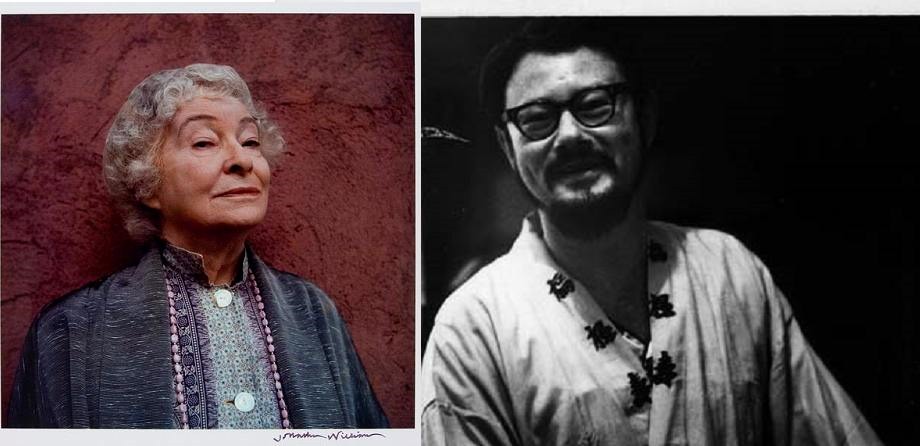
Mina Loy in later life by Jonathan Williams, Paul Blackburn 1966 by Elsa Dorfman
Blackburn is patient, and he rarely man-splains or talks over Loy, something I would be all too prone to do if I was the man holding the microphone. He seems to genuinely admire Loy’s poetry as he seeks to add to a record of a career that was forgotten then, and he wants her to know that in 1960, at least one reader “gets” what she wrote in 1914.
Just past one hour in the recording, something extraordinary happens. Blackburn, touched by one of Loy’s recovered memories, a feeling perhaps amplified by additional visual clues he would have in the room that are not imprinted on the audio tape, exchanges with Loy a memory from his own youth during the second instead of the first world war.
I have taken that story, much as Blackburn expressed it that day in 1960, with some minimal editing and shaping for the words of today’s audio piece.
Of course, we’ve now largely forgotten Paul Blackburn as a poet too, following Hall’s law. Blackburn died too young, and more than 20 years ago, but his story struck me as a tightly expressed spontaneous poem. What was this: a poem he had already written, one he was paraphrasing from memory for Loy? Was it a poem he was thinking of writing as he interviewed the aged poet, perhaps thinking the tape recorder could serve as well as a notebook jot to put a first draft down? Was Blackburn simply a practiced poet who could orally improvise from his skills a well-shaped improvisation?
Whichever, I think it’s beautiful. His story combines looking back at youth and a landscape that is no more, with Dante’s Inferno moved forward to Greatest Generation Pittsburg, and it has a closing that contains a remarkable Imagist jump into synesthesia. I call my arrangement of Blackburn’s anecdote told to Loy “Seventeen Almost to Ohio.”
Today’s music, like the interview, is restrained: contrabass, a pair of cellos, piano, and percussion. I strove in my performance and arrangement to do justice to Paul Blackburn’s story. To hear it, use the player below.
It’s now 1916—well not really—but allow me immediate mode for the time being. Some early 20th Century Modernist characters we’ve already met are about to collaborate in New York City with a largely forgotten figure whose words we’ll meet today.
The Provincetown Playhouse, that CBGB’s of Modernist American theater, has moved its organization from the remote Cape Cod artist’s colony to New York’s Greenwich village, and they’re still looking for new types of plays by new playwrights. How about drama using Modernist poetry?
Verse drama, despite continuing productions of Shakespeare, is a thing that often generates rumors of revival while never really reviving. In 1916, the Provincetown group was open to trying this. Which poets can come up with something?
Alfred Kreymborg could. Kreymborg was a leading networker or influencer in the New York area for Modernist poetry. Ezra Pound, and then Amy Lowell, would publish anthology books of Imagist Poets. Harriet Monroe out of Chicago was also gathering new Modernist work for Poetry magazine. In 1916 Kreymborg would do the same in New York, with a magazine and anthology book series called “Others.” Kreymborg had also been writing poetry, short poems mostly, all of them free verse. Now a play.
The “Others” group: L to R in back: Jean Crotti, Marcel Duchamp, Walter Arensberg, Man Ray, R. A. Sanborn, Maxwell Bodenheim. In front: Alison Hartpence, Alfred Kreymborg (bowtie daddie), William Carlos Williams (w/ Internet click-bait cat) and Skip Cannell
The play he wrote is an odd thing to describe. Titled “Lima Beans,” it’s a two-character play about a couple. The husband loves lima beans, the wife decides he might also like string beans and surprises him with the new beans—but no, he loves lima beans. He stalks off, angry. She scrambles and gets some lima beans. He realizes he loves his wife, returns and she’s got lima beans for him. Kiss. Curtain.
I guess this could be a Seinfeld episode plot decades later, but that’s not how Kreymborg uses it. He writes his play with litanies of repeated words, hocketing between the two voices. After reading the play this month, I’m guessing a performance might sound like a cross between Dr. Suess’ Green Eggs and Ham and a late 20th Century Minimalist musical work by someone like Phillip Glass or Meredith Monk. Or as Preston Sturges’ Sullivan would have it, Waiting for Godot plus vegetables—but with a little sex in it. That musical comparison is particularly apt, because even though the play did not use musical accompaniment, Kreymborg saw it as a musical structure.
So here in 1916 we have the Provincetown group, putting on a play that pioneered a performance aesthetic that still seems audacious 50 or 60 years later. Who are you going to get as actors to realize this—words and a presentation of thought conveyed musically, without actual music?
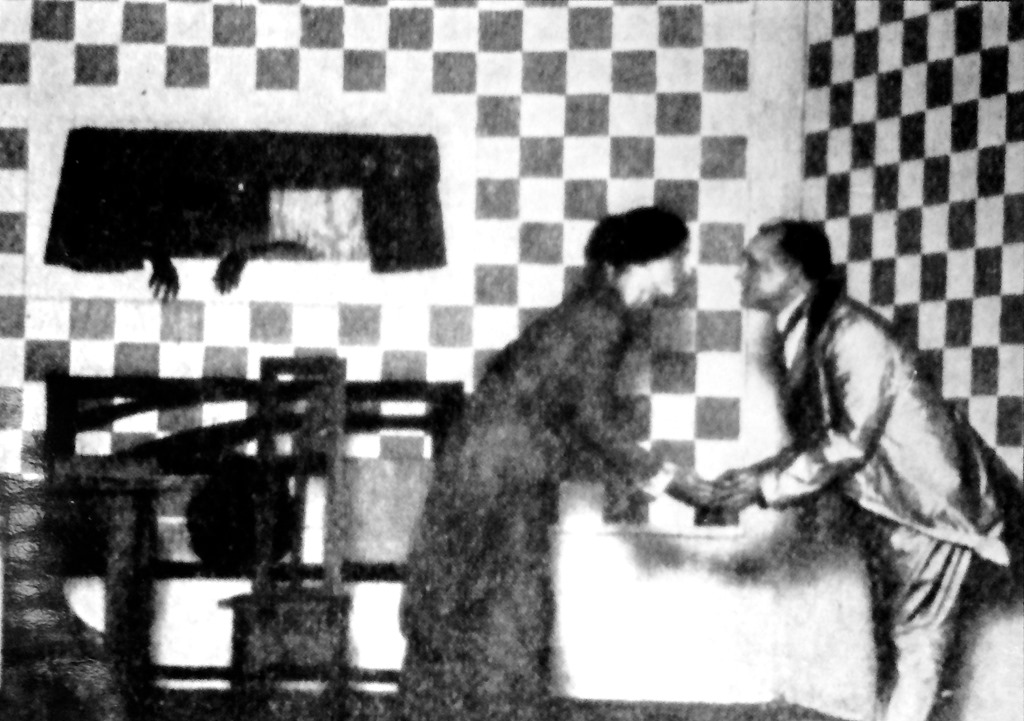
Poets. In the role of the husband, William Carlos Williams. In the role of the wife, Mina Loy, who had just arrived in New York after getting away from those Italian Futurists. Neither poet had acted before, but Kreymborg rehearsed the two poets until they could present his free-verse vision.
Mina Loy and William Carlos Williams in Lima Beans. The set for the proudly independent Provincetown Playhouse production cost $2.50, and its set designer, William Zorach, also played the 3rd character whose hands are hanging, Soupy Sales-like, out the window.
I toyed with the idea of trying to realize Lima Beans here, although with music this time. But it really needs two voices, and I wasn’t sure that a short section could do justice to the structure of the piece.
In it’s place, I looked for a short poem of Kreymborg’s to use instead. This proved more difficult than I thought it would be. I read his two poetry collections from this era, but no poem grabbed my attention. As in the play, he’s looking for a new poetic language in these poems, but it’s hard to grab the emotional center of many of them for performance.
In the end I chose today’s piece: “To W.C.W. M.D.” It’s dedicated to William Carlos Williams. This might be more of Kreymborg’s log-rolling networking skills on display, but its subject also answered a desire I have to do a piece remembering my late wife Renee Robbins in some way today. As best as I can penetrate the emotional core of this poem, it speaks of the need to separate and not separate from those that have died.
Musically, the piece is based on one stacked chord, E minor7/11, but the notes are spread out between the instruments. Besides drums there are two bass guitars, piano, two viola parts, a violin part, and a clarinet in this. To hear it, use the player below.
Complaints about the size of the audience for poetry are far from new. So too, complaints about the quality of its audience. Throughout the course of the 20th Century, one increasingly common theory was to assume that a quality audience for poetry is likely incompatible with a quantity audience for the art.
We’ve just about used up two decades of our century, and that theory is still around. This quantity/quality audience-linkage belief is not always stated plainly, but it’s not hard to see its presence. Poets that rise to modest or surprising audience size will sometimes face some degree of backlash from critics. It may naturally be so that their poetry is less worthy by some criteria. This could be coincidental, honest criticism. It may be that it’s hard to find an audience for poetry criticism, as it is for poetry, so writing about better-known practitioners who have failed in some way helps grow the audience for the critic.
Another way to hold to this theory is to limit what poetry is allowed to do, to narrow its practice or even its definition. Spoken word or slam poetry? Not really poetry, or it encourages a poor selection of poetry’s virtues. Song lyrics? Self-evidently a different art, though given that the consensus canon of poetry is so different among itself, surely difference alone cannot be the criteria. Mix those two as rap or hip-hop and risk both explanations of why it’s not poetry. Short, aphoristic poems? Too insubstantial. Long poetic forms once much in evidence, like the poetic epic or verse drama? No longer living forms of the art for the most part, if for no other reason than the type of poetic techniques the modern academic poet often uses can wear out an audience in a matter of minutes.
Myself, I don’t disagree or agree with those judgements in particular cases, and they could even be theoretically correct, I just viscerally dislike the idea that this thing poetry is so small and limited, that it’s a desert island disc for a few scattered islands, deeply loved by solitary coconut eaters with a very constricted shoreline.
When I break out of those narrow roles and rules for poetry, I will fail, and I do get discouraged. My limitations are bothering me two years into this project; and now 240 published audio pieces later, I may be running out of rules to break and the motivating pleasures of audacity.
Also dreaming of catching fish. Are cat pictures the secret to gathering an Internet audience for poetry?
Here’s a piece today using a poem by someone who somewhat agrees with me: William Butler Yeats. In one way it’s specific to him, and his time. I’ve recently honored two working-class sport fishermen in one of my favorite pieces so far this year, but the fisherman in Yeats’ title, the simple man working his craft on nature to help feed himself rather than for hobbyist enjoyment—well, he, even in a much poorer Ireland of 1916, is admitted as imaginary.
Otherwise, how about those folks listed in the middle section of today’s piece that are harshing Yeats’ mellow? How little imagination is needed to see them today?
I admire Yeats in this poem, embracing his failure, even though he brought immense poetic talents to his work, so much so that I should be embarrassed to admit to that admiration. In one way, the fisherman here is Yeats, casting with deft wrist or verse, but not in the course of the poem catching anything. There’s a saying with the fishermen in my family, “It’s called fishing, not catching.”
But the imagined fisherman is also that audience Yeats seeks. Maybe once, Yeats says at the end, maybe once, he can please an audience correctly, with a single valid poem and valiant audience—even if he can only see that audience in his imagination. I surely hope (and Yeats’ life helps me here) that the singular fisherman is an image for a possible greater audience, and not a headcount. After all, to write for something as large as “his race” (by which he means Ireland), is too small a target to hit, while that tweedy imagined fly-fisher inside his jacket might possibly expand to more countries, more times, more genders. In Yeats’ case, as with all artists, he failed; but he failed reaching for a larger audience with a larger poetry, a poetry which he risked allying with other arts. Many of us will not be able to accomplish that failure, but I’m glad Yeats tried.
You can hear my try to alloy William Butler Yeats “The Fisherman” with a rock band by using the gadget below.
Last post I spoke of Mina Loy and her pre-WWI adventure in Italy with the Futurists who would eventually become Italian Fascists. Loy utilized Modernist tactics in her own art and writing, but she was apparently wise enough to see the violence and totalitarianism in that Italian strain for what it was and extracted herself to less authoritarian circles. I’m unaware that Loy ever presented herself as a politically engaged artist, but the various Modernists she associated with after the end of her Italian adventure tended to the unaffiliated or left-wing side of Modernism.
Another woman, and American this time, had encounters with the early German Fascists in the era between the two World Wars. Her name was Dorothy Thompson. Thompson is another example of fleeting fame: she had a substantial mid-century multimedia presence through her books, journalism, and work in broadcasting. One of her roles was as a Foreign Correspondent, something of an antique designation now, but one that required that individual to live overseas and to report wisely what was happening in that country’s culture and politics. In Germany she was savvy enough to cover the rising profile of a fringe politician, Adolf Hitler. In 1931 she was able to wrangle an interview with him. This is some of what she wrote:
When I walked into Adolph Hitler’s salon in the Kaiserhof hotel, I was convinced that I was meeting the future dictator of Germany….In something like fifty seconds I was quite sure that I was not. It took just about that time to measure the startling insignificance of this man.”
Thompson was nobody’s fool. She wasn’t alone in underestimating the possible impact of Hitler, this “little man,” based on his personality flaws. The canny observer in her was able to figure that he might be able to achieve titular leadership of the German government as part of a coalition with other minority parties, as Hitler indeed did little more than a year later. When asked what his program would be, Hitler was forthcoming: “I will found an authority-state, from the lowest cell to the highest instance; everywhere there will be responsibility and authority above, discipline and obedience below.” Hitler was generally not a secretive, conspiratorial revolutionary. This was his electoral platform. In evaluating that statement, Thompson compounded her error. Thompson concluded:
Imagine a would-be dictator setting out to persuade a sovereign people to vote away their rights?”
That wasn’t a prediction, that was a rhetorical question. She didn’t think it could happen.
She published her article that year, and many thought her view the informed opinion that it was. If TL;DNR existed in 1931 you would summarize: Hitler is a clown car short of a few clowns.
Thompson shortly realized she had been wrong. Less than three years after she had disparaged him in her widely read article, Hitler made Thompson the first foreign journalist formally expelled from his new Germany. Had she helped or hurt Hitler by underestimating him? It didn’t matter, she had belittled him. Soon enough the world would be at war due to this insubstantial and insignificant man, this laughingstock.
She had a dark-humored quip on the matter. “Some got sent to prison. I got sent to Paris.”
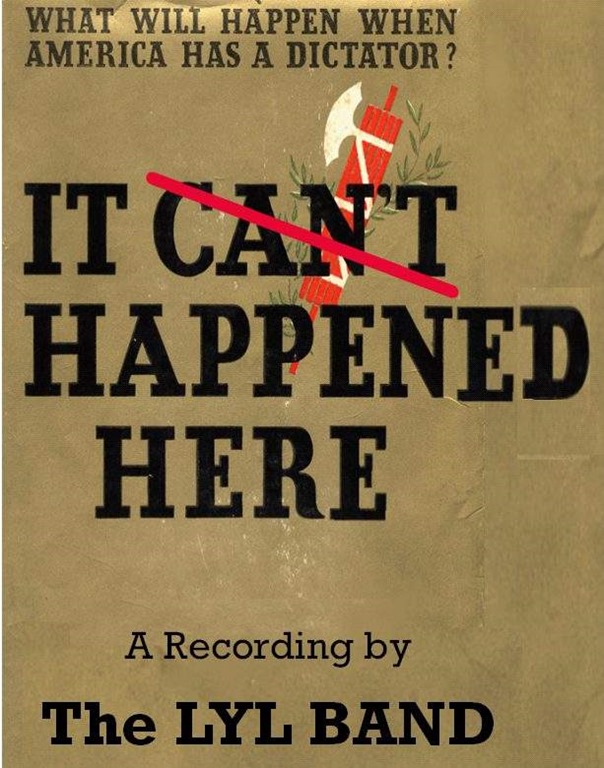
Thompson was married to another writer who was extraordinarily famous between the wars, Sinclair Lewis. In America, another politician was drawing from some a mixture of scoffing scorn and fear as he moved to run for President in 1936, Huey Long. It’s thought that Lewis availed himself of Thompson’s experience, as he began to furiously write a novel about how an American Fascist in all but name could unexpectedly be elected President. For his novel’s title, Lewis created an unforgettable phrase: “It Can’t Happen Here.”
The novel’s main character is a journalist, one who clearly knows that the forces which rise throughout the novel are evil, while underestimating their danger; but like Thompson he is able to recognize his error and take action.
Listen to your first edition here. Slight wear on dust jacket.
We are now living in a time when that phrase that Lewis used for his title may seem more present than memorable. The alternative voice of this project, Dave Moore, has changed Lewis’ tense and described—what—that 1935 novel, or something else? You decide if he changed the story.
The LYL Band’s performance of “It Happened Here” plays with the gadget below.
Today we return to the early 20th Century Modernists with a piece using words by Mina Loy. Last post we had a poet taking a political stand: Longfellow aligning himself with the movement to abolish slavery. Decades later, the Modernists joined political movements too.
One might suppose that since Modernism sought to overthrow the old cultural order and revolutionize artistic expression that many Modernists would be attracted to political radicalism—and to a large degree that’s so.
You might also assume that these artistic radicals would be leftists, aligned with the growing Socialist movements in England and the United States, or attracted after 1917 to the as then untested promise of the new Communist government in Russia. Or perhaps they’d make common cause with anarchism. Or maybe they’d create their own playlist mixing all of the above.
And yes, you can find that. Carl Sandburg in the U. S. Midwest, most of the Surrealists, bohemians in New York’s Greenwich Village, Herbert Read and some other British Modernists.
However, one can also find Modernists who aligned with the right wing in this era—and not only garden-variety Tories, or even those who allied themselves with the “respectable” racist strains of U. S. politics. Even in the years before WWI, the social theories that would coalesce into Fascism found adherents in the new literary avant garde. As to Americans, the most famous case is the indispensable Modernist poet, editor and promotor, Ezra Pound, eventually charged with treason at the end of WWII.
Modernists seemed something like stem cells as their artistic revolution kicked off—they could develop into followers of any kind of political radicalism. At a time when political engagement for artists was common, there must have been a feeling in the air that a side must be chosen if one was to be a thorough-going cultural Modernist.
So, much as the French Surrealists once sought to make Communism a dictate for membership in the Surrealist movement, the slightly earlier Italian Futurists eventually made Fascism a core value of their artistic circle.
It’s now we get to Mina Loy. No, not the delightful Hollywood actress—that’s Myrna Loy (Myrna Loy was the stage name for the woman born Myrna Williams, and it’s just possible that Loy could have been chosen to refer to Mina).
It’s 1905. Modernism is kicking off first in the visual art world, followed just behind by the poets. Loy, in her 20s, has already done the visual art thing in London and Paris, but her marriage is failing, and she’s just had an infant child die. To change her life, she moves to Italy. She befriends Futurist artist Carlo Carra, and if you follow along on your Futurist score-card she had love-affairs there with two principals of Italian Futurism: F. T. Marinetti and Giovanni Papini.
Let’s re-set our scene. Here’s a young woman in a foreign country going through life stress events. The art-world is shifting under everyone’s feet. As a movement that will eventually fancy itself outright as the cultural well-spring of Italian Fascism, the circle she’s fallen in with isn’t just about making it new, it’s militaristic, paternalistic, nationalistic, and it worships violence. That isn’t what jealous opponents say about Futurism, it’s what its own manifestos brag about.
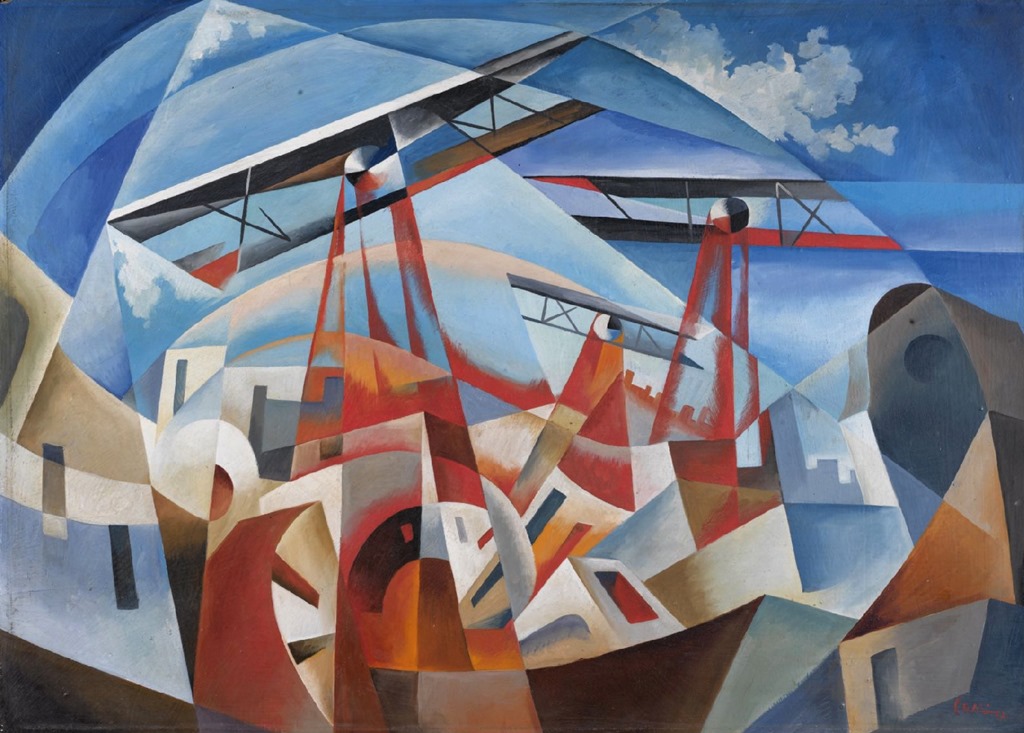
Futurist war painting. Compare its outlook to Guernica or Flint’s poem “Zeppelins.” Marinetti’s Futurist Manifesto declared “We will glorify war—the world’s only hygiene”
.
As preparing actors say, all that would be part of the work to figure out what Mina Loy is experiencing. Here’s another bit of business you might grab onto: young, ambitious, male artists. I doubt some not-uncommon tropes have changed in that field.
What happens?
Mina becomes a poet. A fierce poet. Artistically she uses some of the new ideas that the Futurists are thinking about. Her poetry moves between time and tenses, voices and outlooks, in machine gun bursts. Conventional expression and sentiment? Blow them up, run them over with a locomotive. Sixty years later Harlan Ellison would write “Love is just sex misspelled” and be thought provocative. Mina had already been there in the horse-and-buggy era. How can a woman keep her selfhood (or for that matter, how can any human being do so) in the minefield of desire and relationships? What is deep and inherent in motherhood that society will not express openly?
Though she used some of the artistic ideas of Futurism as effectively as any writer, Loy seemed to resist most of its political ideas and she satirized the pretentions of the “Flabergasts” while writing about her Italian time as being in the “Lion’s Jaws.” Leaving Italy, she next moved to New York, where she joined the Greenwich Village circle.
Today’s piece uses selections I took from a 34-poem sequence called “Songs to Johannes,” inspired by the relationship with Giovanni Papini (Johannes and Giovanni are variations of the same root name). Loy published these in 1914, near the end of her Italian time. Within the little-magazine world of Modernism she made an immediate impact. Eliot, Pound, William Carlos Williams, and Gertrude Stein said good things about her work. Legendary founder of Poetry magazine Harriet Monroe seems to have been scared by Loy’s frankness. Amy Lowell, poet and influential anthologist, was so put off she is supposed to have said that she would not publish in any magazine that printed Loy.
If the patriarchy may have lost the battle with Mina Loy, for a long time they seem to have won the peace. It was only in the last few years of the 20th Century that Loy’s poems of the first part of that century began to be looked at again. Now, Loy has become a key poetic Modernist for literary scholars tired of the usual sausage-fest, but that opens up the danger that work like “Songs to Johannes” may be introduced, academically, like this: “Loy in effect diagnoses an end to love poetry in the light of historical circumstance, anticipating that poststructuralist line of inquiry which urges a rereading of ‘lyric’ as a culturally responsive construct. Instead, her poetry constitutes a critique of the very demand that lyric expression be viewed apart from the social world.”
There’s nothing wrong with that view, but I find Loy’s pre-WWI writing here a lot more immediate assuming one has some applicable life experience to bring to it. Her diction sometimes reminds me of Emily Dickinson, and like Dickinson figuring out what is ironic, and what is earnest, and what is both, can sometimes be a challenge. In performance, any of those three choices seem to work for most phrases here. The greatest error would be to make them all of the same tenor. Also, like Dickinson, Loy will move from speaking concise abstraction to vivid metaphor using very few words. Thus, the high minded and the sensual nitty-gritty are juxtaposed.
My appreciation for this sequence grew tremendously as I constructed this performance. There are strong images, richly ambiguous expressions, and yes, lines that one could deconstruct at thesis length. I didn’t even have room to include the phrase from “Songs to Johannes” that I’ve chosen to title today’s selection, but I can never look at a plump rococo cherub again without recalling it. But the real gift I got, the unique gift of art, is that I could experience some of Loy’s moments in the hot-house nexus of Fascism and Modernism. “Pig Cupid” would probably be more authentic if this was performed in a woman’s voice, but alas my voice is what I have available today. To hear my performance, you use the player below if your reader displays it, or this highlighted hyperlink will also play it.
A couple of posts ago as I presented a piece using words by American poet Henry Wadsworth Longfellow, I mentioned that his prestige has fallen greatly.
Longfellow was minor and derivative in every way throughout his career…nothing more than a hack imitator of the English Romantics.”
“Who, except wretched schoolchildren, now reads Longfellow.”
And Lewis Mumford sums up his significance with a dagger by declaring that Longfellow could be completely removed from the history of literature without much effect.
Furthermore, while there’s no modern bon mot to extract from the Wiki, Longfellow’s didacticism, a huge defect if detected in modern poets, is noted. Even during his lifetime, that rankled the Transcendentalists, always looking for the more inexplicable sublime.
Akin to one our Parlando Project principles, Longfellow took the idea of “other people’s stories” to what are now considered ridiculous lengths. Instead of writing of intense internal experiences as Emily Dickinson did, or expanding the fleshy personal into a democratic universal as Whitman did, Longfellow wrote about many cultures and translated poetry from many languages. The term “cultural appropriation” didn’t exist as such then, but Longfellow could easily be charged with it. His best-known epic poem, Hiawatha, which has left its imprint all over my own region’s place names, is an earnest and non-hateful mishmash of the mid-19th century’s limited knowledge of indigenous Americans mixed with some contemporary to the time German romanticism. Longfellow would be a cultural criminal if he hadn’t already been reduced to a laughingstock.
OK, so what. All of these charges are true, but here’s what they leave out. To say Longfellow was “an American poet” is like saying Elvis Presley was a rock’n’roll singer. He proved that could be a thing, that an “American poet,” could connect successfully with a wide audience. He imitated Europeans and English romantics. Yes. Who the hell else was there to imitate? He wasn’t as original as Dickinson or Whitman. Yes, and neither is most any other poet you could name, now or then. And Mumford’s dagger? Alas, that can be said of most writers, because literature is a vast swarm of similar literary genetic ideas, but if there wasn’t a Longfellow, someone else would have to establish the idea of a popular American poet. That alternate-history someone else might have been good or bad, but it likely would have lead to some difference, even if the difference would be some other writer to rebel against.
I too wish Longfellow had tempered his didacticism, even if that is a large part of what made it possible for him to succeed. Most Victorian poets suffered from this as well, and it’s part of what the Modernists sought to break free from. To the degree that we are now Post-Modern, we can reassess this. Can poetry stand for something and still be art? If that is difficult to do, should it still be attempted?
Today’s piece is an example of Longfellow seeking to instruct, and the charge of cultural appropriation could be leveled at it too. In 1842, as opposition to slavery started to gather force in the United States, Longfellow wrote a short collection of poems on the “issue”—yes, human slavery, for and against, it was a debate. Longfellow explicitly released this collection for publication and distribution in support of the anti-slavery cause.
The obscenity of human jetsam. I learned about the Zong case only this year while traveling in Britain.
“The Witnesses” is from that collection. In it I think Longfellow transcends propaganda for this noble cause and demonstrates his effectiveness as a poet. He audaciously takes the notorious Middle Passage of over-sea slave shipment as his subject here. Though those travails were not his personal experience, the obscene losses at sea in the shipment of chained-up human beings is portrayed. I chose to further highlight Longfellow’s concluding phrase to all this. “We are the witnesses!” he writes, as the still shackled skeletons speak in his poem—but of course, un-romantically, their remains cannot speak. The poet, the reader, the performer, the listener, are the real witnesses here.
A short note. Wouldn’t you know it, after spending a good part of this year exploring the early 20th Century Modernists, I now have been using 18th and 19th Century sources more this summer. One of my favorite blogs, My Year in 1918 recently noted how I was tackling those WWI-era writers with my musical pieces for her readers who might want to sample that.
Well, I’ll return to those literary Modernists soon. After all, a principle here is to try to mix things up, to not be predictable or to always rely on my established favorites. But even today, I think I’ve been tipping my hat to another key early 20th Century American Modernist. As I was writing and performing the music for “The Witnesses,” with its variations on folk-style melodies that twisted between strains and finished with a louder cadence that didn’t resolve the multiplicity, I asked myself “Where’d that come from?” Early this morning it occurred to me: the composer Charles Ives, who was working at almost the same time as those literary figures. If he had access to an electric guitar he could have been Frank Zappa.
Once more I’ll break with my usual practice and apologize that I don’t feel I’ve fully realized this audio piece, mostly because it really should be performed with a number of featured voices and a chorus. While my computer and inexpensive collection of “virtual instruments” lets me reasonably realize a large number of instruments, it cannot represent vocal works very well. Go ahead and listen anyway, and if you can listen on speakers instead of earphones, crank the volume a bit.
I’ve been unable to do as much as usual with this project for the past month for several reasons. One of those reasons was a trip to Massachusetts, which if this was a normal blog would have already generated posts of the travelogue sort. However, this project is about two palpable things, music and words (mostly poetry), that can’t handily be walked along, though you can tour their containers and neighborhoods. Perhaps that trip, in an indirect way, will generate pieces yet this summer.
I was finally able to visit Amherst and the house where Emily Dickinson lived nearly her entire life—and today’s piece uses words from one of Dickinson’s poems—but long-time listeners will know that Emily Dickinson is already a favorite source for words here.
No house, no state, not even any time or country can explain the genius of Emily Dickinson. For reasons of brevity, I’ll try to summarize by saying that she created and entirely new form of poetry, powerfully compressed, elusive and still approachable, and wholly without precedent. The things scholars can trace as influences can be found in her poetry, but no one else made Emily Dickinson poems out of that same stuff. And her poetry has largely not become obsolete. Over 150 years after it was written it still seems modern, maybe even more modern today than it seemed to the early 20th Century Modernists 100 years ago.
Ample? The specific standing for eternity. Emily Dickinson’s restored bedroom in Amherst
I’m attracted to shorter poems that unpack into larger things, and “Ample make this Bed” is that. It’s short even by Dickinson standards, eight lines, 34 words. If one pauses to puzzle at this meaning, the imagery of the grave is what comes to many reader’s mind. It can be read as a shorter companion to one of Dickinson’s most famous poems “Because I could not stop for Death,” but with a bed replacing the longer poem’s subterranean dwelling. However, besides its greater concision, “Ample make this Bed” is using another poetic form, one different from her longer poem.
An aubade is a poem where two lovers wish for the morning to never arrive. Since it is, in fact, arriving, they will deny it, wishing for their night together to remain forever. By using this traditional poetic trope, Dickinson has thrown a rich ambiguity into her 34 words. Although Christian religious belief has its variations, the traditional judgement day is the day of eternal salvation and the universe’s perfection. “Ample make this Bed” compares the morning of divine perfection to the morning that separates the lovers in an aubade.
Is this a statement that the sensuousness of human love can be judged greater than eternal salvation? Or is it a puritan statement that any such love will face its final end and judgement? Could it even be both, balanced on a knife’s edge?
Look too at two of those 34 words describing possibilities of this bed. Its Mattress, where the body rests, may be straight. The body has a straightaway lifetime. The Pillow, where the mind inside the braincase rests, may be round, a circular line that doesn’t end.
Dickinson puts her poetic thumb on the scale with the most beautiful line in the poem: “Let no Sunrise’ yellow noise.” The poem has been puritan with its rhymes until this line, although elusive near-rhymes are present in the first stanza. Now it lets in richness, a rhyme internal to the line, before proceeding to the final perfect rhyme in the last line. Besides the line’s sound, the dawn of eternal judgement is— what?—so much noise. If Keats’ second inversion is so, then beauty is truth—and Dickinson may be indicating her thoughts on the matter.
Musically, I performed this in waltz time and I repeated the first stanza to add some sense of the eternal. Most of you can hear the performance with the player gadget below, but some ways of reading this blog won’t show it. In those cases, use this highlighted hyperlink instead.