Given two-thirds of this anniversary, it’s not surprising that “I Dream I Am Falling” is about grief and remembrance. It is a departure from the Parlando Project’s focus in that this freshly completed song uses a poem I wrote rather than our regular use of others’ words.
I continue to write poetry, though less often as I’ve aged. I think sometimes about prize-winning poet Donald Hall revealing in old age that he’d given up writing poetry. I don’t recall if he knew why he stopped writing poetry, or if he revealed the reasons for stopping if he knew them. For myself, there are elements of regular life interfering, but throughout my life the writing of poetry was the easiest art to interleave with other busyness. I would compose stanzas in my head, trusting memory retention as a good test of their value until they could be transcribed. Or like William Carlos Williams, I might jot down first drafts on prescription pads in slow worknight moments in the Emergency Department of a hospital.
Remembering that, I think writing poetry is unlike musical composition and recording, which for me is constrained by my life’s current contexts. Looking back I recall that as a younger person I was eager to write down observations from life which seemed to me to be important and unique. Now, in my older age, when I see similar things they seem less unique, and my expression of them less apt, for I sense that life I was once observing has all along been watching me too — watching me as the hunter does.
Still, the reason I set the official launch of this Project on my late wife’s death anniversary was to counter that. Life, the actuary, knows something, but I can sing in the meantime. The reason I sing others’ words in my unkempt voice is that the writers here are already dead, and I can stick my thumb in death’s eye by making their words current. Given that death’s eye socket is empty, that there’s no sensitive eyeball there, this does not stop Death — but it feels good to do it anyway.
Partway into this Project’s course I started to include Hiroshima Day, the anniversary of the first use of atomic weapons, in my August 6th observances. Death of one’s specific partner has an intimacy that sears because it’s so personal, but it’s not unique nor fully shareable. The death of thousands in a way that still threatens us by the millions or more — well, shouldn’t we share that?
Let me take then a tiny digression to this presentation of today’s musical piece. This summer I’ve been watching a 10-hour multi-episode documentary on Netflix titled Turning Point: The Bomb and the Cold War. I’m only about ¾ done with it, and maybe there’s something at the end that I should have waited to observe before writing about it, but I’ve found it so good I want to mention it today. For something of this length, its storytelling is compelling, and it often takes the sophisticated choice of leaping out of time’s lockstep to connect things. OK, it is 10 hours, but also roughly equivalent to a graduate-level course on the Cold War and atomic weapons strategy in the breadth of its concerns and detail.
This is an American Sonnet, following my longstanding practice of breaking up the 14 lines in different ways.
.
Now, returning to the new song. I hope it speaks for itself. Many of you, my treasured audience, will have their own experience of grief to resonate with what it sings. I was able to compose and realize it without access to a studio space where I could use acoustic instruments and sensitive microphones. Only the vocal, through a less-sensitive microphone* recorded sounds vibrating in the air as I played the block chords appearing in the left-channel that established the song’s harmonic structure on my little plastic MIDI keyboard. You can hear “I Dream I Am Falling” with the graphical audio player below. No player seen? This highlighted link is an alternative.
.
*ElectroVoice RE-20. Worth considering for anyone needing to record vocals in a space that is not acoustically proper for recording, where low-level unwanted sounds would otherwise end up on the recording. For my budget level, expensive, but it’s been an important tool for me. No, it’s not magic — louder sounds will still intrude — but the sensitive condenser microphones I use to record with acoustic guitar in my studio-space hear everything: HVAC sounds, louder computer fans, outside traffic, even sometimes footsteps on another floor of the building. In my converted bedroom home office where this was recorded, the studio-space condensers would be highly problematic.
Last time in our Halloween Series, an A. E. Housman poem combined with music had death on a knife edge. Placed at the end of the growing year in northern places, Halloween comes at a time in a yearly cycle that suggests death. Note: that statement includes the word “cycle.” Humans have memory, and song, and eventually writing, so we know the turning round — the end of the growing comes before the white none of winter and before the regreening of spring.
Should it be so with death, that full nothing? Some hope and believe that so, though we can have no memory of that. But even one life has many turnings, places we pass through and leave. Today’s piece ends by portraying that we open and close gates of memory, gates that are no longer there.
Edna St. Vincent Millay wrote this poem of a non-threatening ghost. It’s an earlier work, and some see the ghost as a wisp of her not-long-departed girlhood. I’ll add that the choice of having the ghost appear in a garden speaks to the placement of Halloween in a harvest/leaving time of the year. Gardens have needs: nutritious soil, water, sun, and care. Perhaps they need ghosts from time to time as well?
“She paused—then opened and passed through a gate that once was there.”
.
The music I composed and played for Millay’s “The Little Ghost” shows South Asian influences, what with harmonium, tambura, and my vibrato note electric guitar playing. You can hear that combination of words and music with the audio player below. No player to be seen? This highlighted link is an alternative, it’ll open a new tab with its own audio player.
Poetry, musical speech, is so associated with symbols that it may be impossible to imagine it without metaphor as a rhetorical device. This both bugs and pleases readers and listeners. Symbols can add richness, a sense of novel connections, or they may vex the reader, taunting them with needs for esoteric knowledge or psychic investigations of the author’s mind.
For me at least, poems can work when they are clear as any condensed speech would be on first reading — and when they are nearly incomprehensible as anything other than collections of energetic words. So, along that continuum, a poem may succeed (or fail) — but it must compel. After all, we have so many other words that waft over us written, spoken, recorded, some enriched with music, video, some from those already near and dear to us. As a young person I was drawn more to the richness of images and cared less for the clarity of expression. Other poets tried to convince me that clarity showed respect for the readers busy lives, that incomprehensibility wasn’t a requirement for good poetry. I eventually listened to them and somewhat changed what I wrote and admired. In my newer but still ambiguous stance toward poetic obscurity, I believed that a poem needs to be no more complex that it has to be, and no fancier in its conceits than it needs to be to draw a reader’s or listener’s attention. I may have a bit more to say on these issues in another post, but let’s move on to a new musical piece today.
I’m largely unfamiliar with the poet whose words I’ll use for today’s audio piece, Anna Akhmatova.* She became known to me several years back when the unique American roots singer-songwriter Iris DeMent recorded an album of heartfelt intuitive settings of Akhmatova’s poems, “The Trackless Woods.” This record was released in 2015, around the time that I was formulating some ideas of how to do what became this Parlando Project. Many of my ideas were already set down, even some of the pieces you’ve heard here had already been recorded, but I felt then that DeMent’s record reinforced my intents to do this Project at a time of decision.
Now this month I saw Akhmatova’s poem “Like a White Stone” featured in poets.org’s Poem A Day — and it did that “compel” thing with me as I read it in the middle of an otherwise occupied day. I eventually set upon creating a musical setting for it, one which you’ll be able to hear below.
This whole project is so mysterious to me…. It’s just this weird thing that happened instantaneously upon the first reading of the very first poem of hers I ever read which was “Like a White Stone”. In that period of time, within an hour or so I’d set three or four of them to music.”
I also found out, after composing and recording my performance of “Like a White Stone,” that Akhmatova was associated with a movement called Acmeism which reacted against the French Symbolists, a group of French poets that attracted me in my youth. The Symbolists were all about the effusive, exotic and elusive image. The Acmeists, in reaction, all about precision and clarity. The Symbolists were admired by Dada, Surrealism, and the hermetic strains of modern poetry in English. Acmeism could easily be related to other modern poets who want clarity and the power of easily discerned emotional messages.
“Someone looking closely into my eyes would see it” Anna Akhmatova
..
Knowing that, how does “Like a White Stone” stack up on the continuum from clear and direct to wild and elusive? Here’s a link to the poem’s text. I’m working from this translation (by Babette Deutsch and Avaham Yarmolinsky) and I know, as one who’s translated poems myself, that there are risks that I may be grabbing onto details that are the translator’s solution not the author’s own design in the original language. My judgement overall is that this poem is in the middle somewhere, even if closer to the clear and direct pole. The opening image, the one that first grabs the reader, is both clear and elusive for me, a combination that often works to compel. A “white stone**” deep in a well, yet it’s also “hard and clear.” It somehow doesn’t put us off that this is contradictory. How much might we be able to see anything clearly, even a light-colored stone, deep in a well? Yet the poem says we know it’s there, we know its hardness sensuously — it’s not only some indistinct imagination. Is it likely we know the stone, its color, its feel in the hand, because we’ve tossed it there? And the poem then launches into an extended consideration of memory, its dichotomy, how it’s both present and by definition, absent. It’s easy to explicate this poem as something addressed to a false, absent, exiled, or discarded lover, yet it refuses to choose details or say that directly. In the poem’s conclusion, the white stone deep in the well is an image like unto a human turned into a rock or statue, unable to move from or toward exile, as permanent as ended — a memory.
Would this poem be more powerful if it just straightforwardly told us the details? Would it be more artful if it was more elaborate and fanciful in its images? Well, some poem otherwise might be — but this poem compelled both Iris DeMent and me, and maybe it’ll compel you to listen too.
My performance isn’t like DeMent’s at all. I hadn’t even recalled that this poem was one that she had performed when I worked on it this month. Although DeMent uses the same translation as I used, she phrases it differently, and while I’m no stranger to some American roots style musical flavors my choice today was more toward electronic synth sounds. Hers has a Protestant hymn flavor, mine aims at the surging dance of the floating memory mind. You can hear my performance of Anna Akhmatova’s “Like a White Stone” with the player gadget below, or if you don’t see that player, with this alternative highlighted link.
.
*My ignorance isn’t Akhmatova’s fault. Although her work was suppressed by the Soviet Union’s cultural czars, and some of her associates killed, exiled, or imprisoned, she’s now generally recognized as an important 20th century Russian language poet.
**The white stone image, the specificity of which depends on translators’ choice, might possibly connect with another translator’s choice, in the Bible’s Revelations verse about a white stone. But remember, these are two translators, one going from Russian and the other from Greek to our English, each deciding exact words that we put in with our own connotations. Did this white stone have some connotation of translucency, perhaps even a diamond? Intuitively to me it’s a lover’s token, but I could be wrong.
It’s Christmas morning, and besides spending time with my little family, I spent Christmas Eve wrapping a little present to myself and to you, reader and listener. It’s a poem by British poet Thomas Hardy, who has supplied several texts for pieces by this Project. “The House of Hospitalities” is wistful, even melancholy, but I think its heart is in memories — which after all, each Christmas gives and becomes. That’s what we seek out, make, and gift wrap: memories of each other, of each other’s gifts and presents.
Hardy writes using some older words and phrases, a few seeking the rhyme here, and the nostalgic sentiment in his poem might remind us that he lived, and lived past, the Victorian age in Great Britain when some of the Christmas traditions that are still part of observances of this day emerged. There’s hearth, food, company, and music in this Christmas memory, but like a good 20th Century Modernist Hardy tells this story in things, not labels. Note the absence of words naming emotions in this old man’s poem. Oh, “tired” appears in Hardy’s second stanza — but I can testify as a fellow old man that tired is not a verb or adjective, it becomes a very noun in later life. His word-music is graceful, but careful readers of Hardy’s text* that I sing here will notice that I modified it a bit to fit the song music I made and sang this with.
Music as a gift: later today I’ll be going out to hear the Midwestern Jazz combo The Bad Plus, a present from my wife.
.
While other members of my little household baked cookies, I worked on composing that music for “The House of Hospitalities.” It’s a simple tune, but Hardy’s words and my sensibilities didn’t ask for more than that. I played it on an electric guitar as I sang — electric oddly, so that I could keep the sound lower and separate from the household’s other holiday tasks, for Hardy’s poem is solitary save for memories. Then late on Christmas Eve I worked on adding the bowed strings Hardy mentions in the viol that is now home to wood-worms, some treated electric piano, and the tiny lead instrument of the piece you can hear: glockenspiel. I finished after midnight’s noon, Christmas having entered in the dark.
This morning I give it to you to unwrap. You can play it with the graphical player below that most will see. Don’t see that? No problem, here’s an alternative highlighted link that will play my performance.
.
*I need to thank the Fourteen Lines blog who introduced me to this poem of Hardy’s this month. Lots of variety in the poems they share there. Here’s a link to their presentation of it with Hardy’s original text.
Just last month I was writing here about how alternate Parlando voice Dave Moore and I used to perform pieces live and unrehearsed. Infirmities, personal matters, and a little thing called the Covid-19 epidemic meant we haven’t been able to do that for 18 months — but today we did that again.
Rusty? Yes. We’ve always been rough and ready, which means we persevered today because we love our common attempts at spontaneous performance, even though your ears will be spared most of them. Personally, I’m overjoyed to hear Dave’s keyboards mixing in with my guitars again. Perfect or imperfect is another, subsidiary, matter.
Here’s the very first piece we performed today, using for a text one of the sonnets I’ve written this year about infirmities. My sonnet, “Until Memory is Only Forgotten,” tells about an older woman with Alzheimer’s disease which has removed, and is removing, many of the layers of her memory, and who is traveling from the Memory Care Unit where she is presently living to visit siblings back in the farming community where she grew up.
Pictures of the Gone World. The young woman who raised blue ribbon dairy cows.
.
Long time readers here will know this Project normally features us presenting and performing texts by other authors, but since summer tends to bring in a smaller audience, I may be using more of our own texts when I can find time to present work here this season.
I chose to tell this woman’s story without following a time-line, because as with memory (even a degraded one) the scenes aren’t linear. Dave and I repeat some motifs in our playing, just as the subject of the poem sees different crops in the fields and can only see corn and speak again to her daughter-driver of that crop; yet in unmarred memory she recalls her Jersey dairy cows like the other Memory Care Unit resident who can still tout his Holsteins. Structurally this is a free-verse sonnet, though I think the old patterns of iambic pentameter remain rustling distantly in the fields.
Here’s the sonnet used as the text for today’s audio piece.
.
The player gadget to hear The LYL Band performance of “Until Memory is Only Forgotten” will appear below for some of you. If you don’t see it, you haven’t forgotten, you’re just reading this in a mode or reader that won’t show such things. That’s OK, this highlighted hyperlink will also play the performance.
A longish one this time. I’ll try to make it worth your while.
In the places I go it has been hard to escape Joni Mitchell and the 50-year anniversary of her breakthrough record album Blue this month. Mitchell is one of those artists like Emily Dickinson* or Thelonious Monk who people contemporaneously recognized as someone on the scene, someone whose work might appear at hand or gain mention — but then decades afterward the level of originality and importance of what they had done becomes more and more clear.
Mitchell’s Blue wasn’t immediately recognized as a classic, successful statement. Musically it’s a bit odd, even by the eclectic field of 1971 recordings. Though “singer-songwriter”** was a growing genre at the time, most of them would present their songs in a full band context on record. Instead, Mitchell’s record is spare, often just her voice and one instrument — and sometimes the instrument is a mountain dulcimer at that! She often used her voice unusually, with quick almost yodeling leaps in service of the originality in her melodic contours, and this was off-putting to some. One thing I remember about listening to Joni Mitchell LPs back in my youth was that the amount of volume in her upper register would rattle the plastic frame and enclosures of my tiny portable stereo’s speakers, producing a very unpleasant buzzing distortion.
To the degree that she was noticed in 1971, that she could be a figure who’s fame might outreach her record sales or rock critic esteem — it wasn’t just that she was a successful songwriter for others who could round-off her corners just a bit to present “Clouds (Both Sides Now),” “Woodstock,” or “The Circle Game” to a wider audience than their author could — it was because she was known as (this gets complicated, stay with me here) as the “girlfriend” of a lot of male rock stars. This got joked about. The now infamous Rolling Stone “Old Lady*** of the Year Award” in 1971, or a joke picture of a purported Joni Mitchell LP with a song listing of: 1. Crosby, 2. Stills, 3. Nash, 4. And Young.
Do those of my generation remember that? Did you laugh? I did. That’s part of the complication, but then I believe sex is only funny when you’re risking doing it “wrong” — and it is best if it’s funny some of the time. Dead serious and entirely secret? We might as well sign up for Brave New World industrial reproduction or efficient devices shipped in plain brown wrappers.
That said, now-a-days that 1971 behavior toward Mitchell is now viewed as belittling and a case-study in patriarchal attitudes in the “counter-culture.” Which it was. In the era’s defense I’ll say that the times were groping (should I revise that word?) toward an imperfect but different attitude toward sexual relationships. Just exactly what women would have to say about this wasn’t the first or second thing on the official list of speakers, alas.
It just so happens that Mitchell spoke up anyway, and mixed that with a kind of music which might have seemed just a bit odd or imperfect then, but now is seen as effective, important, and original.
And now it’s time to play Frank’s favorite history game. Folks are thinking about Joni Mitchell and 1971’s Blue here in 2021, but what could we see if we rebound off that 1971 time and look back 50 years from then?
Well, they do tilt their berets the opposite way. Edna St. Vincent Millay and Joni Mitchell
.
The poetry fans who are still with this post were wondering when I’d get to Edna St. Vincent Millay. In 1921 Millay had broken out as a young poet to watch, partly by that “being on the scene” presence in New York City in the era around and just after WWI, and by famously losing a poetry contest with a poem that many (including the contest’s winner) thought was the best of the lot. That poem was then featured in her debut book-length collection, and now it was time for the “difficult second album.” She planned that second collection to be what was to eventually become her book: Second April, a title that suggested that plan. But she was having trouble with her publisher, and eventually another collection came out ahead of it, just as the 1920’s began to roar: A Few Figs from Thistles.**** It’s a fair analogy: that book was Millay’s Blue. And like Mitchell’s Blue people noticed the author’s public persona not just the poetry. Millay became the exemplar of “The New Woman” of the 1920s, who were sometimes finding patriarchal marriage a doubtful institution, and flaunting disregard for traditional arguments financial and domestic for that. Speaking openly about erotic feelings. Creating their own art rather than settling for standby muse duties.
I’m not sure if even an incomplete list of Millay’s lovers was known to a general poetry reading public 100 years ago, and one can’t quite imagine Poetry magazine naming Millay “The Old Lady of 1921,” but the persona in A Few Figs from Thistles gave us that adventurer in love character that makes Millay and Mitchell echoing artists. But the original edition was a thin volume, chapbook length, and from things I’ve read this week it seems that Millay worried that it wasn’t substantial enough while Second April’s publication faced continued delays. A second version of A Few Figs from Thistles was hurriedly planned and issued, and some of the additions were standout poems in the collection as we now know it, such as the one I use for today’s audio piece: “Recuerdo.” Here’s a link to the full text of that poem if you’d like to follow along.
In her heyday of the 1920s Millay’s Modernist milieu and outlook wasn’t always reflected in her poetic diction. This may have helped her readership who were not yet used to, or appreciative of, free verse or other experiments in expression. Robert Frost or William Butler Yeats would also retain a poetry audience in this time with lovely metrical verse that expressed the modern condition, but Millay was (to my mind) not consistently as facile with metrical verse and more often fell back to fusty 19th century syntax and language,***** but she could also rise above those limitations. “Recuerdo” is an example of that. It has an effective refrain expressing two contradictory and relatable emotions: “tired” and “merry.” Those emotional words are contained solely within the refrain. The rest of the poem progresses in the Modernist/Imagist style: things and events are described out of order, and in a common Modernist trope in a mixture of tones and importance. How many love poems include a phrase like “smelled like a stable?” Yes, this is largely a love poem — why it even touches on the aubade formula of the pair’s night being interrupted by the dawn — but look again: love (or sexual desire) as a word or even as a direct description is not mentioned once! Yet many readers can sense and feel the limerence of erotic love all through the poem intensely. That is there in this objective and fragmented depiction. Remarkable!
But that absence does allow for some ambiguity. Is there some level of inconsequential going-through-the-motions experience available in a reading of this poem? Or at least some sense of transience in the experience, which after all is framed by the title which means memory in Spanish? I think that’s accessible there too. Suppose I was to present this poem by inventing a frame that imagines it was written by two drug-addled addicts hooking up for one night and to say that that emotion word “merry” in the refrain has some archaic meanings that are congruent with “high.” Same words, different effect in that frame. Or if the same poem was written with a title like “How I Met your Father.”
We do have one clue to Millay’s intent. There is an extant recording of the author reading this poem, and though it’s not very dramatic, it hints at a bit of ironic distance on the events in the poem, a sense of noting the paradoxical koan of memorable inconsequence.
Perhaps I overthink things, but the last stanza with the donation of fruit to the older woman who responds with words of gratitude was rich in ambiguity to me as well. An act of Christian charity, mixed in Modernistically with other random events and sights? Seems likely, but if I’m traipsing around tired and tipsy with my night’s hot flame and somehow, someway we’re carrying two dozen minus two each of apples and pears, their value isn’t exactly gold, frankincense, and myrrh. Is the older woman’s “God bless you” a simple expression of thanks or an implied suggestion that maybe the two younger lovers might want to kick in some spare change, which they consequently provide? Given the push-pull of political radicalism and romance in Millay’s work, can we be sure she doesn’t intend to portray something of the limits of the gesture to the old woman?
How many are thinking then that I’m an unromantic old cynic who has misunderstood and harmed this poem? Is there another group that says I’m not straightforward in my social and political analysis of the situation? Well, my fate is to be doomed to be in both states alternately and sometimes at once. That’s why I like this poem.
One knock against Millay and other New Woman poets of her time once the peak of her fresh fame wore off was that she wrote love poems, not statements about the important, complex issues facing us. Fifty years later, one knock about Joni Mitchell was that she was writing songs about two little people who don’t amount to a hill of beans in this crazy world. Both of those summary beliefs are incorrect — but then, what is it you are saying: love songs are simple?
Maybe for you. Not for all of us.
The player gadget to hear my performance of Edna St Vincent Millay’s “Recuerdo” will appear below for some of you. No player to be seen? Then this highlighted hyperlink will open a new tab window and play it. My music today isn’t very Joni Mitchell-ish (though later Mitchell, much past Blue, was a bit into synths). The vocal turned out to be a “scratch track” I kept because it seemed usefully spontaneous, even though I omit a few words in the poem’s text inadvertently.
.
*Dickinson wrote much of her work in the 1860s, and a small group of people knew of some of it though almost nothing was published in her lifetime. I speak here of the Dickinson that existed at the turn of the century after several volumes of her poetry with regularizing edits had been issued. Today she’s taught as one of the great American poets. Back when I was in school she was a charming slight oddity that seemed to fit in with some of the small, short poems the Imagists/Modernists produced in Millay’s time.
**Years ago I wrote a humor piece where I called this 1970’s trend “Singer Sewing-Machine” artists because so much of their ethos had airs of “back to the land/rent a house in Laurel Canyon/sew hippy blouses and embroidered patches on your jeans.”
*** “Old lady” and “Old man” as in “My old lady” were usages borrowed from what were the old-fashioned/outdated terms for wedded partners. Used in the more fluid arrangements by young people in the mid-20th century counter-culture they were supposed to be ironic statements of: partnership at least for now. Mitchell’s song on Blue“My Old Man” is an encapsulation of that moment.
****Back when I first presented a poem from that collection that so many of you liked this spring,“First Fig,” I was unaware of the origin of that book’s title. I wonder if my father who memorized Millay’s short poem but also studied to become a Christian minister in the Millay era would have known that Millay’s book title is from Jesus’ words in Matthew.
*****Her admirers can parse this as a Modernist use of older “ready-mades” which are being modified in the context of her 20th century verse.
One of the odd things that can happen to a poem is for a single line to become remembered while the poem itself may fade out of fashion. Today’s poem, which is likely to be our final poem for this April’s American National Poetry Month was published in the middle of the 19th century by an Englishman who was away from his home country in Italy. So yes, this one goes out to my faithful British listeners — but, at least in my country, about all that remains of it is the poem’s opening two lines: “Oh to be in England/Now that April’s there.*”
I didn’t know what poem it came from before this month. I didn’t even know it was from a poem, or that Robert Browning wrote it. A poem like his wife’s Sonnet 43 “How Do I Love Thee? Let me count the ways.” may be similarly antique in age and language, but I recall, however hazily, something of the whole of that poem, it’s sense, and meaning.
Robert Browning, making the chin-beard somehow work for him.
.
Since it’s likely that many of you don’t know this poem more than I did, here’s a link to the full text as Browning wrote it.
So, what is this poem saying, what is it on about? It’s a poem very much of longing for one’s home. A romantic catalog of nature details from the English countryside is mentioned: birds, trees, flowers. I’m ignorant enough about such things that I can’t tell you the song or plumage of any of the birds (I even mispronounced the name of one of them in my performance), I know little of the exact trees, and only a bit more of the blossoms and flowers listed, but I think the poem survives this ignorance. The catalog is enough to demonstrate that there’s a specific spring, specific to place (and by now, perhaps to time), that Browning is missing.
There are three telling lines in the midst of this nature catalog. Early in the poem Browning says that if someone simply wakes in an English April morning, they are unaware. This is of course not universally true, some will awake to marvel at a Spring morning wherever their bed is, but Browning’s point is that some will not, and by implication that he himself often didn’t. Another telling line: in remembering the birdsong of the thrush** he says that the bird sings each song twice, seemingly to prove that the bird had fully absorbed and internalized the rapture of Spring, so that it can recall it at will. That opens the question of if Browning feels in his poem if he has been able to do the same, to recall what he is now separated from. Perhaps it’s more so than remembrance. It’s often said that nostalgia and memory increase the sense that what is gone was better and more intense than it was.
Which brings us to the third telling line, which is almost a throwaway in Browning’s version of his poem, but the one I’ve chosen to make a refrain that I think changes and reframes the poem: “In England now.”
Browning’s use of the line may have been largely a rhyming choice in the series of “bough,” “now,” “follows,” and “swallows” — but rhyme, like chance effects beloved by some Modernists, may cause the mind to go elsewhere or to bring out things it would not consciously choose. By making “In England now” a refrain, it sits beside and comments on nearly every part of Browning’s original poem. My intent is that this refrain will bring out different responses to different listeners, perhaps even different responses to a single listener as it reappears. To test that out, you can hear my performance with a player gadget if you see it below, or with this highlighted hyperlink that will open a new tab and play it.
**In other April poetry, we’ve just finished our serialized performance of T. S. Eliot’s “The Waste Land” which features a thrush singing in its concluding section performed and presented here earlier this month. Eliot’s thrush singing in the pine trees he wrote in his notes to “The Waste Land,” was from his personal memories of camping in Canada as a youth.
As we continue our celebration of National Poetry Month, I remind us all that not everything in poetry needs to be heavy business. For example, here’s a poem by American writer Langston Hughes, a man known largely for his poetry that deals frankly with the Afro-American experience, and this poem of his was published in a magazine founded by W. E. B. Du Bois during the famed Harlem Renaissance.
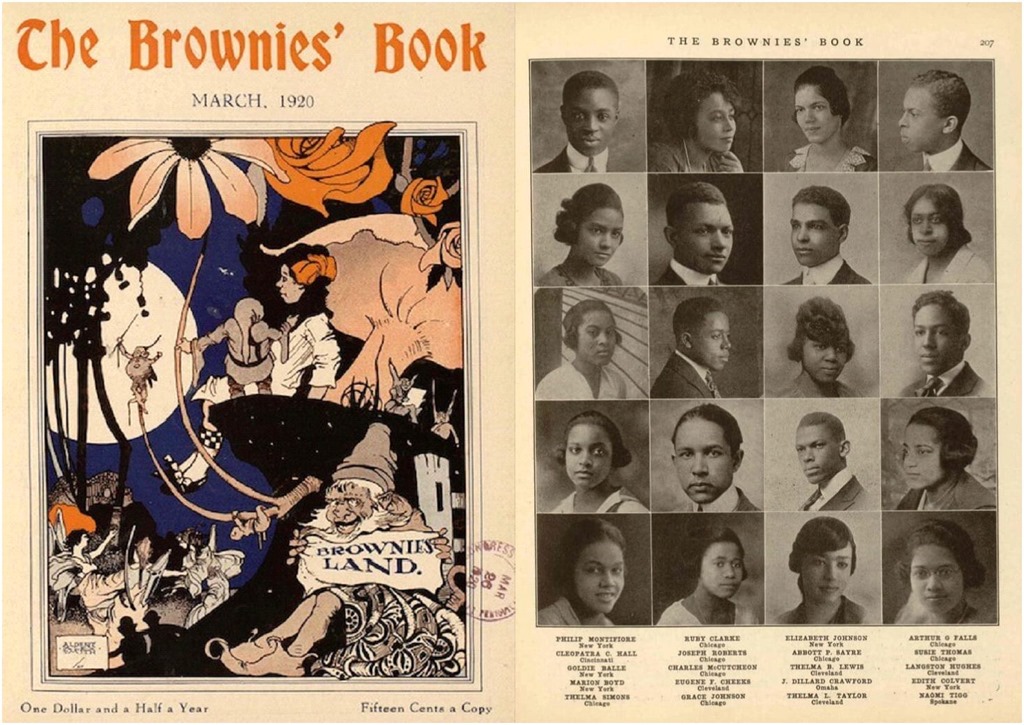
But wait, not only is this a poem about springtime, it’s a children’s poem written for Du Bois’ children’s magazine The Brownies’ Book. I first learned about this pioneering publication for Afro-American children at the My Life 100 Years Ago blog, which among other things often covers what was happening with magazines of that era.
Hughes himself wrote today’s poem when he was a teenager, and The Brownies’ Book was the first publication to publish his poetry. “April Rain Song” is a charming poem, and in rhythm and poetic tactics it reminds me of Carl Sandburg, a fellow Midwesterner whose writing influenced the young Hughes. Here’s a link to the text of Hughes’ poem if you want to follow along.
Check out the high school graduate in far right middle row. Yup, that’s Langston Hughes.
.
It’s been April rainy the past two days in my city, so working on making “April Rain Song” a Parlando Project piece had overcast and setting. Hughes here shows me a mode I sometimes aim for: it’s a nature poem, but specifically set in a city, not in some rural nature. The rain meets sidewalks and street-gutters, not some Eden.
Rain, specifically spring rain, has a strong memory element for me. Perhaps you share this? Outside in rain I’ll often recall other wet spring days, watching from the current distance my child-self walking beside miniature gutter rivers, observing for no particular reason their sweep around last years’ leaves and last winter’s final dusky ice clumps. Or perhaps you recall a particular roof on which fell our general rain? Was Langston Hughes too young yet to have that experience of memory when he wrote this poem? I cannot say, but I have that now, and so I add a bit of wistfulness to his words today.
Nostalgia may be cheap, but none-the-less, we feel it. Perhaps by “cheap,” we mean “common,” and if so, should artists always flee that, the common experience? Interrogating the common may verge on an obligation in many answers to that question. What is it in our mundane experience that we may share with others, that we can bring something else to?
Here’s an attempt I made a few years ago to do that, accompanied by some music I wrote and performed earlier this year. I think it’s an example of some principles and risks in this approach. What are they?
How common is your common? On one hand we often enjoy and seek out the exotic, and art can help us explore that too. I’ve spoken here before about how the exoticism of some of Keats attracted me as a teenager, and the strangeness of Surrealism and the gnomic statements of Wallace Stevens attracted me before I could understand all that they were on about. But just as well we may be attracted as readers and listeners to things that speak to our own parochial experiences. Why would we read or listen to work about ourselves? Are we hoping to learn something just beyond what we already know? Or is it, as it was once said about the readers of small-town newspapers, that they’re read by the townspeople to see what the editor missed?
In these ways you may be helped if your common is shared by a lot of people, who know they share that commonness, or it may be best if your experience is novel enough to not be very common at all, and where the attraction is that common human motivation: curiosity.
How important is your common? Some works spend a good deal of effort making the case that the reader or listener is wrong in not thinking that the common experience the creator is examining is important. Others have a lighter load to lift: those who’ve witnessed momentous events or taken part in widely recognized essential activities.
The degree of difficulty for the former is considerable. You may bore your reader or listener with making your case for the value of the seeming unimportant—or not make your case vividly enough and have them give up with a “who cares” shrug.
Why would one then choose to explore something generally considered unimportant? Well, a good deal of art doubts hierarchies of experience. Societies invest a lot in hierarchies, and artists like to overthrow them. Societies are often wrong, cruelly wrong sometimes, in those constructs. Artists aren’t always right in their alternatives, or completely right, but we are tempted by angels and devils to try.
Back in 1973 I hosted a visiting German artist in New York. The musical souvenir he was bringing home was a copy of Charlie Daniels’ “Uneasy Rider,” a novelty hit single about a long hair at a redneck bar.** German appreciation of American music was it’s own approximation. This picture: “Rules of the Game” is by Renée Robbins, taken in Iowa in 1977. The player in it seemed sort of Charlie Daniels-ish to me.
What do you bring to this common experience? Why does your expression, your examination of some common experience need to exist? As a matter of political and social persuasion, the second dozen or even the second hundred similar account of a similar experience and evaluation of it may add weight to the scales of attention or justice. An atrocity like George Floyd’s needless death gains some of its power and value not because it’s unique, but because it’s not. It’s not the first or the second, or the hundred and first. We ask, we view, in a way that it be considered as if it’s the first, as if it’s an only. We ask too, fervently, that it be considered as if it should be the last. But in the world of the arts, of chosen creation, we have a burden in making the same point over again worthwhile.
But of course, we do take up this challenge. How many poems, how many songs are about the flush of love and desire? How many works of art are about the absences of death? By some accounts, all of them that are any good. I think there’s a great middle range between love and death that is open too to artistic expression, the range of how we see, feel, hear experience between those two poles. It may seem trivial compared to the existential fact of death or the powerful urge of joined fertility—but great or small, your charge is to bring something else to this common experience large or small, call it beauty, call it a frame, call it music, call it a vibration that we can feel together.
Now, let me exit the high falutin and get down to today’s piece and see how I dealt with an element of my common in “Small Iowa Town, after World War Two.”
I had my own mondegreen moment listing to this today. I heard myself saying in line 23-24 “Seeing the storefronts in their row inhaling silently the adults…” instead of what I wrote above. I may keep the unintended revision.
First off, the subject matter is problematic. The experience I speak of here is shared by few even of my age cohort, and every day by fewer, as older generations pass on. Yet, it also has little appeal of exoticism. In my grandfather’s time and before this culture, the small rural American town, was common, and a considerable amount of art (much of it not high-art, and much that was aimed at the cultured market was critical) dealt with it. As I said in starting this post, a sentimental or wistful nostalgia is considered cheap and if it’s also not even considered common to the reader/listener, there’s no path to success.
I will note that I consider the experiences I recount in this piece as exotic. I’ve spent over half a century away from it, it seems strange/familiar to me now, an unusual construction. I make in my defense a common plea of the artist being accused of trafficking in cheap nostalgia: I’m really talking about how memory, change and experience work.
Is it important? I’m not sure. That I’m writing this generalized essay says that I doubt you will think it so. I plowed this field early in this project with one of the least popular pieces ever presented here: “Homeopathic Hometown,” and this may not fare any better. I plead the audacity of the artist that wants to tilt at hierarchies of importance.
Right now there’s a good deal of mistrust in America between the generalized* remaining rural citizens and it’s urban and suburban centers. Even though I’ve been away from small-town Iowa for so long, I can understand loss and aggrievement.
So, what can I, what did I, bring to this problematic subject to make it worthwhile? I tried to talk about the strangeness of the change, that part I find exotic, that far-away world that assumed permanence of a kind. I leaned on the slowly evolving music a good deal today. As in “Homeopathic Hometown” there’s a linkage that I feel viscerally between a certain kind of German music of the late 1960s through about 1990 or so, a melding of the then new synthesizer sounds with a particular European interpretation of progressive rock music, and my experience of these changed small towns. When I listen to the Bowie Berlin trilogy I get nostalgic not for a Berlin I’ve never known, but for a rural Iowa I think I know. It’s one of those odd links I can’t quite explain, but feel. Long rolling songs about long rolling hills and valleys. Small as a palpable absence. Grant Wood as a German Expressionist.
The player gadget to hear “Small Iowa Town, after World War Two” is below. It’s a bit longer than most things here, but I had to give it some time so the music could expand. Perhaps the music will work even if the words don’t succeed.
*Well, there’s a good deal of mistrust, period. And the residents of country and remaining small towns are not monolithic stereotypes. They weren’t then, and they aren’t now—and nobody likes to be reduced to a type—but generalizations of a divide and a mutual dislike and attribution of bad motives aren’t baseless.
**At the conclusion of the song, singer Daniels states that he wishes he’d taken his misbegotten car trip west on a route (across Iowa) through Omaha instead of through Mississippi.
I could have chosen another poem for Easter, but besides this one’s song-setable qualities, “The Easter Flower” is a poem about a Christian holiday written by a non-believer.
No, let me strike that casual term, “non-believer,” which doesn’t seem to fit McKay. He was a life-long radical, an unwavering believer in workers rights and social justice, always stalwart against colonialism and racism. As a radical, black, gay, immigrant man these beliefs were no simple balm to his soul, and by that I judge his beliefs to be strong and tested. McKay was also a confirmed skeptic, analyzing situations and sometimes changing his views on how these goals may be achieved, but that doesn’t alter those beliefs.
Now some of that may or may not resonate with you. Believers who do not share your beliefs can be rough companions to your reading or listening. Rest easy, this poem isn’t like that.
First off, like Wordsworth’s famous “Daffodils,” this is a poem about a past-tense experience, something that exists for the poem’s singer only as a limerent memory as he sings of the flower. McKay who grew up in rural tropical Jamaica spent much of his life in more northern climes. The weather forecast for Minnesota calls for a few inches of wet snow for this Easter, and if non-tropical Minnesotans find this disappointing, all the more so for McKay.
So, the lily in the poem is likely a childhood Caribbean memory, and the plant the Trumpet Lily, the Easter Lily, is not native to these then English colonies. It was introduced there by a missionary who brought it from Japan in the 19th century. I don’t know if McKay knew that, but this flower he remembers at Easter time amidst thoughts of home is a colonial artifact as well as a Christian symbol.
Claude McKay and the flower of his complex memory
In the poem’s second stanza McKay modulates the flower memory, displacing the pale flowers in his mind by liking it to a formation of “rime,” the hoar-ice that forms along shapes when foggy water vapor freezes rapidly, uniting the poems present voice in a colder Easter with the warmer past. The end of this stanza and the beginning of the next form a vivid spring rebirth image, as devotional as any Christian mystic could have written.
And then the poem let’s us know that McKay isn’t a Christian. Indeed, at the time the poem was written he was an atheist.* Therefore, the remembered image of the Easter flower is extraordinarily alienated from the singer. It’s in the past, in the ground of a country he no longer lives in, it’s a religious symbol not of his religion, it’s a non-native plant introduced by colonialists, growing in a climate of soft fragrant April nights, not a sleety cold northern city.
How easily we might skip through this poem, hearing but it’s lovely sounds and involuntarily resonating to the memories of a holiday with flashbacks of chocolate bunnies and jelly beans—or for devout Christians, one might hear only the inspiration of the image of the tomb earth giving way in resurrection. But that’s not this poem. McKay ends saying that he, “a pagan,” is overcome by this none-the-less, worshiping at another religion’s shrine. Why? From what? I think he chooses to make it undetermined. Homesickness even for a colonial homeland he felt he needed to leave is there. A certain ecumenical mystery too. The sensuousness of the flower is an undercurrent, the night smell of the flower has pheromonic power.
To hear my performance of Claude McKay’s “The Easter Flower” use the player gadget below.
*In the last decade of his life, 20 years after this poem was written, McKay was attracted to the Catholic worker movement. After a period of self-searching he became a member of the Catholic Church.




 Frank Hudson