In The Drear-Nighted December

200 years ago this month a 21 year old surgical resident decided to give up his studies to become a doctor and to instead concentrate on the writing of poetry. An interesting decision. He had already rolled up a considerable education debt, and while it’s possible that poetry’s earnings potential might have been greater in 1816 than today, greater than zero is not a high bar.

So how prudent was our young not-to-be surgeon? He had tried his hand at poetry and had published a couple of poems in magazines before his decision. Hmm. Not a great prospectus you might think. In a rough translation for our time, it’s as if the young student had ditched his studies and loan debt for a shot at touring as an indie-rocker, even though he’s only played in his dorm room and doesn’t have a band.

His friends thought he had promise. In the forthcoming year, and with their help, he would find a publisher for his first volume of poems, but his work was mostly unnoticed, and where noticed, the reviews were at best mixed. One reviewer had rich fun with this impudence:

“The spectacle of an able mind reduced to a state of insanity…. It is a better and easier thing to be a starved apothecary than a starved poet; go back to the shop, Mr. John, back to `plasters, pills and ointment boxes.'”

Another reviewer offered this judgement

“We regret that a young man of vivid imagination and fine talents should have fallen into so bad hands as to have been flattered into the resolution to publish verses, of which a few years hence he will be glad to escape from the remembrance.”

We know how this turns out, more times than not: the young fool will be unable to sustain a long career in the arts—and yes, that was the case here. The young surgeon turned poet was to have a career of less than 5 years—but that was because of his early death at age 25. Yup, he dies two years too young to make the 27 club. Our surgeon turned poet was John Keats.

Besides talent, and desire that was the equivalent of foolishness, Keats worked very hard reading poetry, thinking about it, and writing it in those less than five years, producing some of the best lyric poetry in English.

In my own twenties, this encouraged and discouraged me. On one hand, it said I could write and read fearlessly as a young poet in the first half of my twenties; and on the other, as I measured what I had accomplished, I often admonished myself: John Keats died at 25.

Almost exactly one year after he broke from medicine for poetry, John Keats wrote the words for this piece In the Drear-Nighted December. He wrote it after struggling for much of the year to write his first long piece, Endymion, a neo-classical epic in heroic couplets that he never thought he got right.

This is something many writers experience. You struggle mightily to create something. Something big, something impressive. You bring all your craft to it, but it doesn’t quite work. You finish it, or otherwise set it aside, and in the aftermath out pops another smaller-seeming thing that is much more perfect. It’s like the muse says to you “You don’t control me and direct this, and here’s the proof.”

What has Keats done here? First off, those words cannot be read and not sung. This kind of silent melody is not easy to do in English, yet here is the young Keats doing it brilliantly. His images? I’m deep in a minus 17 degree F. Minnesota afternoon as I write this this. His trees with their “sleety whistle,” those branches glued with ice, once flowing water frozen like mineral crystals—I know these things, but Keats has said them well to remind me that we both know.

Keatslifemask

John Keats encased in Carbonite by Jabba the Bad Reviews

And then his sublime last verse, so beautiful I could not help but repeat it. In two verses Keats has setup an nice lyric that doesn’t stray far from convention. To paraphrase: “Hey, look at nature in winter. Doesn’t look like it does in spring or summer at all. Even though we conscious beings know (more than dumb water and trees) that these trees will bud and the brook water will flow again, nature doesn’t care.” Now the third verse: “How smart are we compared to non-conscious nature? We will ‘writhe’ in pain as things are taken from us (and though unspoken: since the image has been of a repeating natural cycle, this will happen again and again). This is not a poem that says “Suffering? Don’t worry, spring will come again.” This is poem that says suffering will come again, as surely as winter. “The feel and not to feel it, when there is none to heal it.” What a line: “The feel and not to feel it!”

A good song for winter solstice, so to hear the LYL Band perform In the Drear-Nighted December, click the play button the player gadget that will appear below.

I Heard of Emerson and Wagons

“Hitch your wagon to a star”. We all know what it means, and we’re wrong.

Well, maybe we’re not exactly wrong: it’s human to draw a variety of meanings from what other humans communicate. The Emily Dickinson poem in the last post is perfect example. I don’t know exactly what Dickinson was trying to say in I Felt a Funeral in My Brain, but the strength of the language and music of her saying of it compels anyway. Poems, particularly short poems, often benefit from this kind of ambiguity. They become, in effect, several poems, poems that are experienced differently—even by the same reader—at each reading. In the end those varied readings become a kind of unstable hologram, a poem that the reader can see around corners in. I think that’s one of the benefits of these Parlando project recordings. You can listen to the words without making singular understanding the all-important goal as you enjoy the musical setting, and you can repeat the process of hearing them. A poem is not an important email from your boss that you must understand correctly immediately.

An essay on the other hand does prioritize clarity. “Hitch your wagon to a star” is from one of Emerson’s essays, and Emerson is a very clear essayist. You can read the published version of the essay, Civilization, where the famous quote appears here.

For the moment, I’m going to pass on Emerson’s racialist and sometimes racist views which saturate much of the first half of that essay. If you are an Indigenous American or a Central African, you may be so revolted by this section that anything Emerson says later may be lost on you. TLDNR: despite some nods to North African, Arabian, Buddhist, and Icelandic (Iceland! Was Emerson predicting Sigur Rós, Jóhann Jóhannsson and Björk?) cultures; civilization is kind of white, temperate zone, coastal U.S./European thing. Gee Ralph, checked your white privilege much lately?

In the second half of the essay, Emerson develops another point. He starts by saying “Civilization depends on morality.” What expectations does that sentence give you? Anytime you read that sentence in the last 50 years, you know what comes next:  a catalog of received, traditional, probably religious, precepts that the author will no-doubt find are being violated frequently by a fallen mankind who is ignoring this at their peril. You expect him to say “Stop screwing around with traditional morality, or civilization is doomed.” Is this what you get?

Nope. He’s soon launching into a rhapsody about the telegraph, and since he doesn’t mention that great mid-19th century technology by name, you could almost dump it word for word into the last part of the 20th century as praise for the Internet. As he talks about the telegraph’s “invisible pockets” you almost think he must be about to invent TCP/IP protocols more than a hundred years early! Instead of the Moral Majority, you get Emerson the Steam Punk.

And then he moves on to describe a then common Massachusetts technology, a mill that was powered by ocean tides, and at his observation of this, he says:

“Now that is the wisdom of a man, in every instance of his labor, to hitch his wagon to a star, and see his chore done by the gods themselves. That is the way we are strong, by borrowing the might of the elements.”

From there Emerson develops the thought that a natural morality of utility, justice, civil order and freedom is—like the geo-thermal power of tides—an undeniable force for progressive change and improvement.

This section of Emerson’s essay is still a complex and novel approach. Emerson’s fellow Transcendentalist Theodore Parker condensed this thought in a way that Martin Luther King often cited:

“The arc of the moral universe is long, but it bends toward justice.”

Is this not proof of the maxim? Emerson in the middle of the 19th century, suffering from the ignorance and misapprehensions of racialism and racism, yet works for abolition of slavery and his philosophy helps inspire others a hundred years later to bring about long-delayed progress?

So that’s why I say we misunderstand “Hitch your wagon to a star.” Emerson would approve the gist of our misunderstanding: that it’s good to set goals high—but that’s not what he meant. What he meant on striking the coinage was more like “align yourself with the natural moral laws of the universe and your struggle for change gains great power.”

Radio Flyer Wagon

Today’s audio piece, I Heard of Emerson and Wagons recounts my mother telling me to “Hitch your wagon to a star” when I was a child. She, like most of us, meant it in the “dream big” way, and in that busy-parent way “yes, that’s nice. Dream big, but I’m busy right now.”  In this piece, the young me is puzzled by just which big dream is the right one—just the thing that Emerson thought he was, in fact, offering guidance on.

To hear the LYL Band perform I Heard of Emerson and Wagons, just click on the gadget that will appear below.


To A Locomotive In Winter

A few years back there was a little Internet brouhaha about a woman who looked like she was talking on a cell phone as she was filmed walking down a street in 1928. “Proof of time travel?” asked the rhetorical askers “In 1928 there’d be no cell phones for 50 years, so she has to be from the future.”

time-traveler-cell-phone
About time we get cracking on Bluetooth don’t you think?

We’ve been talking here recently about Ralph Waldo Emerson, Emily Dickinson, and Walt Whitman, three 19th century Americans. As far as we know, none of them used cell phones, and their considerable accomplishments may have been easier insomuch as they didn’t have to worry about PokéStop locations. But maybe they were time-travelers none-the-less?

One of the remarkable things about Emily Dickinson was that she seemed to be writing 20th Century poetry in the middle of the 19th Century. Oh sure, skeptics will say, she was a genius, and through her genius became influential to later writers. Typical debunkers!

Walt Whitman too, often seems a prophet and precursor of a new age, but maybe he wasn’t a prophet? Maybe he was just reporting from the future, and he knew all his bets were sure things. How else can you explain Whitman’s podcast on gender equality streamed here?

Today’s piece, Whitman’s To a Locomotive In Winter, was written sometime between 1874 and 1876, but it reads like a “Futurist” poem written 40 years later. The early 20th Century Futurists embraced technology and sought to bring it into the arts. Poems, paintings, sculpture and musical works celebrating bicycles, airplanes, motor cars and trains were their stock in trade. Was Whitman a time traveler from 1914 who had read the Futurist Manifesto?

futurism_meccanica_pannaggi_speeding_train

Thee for my recitative!

Another American who paid attention to the Futurists (besides time-traveler Walt Whitman) was George Antheil, a composer, who by the 1920’s was trying to engineer machines to make music. He had this idea that he could realize a musical composition by syncing more than one player piano together so that an even greater mechanized noise could be exactly made. By the 1940s, perhaps after hearing Whitman’s podcast on women’s strength, he was in Hollywood and hooked up with actress Hedy Lamarr—no, that kind of hook up. You see Hedy had this idea for a radio-guided torpedo. One problem: if you used radio to guide it, you could use radio to jam it. What if the control signals could use random radio frequencies Lamarr wondered? How would the controller and torpedo stay in sync? Antheil had the solution, the same thing you used to control player pianos: a roll of punched tape. The tape would tell the radios to switch frequencies in perfect time with each other. You couldn’t jam that jam because the radio frequency could hop at some sick number of beats per minute.

George Antheil with machines

Maybe I should have just developed MIDI instead?


Antheil and Lamarr tried to interest the US War Department on this. Those square faces listened to this idea of randomization and said “No dice!”

hedy lamarr

Not interested in my remote-controlled, frequency hoping torpedo? Can I tell you I invented Fizzies too?


Antheil and Lamarr patented their idea, but after rejection no one cared. Then decades later folks are trying to setup CDMA, the core technology for cell phone transmission. The engineers dig up that patent in a pre-existing-art search—or were Lamarr and Antheil time travelers who had been reading the cell phone engineers’ PowerPoint decks? Maybe that woman in the 1928 street scene is the elderly Hedy talking on a cell phone with Walt Whitman?

So back to Whitman then, and To A Locomotive in Winter, and to time travel. In this piece, Whitman time travels forward to 1956, to Chess studios in Chicago. Earl Phillips kicks off the loping beat. Hubert Sumlin, Willie Dixon and Hosea Lee Kennard fall in. The band is playing a drone their bandleader had heard Charlie Patton play back around World War I, but the bandleader is letting this strange traveler, this gray bearded old white man who says he’s from the over-soul, from the Emersonian universal mind. The bandleader has had to deal with racism for almost half the 20th Century, has had to figure that out as a practical matter, he’s seen enough to not ever be surprised. Walt Whitman steps to the mic…

Walt-Whitman-001

No sweetness debonair of tearful harp or glib piano thine


You’ll need to click on the gadget below to hear the LYL Band portray that that event.


Leaves of Grass

Alas, it’s been a busy week or so with family reasons, and I’ve had to leave Walt Whitman from the last post with his hymn to revolutionary violence hanging out there in one channel.

If you’ve heard the last post’s audio piece, The Blood Of Strangers, recall in that other channel was the tender and exact testimony of someone caught up in gunfire that believes it’s all for a cause. Whitman didn’t write that account, but he could and would speak like that as well. This is Whitman’s great value: he really wanted to write the all of the world. That means foolishness, evil, selfishness, loss as well as tenderness, steadfastness, love—and to write too of all those middle things that are neither: lust, mystery, liberty.
 
Whitman’s use of language is also all over the place. Every reader will find some of Whitman unbearable (as I find his France section I used in The Blood of Strangers) and some sublime.

Rather than write an essay about those qualities of Whitman I’ll offer instead a link to Randall Jarrell’s great discussion of Whitman, of whom he says:

“only a man with the most extraordinary feel for language, or none” (could write as Whitman does.)

The stance that Whitman takes of someone observing the world in its totality, not coldly, but with frank, almost corny at times, emotion, is one that continues to bear poetic fruits. I don’t know that Lou Reed ever pointed to Whitman, but there are times he echoes that outlook powerfully.
 
Earlier this month, as I recorded some new material, I found myself performing Mark Kozelek’s “The Greatest Conversation in the History of the Universe” in its rambling entirety. I like doing things like this. “The Greatest Conversation” is a very particular individual experience, and that work’s catalog of events and opinions I only halfway share—and that’s what I like. Mark Kozelek can embody Mark Kozelek, and it’s not exactly effortless, for being ourselves is not effortless; but none-the-less, Mark probably feels a familiarity as he finds those thoughts in himself. I, on the other hand, must figure those particulars out, find some common ground with them, translate them into performance. Kozelek’s work in “The Greatest Conversation,”  consciously or not, is also Whitmanesque. Essentially his tale of New York City is as close to Whitman’s experience of New York City in the 19th Century as it is to my experience of New York City in the 20th century. Which is to say: different and the same. As I recorded and spoke as Kozelek, I felt Whitmanesque.

young-whitmanLou ReedMark Kozelek (8)

Three blades. Of grass?

 
Because I do not know yet how to go about getting clearance for sharing work still in copyright to use with the Parlando project, you will not hear the LYL Band’s version of “The Greatest Conversation” today. However, you can hear the original Sun Kil Moon and Jesu version here. NSFW warning: “The Greatest Conversation” contains F bombs and a short account of a sexual encounter.

Walt Whitman could have easily embodied Kozelek, he could have embodied Lou Reed or Laurie Anderson too. He would have tried to embody Muhammad Ali as well. This piece uses one of the best-known sections of Leaves of Grass. In it, Whitman stakes his claim to a universality, a universality so broad it transcends death. The music is from the LYL Band again. To hear, click on the gadget you will see just below.

The Blood of Strangers

As we go forward, following Leonard Cohen’s suggestion “Let Us Compare Mythologies,” I’m going to take you to another very dark place. If Siegfried Sassoon was hesitant to publish the last piece Christ and the Soldier, I too am somewhat hesitant to publish this piece, The Blood of Strangers. For The Blood of Strangers to work it must achieve its aim to be provocative. Let’s take that word seriously: it means to provoke you, it means to make you uncomfortable.

That’s one of the things art can choose to do, but it does not give me any lasting pleasure to do so. As an attempted artist I do not believe I must have any greater insight to things than you do, but the nature of art is to try convey things vividly, and in this case I’m going to convey two viewpoints on revolutionary violence.

A year ago, only hours after the terrorist attack on the rock concert at the Bataclan in Paris France, I was scheduled to record as part of the work of making this Parlando project combining spoken word and music. As a musician, I felt compelled to address this event simply and parochially because the attack intentionally targeted music. I chose to use two texts to examine that event: excerpts from a first-person account by Isobel Bowdery, a member of the audience attacked that night, and a section of Walt Whitman’s Leaves of Grass.

Bowdery’s account is to my mind extraordinary, even more so for having been composed so shortly after the attack. Whitman, in contrast, had much more time with his text, as he famously worked and reworked Leaves of Grass over his lifetime. The Whitman piece I used “France”  first appeared in Whitman’s 1860 third edition of Leaves of Grass and was retained in the final edition of 1891. Moreover, Whitman is particularly writing about the French Revolution, events already over 60 years old.

I believe I need say no more about Bowdery’s eloquent words. They are close enough to our time as to speak for themselves. Whitman’s are more problematic.

Modern American poetry has a father and a mother. Its mother is Emily Dickinson; its father is Walt Whitman. As a child, I can’t help but sometimes take after both parents. The Parlando project has already presented work of Dickinson, but this is the first piece we’ve published using Whitman—and this may be an unfortunate introduction, for Whitman’s France is a somewhat mythologized but unwavering appreciation of violence and revenge in the furtherance of a cause. Near the start I told you that I would not tell you what to think of this, but in the just-hours-past the Bataclan attack I was appalled at Whitman.

I suggest at this point, assuming you are prepared to visit a dark place, that you listen to The Blood of Strangers now and have your own experience of it. Musically this is another piece that takes after The Velvet Underground, a band I’ve talked about before this. My intent in speaking the two texts at the same time was not only a homage to a tactic the Velvets used, it was aimed at breaking up the flow of either text so that you will not experience them in isolation from each other, or as a logical “Point Counterpoint” debate, but rather a simultaneous experience in two different frames. The last half of the piece is an “instrumental” where The LYL Band gets to synthesize their feelings in the aftermath of that attack speaking only with music. Link alternative for those whose way of reading this supress the audio player gadget.

OK, if you’re still reading, what can I say in defense of Whitman?

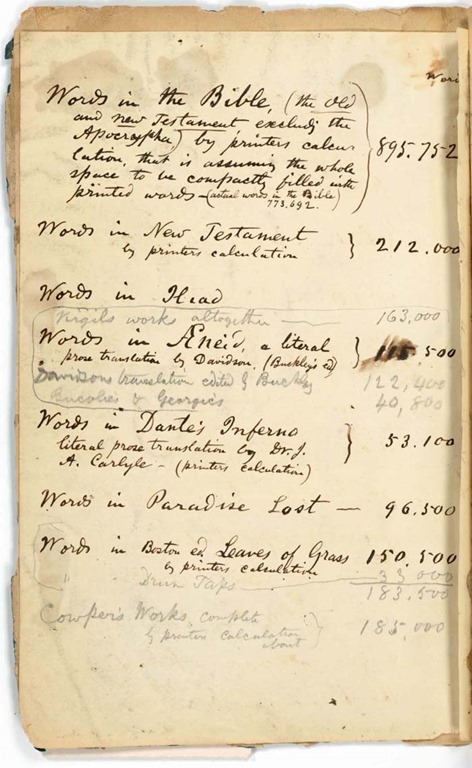
Whitman Leaves of Grass Table

Whitman wanted Leaves of Grass to be all-inclusive. That was one of his core ideas. And this piece, France, was only one small part of this great, lifelong work. In his own copy of the 1860 edition that introduced this piece, he wrote down a table of the word counts of that edition of Leaves of Grass compared to other epic poetic works, proudly noting that he had already exceeded the word counts of the Bible, the Aeneid, Dante’s Inferno, and Paradise Lost. His radical inclusiveness wanted to take in all manner of despised and un-praised things in his great work. Although writing 60 years after the end of the French Revolution, he is writing on the eve of America’s great blood bath, the Civil War. So, as he continued to work on Leaves of Grass, where he kept and expanded the piece called France, he was intimately acquainted with the results of gunfire and bombs. I often thought of that Whitman, the wound-dresser, when I myself was applying bandages or tending to the ill and injured. Whitman famously declared:

Do I contradict myself? Very well, then I contradict myself, I am large, I contain multitudes.

Christ and the Soldier

Tomorrow is called Veterans Day in the United States, but originally it was Armistice Day, celebrated on the day that World War I ended. WWI was a dark dividing line between all that came before and after. Books have been written about only one or two aspects of what changed, but a whole shelf of books could not tell all.

And this year is the hundredth anniversary of one year in that dark dividing line, 1916, when those that thought war was simple, or had to be simple, brought the 20th Century efficiency of the assembly line to killing in the battle of the Somme, where over one million men were killed or wounded.

One of the soldiers in that battle was a poet, Siegfried Sassoon. Last time we took a look at a funny and pious story from World War II, The Deck Of Cards, and had a little irreverent fun with the form of that story in my parody. In this piece, Sassoon’s Christ and the Soldier, the humor is very dark. I’ve heard that it was dark enough that Sassoon did not, or could not, publish it until the war was over.

As usual, I’m largely going to let he piece speak for itself. One thing I like about it is its use of dialog. For some reason, most poems eschew dialog entirely, and I think poetry misses out on a useful device by avoiding it. Musically it’s a mode that the LYL Band visits often, combining organ or piano with electric guitar. I play the guitar part on my Jaguar, a guitar that was once associated with “surf music” but has since had a revival in indie-rock circles. I play it often because its short scale and spring-softened action are friendly to my arthritic fingers.

To hear Christ and the Soldier, click on the gadget that should appear below, but some ways of viewing this blog won’t show it. In those cases, this highlighted hyperlink is another way to play the performance.

The Deck of Cards, or The Old Weird America Part 2

Returning to the other side of that post WWII Tex Ritter record I discussed yesterday, let’s look at The Deck of Cards. I think I probably first heard this as the Wink Martindale version from 1959 which was the third or fourth time a version of The Deck of Cards had charted on some hit parade somewhere, and as the Wikipedia link shows, it would return again and again, which should not surprise us, since the story dates back to the 18th century.

I rather liked the piece when I heard it as a child. First off it was spoken not sung, so it stood out from all the singers on the radio, and the piece’s narrative twist, that the threatened poor and irreverent man would show himself to be learned and pious, is the kind of twist that can keep a piece of folk material current for centuries. As I said in the last post, no one in the mid-20th century folk revival would have ever considered The Deck of Cards an authentic folk song—but like our supposed irreverent soldier—it is, and not what folks presumed it to be.

Did this record specifically influence the Parlando project to mix music and spoken/chanted words? Not at any conscious level. The popular spoken word record with music just was around in my childhood. Yet, as one starts to do concentrated work in some area you may begin to notice all kinds of things that must have taught you some possibilities.

The plot of The Deck of Cards follows the rhythm of a joke: tension, danger, expectation; then unexpected twist, release of tension, pleasure. So, it’s not surprising then that some of the renditions of this old tale passing through the folk process twist it again to parody, and so here’s mine. It’s based loosely on that rough Robyn Hitchcock version, even uses a couple of his lines, but is mostly mine. If you don’t know the 1948 Tex Ritter version, you can hear it first by clicking here. You should listen to Tex, you can’t have irreverence without reverence. Or you can hear T Texas Tyler’s version which predates Tex Ritter’s by a few months here.

Oddly enough, I performed a straight rendition of the 1948 text the same day that the LYL Band recorded this parody, but you won’t hear that here when you click on the gadget that should appear below.

Blues Summit in Chicago 1974

Let’s continue for a one more episode on the theme of the musician, but since here in the Parlando project we believe music and poetry to be naturally joined, let us go there though a poet.

Decades ago, in a small Midwestern classroom, a teacher wrote on the chalkboard “It is better to read (or study) Homer than to be Homer.” I do not remember the teacher’s name. I do not remember who was the author of this epigram–though I have vague memories that the teacher wrote that down too—and no amount of modern web searches have ever been able to give me the source of it. But except for that one ambiguous word (“read” or “study”) I have never forgotten that line. Perhaps what helped me remember the line is the teacher gave us no context. I simply encountered what they had written on the blackboard.

Though I’m going to violate that impact here in regards to that epigram, I endorse it with the Parlando project’s audio and podcast element, where the audio pieces are meant to stand alone without resume or external authority. None-the less, if any readers here do know where the Homer epigram I remember came from, I’d like to know.

What I took that line to mean is not just that the life of an artist may be difficult or cursed by troubles; but the revelation, emotional resonance, and sensuousness of art when it is experienced, can easily be greater than the costs of its creation. Greater for even one reader. Greater than the author’s own understanding of that which is so close to them that they may not see all its sides and size.

So here’s a meditation on that idea. I wrote it after watching a re-broadcast of the initial episode of PBS television’s Soundstage which shares this piece’s title. I believe the producers of the TV show wanted to reproduce a somewhat similar gathering of older and younger blues musicians that resulted in an excellent LP called Fathers and Sons recorded in 1969. Musically, what they captured wasn’t at that record’s level alas, but it was well-filmed and that alone makes it worth watching, for there are small, moving, privileged moments between the musicians captured on camera. About halfway through watching it myself, I found myself noting that almost every musician on that stage is now dead, and it didn’t matter if they were the younger generation or the old guard. Some of the old guard outlived the young guns.

That’s part of the nature of a working musician’s life: there may not be a full measure of it.

And then I looked at the close-in audience filmed at the same time. Since they were my contemporaries I felt I could see through the period clothes and hair styles and make some rough but fairly accurate estimate of their class membership and likely demographic future.

Let’s just narrow our focus to one musician. If you could step back in time, would you ask Michael Bloomfield if it was worth it? “Hey Mike, I’m from the future and I know you’re going to die at 37. Would you rather have stayed in college now knowing that?”  How complex that question is for just that one instance, and equally complex in different ways for each of the musicians on that stage. I suspect some days they’d say “yes” and some days “no”—and much of the time they’d say (in so many words) that your question was beside the point.
 
Now ask yourself:  would you rather Mike Bloomfield had a longer life or you had recordings like Highway 61 Revisited, Super Session, or East/West to listen to? Assuming you weren’t Mike’s friend or relative, and that you know and have experienced his art, then honestly your answer is likely: you’d take the records.

And those college students in the bleachers? Maybe some of them became doctors, nurses, teachers, faithful and helpful friends. Maybe one day one of them will write something on a chalkboard like that epigram I read decades ago, and I will not be able to remember their name.

So to play The LYL Band performing  my piece “Blues Summit in Chicago 1974” click on the gadget below.

This Is the Darkness

This is a more difficult piece for me to put out for you to hear. Not because of the quality of the performance by the LYL Band, the performance is fine. Nor do I disagree with the performance, as it does what a performance should do: it represents a physical, working version of the feelings in the piece. The problem with it is, that taken in particular, it can be heard as out of balance.

I wrote this at a specific time in my life, for that matter at a specific time of year and even a specific time of day. When it was written and performed, I was exiting my middle ages, and elements of my life were out of balance. And it was written at this time of year, which in my upper Midwest US means that it is now dark when one awakens in the morning. At this time in September, there is no more promising summer sunlight tempting you to arise early, the sunlight that says the day has already started and you should go and catch up with it.

Perhaps you’ve had the thoughts I had on the day. You know you have things to do, many of them things you would not choose to do at that morning moment in time. How should one view this predicament?

Albert Camus wrote of this famously in his essay “The Myth of Sisyphus.” You can read the concluding section of that work here. It is not long, but if read thoughtfully it is arduous. Was I thinking of Camus when I wrote this? No, I was thinking of my own life; but other people’s stories, in effect, other people’s myths to explain this mystery, show that we hold these thoughts in human commonality.

I will not try to explain Camus thoughts on this, he does this better than I could. I have no quibble with his analysis of the situation, but as I’ve mentioned previously here, I currently suspect all myth of understanding more than it knows. Furthermore, the close association of myth and heroism makes me the more skeptical.

And that’s why I found this piece, one I myself wrote and performed, problematic. Inside it I come to the same consolation that Camus did, but Camus’ “Myth of Sisyphus,” and my piece “This Is the Darkness” can both be easily experienced in an unbalanced way: the absurd predicament is so strong an image that the consolation, our revolt and continuance of seeking right action in the face of that predicament, can seem all too vainglorious.

So let me suggest another myth. One plainer and less heroic. There is a plainspoken yet strange hymn associated with Christianity “Work for the Night Is Coming.” You can hear it sung here in this short video. As I said, this is a Christian hymn, still sung in Protestant Christian churches. Does it mention Jesus or any divinity? No. Does it elaborate any moral code? No, not really. Does it offer a sure explanation of any mystery or absurdity? No, not directly. It simply says “Work, because soon enough you will not work anymore”. In the context of Christian myth, this can be taken to mean heaven or the advent of heaven on earth, but this strange hymn decides not to say either.

Not so strange that this was written by a Canadian—the natural brethren of us upper Midwesterners, someone who would know intimately that the darkness beyond summer is long—but strange in that Anna Walker Coghill was 18 years old when she wrote it. I had to be much older to understand her words.

That’s a lot of context for this piece, but to hear “This Is the Darkness” performed by the LYL Band, use the gadget that appears below:

The Green Fairy

Here’s another piece with the voice of Dave Moore, and I guess you could say it deals in myths. In the notes for the last episode “Print the Myth” I said that myths arise out of the need to explain mystery, and that there are some dangers there. Your explanation, your perfectly good and gripping story, can be just wrong on the facts as we learn more; but also your favored myth may say more about your culture and yourself than you realize it does.

However sometimes we’ve simply forgotten what the questions and cultural associations were that gave birth to a myth, and they become these free-floating, free-associative ideas charged with a mysterious weirdness that defeats explanation. The myth returns to mystery.

Across the world there are demi-human nature-creature myths. I suppose they might have arisen out of explanations for the capriciousness of nature or the randomness of fate. At other times they serve as perfectly good characters to satirize human foibles in demi-human form. I think one of the strengths of “The Green Fairy” is that none of this is quite clear. Within Dave’s piece, we only know that the Green Fairy, like Godot, is coming (and not coming). I think that late summer mystery is its charm.

While producing this piece, I wanted to serve that mystery musically. I treated Dave’s keyboard part in a sort-of Lucy In the Sky With Diamonds manner and stayed on the drone with my stringed instrument parts.

To hear The Green Fairy, click on the gadget that should appear below to play the piece.