Four Performances-Part Two: “I love it when guns show up”

Today’s performance happened a decade later in 1981. This is a series about performances, so I’ll leave out a lot that happened in-between, but in summary, I left school, began working in a nursing home and subsequently spent almost twenty years working in nursing roles, the bulk of that in what were called, in those days, Emergency Rooms.*  I rather liked the work, as it was undeniably useful, and the broad ad-lib nature of the responsibilities fostered teamwork between staff. There was something else about it too: if one’s own life was not going smoothly or following some path of professional advancement, a great many of the people you took care of were having a worse day than whatever day you were having.

In the mid-Seventies I decided to try to teach myself how to play guitar, and a couple of years later I moved to Minneapolis Minnesota, where I reconnected with Dave Moore. In the middle of that decade a musical movement was forming which had no name for a year or so until it started being called “Punk.” Once something gets a label, folks will come along and take what the label describes as a goal or set of expectations that should be met — but the musical acts that were already there when that label was created didn’t have those restrictions. They were all over the place in musical intents and tactics.

But there was something that united those that were there to be called “punk” founders ex-post-facto. I’ll use this military metaphor: what happens when a regime has fallen, when the standing armies are no longer functioning, yet a struggle continues? Pressed into the battle are the irregulars, the untrained — and those punk-before-the-name bands prime movers were often: poets, artists, & writers, not musicians. Nor were these figures reactionaries who hated hippies, Rock’s traditions, or exploratory musical moves. For the large part they wanted to take up the fallen banners of what had been exciting about Sixties music and to carry them forward. Where they were in opposition, they were against those credentialed musical acts that weren’t doing that.

Well Dave Moore and I were writers, poets. I’d learned a little about how to play guitar. Dave could play keyboards. This new musical moment was allowing a new “underground” of original music bands to pop up in Minneapolis. What Sixties banner could we take up?

The list of artists we shared as touchstones would be long, and what we thought we could take from them would be a long list too. Let me select but one: The Fugs.

Andrew Hickey, the writer behind the excellent music-head project The History of Rock Music in 500 Songs has a maxim he deploys often in his work: “There’s no first of anything.” When a wise writer gets to questions like “What was the first Rock record” or “Who first played electric guitar” and stuff like that, it’s actually impossible to set objective criteria or establish exact dates, but being aware of that useful maxim, the Fugs can be claimed the first Punk band, and they didn’t start in the middle-Seventies, but in the middle-Sixties.

The Fugs and their implications and cultural inflections are too long a story to tell in this post. If my energy holds out, I’ll make my account of the Fugs a “bonus episode” here, but in short, starting at the beginning of 1965 in NYC’s Greenwich Village, two poets Ed Sanders and Tuli Kupferberg began caterwauling songs with various accomplices in what they advertised as “Total Assault on the Culture.” I suspect they saw themselves as an outgrowth of the “Jug Band Music” branch of the Fifties and early Sixties folk music revival,* but the Fugs material was a substantial expansion from the folk-revival jug bands. The Fugs performed single-entendre odes to sex acts, anarchist satire and political protest, translated excerpts from ancient Egyptian or Greek literature, settings of literary poetry, dispatches from drug takers, and the other daily concerns of Bohemia.

Kuperberg and Sanders did not have professional voices. Their first album is so out of tune that the vocal timbres can drive even those that might entertain their political and cultural points to “turn that damn ‘singing’ off!” You’ve heard me sing here — that sort of “we’ll give it a go anyway” audacity actually comforted me.

Dave and I started playing informally in our living rooms, and between the two of us we quickly developed a dozen or more original songs. Our fresh material addressed the social issues of the on-coming Eighties: the Reagan rightward tilt, the local “big boys who always run things” (as Dave put it in one of his songs), and working class experiences. Unlike the Fugs we largely eschewed the aggressively sex-positive topics and the recreational drug-use reports.***  This rundown makes our early songs sound more like doctrinaire agitprop that I think they were. As songwriters we both were fond of the character study, which is by its nature more complex than a protest sign or bumper sticker.

Dave (the more businesslike and socially competent of the two of us) soon set us out to perform publicly by making arrangements with Ed Felien, a long-time city activist who was at the time running a café called Modern Times in South Minneapolis. We started to use a stage at one end of the dining area there to perform publicly.

See the LYL Band Modern Times Cafe Ash Wednesday by Dave Moore 800

One of Dave Moore’s posters for the LYL Band appearing at the Modern Times Cafe in the early Eighties

.

Audiences were small, but it was fun to do. The stage had an upright piano for Dave to play and the place had two vocal microphones connected to a low-volume PA. I played an acoustic guitar which I had to pick with all my might to keep up with the volume of Dave’s two-handed piano chording. I was the weaker of the two of us as a performer, but because of our equality practice of alternating songs, I could feel that Dave’s steadier and more confidently presented songs could keep the audience satisfied, and I enjoyed the accompaniment role during his songs.

So one day, we’re playing on the Modern Times stage to a small crowd. Late in the first set we did a topical song of mine “The Ballad of J.W. Hinckley,”  a song set parodically to the form of Steely Dan’s “Do It Again.”  The song was voiced as being sung by the titular young man from a well-off family who had just shot President Reagan and his Press Secretary in the hopes of impressing Jody Foster. The point of the song was that due to Hinckley’s privilege and America’s laissez-faire gun regs, he was free to make his attempt even after he’d been caught trying to carry guns onto an airline flight. Yes, I suppose there was a wicked wink in my use of the chorus borrowed from Steely Dan’s song: “You go back, Jack, do it again” — but the subject of the Dan song is a chronic loser, and the Hinckley character in my song was non-heroic too.

We took a little break between sets and we were winding up the first song of our second stint when a thin older man entered the dining area carrying a long-gun. Dave was sitting at the piano, facing sideways, stage right. I was right down in front at the lip of the low stage. The man walked up next to the stage, raised his gun at me, and began his spiel.

So what! Let’s take up a song in honor of Mr. Reagan — in his honor….He’s a wonderful man. He may turn this country around. Let’s have both sides of the story. I think I am well educated (both sides) and I don’t have a pointy head anymore.”

Well, once again someone was missing the subtle point a song was trying to make — but I didn’t try to debate the armed man. In my ER job I’d dealt with many angry people, even agitated, insane folks in the midst of mania or paranoia. My default tactic in such ER cases was to listen to them calmly, perhaps waiting to gently redirect them if they calmed down or had a question. It was actually rare in my ER years to have to struggle to restrain them (those who had been violent outside were brought in already restrained).

I listened to the man talk, trying to present myself as interested in what he had to say. What he said seemed almost composed, as if he was (like myself) trying to perform. He was present for less than a minute, but in gun-time things slowed down. I remember trying to judge just how much height I had from the low stage: could I kick or throw myself down over the leveled barrel of the long gun, forcing it to ground, followed by my younger body pinning the older man? No, my acoustic guitar would impede me. I can’t recall if I thought to look at the position of the man’s trigger finger — perhaps I thought such a clear glance rather than paying attention to his speech might be a tell. I didn’t have time to recalculate much, as the man finished saying his piece, turned and walked out onto Chicago Avenue just as he had come in.

Dave, I suspect elevated in expressiveness from being in his outgoing performer mode, said into his vocal mic “We love it when guns show up!”

Did this incident cause me to have stage fright problems? You might think it odd, but it did not — I still wanted to perform, but my problem as a performer continued to be my lack of sufficient performer’s skills and my issues with being confident in what I was able to convey, leading to a progression within a performance of accumulating failure of “nerve,” and the ability to project confidence.

On top of one of the tables in the Modern Times dining area, I had placed a little tape recorder to record our performance. I’d hit record for the second set minutes before the man walked in with the gun. Later that year when we created our only official record, we melded in part of the incident as an intro to the studio version of “The Ballad of J.W. Hinckley,”  and you can hear that with the audio player below. One additional note on the ending part captured in this performance of the song: in my younger years I could improvise poetry over guitar. I think I was modeling that on early Patti Smith, whose first recorded pieces captured at poetry readings were done that way.

Audio player gadget below. What, no gadget to be seen? It’s not stage fright, it’s just that some ways of reading this blog will suppress showing the player.  This highlighted link will open a new tab with its own audio player.

.

*In most hospitals these days they’ve been expanded to departments or subsections, with varying services. All the systems that deal with the acutely ill, trauma victims, mental health crises, or those that have no other place to go for healthcare have been expanded — and I lived through a lot of that change in my lower-level position — but the first Emergency Room that I worked in was literally a room or two located by a ground level entrance where an ambulance could pull up likely staffed by folks with a higher degree of licensure to drive a commercial vehicle than medical training.

**This was in effect a largely white effort to revive a largely Afro-American genre of string band music with vocals that often would include double entendre songs performed at lively tempos. One advantage in the commercial folk-revival was that a jug band group could allow more specialization, grouping effective instrumental musicians with appealing singers. In the mid-Sixties US West Coast, the Grateful Dead and Country Joe and the Fish started as jug band revivalists. On the East Coast, Jim Kweskin’s Jug Band and the Loving Spoonful worked out of that style.

***Exceptions? We did cover two Fugs tunes “Slum Goddess of the Lower East Side”  and “I Couldn’t Get High;”  and though we never played them live, we did play the Velvet Underground’s “White Light/White Heat”  and an original song adapted from a local poet’s poem called “Pussy from the Black Lagoon”  that was renamed on our sole official recording to “Lucy from the Black Lagoon.”

The Fugs were typical male mid-century bohemians in that women’s equality and perspectives were issues rarely addressed. One of my early original songs from 1980 dealt with the then famous case of Mary Cunningham, a freshly promoted VP at the Bendix Corporation who was rumored to be having an affair with the CEO. Employees gossiped, and the Corporation’s board requested that Cunningham be fired. She resigned. The CEO? He remained. I didn’t know then, and I can’t find a quick answer in a web search today if they were actually having an affair, though the two did marry

Heaven and Hail

I sometimes think I’m working against gathering a larger audience for this.

Twice in the past month or so I’ve had an opportunity to speak in passing with poets about what I do with the Parlando Project. I’ve got my elevator pitch carved out: “I combine poetry, usually literary poetry not intended to be performed, with original music in different styles.” Both poets came back with this replying question: “What kind of music?”

Maybe I should start hitting that word “different” with hard emphasis — but Midwesterners know that kind of spoken underline could be parsed in our regional argot as cloaked disparagement. If I was to say:

“I’ve written a piece for a string quartet in which the instruments are placed on the floor and filled with nuts and seed. A herd of squirrels is then unboxed and will proceed to chew through strings and tonewood for the course of the musical evening.“

The Midwesterner is bound to reply “Oh, that sounds different.”

Squirrel Quartet 3

For Friday the 13th: presenting the unexpected, not gnawful, just “different,”  the Squirrel String Quartet.

.

Now, I believe both of those poets this past month are perceptive, I read it in their admirable poetry. If they miss the word “different” it’s because many people have strong feelings about the music they care about.* Long before reaching the age of those poets most listeners have strong affinities for some music and equally strong dislikes for the sounds that they don’t wish to put in their ears. The idea of combining poetry with music is attractive, but what kind of music is an unavoidable point in describing the Parlando Project, and I can’t encapsulate that. Elevator pitch? If I tried, I’d be out of breath and walking up flights of stairs. To both poets I was reduced to trying to start my response with “That’s my problem: it varies.”

Readership of the blog posts here continues to increase through the years, while listenership to the audio pieces has been for the last half of this Project’s life flat to somewhat lower. This bothers me, and I have theories, but one that seems particularly plausible is that the variety itself turns off listeners. One day acoustic guitar folk-scare strumming, the next day some kind of synthesizer sound, a garage-rock quality electric combo, something like Jazz, small orchestral ensembles, Blues slide-guitar, or alt tunings in a matrix somewhere between John Fahey, Joni Mitchell, and Sonic Youth. And then on the third day, a combination of one or more of the above.**

How well do I (who much of the time needs to play or score all the parts) present that variety? I think my own judgement approximate, but it goes like this: on good days I think I do it well enough, on bad days I feel embarrassed by the faults in execution and conception I hear. So, my limitations are a factor here, but even if I was a master of all these forms, I think the problem would remain. In this theory it takes only one or two “bad fit” musical pieces for a new listener’s taste to judge the work has no value, and no further listening occurs.

What will I do about this? I don’t know. I can’t help the eclecticism — it’s been in me since my youth*** and I don’t think I want to try to scrub it out.

Today’s musical piece comes from that “We’re a garage band, We come from Garageland” mode — looser still in that like most of the LYL Band pieces presented here over the years it’s spontaneous, not the execution of parts each instrument is supposed to play. As keyboardist Dave Moore says at the end, the words are “a personal experience story,” an exception in the Other People’s Stories texts the Parlando Project finds, experiences, and presents. Just over a year ago a storm with 60 mph winds and golf-ball sized hail struck Minneapolis. Overall, it caused 1.1 billion dollars in damages. On my roof, my shingles were totaled (the classic hail-storm result), windows were shattered, and there were plenty of cracks in the siding from the wind-driven hail. As “Heaven and Hail”  tells it, it took months, well into the winter, for overwhelmed builder crews to get all the home damage repairs completed in my neighborhood.

Last year at this time work started on fixing the damage at my place. One experience amid the hammers, ladders, and supply pallets: hearing one of the crew’s boomboxes playing a record of garage rock classics all sung in Spanish. Another Rosetta Stone moment, like reading those cereal boxes in French.

To hear this short account of the storm and aftermath you can use the audio player gadget below. No player? This highlighted link is an alternative that will open a new tab with its own audio player.

.

*Neither asked me —and few people ask me — “What kind of poetry?” With non-poets, I ascribe that to the lesser interest in poetry as an art and therefore a lack of strong likes and dislikes.

**This leaves out the subjective qualities of my voice, something which I recognize is of overwhelming importance to most listeners.

***”Top Forty” rock’n’roll radio was extraordinarily broad in “The Sixties™” and I was listening to the classical music station and a country-western station along with that format. Hootenanny was on TV, folkie music was part of church camp. Other than the occasional cross-over hit I’d hear on the radio, the Jazz waited a bit to creep in late in my youth. Eventually the smart programmers figured out that a pop music station that played a “button pusher” record would cause the listener to switch to a competitor. I’m the odd-duck that when I hear a record I don’t like, right after one I do like, I want to hear the third and maybe fourth or fifth record played, particularly if any of the small sample (liked or not-liked) is something I don’t think I’ve heard before.

Fragmentary Blues

Life events are conspiring again to keep me out of my studio space to record new pieces — but it just so happens that I have this rocking Blues recorded back in 2007 with the LYL Band that’ll contrast with our pensive Frost meditation on work from last time. Today’s audio piece was made from Frost’s short poem titled “Fragmentary Blue,”  now recast as “Fragmentary Blues.”

Unlike Carl Sandburg or Langston Hughes, I have no idea if the 1914 vintage Robert Frost had any experience or appreciation of this Afro-American musical form. A quick search found nothing, even though Frost’s lifetime overrode The Jazz Age, The Swing Era, and even early rock’n’roll.

But as poet Langston Hughes soon discovered, the lyrical expression of the Blues was a vital format worth picking up. A first draft of this post included a long aside about the importance of this Afro-American Modernist form, but on second thought I’m going to take less of our time today so that we can focus on how Frost’s poem can be expressed through that form.

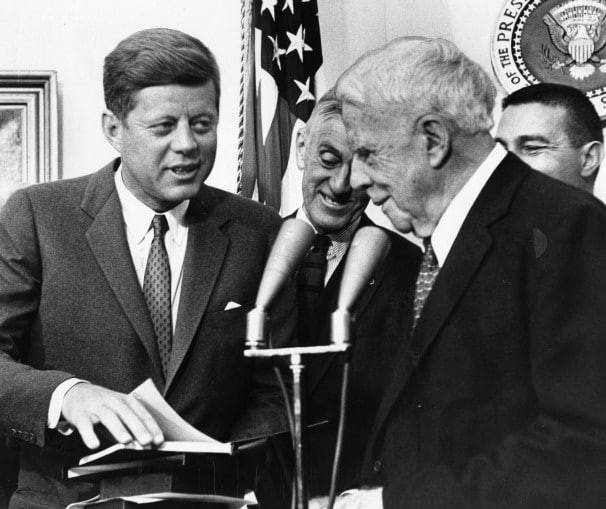
JFK and Frost

JFK: When you wrote “Come on mama, to the edge of town/I know where there’s a bird nest, built down on the ground” were you talking about what I think you were talking about? (wink wink).
Frost: No, you’ve got me confused with another bucolic poet, that’s Charlie Patton — but I believe that’s a philosophic statement about how erotic desire is both natural and elusive. Patton was tuned in open Spanish for that one.”

Blues lyrics often used a stanza format of three lines: one a statement, the second a restatement that may be the same, nearly the same, or subtly varied while still gathering intensity via repetition; and then a third line which can go in any direction the writer/poet/singer wants to take it, though it usually rhymes with the ending of the first two lines. It’s a variation of that ancient and simple poetic scheme the rhyming couplet, but with that repetition allowing for something extra in the balance. And there’s often an element of call and response in the lines: that choral rock, and roll back that Sophocles, Skip James, and Pops Staples could share.

So, let’s go back to our 1914 Robert Frost poem “Fragmentary Blue.”

Why make so much of fragmentary blue
In here and there a bird, or butterfly,
Or flower, or wearing-stone, or open eye,
When heaven presents in sheets the solid hue?

Since earth is earth, perhaps, not heaven (as yet) —
Though some savants make earth include the sky;
And blue so far above us comes so high,
It only gives our wish for blue a whet.

Not in Blues stanza form. Instead, ABBA, and I don’t mean the Swedish pop group.*  But Frost has made the center two lines in each stanza a sort of parenthetical, so that lines one and four are natural couplets and the middle two lines are already couplets that can stand by themselves. This means it was easy to turn “Fragmentary Blue”  into “Fragmentary Blues.”

Why make so much of those fragmentary blues?
Why make so much of those fragmentary blues —
When heaven presents us sheets of a solid hue.

Here and there a bird, or a butterfly.
Here and there’s a bird, or a butterfly,
Or a flower, or a wearing stone, or an open eye.

There’s some savants say the earth includes the sky.
Some say, some say, that the earth includes the sky —
And the blues so far above us, it comes on so high.

Since earth is earth, it isn’t heaven yet.
Earth is earth. It ain’t heaven yet.
It only gives a wish for blues a whet.

So there you go, via show not tell, we rock up Robert Frost in the Blues form. If you read the two sets of words closely, you’ll see something has changed. Frost’s “blue” on first reading seems a stand-in for beauty, while the Blues treats its namesake emotional dissatisfaction as something less than beauty. But, consider again. Frost’s poem says we miss the immensity of natural beauty in our all too earthward human act of trying to possess its emulations. That difference, that dissatisfaction — that’s the Blues. My adaptation only brings out that subtext more overtly. You can hear the LYL Band express Frost most blues-wailingly with the player gadget below, or with this highlighted hyperlink that will play the performance. Most of the better guitar notes here were played by Andy Schultz who played with the LYL Band for a few times, and Dave Moore will once more hear himself back when he could pound and roll on the (plastic) ivories.

.

*Is it too late in their career to suggest that they produce a trans-Atlantic Carl Sandburg tribute record? I’m available, and you need my audience of dozens to hundreds of listeners.

Why am I presenting a song about Christopher Columbus?

I was long-winded last time, so let me try to minimize the gab today. I went to sleep last night wondering if I’ve ever done anything for an Indigenous Peoples’ Day. Though I’m going to keep my own comments brief, I can hear over the Internet a few groans. “Indigenous Peoples’ Day? Isn’t that one of those woke-ish things with a work-ish name meant to single out some small subsection of Americans?” Well, objects in my mirror are closer than they may appear to you.

The Twin Cities is home to a lot of what used to be called Urban Indians. “Indians” of course being part of Columbus’ “My dog ate my GPS” report back to the royals in Spain, where he imagined he had found a route to the frontiers of South Asia. My part of the Twin Cities has a lot of Mexican and Central American immigrants — immigrants that have DNA that says they were in the Americas before my ancestors were.  We’ve got folks around here from India too — makes things confusing.

But for any complaints about special holidays implying special pleading, this day is still widely known as “Columbus Day,” which with footnotes and explications, can be said to mark the start of European colonization of the Americas. But it’s widely known that the day became a holiday through the desires of Americans with Italian heritage wanting a day to celebrate that. I’m fine with that too, it’s just that where I live in our big and diverse country I’m more likely to be around folks who think of themselves as Native or Indigenous Americans.

So, here’s what I did today to hurry up and figuratively meet the Spanish boats with an Italian commander, and to celebrate Americans discovering them. Yes, what happened as a result is a complicated story, and I said I’ll be brief.

I recalled that the LYL Band had once covered a couple of songs on one past version of this holiday. One was Patti Smith’s “Amerigo”  from her under-rated Banga  record. I listened to it, and it’s kind of long and languid, and I’m not in that mood today. Then I listened to the other, a cover of a song from the Nazz.*  Now that was more like it, though my mix of the rough and ready performance from six years ago was not very good. So, I took some time to remix it today, not so that’s it’s sophisticated or genteel. No, it’s still LYL in its immediate punk mode. No acoustic guitar or my approaches to Jazz-my-way. This is turn it up and roar music. Also, some notes escaped being hit in the mayhem. Sorry about that, but in the right punk mode you may be able to deal with it.


You may want to turn it up loud.

.

*The Nazz were a group from the late Sixties that never got as much traction as their records deserved. Think of an American band that sounded like Laura Nyro or Loving Spoonful-era John Sebastian writing songs for The Who or The Yardbirds. Connoisseurs know The Nazz as the band Todd Rundgren emerged from. Todd’s talents as a producer and musician made sure their recordings sounded a lot more polished than our cover, but maybe he’d like our energy? After all, he did get the job producing the first New York Dolls LP (and the Patti Smith Group’s Wave  too). I think I even casually assumed “Christopher Columbus”  was a Rundgren song, but it seems that it was written by the band’s bass player Carson Van Osten. Van Osten went on to have a considerable career behind the scenes at, of all things, Disney.

Went to See the Gypsy

In discussing last May how much fun it is to perform Bob Dylan songs I mentioned that when Dave Moore and I get together to play we often throw in a Bob Dylan song along with our own music. Last month* we finally got together after a long break due to Covid-19 and other infirmities, and as per that tradition the next to last song we played was a Dylan number.

Dave has been extraordinarily prolific with songs over the past few years, so it’s most often I who bring the Dylan to the table. Hipster-wannabe that I am, I often like to cast a wide net for the less-covered or celebrated Dylan songs. This time it was “Went to See the Gypsy”  off of Dylan’s little-remembered New Morning  LP of 1970.

At the time it came out New Morning  seemed important, as Dylan had stumbled badly with his previous record Self-Portrait.  Self-Portrait  seemed to many a lackadaisical record about being lackadaisical, and those many weren’t having that in the turbulent and searching summer of 1970. Think about this: that LP was released almost exactly a month after nine college students were shot and four died on a Midwest college campus. Of those four dead, two were protesting what seemed a widening war in Southeast Asia and two were somewhat distant onlookers between classes. A few days later two more students were killed at Jackson State in the South. The average youthful Dylan fan was less likely to be interested in tunes about all the tired horses in the sun at that moment.

So, less than six months later this other Dylan album, New Morning,  came out. In retrospect it wasn’t really a return of the fiery prophet of Sixties Dylan, but a lot of rock critics had made their bones considering that earlier Dylan style and made the best of what they had in it. One song, and one song only, could be parsed as if it was in that style “Day of the Locusts,”  a protest tune about getting an (honorary) degree from an Ivy League university while that year’s crop of “17 Year Cicadas” chirped their Dada chorus. Maybe some college students dug that one.

With the passage of time, New Morning’s necessity to rehabilitate the great songwriter’s reputation has lost its utility. Dylan has had at least two greater “return to greatness” moments since then, easily supplanting the importance of New Morning.  And of course the measure of the artist over such a long and important career makes bumps in the road disappear in the trailing dust. Though little thought of now, New Morning  is what it may have been intended to be, a much better record of relaxing with the mundane and interrogating it.

“Went to See the Gypsy”  is about nothing happening, a topic that many of the fraught students of 1970 would eventually need to come to grips with, and maybe it fits this second summer of Covid-19 too. The singer goes to meet the undefined titular “gypsy,” who maybe only figuratively that (the word derives from a now considered pejorative term for the Romany ethnic group). I think that character title is used to convey someone exotic and transitory. There may also be a suggestion that the gypsy could be a fortune teller, as many songs that Dylan would have known would have made explicit. The meeting is a big nothing. The two have a nighttime greeting in a hotel room (transitory housing), and then the singer has to go to the hotel’s lobby to make a call. Modern people, sit down in a circle around the fire, and let the old ones speak of this: in those days you couldn’t text anyone if you were running late or you had to get some info or agreement, you were required to go to a place where there where iron-clad telephones chained to a wall that took coins to accomplish that.

In the lobby an attractive girl (“dancing,” intimation of transient movement) begins to do a hype man spiel about the gypsy. How much time passes? We don’t know. Does the singer try to make time with the girl or vice-versa? The song doesn’t say. It only says that dawn is approaching (often the signal to end a song or poem) and the singer returns to the gypsy’s door, which is open and the “gypsy is gone.” The door being open is a telling detail, as it indicates that this wasn’t some planned leaving. The gypsy rushed out or was rushed out by someone. The singer returns to the lobby, the dancing girl is gone. Was she part of some planned distraction? We don’t know. The song ends with the singer instead “watching that sun come rising from that little Minnesota town.”

Now this song all could have happened in a little Minnesota town. One thing that many non-Minnesotans think about Dylan’s home in the Iron Range was that it must’ve been some ethnic Northern European monoculture, which it wasn’t in the least. Personally, I’ve always thought this final scene is a poetic jump cut, and that Dylan’s final sunrise is times and miles away from the events before in the song, but that’s just me.

In summary, a song about things just happening that keep things from happening. Your fortune won’t get told, nor will the mysterious guru tell you what to do, you won’t get to go through the mirror, and a pretty girl may have her own agenda.

Here’s today cover version of Bob Dylan’s “Went to See the Gypsy” Alas, there’s a couple of typos in the captions that flash by. I blame working too late.

.

Musically this is me on electric guitar with Dave playing some soft reed organ sounds at first. After those tracks were laid down live, I decided it’d been too long since I had done a full orchestral arrangement, and so after the fact I did just that and had the orchestra instruments come in partway in the song to represent the potential big something that hovers out of reach over this non-event story. I know dawns in little Midwestern towns, far from the chance of Las Vegas, gurus, or those who can tell one’s fortune. There you make your songs and self, yourself.

I should be back shortly with the song we did right after this one, a Dave Moore original.

.

*This same session produced The Poem, ‘The Wild Iris,”The Dragonfly,”  and I Am Laughing in the Dark Underground  that have already been presented here.

Hortensia

This has not been a month conducive to producing new content for this project, and I’m not sure about July and August either. At some point I’ll probably talk about some of the reasons for that, but I thought it’d be good to leave you with one more June piece, and it’s a fine summer song by a voice this project hasn’t heard from enough lately: Dave Moore.

Dave and I first performed as The LYL Band about 40 years ago, and we’ve kept at it over the years. Our typical encounters this century have been a sort of two-person song circle with each of us alternating in presenting a song, a piece most often completely new and unknown to the other. These first takes* get recorded, and one of them is today’s audio piece.

First takes with unknown material is not the way most bands work, and certainly not how they record. Bob Dylan worked with unknown, fresh material and new-to-it musicians in his classic years (and may still now, there’s just less documentation), often providing at best chord charts for assembled musicians or brief run-throughs. But Dylan would do multiple takes even trying different studios or musicians over time, trying get the right take.

It’s not uncommon for jazz musicians to do the same thing we do in their recording studio dates, though some feel that even with Jazz’s reverence for spontaneity that this is a practice brought forward for logistical and lowered recording-budget overhead reasons, not as a considered artistic choice. Miles Davis seemed to find this practice a considered choice though, and when one listens to a record such as Kind of Blue  we are likely to give some credit to that choice, which Bill Evans likened to spontaneous Japanese painting in the original LP liner notes. Later on, Davis took to the pentimento-practice of having everyone improvising on themes and then letting later audio editing assemble from the mass of recorded playing a post-recording compositional structure. A record like Davis’ A Tribute to Jack Johnson  assembled that way has a different vibe and timbre from Kind of Blue,  but it works for me in its different way.

Are Dave and I musicians like Davis and his band members? No. Nor are we musicians likely to be called to a Bob Dylan session (note to Bob: call us anyway). Most of what we record on any one day isn’t worth more than a self-critical listen on our own parts. And of the rest? There are usually rough spots that even a bit of focused audio editing can’t excise. And then, sometimes something like “Hortensia”  arrives.

If you accept (as I say often here) that all artists fail, then it can sometimes behoove one to make peace with failure. Do that, and then allow, then make possible, for the limited successes to arrive.

I often tend to overstate my guitar parts. I didn’t here. Dave’s keyboard skills at the time of the recording get some space, and while he’s not going to kick Bill Evans or Herbie Hancock to the curb, what he plays works. Dave’s vocals are usually more consistent than mine by a long shot, and his performance serves the song. I think Dave may have even improvised some of these lyrics during the performance — and this is the only performance of this song ever.  And that serves the song too.

You see, I hear this as a summer song, a song of long days, rich days, that are still days,  and must end in earth’s and fortune’s rota. “Now, sweet now” Dave sings. Yes.

Hortensia

I think I asked Dave what the song was about shortly after we recorded it. “The summer flower or the Roman woman?” I think he replied that it was more at something intuitive.

.

You can hear it with the player gadget below. Don’t see a player? This highlighted hyperlink will also play it. “Hortensia” is longer than most of our pieces here, but sit back with a cool drink and listen. Thank you hearty listeners and readers for sticking with this project!

.

*First, and in most cases, the only take. Since we haven’t focused on live performance much in our old age, we aren’t working up material for performance or developing a repertoire for that. Dave has been as prolific with words and with songs with his own music as I have been with musical pieces over the past few years. This means that there was always new material to be tried out, to be brought into existence, even if briefly and for one take.

T. S. Eliot’s The Waste Land, an eclectic musical performance

I sort of meant to do this last month as I wrapped up my five year serial presentation of Eliot’s Modernist landmark. This will not be a wrap-up of all the discoveries and feeling that living with this poem each April brought forward for me, but instead a single post that allows one to find the whole thing as I presented it over the years. The kinds of music I wrote and performed for this project varies considerably: blues, folk-rock, punk, orchestral instruments, synths, and solo acoustic guitar. I think this fits with Eliot’s design for his poem, which varies its voice and voices throughout too. Listening to all the parts below in one sitting will require a longer period of attention than this project usually asks for, over a hour. Not for you? Feel free to look at other posts and audio pieces here which are usually under 5 minutes in length.

Taking T. S. Eliot off the page and onto the wings of music for five Aprils.

.

First, here’s The Burial of the Dead,  the opening section.  If you don’t see a player gadget, this highlighted hyperlink will open a new tab that will have a way to play my performance of this section. April and spring and remembrance falls off into a rather gothic take on the “unreal city.” In-between we get the most popular single sub-section in the entire series, the “Hyacinth Girl.”

.

Next, we move on to A Game of Chess,  which opens rather sleepily*  and finishes with the appearance of the project’s guest voice Heidi Randen. A player will appear for some, and otherwise, here’s the hyperlink for those that don’t get one in their reader.

.

The poem’s third section, The Fire Sermon,  has some of my favorite performances of the entire series, the ones that I think work the best, and from first to last it’s the one I’m most proud of. Gadget below for some, or this highlighted hyperlink for others.

.

The Death by Water  section is by far the shortest, and here it is. By now you know the drill, gadget if your blog reader allows it, or this highlighted hyperlink.

.

I have not rolled up the final section, What the Thunder Said  yet because it would be extraordinarily long. In place of the entire performance of the poem’s longest section, here it is in four subparts as first presented this past April. Highlighted hyperlinks of each part precede the player gadget that some will see and some won’t.

Part 1

.

Part 2

.

Part 3

.

Part 4

.

That final, 4th segment, just above differs from every other one in that it’s an earlier LYL Band live performance which is rough, and ready to take on the complex conclusion of The Waste Land  from a hotly-felt cold-reading of the text (complete with some mispronunciations on my part) .

As I occasionally warned readers here, The Waste Land  is not for everyone, though I think it can be enjoyed simply as a wash of contrasting moods and mysterious words without need for “Will this be on the test?” understanding and extractable meaning. None of these pieces have been particularly popular here, but still the effort to complete this has increased my appreciation for Eliot’s achievement. I’d like to thank in particular Dr. Oliver Tearle over at the Interesting Literature blog whose posts helped illuminate various things regarding this poem and the WWI era while I was creating these performances.

.

*Conceptually, my idea for the opening of this section, to conflate the mood of Eliot’s poem here with Blonde on Blonde  era Bob Dylan was fine, but my execution of that kind of languor wasn’t as effective as it should be. If I ever was to do a new, improved version of something in this entire performance, that would be the sub-section I’d think most needs it.

.

In memory of Lawrence Ferlinghetti: The world is a beautiful place

Some people live so long as to make time and its boundaried eras seem a foggy measure. Such a man was Lawrence Ferlinghetti, the American poet, painter, and bookstore owner who predates and post-dates the Beat poetry scene — or for that matter the Hippie scene, and our century’s activist eras and its search for peace and justice. If you are a fan of generational short-hand (I’m not) you will notice that every one of those eras was widely denounceable as impractical, delusional, and in most ways inferior to those that came before that.

Perhaps I should remind all that Ferlinghetti was 101 years old, and would have been 102 next month. That means: he knew the Roaring Twenties and whatever we have begun in these Twenties. To any of you XYZ believers, that means he was a member of the Greatest Generation. This man, Ferlinghetti, attached philosophically during the entirely of my own longish life to anarchism and pacifism was a WWII vet, who enlisted before Pearl Harbor, who served during the Normandy invasion, and who, when moved to the Pacific theater, was able to view Nagasaki shortly after the atomic bombing. Philosophical pacifism of a most visceral kind.

“Thank you for your service” is the reflex response nowadays. Surely due, but I think also of his post-war service, helping promote a new more vernacular American poetry via his work, encouragement, bookstore and small press. His own 1958 poetry collection A Coney Island of the Mind  was immensely popular,* and seeing it or Allen Ginsberg’s Howl and Other Poems  (which Ferlinghetti published**) in their paperback black and white form was once a common marker in smoky apartments during my youth.

Around the time this Project was beginning I performed a couple of Lawrence Ferlinghetti poems live with The LYL Band. I’d actually hoped to get permission to post those performances someday, but emails to City Lights garnered no replies. Hearing today of his death, and thinking of his life that well-lived, I thought inescapably of this poem of his from A Coney Island of the Mind entitled “The world is a beautiful place.”   I’ve decided to post our performance here in the spirit of gratitude and in memoriam.  If any rights owner objects, let me know, and I will remove. The player gadget for our performance is often below, but this highlighted hyperlink will also work if you don’t have the gadget on your screen. If you want to read silently, or read along, here’s a link to the text of Ferlinghetti’s poem.

.

Want to hear another version of “The world is a beautiful place?”

Here’s Ferlinghetti’s own reading of today’s piece. You can buy a copy of A Coney Island of the Mind from City Lights via this link.

.

*Some accounts say Coney Island  is the most popular poetry collection ever published in English. I’m not sure of that.

**Was Howl  a big “get” that he was lucky to land for City Lights? Not exactly. He was put on trial for publishing it, and Ferlinghetti figured he’d go to jail. The Fifties judge, to some surprise, ruled it not obscene.

Fire Dreams, or Carl Sandburg’s Come On, Pilgrim

Emily Dickinson isn’t the only one of this project’s favorite American poets to write a Thanksgiving poem. Carl Sandburg did so too.

Long time readers here will know how much I like Sandburg and how often I like to speak toward the canon-keepers to point out that early Sandburg was a devoted Modernist with a strong American democratic take on Imagism, one that kept to Imagism’s unfussy and concise mode of expression without dressing itself up with any unnecessary scholastic references. Of course, I’m no opinion-shaper, and even if William Carlos Williams has undergone a reassessment as a domestic Modernist of the same era, Sandburg doesn’t seem to have benefited from the same second look.

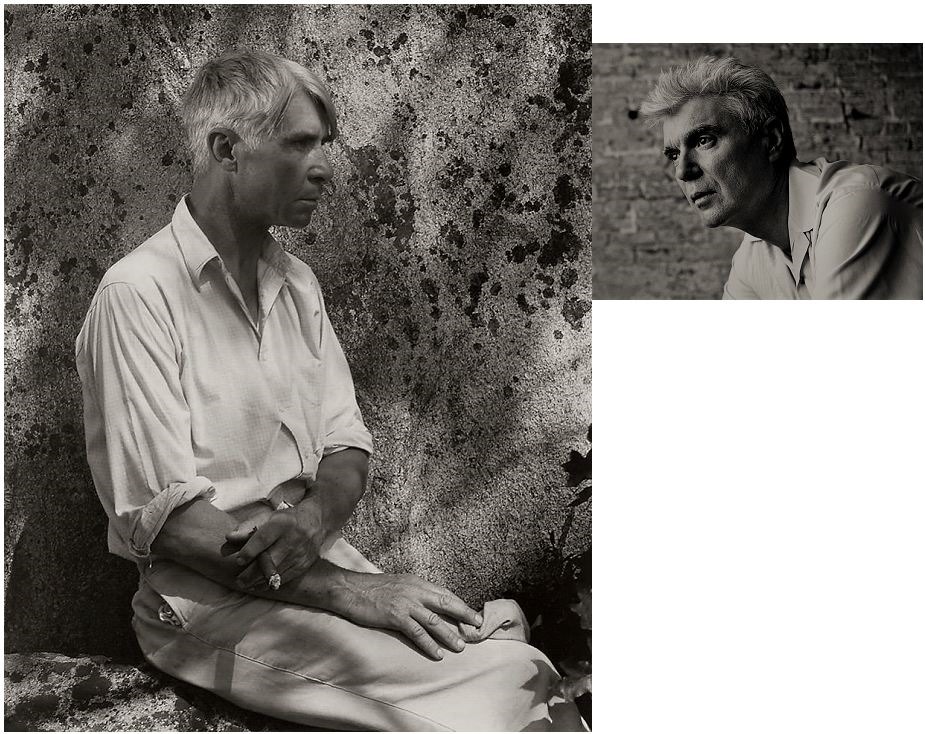
Sandburg and David Byrne seperated at birth

My title may reference the Pixies and Larry Norman, but I think this Edward Steichen image of Sandburg looks a little like David Byrne.


I think this is a great pity. A poem like Sandburg’s “Clark Street Bridge”  is as perfect an Imagist poem as any written in London or Paris, and Sandburg’s subject matter and life-experience is broader than most of his fellow Modernists, because he traveled across America with his Imagist eye and working-class soul.

That said, I have to say that today’s Sandburg text is a partial example of why this might be so. This is the kind of Sandburg poem that people think  he wrote. It’s somewhat sentimental, unquestioningly patriotic, and there are almost no strong, immediate Imagist images in it. Although it’s not that long-winded, it seems to me longer than it is—and if it had broken into a Whitmanesque catalog of a hundred things at least it would have the courage of its convictions.

So, it’s a Thanksgiving poem, but it’s not great Sandburg. Why bother?

Its central Pilgrim history myth may not be entirely accurate, but it is a good story—one that children were told in his time and mine, and perhaps even sometimes now: tempest-tossed dissenting religious immigrants undergoing tremendous trials. For good or bad, Sandburg leaves out the native Americans who helped them survive,* and who were rewarded with a few decades of peace before the wars of conquest ignited in the Pilgrims’ region.

Historians like to point out that the Pilgrim Thanksgiving didn’t include most of the foods that we’ve come to expect for the modern American holiday harvest meal. Sandburg reduces it to “soup and a little less than a hobo handout today,” which is also inaccurate but makes the connection he’s trying to make. America always has pilgrims like these somewhat mythologized Pilgrims. Sandburg, the child of working-class immigrants knew this completely, the ones who worship the God of broken hearts and empty hands.

And though he doesn’t show it here, Sandburg also fully knows the imperfection of America, and yet still wishes to say yes to gratitude, to thanks “if so be” for himself and his child.**  He wishes to say yes before perfection—and continue yes “Till the finish is come and gone.”

So, while this is not the poem to restore Sandburg’s rightful place in Modernism, I think it’s still worth hearing on this holiday. The full text of the poem is here, and the player to hear the LYL Band perform it live*** is below.


*In hearing the story of the Pilgrim Thanksgiving as a child I never absorbed the full story of Squanto (Tisquantum,) which deserves to be better explored. There is a long and detailed Wikipedia entry on the context of this American.

**And before we leave that, let me point out that Sandburg is the rare Modernist who deals with children wholeheartedly.

***LYL principals Dave Moore and myself are both dealing with the inability for our hands to follow what musical precepts we hold, and this has reduced the appearance here of the more spontaneous LYL Band recordings. I’ve been missing that element and we’re trying to do what we can.

Surely You Could Do Better Than This

And now for something completely diff…Oh, Monty Python references may be lost on a good portion of the modern audience—and then today November 22nd is one of those dates that some folks remember, and some don’t. Someone older than Dave, George Bernard Shaw, once said “We learn from history that we learn nothing from history.” Kurt Vonnegut said “History is merely a list of surprises. It can only prepare us to be surprised yet again.” And Ambrose Bierce who for all we know is still wandering around a Mexican border wall with a Sawzall and a book of poems by Du Fu, defined history as “An account false, of events mostly unimportant, which are brought about by rulers mostly knaves, and soldiers mostly fools.”

So how much should we care for all that? Well, as I often say here, my opinion is less important than yours. Today’s audio piece, written and sung by Dave Moore, says something like that too.

Note that in each case today I’m giving the opinions of humorists, the class of thinkers and writers who expect that whatever you attempt you’re going to fail at it a little or a lot. Maybe that’s the lesson of history: that every advance for humankind has been across a field of failure.

Pieter_Bruegel_the_Elder_(1568)_The_Blind_Leading_the_Blind 1080

This gives me a chance to include another Bruegel painting. And it’s a good thing it’s a painting, because sightless people cannot be offended by seeing it.


Use the player below to hear Dave backed by the LYL Band sing his song to those that will dance upon our graves. For those who’ve come here expecting poetry: as my son predicts, it’s likely we’ll be back soon with more of that dead poets society stuff.