Langston Hughes Chooses Jazz Poetry: “Jazz Band in a Parisian Cabaret”

I’m going to write about 20th century poet Langston Hughes’ pioneering Jazz poetry. I’m hoping to condense a lot, trying to make this short – but we’ll see. Like someone commencing a Jazz improvisation, I’ve got an idea – and maybe have some sight of where that idea goes – but what happens after that? That spirit, going there with maybe a first idea to see what you can develop from it, is what makes Jazz improvisation possible. Some skilled musicians, able to translate written scores into music straight off the page are terrified of that leap. Perhaps it’s because they know how to play those set-down compositions right that they’re frightened – if I must improvise, they may think, how will I know what’s right?

Langston Hughes published the words I’ll be using today in 1926 – but I must be in a hurry telling today’s story, because I’ll start in 1835, or thereabouts. Wikipedia puts “circa” next to that date, so there aren’t any attested records, but one Mary Sampson Patterson was born a free woman of color at about that date in North Carolina.

At around age 20 her Wikipedia entry says she fled for Ohio due to an attempted enslavement.*  Records again are sketchy, but in Ohio she in some way studied at Oberlin College – as an Afro-American woman, this a double rarity in the first part of the 19th century. Her education trailed off in 1858 when she married Lewis Leary, a fugitive slave also from North Carolina. Leary was not just a fugitive slave, he became part of the Harper’s Ferry Raid, John Brown’s attempt to start a mass slave rebellion by attacking a military armory in Virginia. Brown attempted this with only 22 men, including Leary. Under the element of surprise, Brown’s men took over the lightly guarded armory, but a little over a day later a full military detachment under the command of Robert E. Lee easily defeated the small band. Nearly half of Brown’s raiders died in the subsequent battle – Leary being one of those – and seven more were executed afterward. Lee didn’t need to be any kind of military genius to win this battle, and whatever Brown’s beliefs, he wasn’t a great tactician either. Were they both improvising? I suppose they were.

The widow Mary married another abolitionist, Charles Langston, and they moved to Lawrence Kansas to raise a family. One of their children was Carolina “Carrie” Langston. That Carrie Langston married a James Hughes. The marriage was short-lived, though it produced a son given the first name from the mother’s family and the last name of the father’s: Langston Hughes. That was 1901 or maybe 1902 – accounts differ. Anyway, we’ve reached the 20th century.

Carrie needed to find work, and so the young Langston Hughes was largely raised by his grandmother Mary. So here you go: a Black woman, born around 1835, in the age of slavery, flees slavery’s grasp, gets at least a smattering of higher education, gives that up for a husband, then in turn gives up that husband in the fight against slavery, and in the end gets a chance to nurture a literary innovator. No one composes such a life and scores it out ahead of time.

I believe this is a photograph of the woman born Mary Sampson Patterson. The place I found it credits Yale’s Beinecke Library. Oddly enough I found two other photos claiming to be the Mary Patterson I write of above. Image search says one is another abolitionist woman from the same era. The other, of an older woman, may be Mary Jane Patterson, who was the first Afro-American woman to get a BA, coincidentally in more than the name, from Oberlin.

.

Hughes started writing poetry as a child. His first publication was as a teenage contributor to W.E.B. DuBois’s short-lived kids magazine. In the 1920’s he’s a young member of what gets called “The Harlem Renaissance.” Like his grandmother, he starts to get some higher education, but that effort is thwarted.**  In 1923 he takes a job crewing on an Atlantic ocean merchant steamer.

How far is he planning ahead? Like many an improvisor, Hughes might have an idea in his head, he goes there, and he sees what happens to fit next. In 1924 he jumps ship while it’s in Rotterdam, and makes his way to Paris. One of the things he finds there: other Black folks, some of them playing Jazz, which in Paris has an added layer of exoticism. Here’s a link to a good short account of some of what Langston Hughes found there.

Hughes is an Afro-American. Jazz isn’t exotic to him, but furthermore he’s part of a smaller group (even among Afro-Americans) who are developing a deeper understanding and appreciation of that music.

Given what Jazz is in our current century – a largely select-audience concert art – I feel I have to go on another expository aside now, filled with what I have absorbed from history. In the early 1920s Jazz is viewed as fast-tempo music, suitable for dancing, drinking, and carousing. Intellectually, it’s considered thoughtless, or perhaps comic, a burlesque of real musical structure, timbres, and practice. It’s associated with criminality, intoxication, and sexual promiscuity to the degree that it isn’t just guilty of being an accomplice to vice but the cause of it: just taking in that hopped-up primitive music might drive its listeners to excess and ruin. Believing that I have a wide generational and geographic range within the readers of this Project, rough analogies to the initial cultural assessments of Rock’n’Roll and Hip Hop may be made – but I have no sure metaphor for those of you who grew up in our present century, for whom those later musical movements are history too.

Just like Rock’n’Roll and Hip Hop, Blues and Jazz are Afro-American musical forms, though both soon-enough have non-Black practitioners, and this points out something that the intelligent 1920s Afro-American young man in his 20s, Langston Hughes, is facing when he writes about his experience of Jazz. In a class or vocational level, is he going to be the college-degree middle-class artist or is he going to be a crewman on a steamer or a servant-job worker? Could he be something else beyond that dialectic? Hughes must have thought of all of this even before he took off from that freighter job, and every poem he writes may be notes and directions to himself in these matters.

I don’t know when Hughes first started to write poetry about Blues and Jazz, but some things I’ve read say that his poems about them go back to his high-school poetry – and I also don’t know when he first performed his poetry with Jazz accompaniment, though I think that music is present anyway in the word-music implied in much of his early poetry – but this was unsure ground to stand on in the 1920s.***  The novelty of a genteel high art like literary poetry speaking with appreciation about Jazz had some controversial power, but cultural gatekeepers, including some of the nascent Black critics, considered the music embarrassing and detrimental. Concert music, particularly Afro-American Spirituals, overtly concerned with the Abrahamic Godhead and Biblical stories (even if metaphor for temporal, earthly liberty and respect) were a competing, easily praiseworthy art that elevated the race. Meanwhile, Jazz, including the way it was adopted by some white listeners and practitioners in the 1920s, reeked of black-face minstrel shows, with white folks playing Black folks playing the fool.

So, once more I’ve taken the long way around, but here’s the 22-year-old Langston Hughes, an Afro-American poet and college dropout, so-recently raised by a Black woman who intimately knew the serious costs of seeking freedom and respect, with $9 in capital equity in pocket, who’s jumped ship from his job, and is in Paris, a capital of European Culture – and he finds, of all things, a Jazz band. Here’s a link to the text of his resulting “Jazz Band in a Parisian Cabaret”  if you’d like to read along.

There’d be a temptation in this for a long poem of internal monolog, or some mighty external manifesto. A great poem might be written thusly, stuffed with much of what I’ve taken your time to discuss today. Instead, Hughes wrote this sly, shorter poem, one that assumes you know this history, assumes you know it in the same way that some other poet assumes you know Ovid or the Trojan War – and goddammit, if you are an American you should know it!   Hughes little poem is made up of contrasting voices, a floating democracy of understandings and misunderstandings, breathing together as Jazz plays. The diverse audience calls out, wants this music. Hughes’ voice inside this colloquy, needs it – not just to remind him of home, but to let he see that home and his culture in perspective – and so he joins the chorus of “Play that thing, Jazz band!” European high culture and wealth enjoys it – and it’s a testimony, not a detriment, to its powers that the demi-monde likes it too. Are the American millionaires (perhaps as culturally stunted as modern techbros) slumming for idle amusement, or covert in foreign secrecy allowing a forbidden release? No matter, schoolteachers, the most modest keepers of culture, find it worthwhile. And oh, this statement, summing up something that Hughes can see in this moment: “You know that tune/That laughs and cries at the same time.” Hughes reports a little babel of European languages is going on around this recognition on his part that the Jazz band knows inherently what he knows. Then Hughes’ voice speaks again in his poem, another remarkable realization about Jazz music, “You’ve got seven languages to speak in/and then some.”

This epiphany then: Afro-American art: Jazz, Blues, Hughes’ own poetry, can go over the heads of the domestic gatekeepers or the reactions of racism.

Hughes chooses to close his poem with a three-line final scene, one which a further dramatic program note might illuminate. Someone is picking up someone else for the night. No gender is lined out, and while it could be Hughes, it may also not be, or it may be Hughes constructing a metaphor.****  The person they’re attracted to is said to be from Georgia. I think that’s an important detail, because the poem’s dialog has it “Even  if you do come from Georgia.” Hughes, Northern-raised, recipient of a white-privilege-level high school education and some Ivy League University is portraying this amour as an uneducated rural person. Metaphorically then, Hughes’ concludes that Jazz and Blues folk-music ancestry isn’t important compared to what it does – and by writing Jazz poetry, eventually performing Jazz poetry, that’s the choice the young Langston Hughes makes. When this poem appears in his first poetry collection, that book is going to be titled The Weary Blues – right on the cover he’s making a point of his decision on what’s worthwhile art.
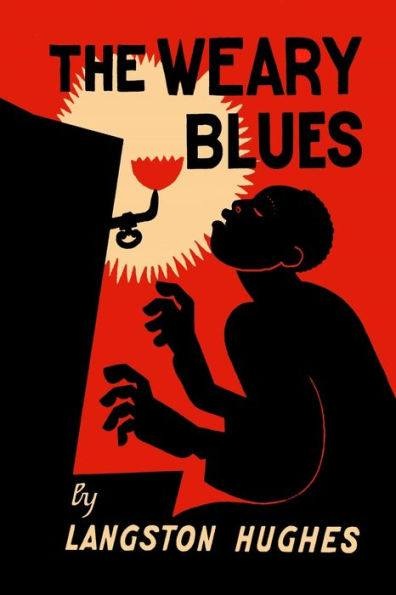
The Weary Blues cover 600

.

Now that I’ve written all that, I’m left with handing off to my musical performance of Langston Hughes’ poem. I felt compelled to “make a Jazz noise here,” as one of my models once titled an album. As a composer I don’t have the theoretical training that most modern Jazz composers do, but I put something together using a characteristic Jazz harmonic cadence. Then the composer called on the inconsistent musician me to realize it and improvise the top line melody. I’ve been practicing my poor chord-comping skills a little bit lately, so I was able to portray the set of written chord changes passably. Spontaneously creating while playing the melodic guitar line was easier for me, as I’ve always been open to improvising that sort of thing. When I start something like that, when I don’t know how to play it exactly – I may have an idea, go there, and see what would fit next. You can hear the result with the audio player gadget below. Is there no visible audio player? No, your ship didn’t leave port without you, it’s just that some ways of reading this blog will suppress showing the gadget, so I offer this highlighted link that will open a new tab with its own audio player.

.

*Putative slaves, property in this debased system, were valuable trade items. One of the most fascinating stories I ran into while researching Emily Dickinson and her family’s relations regarding American slavery was the story of a young, poor, but free-woman of color like Patterson, who was kidnapped to be sold out of state into slavery for a quick profit. Black Amherst residents “stole her back” and were defended in court by Amherst’s most notable lawyer: Emily Dickinson’s father.

**Hughes and his mother were estranged from his father, who had become a company man with the Pullman Company working out of Mexico City. Langston’s father agreed to support his education as long as it was aimed at practical matters such as engineering, not the arts. Langston Hughes agreed to make a go of that, but found he couldn’t leave his literary interests. The train trip to work out this ultimately-to-fail detente produced one of the greatest poems ever written by a teenager.

***Unintendedly, I seem to have stumbled into a theme this fall: literary poetry which has absorbed folk-music forms. Folk revival acoustic-guitar-based music and electric Rock are in my page poetry just as they are more explicitly in my Parlando Project pieces using other people’s words.

****Hughes sexuality is, best as I can determine, hard to determine. Some say he was gay, others assume bi. Some who knew him well paint a somewhat asexual person, or they just say, as I do, that they don’t know.
May Day, Monarchs, Milkweed, and Langston Hughes’ “Teacher”

I went to one of the marker events of my year, the May Day Parade in South Minneapolis last Sunday. It’s a wonderful thing to return to, kids and neighbors dressing up and marching from Lake Street to an urban park, some putting on elaborate homemade puppet exoskeletons, others holding signs of local resistance, beating drums, playing instruments, and riding on contraptions ranging from customized bicycles to the mighty fire belching Southside Battletrain hauled upstreet by local Anarchists, a tribe of pierced and tattooed Sisyphus.

But more precious than all this exuberance was that I got to meet up with my old friend, poet, cartoonist, and musician Dave Moore and his partner. We did as we have for many years: we sat on the low concrete curb near the start of the street parade. The little curb, inches high, is a perfect seat for the lower children, the ones that would leap up near us on either side of the march as any promise of tossed candy delighted them. Dave and I are not children, far from it. Oh, very far. Our old bodies creak up and down when we stand to clap, call out, and cheer “Happy May Day!” as the parade passes by. The tumult covers the sound of our joints, our happy shouts outstay our grunts and groans.

And then there is the silent thing Dave does as our neighborhood starts to disperse back to their homes or other activities after the parade passes. Dave carries a bag of milkweed seeds to the parade each year. The bridge whose street side we’ve been sitting on spans the Greenway, a reclaimed railroad right of way that’s now a walking and biking trail. In its older, more overgrown times milkweed lined the tracks, and the hulking trains then whipped up their fluff from the dried pods — little vegetive boxcars unloading the slightest, near weightless freight of their commerce. And so after the parade, Dave takes handfuls of those seeds he’s brought, and tosses them to the present air. They rise like tiny albino angels, swirling into May skies with a job in their seeds: milkweed is the manna of the immigrant monarch butterflies who migrate from Mexico, whose children depend on it when they are infants bundled as caterpillars.

That, kind readers, is a holy moment. The noise, the quiet, the Spring, the joy of workers celebrating their day.

But there’s another chapter in this story. Someone Dave knows sees him and stops to chat. He’s happy enough with the parade of course, but his conversation is troubled. He’s a schoolteacher. Looking nearly as old as Dave and I, he’s still working as such, and he despairs. The children have no attention span, no lessons can adhere, he reports. No one realizes how tough it is now, he says, and I guess I’m an example of that, but I hope he’s partly wrong. I’m one of those dried seed pods now, I don’t know where the escaped fluff I release here lands, and that lofted randomness releases me.

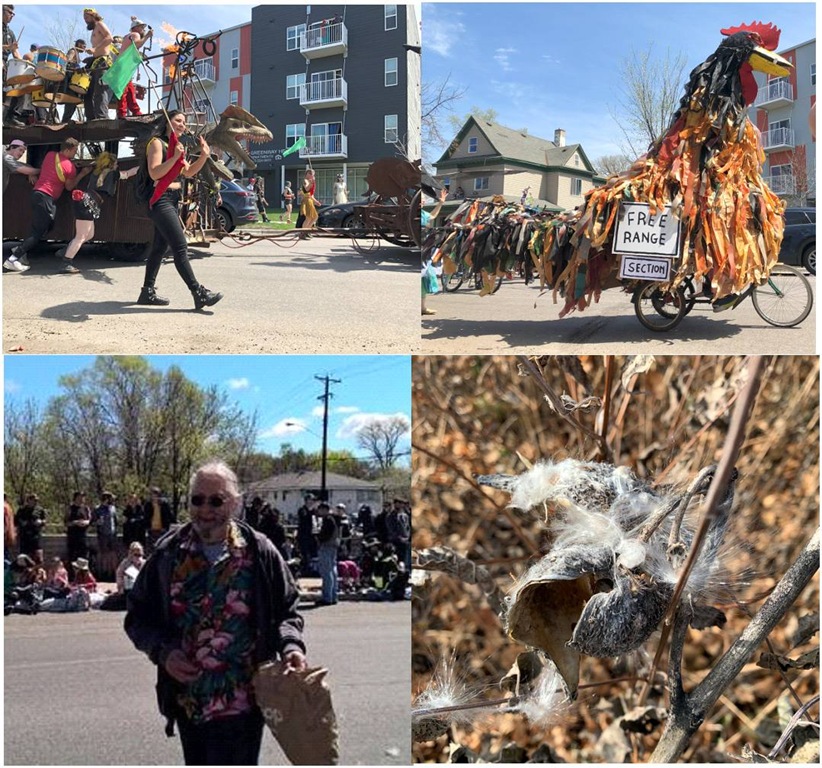
May Day and Milkweed Collage

I made a choice to not take pictures this year at the May Day Parade — but here are some older pictures: part of the Southside Battletrain, a bike-powered puppet-float, Dave with his bag of milkweed, and a milkweed pod

.

I thought of this teacher and his tale alongside this poem I perform today written by the young Langston Hughes. Hughes was in his 20s when he published it, so it seems to be another of those poems about old age written surprisingly in youth. Did Hughes have a particular teacher in mind, or was he (even unknowingly) writing about an element of himself as he created this epitaph? In “Teacher”  Hughes is engaging the poetic trope of the grave as a place of unending reconsideration, but as a person in their 20s he was a chrysalis where the pulpy worm may turn to wings — not a pulpy corpse under a dissolving summary. Hughes has his teacher in the poem speak as if the unvarnished holding on to virtue pinches the soul – and yet virtues are something that young people are always being told they need to develop. I don’t think such lessons are entirely wrong, but they are not the entire either. I think the star-dust that cannot penetrate the poem’s speaker is the diffuse, the random, the broad-spreading possibility. It’s a signifier of entirely unsure hope, a precious kind. Here’s a link to the text of Hughes’ poem.

You can hear my performance of Langston Hughes’ “Teacher”  with the audio player below. Because I wanted a slow, long-hanging-in-the-air, timbre for the guitar here I chose to play electric guitar on this performance— appropriately my Guild Starfire guitar for this representation of star dust or milkweed fluff. No audio player to be seen? Some ways of reading this blog won’t show it, this highlighted link will germinate a new tab with its own audio player so you can hear it.

.

Langston Hughes’ “Cabaret”

Before we close the book on National Poetry Month and International Jazz Day, here’s a musical performance of a poem by Langston Hughes. I didn’t think I’d be able to complete it today — but the opportunity arose, and it’s more than appropriate for both observations.

Langston Hughes was one of the founders of Jazz poetry, and that style of reading poetry that interacts with a musical accompaniment (even if it’s not sung) is an influence for some of the performances you’ve heard here in this Project. I can’t say what year Hughes first performed his poetry that way, but there’s another meaning to Jazz poetry without a band: poetry that writes about the experience of Jazz music itself. And Hughes was repeatedly doing that in the early 1920s.

Decades later, a 1950s Hughes reads his 1920s poem “The Weary Blues” in front of a Jazz combo

.

This, a combination that appreciated Jazz, was not a sure thing in the early 1920s. Afro-American intellectuals and cultural critics were not universally fond of Jazz and Blues music, these great Afro-American Modernist musical forms arising right under their noses. There were reasons: it was associated with drugs, drink, criminality, and sexual promiscuity — and none of that promoted Black achievement and excellence in their minds. And some young white folks were taking an interest in Jazz for those very reasons. Tut-tut voices from both racial camps were observing their young people and thinking it was all about mindless, hedonistic partying. Let me repeat myself: when the last decade to be called “The Twenties” was called “The Jazz Age,” it wasn’t meant as a compliment.

I’d suspect this isn’t widely known to many readers. Jazz, to our 21st century Twenties, might be felt as supposed-to-be-good-for-you-but-boring-art music made up of too many weird chords and snobbish old men with a fetish for instruments you blow into. If we take it too seriously, too often now, the problem in the 1920s was they didn’t think it had a serious bone in its body.

Maybe it helped that Langston Hughes was a young man, a teenager when the 1920s began. He appreciated things in Jazz and Blues that even his Afro-American elders didn’t see. He knew it could be a balm to pain and disappointment, its expression and expiation — and he could see the art in it, an art to wrap into his poetry. This small poem of his, published in 1923 in the W.E.B Du Bois/NAACP The Crisis magazine, hears something others couldn’t: he hears a Jazz band cry — or rather his poem reports a woman heard this. Here’s a link to the full text of the poem.

Even in the shortness of his poem, note the dialectic here. The band, earlier in the night, had dancers, “vulgar dancers” it says. The older cultural gatekeepers at the Crisis would agree as they accepted this poem, “I see the young poet is aware of the dangerous moral unseriousness of the Jazz hounds.”

Why could Hughes hear what others didn’t? Well, he’s a great poet, and a poet that wrote often and empathetically of other people’s experiences. There’s another possible element. Do modern ears hear the poem’s second line differently than his readers in the last Twenties? “They say a jazz-band’s gay” he wrote. “Gay” in the 1920s would have clearly meant “happy.” As far as scholarship understands this, gay=homosexual seems to have come into use a bit later, perhaps in the 1930s, and to general readers, that meaning emerged in an even later era.

Hughes’ own sexuality is not something we know a lot about. Some say he was gay, some say he was asexual. One thing I get from reading Hughes’ early poetry is that he’s hearing and telling his stories not just from a stereotypical straight masculine viewpoint. Is it his anima that’s the she who “heard the jazz-band sob” in the poem? Or is he just listening to a woman?

Well, my performance of Langston Hughes’ “Cabaret”  is ready to be heard. Unlike the last piece, I made no pretense of Jazz music as it’s classically understood this time, but I do throw in some weird chord extensions. You can hear it with the audio player below. No player to be seen? The dancers have left, and some ways of reading this blog suppress the display of the audio player. If so, use this alternative, a link that will open a new tab with its own player.

.

Langston’s Blues (Dreams)

Some of you made it through my summarization of the musical career of the Cats and the Fiddle Jazz combo this week, but even though I was writing about music, we didn’t add much poetry there. One little thing I found out since I wrote that summary: that eBay matchbook collector item should have tipped me off about the site of one of those young Chicago kids’ gigs — a way stop on a trip to Hollywood to try breaking into the movies. It wasn’t at the “Airplane Café Club” as Marv Goldberg had it from his research, but the “Aeroplane  Café. I’ve found a postcard. Looks pretty swanky. I wonder how the Cats act went down there in 1936 — did the Denver white swing kids dig their act? Four or five years later I’d give our band of audacious teenagers better odds on that.

Well, however they were received, they were young, they had dreams of a career ahead of them.

Aeroplane Cafe

Looking at what musical acts were playing Denver at this club and elsewhere during the ‘30s, it was mostly white bands for dancing. Black bands started appearing on the bills in the ‘40s. My research said the Aeroplane Cafe lasted until the ‘80s, hosting in its last years rockabilly bands.

.

So, let’s combine some literary poetry with music, Parlando style today. The words are by Langston Hughes, one of the first poets to recognize that Blues and Jazz were poetic, suitable for praise in poems, suitable to combine with Jazz words he’d contribute. When the young Hughes wrote today’s words for publication, he called the short poem “Dreams.”   I heard it as a kind of Blues, a Blues with a sorrowful side, but with an admonishment to endure. If some reading this are having a February of backlash and disappointment tempting despair, this is after all Black History Month. Afro-American poet Hughes knew that dreams may well be knocked down, ignored, belittled. Yes, I know the word “woke” is a word in present contention. I find it odd it is used by those who smirk and dismiss the word as they speak it, aiming it toward those who know very well the reasons that dreams are extinguished.

Hold fast to dreams
For if dreams die
Life is a broken-winged bird
That cannot fly.

Hold fast to dreams
For when dreams go
Life is a barren field
Frozen with snow.

I’m looking at a bare and snowy landscape out my window this evening. I rode to breakfast in 10 degrees with a cold wind this morning. I read the newspaper when I got to the cafe, because I’m a man who still spills eggs and hot sauce on the news in the morning. None of the news was good.

I spent my last couple of days making the musical piece work as well as I could make it, tickling an old guitar that I played when I was young, playing piano the way I can: a finger or two on the keys, tracking the left and right hand parts separately to disguise my ham-handedness — because music may find a way. I sang Langston Hughes’ words quietly, mouth up near the microphone. I had to, it was near midnight when I sang them, and my family was asleep and I want them to keep their dreams.

I want you too to keep the sweeter of your dreams. Waking right now can script all the nightmares and anxiety dreams that need no help. When the best mysteries come under the eyelids, ones almost too good to remember, I want you to keep them, even just the sense of them.

The audio player to hear my adaptation of Hughes’ poem I call “Langston’s Blues”  can be heard with the audio player gadget below. No gadget? It’s off dreaming, but you can also use this highlighted link which will open a new tab with its own audio player.

I’m planning to return in a few days with more on why I wanted to work at figuring out all I could about that young Jazz combo of the 1930s and ‘40s.

The Prodigal Son: Another mode of Fenton Johnson’s poetry

Over this February I’ve presented a variety of early poems by the lesser-known Black Chicago poet Fenton Johnson. Johnson self-published two book-length collections of his verse in the years before WWI, and he’s an interesting Afro-American poetic bridge between the turn of the century Paul Laurence Dunbar and the poets like Langston Hughes who emerged in the 1920s.

I try to remind myself that one of my goals in these posts is to make things accessible with fewer pre-requisites than a lot of other writing about poetry. Effective poetry can have a degree of timelessness, but I’ve come to believe Johnson was pioneering poetic expressions that we might forget haven’t always been available — so let me briefly explain today some more context that makes Johnson’s work especially interesting.

Dunbar and Johnson’s poems that use conventional late-19th century English language verse are a demonstration that Afro-American poets could utilize established prosody and forms while reflecting their own experiences; but then, as awkward as some of it seems to me,*  Dunbar and Johnson’s dialect poems helped further something Mark Twain and other dialect writers were bringing to literature: a sense that the common vernacular had it’s own poetic diction that could have value. By the time we’ve moved onto Johnson’s dialect mode in a poem like “Mistah Witch” we’re getting something that is Afro-American in both sound and sense. My estimation of how valuable “Mistah Witch”  was as an expression increased many-fold in my journey to performance of it this month. More than anything in dialect that I can recall from reading Dunbar, Johnson’s “Mistah Witch”  reflected the Blues poetry that I treasure in Langston Hughes and song lyricists that will follow. Was there a direct flow-line of this innovation? Did Hughes know of Johnson’s work?**

Today’s piece is another example of Fenton Johnson’s prescience. Within his first two collections Johnson included poems reflecting Afro-American preaching modes to tell pointed versions of Biblical stories. He often called them “spirituals,” and in Visions of the Dusk  where “The Prodigal Son”  is printed, he introduces that section saying this:

These songs we offer, not as genuine Negro spirituals, but as imitations. We attempt to preserve the rhythm and the spirit of the slaves, and to give literary form and interpretation to their poetic endeavour. Here and there we have caught a phrase the unlettered minstrels used; here and there we have borrowed of that exquisite Oriental imagery the Africans brought with them.”

Note the careful and crafted way Johnson frames this section, thinking perhaps of the broad “crossover” audience he desired. To extrapolate: You might enjoy this even if you think of Black people as less smart, he pardons. It might seem strange, but strange might be exotic like other “foreign” things that interest you from farther lands, he offers.

Afro-American spirituals as a song-form emerged in the late 19th century as a popular concert music. White audiences found them moving — and to the best of my understanding, they often came to those feelings in a non-condescending way. For the Black intelligentsia, as late as the between-the-World-Wars “Jazz Age,” spirituals were used as an example of successful and laudatory Black musical expression, while Blues and Jazz might be held at arm’s length as too reflective of baser contexts.

Johnson’s spirituals don’t sound to me like the anonymously-authored choral concert music that has come down to us as spirituals. We have sheet music from before Afro-American artists were generally recorded in the 1920s, but those printed scores don’t show something substantially like the word-music I see portrayed in Johnson’s spirituals. What I do  hear in Johnson’s Literary Spirituals — something recoverable once later recordings entered our historic record — is Afro-American preaching modes.***  This style of preaching is musical, and it will (like Johnson) make quick jump-cuts to other ways of seeing an element of the story being portrayed.

The Prodigal Son

Though it appears in the table of contents as “The Prodigal Song,” here’s Johnson’s poem as it appeared in his 1915 collection Visions of the Dusk

.

As it turns out, this is a strong and versatile poetic form. It continues to be a significant part of the Afro-American strain in American literature. Although we “hear” it through Johnson’s silent printed pages, and also through his particular mind and ear, these poems are valuable in preserving some of this tradition.

Johnson, largely based out of Chicago, was well-placed to observe this. Not only because of Chicago’s diverse Black community including many “Great Migration” internal-immigrants from across the American south, but because Chicago seems to have been a key center in the development of the more overtly musical strain from this tradition, Afro-American Gospel music.****

My performance of Johnson’s “The Prodigal Son”  is not exactly Black Gospel — I’m not sure it’s anything genre-wise really — but it’s more my independent attempt to perform the wide-ranging text of the poem with the musical resources I could bring to bear on it this month. “The Prodigal Son”  is easier to see as a Modernist poem than the more formal, redolent of the 19th century verse I started with this February. It uses a free sense of phrasing in its meter. It uses near-rhyme subtly but has no fixed rhyme scheme. And look at how the poem’s narrative cuts cinematically: starting with a specifically northern speaker in a blustery Chicago winter, to a jump to the Biblical parable of the wastrel son who is seen returning home and the father calling for a welcoming feast, followed by what?*****  Not a homecoming to a BCE Middle-Eastern farm settlement, but heaven, cast with Biblical notables — yet, the feast of welcoming does  occur.

As the poem moves on, a litany of the particular sufferings of American chattel slavery are movingly condensed, in this section echoing the abolition/Underground Railroad folk song “No More Auction Block.”  This welcome heaven/home will have no drivers’ whips, no bread and water diets, no more auction block separating families.

Johnson has one more final jump cut, one in time and place: we end at the River Jordan as the River Lethe (the river addressed in “Waters of Forgetfulness”  earlier this month), and at the end we find that our poem’s singer hasn’t yet arrived to what the middle of the poem has described.  This, the concluding metaphor for America: if we’re a nation of immigrants — including kidnapped ones, and ones driven here beyond their wills — we may find ourselves still awaiting arrival to the fulfilled landing of that promise.

My performance, as I said above, doesn’t really use Gospel music elements. Not only would that be a challenge to my singing constraints, I haven’t found the time to build a more grand musical ensemble that this poem could be said to deserve. I hope the sparse voice and acoustic guitar presentation you can hear below does it some justice. You can hear it with the audio player you should see below. No player? This highlighted link is a backup.

.

*I’m not alone in finding this part of their work troublesome. I can’t say how white audiences of their time might have viewed it, but the air of minstrel show stereotypes must have been hard to escape. When performing blues tunes in vernacular I’ve made the choice to not put on vocal black-face — in part because I’d be bad at it — but also because it can’t (for me) escape that burnt-cork shading, even though I’ll retain informal/colloquial syntax.

**Likely Hughes would have known at least Johnson’s later post WWI work as they published in the same journals and were included in early Afro-American poetry anthologies together. But independent observation of less-documented Black musical expression contemporary to them both (though this was not yet widely recorded for posterity) would have been easy for the two of them. There’s no reason I’m aware of to think that Hughes used Johnson as a model, but it’s fair speculation that reading Fenton Johnson, even incidentally, could have validated or confirmed to Langston Hughes that he was onto something worthwhile.

***In the between-wars era, besides “live” sermons in church or over the radio, we have commercial recordings issued by the same “race records” companies that would have pressed Blues songs — recorded sermons which likely reflect what Johnson could have heard prior to WWI from a slightly earlier generation of Afro-American preachers.

****Did Fenton Johnson influence Thomas Dorsey and contemporaries who helped formulate Black Gospel music in Chicago in the 1920s? I have no evidence, not even a likely. I’m reduced to those expressions from bad cryptozoology and UFO documentaries: “What if…” and “Could it be possible….” Weak stuff. Common inspirations is the real likely here — but with Johnson’s poetry we do have interesting examples of how this was emerging.

*****This is one of my favorite parables, because its narrative point is that the other sons are totally non-plussed by the father wanting to welcome the ne’er-do-well who’s been off carousing with outsiders, finding non-productive failure, and generally sinning. Other sons: “We had to stick around with you pops, doing all this righteous stuff day after law-following-day. Where’s our bar-b-que old man?” The point Jesus and Johnson then make from this: you celebrate the ending of suffering, and that goodness is its own reward.

Langston Hughes “Summer Night”

All too often there is someone dying that interrupts the summer. In my neighborhood, a musician* named August — even doubling the metaphors, named August Golden — was shot and killed last week. His friends speak highly of his kindness and good heart, and we don’t know exactly why he was killed when someone shot up a house concert in a backyard, wounding several and killing him. The story is the shooter came up, said nothing, fired a bunch of shots, and escaped running down an alley. There’s speculation that the attack might have something to do with the young gay and trans audience at the concert, and so — beyond the don’t-knows — that community has fears that this could be.

I’m thinking of August Golden on the anniversary of the poet Lorca’s killing in the midst of the Spanish Civil War. Revisiting Lorca’s story today to see if there was anything new — for example there have been multiple efforts this century to locate where the celebrated poet’s body was buried — I see that there’s also no agreement on who killed him in 1936 or why. It could have been Lorca’s politics, or because Lorca was gay, or even some personal dispute.

Today’s text is not by Lorca, but by his American contemporary Langston Hughes, a poem he called “Summer Night.”   You can follow along as I discuss my impressions with this link to the poem. Hughes doesn’t say what summer month this night was in, but it feels very much like August to me. In America, and its northern parts, August has endings all over it. Long daylight hours recede. The freedom of summer for the young approaches the beginning of school weeks. Autumn and cooler weather beckons, and I’ve started wearing a jacket on some early morning bike rides.

Langston Hughes in front of graphic

Young Langston Hughes, writer and poet, and one of the early proponents of “Jazz Poetry”

.

Hughes’ poem seems like that August of calendared endings, because he starts out with a litany of “lasts” in his poem. As in another Hughes poem I’ve presented here,“Railroad Avenue,”  what he sees is as much what he hears, and it’s full of music of his turn of the century youth: “last” pianos, a “last” wind-up Victrola record player playing Jazz, and the cries of others — or their absence — with a “last” crying baby ceasing to silence. This section ends with the whispers of a heartbeat.

Hughes’ poem continues with its speaker (for simplicity, let’s assume it’s Hughes) now refraining on the word “empty.” What’s this night empty of?**  Music and the companionship of voices. Hughes could have spent the entire poem describing tossing alone at night, but he doesn’t. He spends almost as much time on those things that depart in the poem. Maybe mechanical pianos don’t play in your neighborhood. Maybe it’s break-beats leaking from cars or punk rock not Victrolas, or the house on my corner that plays Mexican music on the weekend as folks gather under an awning on the front yard. This is what we miss when dying interrupts August. This noise that keeps us up, keeps us living.

For my noise tonight, I wanted to summon remote, leaking, night music. I decided to take a cue from the poem and use piano, but as I worked on the piece with my limited keyboard skills I chose to depend on sound design more than other musical ideas. The piano parts are simple triads, but mixed in the grand piano sound is a subtle melding of electric piano. And for the bass part, which was the musical line I followed when speaking Hughes’ words, I decided to mic my Epiphone Jack Casady hollow-body bass as if it was an acoustic instrument and to mix that with the electric pickup output the bass was designed to use. You can hear the result with the audio player below. No player?  This highlighted link will open a new tab with its own audio player.

.

*The stories told about August Golden make him out as an embodiment of DIY punk, the whole idea that you learn to make what you want to have happen by making it happen. I recently wrote of the same spirit as a large part of what animates this project.

**Expanding on that final section where Hughes also talks of desire and “Needing someone, something.” Hughes sexuality is something of a mystery. There are some who believe he was gay, and others who thought he was largely asexual. This poem was included in his first poetry collection published while Hughes was in his twenties, and we do know that in his Victrola-era youth he yearned to be a writer, while this was strongly discouraged by his father.

Observations and Questions Concerning Carl Sandburg

I’m in Asheville North Carolina this weekend, and I visited the Carl Sandburg home national site not far from here. Longtime readers will know that Sandburg is a touchstone for me and this project, and so I thought it’d be worthwhile to put down a few observations and questions that have arisen from my visit in consideration of Sandburg.

I think Sandburg has suffered from succeeding in doing something we no longer expect poets to do. He achieved a certain level of fame during his lifetime — and that alone is problematic. If poetry has lost sufficient cultural interest, as some critics and some poets believe, then a poet too famous has presented a case that they aren’t really writing true poetry. It doesn’t help that Sandburg wasn’t known as a critic himself, and didn’t present an explicit theory of how poetry works. This led to an assumption that there’s no depth, originality, or vision in his work. From this perceived lack, his fame — and one might assume his influence — died off quickly with the celebrity poet character he became in his long lifetime.

Yet there’s one line of influence that I say is underappreciated, one that flows from his writings and public persona, a path of influence that mixed with others who had complementary urges. That line of influence runs through Sandburg’s work with American folk music. He seems to have been working roughly contemporaneously with John Lomax and Charles Seeger* in popularizing folk music at a time early enough that one couldn’t yet term their actions a revival. And he was mixing these folk tunes collected from various subcultures in America’s regions and mixing them within a project that included outreach of high culture poetry and a lefty political slant from the presenter, as if it was all one thing. There was no natural reason these things were required to be combined, and so a successful poet and author combining them, as Sandburg did, helped set the format for the progress of the folk music revival from the WWI era through to the eventual “folk scare” of the Fifties which launched Bob Dylan and many others who would be called song poets.

Sandburg-grandkids-guitar today

Sandburg singing with his grandkids. Note the classical guitar position, a way of holding acoustic guitars I adopted too. Guitar and piano currently in the Sandburg home. I couldn’t get an angle to read the headstock. Anyone got knowledge or a guess what make and model is is?

.

Critical intermediaries in this half-century progression were Pete Seeger and Woody Guthrie, and I’m often struck by how similar their presentations were to Sandburg’s. If you mix Sandburg and Will Rogers** into a cloning machine you wouldn’t get an exact Woody Guthrie, but you’d likely get something like him. Guthrie familiarly called Sandburg’s pioneering 1927 folk song collection The American Songbag  “Carl Songbird’s American Sandbag.” And like this project, Guthrie played and composed music to accompany Sandburg poems for public performance. Pete Seeger’s Chautauqua-ish concerts presented to and aligned with a Sandburgian “The People, Yes”  outlook. Seeger’s breakout group The Weavers made much of this blurb given them by Sandburg “When I hear America Singing, I hear the Weavers.” Before that, when he was beginning, Pete claimed he got ahold of American Songbag   when it came out. Again, like Woody, Pete was Pete. They added themselves.

I admire Langston Hughes, and while not single-handedly, he’s seminal in the development of Afro-American poetry. In reading his early work, some of which remains in the forefront of his legacy, I hear strong echoes of Sandburg’s word-music. Are they both hearing Walt Whitman in their ears? Likely, but the concision of many of Sandburg’s early poems is not Whitmanesque, and Hughes’ poetry likewise could be concise. Langston Hughes was too, himself, but a poet like Sandburg at least ran interference for his work.

Hughes was an early proponent of Jazz Poetry, yet Sandburg’s “Jazz Fantasia”  was there to serve as an example when Hughes’ first poems were published. Later on, I was often hearing elements of Langston Hughes in Gil Scott Heron, and if we continue that line, perhaps there are reflected elements of Sandburg is some down-tempo, socially conscious rap.

One of the things a tour of Sandburg’s home offers is the ability to peak at his many bookshelves and scattered magazines. They show a man with wide interests in politics and human rights alongside poetry. Here’s one little something I didn’t expect to find, wedged in between The Roots of American Communism  on its left and McCarthy: The Man, The Senator, The Ism  on the right: a copy of a science fiction magazine. Did Sandburg read or at least casually follow mid-century SF? Has anyone even asked this question? Is there any way to answer it? Was this one issue or are there many in the house?

Fantasy and Science Fiction

The magazine is right next to the McCarthy study. Hard to read the spine, but it may be this issue.

.

Here’s an oddity that I thought of while sitting in Asheville thinking also of the Black Mountain College that existed nearby. From 1945 when Sandburg moved to North Carolina until the college closed in 1957, it existed in the same part of the Blue Ridge mountains with Sandburg. In the 1950s it became the locus of a group of poets*** who eventually were called The Black Mountain Poets after the school. You might wonder (well, I did)  did any of them seek out Sandburg, or did Sandburg make any note of them? So far, I can find not a trace of an answer to that question. Was Sandburg either too busy or too retired to mix with them? Was he considered too mainstream and successful to be of interest to insurgent “post modernists?” Many Black Mountain Poets admired and communicated with William Carlos Williams, Sandburg’s contemporary — but Sandburg too had championed a more American and less European-culture-centric style of free verse continued by the Black Mountain Poets. There’s a dog not barking there.

In the end, I suspect Sandburg might be comfortable with his diminished reputation in the 21st century — even if I’m not. Sandburg often spoke of the work of the people as being continuous, of that factor being part of the peoples’ power. In that way he might be satisfied. Things he helped build, put in motion, continue to move forward, change, and develop.

For an audio piece today, here’s a short poem by one of the foundational Black Mountain Poets Charles Olson titled “These Days.”   I performed it acapella this morning, recording this very short piece on my phone in a less than quiet room I’m staying at. It speaks of something Olson and Sandburg might have agreed on. You can hear it with the audio player below, or if you don’t see that, with this backup link.

.

.

*Father of Pete, Mike, and Peggy Seeger. Husband of Ruth Crawford Seeger.

**Will Rogers arose in a very similar time-frame to Sandburg. The amateur guitar player/author/speaker Mark Twain had died just a few years previous. The clever yet folksy artist observing the entire range human behavior from a loving/skeptical non-East-coast/high-culture place was a needed character in American life, and while Sandburg isn’t a Twain clone, the role he played was somewhat successive.

***The list of other famous students and teachers of Black Mountain College included Buckminster Fuller, John Cage, Charles Olson, Walter Gropius, Joseph Albers, Robert Motherwell, Robert Rauschenberg, Merce Cunningham, John Cage, Paul Goodman, Franz Kline, Willem de Kooning, Robert Creeley and Robert Duncan.

Jazzonia: May Music Find a Way on International Jazz Day

The end of U. S. National Poetry Month is approaching and there are things I meant to get done (and didn’t) this year, but the last day of April is also International Jazz Day, and I can’t let that go by without a piece to celebrate. Poetry Month and Jazz Day — shouldn’t that be a piece of Jazz Poetry read in front of a Jazz combo?

I looked around the house and didn’t find one. Not the Jazz poem, it was easy for me to think of Langston Hughes, one of the originators of the form, and find a poem of his, “Jazzonia”  that I didn’t perform when I celebrated his book The Weary Blues  a couple of years ago.

No, it’s the Jazz combo that’s missing. Not in the garage, not in my studio space, not under the table in my office amidst that messy pile of stuff. Not in my phone’s contacts list. None marching down the street in my city too northern and cold for Mardi Gras.*  Oh sure, there are a couple of Jazz clubs in town, and local musicians who can play Jazz, but I don’t know them. I’ve handed out Parlando demos to a couple over the past few years, and heard nothing, which may indicate politeness around my audacious use of my limited skill-set — and that would be right. I can sort-of hang with a Jazz feel on a good day with guitar as long as I’m under control of the context,** but Jazz isn’t about tightly controlling the context. It’s about surprise, about flexible chops that fit with a multitude of things.

So, I went about doing my best with what I had at home. I have a little device I use to practice instead of a metronome. It lets one play-in a set of chords in rhythm, and then generating from the form you play a drum and bass track following the harmonic material in tempo you’ve given it. It’s a fine quick practice tool, but I’ve only used it a couple of times here for public Parlando Project pieces.

I prefer to put in work on the digital drum tracks, adding hand percussion, even playing a real ride cymbal I collected from a neighbor a few years ago, editing the hits and beats on drum patterns — but I let that go this time. The machine had supplied a serviceable walking bass part, I let that stand as well. I played the guitar part in a single pass after warming up. I had to duck out a couple of egregious clams, but it represents one of my good guitar days.

Jazzonia 2

In the whirling cabaret, guided robots and human jazzers play for Poetry Month and Jazz’s Day.

.

Looking at Hughes’ poem (full text here)  I see that he specifies there’s six Jazz players in his poem’s combo. If I count my reading at the mic as a player, that got me up to four, including the two robots on bass and drums. So, I next checked out my naïve piano skills. I was pleased with a couple of little motifs I came up with. My repetition with under-elaboration of those motifs marks this piece as more of the simplified “Soul Jazz” emanation*** than a hardcore blowing session. That’s OK with me, I liked those records. For the sixth and final musician, I played some vibraphone over MIDI from my little plastic keyboard.

The above account may have convinced too many readers to not listen to the result, but for a one-day-wonder I think it came out pretty well. It’s a little longer than most pieces I present, but that lets its relaxed celebration grow on you if you’re receptive. The audio player gadget to hear it is below for many, and this backup highlighted link is for those that don’t see that.

.

*One thing my town once had, and I now miss, was the May Day parade that happened each year in my neighborhood. Elaborate giant puppets, kids on decorated bicycles, dancing troops, folks on stilts or riding on fantastic creations, and usually more than one amateur shambling marching band with a touch of second -line New Orleans flavor. Alas, lack of funds and what seems to be a case of sectarian infighting has stopped this annual event. I did some videos of this while it was still a going thing. You can see some here, here, and here.

**Jazz guitar is much about chord chops, something I’m embarrassingly bad at. Similarly, advanced Jazz harmony will confuse me quickly if I try to understand it in real time. Luckily, with this Project I usually get to be the composer and bandleader, so I work with myself the player to do what I can accomplish.

***You’re still here reading the footnotes? Good, this probably should have been the main thing in this post. Langston Hughes’ long life and immediate and lasting appreciation for Jazz meant that he could write about and be influenced by early Jazz when Dixieland was fresh, and then he continued to dig it, incorporate it, and perform his poetry with Jazz musicians in the post-WWII years. So even though Hughes wrote “Jazzonia” about 1920’s Jazz, he lived long enough that he could have performed it more in the mid-century bag I experienced then and sought to manifest today.

What’s extra cool about how Hughes presented the still emerging Jazz of the 1920s in “Jazzonia”  is that he sees it already as part of a continuum from the African Garden of Eden, and then via Cleopatra, and through Harlem Renaissance — so it’s no surprise his Jazz, and Jazz itself, can keep on reformatting itself into new ways of expression. The honesty I shared regarding this audio piece above? It’s part of living the Musician’s and Composer’s Prayer: “May music find a way.”

Winter 2022-2023 Parlando Top Ten

It occurs to me that it may have been a while since I’ve reminded new readers what the Parlando Project is, has done, and tries to do. It started as an idea around 2015 to focus on something I’d done off and on for decades: to combine other people’s words, usually literary poetry designed to be seen on silent pages, with a variety of original music.

I did this not only because I think it’s fun, but because the process allows me to more deeply absorb some sense of what the poets are trying to convey. At least for me, I can read a poem with my eyes and sense that there’s something wonderful there — but then to read it aloud, perhaps even to sing it, allows me to inhabit it, to visit the environment inside it, as if one is deep inside some forest, awash at a water-brink, or walking down its street or inside some meaningful building.

Reading a poem silently is like looking at a picture. Performing it aloud is painting the picture with the words still wet.

Early in the Project many of these performances were with others, most often my long-time musical partner Dave Moore. For a number of reasons those opportunities have decreased. These days the typical musical setting here is composed, and all the parts played or scored, by myself. I’ve done a handful of pieces in the Project without instruments, but that’s unusual. I think that even though they are played by a one-man-band I want the words to have companions. Even the loneliest poems can have these here.

I do these pieces myself, not because I have great confidence or a high appraisal of my musicianship. Far from it. I compose and play the parts because I’m available. I’m an amiable contractor to myself, I enjoy playing different instruments, and I’m unafraid to dive into a variety of musical environments. My estimate is that most musicians who hear what I produce for the Parlando Project are unimpressed by this work, in that I almost never get responses from them when they are exposed to it.*  My guess is that is because I use simple ideas, and my realization of even these basic conceptions via my own playing has imperfections. My musical “thing” is more at participatory folk music or the punk/indie ethos — and though I try to produce good work here, and I’ve put effort into that, I don’t consider many of the Parlando Project pieces the best realization they could have. When I’ve taken to putting up chord sheets of some of the simpler acoustic guitar pieces here in the past year, I’m thinking that a better singer or player might take them to a better musical place.

Hepcats of Venus

Imaginary band gets down in beatnik cellar. Illustration shows my younger self & spouse in the center. W. H. Auden taps his cig on the ashtray in the foreground. Behind the drummer, Gertrude Stein considers Virgil Thomson.

.

Now let’s get on to a brief rundown of the Parlando pieces that were most liked and listened to this past winter. I do this countdown style, from 10 to the most popular. The highlighted titles are links in case you’d like to see what I wrote about the pieces when I first presented it.

10. All Souls Night by Hortense Flexner.  Long-time readers here will know I like to go beyond “Poetry’s Greatest Hits” here, and this spooky piece by a little-remembered author from the time of WWI continued to be listened to long after Halloween.

.

9. “Uncle Sam Says” by Waring Cuney.  This one, jumping forward to the WWII era, is almost cheating, as Cuney, a friend of Langston Hughes, engaged here in straight-out songwriting with bluesman Josh White. I’ve been playing a bit more bottleneck slide guitar this winter, and that’s what I used to accompany this message song about a segregated military.

.

8. “Now Winter Nights Enlarge” by Thomas Campion.  Speaking of songwriters: poet, musician, and Elizabethan-age physician Campion also intended this to be sung — although, as with “Uncle Sam Says,”  I didn’t use the original music for my performance.

.

7. “The House of Hospitalities” by Thomas Hardy.  A poet who spanned significant chunks of the 19th and 20th centuries, Hardy was well-versed in poems of rich remembrances, as in this Christmas season memory of holiday celebrations past and gone.

.

6. “I’m Sorry for the Dead Today” by Emily Dickinson.  One of three appearances by this crucial American genius, this one a jolly remembrance of a cooperative harvest time in Amherst.

.

5. “I’m Afraid to Own a Body” by Emily Dickinson.  An opening line or two in a poem can grab even the most inattentive reader sometimes, and this poem’s opening pair of lines certainly did so for me this winter.

.

4. “Fairy Song” by William Butler Yeats.  Like many a Yeats poem, this one beguiles you and me with its lovely word music. Then I read the play whereupon the poem appears and discovered that its context is exactly that for the song’s singing fairy: a beguiling away of a distressed person from their heart, hearth, and home. That wind that opens this poem is chilling once you know.

.

3. “I felt my life with both my hands” by Emily Dickinson.  I cannot say authoritatively what Dickinson intended the context of this poem to be, but I read it as an examination of body dysphoria, though I’m unsure if anyone else has “read” her poem that way. As I have sometimes done, I’ve performed this with what I call an “Inline Epigraph,” quoting a line from a Lou Reed’s song “Candy Says”  before the concluding section of Dickinson’s text in my performance. I often think of poems as being in conversation with each other.

.

2. Railroad Avenue by Langston Hughes.  I spent an enjoyable but inconclusive time searching for the “real” Railroad Avenue, thinking it could be like Van Morrison’s Cyprus Avenue or a NYC address in a Frank O’Hara poem. Couldn’t find it. May be it’s only mapped in Hughes’ imagination, a construction for the purposes of the poem. Long-time reader rmichaelroman reminded us in comments that America’s separations often are lined by being right in one’s memories from the “wrong side of the tracks.”

.

1. “I’m Gonna Make Love to my Widow ‘fore I’m Gone” by Frank Hudson.  Another bottleneck guitar piece that readers and listeners liked a lot this winter. Well — a self-penned piece about good old-fashioned winter randiness made it to the top of the Top Ten. Go figure. They’re talking single digit wind-chills and a March snowstorm as this week ends up here in Minnesota. Codger cuddling is carbon-free heating people!

.

.

*I ascribe this to politeness on their part. I tell myself that I overvalue the audacity and aims of what I do, when simple competence with simple ideas might be preferable.

Railroad Avenue, Langston Hughes’ Locus Solus

Returning to the poems published in the 1926 issue of Fire!!  magazine which proclaimed it was “Devoted to Younger Negro Artists,” we get this simple seeming, yet mysterious poem by one of Fire’s  most famous contributors and organizers: the then 25-year-old Langston Hughes.

“Railroad Avenue”  looks like a simple free-verse street-scene vignette. Here’s a link to the text of the poem if you’d like to follow along.  Yet the more I looked to understand it, the deeper the mystery of it became.

Here are a few things that seem quite clear: it’s evening. There’s a street, likely named by the poem’s title. A few things are seen or heard: lights in two businesses, a boxcar, a record player, a player piano, a boy and a girl, laughter. Largely unremarkable things, so there’s some specific character given to them.

The record player is a Victrola, a short-lived brand from the early 20th century — for example, the ones with the big conical horn as in the original RCA Victor logo. The businesses are a pool hall and a restaurant serving fish. The boy is at leisure, comfortable. The girl has a dark face that is powdered.*  In what may be internal monologue the poem’s narrator gives us the winning number in the day’s policy game.**

So, are we clearly visualizing the place being described? At first I thought I could. I figured without evidence that this was a crowded urban nightlife street, the two other people only examples of many, the sounds and things part of what could have been a larger catalog. Is that reading possible? Two things mentioned that are likely heard not seen: the player piano (reasonably loud) and the Victrola, which would not be. Victrolas were not electric record players. The records turned via clockwork, the sound was produced acoustically from the grooves in the records. So, it’s not blaring out a window over robust street sounds. If the statement on the winning daily number 942 is audible rather than the interior thoughts of our narrator, it too would likely be at a conversational level (given no indication that the speaker/thinker won).

And then there’s that boxcar. Mentioned twice, Hughes really wants us to see that there’s this boxcar there, yet says nothing about it other than also saying twice that it’s forgotten.  What’s that mean? A boxcar is a freight train car. This is not an urban light rail or passenger train line being invoked. Who forgets a boxcar? Is it just one piece of rolling stock left off somewhere as a spare or scrap? While the poem doesn’t say this, I began seeing it as part of a train on a grade-level street crossing, with the boxcar’s location blocking the road, a location so that it has to be mentioned, can’t be ignored. Did Hughes see this clearly in his mind and forgot to make it plain in his poem, or am I imagining things?

This vision invoked in me of a small town to small city location where the freight train line runs on grade-level, not on bridges over the roads or in tunnels under them, let me begin to see this as a much sleepier street. This isn’t the busy streetlight and neon Harlem of Hughes’ Harlem Renaissance. The dusk is “dark,” the street quiet enough to hear things distinctly as the evening begins. As the poem reaches a crescendo portion, it’s laughter we hear. It’s “sudden,” indicating that it startles the relative quiet and is not muffled by it. Hughes metaphorically amplifies that laughter with repetition — stating that this laughter with its transport from the ordinary and unenergetic street is able to shake the shop lights and move billiard balls.

This is a poem published by a 25-year-old, but I get a sense this may well be a memory of an even more youthful time with daylight ending, with sounds and a scattered glow from remembered lit windows. Dusk is a marking time for many young people, between the era when it says “time to go home” spanning to the age of “time to first go out and explore your nighttime world of romance and adult recreation.” I wondered, would the poem have more context if I knew where the poem’s titular Railroad Avenue is? America has lots of Railroad Avenues and streets, so the name alone tells us little, other than this isn’t a boxcar dropped off miles from a rail line.

Broadway AKA Langston Hughes St and Railroad Ave in Joplin MO

A Google Streetview showing the intersection of a main Joplin MO street now renamed for Langston Hughes with Railroad Ave. Google’s camera vehicles didn’t drive & record down the gravel path that is Railroad Avenue right beside the train tracks.

.

I spent half a day trying to figure out where such a street might be in the places the young Hughes was known to have lived. I’ll summarize the candidates as briefly as I can. He was born in Joplin Missouri, and there’s a very good Railroad Avenue there, with everything you might want for this less-populated scene — though the Afro-American population at the time Hughes’ family lived there was low. But Hughes and his parents left Joplin when Hughes was around 1-2 years old, and there’s nothing I could find saying anyone went back. And was Joplin even big enough and ethnic enough for a numbers game? Hughes spent his grade-school years in Lawrence Kansas being raised by his grandmother. Yes, there were some Black neighborhoods,*** but no likely Railroad Avenue. He spent time at Howard University in Washington D. C. There’s a Railroad Avenue in that city, but it’s far from Howard, and seems to be (and likely was) a non-descript industrial area. Afro-American Howard students might spend evenings on U street circa 1920, but like Harlem in that era, it’d be lit and busy, and no likely boxcars there.  Hughes attended Lincoln University in Pennsylvania, and once more I thought I might have a chance. Not as urban circa 1920 — but then no Railroad Avenue, not even a railroad line for more than 15 miles that I could find. And even if he’s a famous figure from the Harlem Renaissance, Hughes’ Harlem is as unlikely for a sleepy dark dusk with a grade-level railroad line as Washington D. C.

Is Railroad Avenue just something Hughes made up? Is it someone else’s story, something he absorbed from a friend, or his mother or grandmother? Did he go back and visit his birthplace Joplin before 1926 and observe a relaxed scene somewhere on that gravel-surface Railroad Avenue? I’ll probably never know.

But what’s up with that boxcar? Why is it so important, and so specifically forgotten? As a short, Modernist free verse poem, we can think: “So much depends/upon/the boxcar/serenaded by a/Victrola/beside a purple/powdered girl.” One theory: the boxcar is a plausible hobo-ride escape out of the town, but our narrator either doesn’t want to leave, or doesn’t know if the train-car is soon going his way. Within a year Hughes published another poem “Homesick Blues”  written more in Southern Black dialect about someone looking to hobo back south.****  Another theory? If, as I imagined without direct evidence, the train has stopped and the boxcar is blocking the road, it’s a symbol of systematic blockage of the people in the scene. Whoever owns/controls the boxcar doesn’t even need to care about this (it’s “forgotten”) — and meanwhile the laughter of the folks in the scene mitigates their lives as they deal with this unfair, indifferent, hindrance.

I’ll conclude by admitting I composed the music and performed Langston Hughes’ “Railroad Avenue”  without knowing exactly what the poem was about. I did have my supposed internal vision while doing so: it’s a small non-urban place, like some in Hughes’ youth. A boy or young man is watching the grownups, thinking without even thinking much, about where he might go, what he might do as he grows up. He knows somehow this, and he, will go away — but this evening he’s there. That personal, practical, vision of mine is, as Hughes has it, “Neither truth nor lie.”

You can hear my performance with the player below, or lacking that, with this highlighted link.

.

*This line is the only one that specifically calls out the racial caste situation in the poem. Powders to lighten the skin tone of darker skinned Afro-Americans were a common cosmetic in Hughes’ time.

**Number or Policy lottery games were present in cities by the time of this poem. The illegal gambling game was usually a daily low-cost bet, winners determined by some coincidental trio of numbers that could be found published daily in newspapers. While associated with Afro-Americans, it was played by other ethnicities too. I don’t know much about its plausible presence in smaller cities and towns before 1926, though Wikipedia says such games go back to Civil War times.

***During the mid-19th century violence of the “Bloody Kansas” struggle to decide if Kansas would be admitted to the union as a slave or free state the pro-slavery forces sacked and destroyed Lawrence more than once. John Brown became a leader of guerilla anti-slavery forces in Kansas, and Hughes’ grandmother, who largely raised him, had a first husband who was killed with Brown at Harper’s Ferry.

****Example that Hughes was comfortable writing either as a collective noun or in the voices of personas.