Two Minnesota-based Irish-American poets who Dave Moore and I knew and worked with (Kevin FitzPatrick and Ethna McKiernan) used to give an annual St. Patrick’s Day poetry reading in the Twin Cities, a tradition that was ended by their final illnesses and death a few years back. It’s occurred to me that I can carry on that tradition here, so, let’s do that. I’ll start with one of Kevin’s poems.
Kevin’s poems are often parables. He’ll tell a story, most often using simple, off-hand language, though that story may encounter unexpected jumps. A bit of dry humor will often stop by. From working on and talking about poetry with Kevin I learned about the craft and intent in his language. The poems rhythm, sequence, and word-choice were honed – what seemed casual was thought out, and being able to see many of his poems move from earlier drafts to final versions, I’d see Kevin’s poems ending up working like good, even more highly compressed short stories. Like Joyce in Dubliners, the mundane and the particular are a setting in which to find an epiphany.
Here’s a poem, “Two Cities,” from one of his earlier collections, 1987’s On the Corner. It’s set distinctly in Minnesota’s Twin Cities (Minneapolis and St. Paul). These are two, barely fraternal twins. Minneapolis: larger, traditionally more Protestant (its early civic leaders were often New England WASPs) including a strain of tony liberal Republicans that have all but disappeared. St. Paul, more Roman Catholic, smaller, less seated with secular high-culture institutions, a stronger union town. Though not identical twins, they are cojoined, their borders entirely coincident.
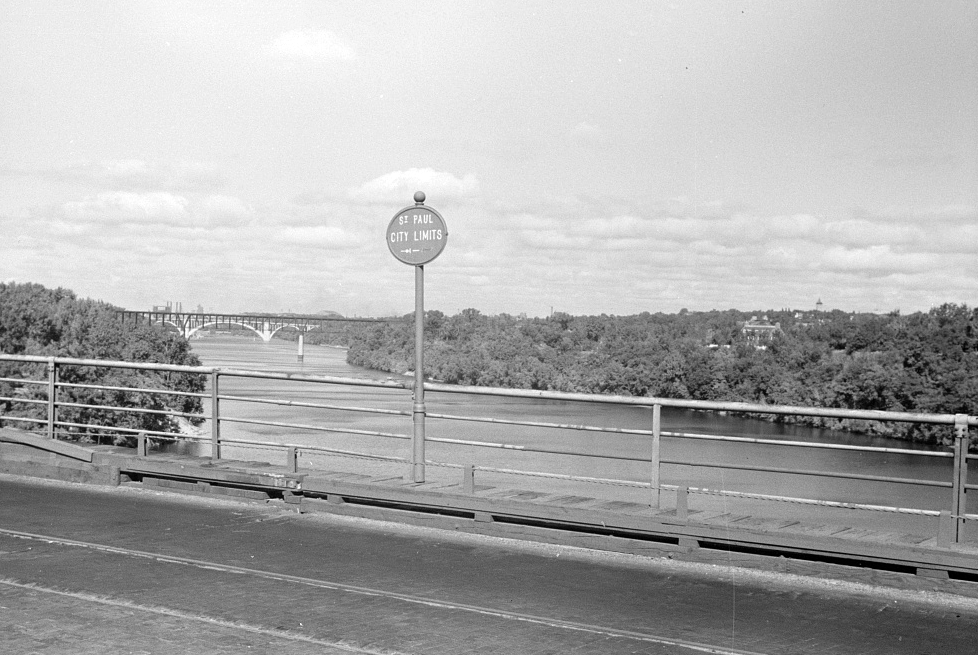
Kevin starts this poem with a tiny, vague head fake about an empty pole, and then drives right into one of the borders. Is it real, even if no one cares to maintain the sign? There are certainly different governments as he shows us in an efficient aside, different even to something as central as time zones. Some residents think the differences in the two town’s citizens are strong, shown in the dive bar anecdote that had me laughing again as I re-read the poem.
The Lake Street Bridge in the mid-20th century at its St. Paul border. I can’t find a picture of the missing bi-directional sign FitzPatrick writes of in the poem
.
He wraps his poem up with another character – and Kevin’s poems are full of characters. Unlike the typically solipsistic modern poem, he casts voices that ask us to consider something/someone else. How quickly Kevin draws him! “Jim” is a military man’s son, not a stay-put native who thinks his birthplace tells who someone is. Perhaps too, from the nature of his family business, he knows the violence that maintains borders more than chipped signs. And “Jim” gets the last word, or rather a last hope: that we can rise above things like borders, see ourselves as ourselves, not as cliches of birth or origin, bound by imaginary map-kept lines.
Is Jim the fool for his hope, when even two neighboring cities in the same state can divide themselves up with rough and ready human pattern matching? The poem sits between those alternatives. By bringing it up, the poem, the poet, asks us to decide.
So, a parable. Yes, its detail is about two cities Kevin and I lived and worked in for several decades. Yes, I’m remembering Kevin for a national culture observance, and remain here, after him – honoring, as it happens, poets with an Irish background. But I write this winter in a time when immigrants are held in a bureaucracy with cruel penalties and moving/sign-less lines. And with wars now too, where the lines of governments are crossed by a mad emperor. Kevin FitzPatrick’s poem reminds us, we all make ourselves (people, towns, nations) what we are, and we might waste our time making someone else what we think they are.
I performed the poem, reading it, to the best of my ability, as I think Kevin might have. I did add one of my “inline epigraphs” to the poem’s text, a line from a song that you’ll hear at the end. Musically I once more unleashed my company of electric guitars, though the Telecaster solo in the middle got caught out by someone’s arrival that meant that would be the last take. While I’m a guitar cosmopolitan, there is something special available from a Telecaster when it and an amp mesh up. You can hear this performance with an audio player you should see below. Has it disappeared like that border sign? No, it just that some ways to view this blog will 86 showing the player, and so this highlighted alternative link is your asylum, able to open a new tab with its own audio player.
It took me an extra beat or two to continue this series, because I soon see myself as inappropriately going on too long about myself — this recounting influences and small events, even if personally meaningful, starts to seem out of proportion. I don’t know if there’s another way to write memoir than to engage in that “objects closer to the mirror” distortion, but I can’t help but think it’d be more appropriate if there was some greater payoff in achievement. The simple fact of the matter is that these are not stories of a performer’s early days before finding a notable level of success with audiences — more its opposite.
I’m grateful for the hundreds that might read one of these posts, for the thousands of times someone has listened to one or another of the audio pieces over the years. I try and honor your attention by being respectful of your time. I’m not so much afraid of embarrassing myself as I’m afraid of wasting your time.
A number of bands that came out of Minnesota in the Eighties did gather national attention — the scene punched above its weight — but as in most artistic or commercial activities, even a successful scene had many more failures-to-thrive than notable acts.* This band of poets, Dave and I, wasn’t going to be one of the notables. Today’s performance was an inflection point for that.
We’d recorded our official album, which was released on cassette tape for lack of capital funds to get LPs pressed.** The local alt-weekly, The Twin Cities Reader, reviewed it, and its cover linked us, the LYL Band, with a new record from The Time.
The Time article promised on the front page teaser was a longer feature in the same issue. Great, but too forgotten too often local rock band Fine Art and their guitarist Colin Mansfield gets mentioned here too.
.
As reviews go, Paul Fishman Maccabee’s “So engagingly out-of-tune and cheerily offensive: it could well become a cult item” wasn’t exactly Robert Sheldon’s “Bob Dylan is one of the most distinctive stylists to play in a Manhattan cabaret in months,” but it allowed us a modicum of creditability. We were trying to evolve from a pair of acoustic folkies to an electric rock band (the recording was largely played on electric instruments), but we were doing that in a meandering way. A neighborhood guy, Jonathan Tesdell played electric guitar — and, we were assured, conga drums. I hoped he might become our analog to the Fugs Ken Weaver as he joined up with us.
At the time of that Reader review we got an offer to play at the University of Minnesota. We took them up on it. We were practicing regularly now, trying to solidify our repertoire. This could be, if not our break, our foot in the door.
A small blip in our ascension dropped before the show date: the University called and asked what kind of music we should be billed as. I think Dave gave them a capsule description of our weirdness — and Dave’s an articulate guy — whatever he said it included the genre label “Punk Folk.”
That week as I walked across the never-named-that John Berryman bridge to the U, I noticed the posters along that span and on into the campus. They said “local PUNK FUNK.” Typo? Mishearing? I don’t know, but if Punk Folk wasn’t yet a common genre category in the early Eighties, Punk Funk was a term Rick James was using at this time for his work, and in the less-commercial indie scene the term was used to describe acts like James Chance’s NYC No-Wave skinny-tie-white-guy James Brown extrapolation. We were a trio expanding from acoustic instruments to electric ones without a bass player or a drummer.
Okay.
Photo in the poster by Renee Robbins. L to R: Dave Moore holding my tiny CasioTone that was my first synthesizer (it was also a calculator). Jonathan Tesdell, the new guy in the group and 25th Century Quaker, and Frank Hudson trying to look like he had Jazz chops, which he didn’t. Yes, our backup singers “The Cookies” did serve cookies and cider to the audience. The Replacements confounded audiences at key times in their career, but they never tried that.
.
The day of the concert came. We loaded Dave’s newly purchased used Farfisa combo organ and my homemade speaker cabinet for it, Jonathan’s Firebird electric guitar and Roland amp, my sound-hole pickup 12-string acoustic and heavily modified Japanese Sixties’ electric guitar along with my Fender Princeton amp into our rattle-trap old cars. On arriving, we found the concert location was a broad stage, the width of the room in front, with audience seats for a few hundred.*** The venue had supplied a full-sized Yamaha grand piano for Dave to play. I recall it had a paper band across the keyboard, which I joked was like the “sanitized for your protection” bands on a hotel toilet.
The audience arrived, accumulating to not a full-house. My memory isn’t clear on this, perhaps just a third or a quarter of the seats. Even so, that could mean at a minimum there were 80 people there, and unlike the shows at Modern Times, most weren’t folks we knew from the neighborhood. I don’t know what Dave or Jonathan felt, but I was hoping to put on a good show, to put forward our intent: some satire and civic points, some music with the not-necessarily-perfect, but perfectly-necessary energy of the still underground indie music movement that was also called around then “College Rock.” How well would we go over with this barely-Rock, with this audience, at this college?
I was on the stage performing when my nerve started to fail. That came during the song that the audience showed the most response too: four-songs-in we played a number that I think we informally called “Booker T” or “Memphis Thing”, an instrumental based on a nice riff I’d come up with as something of a concession to new-member Jonathan, the non-poet who wasn’t much of a lyrics guy. I could sense the audience perking up with that piece’s groove, hopes out there in the seats that things were going to lock in for more of a Rock show. Did some of the audience come for the poster’s Punk Funk? Did they at least expect something more like the other young Twin Cities rock bands that would play the Longhorn, 7th Street Entry or Duffy’s? Whatever, I knew “No, it’s not going to lock in. We’re going to do more folk songs about social issues and weird observations from two poets.” Not being able to change that, however true the set list was to our concept, dismayed me — yet I needed to carry on, while confidence was draining away.
I recall those feelings hanging on after the concert. Rather than having stubborn pride in presenting our band and its shambling, eclectic, cabaret setlist, I felt I’d let the band down. If Dave, the better performer felt any of this, he didn’t show it, and Jonathan , as ever, was by nature a quiet, pacific guy. I remember sitting in the car after loading back out immersed in a sort of punk folk funk, and on the radio — of all things — came Jimi Hendrix’s “Voodoo Chile/Slight Return.” I, the guitar-playing poet. heard him in my mood not as the obligatory guitar-great Hendrix, but as the lyricist Hendrix, the kid who’d scrawled spaceship doodles and poetry in his school-lined notebooks.
I stand up next to a mountain
And I chop it down with the edge of my hand
I pick up all the pieces and make an island
Might even raise a little sand
That’s what artists do. We are at essence pretentious, that thing we fear, that prideful sin we are sometimes called on. And the charge, that indictment, is sometimes true: we fail, or sometimes certain audiences fail, sometimes we lack conviction, sometimes we are convicted, a just verdict. Still, we think we can raise mountains, raise up islands from our imagination. Sometimes that imagination lets others climb on those mountains, take shelter on those islands — other times we fall through our dreams. When nothing is beneath our feet, are we falling or flying? Hendrix continued, singing:
I didn’t mean to take up all your sweet time
I’ll give it right back one of these days
When I took up your time today with the continuing shaggy dog story of my band of poets, I asked if it was worthwhile telling this story about a band that didn’t make much of an impact. Here’s a plausible reason: despite that outcome, I’d do it again — maybe harder next time— and the music-making with fellow poet Dave Moore continued, continues. I know some of my readers are younger and are making music or other art within a career that doesn’t yet know it’s apogee. Have courage: you’re falling or flying.
Here are two pieces from a lo-fi tape of that U of M concert in 1981: Dave’s adaptation of a poem by Kevin FitzPatrick “Bugs in the System” and my own Surrealist summer meditation “China Mouth.” You can hear them with the graphical audio players below, but if you don’t see those players, the highlighted titles are links that when clicked on will open a new tab with an audio player.
And here I am singing the third song in the concert’s set list, “China Mouth”, a song of Summer discontent. The “Memphis Thing” groove-oriented instrumental I write about above was the next song we played.
.
*An off-the-top-of-my-head Eighties Twin Cities list: Prince, The Time, Hüsker Dü, The Replacements, Soul Asylum, Babes in Toyland, Alexander O’Neal, The Jayhawks, Flyte Tyme (Jimmy Jam/Terry Lewis, largely as important producers). And like most scenes, the above acts are a quick list of those someone elsewhere might have heard of, when there’s a list at least as long of good acts that remained at local hero status. Given the LYL Band’s penchant for satire, I could also have mentioned that the Eighties saw the Twin Cities grow a substantial comedy scene, one participant in that became our bass player for a while.
**I believe it was the first cassette-only release in the Twin Cities scene. I duplicated the cassettes myself, and Dave made the packaging for them. I got the idea from ROIR in New York City who in 1981 put out its first cassette-only release (James Chance and the Contortions). Their release and ours followed the introduction of the Sony Walkman, a small battery-powered portable cassette with headphones that was a cultural artifact of the era. I wrote a press release for our recording that exclaimed “Teach your Sony Walkman to crawl!”
***Looking online today I see there are two possible Wiley Hall rooms, one that seats just under 700 and another 362.
Nearly 50 years ago when I moved to the Twin Cities I fell in with a group of Irish-American writers — only they didn’t call themselves that, they called themselves the Lake Street Writer’s Group, and when my friend Dave Moore wanted to roughly categorize them back in those days he’d say many of them worked as bartenders. And so, at first, their monthly meetings would be at a bar table, I think the first one I attended was at the Artist’s Quarter, a bar and music venue.
Time and writing changes one, and so it changes groups of writers. Over the years some wandered off to other pursuits, or to other cities, and one or two died. In its last decade of existence, the group winnowed down to four people. Dave Moore and myself, and two other poets: Ethna McKiernan and Kevin FitzPatrick.* None of us remainers were bartenders. Dave worked for a co-op grocery after working in bookstores. I worked for a public radio network. Ethna ran an Irish-Arts store until it needed to close, and then worked as a social worker. Kevin had a job with the state labor department, but he spent every non-workday at his life-partner Tina’s farm across the border in rural Wisconsin.
The poet I perform today and his last book.
.
Kevin was a healthy seeming guy, able to handle the manual small-farm work in contrast to his desk job. During that decade our little quartet of poets would hear Kevin recount his latest news from the farm, and then we’d hear what he’d transformed out of that when he showed us drafts of poems about the odd turn his post middle-aged life had taken. In this series of poems an office-worker who grew up in the Cities was encountering country labors, mores, and situations, being befuddled or making sense of them.
Kevin’s poems were narrative, and he had a real knack for that form, particularly in his talent for drawing characters in a few words and letting you get a sense of them in a stanza or two.** One of the charming characters we met as the series of poems spun out was the farm dog: an incongruous poodle named Katie — not a Collie or German Shepard, not any other breed you’d naturally think of protecting the flock and farm. The poet didn’t invent that detail of the farmstead’s dog, but the poet knew a symbol when he came upon one.
Farm dogs are pets with job descriptions, but I don’t think Katie was a herding dog in a professional sense, any more than Kevin was a professional farmer. Still, there were in the poems a sense of Katie being an intermediary between the livestock and the bipeds, and she was portrayed as a useful watchdog and companion when Kevin needed to return to his workweek office job.
In Kevin’s poems we learned that Katie had gotten sick; and though it strained budgets, she had gone through some veterinary treatment. Then, at one month’s meeting, we learned that the poodle farm-dog had succumbed to her illness.
The Kevin FitzPatrick poem I perform today came shortly thereafter. For me, this poem works well, even though intellectually it could seem maudlin or sentimental if summarized. We should be wary of such reduction — poems are much more than AI summaries. Kevin undercut the merely weepy here with his dry sense of humor and understated anger — and then too there’s the poem’s sensual detail: a man at work with the remains and memories of a working dog, the corpse as light as a cardboard cutout, the unthawed March cold.
The poem’s ending has extra poignance for me: it was not that long after the poem was written, and the collection that contained it, Still Living in Town,*** was published, that Kevin unexpectedly took sick and died. I think I remember talking with Kevin — before that knowledge on either of our parts — about liking the final part of the poem, how it implies that when the fear and final of death might come to the poem’s speaker, that the dog’s spirit, preceding over the hill, that hearth and home animal in-between livestock and us humans, would be there faithfully there to assuage the fear of what may be nothing in an empty darkness. I call the piece today “Kevin FitzPatrick’s Farewell” because to me its writer ended up making that statement while writing a poem about a farm dog.
Kevin heard a couple of my performances of his poems, and his feedback was that I overstated them — and my performances were certainly different from his. He had that drier Robert Frost reading tone down whenever I saw him do public readings, mixed with the kind of Irish wit that evidences just a slightest eye twinkle and unvocalized “a-ha!” while it spears some folly with an off-hand brickbat or dagger. So, to honor that contrast between us I had to fire up the electric guitar and make the speaker in his poem a little shoutier than Kevin. You can hear that performance of mine with the audio player below. No audio player to be seen? Listen: Katie is barking that you can use this highlighted link that will open a new tab with its own audio player.
.
*Kevin and Ethna took to hosting a poetry reading every St. Patrick’s Day. The last ones not at some Lake Street dive bar, but at a more tony academic site: The University Club near St. Paul’s Summit Avenue. I’m not Irish, but personally I don’t favor the mandatory cute intoxication elements endemic to that celebration, so I preferred a spotlight on that culture’s poetic side. As the holiday approaches this year, I’m planning to get to Ethna’s poetry too in time for St. Patrick’s Day.
**I admire conciseness. I’ve sometimes compared Kevin’s poems to the narrative poems of Robert Frost. While Frost’s longer blank-verse narrative poems have their power and richness, it’s not the mode that I read for pleasure. Kevin’s rural life poems take more after Frost’s shorter narrations like the “Mending Wall.” And Kevin’s poems make more use of humor than Frost’s do.
It’s been an eventful June so far for me, and I plan to be writing like a real blogger about what I’ve experienced in the last couple of weeks shortly. Then too, just this week I started working on a few further Parlando audio pieces. At least one may make the cut to appear here in the next few days.
This weekend is Father’s Day, and a new musical piece that I thought I’d present for that turned out too rough, even for my tastes. So, here’s a well-loved poem by Kevin FitzPatrick that alternate Parlando Project voice Dave Moore performed with The LYL Band a couple of years ago. It seems apropos. Kevin’s books of poetry are available from this website: kevinfitzpatrickpoetry.com Today’s poem appears in his 1987 collection Down on the Corner.
“Bicycle Spring” was first presented here in 2022, but for today’s post I remastered it and made this little video for it. Here it is:
.
Wishing my versatile readers and listeners a happy Summer.
Over the years I’ve presented a fair number of poems by authors well-known for their prose work — James Joyce, Thomas Hardy, Emily Brontë, D. H. Lawrence, and so on — but as I prepared today’s set of words for performance I thought of something I told its author, poet Kevin FitzPatrick, more than once: “If I came upon the matter of this poem, I’d probably choose to make it into a short story instead of a poem.”
That may sound like a harsh judgement. When I said this once, Kevin’s friend Ethna McKiernan once torted back at me sharply “It’s a narrative poem!”
Yes, I know that form. I may be personally more invested in the lyric poem’s momentary compression, but narrative is a perfectly valid approach. And if you look carefully at how Kevin writes, he subtly weaves into his work touches that are poetic extensions to efficient prose storytelling. I tried to explain to Ethna that I had a second part to my statement about Kevin’s poems like “Lambing,” “…but you make it work when you make that your choice.”
This poem’s background is implied in small details within it, and Kevin FitzPatrick’s last collection strung together a series of poems portraying this part of his biography: in later middle-age Kevin’s life-partner Tina decided she wanted to run a small but diversified farm, and each weekend, Kevin would leave from his office job in the Twin Cities to this rural farm across the border in Wisconsin. Kevin was thoroughly a city boy, so many of the poems let us use his unaccustomed eyes to pay attention to the rural culture and tasks of this farm. One trait the poems often touch on: the web of interdependence and cooperation between the community of farmers and country dwellers around Tina’s farm. In “Lambing” we meet Jim and Rose, neighbors and the former owners of Tina’s farm who are called to bring their knowledge to the incidents of the poem.
Kevin worked hard at keeping his narratives tight yet clear. Parlando alternate voice Dave Moore and I would give him notes, which Kevin was always gracious in receiving, and his solutions (not always ours) to problems we might note nearly always improved the poems.* Unlike more elusive and allusive poetry I won’t have to act the village explainer to assist new readers to understand what’s going on in “Lambing.”
Instead, I’d like to point out that this isn’t just prose with more line-breaks. While not exactly a Robert-Frost-style blank verse poem, the Iambs with the lambs** put subtle music to this story. The sound of lines like “Their lantern lit up the shelter late” would in a lyric poem call attention to their sound, so don’t let the flow of the story overlook them if you want to pay attention to how this poem might work its way. And while not a compressed Imagist poem, the small details speak to that kind of poetic impact: Rose’s green dress shoes, the just-born lamb “like something discarded,” the nursing lambkin’s tail twirling like a gauge’s needle gone wacky.
Unintended in FitzPatrick’s spring-set poem, but this time of year I think manger/crèche.
.
Kevin FitzPatrick’s final collection, titled Still Living in Town, contains more poems about his farm experience, and other things as well. It’s a fine, fine book, and its poems are as carefully straightforward as today’s example. Here’s a link to more information on his poetry and a place to buy this book.
I performed Kevin’s “Lambing” today with a piano, drums, and keyboard bass musical backing. At the end of the poem performance there’s a short, less than two-minute, purely instrumental piece for synthesizer and arco bass which I call “Night-Born Lambs” that was inspired by the experience of working on the performance of this poem, and from thoughts of Kevin. You can hear this pairing with the audio player gadget you should see below. What if you don’t see that player? This highlighted link is a backup, and it will open a new tab with its own audio player.
.
*I forget who said it, but I always remember this rule-of-thumb: when someone points out an issue with a draft you submit for notes: “They are usually correct in seeing something is a problem, but that doesn’t mean that their suggested solutions are also correct.”
**Type-nerd note: depending on what typeface you read this with, that sentence could seem a puzzling typographic tautology.
A great many countries have holidays honoring their nation’s soldiers, often with an emphasis on memorializing the dead of past wars. The United States has two such holidays, a Veteran’s Day on the date of the WWI Armistice and the one that arrives this weekend, Memorial Day.
Long time readers here will know I’ve presented a lot of soldier’s poems in this Project, and poems otherwise about wars. This is fitting, war as a poetic subject matter goes back to Homer and further.
Many soldiers’ poems are at least ambiguous about the worth of war, some are outright harrowing. But that’s poets. Outside of poetry, many in the US have developed a particular carefulness in speaking of our wars, a hesitancy to speak honestly about those ambiguities mixed with a deadened obligatory reverence for veterans — a reverence with no other required obligation or attention. Yet we have these two holidays.
Well, do we have such an obligation to remember the horrors of war and the hard-won realities the warriors helped enforce? Asked this way the answer is suggested: yes, we do. For this year’s Memorial Day, I’m going to present two poems that suggest something else in addition.
The first one is by poet Kevin FitzPatrick, who I’ve been memorializing since his death in late 2021. Kevin was not a vet, but he helped with the arrangements that led to his father Bernard FitzPatrick’s memoir, A Hike Into the Sun, about his WWII experience as a prisoner of war in the Bataan Death March. Let me briefly summarize that, for those for whom this is ancient or foreign history: In the early days after Japan declared war on the US, the Philippines came under attack. The fighting was fierce, with Americans and Filipinos resisting without anything like sufficient logistical support to hold out very long.
After they surrendered the near 70 mile march began, with brutal mistreatment and wanton execution of captives adding to the suffering of the weakened and injured soldiers. Forced labor for the duration of the war followed for those who survived the early days. Death counts vary, ranging from 5600 to over 10,000, continental American soldiers and their Filipino comrades. WWII had many accounts of human depravity. This was one of them.
Kevin’s father survived the march, survived the years as a POW doing forced labor, and then wrote his book about it in the 1990s. That’s only background, this isn’t what today’s poem is about. “Survivor” is about his son Kevin visiting his dad in the 21st century while the infirm father in his late 80s was in a care home. How much can someone like myself know about Bernard FitzPatrick’s experience?
It just happens that one of the Parlando Project’s mottos is “Other Peoples’ Stories.” That motto also admits, understands that I (and you) can only partially understand others’ experiences, even if poems and performances might inform us somewhat.
I’m not going to spoil the ending of the poem, you’ll need to listen to my performance in order to hear it. Without spoilers I can say that when I first heard Kevin’s poem, when he read it in draft form, his tale of a chair transfer reminded me of my time working in nursing homes and like Ray was performing those kinds of tasks, but the ending took it another place I didn’t expect the poem to go. You can hear my performance with the audio player below. If you don’t see that player (some ways of reading this blog hide it), this highlighted link will open a new tab to play it.
.
Knowing how Filipinos and US troops suffered in the hands of the Japanese, what does the ending say? There’s no secret right answer, this isn’t a pop quiz. Instead of defining a clear answer, let me supply another poem in a performance I shared here many years ago before some of you followed this Project. I think of it as a great Memorial Day poem because for it to achieve its greatness you need to think about it, think about what it implies in the compressed story it tells. The poem is Carl Sandburg’s “Grass.” Coincidentally, Sandburg was a veteran of the Spanish-American war, the conflict that made the Philippines an American Commonwealth up until independence just after the ending of WWII around 50 years later. Sandburg as a soldier wore Civil War era heavy woolen uniforms while stationed in tropical Puerto Rico, and his commander was a Civil War officer. That’s how close his time was to the bloody American Civil war whose battles are mentioned. “Grass” was written when the bloody battles of WWI, also mentioned, were contemporary events.
Kevin FitzPatrick and Carl Sandburg. A couple of poets imply some things you’re not likely to hear elsewhere this Memorial Day
.
Sandburg’s poem in its short duration reminds of the costs of war — but what does his ending mean? Does it mean it will be best all-tolled when we have the option to forget their sacrifice? Does it simply observe that time passes, and we will forget, eventually? Is he saying that more wars, more bloody battles, obscure the dead of past wars? Chances are you won’t hear any of those statements in any Memorial Day commentary or post — but you will hear about Memorial Day discount savings, and rote uncomplicated praise for service.
Here’s the audio player for The LYL Band performing Carl Sandburg’s poem “Grass” live several years back. And here’s the backup link for it.
This month, as I wondered what poem to explore through setting it with music, a voice — my voice from a portion of myself — often spoke up. “You still have sheets of poems by Kevin FitzPatrick that you typed-up after he died, ones you thought you might perform.”
This week I finally listened to myself.
In my studio space I have a short stack of those sheets, printed out when I thought I might perform them around a year ago. I picked this one up. I had scribbled some chords on it, and I now tried to recall what melody I’d planned over those chords on a day last spring when Dave Moore and I performed things we recalled of Kevin and Kevin’s poetry. That spring day, I had reordered and reduced that stack as the two of us alternated suggesting musical pieces. This one was shuffled to the bottom then. Had I not felt I had finished the composition? Could be. More likely? From what I could see on the page, it had more chord changes than things which work best when I hand them to Dave and he has to try to follow my eccentric phrasing in real-time.
I picked up a guitar and started running through the chords, trying to discover, or rediscover, a likely tune. In doing so I made a few alterations and after an hour or so of that, I sat at my acoustic guitar recording location in my studio space and performed the guitar and voice tracks of the song you can hear below. As I played, I was thinking of Kevin and some full measure of retirement, that as it turned out, he didn’t get.
But then, none of us know what we’ll get. Part of the reason I have had a rapid release schedule over the years with the Parlando Project — its get-it-down-and-move-on-to-the-next pace — is that factor. Not only do I skip over additional steps toward perfection, the amount of things released probably wears some listeners out. Though somewhat more talented, my fellow studio-rat Prince used to get pushback from his record company that he should trim back his output, that it was too much, bad for his career and their business. Well, should he have waited? Did he get enough time?
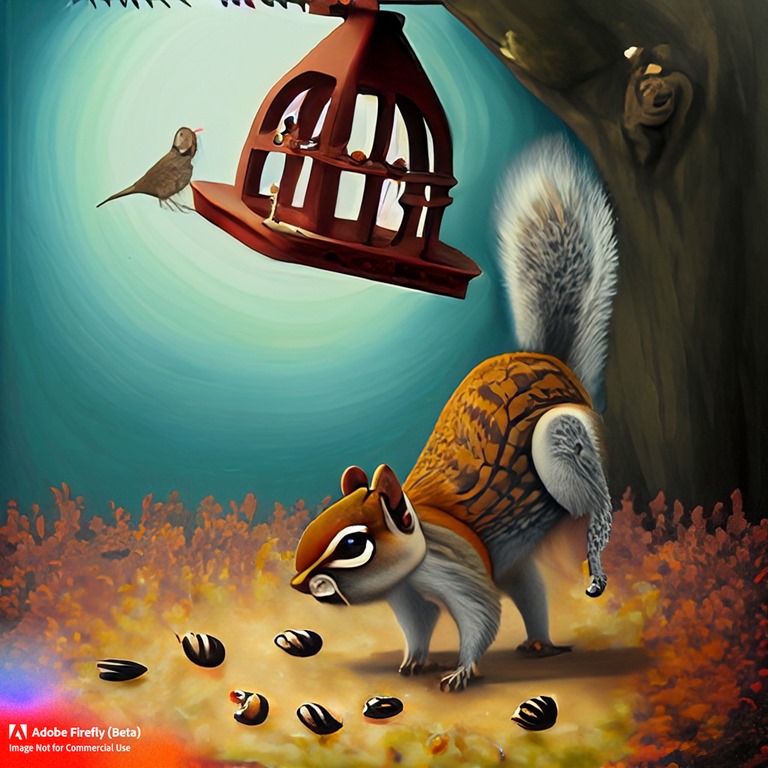
More playing with Adobe Firefly, the AI art generator that claims to not use uncompensated artists’ work.
.
Like most of Kevin’s poetry, his poem “Thinning Shade” doesn’t call out for my extemporaneous insights to direct the attention of readers. But while going through the process of composing the music and going over the performance, the poem did get deeper for me as it repeated in my ear. I see myself as his sparrows and that “fattening squirrel,” “pouncing on seeds…in fussy haste.…”
You can hear my performance of Kevin FitzPatrick’s poem as a song with the link below. As the poem reaches it’s volta, I decided to slow down and add a string sextet to my guitar accompaniment. You can hear it with the player gadget below. No player you can see? You haven’t missed your chance at gathering the seeds, there’s this backup link that will open an alternative player in a new tab.
.
Interested in reading more of Kevin FitzPatrick’s poetry? His books are available at this site, KevinFitzPatrickPoetry.com that I’ll link here.
Here’s a well-worn trope you’ll see somewhere as the year 2022 ends. Someone will write or say:
“2022 — would it ever end? Glad to see that sorry year done.”
Troubling and bad things happened this past year. I know. I’m a grateful and privileged person, but still this year has had stressful and even frightening things in my family. And if we are to look fully at our nations and the world? Distress might seem a slighting word there.
Here’s another trope, one portrayed in many a cartoon around the New Years, one old enough to be old when I was a child: an aged man with a 2022 sash around his stooped body, and a young smiling toddler just able to stand and show the New Year 2023 banner arrayed across its torso. When I was a child, even a younger adult, I always looked fondly at that baby with the New Year’s sash. What wonders, what new things will the upcoming year bring? What burdens will be set down with the expiration of the old year? Even if I didn’t know how the balance of the forthcoming year would settle with the debts of the passing one, I was looking forward, closer in age to that toddler than to that geriatric December 31st.
Now that I’m an old man, that expiring year is closer to me than that tiny child — and it’s not just years that expire or stoop with age. Since last winter, long time alternative Parlando Project voice and LYL Band-mate Dave Moore and I did our part to say goodbye to some colleagues in poetry, and we both have had some family deaths. No wonder that there’s been a good number of elegies presented by this Project lately.
I’ve had the rough tracks of today’s elegy since last spring, the best of which was a vocal track that Dave laid down as part of a session we did in memory of poet Kevin FitzPatrick. It was only this December as the year was coming to a close that I found an idea of what to do with Dave’s song. His words in “Don’t Have To” are all about the routine troubles, tasks, and stresses of life mixed with the aspirations we poets dream to grasp. Kevin, who wrote about work and labor, and who labored and worked at his writing, had all of that.
This was Dave Moore’s own corrected manuscript I worked from to complete today’s piece.
.
It struck me that this is a great life-lot of things, a glorious jumble — Kevin’s poetry that I was privileged to experience, the care and responsibility that his family, friends, colleagues, and clients were sheltered by. If the First Noble Truth of the Buddha is that life is dukkha sacca,* then noticing a cessation of dukkha is apprehending the punching out of the timeclock of a lifetime too. Might it be worthwhile for us on New Year’s Eve to notice, or even thank, the aged 2022 of our families, friends, colleagues, and ourselves for their labors however strained and imperfect they were? When we, like the year 2022, are gone, others will take up that imperfect and sometimes thwarted work.
That thought arose as I took Dave’s vocals from last spring and using the modern tools of audio editing, I sped up their tempo to increase urgency. For music I started with a rollicking piano part which I triggered on my little plastic keyboard but made sound impossibly knuckle-busting by invoking an arpeggiator that kept the sixteenth notes flying. After establishing that tempo, I had to give my fingers a workout on the bass to lay down a bass track, and frankly I was running to catch up the whole length of the song. I added a little vibraphone and guitar to add some visiting outside timbres to the dominant piano and that completed the unusual elegy “Don’t Have To (Now You’re Done)” you can hear with the player below. Don’t see any player? This highlighted link is an alternative way to hear it.
.
*A complicated term to translate, though the simple translation of “life is suffering” is common. Properly, it includes the sense of stress, unease, and dissatisfaction as well.
There were fewer audio pieces presented this past summer, so I’m going to abbreviate our traditional Top Ten review of the past season to reflect that — but I still kind of like this part of the Project, as I get to see what pieces got the most response. Like the Parlando Project in general, the most popular pieces tend to be quite various, and it’s often the pieces I’d least expect that bubble to the top. As a proper Top Ten, we’ll look at them as a countdown, starting with the 10th most liked and listened to one and ending with the most. The bold headings are links to the original posts in case you’re new here and would like to read what we said then.
Very briefly here are the pieces that make up numbers 10 through 6.
10. Arthur Hoehn by Frank Hudson. In the summer doldrums I felt free to include more of my own words. This is a short elegy for a classical music DJ who worked the overnight hours. I’m quite proud of the final lines of this one.
.
9. Staying the Night at a Mountain Temple by Li Bai. Another of my loose translations of a Tang Dynasty classical Chinese poem. I based my translation on my understanding of Li Bai’s (his name is also rendered as Li Po) general outlook. An example here of how I work with orchestral instruments.
.
8. Stratocaster by Frank Hudson. Really, this project is usually concerned with other people’s words, but this sideways ode to an ingenious radio repairman whose swoopy electric guitar design was enshrined in the Museum of Modern Art got a good amount of response.
.
7. The Dick and the Dame by Dave Moore. Alternate voice and keyboard player here Dave Moore says some of this is adapted from Robert Coover, but this really holds together as a poetic liturgy for pulp noir. Also I got to wail on guitar.
Getting ready to lock up my bike late this summer, and my attention is drawn to a message on top of the post.
.
Now let’s move on to the top 5 and say just a bit more about each of them.
5. From Cocoon forth a Butterfly by Emily Dickinson. We’ve done lots of Dickinson poems here over the years. Though we did this one in summer, it talks about harvest time. While poetically condensed, Dickinson observes harvest workers and the proverbially productive bee and contrasts them with a no doubt lovely, but also somewhat unoccupied butterfly. Is Dickinson, the poet, the butterfly? I’m not so sure. My understanding is that Dickinson’s domestic duties in her mid-19th century household, while less than those of poorer families, were also not insignificant. Is the butterfly then poetry, or the poem she’s written, or a fancied life of a full-time artist which she wasn’t? Dickinson ends with this point: at the end of it all, however joyful or laborious, is the Sundown, which is Extinguished. Like the Preacher in Ecclesiastes, I’m thinking she sees vanity in the whole scene.
.
4. To Whom It May Concern (Carry Them Away) by Kevin FitzPatrick. Dave and I both admired Kevin’s poetry and outlook, even if neither of us wrote like him — but then as I said elsewhere here this summer, too few poets write like Kevin. Here’s a short poem written entirely in another’s voice, whose words Kevin the poet recognizes deserve repeating, deserve attention, deserve concern. If I don’t write like Kevin, that essence, that principle, is part of what I do here with the Parlando Project.
.
3. Palingenesis by Henry Wadsworth Longfellow. Poets today read Dickinson (should) and Whitman (must), but few literary poets will admit to reading Longfellow now. Dickinson and Whitman are great rebels, geniuses of make it new. Longfellow worked in traditions, replanting them in America. If you want to rebel with your attention and consider Longfellow, I’d suggest the shorter lyrics. Was this lyric referencing Longfellow’s wife who died too young in his arms? I can’t say for sure, but I used it to reference my late wife who also died too young more than 20 years ago.
.
2. Generations by Frank Hudson. This is a tiny poem in a tidy setting. I’ve been noting recently the lack of perspective in many older persons’ views of the young. Old people are supposed to supply that perspective, to know from intimately observing things over longer time that stuff thought new is just a variation or a carrying forward of the flow of society. Instead, I see all too many who want to proclaim some past got it right and the present is a decadent signal of end times. So, in this short piece I cast myself as the sage of advice to the young, but with a twist.
.
What was the most popular piece this summer? Come back tomorrow for the answer.
It’s time to look back at the last quarter and see what pieces were the most liked and listened to during those months. I released (or re-released) 51 pieces since March 1st here, more than enough to return to our regular multi-post Top Ten countdown format, so let’s present numbers 10 through 8 today as we move toward the most popular one this spring. As usual, the bolded titles are links to the original post in case you’re new here and want to read what I said when I first presented them.
10. “Blackberries” by Kevin FitzPatrick. Kevin, who died last year, was a contemporary and fellow poet to Dave Moore and myself, and this charming poem about his early experiences as a life-long urban dweller (and reader of Irish poetry) getting used to his life partner Tina’s small rural farm is a fine addition to our Top Ten today. This audio performance is a live take, and in honor of our mood of remembrance that day, I decided to leave our longish instrumental prelude in place for the version you heard here.
The player gadget to hear the performance is below for many, and this highlighted link is a backup way to play it.
.
9. Sonnet To Beauty by Lola Ridge. While reading Lesley Wheeler’s new book about encountering poems in the context of one’s life, Poetry’s Possible Worlds, I was pleasantly surprised to find some poems there from modern New Zealand poets. If I had world enough and time, I’d like to be even more various here with the countries’ poets I present, even though most of what I know about New Zealand is from scholarly works: The Flight of the Concords and Wellington Paranormal. Despite sharing a name with an Australian settler poet, I’ve only presented a couple of emotionally riveting and under-known poems by Australian Modernist Kenneth Slessor as part of the Parlando Project — and what, not a single New Zealander? Oh, wait. There’s Lola Ridge. Ridge was born in Ireland in 1873, moved with her family as a preschooler to New Zealand. After a brief marriage, she left for Australia and then finally to America where she spent most of her life, though her early poetry does reflect her times in the Antipodes.
“Sonnet to Beauty” is likely one of those poems. Though Ridge soon became known early in the 20th century in the US as a staunch advocate of social reform and radicalism as well as knowing and interacting with many of the NYC area early 20th century Modernists, “Sonnet to Beauty” is a regular sonnet about the radical appeal of the artistic life — even while life may present buzzards misapprehended as if swans. Ridge lived that twin social and artistic radicalism thoroughly from most short accounts I’ve read.
When I presented Ridge’s poem this March it was easy for me to pair that twinned dedication with another contemporary of Dave, Kevin, and myself: Irish-American poet Ethna McKiernan. Ethna died this past winter. Yes, somedays it’s hard to see the swans instead of the certain buzzards.
Same deal, player gadget if you see it, highlighted link if you don’t.
.
The 3 poets whose words I use today: tilt, tilt, and look away. The light turns a buzzard out a swan?
.
8. The Pool by H. D. I said, re-released above, and here’s the story. Roughly a third of the listeners to this project’s audio pieces never read the posts I put up about my encounter with the poems or any thoughts I write on composing and realizing the original music. Instead, they find the recordings via podcast directories where I present only the musical pieces without the usual talking and joking that fills the running time of most podcast presentations. Having seen radio production done at a high level close-up for a couple of decades in my day-job life, I suppose I could have attempted a talking pod show about music and poetry — but if only for myself I see an appeal of these 5 minute or less podcasts that might serve as a palate cleanser between main courses of talk-talk-talk.
I’ve noticed that some of my most popular early episodes, ones that racked up a lot of listens in the early years of this Project, had rolled off the “last 100 episodes only” offering lists of most podcast directories, and so for April’s National Poetry Month I decided to “re-release” 30 of them. Even for the blog readers like you, I think many of them would be new to current readers here as well. Coming in at number 8 this Spring then is early Imagist Hilda Doolittle’s “The Pool,” a mysterious very-short poem about a tidal pool encounter. It’s so short and compressed that even at one and a half minutes of run time I had to creatively elaborate the text a bit to reach that length. I rather like the music I composed and realized for this little piece. A lot of listeners did too.




 Frank Hudson