The song below using the words of William Butler Yeats had a direct, contemporary inspiration: John “Paddy” Hemingway died this St. Patrick’s day. He was Dublin born, and in Dublin he died — and he was in the news because he was the last surviving RAF pilot from the Battle of Britain during WWII.
Reading the notice, I immediately thought of this Yeats poem, about a fatalistic Irish pilot during WWI who flew into battle having no love for the British Empire. John Hemingway’s Wikipedia summary mentions nothing about his weighing of the enormous risks he took in RAF battles, but a recounting of the number of times he was shot down and got back to flying again makes me think he’d accepted his death as a probable result of his service. Fate had sport with him, he lived to be 105.
So here’s this poem by Yeats, written during WWI about an Irish combat pilot. Yeats seems prone to removing the specifics in some of his poems written about contemporary events. One of the most popular posts ever here draws interest because it resolves the mystery of who and what the friend and work was in Yeats’ poem “To a Friend Whose Work has Come to Nothing.” Did Yeats invent the fatalistic airman in today’s poem, or did he have someone in mind?
Not much research required in this case, it’s widely recognized as a poem written as an elegy to a particular doomed Irish Airman, Robert Gregory, the son of a friend and ally of Yeats, Lady Gregory.
I know nothing of how this poem was received by the mother who’d lost a child. Yeats portrays a peculiar heroism with the poem’s subject. Using only the evidence within the poem’s boundaries, it’d be a fair reading to say that the titular airman here was driven to mortal combat because there was no hope otherwise in his country’s situation. Another reading, more specific to the man Yeats had in mind, might be that the airman was drawn to air warfare for the pure sport and sensation of it, but that latter reading still incorporates, if not an outright death wish, a sense that the most intense love of the moment asks for an acceptance of imminent death. So, an odd poem, poised between self-destructive despair and dark romantic thrills.
Well, whatever — it is a poem by Yeats, so of course it’ll sound wonderful, and reading it on the page will cause any number of its silent readers to want to sing it. After I completed my version, I listened to nearly 10 other musical versions, yet I still hope that my version isn’t superfluous.

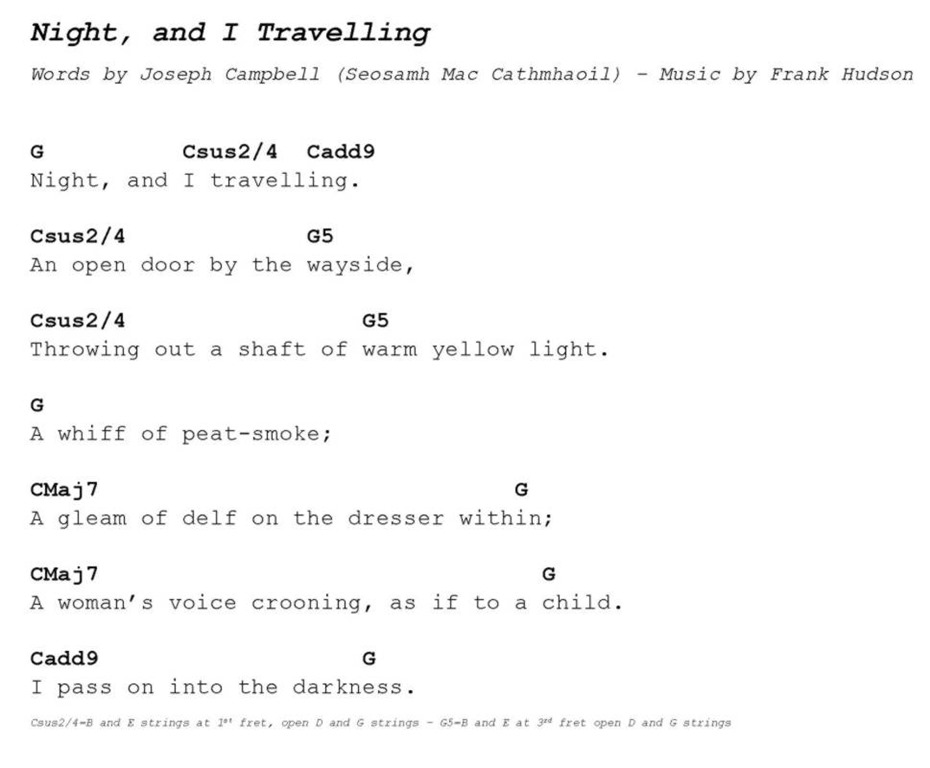
Here’s the chord sheet for today’s song version of Yeats’ poem. Feel free to improve on my attempt. As I play it the G and A chords in the last line of each stanza are played at the 3rd & 5rh fret positions.
.
I chose to make my song entirely jaunty, a reverse of my minor key remembrance in the E. E. Cummings Spring poem last time. That doesn’t mean I want the listener to take it as a recruiting poster or an endorsement. Poetry is portraiture you can feel in your ears or breath, but you’re still allowed to think. Whatever his internal motivations or conflicts, the singer of Yeats’ words seems proud of his choice. John Hemingway likely thought he was in for the same deal that Robert Gregory signed up for. Fate laughed. Reports say Gregory, the brilliant Irish WWI flying ace, may have died either from friendly fire or pilot error secondary to a case of the flu. Another man, a proudly stupid one, once said that he liked pilots who didn’t get shot down. Hemingway, as it happens, was shot down several times in WWII, and yet had decades to live other pleasures I’d find more delightful than combat. And that otherwise unrelated man, the one who truncates his thought, but not before he asks to be judged by his judgements — how is he weighed?
You can hear my performance of Yeats’ “An Irish Airman foresees his Death” with the audio player below. No player to be seen? You can hear my performance stored somewhere in the clouds above by clicking this link, which will open a new tab with its own audio player.
.




 Frank Hudson