Today is International Women’s Day, and I was fortunate to be able to complete this recording of a new musical piece setting a poem by Alice Dunbar-Nelson before the day ended.
“I Sit and Sew” is likely Dunbar-Nelson’s best-known poem — it’s certainly the first one I knew of. I’d encountered it as a poem written amid WWI during the years this Project was noting that conflict’s centenary. “I Sit and Sew” still comes up fairly often in regards to war and destruction, or because it mentions domestic, woman-associated work in the context of the greater world.
I noticed one other element in re-reading it this week: it seemed to me to relate to another line of woman-associated work: medical nursing. Having spent a couple of decades doing nursing work myself, the poem’s focusing-in on the trauma and injuries of warfare really made me think Dunbar-Nelson wasn’t just thinking generally, writing something that could be paraphrased as “War is terrible, and yet here I am peacefully making or mending something with needle and thread, as women have for millennia.” There’s nothing wrong with experiencing the poem that way, as a companion-piece perhaps to Hardy’s “In the Time of the Breaking of Nations” — but I’m a person who often asks questions while reading.
While the poem can stand on its own, I wondered if Dunbar-Nelson herself wanted to serve as a nurse.* Short answer: this issue has additional complications. Currently in the United States we’re suffering from numerous outlandish statements and acts snuffing out complexities of diversity, but historically women’s wartime work, including nursing, is tightly connected with increasing respect and civic equality for women.
Alice Dunbar-Nelson was an Afro-American woman. The U.S. armed forces were segregated during WWI, and the roles available to the non-White military were limited along with that, based proximally on rules about race-mixing no-doubt supported by a pervasive background of racial superiority. A few years back, while learning about another poem, I came upon the case of Col. Charles Young, a Black West Point educated officer with experience in two foreign deployments who couldn’t get himself utilized as America mobilized for WWI. The situation for Black Americans who wanted to work overseas as nurses was also exclusionary. I’ve found out Dunbar-Nelson was working as a national organizer, a member of something called the Women’s Committee of the Council of Defense, and her focus was on Afro-American support of the war effort. She published today’s poem in 1918, and after the war she wrote up a summary of Black women’s WWI efforts.
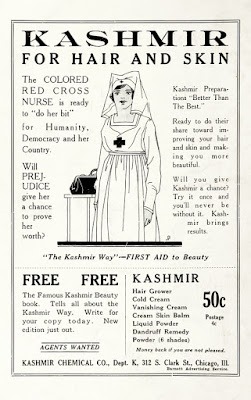
We Wear the Mask Dept. I found this ad here in another post mentioning this poem. In her article linked above, Dunbar-Nelson mentions, in passing, (pun intended) that some lighter-complexion Afro-Americans snuck through the overseas nursing service ban.
.
No long post today, that’s a start for anyone who wants to dig deeper.
The song I made out of her poem came together more efficiently than many, partly because it began before I knew I was making a song. This week I remodeled a nearly 30-year-old Squier Telecaster that I had put a Bigsby vibrato bridge on a decade or so ago. This guitar and that bridge just never worked out. I couldn’t get the neck angle and string height right, the saddles rattled, and the strings slipped sideways when I bent strings. After some looking, I unearthed the guitar’s original non-vibrato bridge and put it back on.** The guitar was transformed. Back when I put on the Bigsby I’d also installed a set of upgraded replacement pickups, and with the string-path mechanics sorted out, the guitar played and sounded great! While I was resetting the action/intonation etc., I quickly made a short musical piece on my recording computer that would let me play strummed chords, arpeggiated chords, and single-note lead lines over three separate sections — just so I could have fun while seeing if I’d eliminated all issues.
Funny how fast you can compose, if you’re not composing. I saved the drum pattern, the bass track, and the keyboard noodling after testing the guitar, thinking “Hey, I like that groove, might be useful.” This morning, I had about an hour when I could open a mic and record. I loaded the saved rhythm tracks, worked them into a longer song-form, recorded the guitar parts using the transformed guitar, and found that I could sing Dunbar-Nelson’s poem to this.
You can hear it with the audio player below. No player? It’s not hiding under a box, it’s just some ways of reading this blog suppress the player gadget. This highlighted link will open a tab with its own audio player.
.
*”Nursing” is a very broad word covering a wide range of caring work and levels of technical knowledge. Dunbar-Nelson’s write-up seems to indicate the women’s war work she was promoting covered a range of things, not just licensed medical nursing as we know it this century.
**One difficulty was that the original — like the Vibramate-brand vibrato bridge I took off — was a non-standard bridge. When I finally found the original bridge, it was sitting underneath a storage box in my studio space. Luckily, like most Telecaster parts, it’s not a fragile thing. By the way, I’m not knocking Vibramate’s hardware. I’ve used Vibramate products to add Bigsby vibrato bridges to other guitars with good results, and their “Spoiler” accessory for Bigsby bridges makes restringing or replacing a broken string a much calmer experience.


 Frank Hudson