Those cattle smaller than a Bee

It’d be possible to do something like this Project using only the poetry of the great American poet Emily Dickinson. While we’re approaching publishing our 700th piece of original music combined with various words (mostly literary poetry) — there are nearly 1800 poems that Dickinson wrote. That’s a lot of material.

The Parlando Project has featured poets all the way from classical antiquity through the first quarter or so of the 20th century,* and I like to vary moods and poetic approaches in the pieces I set to music here — but Dickinson has enough different modes that just her work alone might suffice for variety. Would I miss some of the freshness I find in early poetic Modernism? A woman of the middle of the 19th century, Dickinson was present in an America that is both like and unlike our present country, but like all poetic geniuses she has the power to make time and place fade in importance. As it happens, I was looking for and reading early 20th century poetry when this poem came across my screen, and I found it as immediately fresh and vivid as one of those newer poems. Dickinson’s poem here uses the title of convenience taken from the poem’s first line: “Those cattle smaller than the Bee,” and you can read the text at this link.  Rather than a grand poem about important life points, specific social conditions, intense feelings, existential issues, or majestic nature, this is a poem about a prosaic insect, the fly. Dickinson starts out very much like a Surrealist here, imagining as if the fly was a useful domestic animal, like a cow or the honey-producing bee, but the poem then goes on describing what could be a bothersome number of flies inside the Dickinson Homestead house.

A herd of houseflies 600

“Well Lavina, I’m thinking I’ll go for prize houseflies at the next town fair.” Surrealism manufactured by the AI art program that claims it’s trained on art work that the artists have been paid for.

.

I may be paying too much attention to detail in this playful poem, but I wondered what kinds of flies she’s observing. The season of winter is mentioned, and houseflies generally lay their eggs inside in colder parts of America to hatch during winter. Since Emily cooked for the family, I can imagine that hatching would not make for a pleasant kitchen. Noting Dickinson’s choice of an unusual word “odiouser” in the poem, that may be what that strong language is about.

The final stanza admits that the chapter of the Transcendentalist book of nature describing the worth and meaning of flies is one that Emily hasn’t yet read. Also note: she chose “remand,” a courtroom term, in that final verse — more evidence that Emily picked up some lawyerly ideas from her male family members’ line of business. The Bee mentioned in the first line is something of an Emily Dickinson touchstone, the word and animal appearing often in her poems. In contrast, the fly is quite rare in Dickinson compared to the bee or the butterfly. There is another Dickinson poem that begins “If you were coming in the fall”  that mentions a housewife brushing away a fly — but by far the most famous fly in Dickinson is inside “I heard a fly buzz when I died,”  one of her strangest and most gothic poems.

I tried to keep the music today reasonably light to go with the mode of today’s poem. You can hear my performance of Dickinson’s “Those cattle smaller than a Bee”  with the audio player below. No player to be seen? This highlighted link will open a new tab with a player then.

.

*I rather like the early Modernist era of poetry, but another reason that I generally cut things off at 1927 is that such works clearly in the public domain are free to modify and use however I wish.

A July Afternoon by the Pond

I’m much enamored of this clip where Jack Kerouac appears on Steve Allen’s show on network television. This happened in 1959 when there was only triune TV culture in America —and less than that, there were often only two sides to things. Allen is going to open here by taking the side that Kerouac was an authentic writer of merit. The other side? Kerouac was a tiresome imposter best able to fool young people, who of course didn’t know any better.

Nobody knows what’s going to happen to anybody besides the forlorn rags of growing old. I think of Walt Whitman. I even think of old Walt Whitman the father we never found. I think of Walt.  Whitman.

.

At around two and a half minutes into the clip, Allen and Kerouac have this interchange:

Allen starts it by asking “Who else writes poetic type prose, Thomas Wolfe I guess…”

“Walt Whitman” Kerouac quickly responds.

“Uh, huh.” Allen laughs, perhaps thinking Kerouac was making ironic reference to the criticism that free verse was really prose not deserving of being called poetry.

“His Specimen Days…”   Kerouac then repeats this for emphasis. He really wants to get a plug in — not for his book, but for this lesser-known Whitman book.

“Oh, I thought you were putting me on there. All right, we’ll look into that.” Allen says.

This is all prelude, what follows is Kerouac reading to a jazz combo backing with Allen apparently playing live on piano and meshing well. You may or may not like that sort of thing, but if you’ve stuck around here, you probably at least tolerate it. Me? It gets me, every time I view it, when Kerouac comes to the part where he reads “In Iowa I know by now the children must be crying in the land where they let the children cry, and tonight the stars’ll be out…” Kerouac, the East Coast guy who traveled back and forth to the West Coast, had some notice, some feelings of that state in-between* that was not either/or. It’s a coincidence, but Iowa is where I would have been in 1959, not necessarily crying — or not, for sure, not. I’d be looking then at those night stars from Iowa ground, the sky that Kerouac says he can see in New Jersey, remembering his Iowa nights.

So, as that filmed interchange left off promising to do in 1959, let’s look into Walt Whitman’s Specimen Days. Today’s piece is Whitman, looking at his ground, his water, his skies, on a hot summer day in a section of his book titled “A July Afternoon by the Pond.”   Here’s a link to the full text on which I based my performance. One can easily see what Kerouac drew from Specimen Days.  Whitman’s consciousness is free-flowing** and seems informal, off the cuff. Yet it takes care to catalog a lot of the moment it’s describing at length. There’s no legendary telegraph paper roll, but Whitman does roll on without pause or paragraph. Spontaneous Bop Prosody before its time? Close enough.

I’ll leave you with one more light by which you can read or listen to this piece. Whitman wrote and collected Specimen Days  while he was dealing with the aftereffects of a stroke. As I’ve mentioned, I’ve been working on a theme of infirmities recently. That infirmity is not indicated in “A July Afternoon by the Pond,”  but Whitman, in his convalescence, prescribed for himself a heavy dosage of nature observation. A young person could have seen this pond, but the man who included this piece in his late-career book, was an older man. The eternity the Whitman here sees in the natural world is not the eternity of innumerable afternoons to come as it might be for a young person, but instead the observation of age and infirmity, that of an ongoing nature that will be there after he’s gone, mysterious and as yet unsolved. I love Whitman’s final two words here: “Who knows?” He doesn’t expect you to solve it either, only to share the mystery with him.

You can hear my performance*** of “A July Afternoon by the Pond”  either of two ways. There’s a player gadget embedded below for some of you. But some ways of reading this blog will not show it, and so I also provide this highlighted hyperlink that will open a new tab window to play it.

.

*One summarized view of Kerouac’s vision of Iowa is collected at this blog link.

**More so than my performance includes, for reasons of length and production schedules. I had one musical track down when I recorded my performance of Whitman’s words, and found that I had to rush the text too much to get it all in. Rather than re-record the musical foundation or damage the groove of the words, I ended up editing Whitman’s text on the fly, leaving out some of the digressions.

***As it happens, in the end I didn’t use the musical track that caused me to trim back some of Whitman’s digressions. What you will hear is a two-part improvisation (based on the chord structure of the excluded track) that I recorded to respond to my reading of the words, much as Steve Allen needed to respond to Kerouac in the video clip above. The two instruments are a hollow-body electric guitar and the distinctive voice of my Fender Squier Bass VI, an electric bass that includes two higher pitched strings above the usual four for a bass, giving it access to a baritone guitar range here. Using that facility, there are some high F notes in this piece, played on this bass, that are not available (other than as harmonics) on a conventional bass.

On the Grasshopper and the Cricket

There used to be a thing, back in the Seventies when “The Sixties” were being established as a retrospective era: “The Beatles or The Stones?” The idea was that this choice, which was supposed to be somehow exclusive, was an “opener,” a what’s your (astrological) sign query that would tell the questioner who you were—or at the least start a conversation.*

Among the smallish subset of 20th century young people who liked poetry in English and were inclined to the Romantic revolution launched by Wordsworth and Coleridge at the beginning of the 19th century, one could play a similar game: “Byron, Keats, or Shelley?”

Sarcastic Byron “Mad, bad and dangerous to know” was the bad boy. Shelley was the beautiful intellectual, the man whose genetic material you wanted to incorporate. And Keats was the misunderstood outsider, the garageman’s son who presumed words alone could elevate him.

English Romantic poetry’s boy band—choose your poster.

I was easily a Keats man in this forced choice. I’m not sure, but I think Parlando alternate voice and keyboardist Dave Moore was a Byron guy back then. Early supporter of this blog, Daze and Weekes, Shelley. There are no wrong choices there, and when it comes down to it, no necessarily exclusive choices there either.

Keats hasn’t played a lot here in the Parlando Project. I’ve expanded my interests much since my teenaged years, and I guess the English Romantics have fallen back into the pack of poetic schools as I moved on to other things. Coincidence can bring Keats back though.

John Keats and the Chirping Crickets 3

Unheard music will Not Fade Away! John Keats and his “Chirping” Crickets.


Last weekend I hesitantly went to the newly reopened Minneapolis Institute of the Arts with my family. It was my wife’s idea, a way she hoped would be fairly safe in these Covid-19 times and still get us out of the house. She wanted to see a special exhibit on the immigrant experience. I thought I’d like to review their Chinese section.**

I may well write about the immigrant exhibit later, but the reason I wanted to do a bit of a wander in the Chinese wing was from my recent presentations of 8th century Tang dynasty poets here: Du Fu, Wang Wei, and Li Bai. As it turns out the holdings are a bit lacking in artifacts from that time. While this was a golden age for classical Chinese culture, that might not have carried over to the tastes or availabilities of objects to Western collectors.

But as I wandered the hall, I noticed something that had persisted in Chinese culture for centuries that I hadn’t encountered before. Beside a large, lacquered Chinese string instrument (the size of a pedal-steel guitar), there was a note that Chinese interest in music extended to modifying pet crickets vibrating wing edges with metallic powders and resins to increase the qualities of the cricket’s song. That grabbed this music-nerd’s interest! I started to examine other displays: there were cages and holders for pet crickets, tiny dishes in cricket-scale to feed them, and in one, two tiny wands, like fine detail paint brushes, only finer, the brush a single small hair. These, the note told us, were cricket ticklers designed to encourage the insects to start their music.***

Chinese Qin and Cricket Note

Beatles or Stones? Qin, songbirds, or crickets? The sort of things that a Chinese scholar might have in China during the time of Keats.


I’d already been looking at Emma Lazarus’ summer sounds poem before this trip, with its pairing of cricket-chirp with far-off children’s laughter. And then I found this slight little sonnet by John Keats, another one with crickets. My favorite short Keats poem, In the Drear-Nighted December  is a fine quasi-Buddhist meditation on suffering depicted as an appreciation of a frozen winter water-run. This one, “On the Grasshopper and the Cricket”  doesn’t strike my heart as strongly, but it’s still charming in comparing warm days and winter. This one has almost a Midwestern tang to it. I could see James Whitcomb Riley or Paul Laurence Dunbar writing it. The humble man in nature noting the grasshopper’s****  song even in the hottest summer days, and the comparison of the like sound of a housebound cricket chirping behind a wood stove in darkest winter.

The player gadget to hear my performance of John Keats’ “On the Grasshopper and the Cricket” is below.


*Don’t ask a music-nerd like me this question. Yes, I understand the points it’s attempting to weigh, but I won’t be able to resist spilling out mini-improvised essays on The Animals, The Yardbirds, The Zombies, The Kinks and so on, and then I’ll interrogate the now exhausted and bored questioner about how these exotic British acts are viewed as “saving” us from Bobby Rydell et al, when Afro-American jazz and R&B artists—right on the other side of town in a lot of cases  here in the U.S. —were doing vital work then that inspired these Brits. You can see I’m no fun at parties now, can’t you.

**Like some American museums that date from the late 19th century, Asian art was a significant part of the MiA collection. A significant number of wealthy collectors then were interested in the “exotic east.”

***There’s more I learned. Besides keeping them as pets and enjoying their music, cricket fights were a broad Chinese cultural thing as well, and because a full-formed cricket’s life span is but a few months even without visits to the Disabled List, an entire industry rose up in the capture of crickets for song and sport, with a hunting season in August and September gathering the most from the wild.

****Despite their somewhat similar appearance and sounds, the cricket makes its spiccato with its wing-edges, the grasshopper with its legs. I plucked a 12-string guitar and had double-basses provide some heavy late-summer air for this piece, but probably the most cricket-like sounds in the recording are from a marimba. The old saw says that if you take the number of cricket chirps in a quarter-hour and add 40 to it you’ll get the temperature in Fahrenheit. If so, this is a fairly cool bpm cricket.

The Fly

The state I live in, Minnesota, has a reasonable list under “claims to fame.” Lots of lakes, a funny accent, Prince, F. Scott Fitzgerald, Sinclair Lewis* and Bob Dylan. And bugs.

It may be all that water, Some of the Twin Cities sits on what was once marshland, and even when it forgets that, the bugs have longer memories such that the oldest joke in the state is that the Minnesota State Bird is the mosquito. Farther upstate to our northern forests the most feared animal isn’t the bear or wolf, but the tiny biting gnats and other larger and blood-hungry black fly species. All and all, it’s likely there are no vampires in Minnesota. Too much competition.

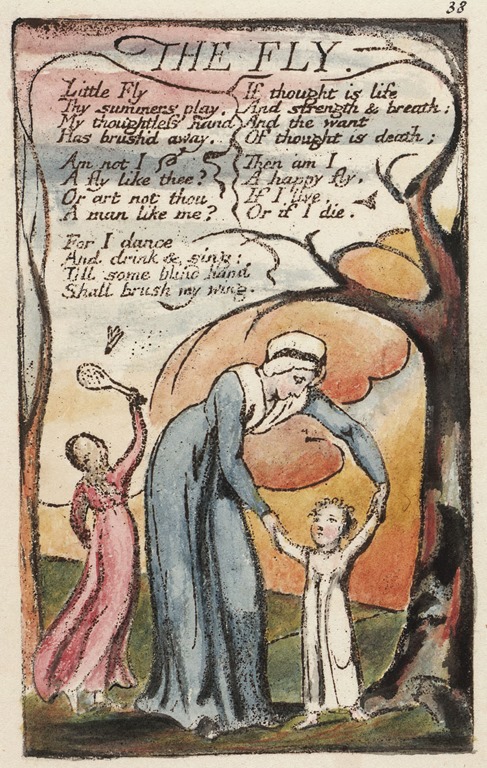
I’ll go to English romantic poet, political radical and mystic William Blake for today’s piece “The Fly”  from his collection Songs of Experience.  Blake’s short poems can be shockingly brief in a way that Emily Dickinson’s sometimes are too. For a simple looking poem with only small and common words, there are numerous commentaries explicating the mystic or philosophic meanings of “The Fly.”  It opens with an uncomplicated setup: a fly bugs Blake one summer day, he brushes it away, something a hundredfold mundane. In an impossible way, he says he did this thoughtlessly, as he’s got four more short stanzas packed with thought and meditation.

Songs_of_Innocence_and_of_Experience_THE_FLY

Here’s the text of the poem as Blake the artist presented it. Toddler Robert Frost in front right is telling the woman that Allen Ginsberg (pretty in pink) is playing badminton without a net again.


For a mere 30 words in two stanzas Blake speaks on the similarities between the insect and himself. In a typical explication of this poem, the first stanza’s shoe-fly act, self-labeled by the poet as thoughtless, is read by those as a swat, killing the fly. But Blake doesn’t describe that as I read it. Instead I read it as a mutual act of interruption. Blake has interrupted the fly who has interrupted him.

The fourth stanza in my reading sums up a value Blake sees in this interaction, a stanza which would be quite obscure if this was indeed a meditation on a sudden death of the fly. The fly’s interruption wasn’t thoughtless after all, it caused thought in Blake.

The “Dance and drink and sing” line is not, or at least not only, a paean to the joys of living. It’s a remark on the superficialities of life for a fly and human, in the Buddhist sense, maya. “Thought is life…and the want of thought is death” is Blake’s precept here. It was good that he and the fly engaged in a momentary summer dialectic. The final stanza is mysteriously balanced. If to think is to live, the unconsidered life is death. The human choice should be then to think, to interrupt thoughtlessness. In the final stanza, is Blake saying that the fly’s insect’s brain cannot choose, and that humans who don’t make their possible choice for thought may be happy flies, but they are not exercising their human potential?

I wonder if Blake was knowledgeable of Socrates and his claim that he must be a gadfly to society, the presenter of bothersome ideas, the interrupter of the thoughtless, or if this was an independent realization. Others certainly borrowed it. Gandhi liked Socrates’ fly thought. Martin Luther King used that gadfly line of Socrates in his “Letter from Birmingham Jail”  too, and it even inspired the periodical that alternate Parlando reader Dave Moore started up that he called The Gadfly  a half-century ago.

Minnesota also had a reputation for political progressivism. Maybe it was the bugs?

I won’t interrupt you long for today’s audio piece, my performance of Blake’s “The Fly.”  There’s a player gadget below.


*Literarily, a step down in fame, we also have Robert Pirsig, who wrote Zen and the Art of Motorcycle Maintenance  living over a shoe-store a couple of blocks away from where I’m typing this, and Robert Bly, he of the deep image and a revised-standard-version of masculinity. Some would even claim John Berryman, an interstate grump who was teaching here when he took a faith or faithless leap off the Mississippi bridge that  I once traveled over between my job at a hospital and my last few dollars of college education. I kept walking, and encourage you to do so too.