The Most Anthologized American Poems of the Modern Era

Here’s a list of poets and poems, along with the year they were written:

Top 20 Poems List


OK, you probably already read the title of the post, so you know what they are.

This list comes from an article I bookmarked this summer that intrigued me, and today I returned to it because I’m thinking a bit about “The Canon”—those poems and poets that are judged by some generalized panel of experts as being worthy.

The whole The Canon thing is full of controversy, with complaints that it doesn’t include enough of what some favor in terms of poetic expression, or that it’s too-much a dead white man’s club; but part of what makes that discussion worthwhile is that The Canon is how almost all of us got introduced to poetry as an adult practice. Somewhere in our school years, we will be asked to open a textbook, and there on the pages will be some “great poems” that we will be asked to grapple with. Some of us will be puzzled that we can’t figure out how to do the sums of what these poems mean; and some of us will want to emulate them, to steal a little of their vision of existence, and some will hope to someday gain for ourselves something like that esteem in the eyes of others, to be, in our words, on a page in an anthology.

Sure, we may have already encountered nursery rhymes, Dr. Seuss, and perhaps some song lyrics, but these poems are the adults, writing the adult things. Poetry sections of literature classes can be as fraught with adolescent frisson as sex ed.

The article I was intrigued by was written by Emily Temple and posted on Lithub. It’s a painstakingly counted-up list, collated from twenty anthologies of poetry. The selection of anthologies has some problematic focus: half of them were specifically focused on American poetry, and nearly half (eight) were anthologies of modern or contemporary poetry. Still, the work to make this list must have been considerable, and I don’t know any similar, but better, efforts to use instead. For this post, I’ve decided to take even more shortcuts, over and above relying on Temple’s work, so bear that in mind.

I’m going to focus on the “Top 20,” the poems that appear in nine or more of the twenty anthologies. While this doesn’t eliminate the anthology-weighting to modern Americans, I think it means that these 20 poems and their authors are safely in “The Canon” as constituted in our current century. Here are a few scattered, short, observations about these most of the most anthologized modern American poems.

I had read and/or remembered reading all but three of the poems. (“Musee des Beau Arts,” “Skunk Hour,”  and “Love Calls us to the Things of This World”).  I suspect anyone who’s been interested in American poetry for a few decades would come in around that.

I sometimes worry that I’ve concentrated here too much on works from the first quarter of the 20th Century, and particularly those connected to the “Imagist” revolution in the center of that time. From this list, I shouldn’t. Nearly half the list (nine) is from this period, and if one was to play the “Kevin Bacon game” with Ezra Pound concerning these, your number is always zero to one, or you’re Wallace Stevens. I use so much from this era because I have trouble even finding the time to seek the rights to present a piece still in copyright, but also because I happen to find that era fascinating—and it turns out as far as modern American poetry is concerned, it’s still the core of The Canon.

However, even though the Parlando Project is closing in on 140 pieces, we’ve only done two of these top twenty poems (“The River Merchant’s Wife,”  and a small portion of “The Waste Land.”)

What era other than the Teens and Twenties of the 20th Century was over-represented? The Fifties, four selections, and you could consider Gwendolyn Brooks’ 1960 “We Real Cool”  sneaking in as a fifth.

Dead White Man’s Club? Not as bad as it was when I was in school. Not Dead White Males: 7 out of 15 authors if I count William Carlos Williams’ second-generation Puerto Rican heritage and don’t count that Richard Wilbur, though white and male, and still alive. The Canon is always historical, always trailing the contemporary. It’s not 7 out of 20 because five authors had two works in the Top 20. If someone does this article in 2117, or even 2067, I wager the pale dead males will be less than 50%. This is an easy bet (I won’t be around to collect from after all) but also because if we take the short-term acclaim of literary awards for new work in the past few years, I informally believe we’re already at that level. I know some will object to even mentioning these distinctions for various reasons. That’s a big topic, another time. If one wants to make an argument for tokenism from either side of that debate, that only the white males got double selections in the Top 20 would be your data point.

UPDATE:  not to belabor the White Males count, but as I pointed out when we presented “The River Merchant’s Wife” back in July, the authorship of that poem in a complex subject. It is  a translation of classical Chinese poet Li Bai. Pound’s Chinese translations are acknowledged to be of the looser variety however. If we split that one 50/50 we’re halfsies on White Males.

Here’s one that was interesting to me as I think about another issue: how old were the authors when the wrote their “Top 20 poem?” Go ahead, guess….

You didn’t look ahead, did you?

I guessed low. I was of the impression that poetry was a young person’s game, and many of the poems I’ve used here were written by authors below the age of 30. Turns out the average was a fraction over 40 years old, with Elizabeth Bishop at 65 and Wallace Stevens for his second selection at 75 making appearances for the Medicare set. The youngsters? Eliot at 27, Pound at 28 and 30, Auden and Moore at 32, Dickinson and Plath at 33. One oddity? Despite the average of a bit over 40, no one wrote a Top 20 poem in their 50s. If you’re under 30, don’t despair, as I did, thinking “John Keats died at 25, and what have I accomplished.” If you’re a poet in your 50s, consider a career in the insurance industry and plan on being Wallace Stevens.

This is another of the posts here that I’m tagging “About” that are not occasioned by a new Parlando Project audio piece. For those who can’t wait for the next piece mixing various words (mostly poetry) with original music, here’s that “included in 10 out of 20 anthologies” hit “The River Merchant’s Wife: A Letter”  done up Parlando Project style. Use the player below to hear it.

Autumn

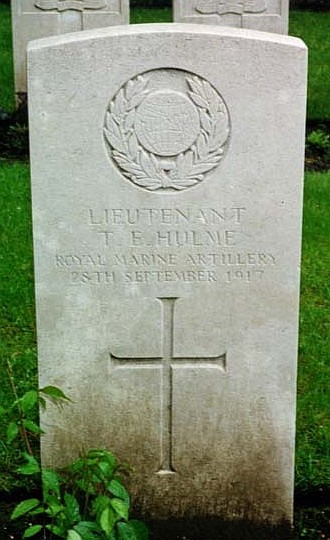
100 years ago, a WWI German artillery shell ended the life of T. E. Hulme, the man who sparked off what we now know as modern English poetry. I was going to say “invented,” but that’s a dodgy word in art as much as in science. Hulme borrowed ideas from several places, and adapted poetic tactics the French and some Americans had already made use of. But we can still say he started things off because he collected the tinder and cordwood in the Poet’s Club in London in the first years of the 20th Century, and the spark was applied by suggesting that everything he thought poets were doing since, well, just about the Renaissance, was wrongheaded. Too flowery. Too ornamented. Too “romantic,” an error he believed made them think of mankind as exalted and godlike.

Hulme, interested in visual art as much as he was in literature, thought the new literary direction should be visual. Cold hard images, direct and vivid, not abstract, were to be the new order, but these images could even be homey and simple (as long as they retained that vividness), not the sort of thing that signaled high culture in the British poems of the past couple of centuries. He was very certain of this, and he either made a convincing case in person or provided the theoretical underpinnings through first or second-order influence to the soon to be mighty modernists: Pound, Eliot, Yeats, H.D., and Frost.

Bust of Hulme
Bust of T. E. Hulme by Jacob Epstein, another member of the early 20th Century artistic “American Invasion” to England

Hulme illustrated his ideas with short poems. I’m not altogether sure how seriously he took these writings, but I find they have three attractive attributes. First, for all the bluster and pugnaciousness that he propounded his theories, the poems are very unassuming. In subject, they often seem to follow one of the principles I try to follow in the Parlando Project: “Other people’s stories.” Second, they are short, and I am attracted to the variety of expression that can succeed in short poetry. And lastly, they are the first. They have that charm, the same charm I might apprehend looking at a Chuck Statler music video, an Apple I or MITS Altair personal computer, an early horseless carriage, or the pictograms on a cave wall. The other beginners looked at this, and said “why not?” Ezra Pound related to Hulme’s ideas in formulating “Imagism.” T. S. Eliot either saw or was reinforced in his ideas for a new classicism in poetry in Hulme’s work.

What would be striking about today’s piece, Hulme’s “Autumn,”  in 1908 when it was published?

It’s “free verse.” No rhyme, no regular metrical scheme. Besides some French poets, American Walt Whitman had done this, but this was still rare, and rarer still in England. The last part of Hulme’s “Autumn”  is still musical however, essentially iambic, and sound echoes, if not rhyme, are present in “wistful stars with white faces.”

Hulme’s two substantial images in “Autumn”  are extraordinarily unpretentious, particularly the first one: “the ruddy moon” at sunset leaning “over a hedge/Like a red-faced farmer.” Compare this to Shelley’s “To the Moon” where the moon is “of climbing heaven” and is addressed as “Thou chosen sister of the Spirit” or Wordsworth’s “With How Sad Steps, O Moon” which is “running among the clouds a Wood-nymph’s race”—and these are examples from good poems of the 19th Century, not the more forgettable lot.

Over at the Interesting Literature blog, where I discovered Hulme, it is pointed out that Hulme, who was from a rural district, also had a ruddy complexion. Perhaps Hulme is looking at himself when he sees the ruddy moon, or his hometown in the moon, but we don’t need to know this subtext to sense the nostalgic comfort in this scene. Except for “cold” near the beginning, which is a sensation as well as an emotion, the only other emotion that is “told” rather than “shown” in the poem is the adjective “wistful” applied to the stars.

Did Hulme toss this off, just to say “Look! You can write a poem like this.” I don’t know, but that’s beside the point. As a person myself who has emigrated from a small rural town, Hulme’s “Autumn”  works as well or better than a grander poem in a more florid manner.

What would Hulme have done if he hadn’t insisted in serving his country in WWI, or if that shell had landed on some other poor soul? That, no one can tell.

Ascenseur pour l'échafaud cover

Like Pound, Eliot,  H. D., Frost, and Epstein, Miles Davis was another American making new art abroad.


For today’s performance, I was struck by rehearing a portion of Miles Davis’ soundtrack to “Ascenseur pour l’échafaud”  earlier this week when a piece of it, “L’ Assassinat de Carala,”  appeared unexpectedly in Ken Burns and Lynn Novick’s “Vietnam”  documentary series.. Performed by Davis with a mostly French pickup band over a couple of days during a short stay in France, it’s something of a radically simple first of it’s own, as Davis essays a spare style with less harmonic movement, a style that he was soon to use with a company of more experienced and exceptional improvisers in his epochal “Kind of Blue” recording. Other than Davis’ own trumpet, the featured instrument on “Ascenseur pour l’échafaud”  is Pierre Michelot’s bass. In my music for “Autumn”  I made more use of the drums as well as the bass, as the only “trumpet” I could use was a synthesized approximation of the timbre of the real thing. There’s another first here: the first drum solo on a Parlando Project piece. To hear T. E. Hulme’s “Autumn”  as I performed it, use the gadget below.


Millay’s Sonnet 43

Edna St. Vincent Millay was another poet who offered little to the “New Criticism” critics who largely set the canon for the 20th Century, even though her career, which covered the first half of the 20th Century, ran almost exactly through the same time as Eliot, Frost, Pound, William Carlos Williams, and Wallace Stevens, and even though she achieved significant readership and a level of awards and accolades while living.

What was their problem with Edna St. Vincent Millay? Well her popularity would be a negative in some lights. In this regard, critics are often no different than the record store clerks of my own day, whose estimation of any indie band would inevitably drop as soon as they achieved a widely-played record. And there’s the “her” and “she” problem. The level of disbelief of the idea of a woman artist probably varied among these critics, but literature was still a very male world at that time and unconscious prejudices are a given. But even if we skip those two, frankly illegitimate, factors, there is the issue of Millay’s plainspokenness.

St Vincent

Annie Clark performs as “St. Vincent,” Edna St. Vincent Millay is on the right. Google carefully!
Clark has said the stage name came from a NYC hospital, but if that’s so, it’s a remarkable coincidence.

Odd isn’t that? This value that you might rate highly in friend was held as low regard by the New Critics, who likely thought it common and unremarkable. A Millay poem typically says exactly what it means, right out. There may be images, but they might not pass Imagist muster. They aren’t stark omens whose meaning is felt and then deciphered, they may be more like the illustrative images the Imagists wanted to leave behind. Millay’s all tell and too little show for them.

And Millay’s language often seems stuck in the 19th Century too. Some lyrical poets like Yeats and Frost adopted Modernist tropes and were able to make their rhymed and metrical poems sound more like contemporary speech. Millay sometimes seemed to be reading from a somewhat musty library book when composing her poems.

The most extended image in “Sonnet 43”  is a bare winter tree, which could be a borrowed image, or a homage, and I choose to manifest the later in this performance.

Can our modern (post-modern) age free up some respect for Edna St. Vincent Millay? I think so. With contemporary poets, we now sometimes value plainspokenness. And the cluster of things that Millay spoke plainly and honestly about include love, sex, and desire.

This sonnet was published in 1920, it’s nearing a century old. If we slide over some of the 19th Century “poetic diction” (something I found easy enough to do when performing this) it’s as honest and as nuanced report on the state of a heart as anything written then or now.

And if one must have ambiguities for art’s sake, honesty can contain that too. Some read this poem as bitter, or a lonely-hearts club statement, or as regret for a life that Millay’s time would’ve called promiscuous. That’s not how I understood it to perform it. I think the speaker is recalling an active love life they rather enjoyed. They reveal themselves (honestly) as something of a sensualist. As the Petrarchan sonnet wraps up its octet, the speaker allows a touch of regret about those lovers who turned to the speaker at midnight “with a cry.” What did the speaker offer them? I think the closing lines say some “summer,” a summer that “sang in me”—that is, that summer is not something the speaker intentionally gave or offered, and the speaker doubts that the muses of that summer offering will still speak through her. William Carlos Williams—unlike Millay, following all the Imagist rules—touches also on the caprices of summer and fulfilled desires in It Is a Small Plant,”  but some are more accustomed to a male author speaking ambiguously about the honest incursions and boundaries of desire.

Perhaps this poem benefits with some listeners in being heard performed in a male voice? I can’t say for sure on that.

Among the 20th Century admirers of Millay’s verse were my father (who grew up on the 19th Century Longfellow and the like, so Millay’s 19th Century diction was no bar) and a distant cousinoid of mine, the modern American theater pioneer Susan Glaspell.

I rather like the musical accompaniment for this one. I worked quite a bit on the drum part trying to bring out different colors, and for the bass I was able to supplement the electric bass with some bowed contra-bass, which is one one of my favorite sounds in the world. Ironically, Millay started out wanting to be a concert pianist, and the top line here is one of my naïve piano parts. To hear me perform Edna St. Vincent Millay’s “Sonnet 43”  aka “What lips my lips have kissed…”  use the player below.

It Is a Small Plant

September 17th is the birthday of the American Modernist poet and physician William Carlos Williams, and today’s piece uses the words from one of his poems “It Is a Small Plant,”  the best known selection from a sequence of poems Williams called “The Flowers of August.”

William_Carlos_Williams_passport_photograph_1921

Just because you have have a passport doesn’t mean you have to move overseas.


Unlike some other American Modernists—including two poets he met and befriended while a student at the University of Pennsylvania, H.D. and Ezra Pound—Williams spent most of his formative writing years in the United States, much of it in his native state of New Jersey where he practiced as a pediatrician. Like his fellow stay-at-home Modernist Carl Sandburg, Williams wrote poems the followed the new Imagist rules, at least at the start, finding them useful in breaking away from the old poetic styles.

One of those Imagist rules, the first one in fact, was “direct treatment of the ‘thing.” That doesn’t mean that you just directly state the message from your heart. Rather, it means that you honor and hone the image(s) that represent your meaning as palpable thing, not as mere poetic decoration for your words. “It Is a Small Plant” demonstrates that by spending nearly the entire poem presenting a description of a flowering plant.

In the series “The Flowers of August,”  each of Williams’ other poems are titled with the name of a particular meadow or pasture flower, but not this one. So, I suspect this is meaningful. The description of the flower here sounds a bit to me like the common bluebell, but it’s possible that he diverged from botany in service of one of the poem’s images, or that the omission of the flower name in the title for this poem made a point for him.

The other, more important, mystery is who the “her” that is inspecting the flower with the poet is, the her who regards the subject flower as “a little plant without leaves.” At first. I wondered if it was perhaps a young girl looking at the flowers, but I now believe that it’s the “her” featured at the poem’s close: summer. If that’s so, that is the reason the flower has no name, as the human name doesn’t exist for nature and for nature’s incarnation as summer. And in the course of the poem, summer then too cannot care about the anthropomorphic desires presented in Williams’ presentation of the image of the flower.

Violet

Unlike William Blake, William Carlos Williams didn’t see Heaven in a wildflower,
but he did see nature observing himself observing the flower.

I’m not a quick understander of poetry. In working on this piece, I read Williams’ poem, enjoying some lines in themselves. The ostensible subject seemed to fit with the season and coincidentally with some other pieces I’m working on—but I wasn’t sure what it meant. In the course of fitting it with music, recording the vocal, and then tweaking and mixing the music, I lived with this poem for a good part of the last couple of days, reading or hearing the words over and over.

If I had been too concerned with its meaning, I might have stuck with my initial supposition, that it was child apprehending the flower. I was pre-disposed to that on first reading, having briefly re-meeting Margot Kreil earlier this week, a poet who wrote an excellent poem called “Weeds”  which featured just such an image. But I was more concerned with getting the drums right, playing the bass, setting up delay divisions for the guitar lines, and marshalling my limited keyboard skills for the soft keyboard parts, and then making that all fit together.

Through you don’t have to go through those composition and production steps, this points out again one of the things that music can do to change the context for words when it’s combined with them. While music can emphasize some mood or presentation of the words, in the same way that suspense music makes a film clip of a character walking down an unremarkable hallway scary, it can also offer its art as a distraction from worrying about meaning too soon with a poem.

To hear my performance of William Carlos Williams’ “It Is a Small Plant,”  use the player below.


Raleigh In the Dark Tower

Today’s post uses a very short poem about a famous doomed adventurer written by a too-little-known early modernist soldier-poet.

The words’ author, T. E. Hulme, is a name I kept running into as I read about the connections between modernist American and Irish writers in England at the beginning of the 20th Century. Many of those connections can be traced to a group of writers and artists, led by Hulme, who congregated in London beginning around 1908. It’s there that Ezra Pound, soon to be literary modernism’s greatest promoter, met Hulme, who many view as modernism’s originator. The argument for preeminence comes down to classic one:  who thought of it first vs. who practically introduced it.

So far here I’ve concentrated on Pound’s role, but as I began to look at this circle, I must consider Hulme’s impact as well. And then a few weeks ago, through the wonderful blog “Interesting Literature,” and its founder Oliver Tearle, I finally read some of Hulme’s poetry, his own practical application of his ideas.

T E Hulme

T. E. Hulme, the man whose brief poetic spark set off Imagism


If there’s a reason I hadn’t read Hulme yet, it may be that his poetry isn’t as well known, and there is very little of it—and what there is, is little twice: about 25 poems totaling about 260 lines. That’s right, as disciples of Bill James will quickly recognize, the average for a Hulme poem is shorter than a sonnet, just a bit more than 10 lines. His short poems, as much or more than other famous short Imagist poems like Pound’s “In A Station of the Metro”,  Williams’ “The Red Wheelbarrow”  or Sandburg’s “Fog”  challenge the reader to find worth and significance in a few words and a putatively mundane subject. Today’s piece uses the words of Hulme’s “Raleigh In the Dark Tower,”  and is something of an outlier in Hulme’s poems, as it’s subject is not so ordinary.

I used Sir Walter Raleigh’s The Lie  earlier this month, and in writing about this extraordinary condemnation of human failings, I told you what every English schoolkid of certain generations would have learned or known about Raleigh: that he was an Elizabethan English hero, and yet he was executed by the English government.

Raleigh Tobacco Tin

Also to blame for Duke basketball fans


Once more I’m going to have compress Raleigh’s life into shortcuts, some of which are matters of dispute. He lived in a time of brutal Christian religious wars and is said to have witnessed both the St. Bartholomew’s Day Massacre and to be captain of the troops ordered to perform the execution of prisoners after the Siege of Smerwick. He was lifetime soldier of fortune and entrepreneur, a cross between James Bond and Richard Branson. He popularized the potato and smoking tobacco, and so can be blamed for lung cancer and my spreading waistline. His expeditions pioneered European settlement of North Carolina, which means he is partially responsible for both Michael Jordon and insufferable Duke basketball fans. He twice led English expeditions into Guyana in South America, without which we would not have Davey Graham and acoustic guitars tuned to DADGAD. Oh, and he was a writer.

Even during his three separate confinements to the prison in the Tower of London, Raleigh wrote. Or perhaps he wrote because of his confinements? He wrote the first volume of a monumental attempt at a history of the world during one prison stay, but his release ended the chance of the series continuing.

To present Raleigh, Hulme in his conciseness, give us just these few lines:

Raleigh in the dark tower prisoned
Dreamed of the blue sea and beyond
Where in strange tropic paradise
Grew musk

For my music for “Raleigh In the Dark Tower”  I used acoustic guitar and a string quartet. To try to bring out the dream half of Raleigh’s prison I tried to perform a second, higher, vocal line. To represent the prison half of Raleigh’s experience, I repeated the words a second time, as a prisoned day would follow another prisoned day.

More depends on Raleigh’s life than depends on a Red Wheelbarrow, but Hulme lets that be only understood. And Hulme’s Imagist philosophy, a “dry hardness”, would urge fewer romantic dreams and more direct observation, but even in his few words, he allows this prisoner the immediacy of his dreams and voyages.

Raleigh would be executed for serving the amoral interests of his country too well, and Hulme would die a soldier on a WWI battlefield believing to the end in the causes of a war that was soon portrayed as absurd.

Hulme grave

Another soldier-poet whose leaf WWI cut short


To hear my music and performance of T. E. Hulme’s “Raleigh In the Dark Tower,”  use the player below.

On the Troop Ship to Gallipoli

In the past few posts I’ve mentioned how Ezra Pound was more than an exemplary writer, theorist, and promoter for the early 20th Century modernist poetic movement that he called Imagism. He was also an excellent editor.

His most famous blue pencil job remains T. S. Eliot’s “The Wasteland,”  but he also worked with H.D. and Ernest Hemingway, teaching with his editing how to pare away extra words, overused similes, and extraneous authorial sentiment. And once shown, those writers we able to use Pound’s insights to do the create their own pared down, modern styles.

In the last episode, I noted that Pound had been critical of some WWI poems written by Rupert Brooke. Here for example is the first part of Brooke’s most famous war poem “The Soldier:”

If I should die, think only this of me:

That there’s some corner of a foreign field

That is forever England.  There shall be

In that rich earth a richer dust concealed;

A dust whom England bore, shaped, made aware,

Gave, once, her flowers to love, her ways to roam,

A body of England’s, breathing English air,

Washed by the rivers, blest by suns of home.

Written as England entered into WWI, and as Brooke himself rushed to enlist, this poem was embraced by a patriotic public almost immediately. If one shares it’s sentiments, the actual technique of the poetry probably admits no impediments to a reader, even today—but ask yourself, does it have a sense of actual immediacy? As you read, do you share with a fellow human, feeling, seeing, smelling, this experience? What I get as I read it is a thought, where a soldier thinks that if he dies in battle and his body rots overseas, that his body will homeopathically retain its English birth and experience, and that experience, it is inferred, is worth dying for. Why? Well because the poet says so, and he says it with rather polite poetical words. “Die” and “dust” are perfectly good, simple words, but as a description of death and decomposition, they are surrounded by forevers, flowers, air, rivers, and sun—all presumably sweet and genteel.

Rupert Brooke died at age 27 of an illness he contracted while on his way to the Gallipoli campaign in his war, but what if he, like Yeats, had continued to live and react to the developments of his young century? And what if Ezra Pound had gotten a hold of him and showed him how to punch up his verse?

NPG P101(a); Rupert Brooke

Rupert Brooke, charter member of “The 27 Club


Today’s piece shows what could have happened. One of the last things Brooke wrote was this fragment written on the troop ship in the month he died. Here’s the original:

I strayed about the deck, an hour, to-night

Under a cloudy moonless sky; and peeped

In at the windows, watched my friends at table,

Or playing cards, or standing in the doorway,

Or coming out into the darkness. Still

No one could see me.
I would have thought of them

–Heedless, within a week of battle–in pity,

Pride in their strength and in the weight and firmness

And link’d beauty of bodies, and pity that

This gay machine of splendour ‘ld soon be broken,

Thought little of, pashed, scattered. . . .
Only, always,

I could but see them—against the lamplight–pass

Like coloured shadows, thinner than filmy glass,

Slight bubbles, fainter than the wave’s faint light,

That broke to phosphorous out in the night,

Perishing things and strange ghosts–soon to die

To other ghosts–this one, or that, or I.

What can I, acting as Pound might have, do with this? Well first I can locate the charged images in it, hidden as they are inside Brooke’s extraneous comment. What are they? The soldier pacing at night on his troop ship. He’s staring back inside the ship, looking at his fellow recruits on the way to their first battle. If we have any empathy as readers, we don’t need to be told anything about what he’s feeling if it can be conveyed by what he’s seeing. What are our charged images? The troops are playing cards, games of soldier’s chances. They can’t see the poet, and he can see them only imperfectly, backlit by uneven lighting, “coloured shadows,” which is a great image obscured by all the muck about it. And he sees the faint light of a wave’s phosphorescence as bioluminescent plankton are sweep aside by the wake of the ship. The soldiers, and the poet himself, are already in the course of war, like ghosts, fleetingly seen, or only partially and incorporeally seen.

Have you tried the exercise where you make a poem by taking a marker and blacking out most of page of text, revealing a poem could be in what remains? That’s like what I did with Brooke’s fragment:

On the Troop Ship to Gallipoli

I strayed about the deck, an hour,

Under a cloudy moonless sky.

Peeped in at the windows,

Watched my friends

At table, playing cards,

Standing in the doorway,

Out into the darkness.

No one could see me.

I could but see them

Against the lamplight,

Coloured shadows,

Thinner than glass.

A wave’s faint light,

Broken to phosphorous.

Perishing things and strange ghosts

Steaming to other ghosts,

Only, always.

I removed over a hundred words that didn’t need to be there, which covered up what did need to be there. I don’t need to say that these things relate to each other, putting them in a short poem together makes that clear. I added only one word, choosing to add “steaming” instead of just “to other ghosts” because it’s an action word, and because “steam,” though active and industrious, is another thing that dissipates and disappears.

I have two unfair advantages over Rupert Brooke as I transformed his words. First, he died in service to his country shortly after writing this, so he didn’t have the chance to revise his fragment. Secondly, the place he was going, Gallipoli, and the outcome for so many British and Commonwealth soldiers who were deployed there is now infamous for poor tactics and horrendous casualties. I can simply use “Gallipoli” in the title and magnify the dread of soldiers on their way to battle.

Today’s episode is dedicated to Julie Shapiro, who introduced me to Eric Bogle’s “The Band Played Waltzing Matilda.”  This is a song about Australian troops at Gallipoli, and though I can link to one of my favorite singers, June Tabor’s, version of it, there is nothing but my memory to testify to the devastating version Julie used to perform.

My First Guitar

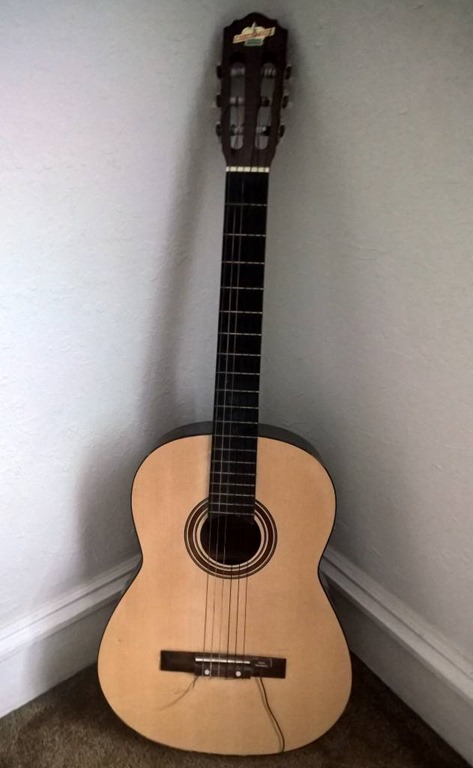
My first guitar, purchased for $40 in 1974, and played on today’s audio piece


Long post again, no time to talk much about the music for this performance. Perhaps I don’t need to tell, you just need to hear it. Use the player below then for my performance of a revised fragment by Rupert Brooke.


South Folk in Cold Country

Here’s one more piece from Ezra Pound’s 1915 breakthrough collection “Cathay,”  a war story he called “South Folk in Cold Country.”

At the time Pound was working from Ernest Fenollosa’s, and Fenollosa’s Japanese teachers,’ notes to translate classic Chinese poetry, World War I had broken out, and England, where Pound was living, had mobilized to fight this war. Like William Butler Yeats (with whom Pound was staying for part of this time) Pound did not want to take a side in the war. Not only skeptical of the war’s patriotic rationales, Pound also wanted to continue to focus on his modernist artistic revolution.

Earlier in the Parlando Project, we’ve seen how Yeats responded at the beginning of the war. His On Being Asked For a War Poem”  cloaked his disdain for statesmen’s’ rhetoric while seeming to take a aesthete’s stance of artistic superiority and inferiority.

Pounds Directions to Yeats House

Robert Frost needed to get to W. B. Yeats house,
so a helpful  Ezra Pound drew him this map.


Pound felt similarly. He may not have been sure, at first, of the what he would eventually call lies by the politicians by the end of the war, but his poetic BS meter was immediately sure that the patriotic verse being produced to ennoble the war was false ethically and artistically. But Pound also recognized that any poetry he would write in such a charged environment would be inescapably seen in the context of the war.

Still, he was wary of writing about war as a civilian who had never fought in battle. At one point, he reported he had tried to enlist, but was turned down due to his (then neutral) American citizenship. At another point, he wrote a review critical of Rupert Brooke’s war poetry, only to have Brooke, who was serving in the British armed forces, die while in service, leading Pound to qualify that he was only criticizing the poetry, not the citizenship.

So as Pound created and promoted Imagism, his vision of new modernist poetry by recreating classical Chinese poetry in English, he came upon a solution. He would use the Chinese poets, both as the model for his new kind of verse and as a way to comment on the war.

Today’s audio piece is an example of how Pound went about those two things, once again translating and transforming the work of 9th Century Chinese poet Li Bai.

“South Folk in Cold Country”  is an account by Li Bai of a military campaign in the north of China that had occurred almost a thousand years before he wrote. Pound, taking this for his modernism, has the soldiers who speak of their war experience say nothing of what they are feeling. There is not a word of them saying they are tired, confused, frustrated, or suffering, but their world is described by them as the image of all these things. While Li Bai/Pound’s “River Merchant’s Wife”  reads musically off the page, despite being “free verse” in English, “South Folk in a Cold Country”  has a more abrupt and doubtful music. Pound was trusting Li Bai and his own artistic sensibilities so that he might get some of the war experience right.

When I first read “South Folk in Cold Country”  this year I thought: this sounds like a bag of fortune cookies mixed in with Ernest Hemingway. Either or both of those comparisons may sound dismissive to you, but I suspect the best fortune cookie aphorisms have some relationship, however strained, to the concision of classic Chinese poetry, and Hemingway, however familiar he may seem to us now, was using Pound’s ideas as part of what was to be Hemingway’s revolution in prose. Thanks to Hemingway, and in turn, to Pound who directly influenced and taught him, we now are not surprised by representations of war, violence, and death that assume concise description and charged observation can be truer than superfluous remarks by the author.

Hemingway in uniform

Hemingway, who did serve in WWI, sought out Ezra Pound to shape his writing about it

I did wonder about the General Rishogu mentioned at the end the piece. His Chinese name (remember, Pound was working from notes of Japanese scholars, not Chinese ones) was Li Guang, and his story is here. I like this as an ending. I’m not sure if Li Bai’s soldiers who speak in this piece are using Rishogu/Guang as an example of the hard fate of soldiers; or if they are saying, after what we’ve been through, making all those rapid marches to make Rishogu/Guang’s name, who among them will care about the general’s death. On the odds, I’ll take the later.

Musically I used some relentless vibes over electric piano and bass to stand for the rapid marches that the “swift moving” general kept ordering, and then some neighing winds from a synthesizer patch. To hear me perform “South Folk in Cold Country”  with that music, use the player gadget below.


Heat

Just after the start of the 20th Century two teenagers met at the University of Pennsylvania. One was 16 years old, a smart and cocky boy without much in the way of money, who had somehow managed admission to the University at such a young age.  The other was 15 and the only daughter of an astronomer and professor at the college. So devoted was the girl’s father to his astronomy, that it’s told that his wife needed to come by during the colder months with a kettle of hot water to unfreeze his eyelashes from the eyepiece of his telescope. This professor was the enlightened sort of early 20th century father who believed in women’s intellectual equality. He dreamed that his daughter would become another Marie Curie.

However, the two teenagers soon fell in with each other, and science was not in their bond. Poetry and the arts were. A year or so later, a new freshman arrived at the University to study medicine. That freshman was William Carlos Williams, and he would complete his studies and become a pediatrician and family doctor who practiced for decades in Patterson New Jersey while writing purely modern poetry. The boy and the girl fell in love, and were secretly engaged, knowing that the boy’s lack of money and established career would prevent the girl’s father from giving permission of them to marry.

Real Genius Jordon or HD
The 1985 movie “Real Genius” is a documentary of this meeting between two teenagers in college.


The girl grew up and was sent to Bryn Mawr, a woman’s college that was known for having a tough “men’s curriculum,” following her father’s hope that she would become a scientist. There she met Marianne Moore, who also became a noted modernist American poet, but at Bryn Mawr she failed in her studies. The American oracle Barbie would later proclaim: “Math is hard!” and a career in science was out.

But wait. What of that cocky boy? Oh no, he’s gone to England! And double oh no, he now engaged to another woman there. After all this, we can now begin our story again.

This now young woman who had already met and befriended William Carlos Williams and Marianne Moore, went to England to meet back up with the young man she had fallen in love with as a teenager. The young man was Ezra Pound, and the young woman was Hilda Doolittle—but she wouldn’t be much longer.

Young Ezra Pound2HD

Sorry, “Real Genius” its really about how Tears for Fears was uncool, but now is kinda cool.
And here are the real and young Ezra and Hilda.


Pound was in England trying to stir up a poetic revolution, something that would forge past the reformation of William Morris and the Pre-Raphaelites and give poetry a fully modern cast. Hilda showed Ezra some of her new poems, and Ezra did three things that he would do repeatedly for other poets in the next couple of decades.

He immediately recognized that Hilda was writing the kind of fresh, spare, honest poetry that he thought necessary to break the grip of the past. He would see to it being published.

After admiring it, it took his pencil to it, and slashed out parts of the already concise poems. I can hear some of you drawing a breath on that, considering the sexual politics, ready to cry “Asshat!”—but that’s Pound, even with poets of genius: cut it, pare it down, make it new, not one extra word. A few years later he’d do the same thing to T.S. Eliot, and the surviving variorum manuscripts show why Eliot called Pound “The Better Maker” of The Wasteland.”   Pound’s editing pencil seemed to teach like the sensei’s stick, and once shown, poets like Hilda Doolittle and Eliot understood how to do the same thing themselves.

And then he took that editing pencil and signed Hilda’s poems “H.D. Imagisite.”

That last move was another part of Pound’s talents. He was probably more successful in launching other poet’s careers than he was his own. He had a shrewd promoter’s eye. “Imagiste” or “Imagist” was the name Pound would give to the modernist poetic movement that would during the years of WWI as radically reshape English poetry as the war would reshape the maps of the world, and here he was saying, rightly, that H.D.’s poems would be the ne plus ultra of that movement. As a name, H.D. was as pared down as the new poetry would be. If he’d lived long enough to see video screens with 1024 lines, he could have said calling them HD for “High Definition” was a tribute to his call for seeing things truly. And H.D. masked Hilda’s gender, still important in a world where women were widely thought to be incapable of great art. The former Hilda Doolittle didn’t object. She’d never liked the family name (“Do-Little” she thought it scanned) and besides, her sexual identity and friendship affinities were at least HD.

Let me admit that this post is unfair to H.D., the writer of the words of today’s piece. We’ve gone past my customary length limits and we’ve only barely touched on H.D.’s talents and extraordinary life. I’ll need to revisit her work soon and give H.D. her due.

What can I say about today’s piece “Heat?”  Well it’s an appropriate July poem, and the titular heat, in true Imagist fashion is both a closely observed thing: actual summer heat, and an image that, without simile or extra framing, is imbued with complexity. Last episode we had Pound/Li Bai, two men, showing desire and longing in the “River Merchant’s Wife”  with only a few actual named emotions or feelings. H.D., the better Imagist, shows female desire with not a single named emotion. The poem’s final phrase:

that presses up and blunts

the points of pears

and rounds the grapes.

is sensuous beyond words—it’s only 13 words to be beyond after all—and with four p and s sounds it holds four kisses.

To hear my performance of H.D.’s “Heat,”  use the player below. And thanks again for the likes and the social media shares!


The River Merchants Wife

The River Merchant’s Wife: A Letter”  has a very complicated history. I can’t even say “Ezra Pound’s ‘The River Merchant’s Wife”— though he’s often listed as the author.

Let’s begin, as a river or a journey might, at the beginning. Back in the 9th Century in China there were two great poets. One of them we’ve already met there: Du Fu. He was known for his wisdom and level-headedness. The other was Li Bai (his name is also written in western letters as Li Po and Li Bo, and in Japan as Rihaku) who was known for his more excessive existence. In China both have been continually revered, but in early 20th Century Europe or America, they were nearly unknown. Only scholars interested in off-beat subjects knew of these men’s work.

One such scholar was an American, Ernest Fenollosa, who had traveled to Japan and become deeply immersed in Japanese culture, and as a sidelight to that, he also was exposed to Chinese culture. Early in the 20th Century, Fenollosa was one of a group of Americans living in England. We’ve met others here who were part of this “reverse British Invasion” of Americans: Ezra Pound, Robert Frost, T.S. Eliot—and you’ll soon get to meet another, H.D.  Fenollosa then died in 1908, still in London.

Here’s were something fateful happened. Fenollosa’s widow, for some reason, gave Ezra Pound a bunch of her late husband’s papers. Pound was a young man who was trying his damnedest to start some kind of artistic movement in London. In the papers were scholarly prose translations of Li Bai’s poems done by Fenollosa and two of his Japanese associates, Mori and Ariga.

Ernest FenollosaLi Bai

Ernest Fenollosa, deeply attracted to fur; and Li Bai, more into silk

Pound fell upon these scholar’s notes. He’d already sought out other old poetry for inspiration for his revolution (much as the Pre-Raphaelites had looked backwards for something fresh), but in this old Chinese poetry he found what he was looking for. It was concise. It was free of centuries of cruft that English poetry had accumulated. And Pound naïvely felt that the poems themselves grew out of the ideograms for their words, Chinese characters which had evolved from drawings of objects. He had found his poetic revolution. Poems should be constructed of little more than images. Not images in the sense of elaborate similes or strained allegories, images in the sense of a presentation of the direct observation of the poet, unadorned. Pound published what he created out of those scholars’ notes as a ground-breaking poetry collection “Cathay,”  and he quickly began to compose his own modernist poems using his epiphany.

If Fenollosa hadn’t died in London, and if his widow hadn’t given this tranche of papers to an artistic provocateur such as Pound, it’s possible that Li Bai would be no better known in English today than he was in 1908, and it’s even more likely that poetry in English from that point on would have evolved differently.

If Fenollosa hadn’t died in London, and if his widow hadn’t given this tranche of papers to an artistic provocateur such as Pound, it’s possible that Li Bai would be no better known in English today than he was in 1908, and it’s even more likely that poetry in English from that point on would have evolved differently.

Seems like a miracle when such things line up, doesn’t it? Well, here’s something as miraculous: though “The River Merchant’s Wife’s”  source was written over 1200 years ago in a culture so far removed from America that the childhood legend was that one would need to dig a hole through the center of the Earth to get there, even though it comes to us filtered through non-Chinese scholars, and even though the particular words I’ll use today to express it were written by an avant-garde poet whose work remains little-read and understood today, many people have an immediate deep emotional response to this poem the first time they hear it.

Isn’t that odd? All that strangeness in customs, place-names, time, provenance—and yet more: it’s a poem of female desire written in the voice of young woman by a man, and translated and transformed by men. And yet, woman and men, young and old, hear it, and they feel the pangs of desire and separation just as much as any 8th Century resident of China—even though the poem, following the tenants of what Pound would call “Imagism,” barely mentions the speaker’s emotions (“bashful,” “desired,” and the only present-tense one, “hurt.”)

I know I felt those things when I first heard it, aged perhaps 21 on a sad journey with a young woman. I hear it now as an old man too, and think once again of my friend John, and of China. The place, Cho-fu-Sa, that the river merchant’s wife says she will go out to meet her husband is, I’m told, hundreds of miles from her village in the poem. What is such distance to the heart?

To hear my performance of “The River Merchant’s Wife: A Letter”  use the player gadget at the bottom here. Since this post is already long, I’m not going to talk much about the music today. The higher-pitched string instrument you’ll hear is my approximation of the pipa, a traditional Chinese lute. There are many moving recitations of this poem available online, but to see an entirely light-hearted modern translation of “The River Merchant’s Wife” after listening to mine, view this one.

Grass

In the last post, I presented Ezra Pound’s rant about the society that lead so many to their deaths in WWI, deaths that included several of his own modernist artistic circle. Taking it personally, Pound exclaims that their “fortitude as never before” for change and their “frankness as never before,” lead only to equally great “disillusions”. He sees lies and liars leading others into the war and their sacrifices, and only liars as triumphing.

Speaking repeatedly about liars and lies and illusions, Pound’s “These Fought” would not be a very popular choice for a Memorial Day speech then, just as it probably would not be one now. If you agreed with him, you might enjoy his precise inventory of folly. If you didn’t, you’d say he was unappreciative of his friends (and so many others) sacrifice, and that his disbelief in the stated high motives for the war could be mere cynicism. I can hear what some voices must have said then (and would say now): “You can complain about what is imperfect, perhaps even foolish, but what’s your solution, other than to stand to the side and write poems?”

Alas for Pound, he did propose a solution. It was a solution chosen by many others disappointed after WWI, a fresh modernist conflation of race hate, nationalism, technology and authoritarianism, the fascism that lead to WWII.

Commonwealth-war-graves-WWI-cemetery-Belgium

What place is this? Where are we know?

Today’s episode: “Grass”  by Carl Sandburg is just as pure a modernist, imagist poem as any by Pound, but it’s statement about the sacrifices of war is more indirect.

Sandburg has a reputation as a clear-spoken poet who makes his points straightforwardly, as if plain words mean simple thought. I believe this is mistaken. Sandburg’s mind was not a simple, unicameral mind.  Sandburg was leading multiple lives at once during the WWI era. He was writing, sometimes under a pseudonym, for radical leftist/labor IWW publications, while writing for the mainstream Chicago dailies, while writing modernist poems. When Sandburg was protesting the jailing of IWW antiwar activists, and writing today’s compressed, Imagist, “Grass,”  Sandburg had also published a long, Whitmanesque populist and blood-thirsty poem “Four Brothers” lauding the urge of Americans to go overseas and put the German Kaiser’s head on a pike. “Grass”  too has its echoes of Whitman—not the martial revolutionary Whitman, but the Whitman who wrote of grass as “the beautiful, uncut hair of graves.”

So, this is a complicated and perhaps self-conflicted man who is writing this, and when we move in “Grass”  from the catalog of history’s deadly battles, ending with two great battles of WWI, Sandburg’s poem takes a turn.

In two years or ten years, what is this sacrifice? In“Grass”  the places of these battles become nowhere. Is this a hopeful statement, that after this “War to End All Wars,” we will now be able to forget war? Is this an anti-war statement that would say, as the radical Sandburg or Ezra Pound would have said: that after all such strife, the liars and those that run things will continue to run things anyway, as if the war settled nothing? Is it a statement of reconciliation to come, when elderly soldiers from opposing sides meet and speak of their common experience and equally lost comrades? Is this a statement of the democratic socialist Sandburg, that the forces of inevitable Marxist proletarian revolution will come and obsolete all that was before? Or is it a cool and detached statement that all human efforts are transient?

I don’t think it’s an accident that this divided man wrote a poem about the sacrifice of war that lets it be all those things.

To hear the LYL Band present Carl Sandburg’s “Grass,”  use the player below.