Frost Warnings: an appreciation of the poetry of Phillip Dacey

I mentioned earlier this month that my late wife took creative writing classes with poet Phillip Dacey in the mid-1970s. Later, through her, I met Phil and was able to talk to him a bit about poetry. Phil was generous about this, and I’ve never forgotten that.

It’s always hard to accurately, objectively, analyze where one is in in their writing craft. I knew I was only partway in craft, but I self-judged myself as better than average in the imagination aspect. Looking back at that young man I was then, I’d re-set my judgement now to say I was even less far along in craft than I thought, but I still think my imagination was as good or better than many. Those models that I looked to back then: Blake, Keats, Sandburg, Stevens, and the Surrealists were good enough for starters.

Of course, old men can be wrong when looking at themselves too – presently or retrospectively. I’ve come to consider self-judgment as so unreliable that I treat it as a traveler’s tale: something to listen to, but with a duty of skepticism. If I get time, I might extend this informal series engendered by finding old 1970’s manuscripts packed away in boxes with a few of my youthful poems. If I do, I’ll try to make it worthwhile for you rather than self-indulgence.

This Project takes author’s rights into strong consideration, and you may notice that we almost always perform works in the Public Domain.* As the Parlando Project was starting I learned that Phil Dacey had died. I hadn’t seen him in over a decade at that point, but I contacted his website on hearing the news, and got permission from one of his sons to perform a couple of his poems here. This autumn, while in a dusty boxes clean-out, I came upon a letter from Phil to my late wife dated November 1977, and within the handwritten letter was a typed copy of a poem of his about this time of year.**  I felt I had to perform it for you. Phil’s personal site is no more, and I retain no contact info for the family, but this not just a non-profit – non-revenue – Project would propose that the promotional/educational aspect far outweighs any abrogation of the rights holders. If one wants to seek out and read any of Phillip Dacey’s poetry collections, you’d be following my recommendation. I don’t know if today’s poem made it into a collection (I only have some of Dacey’s many books), but you will find poems like this in them.

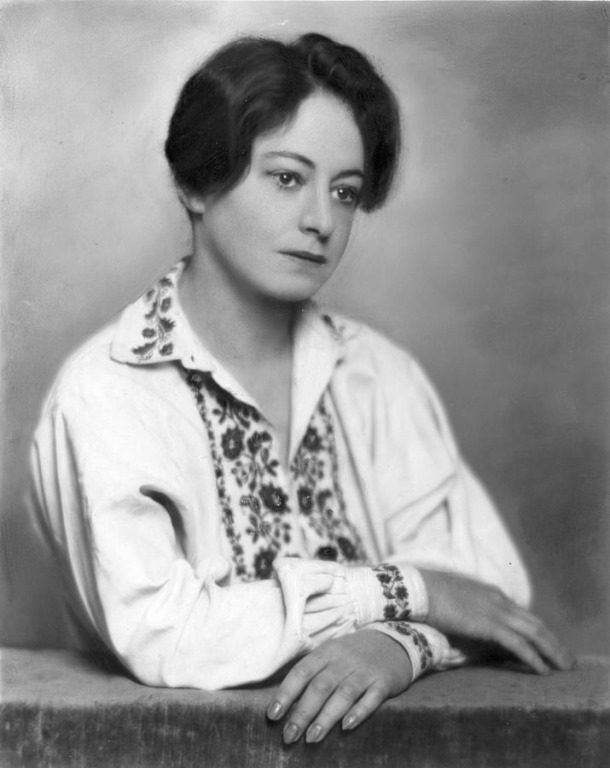
This picture of Dacey is from the poetryfoundation.org site. There are some other poems of his linked to a short bio there.

.

The subject matter of Dacey’s poetry when I met him was spread out between memories of his childhood in St. Louis (a city that punches above its weight in modern American poetry), a Roman Catholic upbringing, erotic desire and its complications, and family and marriage. He came into a long-term teaching gig at a rural Minnesota college, and stayed in the state during his retirement; and as a result, the setting for many of his poems is distinctly Midwestern. In my early posts here where I wrote about Phil’s poetry, I stressed the humor in it and the unusually engaging way he presented his work to audiences. Both of those things might endear him to listeners and readers, but I fear they might blind the completely earnest (or the envious) to other strengths in his poetry.***  I don’t know how he taught the craft professorially, but he models for young writers a subtle kind of poetry, and the piece I perform today is an example of that strength.

“Frost Warnings”  begins – and with only casual attention might remain – an occasional poem about the present point in an Upper Midwest autumn. Afternoons remain warm, yet the hours before dawn drop lower and lower until they eventually sink below 0 degrees Centigrade – frost and freezing time for plants. Food gardeners must make their household harvests, flower gardeners, preserve their late bloomers. The poem’s bed sheets with rips and out-worn baby blankets start as reportorial items in a task to stave off frost-burn, but are, if we think again, stealthy deep images of desire and parenthood, the kisses from which we make mankind as Éluard had it our last post.

Then a third of the way in we meet the bedding again, cast as shabby Halloween ghosts. Dacey’s unshowy poetic compression of the worn-life of young parents “too much revelry and worry” is masterful, but might you overlook it on first reading? The modesty of how Dacey uses his craft pleases me – and then he playfully indulges himself by breaking into Wallace-Stevens-voice for the word-a-day-calendar delight of writing down the ridiculous sounding “tatterdemalion.”

On the page it’s also easy to miss the use of rhyme and near-rhyme in this poem: that “revelry” with “worry,” “find” and “vine,” and the comic “jalopy” and “credulity.” Finally, the poem sticks the ending with a rhyme: “Fall” and “mortal.” For at least a while, I think Dacey was associated with “New Formalism” in poetry. “Frost Warnings”  is Formalism unfettered.

I wish I’d spent more time on the music I made for this one. It’s been a busy week or so for me, getting vaccinations, some banking business, attending a large gathering against cruel and capricious authoritarianism, getting my own “garden” of bicycles and composing/recording equipment ready for the upcoming winter. As a result, the music I performed with Phil Dacey’s poem is quite short, and is just a trio. I wanted to add a melody instrument, and strip back or deemphasize the piano part for a guitar, or even a horn or wind instrument part, but that would delay things, and I have a half-a-dozen other pieces in WIP state that also want completion.

Phil was a great performer of his own work. He’d have done a great job presenting this, so I tried to use my memories of him to guide me. I attempted to memorize the poem for the performance (Phil often did poetry readings without “reading”) and I hope I brought out some of the elements in my recording that a quick reader of the page poem might miss. So, it’s done, and you can hear Phillip Dacey’s “Frost Warnings”  with the audio player below. Worried that someone’s taken the audio player away and spread it over last roses in the garden? Don’t wilt, I’ll provide this alternative: a highlighted link that will open a new tab with its own audio player.

.

*Yes, I have bent the rules a few times – and as the Project was beginning, I thought I’d get permission to use more recent poems by sending simple requests, only to find that would too often require prodigious effort and persistence.

**Here my late wife and Dacey were operating like 19th century Emily Dickinson and Thomas Wentworth Higginson well into the 1970s. By the end of the 20th century it’d be emails, and by now, social media or chat software. My dusty boxes and my late wife’s metal box held things for near 50 years, but who knows at what interval current inter-author correspondence-in-effect goes all Library of Alexandria.

***Often humor has a shorter shelf-life and lower canonical trajectory in literature. Using humor, or other approaches which seem to attract a wider audience, can attract a distrust of “mere entertainment.” The argument here, to be fair to detractors, is that such an audience is shallower even if broader, and that “fan-service” audience-pleasers keep an artist from growing and dealing with difficult subjects. My personal belief? Those most difficult subjects are absurd, incongruous, impossible mysteries and dichotomies to solve, and that humor can portray them as well as any other mode.

Phil read a few times with musical backing, as I present him today. One performance I attended was with his sons’ alt-rock band. His “readings,” even if acapella, could have performance elements. He’d weave well-told stories into the poems in such a way that you didn’t always know when the poem had started and explanatory introductory material had ended. He sometimes sang lines when he quoted a song inside a poem. Again, let me concede this sort of thing can be cloying. I’ve heard poetry readers down-rated for an “AmDram (amateur drama) style of presentation, and the “You are hereby sentenced to attend my one-man-show” jokes are easy to make – and that’s sometimes justified. My summary? This can be done badly. Just about all ways of presenting poetry can be done badly.  I thought Phil did it well. Other than talent and attention to his craft (including presentation) one reason it may have worked for Phil was the modest and subtle nature of his poetry that awaited and welcomed being presented more expressively than on the silent page. Still, and unlike some performance-oriented poets, Dacey’s poetry does stand up on the silent page – I just have had the pleasure of seeing it in that other framing.

Dorothy Parker’s “Portrait of the Artist”

Is Dorothy Parker a humorist or a poet? If choosing one, do we diminish the other? Wikipedia leads with the latter – which surprises me a little, because if you’d asked me in the midst of my literary engagements decades ago, I’d have replied the former. The poetic literary cannon doesn’t mind wit, but it downrates those suspected of making humor the main point of their work. And there’s the matter of how it was presented: Parker published in general periodicals (though at a time when they were still engaged more than now with literary poetry). Her collections are filled with short verses sharply focused on catching the busy glossy page-turner a century ago. Are they the poetry equivalent of a New Yorker cartoon – some insidery cultural memeability, yes – but not meant to be judged alongside fine art with substantial complexity?

What if we were to read her in translation, and she was a writer from a culture and times we were substantially distanced from? Imagine a poem like the one I’ll perform today not as a 1920’s American work by a writer whose lifetime overlapped my own, but as a fragment of Sappho or a poem taken from the pen-work of Li Po? Might we see something else?*

Here are some things I see looking at today’s poem this way as I worked to set it to music and perform it. The first is some awkward syntax, some of which could be “poetese,” that mangling of normal word order that is reaching for a sense that this is “special” speech cast in some archaic or fancified manner. In humorous verse this is often used as part of the joke: you were expecting some grand edifice of beauty and truth – dressed in this artificial, inflated manner – and instead you get a pratfall? Ha ha! This still works as a humor tactic, though its sharpness is dulled by the relative absence of literary poetry in our culture. Needing to reach the rhyme is part of the humorous charm of light verse – forced or outlandish rhymes are laugh points. Parker doesn’t go Ogden-Nash-hard on this here, but I smiled when the “rankles” and “ankles” chime goes off in the first verse.

An allied tactic is the use of some unusual words, another high-falutin stance that aims to make the pratfall funnier. I actually had to fix my recording of this. Having recently worked on Yeats famous apocalypse “The Second Coming,”  I actually sang “And gyre my wrists and ankles.” “Gyve” is to bind or tie, “gyre” is to move in a circle or spiral. I don’t know, maybe I was visualizing RFK Jr’s falcons besetting the poem’s speaker with fetters in their beaks and claws.**

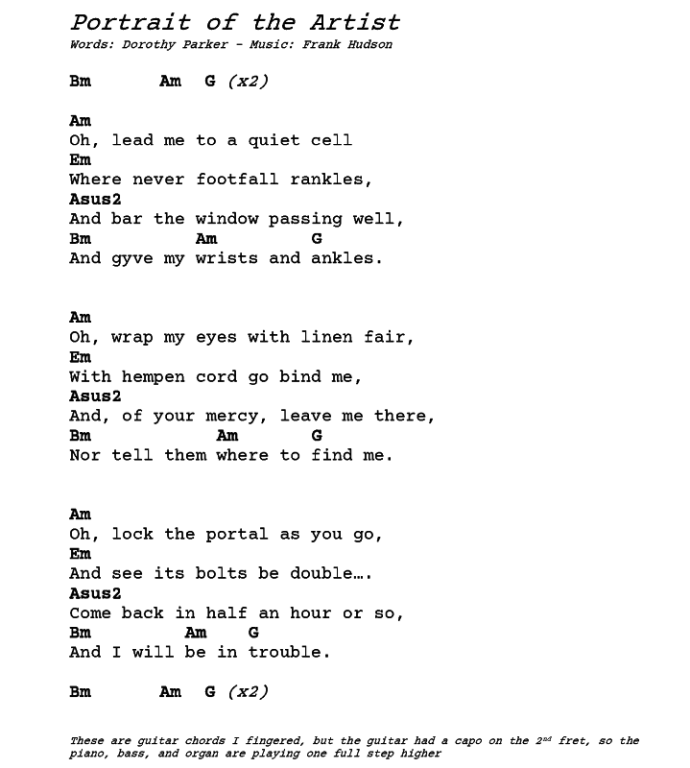
Portrait of the Artist

Here’s a chord sheet for the song I made of Parker’s poem

.

Also noted when dealing with this poem: the situation set out in the poem is extreme, and taken literally it’s a portrait of bondage, exile, or imprisonment. If parts of this survived as a Sappho fragment, I can see this being decoded erotically. Scholarship and kink cross-over more often these days – and the poem’s imagery is specifically sensual – but don’t put that in your scholarly paper until you do further research.

And here’s the last, most important thing I noticed: I’ve been living this poem recently. First off, a sidelight on the manner in which I found Parker’s poem: I have been going through books and disposing of most of them. My wife is distressed by the number of books and recordings I’ve accumulated over my life. Little difference most sit shelved at the edges of rooms, they are clutter,  and she believes that the space could be used otherwise. At this point in my life, I can see this issue another way: I’m of an age that there’s no world enough and time to imagine going back and rereading or reading the majority of them. Books that I once treasured as reference materials are likely obsoleted by the Internet. For example, I’m torn about keeping my thick hardbound French to English dictionary which was a companion when I started translating French poetry years ago. I’m keeping most of my books of poetry, and some on music, as I intend to keep doing this Project. Novels and general non-fiction? To be carried away.***  Is it clutter? Among my small segment of humanity, I’m not alone in being comforted by books and music surrounding me, and the irrationality of there being more than I can consume in whatever time I have left as an aged person doesn’t change this, but having accumulated an overwhelming amount submerges some books. Going through my books I was surprised to find a 1930’s printing of Parker’s collected poems. I don’t remember buying it, though I did spend time and a dollar or two in any used bookstore that had a hardbound poetry section during my youth.

Last week I read through the first segment of Parker’s book, work that is now in the public domain, and it’s there I found “Portrait of the Artist.”  I’ve mentioned recently that my opportunities to create new work here has become constrained. I’ll spare you the logistical details, but in the early years of this Project I had the five workdays of the workweek to research, compose, and record. The hundreds of pieces I produced in the first half of the Parlando Project’s run say I used that time productively – but if I was to be honest, I’d report that there were days I just blew off, knowing that the next day would be just as good to start or complete some Parlando work.

Now? I can’t tell for certain when I can record, I just know there will be fewer hours available. My energy level as I age is lower, and my old body no longer finds itself able to sit in an upright office chair for hours at a time. I do more of my research and reading on a tablet, which however marvelous, is a poorer environment for complex work with its constrained single smaller screen. I’m still able to play my instruments when I can use my studio space, though I need more time there practicing or simply blowing off the stress of life with a plugged-in electric guitar moving air around me. There are some mornings when my wife, being helpful, will tell me I’ll be able to work on recording for a few hours that day. I’ll think: I don’t have any new poem-texts selected, or the basis of a musical setting ready to be realized, and my energy is low. What can I do (anything?) with that time? And if I can’t do anything, when will the next chance come?

Whine. Whine. What else is the Internet for – complaint and its opposite, the carefully curated presentation of one’s perfectly actualized life to be envied. In Apollonian distance I can clearly see that to have the opportunity and the wonderous technology to do creative work, is a historical exception of the first order.

But then artists, many of whom are toward the introverted side, are often like the one in Parker’s poem: always swearing they wish they had the solitude and freedom from the distractions of life. And then the poet faces the blank page, the composer the silence in the room, their muse taunts them “What’ya got?” and the artist mumbles “That’s your job,” knowing that there’s really no one else in the room, just as they wanted.

There are lots of things in life that are temptations for self-pity or abuse. Sometimes the de profundis answer is “Ha ha.” That doesn’t mean it isn’t serious. The consequences for this troubled encounter with the chance to be creative, and perhaps to come up dry, have killed and crippled.

Simeon the Stylite 600

Simeon the Stylite has figured out how to get some work done without Robert Benchley, FPA, George S. Kaufman, Alexander Woollcott, et al.

.

All this feeds into the choices I made in the musical performance of Parker’s poem. I treated it no differently than I would have a “serious” literary poem by Parker’s contemporaries Elinor Wylie or Sara Teasdale, though I believe there are a couple of times I’m subtly winking as the singer seeks the situation of a desert-steeple mendicant. The fool is funny – still is when the situation is serious. This is often the lonely place of business for creativity: weighted on commercial and logical scales, it’s absurd that we do it – even, or especially, alone in that room with silences and tabla rasa.

You can hear this performance of Dorothy Parker’s “Portrait of the Artist”  with the audio player gadget below. What, is any such gadget gyved up somewhere? Well then, I provide this highlighted link that will open a new tab with its own audio player.

.

*We can prosecute mootings on more recent American authors too. I’ve recently written here on the difficulties in deciding how often Emily Dickinson means to make a humorous/satiric point in her poems vs. how often she’s an earnest transported romantic. A mixture? Likely, but what are the proportions? What are we missing if we miss the joke?

**Ah, the powers of overdubbing. I fixed that word-mistake ex-post-facto.

***I’m fond of the term “Death Cleaning” for this process. Time’s winged chariot is heading for Goodwill. While I’m blessed to be healthy for my age, I can no longer fool myself into thinking that someday I’ll get around to this, and that…and that, and that.

Ars Poetica

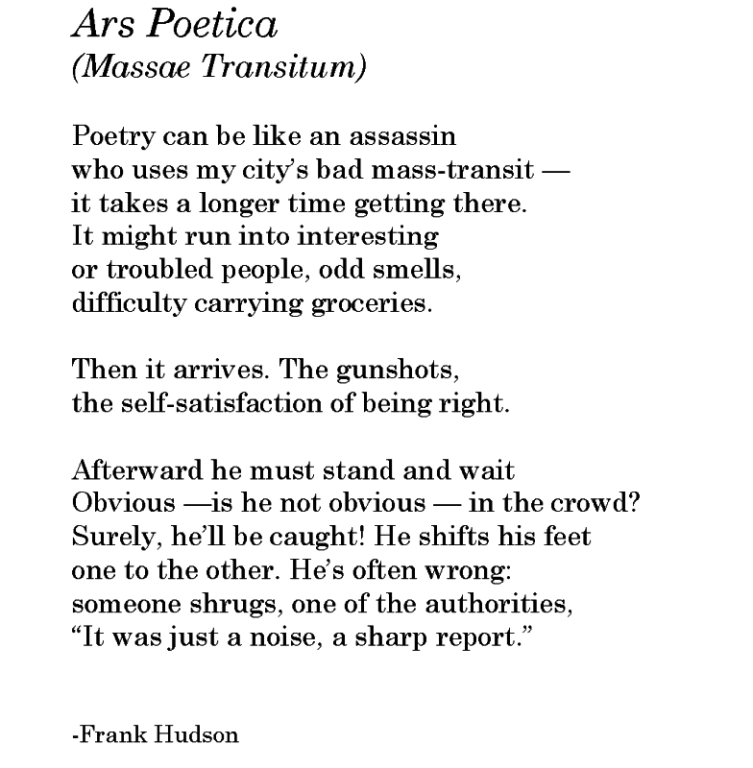
Today I take on one of those poetic expressions a great many poets have engaged with: the poem about the state of poetry. The title gets written in Latin to puzzle readers, and because Horace wrote in Latin back when the world had to worry about the whims of tyrannical kings and poets got their words carved in marble. We’re much more culturally advanced now. You can hear this poem anywhere in the world using the Internet. Dozens will listen with you during National Poetry Month. Dozens!  Imagine the value of that if that dozens was of eggs.

I briefly hesitated to share this poem of mine publicly. Not only is this project largely about other people’s words, but my Ars Poetica poem starts off comparing some poets to assassins. That’s a metaphor, a conceit, a simile.  I’ve shared other civic poems about the fate of nations this month, but I’m not a big fan of political assassination — but then I’m also not a big fan of making fun of poets, and I’m going to do that today. And it is  a civic poem. On my way to comparing poets to assassins I make note of the state of mass transit in my fair-sized midwestern American city, which is: pretty bad. Not assassination bad. No! Rather my point is that it would be bad for an assassin. Or for poets trying to get to and from poetry readings.

Ars Poetica

32 bar AABA tune. Chords are F C Am G and then Cm Gm Cm Dm in the bridge, though there are some substitutions.

.

Well, you don’t have to go anywhere to listen to the performance. And it’ll be doubly good to do so because the last day of National Poetry Month in April is also International Jazz Day, and I’m going to make some fake Jazz.* Poets, we get a month! Jazz — like a whole world of it — gets only a day. Well, it’s an international day, sliding across the globe’s time zones, but still…

You can hear me reading my Ars Poetica poem with a Jazz combo using the audio player below. No player? The Jazz Police haven’t come for it, it’s just that some ways of reading this blog suppress it. There’s an alternative: this highlighted link will open its own browser tab with an audio player.

.

*Way back in the 20th century, when we had to carry the dead weight of a constitution around all the time with laws, and due process, and so forth, a group of local improvisational comic performers used to get together and the agenda was to play bad Jazz. No, not to parody or put down Jazz, more at an honest admission that their musical skills weren’t up to that level, but the desire to have a go at it was still there. That’s me making up this Jazz quartet today. I’ve cut a corrupt deal with the composer to only write things I can play on bass and guitar, and I give the computer the chords to tickle on the piano.

The Terror of the Blank Page

I think today’s audio piece is something many writers will relate to, but since it’s one I wrote I’ll be brief later down the page in writing about my encounter with it. The top part of this post will be a process post about music and working “live in the studio” with Dave Moore again after a long break. Feel free to skip to the bottom if this process stuff isn’t your thing.

For many years I’ve taken time every September 18th to remember guitarist and composer Jimi Hendrix. This September 18th I planned to get together with Dave Moore to do what we’ve done off-and-on for more than 40 years: attempt to make music together as The LYL Band.*   For almost all that time we’ve done this in a peculiar way.

I have a space with various guitars, basses, drum pattern software, and a couple of keyboards. Dave comes there after I’ve setup the recording equipment. I start playing something harmonically simple (often a one-chord groove) and Dave walks up to a keyboard. I start with some words (usually something from another writer) as we play off the top of our heads while the recording software rolls.

After that, Dave hands me a sheet of paper with something he wrote or wants to play. Sometimes there are chords handwritten on the sheet, sometimes not. I ask for a key center. He starts off and I try to follow and figure out a part on the spot. We finish playing to that set of words. I hand Dave a chord sheet with chords written out, something I’ve composed or want to play. I start out and Dave tries to come up with a part on keyboards.

We almost never do second takes. We rarely present the songs to each other by playing the sections through to demonstrate before recording. This alternation of I, then Dave, leading a piece continues for a couple of hours with a short break in the middle to rest our hands and voices.

A great many musicians cannot do this, wouldn’t do this, are perhaps afraid to do this. It is not an exact way to accomplish the art of music. Many skilled folk, Blues, and Jazz musicians can do this if they choose to.**  Dave and I are not at that skill level. What comes out can be inarticulate, chaotic, of no use whatsoever. We give it permission to utterly fail.

Are we just lazy or eccentric. Well, maybe the latter, but the aim is to catch moments when something happens spontaneously that has a quality of that type of creation. You know the expression “Building an airplane while it is flying?” That’s the feeling when something coheres as we feel our way into the piece. I believe the best of the pieces that come out of this process may transfer some of that feeling to a listener later on.

When I work on the Parlando Project pieces I work as a composer, usually playing or directing most of the parts myself. It’s a thoughtful process, painstaking to a degree though I try to create more pieces rather than a few most perfect and maximally impressive pieces. There’s lots of do-overs, retakes, instruments attempted and rejected. What Dave and I do when we play together uses a very different part of the brain. I love the change, each type of music-making refreshes the other.

Epimetheus Unbound Cover picture

Part of collating the useable material from a session is creating a cover image. I had no idea who Epimetheus was until I encountered this Greek titan in a Longfellow poem that you may hear more about later this fall.

.

Today’s new audio piece

Back to today’s new audio piece. It’s the first thing Dave stepped up to the keyboards to play with me this past Monday. “The Terror of the Blank Page”  is a poem I wrote more than a decade ago during what the US liked to call “The War on Terror.” I think the germ of the idea may have come from finding out that Saddam Hussein had fashioned himself as a novelist and had several books published attributed to him as an author. The finished piece isn’t really about that, it’s about how we punish ourselves if we are writers for fearing and avoiding starting new work. What if it’s not the best idea? What if it’s bad, embarrassing, revealing of our faults as artists? In the end, I think my poem and this performance makes fun of that fear as it names some imagined incarnations.

The process I talked about above, the one that Dave and I use to make music quickly is a way to get out the door before the fear arrives to arrest us. To hear our live in the studio performance of “The Terror of the Blank Page”  you can use the audio player gadget below. No gadget? This highlighted link is there for those whose way of viewing this doesn’t show the gadget — it will open a new tab with its own audio player.

.

*Various other musicians have played with Dave and I from time to time in The LYL Band. Given our peripatetic musical path, it takes a special kind of musician to enjoy playing with us. One could easily say that a model for The LYL Band is The Fugs, an intently impolite band created around a core of two poets and assorted others. Don’t go listening to The Fugs recordings around your parents, your children, your school board censors, or anyone who can’t help but mention when your singing or guitar is out of tune.

**Two accomplished musicians who have used something like this approach are Miles Davis and Bob Dylan. Dylan’s classic mid-60’s ensemble recording sessions would start off pieces live in the studio which (just maybe) a music director of a sort had prepared the musicians somewhat for. He’d try a few takes, and if it didn’t work, he just went on to something else or some other combination of musicians. A record like Highway 61 Revisited  is corralling the best attempts to make chaos cohere. Miles Davis hired exceptional musicians with extraordinary ears and knowledge of the Jazz repertoire. Even though Davis was comfortable with charts and pieces with set forms and sections, he had periods when he worked with a roomful of musicians given little direction. He made a series of records from In a Silent Way  on that were mostly assembled after these live sessions by editing and collaging the best parts of this spontaneous playing.

That approach by Davis is similar to what I do with some pieces that Dave and I originate together in spontaneous live playing. I’ll add parts and remove or edit parts to create a resulting hybrid recording that contains live and composed playing.

Leonard Cohen’s Jukebox

I first encountered Leonard Cohen in one of those so serious  Sunday arts, religion, and culture shows that broadcast TV felt required to provide around the past mid-century. As he was consistently able to do throughout his life, Cohen was able to articulately weave a good deal of provocative thought into an interview. I was struck, and took to reading and listening to Cohen from that point on.

I was young then, and Cohen’s eloquence was novel to me. In the many decades since, I have heard others work the provocative angle in interviews, but never with the same level of quality as in Cohen’s spiel. Poetry, religion, music, politics, and more could enter into his answers — and often when the question didn’t determine which of those things would be in his response.

I cannot find any online video of that exact Sunday TV show from The Sixties, but his 1966 CBC interview is an example of what a Cohen interview would be like.

.

To some that could seem pretentious. And that is a risk: a lot of provocative interviewees when challenged are bluffing. Asked to show their cards, they will throw the cards and the table in the air, or will fold into muffled defensiveness. Cohen seems to have never done that. He always had, seeming at hand, another answer, deeper or funnier, or more provocative. And those Sixties interviews are even more remarkable in that many current televised interviews are prepared: a demi-scripted performance where the interviewer is tasked to ask questions prepared beforehand, so that the interviewee can be setup to tell their clever story or give a canned pitch for their current work, cause, or situation. My sense is that Cohen wouldn’t have followed such a scheme even if it was expected of him then.

Did you “huh?” at that “funnier” in the above litany? Maybe it’s the baritone voice or the unrestrained gothic concerns; to many superficial observers Cohen has always seemed the uncut expression of despair and sorrow — but with a little sex in it. Yet absurdity and satire were always part of his expression. Those looking for the correct and proper level of seriousness, those with the least sense of humor and the highest expectations for consonant entertainment, are the most likely to miss that element in Cohen.

This a longer-form documentary on Cohen from the mid-60s. Watch the first 3 minutes and ask yourself if songwriting might have lost a talent to stand-up comedy if Cohen had emerged a couple of decades later.


.

Today’s piece is a short passage from Cohen’s first novel, The Favorite Game, though the words (and I) perform it much like a poem in the Parlando Project manner with The LYL Band. I thought of this older performance today because I recently had a restless dream which had a jukebox in it, and that caused me to think of the disappearance of this phonebooth appliance that directly connected one to the sound of a voice for a coin in public places. How strange that seems now, with our earbuds and all-you-can-bear-to listen-to streaming. Cohen calls out the mechanism’s comic mystery in this passage, and you can hear it without a dime or quarter with the player gadget below — or if you don’t see that player, with this highlighted link.

.

Stopping by a Woods with Bad Cellphone Service for National Poetry Month

A couple of posts back I suggested we do more than poetry prompts or poem a day writing challenges for National Poetry Month. Here’s a demonstration of an idea that’s half-way there. While still a poetry writing prompt, it also acknowledges the tradition we’re working in.

Write a parody of a poem you like, you dislike, or you just have heard too too-often that you want to mess with it.*

One of the first teenage poems I wrote decades ago was a parody of Keats’ “Ode to a Grecian Urn”  titled “Ode to a 1953 Automobile Ad.”   I loved Keats’ poem, and while I wanted the smile that my title could engender, my parody was more at pointing out that Keats’ painful air of not-quite-realized truth portraying beauty wasn’t just a 19th century thing. Like most all of Sappho, that one may be lost to the ages, but here’s one recent enough to have been performed in the early years of this project: “Stopping by a Woods with Bad Cellphone Service.”

Did I like, hate, or just want to mess with Frost’s Stopping by a Woods on a Snowy Evening?”   Maybe a little of each. Long time readers here will remember that I disliked Frost in my youth. I thought then he was spouting platitudes, but I was wrong on that. When I presented Frost’s “Snowy Evening”  here years back I said that the most important thing in the poem has been little realized. The poem’s speaker isn’t being tempted by wasting time admiring natural beauty. He’s not seeking Transcendentalist truth by closely reading the book of nature — though Frost does read the book of nature, his readings are unusually dark. Those are common understandings of Frost’s poem, which do sort of find the poem’s ending as a platitude: “You know what you need to do, get to work.” So is it darker? Is he basically being tempted to crawl into the woods and end it all? Not quite that either. The most important fact in the story of this poem is that the speaker is lost  on a rural road in the early 20th century on the “darkest evening of the year,” which would be utter darkness in the days before electric light. There’s no beautiful Currier & Ives woods. It’s so deserted and without information you can hear snowflakes rubbing on each other. The famous opening is (with added italics) “Whose woods these are I think  I know.” Not really knowing = lost. When he decides to press on, it’s the act of acting without there being any knowledge that he’s going the right way. The poem sounds beautiful, and that ennobles that act, even if it says the speaker may have been foolish and is risking acting without knowledge at the end.

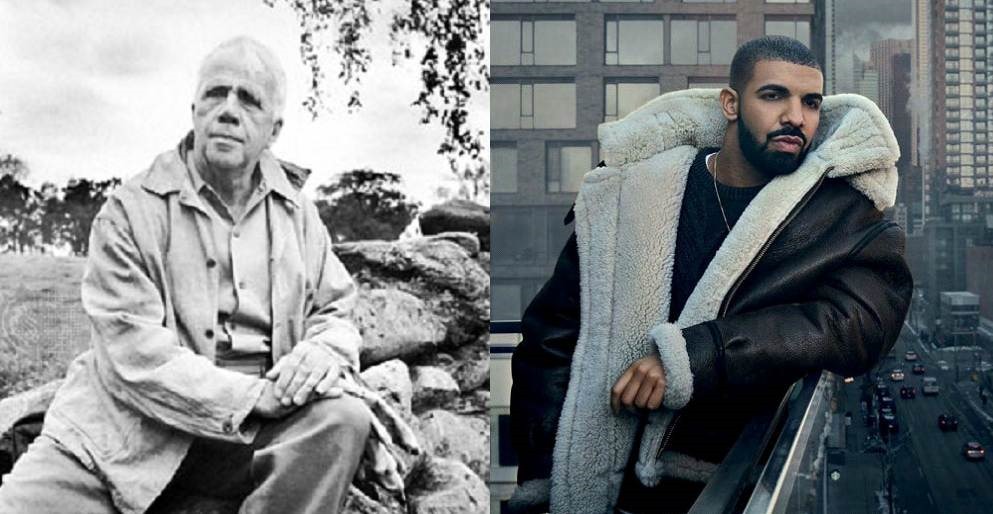
Frost Drake

April is National Poetry Month, and spring is here. Two gentlemen are unbuttoning their coats.

.

My parody is more lighthearted, and is set in the 21st century, but like a lot of jokes the situation isn’t pleasant. By writing a parody you are acknowledging the poem and your knowledge of it — so even if your parody is meant as a corrective to make the reader never read the original poem the same way again, you are engaging in the type of activity I’m urging more of this Poetry Month: that we should encourage more expression not just by adding to the sum total of poetic examples of it, but by acknowledging it in others.

Three ways to hear The LYL Band rip into this snowy poem: this is the link to a lyric video, or (for some of you) a player gadget below to hear just the audio, and finally there’s this fallback link that will play it also.

.

*There’s a long tradition of this in poetry and songs. It’s not just Weird Al. In my youth they were called “answer records” — and later on in hip hop, a “dis track” might twist someone else’s rhymes or musical samples in service of dialectic. We’ve presented some poetic “answer records” here. Like this famous set of poems here and here. Or this quippish answer I appended to another short poem.

I also sometimes make moves that feel a little like parody in some of my looser or “after” translations of older poems. Here’s one example. And another. And one more. These aren’t meant to be “funny ha-hah,” but there’s a pleasure in finding history’s cultural “rhymes.”

Coyotes

Today let’s examine the place of hands and humor in poetry and music. Let’s start with hands, before we turn to the subject of humor and a poem about farming.*

You just heard alternate Parlando Project voice Dave Moore last time here, but besides letting you get a break from my vocals, Dave has played keyboards with me since the late 1970s as the core of The LYL Band. That’s a long piece of work, particularly in that I’ve needed him more than he’s needed me with this. Here are the basics of that: I’m a poor rhythm guitarist. I like to add color and decoration whether the song is fast and loud or quiet and moody. Groove, beat, a solid march of chords to carry you along? Not in my wheelhouse. The LYL Band has had other guitarists over the years to handle some of that, but most of the time it’s been down to Dave for the chords and groove. Back in the earliest days of recording us, when four tracks were a fresh luxury, I’d put Dave’s keys on the same track as a drum machine, sure that he’d be solid as the machine.

Now we’ve both got some mileage on our hands, and Dave has encountered some issues with both of his arms and hands. He tells me that the fingers just won’t do what he asks them to do some of the time. He’s become more like me now as a musician: able to do some things, some days, within limits. My own hands have had problems too, which currently are no worse, and many days a little better. Oddly, writing and composing can let my hands weaken. To wrangle a guitar as I often like to takes not just flexibility but also finger strength which is best approached by regular use with a gentle uptake, not a two-hour live session where I need them to work right off after weeks of musing on poetry and tapping out a sonnet. I’ve been trying to carve out more time to “just play” in order to keep my digits loose and strong.

So, when Dave and I got together this month to honor our friends who’ve recently died, I assessed that my hands were ready to rumble by current standards; but Dave, while game, wasn’t sure. During the session, he did all right, even if he wasn’t nearly as strong as he was in our little band for years.

Now on to humor. Kevin FitzPatrick was a poet we got together to honor. We both knew him for decades, and Kevin even played a little blues harmonica with us a few times in the early days. One thing that Kevin’s poetry often used was his dry sense of humor. If his poems “had other people in them” the interaction between those characters was often humorous. Humor is like that, isn’t it? With poetry one can easily fill a chapbook with solitary musings, singing philosophies, and hermit’s prayers, but humor generally requires other people, our rubs, our missed and kissed connections.

Kevin’s final collection Still Living in Town  has several characters, but the central ones were his own persona, a city-living office employee and his life partner, Tina, a woman who had decided she wanted the rural life — and not a Walden cabin in the woods, but a farm growing a variety of produce and sheep.**  Kevin was in his 60s, but he was a big fit guy (he boxed and taught martial arts in his youth) and however urban his life had been, his character pitched in with the farm labor.

Kevin’s farm poems are and aren’t like Robert Frost’s to compare them to a famous example. That Kevin could approach a blank verse feel in some poems would connect them — but Frost, urban-born and professionally an itinerant teacher, liked to cast his persona in his farming poems as knowledgeable and in place with farming, while Kevin portrayed himself with beginner’s mind on the farm. Given that fewer living readers have any connection with farm work, Still Living in Town  invites us into that milieu wonderfully.

The poem of Kevin’s I used for today’s piece is looser metrically, but while it’s set in like weather to this current March (wheeling rain and snow and thaw) it most wants us to hear a little story about the two characters, the labor of farming, and yes, the humor in hands and their stubbornness.

Jazzmasters!

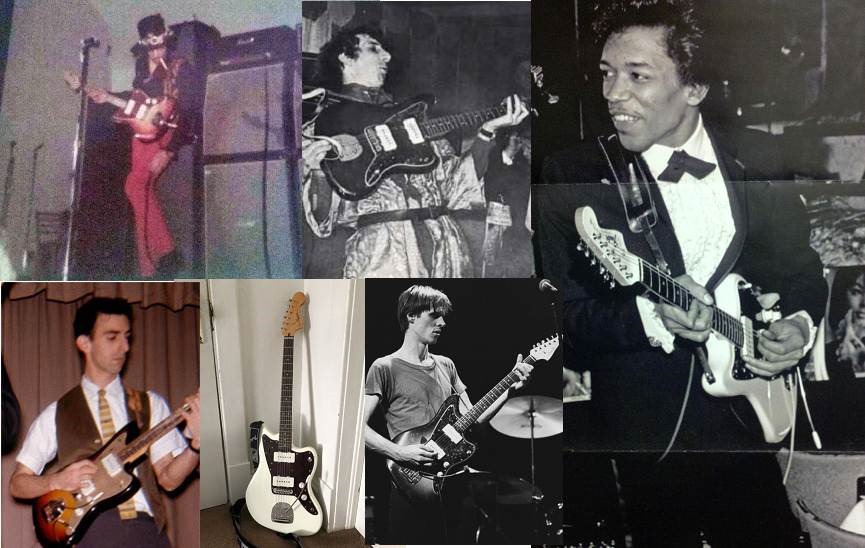
Jazzmasters! From the upper left: Jimi Hendrix without a Strat; Pete Townsend about to decrease the supply of used guitars; some guy named Jimmy James (wonder what became of him?); Frank Zappa, who didn’t say “The Jazzmaster isn’t dead, it just smells funny;” my Jazzmaster painted the homeopathic color Sonic Blue; Tom Verlaine, vanguard of the alternative nation which latched onto the bargain unwanted Jazzmaster in the 1970s.

.

A few notes on the music. I sometimes create the drum tracks for my compositions before the live session begins. And since I’m usually needed in the guitarist role, I sometimes lay down the bass parts with those tracks ahead of time too. That’s how this piece was. On the day of the session, I sang and played the wailing lead guitar*** and recorded the reading of Kevin’s words live with Dave playing a baaing/buzzing synth part live. Dave’s part, subject to his current hands, didn’t fulfill all the groove chop I thought the piece needed. So I added a second guitar part doing my best at rhythm guitar on my Telecaster, but a lot of the final groove you hear is an electric piano part that I laid down trying to imitate my friend and partner Dave’s playing as I recall it from the past.

By now I hope you’re ready to hear the musical story of Kevin FitzPatrick’s farm poem “Coyotes.”   The player gadget is below for many of you. Don’t see that? This highlighted link is provided as an alternative so you can hear it that way too.

.

*I have to repeat this one, which I read in a comment thread this month regarding the upcoming Hollywood Oscar awards event: “The only Oscars I care about are Peterson and Wilde.” In the context of Dave Moore, even the young Dave wasn’t likely to stand toe to toe (finger to finger?) with Oscar Peterson on piano. On the other hand, I’ll hop on top of Oscar Wilde’s tea table in my slush-muddy Minnesota shoes and declare Dave’s poetic wit with Wilde’s.

**Other reoccurring characters weave in and out in the farm poems too — and while four-legged, the couple’s farm dog, the incongruous poodle named Katie, makes a cameo appearance in this one and others.

***The lead guitar part is played on a Jazzmaster, a famous failure in Fender’s otherwise wildly successful line of mid-century electric guitars. A couple of decades into its Edsel-hood of “what were they thinking” failure, unwanted used Jazzmasters became an affordable choice pragmatically chosen by some punk and alternative musicians. Even so, few think of a Jazzmaster for this kind of wailing lead guitar with a bit of funk flavor. As long as one is able to address the Jazzmaster’s bridge design issues, it can  do that sort of thing.

The Men in the Basement

Late last year I promised you’d get to hear some pieces based on the poetry of Ethna McKiernan. I thought about which one to start off with, and decided I’d perform this one for you first. Why? Because it may make you smile.

Regular readers here recently will have caught up with my connection with Ethna: how I heard her read work in progress in a small group of other writers who cycled through each other’s homes each month to do that. You’ll also know that the rest of the group was usually men in its later years.

When we met in Ethna’s our meeting would always start in her little kitchen. We’d stand near her sink and stove and brew up some tea and talk a bit about what happened since we last met, until our remaining writer’s group members accumulated. On one side of that room was the clipping and photo-decorated refrigerator door, a generalized cultural artifact, and on the other side a small table and chair. Her house was a modest South Minneapolis bungalow probably built in the last Twenties, a couple of blocks off of East Lake Street. Comfortable and reasonably roomy with the usual shelves of books in its main-floor rooms and a couple of wandering cats as one might find in a poet’s house. I never saw more than the main floor, but there was a second story up a wooden staircase, and as we shall shortly hear, a basement below. That all said, it seems Ethna wrote and revised mostly in that small kitchen.

Kitchens are a physical metaphor, the site of drudgery and giving, sustenance and routine. If I may gender a floorplan: the most female part of most houses.

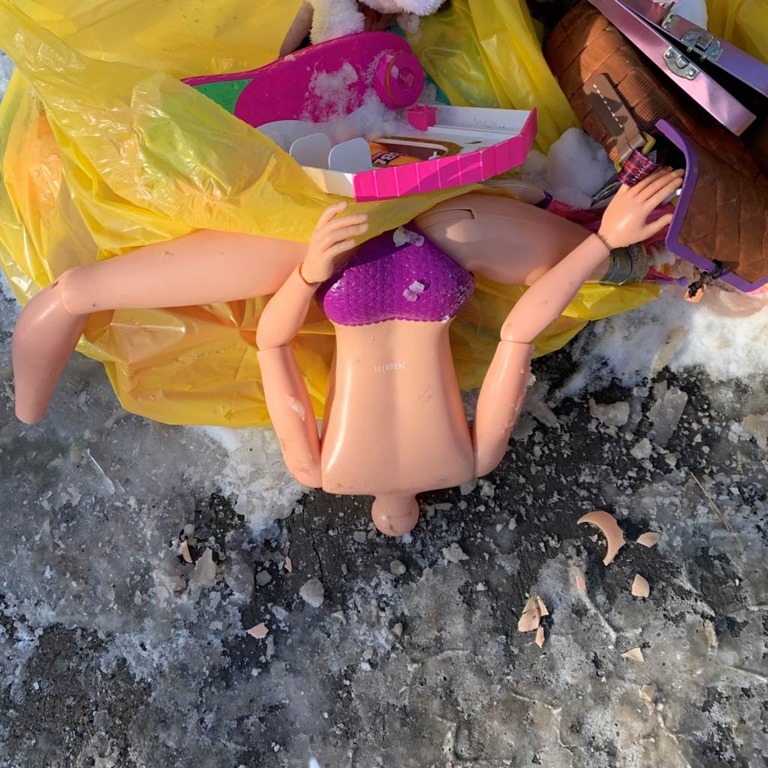
South Minneapolis is Tough on Barbies by Heidi Randen

Approximately how some of us feel on winter days. If only there was some help…

.

I remember hearing “The Men in the Basement”  at one of those meetings. Everyone enjoyed it, got it, right off the bat, which was far from a universal reaction to the work we shared. I heard her read it at least once at a public reading, and since it was included in her New and Selected  collection* published just before her death late last year, we can be sure that Ethna herself liked this poem and expected audiences to do so too.

Do women understand this poem more than men do? How the hell should I know, though I suppose some raise themselves to opinions on such matters. I myself found it easy enough for my anima to perform it, though maybe some listeners will find that strange. Again, how the hell should I know? Anyway, given that we all bruise, want, wonder, live together and alone — and sorry, buzzkill for this entertainingly arch poem, we all sicken and die — I don’t find it worthwhile to predict or expect right now.

Musically I made this one an assortment of sounds, and I even worried that I may have over-egged it with the variety, but I’ll limit my predictions to that you’ll enjoy meeting Ethna’s text today. There’s a player gadget below for many of you, but you can also use this highlighted hyperlink where the player isn’t shown to hear it.

.

*That book, Light Rolling Slowly Backwards: New and Selected Poems  is a great summary of McKiernan’s poetry. Here’s a link to the publisher’s listing.

Love and Sleep — or I re-examine Swinburne, with a little sex in it

I have to hand it to the Victorians — when it came to the names of some of their poets, they seemed to know how to roll right through the evocative, and tumble ass over teakettle into camp.*  This project has touched on the Pre-Raphaelites, those 19th century hipsters with their love for the middle-parts of the Middle Ages, and one of their leading lights Dante Gabriel Rossetti had a moniker that seemed to mix angels and demons with some flowery notes. Or then there’s the pioneering Canadian poet who decided to flesh out Sappho’s fragments with his own poetry: Bliss Carmen. But let’s suppose you’re writing a comic novel set then. You want a character name that’s really, really over the top. If so, you might then independently invent the name Algernon Charles Swinburne.

Sorry, already taken.

I can remember first running into the name in a poetry anthology while a teenager. I laughed out loud at its outrageousness. Algernon had been dead for a bit more than 50 years, but as we shall see, I doubt he minded my noting that. Honestly, I laughed for myself, but of course as a teenager who liked poetry I may have needed to laugh at that name out loud too. Young men in my place and time weren’t much for poetry, but I could suppose a name like John Keats could slip under the radar. Algernon Charles Swinburne, on the other hand, could have written poetry like Robert W. Service and he’d still have such a foppish name.

I went to read his poems anyway. Or I tried to. They didn’t seem outrageous to me — their effect was more at ornate, over-decorated boredom. And his poetry seemed to have nothing to say other than its fancy dress. In the years since, I’ve occasionally looked at a few Swinburne poems, and nothing has changed that opinion.

Algernon_Charles_Swinburne,_1862

Portrait of Swinburne by Dante Gabriel Rossetti. Let’s forget poetry for a moment, what product does he use for that much body?

.

This year while reading some accounts and memoirs of early poetic Modernists I did notice something odd. More than a few of them went through a Swinburne phase.**  I had known that the Pre-Raphaelites (Swinburne knew and was associated with them) and their “Forward Into the Past” revivalism of earlier literary and visual styles was an influence on some Modernists, but the things they sought to revive tended to be simpler than the mainstream Victorian style: old ballads, flatter painting, hand-hewn furniture, that sort of thing. Swinburne just seemed rococo through and through.

But there was another element that may have attracted them. Swinburne’s poetry was considered in the late 19th century to be, well, hot stuff, erotic, even transgressive. Swinburne’s contemporaries thought that Swinburne if anything reveled in those characterizations. Oscar Wilde (here we go again with the Victorian names) might be thought as someone comfortable with this, but more than one article I’ve read notes that Wilde said of Swinburne “A braggart in matters of vice, who had done everything he could to convince his fellow citizens of his homosexuality and bestiality without being in the slightest degree a homosexual or a bestialiser.”

School poetry anthologies skipped over that part, but Swinburne’s indirection in his poetic diction isn’t going to cause me to create a “radio edit” of today’s piece, his love sonnet “Love and Sleep.***”

So, what’s going on in this poem? S-E-X of some kind, though the down and dirty details are hard to suss out. A lot of what you may “see” in it is portrayed by implication and connotation. The “nudge, nudge, wink, wink” elements of the famous Monty Python sketch can be invoked in close readings here. I don’t want to play the Eric Idle character from that sketch for you, but I must risk being a mixture of risqué and ridiculous if I’m going to talk about what the poem does with language and imagery. Here’s a link to the complete text of Swinburne’s poem that I used for today so you can follow along as I go through the sonnet line by line.

  1. Classic mechanical clocks of that era might strike to mark the hours of nighttime. They don’t stroke. Make of this what you will.
  2. The lover, or perhaps some dream, imagining, or otherwise non-corporeal manifestation of them arrives at the poet’s bed.
  3. Flowers are invoked. Georgia O’Keefe, Judy Chicago, and Cardi B have yet to be born. Details in Swinburne’s imagery sometimes seem contradictory in a way I find hard to read. Something “pale as the duskiest lilly’s leaf” is hermetic. Is what is being viewed pale or dark?
  4. Erotic nibbling, or call for Van Helsing? You decide.
  5. Skin. Bare skin. Victorians are getting hot and bothered now. A lot of care in trying to describe the skin’s tone that just confused me. Wan (pale again) yet…
  6. “Without white or red.” Is Swinburne color blind? Is this night-vision gray? Even readers who are POC are getting confused here. One reading informed by those bestiality rumors: cephalopods. Students who find this post later: don’t put this in your essay, it will not help your grade.
  7. Well, the lover appears to be female, and she’s going to be allowed to speak. Thanks patriarchy!
  8. She speaks like a veddy veddy proper lady too — but apparently interested in “Delight.” Is that what the kids are calling it now?
  9. “Her face” is honey. Good, let’s keep this PG.
  10. Her body is “pasture” which borders on Surrealist de-humanizing imagery, though by implication this may be portraying the poet as a horny ruminant — so equality! If then: several stomachs. He can go all night.
  11. English poets love the word lithe. I’m not sure why, other than to prove they can enunciate without lisping. I don’t think Victorian English winter heating systems were well-ranked, and even in modern Minnesota we have our own personal erotic frissons with hands far from warm. Anyway, in Swinburne’s poem, the hands are “hotter than fire.” Let’s hope the beloved wasn’t chopping jalapenos in the kitchen before coming to bed.
  12. “Quivering flanks.” Good, someone’s having fun. “Hair smelling of the south.” In the mid-19th century Swinburne was living with William Morris and Dante Gabriel Rossetti in a house in Chelsea just north of the Thames. Luckily for poetic romance, this was a few years after this smell that would have come from the south.
  13. Feet. Thighs. More skin. Swinburne may have had trouble describing it, but he knows it’s sexy.
  14. “Glittering eyelids of my soul’s desire.” The arrival of Mark Bolan is prophesized by Mr. Swinburne. Get it on! Bang a gong. Get it on!

The poem’s title may be an indication this is a dream or imagining. Those on the material plane could suggest it’s a report of the great lover Swinburne, post quivering flanks.

Now, can singing help this text out? That’s plausible, as song lyrics can escape close examination and play to Swinburne’s strengths in meter and rhyme.**** And absurdity and mutual laughter are not enemies of eroticism. I give you a testimonial, available with a player gadget below for some of you, or where that’s not seen, this highlighted hyperlink which will open a player in a new tab window so you can hear my performance of “Love and Sleep.”  A couple rough spots for the acoustic guitar track I had to throw down quickly, but I love the C# minor11 chord I throw in at the end, even if I don’t know what color its skin is.

.

*By the 20th century Americans were much more straightforward with their name-branding. “Robert Frost” is the best name for that poet of New England’s cool stoicism. Ironic, what with the Anti-Semitism, but then what’s a better name for the poetic force that sought to revive the freshness of poetry’s texts, carefully weighing his words, than Ezra Pound. And for someone who would grow up to like the most honest poetry of the New York School, I can thank my family for Frank Hudson.

**As late as The Sixties, the anarchist and sex-very-positive  musical group The Fugs would perform a Swinburne poem just as they would perform Ginsberg and Charles Olson. Not suitable for the easily, or even not so easily, offended, The Fugs usually skipped the euphemism in their name, and as far as looseness in performance and vocal perfection they could make The Replacements sound like The Captain and Tennille. Don’t blame them, but they were a big influence on Dave and myself forming a band.

***Once again, I have to thank the Fourteen Lines blog for bringing this poem to my attention. This summer he’s had me look again at Joyce Kilmer, and now Swinburne. Well worth reading and following if you are interested in shorter poetry forms and expression. Like this project, Fourteen Lines doesn’t limit what they present to the poets they like the most.

****After all, pace Mr. Bolan: what the heck is “I’m just a Jeepster for your love” mean anyway? Did it seem exotic Americana to Marc? Just easier to scan than “I’m a Humbler Super Snipe for your love?” Perhaps, just as Paul  Éluard would have it, the beloved makes you “Speak without having a thing to say.”

Distance Blues (Theory)

Here’s another woman writing very compressed verse about life and love around a hundred years ago, during that last decade we called “The Twenties.” She’s Dorothy Parker, and you’ll often find her work filed under “humorist.” As I said a few years ago when first talking here about Parker, I suspect that classification tended to prevent her work being discussed as poetry.

Young Dorothy Parker

Let me extend Charles Mingus: If Dorothy Parker was a gunslinger, there’d be a whole lot of dead serious romantic poets

.

That label, used to set humor aside from “important work,” like the idea that verse sung with music is unlikely to be real poetry, seems not just needlessly exclusionary, but ahistorical. The western classical canon didn’t make this distinction when the verse was in Greek or Latin. Maybe translation slows down the appreciation of the jokes in Catullus for example? Perhaps Parker’s real fault (other than being a woman who wasn’t publishing in poetry journals in this era) was in being seen as “only” a humorist, and one that tended to write, like several other popular female poets of her time, about the abundant absurdities in human romantic relationships.*

This April I finished my several-year serial-performance of Eliot’s “The Waste Land,”  a poem that wants to, indeed its innovative design is to, talk about a wide variety of things. Its middle part, like our middle parts, is very concerned with just such human miss-connections — but for good or ill that section is surrounded by an elaborate series of scenes time-adrift and spiritual that wear the mask of tragedy and religious/academic vestments. Does Eliot ever make you laugh at the absurdities? Well, there are a few sly jokes in it — but more in contrast, “The Waste Land”  is long, it’s elaborate, and for me it remains powerful assuming you can accept the way Eliot sung his suite of songs printed silent on paper. Is elaboration the superior art? You tell me. I think it has its powers, as does concision. Are we less likely to be moved or changed by laughter or tears? Again, you tell me, I don’t know.

Where is it that Parker fails if we are not to consider her short pieces, printed in glossy magazines as witty amusements, as actual poetry? Are her observations merely trite, just a chuckle the first time we hear them, and unrewarding beyond that? Does humor outdate faster than solemn meditations?

I’ll sing a couple, and you decide. Today’s audio piece is an old recording where I combined two Parker poems, “Distance”  and “Theory,”  with a bit of acoustic guitar blues feeling. Combining short pieces is a tactic taken by several of the Modernists of Parker’s era:** the idea is that short, epigrammatic poems can gain power if presented as a facet in a collection of other short verses. The player gadget will appear below for some of you, and if you don’t see it, this highlighted hyperlink will open a new tab or window to allow you to hear it.

.

*Parker also ridicules patriarchal attitudes, which might have been minimized as mere jokes without consequence to assuage male privilege, but she’s also rough on some female-gendered behavior. This can be read by some as both-sides-ism, but maybe there’s also a reading that says it’s a more essential, radical critic of gender.

**I’ve been thinking about that tactic, used by poets Wallace Stevens, Alfred Kreymborg, Edgar Lee Masters, and others in the early Modernist era, and just now I recognized that the common practice of Blues singers of combining as series of floating or not directly related Blues verses has at least surface similarity. Perhaps this subconsciously led me to combining two Parker poems in my bluesy singing of them — but it could also be for a practical reason, one that may have obtained for some of the Blues singers: it made a piece out of shorter material that reaches a longer, desired length.