Langston Hughes Chooses Jazz Poetry: “Jazz Band in a Parisian Cabaret”

I’m going to write about 20th century poet Langston Hughes’ pioneering Jazz poetry. I’m hoping to condense a lot, trying to make this short – but we’ll see. Like someone commencing a Jazz improvisation, I’ve got an idea – and maybe have some sight of where that idea goes – but what happens after that? That spirit, going there with maybe a first idea to see what you can develop from it, is what makes Jazz improvisation possible. Some skilled musicians, able to translate written scores into music straight off the page are terrified of that leap. Perhaps it’s because they know how to play those set-down compositions right that they’re frightened – if I must improvise, they may think, how will I know what’s right?

Langston Hughes published the words I’ll be using today in 1926 – but I must be in a hurry telling today’s story, because I’ll start in 1835, or thereabouts. Wikipedia puts “circa” next to that date, so there aren’t any attested records, but one Mary Sampson Patterson was born a free woman of color at about that date in North Carolina.

At around age 20 her Wikipedia entry says she fled for Ohio due to an attempted enslavement.*  Records again are sketchy, but in Ohio she in some way studied at Oberlin College – as an Afro-American woman, this a double rarity in the first part of the 19th century. Her education trailed off in 1858 when she married Lewis Leary, a fugitive slave also from North Carolina. Leary was not just a fugitive slave, he became part of the Harper’s Ferry Raid, John Brown’s attempt to start a mass slave rebellion by attacking a military armory in Virginia. Brown attempted this with only 22 men, including Leary. Under the element of surprise, Brown’s men took over the lightly guarded armory, but a little over a day later a full military detachment under the command of Robert E. Lee easily defeated the small band. Nearly half of Brown’s raiders died in the subsequent battle – Leary being one of those – and seven more were executed afterward. Lee didn’t need to be any kind of military genius to win this battle, and whatever Brown’s beliefs, he wasn’t a great tactician either. Were they both improvising? I suppose they were.

The widow Mary married another abolitionist, Charles Langston, and they moved to Lawrence Kansas to raise a family. One of their children was Carolina “Carrie” Langston. That Carrie Langston married a James Hughes. The marriage was short-lived, though it produced a son given the first name from the mother’s family and the last name of the father’s: Langston Hughes. That was 1901 or maybe 1902 – accounts differ. Anyway, we’ve reached the 20th century.

Carrie needed to find work, and so the young Langston Hughes was largely raised by his grandmother Mary. So here you go: a Black woman, born around 1835, in the age of slavery, flees slavery’s grasp, gets at least a smattering of higher education, gives that up for a husband, then in turn gives up that husband in the fight against slavery, and in the end gets a chance to nurture a literary innovator. No one composes such a life and scores it out ahead of time.

I believe this is a photograph of the woman born Mary Sampson Patterson. The place I found it credits Yale’s Beinecke Library. Oddly enough I found two other photos claiming to be the Mary Patterson I write of above. Image search says one is another abolitionist woman from the same era. The other, of an older woman, may be Mary Jane Patterson, who was the first Afro-American woman to get a BA, coincidentally in more than the name, from Oberlin.

.

Hughes started writing poetry as a child. His first publication was as a teenage contributor to W.E.B. DuBois’s short-lived kids magazine. In the 1920’s he’s a young member of what gets called “The Harlem Renaissance.” Like his grandmother, he starts to get some higher education, but that effort is thwarted.**  In 1923 he takes a job crewing on an Atlantic ocean merchant steamer.

How far is he planning ahead? Like many an improvisor, Hughes might have an idea in his head, he goes there, and he sees what happens to fit next. In 1924 he jumps ship while it’s in Rotterdam, and makes his way to Paris. One of the things he finds there: other Black folks, some of them playing Jazz, which in Paris has an added layer of exoticism. Here’s a link to a good short account of some of what Langston Hughes found there.

Hughes is an Afro-American. Jazz isn’t exotic to him, but furthermore he’s part of a smaller group (even among Afro-Americans) who are developing a deeper understanding and appreciation of that music.

Given what Jazz is in our current century – a largely select-audience concert art – I feel I have to go on another expository aside now, filled with what I have absorbed from history. In the early 1920s Jazz is viewed as fast-tempo music, suitable for dancing, drinking, and carousing. Intellectually, it’s considered thoughtless, or perhaps comic, a burlesque of real musical structure, timbres, and practice. It’s associated with criminality, intoxication, and sexual promiscuity to the degree that it isn’t just guilty of being an accomplice to vice but the cause of it: just taking in that hopped-up primitive music might drive its listeners to excess and ruin. Believing that I have a wide generational and geographic range within the readers of this Project, rough analogies to the initial cultural assessments of Rock’n’Roll and Hip Hop may be made – but I have no sure metaphor for those of you who grew up in our present century, for whom those later musical movements are history too.

Just like Rock’n’Roll and Hip Hop, Blues and Jazz are Afro-American musical forms, though both soon-enough have non-Black practitioners, and this points out something that the intelligent 1920s Afro-American young man in his 20s, Langston Hughes, is facing when he writes about his experience of Jazz. In a class or vocational level, is he going to be the college-degree middle-class artist or is he going to be a crewman on a steamer or a servant-job worker? Could he be something else beyond that dialectic? Hughes must have thought of all of this even before he took off from that freighter job, and every poem he writes may be notes and directions to himself in these matters.

I don’t know when Hughes first started to write poetry about Blues and Jazz, but some things I’ve read say that his poems about them go back to his high-school poetry – and I also don’t know when he first performed his poetry with Jazz accompaniment, though I think that music is present anyway in the word-music implied in much of his early poetry – but this was unsure ground to stand on in the 1920s.***  The novelty of a genteel high art like literary poetry speaking with appreciation about Jazz had some controversial power, but cultural gatekeepers, including some of the nascent Black critics, considered the music embarrassing and detrimental. Concert music, particularly Afro-American Spirituals, overtly concerned with the Abrahamic Godhead and Biblical stories (even if metaphor for temporal, earthly liberty and respect) were a competing, easily praiseworthy art that elevated the race. Meanwhile, Jazz, including the way it was adopted by some white listeners and practitioners in the 1920s, reeked of black-face minstrel shows, with white folks playing Black folks playing the fool.

So, once more I’ve taken the long way around, but here’s the 22-year-old Langston Hughes, an Afro-American poet and college dropout, so-recently raised by a Black woman who intimately knew the serious costs of seeking freedom and respect, with $9 in capital equity in pocket, who’s jumped ship from his job, and is in Paris, a capital of European Culture – and he finds, of all things, a Jazz band. Here’s a link to the text of his resulting “Jazz Band in a Parisian Cabaret”  if you’d like to read along.

There’d be a temptation in this for a long poem of internal monolog, or some mighty external manifesto. A great poem might be written thusly, stuffed with much of what I’ve taken your time to discuss today. Instead, Hughes wrote this sly, shorter poem, one that assumes you know this history, assumes you know it in the same way that some other poet assumes you know Ovid or the Trojan War – and goddammit, if you are an American you should know it!   Hughes little poem is made up of contrasting voices, a floating democracy of understandings and misunderstandings, breathing together as Jazz plays. The diverse audience calls out, wants this music. Hughes’ voice inside this colloquy, needs it – not just to remind him of home, but to let he see that home and his culture in perspective – and so he joins the chorus of “Play that thing, Jazz band!” European high culture and wealth enjoys it – and it’s a testimony, not a detriment, to its powers that the demi-monde likes it too. Are the American millionaires (perhaps as culturally stunted as modern techbros) slumming for idle amusement, or covert in foreign secrecy allowing a forbidden release? No matter, schoolteachers, the most modest keepers of culture, find it worthwhile. And oh, this statement, summing up something that Hughes can see in this moment: “You know that tune/That laughs and cries at the same time.” Hughes reports a little babel of European languages is going on around this recognition on his part that the Jazz band knows inherently what he knows. Then Hughes’ voice speaks again in his poem, another remarkable realization about Jazz music, “You’ve got seven languages to speak in/and then some.”

This epiphany then: Afro-American art: Jazz, Blues, Hughes’ own poetry, can go over the heads of the domestic gatekeepers or the reactions of racism.

Hughes chooses to close his poem with a three-line final scene, one which a further dramatic program note might illuminate. Someone is picking up someone else for the night. No gender is lined out, and while it could be Hughes, it may also not be, or it may be Hughes constructing a metaphor.****  The person they’re attracted to is said to be from Georgia. I think that’s an important detail, because the poem’s dialog has it “Even  if you do come from Georgia.” Hughes, Northern-raised, recipient of a white-privilege-level high school education and some Ivy League University is portraying this amour as an uneducated rural person. Metaphorically then, Hughes’ concludes that Jazz and Blues folk-music ancestry isn’t important compared to what it does – and by writing Jazz poetry, eventually performing Jazz poetry, that’s the choice the young Langston Hughes makes. When this poem appears in his first poetry collection, that book is going to be titled The Weary Blues – right on the cover he’s making a point of his decision on what’s worthwhile art.
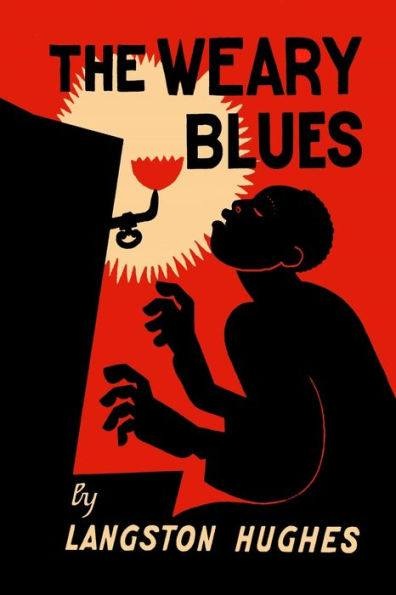
The Weary Blues cover 600

.

Now that I’ve written all that, I’m left with handing off to my musical performance of Langston Hughes’ poem. I felt compelled to “make a Jazz noise here,” as one of my models once titled an album. As a composer I don’t have the theoretical training that most modern Jazz composers do, but I put something together using a characteristic Jazz harmonic cadence. Then the composer called on the inconsistent musician me to realize it and improvise the top line melody. I’ve been practicing my poor chord-comping skills a little bit lately, so I was able to portray the set of written chord changes passably. Spontaneously creating while playing the melodic guitar line was easier for me, as I’ve always been open to improvising that sort of thing. When I start something like that, when I don’t know how to play it exactly – I may have an idea, go there, and see what would fit next. You can hear the result with the audio player gadget below. Is there no visible audio player? No, your ship didn’t leave port without you, it’s just that some ways of reading this blog will suppress showing the gadget, so I offer this highlighted link that will open a new tab with its own audio player.

.

*Putative slaves, property in this debased system, were valuable trade items. One of the most fascinating stories I ran into while researching Emily Dickinson and her family’s relations regarding American slavery was the story of a young, poor, but free-woman of color like Patterson, who was kidnapped to be sold out of state into slavery for a quick profit. Black Amherst residents “stole her back” and were defended in court by Amherst’s most notable lawyer: Emily Dickinson’s father.

**Hughes and his mother were estranged from his father, who had become a company man with the Pullman Company working out of Mexico City. Langston’s father agreed to support his education as long as it was aimed at practical matters such as engineering, not the arts. Langston Hughes agreed to make a go of that, but found he couldn’t leave his literary interests. The train trip to work out this ultimately-to-fail detente produced one of the greatest poems ever written by a teenager.

***Unintendedly, I seem to have stumbled into a theme this fall: literary poetry which has absorbed folk-music forms. Folk revival acoustic-guitar-based music and electric Rock are in my page poetry just as they are more explicitly in my Parlando Project pieces using other people’s words.

****Hughes sexuality is, best as I can determine, hard to determine. Some say he was gay, others assume bi. Some who knew him well paint a somewhat asexual person, or they just say, as I do, that they don’t know.
I Dreamed I Saw St. Augustine, with connections

I’m not one to closely follow religious matters, though many poets over the ages have — the history and the weight of all that combined belief and its inconsistent practice is considerable. I did have an interval as a youthful churchman of the Protestant kind, attracted by the community bonds and social activism of the Martin Luther King era,*  but it was recent reading of those fresh drafts of history that we call the news that brought the selection of a new Catholic Pope to my attention. For a moment my country was caught up in ancient offices as a break from the depravity of our domestic head of state.

So, first the death of the serving Pope, then the mourning, then the secret conclave in its smoke-emitting room, then the new Pope and the follow-up consideration of his background and concerns — extended this time by his North American origins. My BlueSky feed of wits supplied me with humorous predictions based on Bob/now Leo’s Chicago origins, but the pedant in me snorted most heartily when I read this news service summary of Leo’s biography explaining that he was a member of the Augustinian Order, monks with a call to service and piety. The wire-service, no doubt constrained by the spread-so-thin-the-bread-tears nature of modern journalism, informed its readers that the Augustinians were founded in the 13th century by Saint Augustine.

I have no idea what the titrated level of history buffery is within my treasured readership, but they were off by near a millennium — St. Augustine being a 4th century North African early church father! The medieval founders of this order of monks were looking back to late Western Roman empire times for a guiding light.

The Parlando results of my guffaws? I thought of a song that abides with me that I found on one of the first three record albums I bought as 1967 turned into 1968: “I Dreamed I Saw St. Augustine”  from Bob Dylan’s slightly undervalued LP John Wesley Harding.**   Dylan was on the face of it no more accurate than our news-service scribe. His apparition of St. Augustine is a troubled man, as many spiritual people are, and he briefly charges us with his preaching in the song, but Dylan’s Augustine is also specifically a martyr who was put to death, presumably by the authorities. Unlike many saints, Augustine of Hippo was not a martyr. While Augustine’s town was under siege by Vandals (the original ones, doing business as that tribal name not as members of DOGE)***  he died an old man from natural causes.

Dylan’s song is brief, brevity being an unusual virtue Dylan exercised in all but one song on John Wesley Harding.   And yet he was bringing history into the three verses, no choruses, no bridge song structure of his song. Within his seeming historical inaccuracy was his choice of a borrowed tune. “I Dreamed I Saw St. Augustine”  uses the melody and the structure of a 1930s song setting by Earl Robinson of a 1920s poem by Alfred Hayes**** about a man put out to death in 1915: “I Dreamed I Saw Joe Hill Last Night.”   I believe Dylan clearly meant to link the two men, in the way that dreams can combine things we never see in waking hours.

This song, and Dylan’s performance of it, has always touched me — and so having the coincidence of Augustinians being in the news, and the hopes that the new Pope may preach to our current overly-gifted Kings and Queens, I went to record myself singing this song of a remarkable comparing. Since it’s a copyrighted work, I present that performance today as a YouTube video. The few-hundred views one of my videos might gather would not make even a widows mite, but it’s my understanding that any revenue gathered from those annoying YouTube ads can be claimed by the rights holders. For my video I mingle artists representations of Augustine and Hill. If you can’t tell, the photos are Joe Hill and a news photo of a memorial march for him in 1915. Our 4th century Augustine was camera-shy, and has to be represented by artists’ paintings.

.

*My youth included a couple years working at a hospital still being actively managed by an order of nuns in those days.

**In search of more footnotable connections: was it coincidence that the then considered inscrutable cover of the LP has two Bengali Baals, singers in the tradition of the first songwriter to win the Nobel Prize, Rabindranath Tagore. Surely the Bob Dylan of 1967 didn’t know he’d eventually be the second. Another connection: Joe Hill was a songwriter who sang for union organizing meetings and “He who sings, prays twice” is a saying attributed to Saint Augustine.

***Augustine’s writings include thoughts on The City of God that may survive the fall of empires. Shortly after Augustine’s death, the Vandals sacked his city. Stories have it that these Vandals were impressed by Augustine’s learning, and spared the library he had established there. The current ones aren’t up to that level of civilization.

****Hayes had a long writing career. Wikipedia tells me he was an uncredited screenwriter for the famous Italian film The Bicycle Thief.   It also claims he wrote a script for The Twilight Zone, but IMDB doesn’t confirm that.

Racial Relations and gender play in the 1940s-‘50s scrapbook, Part Ten

Early this morning, I was reading a blog of a modern avant garde poet who has lots of philosophic theories about prosody, and there this quote of Walter Benjamin’s is brought up: “To write history is to give dates their physiognomy.”  Well, yes, I thought, that’s what I’ve been doing in this Black History Month series. This scrapbook, its photographs, ephemera, ads, and clippings from newspapers — all a picture of the history of an American Black man: Lawrence Kasuth “Hank” Hazlett, a musician and singer who lived from 1911 to 1990. That scrapbook that had come into my hands portrays his nation-touring time in the 1940s and a residence in South Minneapolis in the 1950s. When it comes to civil rights or diversity, we tend to see change, or the preceding things that needed to change, from a later vantage point. The scrapbook documents such a preceding time, and the sort of things that musician Frank Zappa liked to call “mutations” — the tiny breaking of norms. But, isn’t it just a scrapbook?

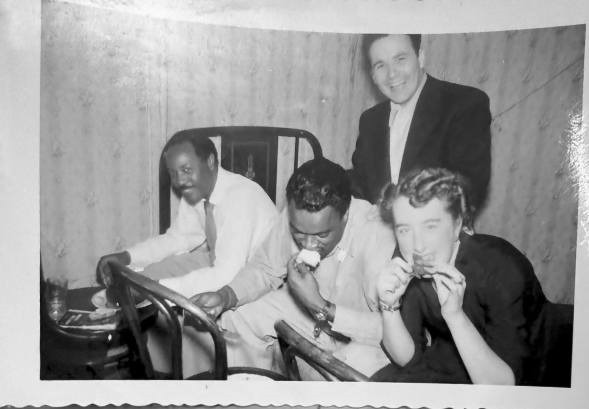
There are pieces in the scrapbook that may give us a glimpse into what its maker noted and selected to save. In the last post, we saw a picture of Hazlett playing on stage with a white bass player with the hippest of truncated neckwear — but overall, the performance photos show black musicians with him, playing (as far as I can see) to black audiences. Yet, here’s a photo from the scrapbook that stood out from that segregated norm:

Bedsitting photo

.

In this photograph two black men (the one on the left appears to be Hazlett) are sitting on a cheap enameled-bedstead bed eating. Sitting on the same bed is a white woman and behind those three, a white man in a dark suit is standing. Black and white, men and the woman are smiling. It looks like an inexpensive hotel room, and maybe they’re all on tour.

Jeannie and her Boyfriends promo

On the back of the postcard they wrote: To Edith and Hank. So nice meeting you, it’s a pleasure to be an entertainer along with you. Jeannie Bill and Don

.

The scrapbook also collects this promotional picture postcard for an act called Jennie and her Boyfriends, who issued a single 45 RPM do-wop style record in 1959. Jeannie in the promo picture has a completely different hairstyle and hair-color, but it’s plausible this is her and one of the members of her trio in the bed-sitting photo.

Also in the last post in the series, we showed some clippings in the scrapbook of Black entertainers working to defeat limiting stereotypes, but one thing that struck me was that the scrapbook also contains clippings showing white entertainment figures. Ephemera in the book, like that MGM W2 form from ’44 and Los Angeles addresses for Hazlett make me think that he might have had at least tenuous connections with some of them during the 1940s. Here’s a page from the scrapbook showing a clipping featuring Lana Turner, which may have been included because its caption says Turner likes Duke Ellington records.**

Lana Turner likes Eillington records

Lana Turner isn’t into vinyl, she’s spinning shellac.

.

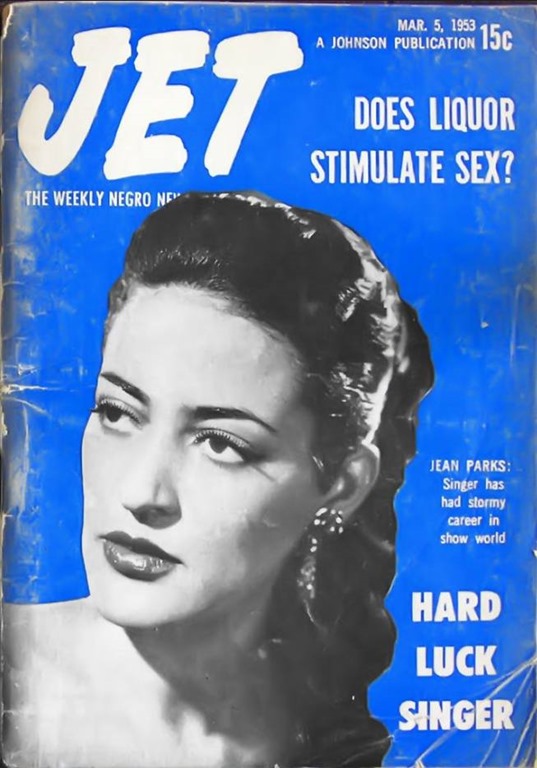
These are old clippings, sometimes from lower-res reproduction, and occasionally I’m misled by the ambiguities of race in the photographs. Take this one of Jean Parks found on this page with both white and Black entertainment figures. I figured she was white.

Jean Parks et al

Find the second Afro-American woman on this page.

.

Those who’ve followed this blog will know that I was immediately saying to myself “Who’s Jean Parks?” The story outlined from asking that is as rich or richer than the story of Bruce Dybvig from earlier in this series. WWII military service put a crimp on the supply of male musicians — so just as with other occupations, there soon arose a number of female bands — Rosie the Riveter, only with saxophones. Popular pre-war bands often enough had female singers, and there were a smattering of woman pianists (and small-group guitarists) — but women playing horns, reeds, drums in big bands— important featured instruments in those ensembles — I can’t think of one. Then came the war and mobilization. All of a sudden there were groups entirely made up of Black or white lady musos sprung full borne from the brow as it were.

One of those was Eddie Durham’s All-Star Girl Orchestra.   OK, now we’re studying history, so we have to do dates. It’s Victory over Japan Day, the war is over. In NYC a sailor grabs a nurse in a crowd without her consent, starts kissing her in front of a cameraman, and everything thinks this is splendid because the immense horrors of world war are over — and the, you know, sissy stuff  of regular old living is to return. The All-Star Girl Orchestra are in the middle of an engagement on the opposite coast, in Oakland California. The link above says that manager Durham sees that the men are going to return — and just then, dissolves the act. Well, sort of. Some remainder is rebranded around singer Jean Parks. As it turns out, the post-WWII years will be tough for all big bands — and all-around, the all-girl band thing doesn’t survive the peace.

And here’s what happens when Parks meets the world of The Fifties. Just look at the bad-girl triple-double implied and indicted in this paragraph: Black, caught with a 6-foot-tall platinum blond “friend”/roommate, sex-work — and drugs? We got’em all: reefer, opium, cocaine. Other than a Communist Party membership card signed Mr. and Mrs. and documents linking her to a plot to cancel Howdy Doody, this is complete “All-Star” material.***

Parks arrestHard luck singer Jean Parks Jet cover

Seeing that other headline on the Jet cover, and suddenly I’m a teenager in the back row of the classroom muttering to a classmate “I must be drinking the wrong kind of booze.”

.

Two other pictures in the scrapbook seem to tell some kind of story about connections between the races, likely in Minneapolis in the ‘50s. There’s this snapshot, pasted on the same page as the similarly posed picture I speculated last time might be of a child of the Hazletts. I have no idea who Maxine is, or who’s Chuck. But as with the other pictures and accounts in today’s post, I’d reckon that mixed race connections like this had elements of risk beyond just social disapprobation. White school integration riots, Emmett Till, the beating and burning of the Freedom Riders buses, all were contemporary with the scrapbook.

Maxine Chucks wife

.

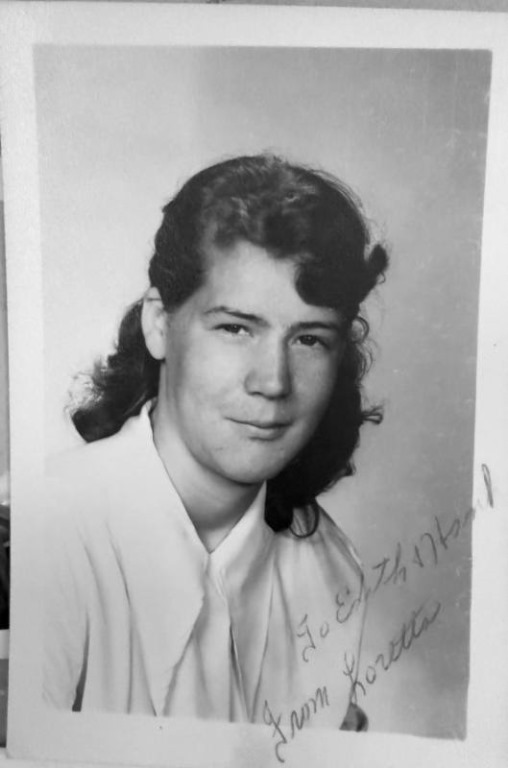
Then there’s this picture, inscribed to Hank’s wife Edith and so presumably from the early 1950s. So many of us have awkward school-picture-day photos, but I found this one more arresting than awkward. This is hard to detail, so I’m going to be more awkward than the picture, where after all Loretta is smiling and seems comfortable with themselves: Loretta looks quite masculine. Unattributed, it could easily be a 20-year-later photo of a mullet-head male guitar player in someone’s high school rock band. Burn-out the long-point blouse collar and retouch the long tresses in the back and it would be a 1950s boy who wants to grow up to play in Elvis’ band.

Get Back Loretta

Loretta.

.

There’s no other context other than the inscription and being in the scrapbook. Looking at Loretta’s photo this month I immediately thought of “Get Back,”  the Beatles lyric. Some of you may be singing the applicable verse in your head now that I’ve said that. My second thought: I’d love to know Loretta’s story, but there’s next to no chance I ever will.

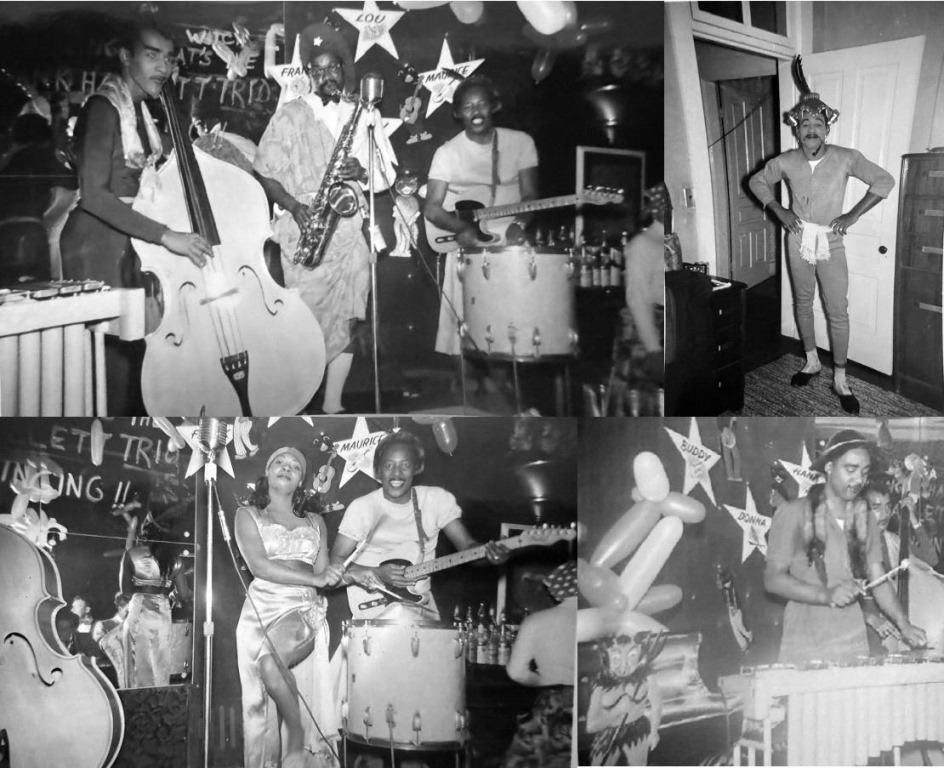
And now a transition that may or may not be apt. There are several pictures of Hank Hazlett, and Hazlett with his Trio, dressed in drag. I can’t place the club stage shown in most of the pictures. The Telecaster he’s playing says this is likely during the Fifties when he’s largely working out of Minneapolis, and it may be a Minneapolis club. Everyone looks like they’re having a good time, and dressing in drag is a multivalent act that can be meant to convey different things.

Drag performance Hank Hazlett Trio

..

Everyone seems to be having a good time. Of course, right now we know it’s supposed to mean danger to children, and therefore we must let rich folks get richer so they can stop those goings on, because…religion. That’s a very serious opinion, mandate and all — you ought to pay attention to it instead of looking at this approaching 20,000 word series on — what? — a scrapbook about a Black musician who few have even heard of. And the scrapbook is mostly pictures,  where’s the meaning in them? Of course, then there are these other Walter Benjamin quotes: “Those who do not learn how to decipher photographs will be the illiterate of the future” and “We collect books in the belief that we are preserving them, when in fact it is the books that preserve their collector.” Benjamin’s life, which we know more about than Hank, or Edith Hazlett’s, or Loretta’s life, could be called in to rebut those quotes. In a corporeal sense, he had little future, books didn’t extend his human, breathing, skin-coated living. But Benjamin did have his quotes, groups of words that might work like poems to let us see something new, and there are even some who will read philosophy at length.

There’s a new musical performance today, taken from a piece of folded and unfolded paper that was pasted into the Hazlett scrapbook. Did Edith carry it? Did Hank? On it, in faded pencil, are written 6 quotes, 6 maxims that someone wanted to carry in order to carry on. They are from a mixed-bag of writers, numbered 1-6 on the page, and in which order I read them in this performance: M. B. Whitman, H.D. Thoreau, Lloyd C. Douglas, Helen Keller, Herbert Kaufman, and Ambrose Bierce.

You can hear that performance with the audio player below. What? No player to be seen? Well, there’s injustice, carelessness, and cruelty we don’t see, and that’s a bigger deal than a couple of minutes of me dressing up in weird Jazz-band drag and reading some inspirational quotes — but you could use this highlighted link which will open a new tab with its own audio player.

.

*Marv Goldberg mentions that the Cats and the Fiddle might have had some involvement with the 1945 MGM Judy Garland film The Clock,  which would have been several years and lineups past the original Cat’s quartet burst of Hollywood film appearances in 1938 — those all even before they had made their first appearance on recordings. A 1945-released film would have overlapped the time that Hazlett was in the Cats, could explain the 1944 W2. Mysteriously, I distinctly recall seeing a clipped advertisement for that movie when I first looked into the scrapbook years ago, thinking I should check the film out — but for some reason it isn’t in the scrapbook now.

**Frank O’Hara poetry fans will note Turner is fully upright and operational in this photo.

***Like The Clock ad, I also distinctly remember seeing an article about someone in entertainment arrested for prostitution when I first looked through the scrapbook years ago. It too is missing now. The scrapbook was part of at least one move, and when I look at it now, I have to take care, as it’s falling apart. I now suspect that might have been more on the Parks case. The All-Star Girl Orchestra could have shared bills with the Cats in Hazlett’s time — they played the same theater circuit during WWII.

The Cats and the Fiddle: a fast grasp of opportunities to be ahead of their time

Time for me to lay out all I know of the story of a 1930s and ‘40s Black American Jazz vocal quartet: The Cats and the Fiddle. Last time in this February series, I reminded moderns that so much in my parent’s and grandparent’s time revolved around neighborhoods. That’s going to continue today as I tell about some kids who shared a location. Previously we’ve seen the Cats and the Fiddle appearing in small-time Hollywood pictures in the Thirties, which might give you the idea that they were a well-established band with hit records and thriving career. That’s not the case. They were young, from out of town — and though they did have a few years of performing under their belts, they were likely around 20 years old. How’d they get there? Where did they go?

The Cats and the Fiddle didn’t start in Southern California. The original quartet were classmates at Wendell Phillips High School, an important school in Chicago’s Black South Side. Last February here we featured Fenton Johnson, an ambitious Black poet who graduated from Phillips decades before the Cats’ founders attended, but some other folks could have passed the band members in the hallways in their day: Nat King Cole and just possibly singer Dinah Washington. Cole was likely the same age — Washington 5-6 years younger but there was a Junior High section at the school.*  Oh, let’s not totally leave off poetry — poet Gwendolyn Brooks was the same age as Cats members, and Phillips High School was one of three Chicago area high schools she attended. The thought that these teenagers, poets, singers, musicians, and songwriters, might have taken inspiration from each other, or some other, lesser known commonalties is intriguing.

While in High School the future Cats were in two different bands, the Harlem Harmony Hounds and another group which was — at least at times — performing as Four Dark Flashes. No, the first band had nothing to do with Harlem, these were Chicago kids. There’s a round-up of Cats and the Fiddle history available online put together by Marv Goldberg. He’s found a reference to the Harlem Harmony Hounds as early as summer of 1932, which says they were appearing on radio station WCFL in Chicago.**

The Four Dark Flashes appeared to have traveled some. In October 1936 they were listed as playing the Casino Theater in Toronto Canada, a 1,200-seater which would have just opened earlier that year. If they were all Barksdale’s age, they’d be 16 or so, and traveling out of the country during the school year. This would indicate that some of the Cats-to-be had dropped out of school early to pursue music. ‘36 was likely the year the Four Dark Flashes group lost a fourth, their lead singer. Harmony Hound Austin Powell singer and guitarist was the handy neighborhood replacement to join Ernie Price (tenor guitar), James Henderson (tipple), and Chuck Barksdale (bass). The whole group sang, and beside Barksdale holding down the upright bass, the fretted stringed instrument combinations of 6-string guitar, tipple, and 4-string tenor guitar might shift from song to song.

In October 1937 we get the first mention of Cats and the Fiddle as an act that Goldberg has found. The famous Chicago Black newspaper The Defender  wrote that “Four Cats and a Fiddle” were booked to play the Dome Club in Bismarck, North Dakota along with a Bessie Mitchell.

OK, who’s asking “What are a bunch of teenage hep-cat Black musicians doing in Bismarck ND in 1937?” I don’t know. I can find nothing about the Dome Club there, but chances are slim that there were enough Afro-Americans in Bismarck in 1937 to support a Black entertainment establishment. Another Afro-American vocal act with guitar accompaniment, the four Mills Brothers from Ohio, had gotten on nationwide radio, and though their hit records are a smoother sweeter sound and have none of the jive talk found in the early Cats’ lyrics, it’s possible that our group of teenagers had a set-list of tunes tailored for white audiences. The Chicago Defender,  when announcing the act’s road gig on its pages says the Cats had “one of the greatest floorshow acts in the game.” Promotional hype supplied by the Cats themselves? Or had they already done some show-stopping appearances in Chicago? Were upper Midwesterners plausibly ready for something like that “Killin’ Jive”  hard-swinging Jazz aimed for Black audiences?

Then on November 20th the Pittsburg Courier (another Black newspaper) says The Cats and the Fiddle, consisting of the quartet of guys and a Bessie Sutton  are playing at the Airplane Club Café in Denver this week. Not sure why anyone is concerned about this in Pittsburg, unless that Bessie is from there. What kind of venue was the Airplane Club Café? The only thing I can find is this picture of a matchbook once offered for sale on eBay.

Airplane Club Cafe Matchbook

The young Jazz guitar & vocal combo was going places. Lenny Kravitz’ grandma not pictured. (just checking to see if you get to the footnotes)

.

That pair of odd Fall ’37 notices bill a Bessie Mitchell and a Bessie Sutton as being with the Cats. It’s unclear if they are one or two different people, and if they are full-fledged members of the band or a separate act that might use the Cats as road show accompanists.***  If neither Bismarck or Denver seem like a common tour stop for a locally-known Chicago Afro-American combo in 1936, swing Jazz had a generalized popularity that was testing racial barriers. It’s also possible that clubs expected the Mills Brothers and got something a bit wilder, or that Bessie or Bessies were the headliners.

Where can we put our Cats on the map next? On January 13th, as 1938 has begun, Goldberg finds them in another Black newspaper, the Los Angeles California Eagle.  The paper names the original four schoolmates and a Willis Rogers as members and they go on to say the group will “go far in pictures.” Once more I provisionally assign PR from the group to that prediction. I wondered if the late ‘36 Bismarck and then Denver gigs were just part of a “play your way to pay your way” tour to get to the American west coast. I’m just enough of a trainspotter type to wonder about passenger train service from Chicago to Bismarck to Denver to LA.

Want to figure their transit route with me? Chicago to Bismarck to the Pacific Northwest coast. Sure, the North Coast Limited. A lower Midwest route from Chicago to Denver with connections to LA? Yes, those are options on the Union Pacific Overland Route. But Bismark to Denver? Your faithful researcher looked. You’d likely have to go back to Minneapolis from Bismarck, and then from Minneapolis to Denver before going on to Southern California from Denver. But what’s the alternative? They could have driven, though I know nothing about their family’s financial resources to buy a car, and there’s the season of that traveling: modern indie band road dogs would dread a late Fall tour itinerary from Chicago to North Dakota then off to Denver before a jaunt to LA, when if LA is your goal from Chicago, a southernly “Route 66” highway beckoned. So, if the three dates Goldberg lists are accurate, I think of these four or five ambitious young Midwestern musicians zig-zagging like water bugs on train routes aiming for Hollywood. Yes, I’m grasping here at details, hoping that like a detective they lead to solutions to greater mysteries. The mysteries remain.

You’ve seen the high points of that movie career in the earlier installments of this series. For Afro-Americans in the mid-1930s that would be low-budget all-Black cast and audience pictures, novelty appearances in B movies, and possible work as extras or as a musician for soundtracks. Seems pretty meager when I list those opportunities, but to look at it another way it wasn’t that far from what bigger Black musicians were getting in the movie industry then. Racism and segregation were still unavoidable, overt issues, but Jazz as a rising popular music was softening some barriers in that decade. And it was the Great Depression. Black unemployment was even higher than the general unemployment rate. Appearing as “native” extras on a studio backlot might be demeaning, but even that level of employment meant a paycheck.

Still, they were all about 20-years-old, and they didn’t even have a record contract— yet. And our intrepid group still seems to be traveling back to Chicago from Hollywood.

Lawrence Cohn, who wrote liner notes for a 1976 reissue of the Cats and the Fiddle recordings, tells that Cats were visiting outstanding guitarist Tampa Red’s apartment in Chicago in the spring of 1939 after their spate of 1938 movie appearances, when Red introduced them to Lester Melrose. Melrose was A&R for Bluebird, RCA Victor’s “race records” label for artists of color. In the 1930’s and ‘40s, Bluebird was making good money on a variety of Blues related vocal records, often featuring small combo accompaniment, catchy rhythms, and double-entendre lyrics. Melrose worked out of Chicago where he collected a lot of Black talent for the label.****

How well did the Cats records do? Middling at best. Their closest approach to a hit was a ballad recorded on their first studio session in the summer of ’39, “I Miss You So” — but as WWII was about to break out in Europe, no one knew yet how big the young Cats could be. Cohn compares them to the Ink Spots, a vocal combo who started having big hits on Columbia Records around this time. He tells us the Cats and the Fiddle were repped by William Morris (the same talent agency as the Ink Spots) who started booking them all around the country to see what kind of career they could have. The subsequent gigs Goldberg tracks are mostly at Black audience theaters, but they include the big ones, the ones the most successful Black stars would play.

In America, WWII was still two years away. Victor records recorded more than two-dozen songs as they toured. That maybe-kinda hit “I Miss You So”  wasn’t issued until 1940, and it wasn’t representative of their typical fast-tempo jive-slang songs.

Then the war came, and the previously stable, self-contained quartet group of high-school-pals started to churn. Henderson (who wrote “I Miss You So”)  died shortly after the record came out. The bass-fiddle guy Barksdale died in ‘47, but was in and out of the lineup from ’41 on. Henderson and Barksdale were replaced by ex-Harmony Hound members Herbie Miles and George Steinback. In the midst of this ’40s churn Tiny Grimes was in the group for a couple of years, even wrote a tune or two for them. Grimes would leave the Cats to play with Art Tatum and Charlie Parker, and along with Charlie Christian, he would help popularize instrumental bebop styles for the guitar. Grimes left our vocal act because by then it wasn’t paying much, and he didn’t think it was going anywhere. A musician’s recording strike and a shellac shortage greatly reduced the issuance of records during the ’40s, and the audience mix for live shows must have changed some due to the overseas war. Amidst all this, Austin Powell, the most prominent singer and songwriter in the Cats was drafted. Hank Hazlett, a guitarist originally from St. Louis, was brought in when Powell went into the armed forces. Hazlett would play with the Cats from ’43 until late 1945. Powell was de-mobbed in Spring ’46, and the somewhat tattered group was still recording and playing, but to smaller and smaller returns. In 1950 the Cats and the Fiddle disintegrated, though surviving individual ex-members continued to be involved in music.

Lawrence Cohn was a highly knowledgeable man about this era, and he worked on a number of important late 20th century reissues of classic Blues and Jazz recordings. When in 1976 RCA collected most of the Cats and the Fiddle’s recordings in a double LP, Cohn wrote the liner notes, yet he only rises to faint praise there. He thinks the songs sound too samey. He says their musicianship was mediocre at best. In the end he’s left with the idea that their humor might be viewed as a corrective to the (in his opinion) too serious and artsy Jazz around when he wrote the notes. This sour summation ends Cohn’s notes:

In general this kind of happy jazz and pop combination disappeared, along with most of the melodic kind of jazz, during the Fifties and Sixties when rock and roll replaced the earlier style of music, and when jazz became politicized. A lot of people stopped going out when this kind of music was not being presented. Perhaps this release may in some small way facilitate its return.”

So besides knocking the Cats, Cohn seems to want to take some shots at the Spiritual and Black Arts Jazz musicians contemporary with his notes. I apparently like those musicians more than he did, and I like the Cats and a Fiddle more too. As to the Cats’ musicianship, I’m of the school that says the essential is that the players did a good job putting their own songs over, and that’s what counts more than an academic skills comparison. Barksdale was good enough for Coleman Hawkins when playing outside of the Cats. Tiny Grimes could trade riffs with Charlie Parker. Austin Powell was still gigging and recording with Louis Jordan and his Tympani 5 until the end of the 1950s, apparently playing not only guitar, but sax and piano.

Decades after Cohn, Australian critic Bruce Elder got the job to write up the Cats and the Fiddle for the current music streaming service Apple Music. Writing there Elder says

If anything, the Cats & the Fiddle were ahead of their time, producing a bolder form of R&B than critics were prepared to accept at the time, such as ‘That’s All I Mean to You,’  which likely would have slotted in perfectly a decade later, but in 1940 just seemed like style-less noise with a swing beat.”

Being slammed as “Style-less noise, with a…beat.” Does that sound like a description of something else that would come around after the Cats broke up post-WWII? Self-contained combos who play their own instruments with guitars mixed to the foreground, brisk tempos, uninhibited stage performances, energetic, youthful, close-harmony singing, witty lyrics that might wink with some “the squares won’t know what we’re talking about” slang?

I’m leading you to say “Rock’n’Roll.” I suspect older readers will be the first to follow that lead with that response, as I find many listeners in middle-age (and younger) think of the later evolution of what gets called Rock — or now, Classic Rock — as a more overdriven electric guitar thing, backbeat drums with less swing laying down the beat, with lead singers often singing alone only with occasional backing vocals. I used to shake my head (and type someone’s-wrong-on-the-Internet posts) in my 20th century Usenet days when the admittedly problematic Rock’n’Roll Hall of Fame would select some (usually Black) harmony vocal group for enshrinement and posters would object that’s Do Wop, or Soul, or something, but not real Rock. I’d try to remind them that Rock’n’Roll originated as a diverse mongrel genre, and that groups who approached music with an outlook, energy, and vocal blend like the Cats, were all over the first decade or so of Rock’n’Roll. These Black high-school students from the South Side of Chicago had an idea and put some audacious energy into propagating it.

About thirty years after the Cats and the Fiddle took their warning-track fly ball swing for the fences, this group of plaid suited white rubes — who looked exactly  like you’d expect to find them at the Dome club in Bismarck North Dakota — got to have their moment in a low budget Hollywood movie. This is how they looked and sounded:

On discovering this band in a rural roadhouse, the film’s hero enthusiastically shouts “It isn’t boogie. It isn’t jive. And it isn’t swing. It’s kind of all of them.”

.

*I’m basing age estimates for the original Cats members on a military draft registration record Marv Goldberg indicates he’s seen for original member bassist Charles Barksdale, documenting that he was born January 11th, 1918. Nat King Cole and the Cats were seen again in Hollywood, as Black extras playing South American natives in the Myrna Loy/Clark Gable romcom Too Hot to Handle.  Dinah Washington was playing in Chicago with the Cats and the Fiddle as her backing band for the gig when the club owner dragged Lionel Hampton to hear her and nationwide fame for that great singer ensued.

**This radio show was said to be weekly, and other references led Goldberg to think the show lasted until January 1935. WCFL’s history is interesting. Nathan Goldfried’s book WCFL, Chicago’s Voice of Labor has it that it’s “the first and longest surviving labor radio station in the nation, beginning in 1926 as a listener-supported station owned and operated by the Chicago Federation of Labor…” and that ““The station emphasized popular entertainment and labor and public affairs programing, seeking during its earlier decades to help organize workers, increase public awareness and support for the union movement, and enhance public awareness and culture.”

***Entering into wild/just plausible territory: Bessie Mitchell was the birth name of actor Roxie Roker’s mother, musician Lenny Kravitz’ grandmother, and actor Zoe Kravitz’ great-grandmother. She would have been in her mid-20s in 1937, but I have no info that she was ever in entertainment at all, or connected with the Chicago scene.

****Bluebird recording artists included Memphis Minnie, Big Bill Broonzy, Jazz Gillum, Memphis Slim, Victoria Spivey, Arthur Crudup, and LeRoy Carr. Melrose reportedly passed on Muddy Waters — Waters said Melrose was looking for a sweeter style of music than he and his post WWII generation played. One thing I wonder regarding Melrose likely having some responsibility for how big a promotional “push” might be given the Cats. Members of the Cats and the Fiddle from the start wrote most of their own material. Melrose often engaged in the pernicious practice of taking co-writer’s credit on records by acts he shepherded, cutting himself in on that element of royalty monies. At least on the Victor reissue LP I have, Melrose is never listed as having a songwriting contribution.

Black History Month 2025: There is a house…

In the past few years I’ve enjoyed focusing here on Afro-American poets during the month of February. Last year, I dug in and did a bit more research on an understudied but fascinating Chicago poet Fenton Johnson, whose published work sits between the emergence and premature death of Paul Lawrence Dunbar and the Harlem Renaissance. Johnson became easily identifiable as a Modernist before his access to extant publications dried up in the 1920s, and I suggested last year that his poetry allows us to see —albeit silently on a page until I did some musical settings — into the formative years of Afro-American Gospel and Blues music before it made it onto recordings.

Here’s something I formulated for myself early in this Project as I found myself often looking at the rise of Modernism in the 20th century: a part of why Americans became highly significant innovators in Modernism has to do with Afro-Americans. Literary-only scholars might not focus on this inside their silo, but at the same time Pound, Eliot, Frost, Moore, Stevens, Millay, Williams, H.D., Sandburg, et al were reforming poetry, Afro-Americans were spearheading a revamped approach to music. Black poets like Johnson and Langston Hughes were hip to how those two things should be viewed together from the start, and after all, Modernism took root during the last decade called The Twenties under the banner of “The Jazz Age.”

That 2024 series on Fenton Johnson let me further express the musical part of the Parlando Project: “Where Music and Words Meet” — and it should also be obvious by now to regular readers that history is one of my interests. So, this February, like the Fenton Johnson series of last year, I’m going to get into the deep weeds a bit this on some lesser-known stuff.

I’m unable to schedule the Parlando Project work in a fully professional manner, so it’s likely you, if you follow along this month, will be going on a journey with me as I look into elements in real time. I may be revising myself before the finish, and if that gets awkward, let me say at the start that this isn’t some plotted-out documentary, I don’t know what all I’ll find. It’s likely going to be very first-drafty, so put on your reading sweater.

If this was an audio presentation, at this point there’d be one of those audio fades with reverb to suggest a passage of time now. From out of the echo my voice will be saying: “It all started in 1976 when I moved to Minnesota from New York…”

I was looking for a new start. It wasn’t entirely clear if I was going to continue intermittent attendance at college, which was both logistically and financially limited to me at the time. One advantage I had: doing nursing work in an Emergency Department was an easily transferable skill, I could go most anywhere that had a hospital, and maybe it would be good if where I moved also had a college. I settled on Minneapolis because I knew a couple living there from my Iowa college experience in The Sixties. One of that couple, Dave Moore has remained a friend (and contributor to the Parlando Project). Dave and his then wife had plotted out a plan for themselves. They were going to run a small mail-order used book business and needed a place to collect stock, store it, and run that business. They purchased (for an attractive low price) a large old house on Park Avenue in Minneapolis. Park Avenue was, in the last Gilded Age, a place where newly rich Minneapolitans built their mansions along a wide tree-lined street leading into the business center downtown. Now in 1976, this couple I knew were going in big on the sweat equity thing, rehabbing that house. The place, 3132 Park Avenue South, was built as a sort of a Junior-Grade Mansion. The 3rd floor, where the original owners had servant’s quarters would hold their stock of books which Dave was obtaining from aging bookstores that were beginning to close down or dump old stock. The other two floors would be their living space and nursery for the child they were planning to have. I could help a bit with the enterprise and rehab, and stay with them for a while.

It was a grand adventure. I had no builders skills, but mainly helped with the stripping of paint off the old woodwork and general lifting and toting. Work was already more than half done when I arrived. Dave told me that around mid-century the house had been turned into a set of small rentable spaces part-way between a rooming house and a set of apartments. Most of those changes had been removed already, and the book business part of things was more at my interests. For that, I’d go with Dave on trips to the basements of sole-proprietor bookstores, some closed, closing, or soon to close, to clean out old stock in their basements or back rooms. There was so much stuff from the 50s and the early 60s — before, you know, The Sixties.  From ruined books I collected a small batch of lurid pulpy covers on these expeditions. The packrat in me wished I’d grabbed more.

Pulp Joyce cover

It’s James Joyce’s birthday today. This cover from those ‘70s bookstore hauls was stuck up in my studio space for years. There’s no music directly for this essay today, but here a Joyce poem conveyed in the early years of this Project.

.

This house on Park Avenue is just a location for the drama, a set for one of the acts I want to present haphazardly this month. The whole play is not extant. It exists only in fragments, a bad quattro. How do we raise the curtain?

Dave knew I had an interest in old Blues music, and somewhere in an interval after I was staying at 3132 Park Avenue and maybe as late as when I moved into the rented part of a duplex next door a few years later, he gave me a tattered scrapbook found when they were cleaning out those rooming house remnants. I’ve learned a lot since that scrapbook came into my possession. Let’s take a look inside as this series continues.

Paying the Piper chapter 4: “I heard my mother sing this ca. 1876”

Today is Juneteenth, a holiday coming into greater recognition as a celebration of the ending of America’s race-based chattel slavery. Why this date? I repeatedly warned you that I can’t tell a story simply and briefly, but for this holiday I have an excuse.

Slavery began in the American British colonies somewhat haphazardly, but by the time we became an independent country we had lots of laws, customs, and beliefs to entrench it. As it often is with the mechanics of oppression, the structures to hold it up took work to maintain, and by the 1850s there was great worry between slaveholders that it would collapse. In the 1860 election, Lincoln won, and even though he’d stated a politician’s compromise middle ground on the slavery issue, his party included enough abolitionists that most powerful slave-holders were ready to press their states to rebel and set up their own government. Civil war ensued.

Which didn’t free the slaves — at least not yet.

Of course the enslaved had been freeing themselves, when they could, all along. Armed rebellions hadn’t worked for more than moments, but the brave, lucky, and skilled might successfully flee at least from the slave-holding states if not to Canada where US law couldn’t touch them.*  But it wasn’t easy traveling all that far.

Once the war started in 1861, some enslaved people recognized they could try a shorter route: just make it to the Union troop’s camps, and a good many did just that, which created an awkward situation. You see: nothing had ended slavery’s legal framework, Lincoln still maintained he wasn’t doing that (if only because a few slave-holding states and slaveholders remained on the Union side). He just wanted to put down the rebellion.**  Law still said the slaves were property.

Someone on the Union side came up with a peculiar idea. If the enslaved were legally property, they could be confiscated during wartime like a cannon, horse, ship or other enemy property could be. Dehumanizing language? Sure, but escaping past the Union lines meant an increasing chance that they wouldn’t be taken back.

Eventually, Lincoln supersized that freedom, by declaring that all the enslaved in the states in rebellion were free. This, the Emancipation Proclamation was issued at the beginning of 1863. American slaves elsewhere? Nope, not in the Proclamation. Slave owners in places under Confederate rebel control? Not gonna listen to Lincoln’s order. In April of 1865 Robert E. Lee surrendered the bulk of Confederate troops, but that still didn’t mean all enslaved were free, and the legal matter wasn’t consolidated until December of that year with the adaptation of the 13th Amendment.

A couple chapters back I talked about how slow by modern standards communication could be in the mid-19th and early 20th century. Well, it was slower yet when not everyone was on-board with the news. Juneteenth, with an absurdity that is so often a part of America’s racial history, celebrates when Union troops got over to Texas in June of 1865 to announce that the war had been over for over a month and the enslaved in Confederate Texas were no longer legally slaves.

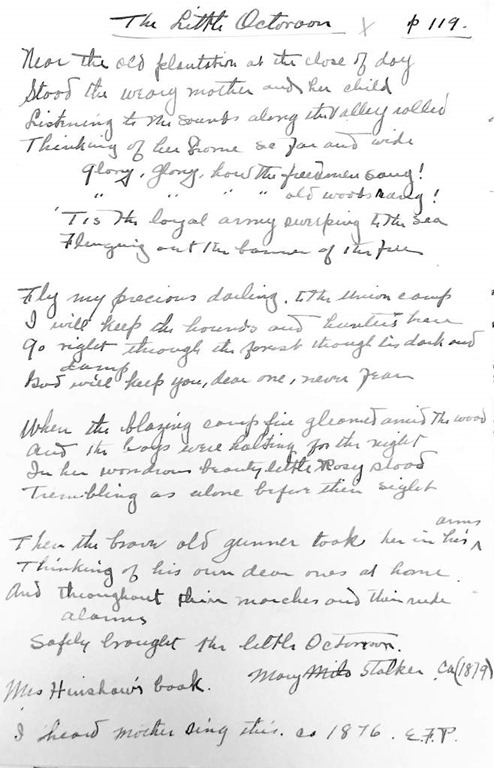
When I left off I was (more or less) talking about folk songs and the songs collected in the American Midwest before WWI by poet Edwin Ford Piper. I’ve also already mentioned that folk songs aren’t unchanging, and aren’t pure. While going through the yellowing paper in Piper’s archives, I came upon this song, handwritten in his own handwriting. He has the title as “The Little Octoroon.”   Things aren’t going to get simple here readers. I can’t be simple.

The Little Octoroon 1024

The song as Edwin Ford Piper heard it from his mother

.

Octoroon is a largely obsolete word, derived from a lot of rigmarole regarding how Black someone was. It means 1/8th (octo=8) Afro-American. In general, the mumbo-jumbo legal biochemistry in American history regularly said it didn’t make much difference. Half, quarter, sixteenth — hell, for those who had trouble with fractions it was sometimes written down as: 1% Black, you’re legally Black.

An octoroon may not look  Black. I can still recall when I was 14 or so, and having grown up in a tiny rural Iowa town. An Afro-American man who was a civil-rights activist was to visit my church camp. He arrives. Wait — that man’s Black? I remember in my naivete looking at his summer hands and forearms. The man had freckles people!

So why does this song, which is clearly a song from the Union and Abolitionist side make some point about the child being an octoroon? This will get weird: it was possible to be an abolitionist and  a white supremacist thinking Afro-American’s inferior. Yes, you could be smart and ignorant at the same time! If you’re trying to end chattel slavery, and you’re counting votes or troops, you might not care to make a sticking point about this, ugly as it is. Those with pseudo-scientific beliefs such as an octoroon is “nearly a white person” might have stirrings of respect. (Ugh!) And then at the unconscious, illogical level, there’s the factor of that person looking much like me, so maybe they  should have rights like me. Even if it’s a song (something with no visual element) those factors may have entered into its composition.***

While there are no notes I saw in the archive that Piper knew this, this song does have a composer: George F. Root.  Root didn’t quite reach Stephen Foster or Dan Emmett level of 19th century American songwriter fame, but he had his “hits” such as they were in the pre-recording era. During the Civil War period and based out of Chicago, he specialized in songs for the Union side.

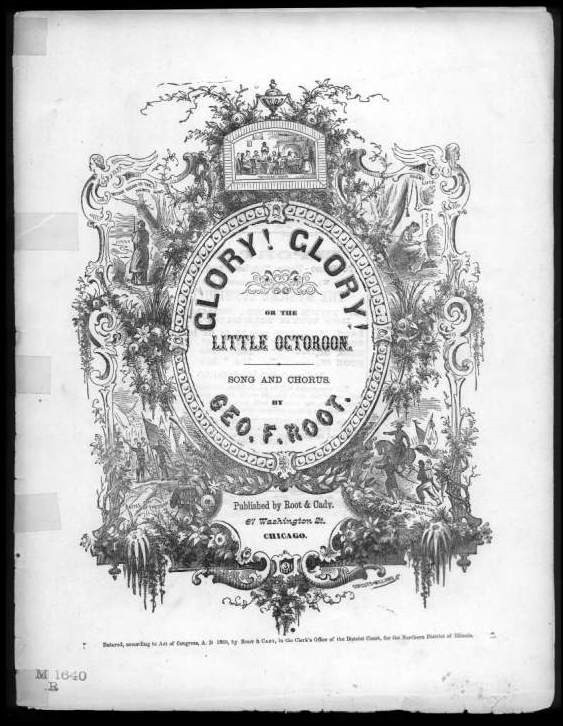
The Little Octoroon song sheet cover 800

The sheet music from George F. Root’s music publishing firm. When Piper remembers his mother singing this tune, it would have been only 10-years-old.

.

Did Piper’s mother learn this from someone else? Was there sheet music in a piano bench for this, unknown to the 5-year-old Piper? In the quiet library archive, I visualized two white people, a mother and child, in rural frontier Nebraska sharing this song. The differences in the printed song from the one Piper wrote down from his mother’s singing say this isn’t likely a handwritten copy from sheet music.****

Here’s my conclusion, which I hope I’ve demonstrated even though I’ve trimmed parts of this piece back: Juneteenth is the most complicated American legal holiday.  The only simple thing about the holiday is that it stands for freedom and the lifting of oppression. Taken at its whole, though messy and with calculated delay, that makes it a favorite of a person like me, who still cries and wonders at how simple truths and rights take so long to be established. The song I’m performing today, its path and turning into a folk song, isn’t that complicated — but yes, the path of American freedom is.

You can hear my performance of Root’s “The Little Octoroon”  with the audio player below. No player? This highlighted link is an alternate.

.

*In 1850 a Fugitive Slave Act was passed that required northern state governments, not just the federal government to return enslaved people who reached northern states. Some cities and states wouldn’t comply (there’s this Minnesota case for one example).

Piper’s mother was in Canada near the US border in this era. It’s possible that fugitive slaves might have crossed over into her region. I also note that Piper says she was singing it in 1876, perhaps because that’s the border of Edwin Ford Piper’s memory, but I read the date and think about it being the year Reconstruction largely ended and new de-jure laws and customs greatly restricted Afro-American citizenship.

**No, Nicki Haley, slavery was the cause of the Civil War, even though many liked to parse Lincoln’s compromise and coalition statements of this time to make it sound like it wasn’t. The flaw in that framing? Lincoln didn’t start the war, the South did, and they were explicit in proclaiming why they did it.

***There’s another song using this terminology that this Project has already presented: Longfellow’s scathing pre-Civil War poem “The Quadroon Girl.”   In Longfellow’s poem the situation leading to that poem’s mixed-race child is laid out: feudal concubinage and/or rape by slaveholders. For making a speech implying the same, Longfellow’s friend, US Senator Charles Sumner was beaten to within an inch of his life on the floor of congress.

****The biggest difference: the printed song’s title calls out the chorus — it’s officially “Glory, Glory, The Little Octoroon.”   I only sang the martial chorus twice in my performance because I was more drawn to the bravery and sacrifice told in the verses. We have two holidays that say soldiers made us free, but it’s not only soldiers.

I followed Piper’s transcription for the words, not the printed lyrics, honoring the chain of transmission to me rather than accuracy. I also modified Root’s tune and chords to suit my tastes and tendencies. I could not help but think of these things as I sang this: first, the mother, her family heritage caught in that sexual exploitation making the choice to stay and face the slave hunters and their dogs to assure her child’s escape. We never find out if she and the daughter will be reunited, or even if she survives. Then next I think of those pursuers who to the degree they are portrayed in the song would be gaslight villains — but in history they would be real people doing great evil, who could be thinking they were serving justice. And then lastly, the final-verse gunner who cares for the child, though he’s more the Horatio of the story, with the mother being the tragic hero. I ask you not to skip over the villain characters. It’s fine if you empathize with the gunner, but some great dangers in one’s life (and often to other lives) are those middle souls, like the slavecatcher pursuers, who have a system that tells them they are arduously, justly, doing right.

National Poetry Month 2024

Earlier this Spring I had an idea for a Parlando Project feature for this year’s National Poetry Month. It was based on something I read in the blog “My Life 100 Years Ago,*”  as blogger Mary Grace McGeehan turned some of her attention to children’s literature. As those interests crossed over for her, I learned there were a paired set of poetry anthologies from a century ago, one first published in 1922, The Girl’s Book of Verse, and the other the following year, The Boy’s Book of Verse.

A reason I’m drawn to poetry is that poets often examine and see things many others would miss. I read of those two titles and was intrigued. Lots of things to examine. One, the books are gendered — unsurprisingly, they only saw to market two volumes then — and being published in the early 1920s they might say a lot about how the anthologists viewed childhood and gender roles at the time that Modernism was starting to become a substantial part of literature in America. And for those targeted boys and girls (and their parents) the world was changing in areas well beyond poetry, music, and the arts. Adult women had just been given the right to vote, and there was increasing belief in expanding women’s roles. Fathers had in some cases returned from America’s first extra-continental wars.**

And there was another reason, I had recently come to see appealing elements in some of Robert Louis Stevenson’s poetry aimed at children as I revisited it. It’s long been a cultural commonplace that Mark Twain and Lewis Carroll are children’s books with layers of understanding, not just fantastical adventures. And in our present culture a great deal of our marketplace is taken up by young-adult books and genres that often have roots in youthful reading: Fantasy and Speculative Fiction for example.

So, what if we step back a century and see what’s there? I found a number of interesting poems in the two books, and my plan was to step up the posting tempo of this blog to at least double time. There’d be writing on what I observed in the books, and the Parlando Project’s combining of literary poetry with original music in various ways and styles would top that off. I started stockpiling some compositions, even recorded initial tracks for a couple. I was realistically readying myself for more activity here than usual to celebrate NPM 2024.

NPM 2024 poster 720

I didn’t know this would be the poster for this year when I started out. Seems appropriate for my plan.

.

Great plan.

Great plan, meet life.

I’d already figured what would be the first two pieces of this series. Monday I was going to complete recording the music I had set for the first one. My old-man energy didn’t hold out, and mid-morning recording expectations turned more into an early afternoon plan. Monday afternoon, I grabbed my music to go record, and..

The music stayed on the table. More family distress came home. I haven’t found a way to write about this that feels appropriate to me — and I’ve felt so blessed the past eight years of this Project to have so much time to do the extensive work it entails that I don’t want to be disproportionate in measuring my little change of plans this week against the reasons for distress. Today’s concluding summary: this is an introduction of my original intent, and a public statement that I still have hope for some variation of the plan still coming off for this April Poetry Month here.

My appreciated long-time readers will know to wait — and new visitors: there’s a lot here for those interested in poetry and the various ways it can be combined with music. You might want to search for a poem or poet and see if we’ve already presented it. Over 700 pieces, there’s a lot here — but it’s all over but the footnotes today — and those footnotes are something else this blog picked up from Mary Grace.

.

*Her blog started out with a pledge to only read material from 1918, but it has transitioned to an occasional look through stuff that was contemporary a century ago. Lots of considerations of what women in this dynamic time were presented with, often through magazines of the day. This stuff fascinates me. It’s the mundane and commercial mirror to the era when a lot of the poetry I’ve presented was created.

**How about other historically significant issues in this last decade that called itself The Twenties? Social inequality was certainly on some adults’ minds then, but that generally goes unreflected in these middle-class oriented poetry anthologies. I may take a second scan, but the issues of America’s racial caste system are largely ignored, though there is a bizarre Longfellow poem I hope to at least mention in the series (even if I might never figure out how I could perform it). Another thing to think about as we consider these century-old books: the children’s audience here would be inside that Greatest Generation who experienced the Great Depression, the global rise of nationalistic fascism, and eventually an even greater world war and its aftermath. Is there anything here in these poetry books which the authors suggested their mothers should be handing them that helped them through that?

Cool Tombs

It’s been too long since I’ve presented a poem by Carl Sandburg here, and awhile since I had the time to make one of my “punk orchestral” pieces accompanying one of the poems.

Carl first.  Unlike Frost (birthday boy today, happy birthday Robert!) I appreciated Carl Sandburg as a young person. A poem like today’s “Cool Tombs”  doesn’t appear to truck with irony or express its perceptions subtly. It appears to say what it means to say. Those schoolchildren sure that poets and their literature teacher accomplices are seeking to make fools of us dense and under-lived students can rest easy with what this poem seems to be. Here’s a link to the full text of the poem, if you’d like to follow along.

I’ve made my point elsewhere in this Project that Sandburg, likely with intent, had other poetic modes. Like Frost (which Sandburg was once considered a peer to in literary merit) he’s always plain enough speaking that one can be fooled into thinking his thoughts are always straightforward. Read quickly enough, seeing only the plain-talking, “Cool Tombs”  has just one thing to establish: that our selves lose and are left-loose from our deaths. Great accomplishments, great enemies, great failures — eventually, nothing.

Where’s the ambiguity? Where’s the deep reading that great poems reward?

My answer, my reading of Sandburg here, is that is to be found in American history — that history a denser poem full of every Empsonian ambiguity — and Sandburg clearly is roping in American history here.   Are his choices incidental/accidental? Well, they do include things that disappear, even if like love they remain inescapable, returning things.

Other than American historians, few readers today will understand what a “copperhead” is referring to when Sandburg speaks of Lincoln, other than perhaps knowing it as a species of poisonous snake. That it was, and is — but in the American Civil War those in the North opposed to fighting the secessionist slave-holding rebels took to using an incised liberty head carved out of the mid-19th century American penny coin as an emblem of their sentiments. If you reach into your pocket now and note who’s on the current copper penny, you’ll see the head of Lincoln.*  Did history write some irony there?

Civil War hero and post-war President Grant suffered from corruption among businessmen in and surrounding his administration, details now lesser-known outside of historians today. The Sandburg that wrote this poem, ex-political operative and then still daily newspaperman, knew that government corruption hadn’t disappeared conceptually. Perhaps he also knew that Grant intended to — to some degree did — try to set up a fairer settlement to those newly emancipated from slavery. In the cool tombs of history, perhaps we remember Lincoln and Grant for those efforts, even if imperfect and eventually abandoned, they were.

Pocahontas’ story, as much as can be deduced from records and oral histories, is complex, and subject from the beginning to substantial romanticization by English settlers.**  An indigenous American, she married an early English-American settler, and legends of this marriage and other friendliness of Pocahontas to the English settlers are the prime reason she became a historical character to the eventual conquerors. From the First Nations standpoint, one can easily see this story rests on a vibrating matrix of love, coercion, or treason. As her story leads into Sandburg’s voice claiming for the lovers in the concluding section, perhaps Sandburg holds primarily for the first of that trio — but he and I were not there, we cannot really tell. I also don’t know Sandburg’s intent, but the previous two situations are suffused with crimes and evil: slavery, murder, corruption, and greed. Is Pocahontas’ story contrast or continuance? The poem’s text allows either reading. Perhaps the fairest reading, the one that was in my sense as I read it, is that Pocahontas’ love was tragic given how the conquest continued with so much killing and subjugation. Note too that Sandburg says a hail-the-conquering-hero parade (perhaps to the tomb?) should be examined as a vainglorious exercise.

Lincoln, Grant, Pocahontas cool tombs

Lincoln’s tomb in Illinois, Grant’s tomb in New York, and Pocahontas’ burial site in England.

.

Is all this external exegesis based on unintended things that I’m artificially assigning to a simple or at least single-minded poem? Most modern academic readers of Frost understand him to be a poet comfortable with intentionally invoking subtext. Certainly, if this were a set of incidents in a T. S. Eliot poem with reference to metaphysical poetry, with passages in Latin and Greek referencing classical history and legend, we’d know he wanted us to consider those connections.***

But Sandburg? I’d caricaturize my sense of how Sandburg’s viewed today like this: he’s written off as a superficial popularizer of unremarkable intellect and talents. He fooled some folks earlier in the 20th century into thinking there was something there, but now we have a better vantage point.

I obviously don’t see it that way. I could be mistaken — in which case it’ll be forgotten in the cool tombs.

Carl Sandburg's grave

Carl Sandburg’s grave in Illinois. Not so grand, but it also asks us to add history to the grave. There’s a little plaque on the footing bearing the legend “For it could be a place to come and remember.”

.

Alas, now again I spent more time spent writing on the words, leaving less time for the music. I recently had enough energy and assured time to try to do something with a larger group of orchestral instruments. Let me be brief. I wrote this originally as a non-harmonized melody, but transformed it into a harmonized piano part via some software that extracts harmonic ideas from a monophonic line, choosing the one that interested me the most, and tweaking it from there. The piano part then became the orchestration by another translational process of placing the piano’s range of notes with various other instruments.

If I had the focused energy or assured time, this could be a movement of a larger piece with other themes, variations, contrasts in color — but that doesn’t fit my life. I’ve come to call these short pieces, often expressing a simple musical idea by whatever means I can bring to hand “punk orchestral.” You can hear the recording of my performance of Sandburg’s words with this orchestral music using the audio player gadget you see below. No player?  This highlighted link will open a new tab with its own audio player.

..

*That liberty head cent had been replaced with a new design just as Lincoln was elected, though still in circulation. The new 1859 design replaced the classical liberty head profile with what? An American Indian in native feathered headdress. The current Lincoln profile penny was adopted in 1909, less than a decade before Sandburg wrote his poem.

**A couple of obscure horticultural details occur in the Pocahontas section. “red haw” is a tree that produces a crab-apple in Autumn. So too is the pawpaw, a fruit widely raised and eaten by native Americans. Sandburg oddly refers to the “pawpaw in May” which would not be a sweet, edible fruiting time for the plant in North America. Is there intentional metaphor there, or a mistake?

***I don’t know if Sandburg had this poem by Thomas Campion, which in turn was a loose translation of Catullus — but the lovers getting as much as they can while tomb-wise element was brought to mind as I newly considered Sandburg’s tomb poem.

Some Presidents Day Stories

I was talking to Glen at the café I rode to for breakfast this morning. “It’s President’s Day. Did you get him anything?”

Glen has a pretty quick mind, but he thought for a moment and countered “Well, it’s one of those vestigial holidays. We’ve got a tailbone, but how many million years since we’ve needed it? It’s on the calendar and that’s about it.”

I think he’s right. It used to be more at Washington’s Birthday, and in some states Lincoln’s Birthday was also celebrated this month. And then one of the reasons February is Black History Month is that this short month also includes the date celebrated as Fredrick Douglass’ Birthday.

No sub-text here: 19th century celebrating heavenly Presidential bromance

.

My celebration, my observance was taken up with the ubiquitous modern American civic act this weekend, watching things on a screen alone — which is kind of sad, but the others in my family have more proximate concerns nearer to them than my fiddly interest in musty histories and art.

I started by watching Lincoln’s Dilemma,  a four-part, four-hour documentary mini-series produced by a number of Afro-Americans that is available on Apple TV+ now. It covers the time from Lincoln’s entry into state politics until his burial, focusing on his evolving and politically and war charged relationship with American chattel slavery and the Afro-American’s subjected to that. I was a teenager during the centennial of the American Civil War who read avidly about it, and between that and my interest in American Black history there was a lot that was only refrain and time-line refreshment for me, but like any well-done extensive overview there’s a power in putting things together and linking this and that.

Two things discussed fairly early in the documentary were stories I hadn’t known. One deals with the Christiana Incident, something I’d heard nothing about. It’s easily as gripping as my own city’s Eliza Winston story, or the Emily Dickinson adjacent stories of Angeline Palmer or Dickinson’s “Preceptor” Thomas Higginson’s armed assault on a Boston jail. The other was its accounts from the under-covered period between Lincoln’s election, his subsequent spring-time inauguration, and the firing on Fort Sumter that started the Civil War. I would eagerly see entire documentaries or “based on a true story” depictions of either. For example, did you know (I didn’t) that during this period, as a last-ditch effort to placate southern states that were issuing their declarations of succession based on the Federal Government and its soon to be leader’s insufficient devotion to slavery, that a proposed 13th amendment that would constitutionally prohibit  the ending of slavery was put forward? It passed the House and Senate with the required 2/3 majorities. Although the Civil War would soon be raging, five! states ratified it.

If this sort of thing sounds interesting to you, and you have access to it, I easily recommend Lincoln’s Dilemma.

I took a break halfway in on Lincoln’s Dilemma  to watch John Ford’s 1939 Young Lincoln  staring a startlingly well-made-up Henry Fonda as Lincoln. For good and ill this well-made film hits all the John Ford tropes* and is very inconstant in a “print the myth” way regarding historical accuracy. I suspect Young Lincoln’s  emotional content no longer communicates, and more the same, it’s earnest civic lessons would be lost to most audiences today too. But it’s Ford, so we’re left with mise en scene and striking tableau frames that contemporary film makers might still copy. For humor’s sake I could try to hype its contemporary value as “The story of the trial of a pair of accused cop killers who are surprisingly defended by a lawyer reverently devoted to the law.”

Before I leave you, let me touch on George Washington, the man who posthumously gave up his birthday for President’s Day. The story of the Civil War and the end of slavery is but one example of a dictum often taken as absolute by revolutionaries: “Power concedes nothing without a demand. It never did and it never will.” And of course, as the leader of an armed revolution, Washington would seem to be an example** of demand backed by guns. But the singular greatest fact about Washington, a thing we should be grateful for beyond other things, is that after the American state got independence and he became its leader, he willingly, and without demand or struggle, gave up power. That’s rare.

Love of the thing one is struggling for, not for personal power, or opportunity, or mere revenge and expiation, is a hard thing to find — perhaps even more so in those who win some part of their struggles. So, let me leave off this Presidents Day not with a piece about a President, but about the man who stated that revolutionary’s dictum above, Frederick Douglass. Written by poet Robert Hayden,*** with my music and performance, you’ll can hear it with a graphical player below if you see that — or if you don’t, with this highlighted link.  If you want to read Hayden’s sonnet about Douglass as you listen, you can find the text here. Back with new pieces soon.

.

*Although I’m reasonably familiar with why Ford is viewed as an important foundational cinema artist, I actually haven’t seen all his best-regarded films. Only last year I saw his The Searchers  for the first time. As to that film: I found it highly compelling, significantly because it’s a film about racism made largely by men that could be fairly judged as patriarchal racists, and yet it’s not Triumph of the Will,  some sharply focused mirror of evil, either. Somehow, Ford and fate made it multivalent.

**Combining slavery and Washington is a natural combination alas, since Washington was a considerable slaveholder. Rather than the myths of cherry trees, I like this story of Washington and how he crossed paths with an Afro-American boy freed as the spoils of war.

*** Thanks to the publisher for permission to perform this. “Frederick Douglass” is Copyright © 1966 by Robert Hayden. From COLLECTED POEMS OF ROBERT HAYDEN by Robert Hayden edited by Frederick Glaysher. Used by permission of Liveright Publishing Company

Vonnegut and Veteran’s Day, or The Children’s Crusade

Even before I was interested much in literature, I developed a love for history. Today’s Veteran’s Day post will only briefly touch on literature, and instead offer a slice of history. Older readers may think they know all this, or know it better than what I’ll write today. Some younger readers won’t care, but perhaps a few will learn something they didn’t read or hear elsewhere. As with any short piece, I’m going to need to leave out many things. While this post was not written intending to be a puzzle, I noticed that one thing was left out of this Veteran’s Day post. By that I don’t mean some opinion or judgement, or even some biographic item — I mean a particular significant historical Veteran’s Day fact that I expect few will notice is missing. When I reveal it late in the post, I’m also thinking you’ll take that elision as something to consider.

So, a bit over 50 years ago there was a war going on, the Vietnam War. The way it was presented then: our great geo-political rival had invaded another country and we were morally obligated to resist that aggression. This doesn’t seem to have been the case, at least not in any way that could be simplified as such. Another summary would be that Vietnam had invaded Vietnam, as it had been doing since the days of WWII, seeking to become an independent country. In the course of things, they succeeded, and now are one of those more or less unremarkable governments around the world that may be good or bad to their citizens in some mixture that we don’t generally concern ourselves with.

This obligation eventually led to a considerable number of American troops fighting in South-East Asia, but luckily the post WWII Baby Boom had raised a bumper crop of what were considered prime fighting age 20-year-olds. I was one of them. Even though this was a war, there were only so many troops that could be used. The amounts that could be used were filled to a significant degree by draftees, young people conscripted (other words: forced, obligated, duty-bound) to serve in the military, and since there was a war going on, some percentage of those draftees would be asked to kill other people or to be killed themselves.

To a surprising extent, this was not remarkable then. I can imagine how many living adults now find that odd, what with present controversies about wearing cloth masks and getting vaccinations — as not only were these conscripted men plausibly in for the kill/killed experience, they were also vaccinated forthwith and forced to wear entire uniforms. And yes, in certain training situations they were instructed in how to put on masks.

I can say that as a teenager in that crop of draft-age men then, I thought about this, and remarked on it. Others in my cohort did too. But there were whole days when one didn’t think about it, and instead thought about sex, fun, school deadlines, the price of a pizza, the general meaning of life and what that meant for you personally, and so on and so on. Still, it was an issue considered by the young.

But no, in general the adult country was fine with this, and even to observable empirical level it was not the biggest deal for a lot of my immediate cohort. You see, I was in college, a small one in a not very big town in Iowa, and because only a certain number of troops were needed, college students were given “deferments.” They didn’t need to serve while in school, and if this was a political post one could get into why that might be so. I’ll also add that dropping out of school, or failing out, or being short of tuition funds, or just deciding to take a gap year — those things would make the draft imminent for a college student — but for college 20-year-old men it wasn’t a next Thursday kind of worry, though it could be a next year one.

Now I and a few of my friends did think this was a bad thing, the war, the draft — oh, and a lot of other stuff: racism, what recreational drugs were legal, female students having “hours” where they had to be back in dorms by a certain time each night. The “we should do something about this” group was probably around 5% of the student body at my college in 1968.

Then in the spring of 1970 something happened that surprised me. The President made public (as if it was a new decision rather than a more substantial incursion that couldn’t be kept secret) that US troops were going to invade countries next to Vietnam. To those who had been paying less attention, this seemed a sign that this was maybe going to be around a lot longer, like past graduation, with more draftees needed. Opposition to the war on college campuses had been growing for about a year, and this gave it another bump, and on an obscure Ohio campus, Kent State, this boiled over (as it occasionally had elsewhere) into disorder and vandalism which wasn’t enough to cancel classes, but was enough for the National Guard to be sent in.

Something happened, likely a confused Guard squad, and the Guard opened fire, A bunch of students got shot, some were just walking between classes — because again, whatever disorder this was, classes were in session — four died.

Of course, I was appalled, but did that surprise me? Not greatly. Even in my youthful life there had been the drumbeat of the civil rights movement martyrs and assassinations of Presidents and Presidential candidates. In my crowd the fatal Chicago police shooting of Fred Hampton was considered duplicated multiple times against the Black Panthers. And in 1969 there had been a shooting death in the People’s Park confrontations.

Here’s what surprised me more. Not only around the country, but in my little Iowa college, much larger numbers of students thought something had to be done right now about this. One by one colleges and universities suspended normal operations and any number of alternative actions were taken that spring. This was called a strike. Here’s something little remarked on about male students choosing to do this for what was then an unknown duration in 1970: it could’ve led to them becoming subject to the draft.

Veterans Day 2021 2

There are no pictures available of my 1970 memories, so the guy on the left will have to stand in. The statue on the right is a clue to this post’s subsidiary riddle. The Nov. 11th born veteran Vonnegut tried to speak between generations.

.

Ad hoc organization coalesced at my school and as I recall the one concrete action to “really do something” was to try to garner support for a federal bill that would restrict funding or expansion or authorization or some other matter regarding the war in SE Asia. The bill had been co-sponsored, or co-authored, or supported by one of Iowa’s Senators, Harold Hughes.*

Let me stop for a moment and get to a reason I’m writing this on a Veteran’s Day. Sometime, maybe a generation after these events, it became a commonplace that Vietnam war opponents, or college students, or hippies, or leftists, or some Sixties group hated soldiers in general. “In general” is a dodgy term, but I think it’s meaningful in this matter. I spent time with all those supposed soldier-hating groups, in both Iowa and New York (two fairly unlike places), and I never heard anything like that, not once. And it would have seemed so odd to me personally, that if I had heard it, I think I would have remembered it. And it wasn’t reticence or propriety that would have masked those feelings. Expressions against police were so common that I couldn’t count them then, much less now. And fairly soon, as early as 1971, I was running into ex-Vietnam era soldiers who could be put in those loosely defined groups above themselves.**

Back to working with this newly motivated group of Iowa college students who naively thought they had to do something right now about this expanding war. We were going to go door-to-door asking for folks to write letters in support of this bill. Now who takes point walking on a patrol, or even boring days painting what doesn’t move, or for that matter being under a napalm attack — this isn’t on that order (well, maybe the middle one is a little), but for some reason, I have memories of the few days I did this before leaving for New York. I believe now what we were doing was essentially meaningless, if the best we could come up with at the time.

In our door-knocking in town we might run into what was later called “The Greatest Generation.” Most said little to our spiel, but a couple of them, men, wanted to set us straight as to what we didn’t understand. Well, even then I suspected there were things I didn’t know, and now I can drop the suspected and replace it with certainty. The one I remember most vividly responded with a statement that I didn’t know what it was like to watch your buddies die.

I try to replay him saying that through the fog of the years. Although there was anger in it, I think it was a sincere personal statement. I often think since of what did that statement, however incongruous, mean? Did he mean that I should watch my buddies die? That that would be enlightening, educational? I don’t think so, no more than it was his considered opinion that such an experience had been worthwhile or ennobling for him. What he meant, putting my most empathetic interpretation on it, was that a certain sacrifice and commitment added something to one’s opinion on national matters.

More broadly though, his generational experience was why there was not a great deal of concern then, other than a slowly growing one among those of draft age, for the idea that young men could be conscripted to possibly kill or be killed. The Greatest Generation had faced the same sacrifice, and so this was normalized, not even Great yet, unexceptional. In the case of WWII good wasn’t a question, necessary was the question.

In those times, some in my generation eagerly latched onto WWII veteran Kurt Vonnegut’s books (and Joseph Heller’s Catch 22  as well) to portray everything else around the necessary part of WWII. They were our cross-generational allies in seeing and saying that war needed extraordinary necessity. Vonnegut even wanted to connect us 20-year-olds with his Dresden POW book Slaughterhouse Five,  subtitling it “The Children’s Crusade”  which had been a nickname for the 1968 US Presidential campaigning by folks often too young to vote for anti-Vietnam-war candidates, and which he then applied to the 18-20 year old range of his WWII cohort.

OK, what Veteran’s Day historical event did this old man leave out of the above story, dealing as it did with differences and connections between men serving in the Vietnam War era and those who wanted to end that war, and between 20-year-olds and the WWII generation then in middle age? I completed an entire first draft and didn’t notice it myself. And I’m not alone. American Veteran’s Day stories in 1970 and up until now almost always leave it out. It’s the Korean War. As with WWII, few living veterans of that war are left now, but it occurs to me that the fervent man at the door in 1970 could easily have been a Korean War vet. And in historical analysis, that war had as much or more to do with the missteps of the Vietnam War as WWII.

The musical piece today is another song from birthday-boy Kurt Vonnegut’s novel “Cat’s Cradle” in which his trickster guru character Bokonon muses ontologically. You don’t have to look up the word to appreciate this little song. Player gadget below to hear it, and if you don’t see that, you can click this highlighted hyperlink.

.

*I knew all those details then, even if I don’t remember them now. Harold Hughes is a little-remembered figure these days. Capsule description of Hughes: imagine if Johnny Cash had been a governor and then a U. S. senator. As to the general student feeling, I think it was close to how some people felt in the post-George Floyd murder reaction. The watchword was “We’ve got to do something.”

**Some of you may find this striking, The precipitating event of the college strikes of 1970 after all was men in military uniforms shooting and killing students, In this era, various acts were taken against what was considered part of the recruitment and processing of soldiers: draft boards, recruitment offices, ROTC buildings, that sort of place. I can’t know everything, but I never heard any of this characterized as “let’s go get those soldiers” and was more at “let stop more from being conscripted as soldiers.” Given human nature someone somewhere in 1970 may have said or thought that, but speaking of my experience: war-fighting soldiers were what we young men at that point increasingly feared being forced to become. Opinions differ on the nobility of those thoughts then and now, but we might have thought of cops differently if we knew that folks like us, and potentially us ourselves, might be forced to put on a police uniform.