“I heard one person starve, I heard many people laughin’
I heard the song of a poet who died in the gutter
I heard the sound of a clown who cried in the alley”
-Bob Dylan, “A Hard Rain’s A-Gonna Fall”
How much did the young Bob Dylan learn about Greenwich Village history that might have been known to long-timers when he arrived early in The Sixties?™ His early “Song to Woody” testifies that the young man who traveled from the Midwest to New York idolized some lefty-aligned folkies who came before him. Residents like his early NYC mentor Dave Von Ronk (“The Mayor of MacDougal Street”) could’ve further instructed him, and Dylan himself might have studied the Greenwich Village culture as a cross-country immigrant seeking to fit in. If so, here’s one example* he might have heard of: there was a between the wars Village fixture who eventually became a starving poet, and who more-or-less died in the gutter: the bold self-styled “King of the Village Bohemians:” Maxwell Bodenheim. Bodenheim’s sordid death happened less than seven years before Dylan’s NYC arrival – though the peak of his fame was in the 1920s, that’s still only 30-40 years before the young Midwesterner rolled into town,** well within the memory of living adults.
Now I have to say no one has schooled me on Bodenheim, though as a non-playable character, he’s strolled across research and reading I have done. My limited impression is that he tried a bit too hard to underline his bohemian cred, and that as a literary force his brief candle was snuffed out even before his inglorious end. So, I hadn’t read any of his poetry, even if he published in the right American Modernist journals and had several book length poetry collections printed during the last decade to be called The Twenties. As such, Louis Untermeyer’s attempt at an objective survey in his between-world-wars anthology I’m using to supply this April’s poems includes him – but in introducing Bodenheim’s poems there he throws some pretty sharp elbows:
In 1918 his first volume appeared and even those who were puzzled or repelled by Bodenheim’s complex idiom were forced to recognize its individuality…. Sometimes he packs his metaphors so close that they become inextricably confused. Sometimes he spins his fantasies so thin that the cord of coherence snaps and the poem frays into unpatterned ravelings.
The communication [in his later 1920s work] is more involved than ever: the expression of an acrobatic mind that juggles a dozen mixed metaphors, balancing itself meanwhile upon the knives of emotion with a mordant grimace…. He has something to say which the reader, provoked though he may be by the author’s supercilious disdain, might listen to with profit. It is, never the less, still true that Bodenheim too often writes in the role of literary ring-master, cracking his savage whip over cowering adjectives and recalcitrant adverbs, compelling them to leap in unwilling pairs over the fantastically piled barriers of his imagination.”
I chose to perform Bodenheim’s “Old Age.” Here’s a link to the text of the poem. Just as with George Dillon writing about Lake Superior the poem has already sold itself to me partway with its title – I’m an old man, and I think about that state a fair amount of the time, whether I want to or not. For this poem I’m not sure what in it is metaphor and what is memory. The poem sets out the scene of a village or neighborhood from an era before motorized trucks. While there are details, it’s a generalized enough portrait that I can’t say where this village is located. This poem was first published in 1918 – it could have been a NYC neighborhood, perhaps the immigrant section that would come to be known as the East Village. Or it could have been parts of Chicago where Bodenheim lived before New York. I even get a sense it could be a European town. Bodenheim was the son of German/French immigrants, and if he was to think of old men, his grandparent’s generation, in his bloodline if not first-hand experience, that would be their locale.
Still, this may not be some early 20th century “Penny Lane.” I take seriously the line “The old men are my thoughts.” Is he a careless writer who meant to write “are in my thoughts?” I like the poem better if I take him at his word. His thoughts, his consciousness, would then be portrayed as this semi-autonomous set of people, with their customs and cross-purposes that he has become accustomed to so that he views his inner psyche like an old man who’s seen them all many a time, is comfortable that he’s seeing that flow of things again; and who will choose casting his inner self as the old men talking, or the gamboling children, or the young strong men, or the shopkeepers, or the women with some tinkling part in the multicurrent flow inside his head.
I can resonate with that, what with the variety I seek to keep up with this Project. I am happy in this village of choices of poetry and music I choose to experience and work with, each of which seems native to me, even if outwardly they seem so differing. And I’m hustling like the line in the poem that brings an urgent cartload of supplies to the village with pale flowers in its square, because I know the poem’s last line, “Some evening I shall not return to my people,” intimately.
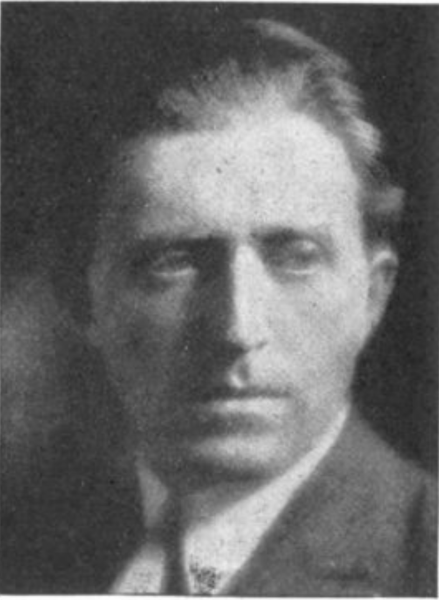
Maxwell Bodenheim. No chord sheet this time, but today’s music is a 2-chord vamp: CMaj7 & Bm7. I wrote this post during the afternoon of April 7th, and I’m grateful the my country’s mad king didn’t make me think even more of “A Hard Rain’s A-Gonna Fall today.”
.
Before I leave off and ask you to listen to my performance of Bodenheim’s poem, I have one more observation to make: this is yet another poem by a young person about being old. Bodenheim was 25 when this was published. Some years back I even did a series here of such poems: poets under 40 who wrote of the experience of old age. That there’s a goodly number of such poems, some examples among the ones most cherished by older readers, surprises me. I don’t recall in my 20s spending a great deal of time thinking of how I’d experience old age. Oddly, at my current age I find myself thinking of my future time much like I did as a child – then I knew that in 10-12 years I’d be this other creature with other concerns, an adult. Now, I know in that interval (or less, oh yes, the chance of less) I’ll likely be dead or significantly incapacitated. These two similar considerations over the horizon line were (for me) a feature of childhood and being much older than young adulthood or middle age.
Full-on spoken word this time, and the electric Telecaster guitar returns in full voice for today’s musical performance. Spring allergies or a late season cold hampered my voice, but I have several more poems from Untermeyer’s anthology I want to get done, and so this one needed to unload its creaking cart. You can hear that performance of Maxwell Bodenheim’s “Old Age” with the audio player below. Has that player crossed the rainbow bridge? Send no flowers, it’s just that some ways of reading this blog hide the player, so I offer this highlighted link that will open a new tab with its own audio player.
.
*The other NYC name that has made me have similar thoughts: Sweet Marie Ganz was a local political activist who was imprisoned around the time Bodenheim published today’s poem. Ganz was pretty pissed-off by the mutual-aid failure of other socialist-anarchist figures to support, or even visit her when she was behind bars. Dylan’s “Absolutely Sweet Marie” with its up-the-river penitentiary and anarchist motto “to live outside the law you must be honest” has me making wild speculations that someone like Von Ronk told him tales of the young woman who stood in front of John D. Rockefeller’s NYC townhouse and told an angry crowd protesting there that she herself was so mad that if she had a gun she’d shoot the oligarch. Then someone in the crowd handed Sweet Marie a gun. Damn that’s a good story, but one for another day.
**Early part of the 20th century had plenty of Midwesterners making big noise without going through the East-Coast Ivy League gateway and finishing school: Floyd Dell, Don Marquis, Carl Sandburg, Carl Van Vechten, Vachel Lindsay, Edgar Lee Masters, and my relative Susan Glaspell. Bodenheim was another. He started his literary efforts in Chicago where he paled-up with Dell and Ben Hecht before decamping to New York.