Dirge Without Music

I’ve worried a bit lately that I’ve been doing too many Parlando pieces presenting sad poems. It’s likely that mood is part of my nature despite living a life I’m grateful for — perhaps even more so because I live a life I’m grateful for, and I’m therefore aware of its temporary nature that I cannot keep. Because of this, I’ve kept a quote, a suggestion, from Kurt Vonnegut close to me:

I urge you to please notice when you are happy, and exclaim or murmur or think at some point, ‘If this isn’t nice, I don’t know what is.’”

Vonnegut wrote this in one of his last books, one that might again speak to my mood in this state of my nation and its ideals, A Man Without a Country.

At my age, it’s no longer morbid to think about death. This past weekend my wife and I went on a goth date, and visited one of the fancier local cemeteries. We mostly went for the 1910 main chapel building full of early 20th century William Morris/Pre-Raphaelite derivations which echo back to the start of the era I mine for a lot of the poetry here.*  The cemetery was taking part in a special open-house event held around the Twin Cities offering more access for the public to “behind the scenes” parts of the facilities.

We walked by famous early citizen’s gravesites, some elaborate with statues and such, and then too the many small vaults with names and dates on their file-cabinet sized faces. One room’s space was maximized with rows floor to ceiling across the room — so much like a library, even up to having a rolling metal staircase that would facilitate viewing the topmost. Instead of spines one views in those tall rows names, and partner’s names, and those bookend years. Every one of them, like every book I suppose, expects that there’s someone left to see and remember them, and I paused to consider that that wasn’t always so.

In another part of our tour, another portion of my nature was stoked. Walking by the cemetery’s crematorium, I noticed this homely implement hanging on the wall. As the old prayer book has it: ashes to ashes, dust to dust — and that passage now had a corollary: and dust to pan.

Dome and Dust Pan

Part of the main chapel: tiled mosaics, stained class, intricate motifs, capitol mottos. Crematorium: clean, professional, and an inexpensive hanging broom and plain white plastic dustpan, the same model as hangs in our home pantry.

.

Oh, it was a beautiful Spring day, full of decoration, full of evidence of grief, inscriptions of loss — and to the puritan, evidence of vanity. Life is so big, or so small, we must laugh at it.

Which brings us to today’s poem I’ve performed with music: Edna St. Vincent Millay’s “Dirge Without Music.”   I had finished this piece earlier this Spring, but at first held it back because I feared it was too much like some other musical pieces I was working on — and then after those coincident issues expired, I started to worry that it was too much-more sadness. Revisiting it this week, I now think no, it’s not just bleak — it’s a bald-faced statement of honest feelings about death and loss. Here’s a link to the full text of the poem.

In writing music and preforming this poem, am I disrespecting the author who titled her poem “…Without Music?”   I think Millay’s intent here was to speak against sentimentally decorating loss. Loss has patterns, resolutions, codas, and rests — and music too, even if it has repeat marks, has an ending measure — but music’s part of the equivalence is so often beautiful. In such ways fine poetic word-music, as well as that with express melodies, may speak over loss, interrupt it. Perhaps my rough-hewn voice with its limits and plainness, its lack of precise or elaborate lyricism, is apt for Millay’s mood here?

You can hear that musical performance of Millay’s poem with the audio player below. What if you see no player? That’s likely because some ways of reading this blog suppress showing it, but this alternative highlighted link will open a new tab with its own audio player.

.

*A few years back here I did a series on “before they were Modernists” with early poems by some Modernist figures. More than a few had roots in those retro-hipster movements of the late 19th century, and many a free-versifier had carried around a Swinburne volume in their youth.

Sandburg’s Couples

Time for me to get back on my Carl Sandburg soapbox. I’ll be brief — as today’s poem, now song, is as well. My point (again) is I think there’s more there in his poetry than is currently remembered or considered. Your impressions may be from two stalwarts of American poetry anthologies: the Whitmanesque “Chicago”  with those big shoulders and the quite contrasting short metaphoric poem “Fog”  with its cat’s feet. Not a lot for a poet who wrote so much, so early in the Modernist era, but it does point out a range of expression.

I’ve performed segments of Sandburg’s prolix mode here. I like Whitman well enough. Within limits, I like Sandburg doing Whitman’s mode too. He’s not quite the opera singer that Whitman aspires to be, he’s more of the folk-ballad, song-suite, kind of poet. America’s a big country, so I guess we need big, shouting, poems — and even if that’s not my favorite mode, either poet can move me as they traverse long distances with galloping catalogs and litanies. My point today is that this Sandburg, being bigger, overshadows another Sandburg, one that I particularly treasure, the one that reminds me more of Du Fu than Whitman: the forgotten, pioneering, ground-level reporting, American Imagist, Sandburg. Sandburg’s poems in the compressed style are not accidents, seeds of long poems that didn’t germinate, or little palate cleansers between his important work. His earliest collections are packed with sub-sonnet-length pieces.

On awaking this morning, I was thinking of a set of poems by a couple of the earliest American Modernists, Ezra Pound and Sandburg, where they each showed gratitude for their American forbearers. I paired their poems as one musical piece early in this Project, and here’s a link to that.  Pound, within his characteristic grumpy mode in “A Pact,”  makes peace with Whitman — and while casting a little shade on Walt for being the son of a house-carpenter, he claims his own finely crafted woodcarving is descended from the cross-cut and rip saw of Whitman.

Who does Sandburg say are his native 19th century inspirations? Whitman? Nope. Maybe Longfellow, with his civic-minded striving for uplift and justice? No. Who’s left? Poe? Hmm. Interesting thought, even if Poe is awfully rhymey for a free-verse poet. The other Fireside poets? Well, yes, Sandburg wanted a wide audience, but as the child of an immigrant couple and attendee of a non-descript Midwest school, he lacked their pedigree.

Sandburg in his “Letters to Dead Imagists”  is declaring his allegiance to that spear-point of English-language Modernism, but here he claims a couple of Americans as his predecessors: Emily Dickinson and Stephen Crane.

The poet he names first, Dickinson, will likely seem a more conventional choice to those reading this today than it was when Sandburg wrote his poem in the early 20th century. Dickinson’s eventual rise to genius status would still be early in its slope — she was more known then as an eccentric than as a model for poetic expression. The second, Stephen Crane, is more associated with prose, but he wrote a singular collection of gnomic, short free verse poems, The Black Riders,  in 1895. An inspiration for Crane’s unusual work: the new, first publication of the poetry of Emily Dickinson in 1890.

Sandburg was among the first to try to form a 20th century style combining the “mother and father” of American poetry: Dickinson and Whitman. And I happen to like it when he takes after dear old mom.

Today’s piece, Sandburg’s “Couples”  sounds a little like Crane, a little like Dickinson, and it has a characteristic early Imagist trope of close-focus specifics and vivid color by name. Here’s a link to the text of it.  If one thinks of Sandburg as being a clear-speaking poet, this poem should disabuse you that he’s always about some obvious point. Part of the delay in publishing my version of his poem is that I’m still not sure what he’s describing. There’s parallelism set up between six “women” dressed in green and six “men.” They’re described as dancing, likely haphazardly as the infamously strong liquor absinthe* is mentioned, they make a hissing laughter sound. They are somehow cheating or gaming each other. There’s a worn path of hard packed dirt said to be from the dancing feet. The poem closes with dewy weeds said to be as high as six little crosses, one for each couple.

I’m stumped. A graveyard? Then maybe the dancers are ghosts. But if so, why the specific detail of the dirt floor packed down if it’s a weedy, less-than-well-tended graveyard? A barn-dance? The weeds are described as “mourning veils.” Or are the six live couples dancing around six graves? Why, who are they to the buried, if it’s that? Perhaps instead, the dancers are green plants of some kind, their dance uncoordinated as random winds, and the wind through them is the hissing laughter, and they’re maybe even the weeds the poem closes with. Did Sandburg just choose their number to be six out of desire to be specific? But again, he spends two lines of a short poem on the packed down dirt floor under the “dancers,” and plants dancing in the wind wouldn’t compress the earth.

In summary: as obscure as any of Crane’s Black Riders  poems — but specific, like a closely-observed Emily Dickinson riddle poem. If Sandburg intended mystery, he achieved a stubborn dose of it in this poem of his, and the incantatory power of its spikey, inexplicable details may still carry us through. While it’s unlikely Sandburg’s model, if one was to translate this into French and say it was from Rimbaud’s “Drunken Boat”  how would we experience it?

Carl Sandburg with guitar at mic

Glad to be at the open mic. I’m going to do “Wagon Wheel” and this Oasis song “Wonderwall” now.

.

If forced to a final guess: they are  graves, and the dancers are the living as continuing life-force, not dancing on the graves as revenge, but out of the joy of continuance, and the packed dirt is the mark of our ongoing life-work and dance. The cheating? The unfaithfulness and trifling of love and desire, or they are cheating death by living and loving. The couples of the title then are not only the paired male and female dancers engendering a new generation, but the connection between the living and the dead. Why six? I don’t know.**

I performed this with just acoustic guitar, Carl Sandburg’s own instrument of choice. When assessing his guitaristic skills, Carl would sometime say he was at least one prison sentence from getting any good. You can hear my misdemeanor playing with the audio player gadget you should see below. No gadget? It was pardoned, or impounded, or deported, or took a buyout, or something. No one seems to know, because some vain fool runs things, and there’s not enough conscientious people left to make knowledge from foolishness. But I do give you this highlighted link that’ll open a new tab with its own audio player.

.

*Absinthe is colored green, doubling down on the use of that color in the poem.

**Rejected guesses why six couples and six crosses: six is sometimes used as the number of cardinal directions, sometimes shown as a six-armed cross, but Sandburg seems to be clearly saying six separate crosses. The Oklahoma state flag shows a First Nations (Ossage) shield with six separate crosses on it (the cross is a common indigenous American symbol) — but that flag was adopted a decade after the poem, and I can’t find any source of previous use of that distinct six crosses symbolism that the flag drew on.

Cool Tombs

It’s been too long since I’ve presented a poem by Carl Sandburg here, and awhile since I had the time to make one of my “punk orchestral” pieces accompanying one of the poems.

Carl first.  Unlike Frost (birthday boy today, happy birthday Robert!) I appreciated Carl Sandburg as a young person. A poem like today’s “Cool Tombs”  doesn’t appear to truck with irony or express its perceptions subtly. It appears to say what it means to say. Those schoolchildren sure that poets and their literature teacher accomplices are seeking to make fools of us dense and under-lived students can rest easy with what this poem seems to be. Here’s a link to the full text of the poem, if you’d like to follow along.

I’ve made my point elsewhere in this Project that Sandburg, likely with intent, had other poetic modes. Like Frost (which Sandburg was once considered a peer to in literary merit) he’s always plain enough speaking that one can be fooled into thinking his thoughts are always straightforward. Read quickly enough, seeing only the plain-talking, “Cool Tombs”  has just one thing to establish: that our selves lose and are left-loose from our deaths. Great accomplishments, great enemies, great failures — eventually, nothing.

Where’s the ambiguity? Where’s the deep reading that great poems reward?

My answer, my reading of Sandburg here, is that is to be found in American history — that history a denser poem full of every Empsonian ambiguity — and Sandburg clearly is roping in American history here.   Are his choices incidental/accidental? Well, they do include things that disappear, even if like love they remain inescapable, returning things.

Other than American historians, few readers today will understand what a “copperhead” is referring to when Sandburg speaks of Lincoln, other than perhaps knowing it as a species of poisonous snake. That it was, and is — but in the American Civil War those in the North opposed to fighting the secessionist slave-holding rebels took to using an incised liberty head carved out of the mid-19th century American penny coin as an emblem of their sentiments. If you reach into your pocket now and note who’s on the current copper penny, you’ll see the head of Lincoln.*  Did history write some irony there?

Civil War hero and post-war President Grant suffered from corruption among businessmen in and surrounding his administration, details now lesser-known outside of historians today. The Sandburg that wrote this poem, ex-political operative and then still daily newspaperman, knew that government corruption hadn’t disappeared conceptually. Perhaps he also knew that Grant intended to — to some degree did — try to set up a fairer settlement to those newly emancipated from slavery. In the cool tombs of history, perhaps we remember Lincoln and Grant for those efforts, even if imperfect and eventually abandoned, they were.

Pocahontas’ story, as much as can be deduced from records and oral histories, is complex, and subject from the beginning to substantial romanticization by English settlers.**  An indigenous American, she married an early English-American settler, and legends of this marriage and other friendliness of Pocahontas to the English settlers are the prime reason she became a historical character to the eventual conquerors. From the First Nations standpoint, one can easily see this story rests on a vibrating matrix of love, coercion, or treason. As her story leads into Sandburg’s voice claiming for the lovers in the concluding section, perhaps Sandburg holds primarily for the first of that trio — but he and I were not there, we cannot really tell. I also don’t know Sandburg’s intent, but the previous two situations are suffused with crimes and evil: slavery, murder, corruption, and greed. Is Pocahontas’ story contrast or continuance? The poem’s text allows either reading. Perhaps the fairest reading, the one that was in my sense as I read it, is that Pocahontas’ love was tragic given how the conquest continued with so much killing and subjugation. Note too that Sandburg says a hail-the-conquering-hero parade (perhaps to the tomb?) should be examined as a vainglorious exercise.

Lincoln, Grant, Pocahontas cool tombs

Lincoln’s tomb in Illinois, Grant’s tomb in New York, and Pocahontas’ burial site in England.

.

Is all this external exegesis based on unintended things that I’m artificially assigning to a simple or at least single-minded poem? Most modern academic readers of Frost understand him to be a poet comfortable with intentionally invoking subtext. Certainly, if this were a set of incidents in a T. S. Eliot poem with reference to metaphysical poetry, with passages in Latin and Greek referencing classical history and legend, we’d know he wanted us to consider those connections.***

But Sandburg? I’d caricaturize my sense of how Sandburg’s viewed today like this: he’s written off as a superficial popularizer of unremarkable intellect and talents. He fooled some folks earlier in the 20th century into thinking there was something there, but now we have a better vantage point.

I obviously don’t see it that way. I could be mistaken — in which case it’ll be forgotten in the cool tombs.

Carl Sandburg's grave

Carl Sandburg’s grave in Illinois. Not so grand, but it also asks us to add history to the grave. There’s a little plaque on the footing bearing the legend “For it could be a place to come and remember.”

.

Alas, now again I spent more time spent writing on the words, leaving less time for the music. I recently had enough energy and assured time to try to do something with a larger group of orchestral instruments. Let me be brief. I wrote this originally as a non-harmonized melody, but transformed it into a harmonized piano part via some software that extracts harmonic ideas from a monophonic line, choosing the one that interested me the most, and tweaking it from there. The piano part then became the orchestration by another translational process of placing the piano’s range of notes with various other instruments.

If I had the focused energy or assured time, this could be a movement of a larger piece with other themes, variations, contrasts in color — but that doesn’t fit my life. I’ve come to call these short pieces, often expressing a simple musical idea by whatever means I can bring to hand “punk orchestral.” You can hear the recording of my performance of Sandburg’s words with this orchestral music using the audio player gadget you see below. No player?  This highlighted link will open a new tab with its own audio player.

..

*That liberty head cent had been replaced with a new design just as Lincoln was elected, though still in circulation. The new 1859 design replaced the classical liberty head profile with what? An American Indian in native feathered headdress. The current Lincoln profile penny was adopted in 1909, less than a decade before Sandburg wrote his poem.

**A couple of obscure horticultural details occur in the Pocahontas section. “red haw” is a tree that produces a crab-apple in Autumn. So too is the pawpaw, a fruit widely raised and eaten by native Americans. Sandburg oddly refers to the “pawpaw in May” which would not be a sweet, edible fruiting time for the plant in North America. Is there intentional metaphor there, or a mistake?

***I don’t know if Sandburg had this poem by Thomas Campion, which in turn was a loose translation of Catullus — but the lovers getting as much as they can while tomb-wise element was brought to mind as I newly considered Sandburg’s tomb poem.

Stones Under the Low-Limbed Tree

Today’s piece has an eerie history. It started as a poem by Robert Frost, but I think four years ago I turned it into a song. I had more or less forgotten about it, but this past week I found it in some past work that I had separated out to work on for this project.

Looking at it, I put it near the top of the pile. I thought it representative of the best of early Frost, when he was a supple lyric poet. “This’ll be great. So clean in language. So concise in his laying out of the story.”

The process of producing the performance and recording that you can hear below went well enough. So today I was getting ready to write about my experience of Frost’s poem after going through this project’s process. As usual, I wanted to find a location for the original text for those that want to read along. I found a good link to Frost’s poem. It’s here.

Surprise! Turns out I had modified Frost’s poem much more than realized. I had recalled only that I had repurposed a pair of Frost’s lines to create a chorus/refrain—but when looking at the original poem I hardly recognized the text I had been working on during the recording of the performance this month. It turns out, “Ghost House”  (as he titled this piece) was an early poem of Frost’s, written in 1901 and included in A Boy’s Will,  his first collection of poems published in England in 1913. Unlike most of the poems in that collection, “Ghost House”  had been published, back in 1906 in a magazine. The reason A Boy’s Will  was published in England was the Frost had made little headway as a poet in the United States. At that point he was nearing 40 years old, so it’s possible that if Frost hadn’t traveled to and succeeded in England, this greatly loved American poet would be nearly unknown.

I stress the actuality that I had no recollection of recasting the poem extensively when I say that I prefer “my version” to Frost’s original. The lack of any memory of the work I did means that this judgement is rather impersonal. Frost’s “Ghost House”  isn’t bad, but it’s not as distinguished as other poems in his early work. It seems more 19th century for one thing. It also overdoes it, seeming to confuse more elaboration and details for more impact and substance.

Stones Under the Low-Limbed Tree

Here’s Frost’s poem as revised for singing.


When I briefly try to reconstruct what I did to make the text for today’s piece, I see I used his lines for the most part, but I trimmed out much. My lyric is essentially 17 lines. Frost’s is 30. I dropped entire images, some inconcrete and a bit trite (“I dwell with a strangely aching heart”—you’ve shown us that mood Robert, telling us that is less vivid), and some redundant (we’ve got raspberries and grapevines, we don’t need the apple tree* too). Then too, I chopped the entire whippoorwill stanza, which some argue contains the key image in the poem.**

I also may have just been trying to make it more sing-able.

These two things are lessons. First, poetry often gains power by saying something in its most striking, sensual, and strong way—or even when it’s being less direct, by combining a few things (perhaps only two things) in an unexpected but powerful way. Everything beyond that may detract. The second-best or third-best image subtracts by its addition. Frame your best images, don’t embarrassingly hide them in clutter. And secondly, at least with lyric poetry, when it sings it means.  Poetry works through the music of thought. Even something that clarifies the meaning or explains further a point may sometimes be dispensed with in order to make a poem a musical statement that will lodge in the reader/listener’s ear, and via that canal to their brain. In this case I don’t think I sacrificed clarity, but also I don’t think I could sing Frost’s version—and at least in my case, I didn’t remember his.

Did what I do mean I think I’m a better poet than Robert Frost? Nope. I also may not be a better poet than you. But on any one day, on a particular task, with a particular aim, I might be. Frost was a famously grumpy personality, but perhaps his ghost has mellowed with immortality. If so, I hope he might think I served the inspiration of his early poem by trimming it back. Or maybe I didn’t make these changes, since I don’t remember? Perhaps Frost’s ghost came by and made the revision?

To separate this version from the canonical Frost version I call it “Stones Under the Low-Limbed Tree.”   The player gadget for my performance is below. Oh, and do follow at least one of the links in the first footnote below. You’ll visit other ghost farmsteads in search of fruit still yielding outside fallen cellar walls.


*This morning I read this fascinating story that went out on the AP wire. It covers something called the “Lost Apple Project” which is haunting abandoned farmsteads looking for old varieties of apples that sustained—or tried to sustain—homesteaders. Oh man did this resonate when working on this piece!

**I didn’t know, but some readings of “Ghost House”  say the whippoorwill is known as a bird foretelling death or other disasters. News to me. Even if I knew that, foretelling seems to blunt the impact of the poem as I cast it. In my mind the point is that the death/disaster has already occurred. Yes I know, some readings say that the poem’s speaker is either dead or gothically welcoming death for himself. I don’t disagree with that, but it doesn’t change my view. Even if the speaker is still alive but wants death, an omen bird’s warning is gilding the raven.

Gacela of the Dark Death

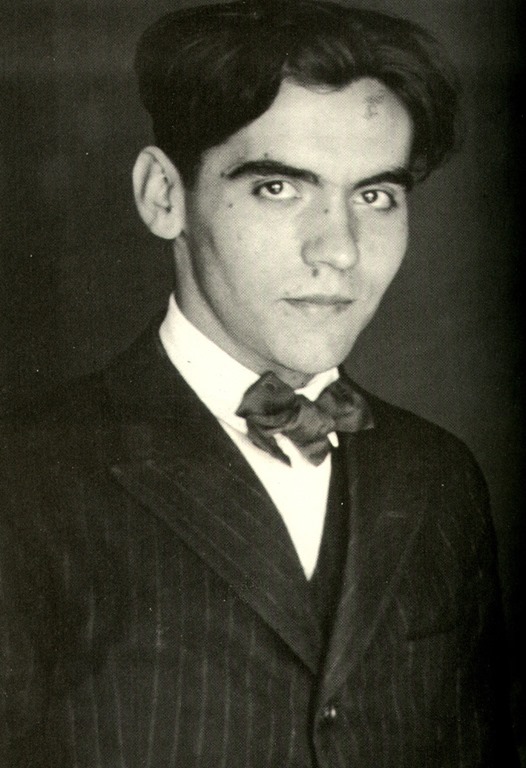
Here’s a piece using a fresh translation I made this month of a Spanish poem by Federico García Lorca. I’m sure there’s much to say about Lorca from those that know his work better than I do. That group of Lorca admirers includes many other artists whose work I respect, so it’s about time to present something by him here.

I’m told that a Gacela is a traditional Spanish form, but that Lorca’s poem follows the form only in spirit. Because Lorca was executed during the Spanish Civil War, not long after this poem was written, some view it as reflecting his experience of the war, but I get the impression that death elements were present in Lorca’s work even before the war. While encountering this poem in order to translate and perform it, I came to believe there’s a compound commentary on human mortality and more here.

Federico_Garcia_Lorca

Federico García Lorca, a poet with open heart dreams


The poem opens and closes with a refrain that ends with a strong, bloody, and yet ambiguous last line carrying the image of a boy wanting to cut his heart. I chose not to overdetermine that image because I believe its ambiguity should remain. It could be an image of desire, or of self-harm, or emotional outreach—so let it be any or all of those things.

The middle portion of the poem, which I chant rather than sing, has a tone in my reading that has humorous elements, even if that seems to go counter to other readings of the text I found. When this section starts with what sounds like folk aphorisms about the dead, I take them as dark humor. In the next line “No quiero enterarme de los martirios que da la hierba” I decided for the only time in my translation to intentionally make the image stronger to American readers, by making the hierba, the grass, “leaves of grass” to connect to Whitman and his great image forged in the American Civil War. I can’t be sure, but I spent a long time on that stanza’s moon with a snake’s mouth image, “la luna con boca de serpiente” and what with the punch line about that mouth always working before dawn got me asking the question if this was a vampire image, which I decide to refer to sideways by determining that fangs were what serpent’s mouth means. Consistently in this stanza Lorca is giving us death images, but he’s also saying he doesn’t want to hear them.

I think the next stanza is meant to be humorous too, starting off with the wanting to sleep (perchance to dream?) for a moment to maybe as long as a  century—but “pero que todos sepan que no he muerto,” “let everybody know I’m not dead” as I translate it. Yes, like Hamlet he wants to compare sleep and death, but he’s playing with it. I’m at a loss if the “pequeño amigo del viento oeste,” “little friend of the west wind” is referencing something. It sounds almost like a children’s story or lullaby. I think this stanza’s concluding line is so wonderful that it transcends mood and attitude: “soy la sombra inmensa de mis lágrimas,” “I am the immense shadow of my tears.”

This stanza’s concluding line is so wonderful that it transcends mood and attitude: “soy la sombra inmensa de mis lágrimas,” “I am the immense shadow of my tears.”

The final chanted stanza before we return to the sung refrain also seems to me to be playing with death. Are we meant to take the insects here as accomplices of the grave’s earth? But this sounds like a boyish schoolyard dispute “He threw ants at me!” And what’s with the scorpion claw? As a northern North American I don’t deal with actual scorpions (hey, tropic readers, let me tell you about black flies…) but isn’t it the stinger that’s the weapon? I’m left wondering if there’s some idiom here that I just don’t know, even some kind of schoolboy pestering like unto a “noogie.”

And then the poem returns to a variation of the refrain, mysterious, beautiful, and I think serious. As to the intent of the poem, I felt I could perform the mystery and commit to the humor I found in the middle section without knowing the poem’s heart entirely. I think you can listen to it the same way. It is a darkly playful meditation on death? A comment on the outbreak and casualties of a civil war? Or is it a longing for childhood life and adventurous dreams? Or a love poem to a young man in Lorca’s life at the time the poem was written? Walt Whitman could sing all those things together, so why couldn’t Lorca?

I felt I could perform the mystery and commit to the humor I found in the middle section without knowing the poem’s heart entirely. I think you can listen to it the same way.

Musically, I sought to contrast the two refrain sections from the poem’s middle one. I was going to play my nylon string guitar for a Spanish flavor on this. Sadly, when I opened its case this week I found that its bridge had come completely off the top. Oh well, my battered Seagull Folk guitar had to stand in. My orchestration brings a bassoon part forward.

You can hear my performance of my English translation of Federico García Lorca’s “Gacela of the Dark Death”  with the player gadget below.